I haven’t been in this wood since June, and I didn’t get into it this year until April, whereupon the first session produced just seven birds. It was time to give it another go. Obviously, the Braydon Forest woodlands have given very poor returns in the last month: probably as a result of the awful weather we have been having. So I did have some trepidation about this session. That said, I did decide that I would not be up incredibly early, given the time that catches have been starting at other sites where I have been on site at 5:00 or 5:30, so I agreed 6:30 with Rosie. As is the way of these things, I woke up at 5:10, instead of the 6:00 my alarm was set for, so ended up at Ravensroost at 6:00. Rosie joined me to help set up at 6:30 and we had the nets open by 7:00, with the first birds in the net at 6:55! Oh yes! Two Great Tits, a Robin, a Long-tailed Tit and a Blackcap all decided to fly into the unopened nets! The net set up was:
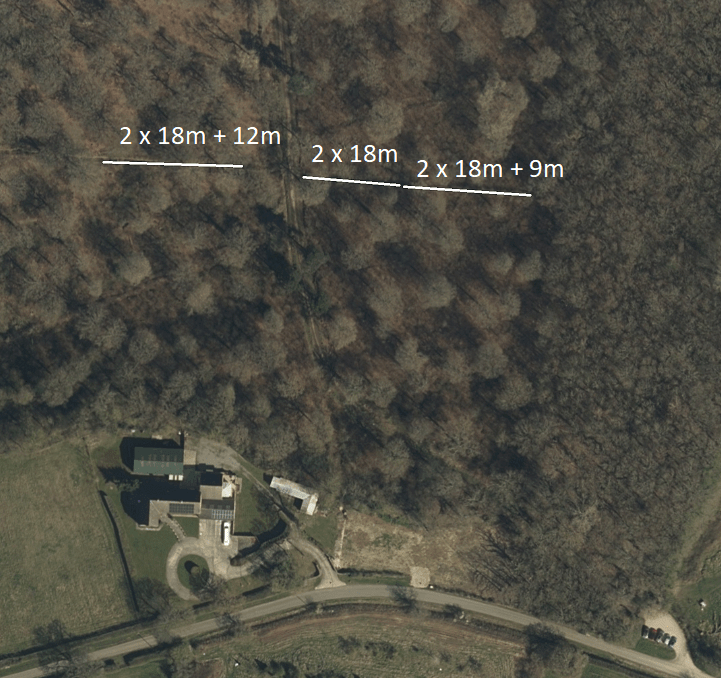
Unfortunately, that was the best round of the day. We did catch one or two birds nearly every round but not large numbers. Rosie had to leave at 9:30 for a work meeting but I continued until I closed the nets at 11:30.
Unlike some of the recent woodland sessions, we did actually catch some adult birds: lots of moult going on, which I love analysing and scoring. All of the birds that fledged this year undergo a post-fledging moult, usually to infill the missing body feathers not required whilst in the nest. Both adult and juvenile Long-tailed Tits (and Nuthatch and House Sparrow) undergo a complete moult into the same / adult plumage so, by the end of September, it is nearly impossible to tell adults from juveniles on plumage. The Long-tailed Tit that we extracted in the pre-opened nets was an adult, which we knew from the ring number, but it had nearly completed its moult. There were just two primary feathers still growing and (it was a female) the brood patch was nearly completely feathered. Perhaps the most surprising find was that one of the juvenile Great Tits was moulting its tail feathers. In the past I used to think that they must have lost them through accident, but last year I found out that this is an actual moult strategy in juvenile Great Tits. Since then I have seen it quite a lot, but it still seems odd.
Talking of odd: the last Chiffchaff I took out of the net was very unusual. It had very dark brown, almost black, legs. It had the typical rounded head shape of a Chiffchaff and what I see as typical juvenile colouration: a couple of pale brownish patches at the sides at the top of the breast. However, when I checked the right wing the 6th primary feather, which should have been emarginated, wasn’t. It was just straight, as found on a Willow Warbler. However, when I checked the left wing, the 6th primary was very definitely emarginated. Goodness knows what species I would have ascribed it to had that not been the case. (For those not au fait with the term: an emargination is a shallow notch on the distal side of the outer fifth of the feather, and is the key, unambiguous, diagnostic feature for identifying Chiffchaff from Willow Warbler.)
The bird of the day for me was this:
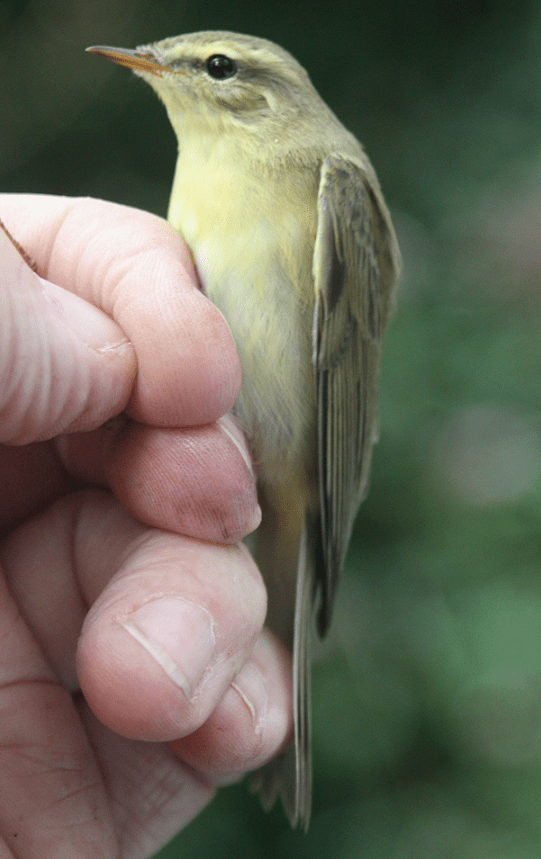
Juvenile Willow Warbler, Phylloscopus trochilus
It had completed its post-fledging moult and, unlike the one at Somerford Common on the 24th June, is probably a bird on autumn passage. The colouration was stunning, more so than this photo indicates.
The list for the day was: Treecreeper [1]; Great Tit [2]; Long-tailed Tit (1); Wren [3](1); Robin [2](2); Song Thrush 1; Blackcap [3]; Chiffchaff 2[2]; Willow Warbler [1]; Goldcrest [2]. Totals: 3 adults ringed from 2 species, 16 juveniles ringed from 8 species and 4 birds retrapped from 3 species, making 23 birds processed from 10 species. Of the retrapped birds just one was a juvenile.
As well as the birds caught there were quite a few other birds around, making their presence known: particularly Nuthatch, Green and Great Spotted Woodpeckers.
Whilst not processing birds, or torturing myself listening to the football, I spent a considerable amount of time watching the butterflies. There was still a decent contingent of Silver-washed Fritillary flying around. At one point two of them got into one of those dances where they spiral up into the air. I have seen it often with Speckled Wood but it was the first time I have seen it with this species. Is it the butterfly equivalent of a territorial dispute or a mating display? I have no idea. Alongside these there were Large White, Small White, Peacock, Brimstone, Speckled Wood and Small Copper. It was a pretty good show of species.
I shut the nets at 11:30, took down and left site at 12:15, astonished to hear that England had actually won. Having listened to the commentary I expected them to have been knocked out. So, not a bad session at all, all in all.
 Ringing In The Braydon Forest & Beyond