Back in April 2020 I did a brief piece on the status of Marsh Tits in the Braydon Forest, as understood through my team’s ringing activities. A lot has happened since then, and I have also realised that some trend analysis might be useful. For example, in the first piece I reported simply on base numbers ringed and retrapped. What I didn’t analyse was how those numbers are affected by the effort put in. With the restrictions imposed by the BTO and the Wiltshire Wildlife Trust as a result of Covid, I thought I would fill the activity void, created by the dreadful weather recently, by doing some further analysis.
For this report I started with the data collected from 1st January 2013 up to the 31st July 2023. I didn’t take the earlier data as ringing in the Braydon Forest up until then was restricted to Ravensroost Wood and a couple of months in the Firs, so wasn’t representative of the work done in the forest over the last decade. What I do not pretend is that there is a huge Marsh Tit population in the Braydon Forest: what there is, is a stable population and it is that stability that I wanted to look at.
The first thing was to look at the number of sessions carried out in the forest by year. This was to use as a baseline for the ongoing analysis. Previously I have used the number of sessions in which the species was caught, but that isn’t truly representative of the return on the investment of time and effort. The number of sessions carried out by year was:
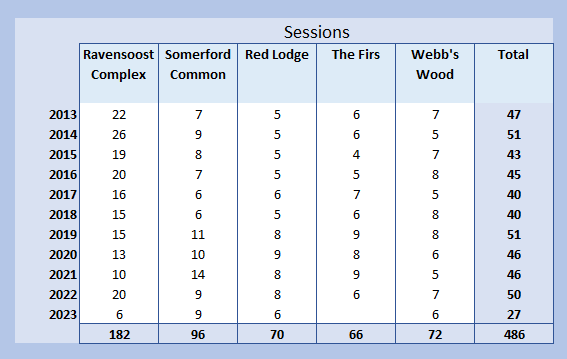
From this I then had a look at the numbers of birds processed by year:
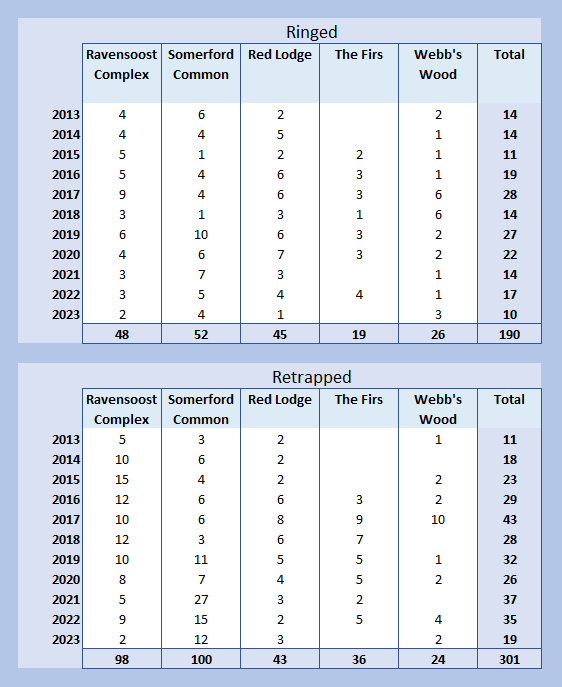
Following on from this, I looked at the average numbers caught per session:
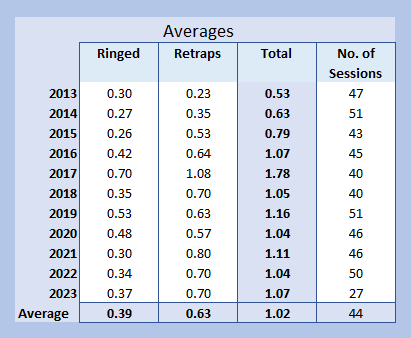
I was surprised to find that the catch averages out at a Marsh Tit being caught in every session. Obviously that doesn’t mean that we catch them in every session, but they are caught regularly. When put into graphical form it looks like this:
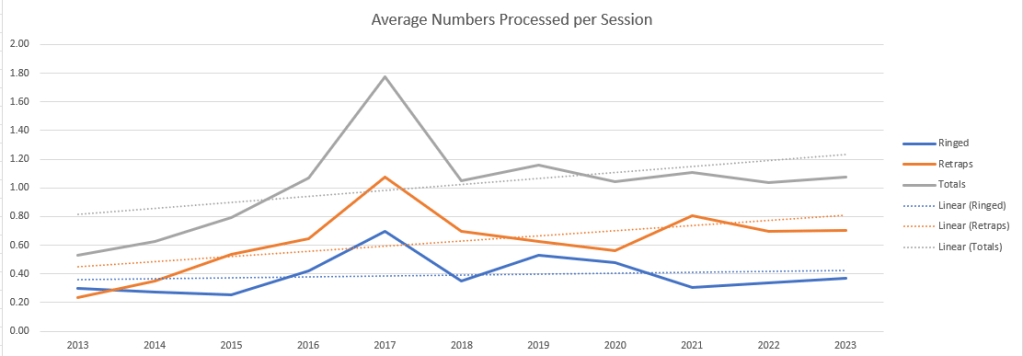
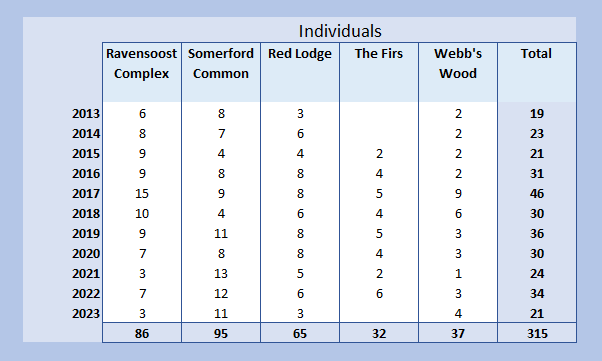
As you can see from the trend lines, the trend is slightly positive across each category. That’s a good start. However, one of the things that can distort the situation is multiple recaptures of the same bird within the year. For example, AAL0191 was caught and ringed in the Firs in February 2020, and then recaptured in July, October and December of that year. So four records representing one bird. So I then looked at the numbers of individual birds processed per annum. The results were somewhat different:
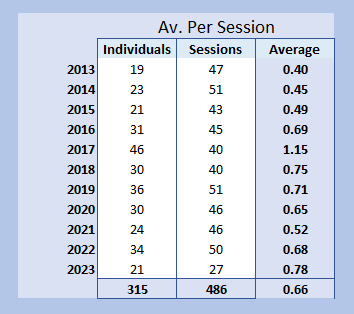
Working that out as average per session gives the following:
Graphically it looks like this:
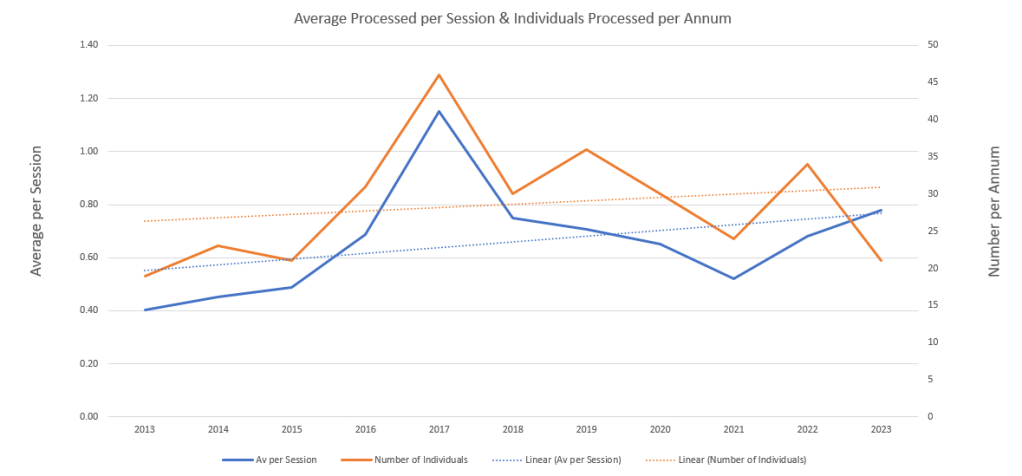
Clearly it is what one would expect, but the linear analyses show a somewhat higher rate of increase than previously.
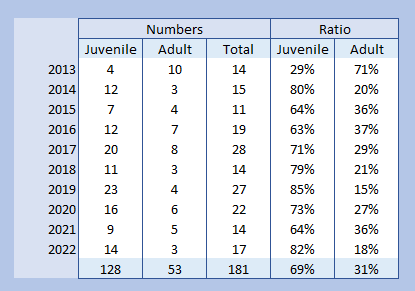
The next thing I looked at was the juvenile recruitment in the forest versus the number of adults. This I did by comparing the number of adults and juveniles ringed each year and the ratio between them, expressed as percentages. For this I didn’t include 2023 data as, although the year has started well, with 21 individuals processed, 10 of them ringed, it is too early to accurately compare numbers of youngsters ringed versus adults, as the fledglings only start to appear from approximately between the third week of May to the third week of June (BTO BirdFacts data).
Graphically it looks like this:
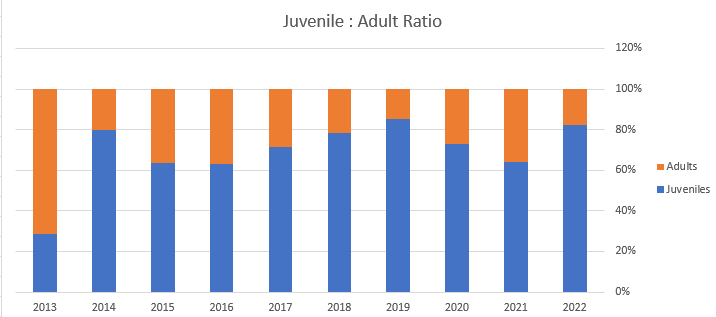
Apart from 2013, and I have no idea why it should be that anomalous, as one would expect, over twice as many juveniles are ringed compared to adults each year. It should be said that, as the year progresses, it becomes increasingly difficult to distinguish juvenile Marsh Tits from adults. The primary distinction is based upon retained greater coverts present in the juvenile, the adults replacing all of theirs during their post-breeding moult. The other thing to be aware of is that, for this analysis, birds that fledged in one year are considered adult after 1st January of the next year, even if they can be identified as having fledged the previous year. i.e. a bird fledged in 2021 is considered adult on 1st January 2022.
What does all of this mean? I accept that the population is not huge but it does seem to be stable. Juvenile recruitment seems to be consistent.
As well as looking at these relationships, I had a look at a couple of other figures: longevity and movement. Movement is the easy one: of all of the records for the species only one bird has moved further than 1km from its natal site: D983277, ringed in Webb’s Wood on the 13th June 2014, retrapped on the 24th January 2015, 3.5km away in Red Lodge.
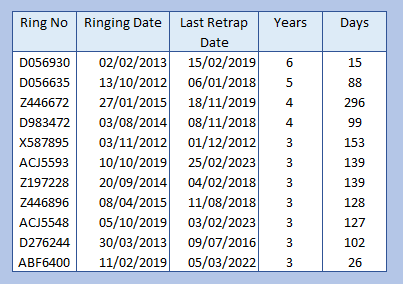
Longevity was somewhat different: the typical lifespan of a Marsh Tit is two years. The oldest known survived for 11 years and 3 months from date of ringing (and who knows how much longer after that!). I looked at the number of individuals that have survived for over three years from date of ringing. There are 11 individuals:
 Ringing In The Braydon Forest & Beyond