After another rainy day on Tuesday it was a relief to wake up to a dry day. It started misty but the sun came through and burnt off the mist by 8:00. The moon, at about one-third full, was present in the north-western sky throughout the morning session: that always seems a bit weird. I was joined for the morning by Miranda plus Laura with Daniel and Adam at 6:00. With everybody pitching in, and with me being able to find the first few pole holes without having to re-establish them, we had the first nets open by 6:15 and the rest open by 7:00 and, like Monday, caught the first bird before the last net was opened.
It was a very pleasant session but, like almost all of them this year, the numbers were well down. In fact, they were exactly 50% of the same session last year! Indeed, both the number ringed and the number retrapped were both 50% of the equivalent number last year. We were taking birds out of the nets every other round, i.e. every 40 minutes we would have something to process. One of the benefits of not being rushed by larger numbers of birds is that there is time for personal development. Laura isn’t currently interested in actually ringing the birds but does want to be able to extract them. So we could take some time this morning to start her on that path. I am pleased to say that she got the hang of it quickly and has now extracted her first couple of birds.
Once again the catch was devoid of Chiffchaff. We could hear them all around us but only one came near the nets but managed to extract itself whilst I was extracting a Cetti’s Warbler. We had a couple of those again this morning: as well as the Chiffchaff there was a Dunnock and a Wren. Unusually, these were in the Merlin nets, which are generally deeper pocketed than the Ecotones I use in more open area and, therefore, less likely to allow birds to escape. The Cetti’s Warbler was our second juvenile of the year.
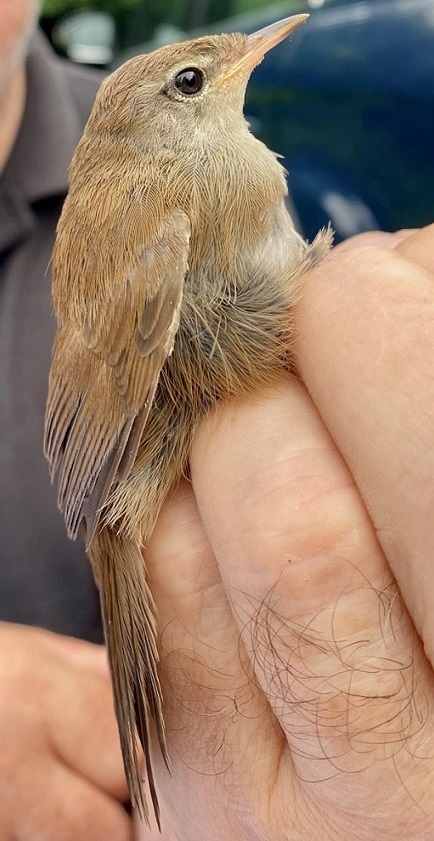
Juvenile Cetti’s Warbler, Cettia cetti
The list for the day was: Treecreeper 1; Blue Tit 1(3); Great Tit [1]; Wren 1[3]; Dunnock [2](1); Robin [2]; Cetti’s Warbler [1]; Blackcap [2]. Totals 3 adults ringed from 3 species, 11 juveniles ringed from 6 species and 4 birds retrapped from 2 species, making 18 birds processed from 8 species. That compares to 28 birds ringed and 8 birds retrapped from 14 species in the equivalent session last year. The catches have been declining for the fourth year in a row. This year perhaps it has been exacerbated by the bad weather but it is still a worrying trend.
As ever, there were squadrons of dragonflies and damsel flies around the area, including this lovely Common Darter:

Immature female Common Darter, Sympetrum striolatum
The Brown Hawkers and Emperors wouldn’t settle long enough for a decent photo, probably because this time I took my macro lens on the camera! With the session time coming to an end and five of us to take down, we were cleared away very quickly and off site by 12:30.
 Ringing In The Braydon Forest & Beyond