I spent today with my new trainee, Justine, and helper, Mark, being driven around the Wylye Valley to check on a number of Barn Owl, Tawny Owl, Kestrel and Little Owl nest boxes. The back story to this is that Justine was being trained by the legend that is Nigel Lewis in monitoring and ringing raptors throughout the Wylye Valley area and Salisbury Plain as part of the Salisbury Plain Raptor Ringing Group (SPRRG). Nigel, having reached a ripe old age, decided that he would step back from being a licensed ringer. That left five of the members of the group without a trainer. Although they were all C-permit holders, so could operate independently, they still have to have a trainer to take responsibility for their activities, and for their development to become A-permit holders. They were all on restricted permits: allowing them to target a limited number of species and stages. In their case it is Barn Owl, Tawny Owl, Little Owl and Kestrel pulli, i.e. box nesting birds of prey.
Justine was already working with me, to expand her knowledge and skills to cover the additional bird groups that are on my permit: Passerines, near Passerines: both adults and pulli, to get them added to the endorsements on her permit. When the news came through about Nigel, I straight away offered to take her on as my trainee. Subsequently, I have taken the other four on as well, not that they are going to spend much time working with me, but so they can carry on working within the SPRRG, as there were no other trainers within that group who could take them on.
Today was the first time I went out to assess how Justine handles the pulli of her target species. I was perfectly confident in her ability but, apparently, she was more than a little worried that I wouldn’t think she was up to scratch! Suffice to say, I was very happy with her handling, ringing and measuring skills. Mark is a great help: driver, chief ladder carrier, pullus handler (getting them in and out of the boxes) and nest box cleaner! They make a good team.
I met up with them in Warminster at 8:45 and we then headed off to check on approximately 10 boxes. Straight away I was impressed with the organisation of the session. Justine and Mark had already visited these boxes at the beginning of April and noted the status: whether there were adults roosting, eggs or young in the nest boxes, etc. Justine had then worked out, using the available data, what stage she expected the birds to be at. She was correct on all bar one of the sites checked! That’s pretty astounding on something that is based on ranges of values, rather than absolutes.
One thing I noticed as we were driving over the farmland to reach the sites were the sheer number of Hares that are out there on the farmlands of the Wylye Valley. It is no wonder Justine posts so many photos of them on Facebook! Everywhere you looked they were in view!
Our first site was a disappointment. When checked earlier in April there had been a clutch of seven eggs in the box. We realised pretty well immediately that there was a problem when we found one the chicks dead on the floor between some hay bales about 7m away from the nest box. It hadn’t been predated or scavenged: there was no meat on it. On checking the box we did discover three chicks: two were large and rather healthy, which might explain the reduction in numbers. One was somewhat smaller, but healthy enough. When given a dead mouse to eat it swallowed the beast willingly. I suspect that the bad weather over the last month had severely impacted on the availability of food. It made us a bit concerned about what we might find at the other boxes. Fortunately, that was the only tale of tragedy that we had. I hadn’t thought of taking food with me but, as pet shops stock dead mice for feeding pet snakes, I might have to investigate and lay hands on some, for emergency supplies in times of dearth.
The rest of the day went well. We ended up ringing four broods of Barn Owl: comprising the first three, then a remarkable brood of seven and two broods of five each. All were good weights, mainly with feathers medium. One or two of the younger ones were still feathers small:
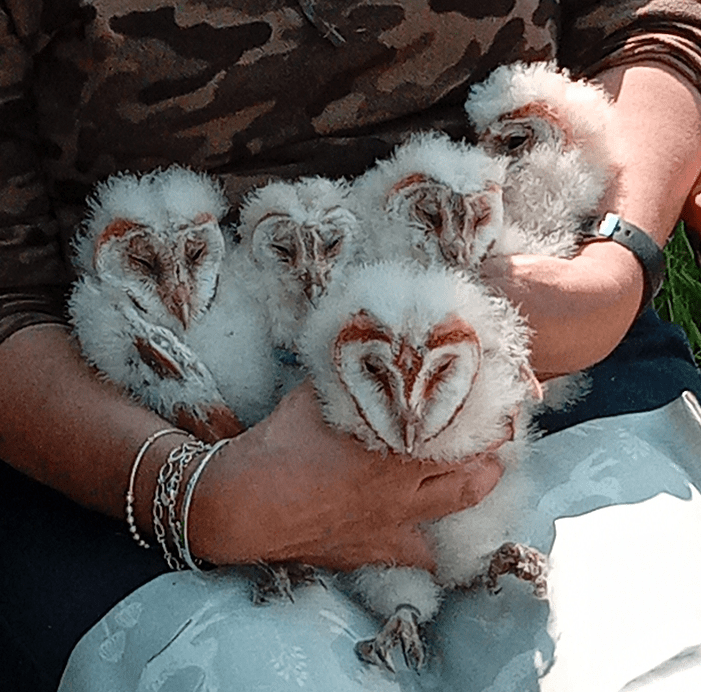
Five sleepy Barn Owl pulli. For those who worry about photographs like this: this photograph was taken whilst Mark was cleaning out their box and lining it with some clean, dry bedding. They were returned straight after, and resumed sleeping. It was this brood that was the one Justine didn’t get quite right. Having visited on the 2nd April, when there were four eggs, it was really quite a surprise that, firstly, there were five and, secondly, that they were all ready for ringing. One other Barn Owl box had three small young and three eggs: it will be a while before they are ready for ringing.
The most unusual site / sight I suppose was this:

This is a Barn Owl box made from an old ammunition box: hence all of the catches and hinges. A large proportion of the members of the SPRRG are ex-military and have retained contacts and, apparently, quite a few of the nest boxes on Salisbury Plain are of the same construction. What was surprising about this box were the occupants:

Tawny Owl pullus. Generally, Tawny Owls prefer deep nest holes, but it is clearly not obligatory. There were three of them in the box:

Again, three sleepy chicks waiting for their box to be cleaned! They do make the most remarkable bill clacking when being handled. It really did echo around the barn. However, as you can see, they don’t waste energy when they can go back to sleep.
We checked on a few Kestrel boxes: two were occupied. One was part way through laying the clutch with three eggs laid so far, the other had probably finished laying, with six eggs present. They will be checked again in four weeks or so, by which time they should have hatched and be ready for ringing. The incubation time, according to BTO BirdFacts from Nest Record Scheme data is 28-29 days, with subsequent fledging another 32 – 37 days.
The check that struck the most personal note with both Justine and Mark was the solitary Little Owl box that we visited. The box at this site had crashed to the ground last year, and the two youngsters in the brood were lost. A new box was erected but the adults disappeared. The male Little Owl had his preferred perch but on previous checks this year he had been conspicuous by his absence. However, as we drove up to the site today he could be seen sitting back in his usual place. This gave us some hope, which was confirmed when the box was checked and the female was found to be sitting on three eggs. That is a lovely, hopeful step, particularly with Little Owl being in steep decline across the country (some 78% between 1967 and 2020).
It was a long day, very rewarding and good for me to see just how competent Justine is with these birds that are the mainstay of her work to date.
 Ringing In The Braydon Forest & Beyond