I was expecting to be at Webb’s Wood with just myself, Miranda and Laura Friday morning. However, at the last minute, David and Pete wanted to come along and I can never say “No”. So we set an extra 3 x 18m nets but, unfortunately, still ended up with the 30 birds I was expecting. It is that time of year in the woodlands. In another month, as the nestlings fledge and forage through the woods, the numbers will rise significantly.
It was a lovely morning, so I think we all appreciated the sunshine, warmth and lack of breeze. The breeze did get up eventually, but it was after 10:30 when we were all thinking about packing up anyway. Whilst sitting there in between rounds, we could appreciate the sheer volume of bird song, plus a couple of other rather good events. I think the key one was the most enormous flock of Jackdaw flying over the wood heading for Echo Lodge Meadow to the south of our ringing site. It was like a scene from Hitchcock’s “The Birds”. Went on for ages: probably close to 100 if them. Given the stage of the Jackdaws I ringed on Thursday, I did wonder if they were all adults or if there were some recently fledged birds in there. Perhaps mine started breeding later. A little later we had about 20 Carrion Crows fly over in the same direction.
Finally on the Corvid theme: we had the Ravens flying around, cronking as they went, but we also heard this really weird, but loud, shriek on occasion throughout the morning. I came to the conclusion that it had to be a juvenile Raven. It seemed the only logical answer.
Apart from that, we had Muntjac barking all morning: must be their rut.
So to the catch: Treecreeper 1; Blue Tit 2; Great Tit 3(2); Marsh Tit (1); Long-tailed Tit 1; Wren 2(3); Dunnock 1(1); Robin 3(1); Song Thrush 1; Blackcap 5(2); Chiffchaff (1). Totals: 19 birds ringed from 9 species and 11 birds retrapped from 7 species, making 30 birds processed from 11 species.
It was nice to ring another Song Thrush. So far this year we have ringed 17 Song Thrush. The biggest catch we have ever had prior to this in the first five months of the year was 13 back in 2017. Our biggest annual catch was 29 in 2019, hopefully we will pass that this year.
The other thing that stood out was the shear wear and tear on the Blue and Great Tits:
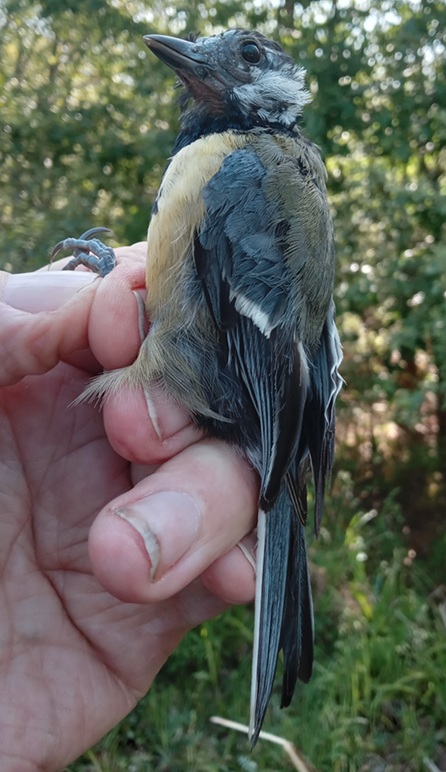
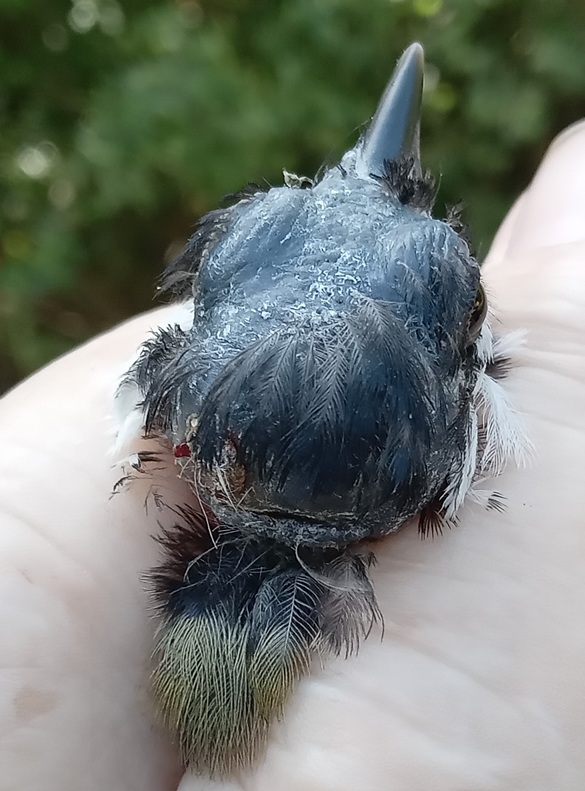
This is what you call “wear and tear” on an the adult Great Tit in the first photo.
Anyway, it was quiet, but a nice morning. It took only a short time to get packed away, with so many of us on hand to do so, and we left site before midday.
 Ringing In The Braydon Forest & Beyond