Another post from Lucy, updating her activities at Spurn Observatory. This time she is blogging about her activities away from the Little Tern colony.
Summer is turning to autumn here at Spurn, but in the past month I have had some fantastic opportunities to ring a range of young birds.
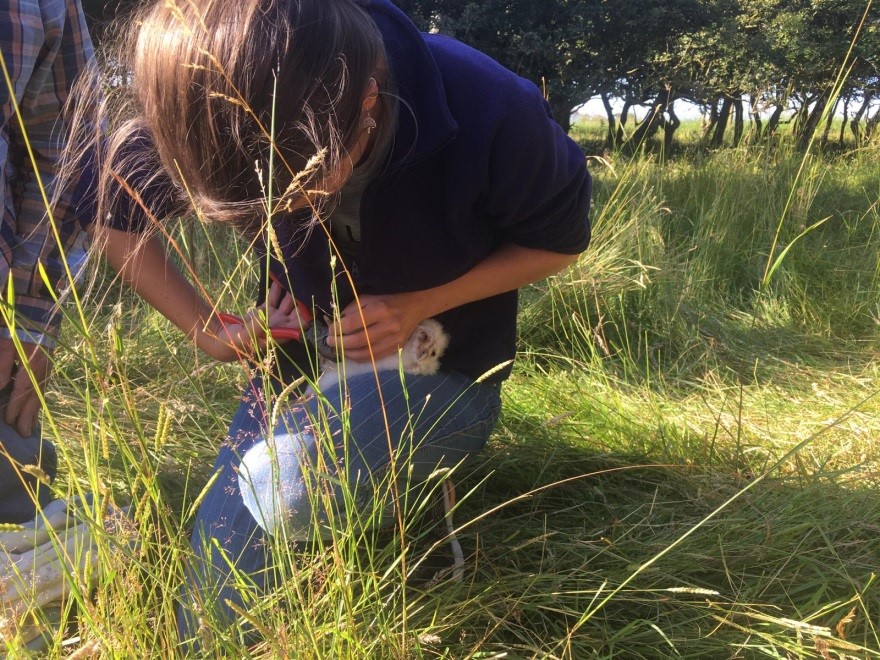
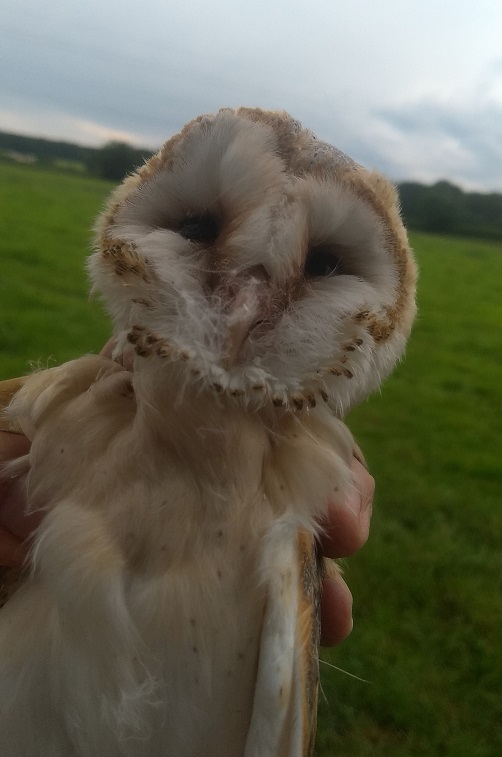
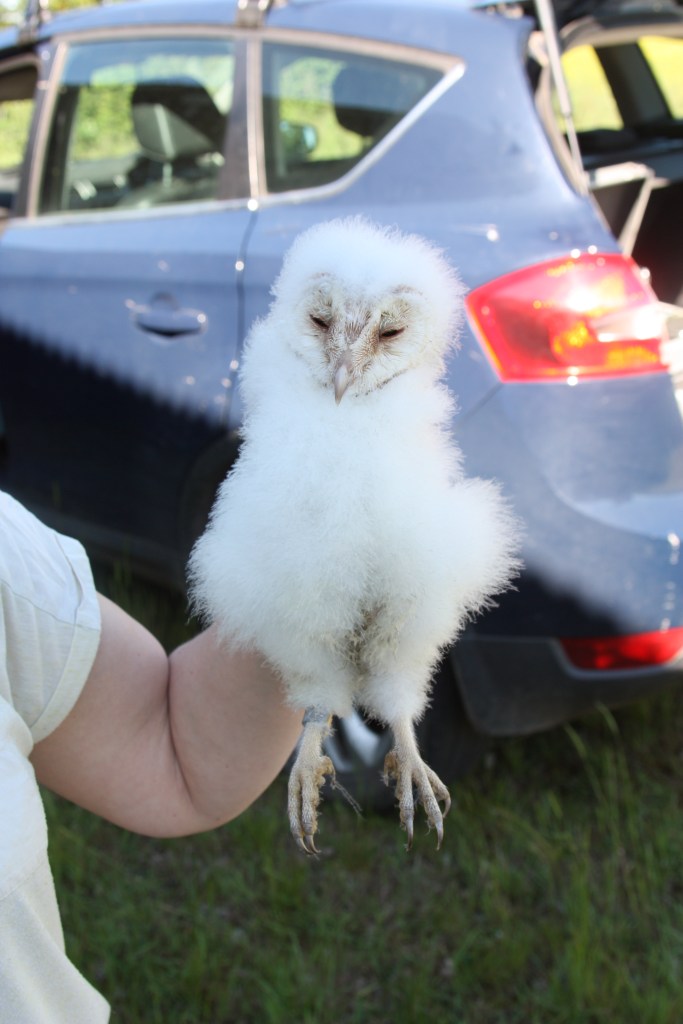
Having checked the barn owl box in late June to find four chicks only a few days old it was lovely to return in July to find five big, healthy looking chicks, ready to be ringed. The adult birds can regularly be seen hunting in the surrounding fields, and have been very successful parents in the past. These were the first barn owls that I have ringed, and they are an absolute delight!
The following morning I ringed two Stock Dove chicks whose parents had taken up residence in an owl box. They had very full crops and were about a week off fledging. I forgot to get a picture of them!
I have spent a couple of beautiful evenings mist netting juvenile Swallows and Sand Martins. We set up a single double shelfed net along a hedgerow adjacent to a pond and set tapes to lure the birds in. They are amazing acrobats and spent as much time sitting on the top and middle shelf of the nets as they did wheeling above our heads. A steady stream of birds were caught and ringed, and the nets brought down in time for the swallows and sand martins to roost in the rushes in the pond. Again, I forgot to take a picture of the Sand Martins.
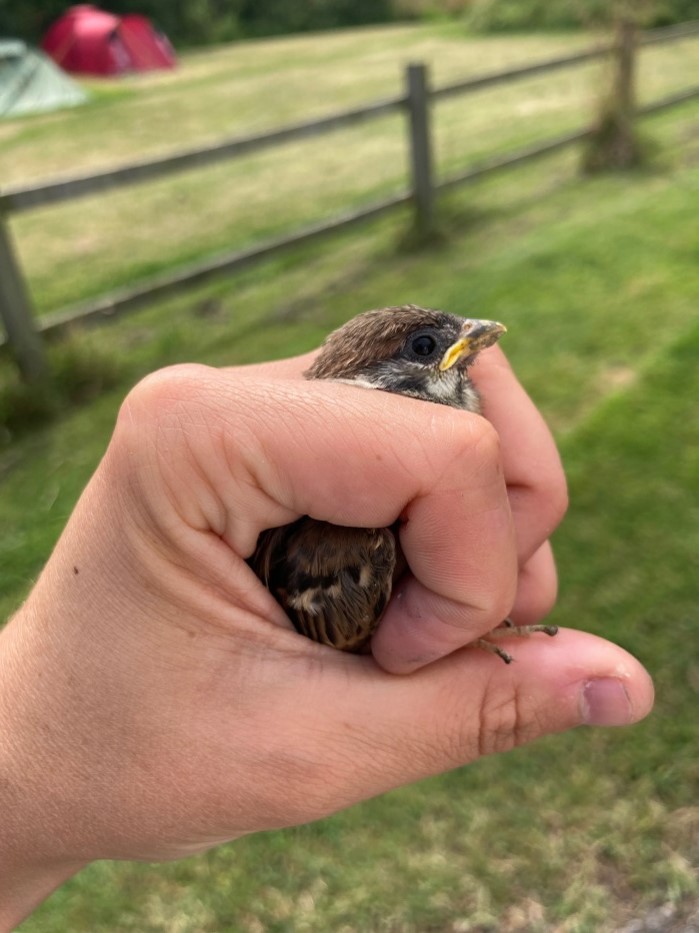
My most recent ringing exploit was to a nest box just behind my accommodation where four Tree Sparrows were ringed. As you can see they were very close to fledging and stayed in the box for only a couple of days after they were ringed.
Ringing here at Spurn continues to surprise and delight me and I’m very excited for what the coming weeks will hold!
The following post is by WWRG trainee Lucy Mortlock, currently working as a warden at the Little Tern colony at Spurn Point, covering her work at the site.
The Little Tern project at Spurn is primarily focused on monitoring and protecting the Little Terns that arrive here each spring. Maximum numbers of Little Terns are currently around 100 individuals most days. Some adults and juveniles have arrived from colonies further north, slightly swelling our numbers, but they are remaining fairly consistent. Our first chicks hatched on 3rd July, meaning that we now have some of our very own juveniles fledging. So far we have three fledglings, with more to follow this week. It’s an absolute delight to watch them stretching their wings and preening their feathers on the shoreline, and a little scary to think these tiny, young birds will soon be departing for west Africa.
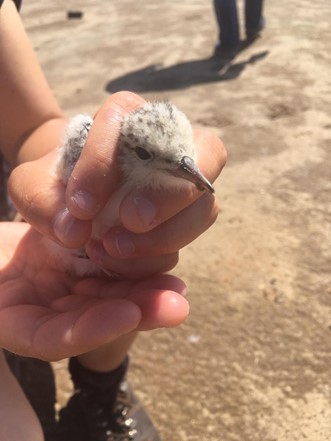
Little Tern chick
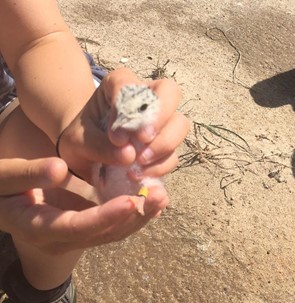
As part of the project chicks are ringed with metal BTO rings and, if they are big enough, yellow colour rings.
Little Tern chick with yellow Darvic ring
The colony is protected by an electric fence and has a 24 hour warden watching effort, meaning that it is a great choice of nesting habitat for other ground nesting birds. In among the terns, Oystercatchers and Ringed Plovers have been nesting and raising young. At least 10 pairs of Ringed Plover have successfully hatched chicks, and as recently as this week two new pairs of chicks have been seen on the shoreline.
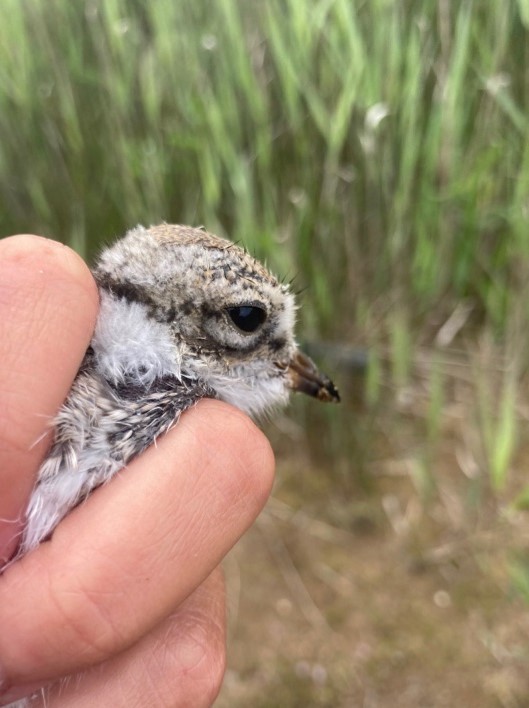
Ringed Plover chick
Ringed Plover chicks can run and feed themselves within a few hours of hatching, meaning that you can often see these fuzzy little pompoms dashing about on the shoreline, more or less completely independent of the adult birds.
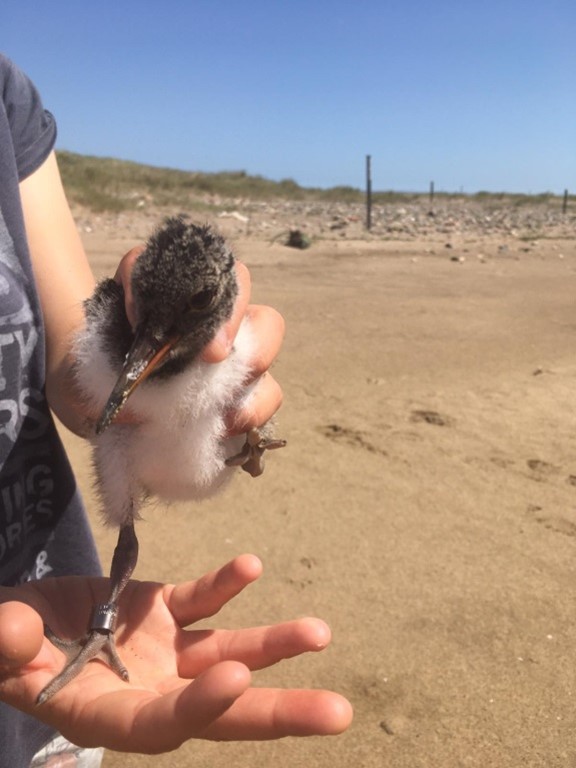
Oystercatcher chicks are a little less independent of their parents, and tend to be seen in association with an adult bird. Seven Oystercatcher chicks from four nests have hatched within the colony, and this lucky bird got a ring. While Ringed Plover chicks can be ringed while they are still very young, Oystercatchers need a couple of weeks to grow into their legs before they can be ringed.
Oystercatcher chick
The Little Terns will be heading off within the next couple of weeks and we’ll have a final count of the number of chicks fledged. It will be very quiet without them!
All birds have been ringed under license from the BTO.
We have been busy monitoring Barn Owls in north Wiltshire this year. Our activity started on the 14th June, when we ringed 4 chicks at the Wiltshire Wildlife Trust Avis Meadows site. Since then we have visited 20 boxes and have been pleased with how productive things have been.
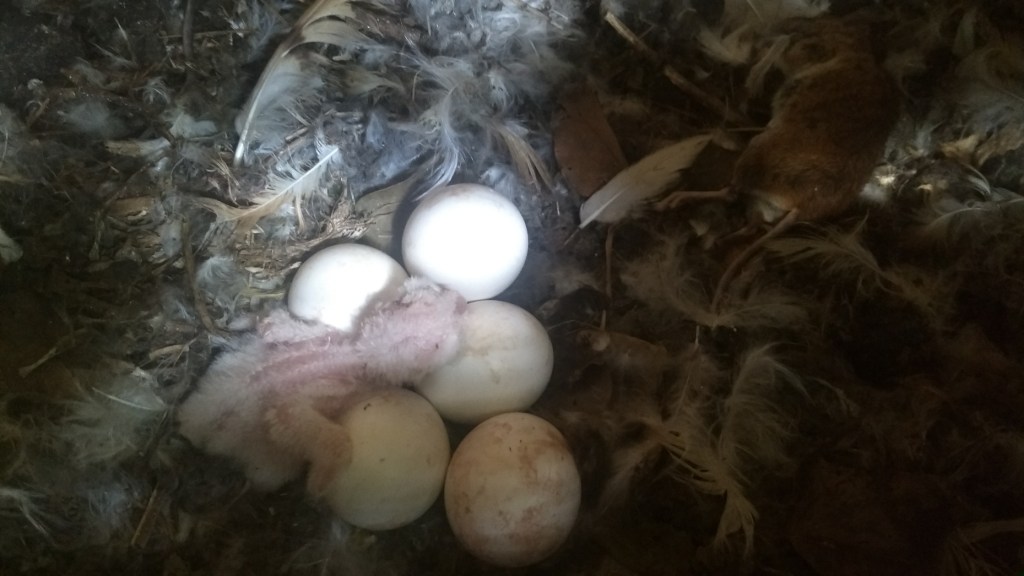
Today I was joined by Anna, and we went to carry out some follow up checks on boxes. We started at Upper Waterhay Farm. At my last visit there, on the 23rd June, the box to the east of the farm had 5 warm eggs in it, the dilapidated box in the grounds of the Chancel was empty and the box to the west of the farm was full of twigs and muck where we had not been able to get to it to clean it out last winter. Needless to say, we cleared the box on the 23rd June, so wanted to see if anything had taken advantage.
We were joined by local farmer and birder Andy Rumming and his children. They were keen to see what they have on their land. It was very pleasing to find that 3 of the eggs in the east box had hatched and the young were of a good size, ready for ringing. This enabled Anna, on only her second ringing trip, to ring her first Barn Owl and Andy and his children to see the birds close up. The chancel box is looking even worse, and we really will have to replace it this winter. When we got to the west box an adult flew off as we put the ladder in position. I climbed up and saw this:
Newly Hatched Chick plus 5 Warm Eggs
We will check it again in about 5 weeks time. Hopefully we will find 5 healthy chicks in the box. What you cannot see from the photo are the corpses of half-a-dozen short-tailed voles that the parents have clearly provisioned for the larder. There does seem to be a glut of these rodents in the area this year. Not only have I seen the evidence in the Barn Owl boxes but several local landowners have commented on what they have seen on their own farms to me.
Having finished with these boxes, we headed off to Plain and Drill Farms to check the boxes there. First we went to Drill Farm, where we ringed 3 Barn Owl chicks on the 17th June. I fully expected them all to have fledged by now but wanted to be able to confirm that they had been successfully reared. They certainly have, but they are still using the box as a roost. One flew off when I opened the box and a second seemed a bit bemused by it all, and I managed to catch her and process the biometrics and, as you can tell from the pronoun, sex the bird.
We first visited the box at Plain Farm on the 17th June when, despite the back of the box having fallen inwards, leaving it open to both the elements and predation, we found 4 naked young. We went back to ring them on the 2nd July and ringed the three surviving chicks. Again, I wanted to check on their progress. The largest chick flew off strongly from the box as we approached. The others decided that they would try and fledge prematurely. One flopped into the hedgerow and disappeared; the other flew into the field next door and was soon recaptured and returned to the box. I take my responsibilities very seriously, and this is the first time that this has happened with any birds on my watch, so I was determined to get it returned home. However, search as we may, we couldn’t find it.
I decided to leave it for a while and then go back, working on the assumption that it would work its way back towards the box if left alone. In the event, it was pouring with rain for the rest of the afternoon, so I went back at 6:30. The bird was found quite quickly and, although it made a dash for it, an accurate throw of my ringing smock managed to cover it. I bagged it and carried it back to the car, put up the ladder (don’t tell Health & Safety but I was working solo), climbed up, opened the back of the box and put it back in. Only it decided to go straight out the front and fly into the next field! Not to be outdone by a Barn Owl chick, I thought about it and decided that, next time, I would put it back in from the front of the box, so I could block its exit. So I caught the bird again and bagged it. Then I brought the ladder through to the front of the box and replaced the bird in the box. This time it stayed put and I could go home.
July 2021 has been dreadful – not for everybody, and certainly not for Jonny Cooper, with the receipt of his A-permit, making him now a fully-fledged, independent ringer, but it certainly has been poor for me and my sites in the Braydon Forest and at Lower Moor Farm. For the first time I can remember, I abandoned 2 sessions, after 3 hours each with 2 and 3 birds at Ravensroost Woods and Meadows respectively, and finished it with just 7 at Webb’s Wood on Saturday. I ended the month with just 59 birds ringed and 26 retrapped (which includes 4 Barn Owl chicks and 2 Stock Doves chicks ringed earlier in the month and still in the nest boxes, so they don’t really count) from 21 species. Compared to Covid-constrained activity last year, when I still managed 240 ringed and 24 retrapped from 31 species, it really is a poor return.
To be fair, July of last year was our best ever performance in that month, by over 300 birds from the next best (in 2015) and only 100 d0wn on 2019. The weather didn’t help, with too many wet and windy days, and then nearly a week of cripplingly high temperatures, during which I banned my team from doing any ringing, to avoid heatstroke for them and heat stress for the birds. Others also clearly had better catches than me but we still processed nearly 10 birds fewer per session compared with 2020.
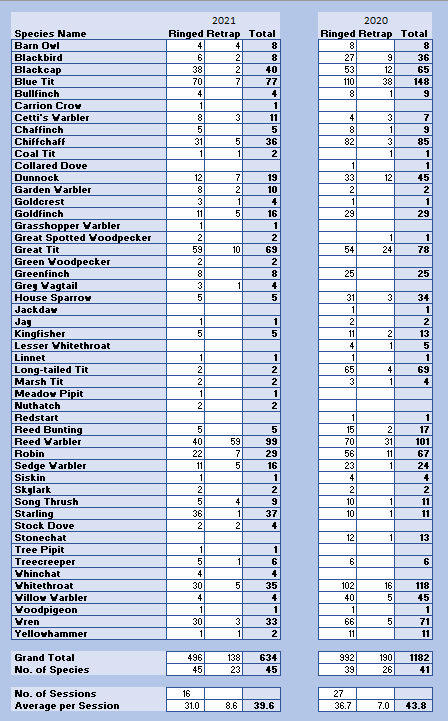
Comparison July 21 to July 20
The difference in the species catches is clear to see from the table: the numbers ringed almost across the board were down. In fact, of those species where we ringed more than a token few, the only species to show a clear increase in numbers ringed was Starling, the only one to show a comparable figure with last year was Great Tit, the rest, resident or summer visitor, were well down. Looking for positives, 45 species ringed this month, compared to 39 last year.
The most measurable fall for me was in my Lower Moor Farm CES. 2019 was the last time I was able to carry it out, as Covid prevented me accessing the majority of my rides in 202. These are the comparisons:
CES Comparison July 2019 to July 2021
Looking forward to August and hoping that it is an improvement both on July and on last August.
I haven’t been into Webb’s Wood since November of last year. Over the winter the contractors were on-site carrying out extensive thinning operations in the wood. Once they finished, at the end of February, the track was left impassable to anything but off-road vehicles with high ground clearance. The track was repaired over the next couple of months but with other commitments, and a combination of weather and illness, this was the first scheduled session at the site that has actually taken place since it became accessible again.
In 2015, following the thinning operations at Red Lodge, it took until the winter feeding flocks for the numbers to recover. I was interested to see how the work would have impacted on Webb’s Wood. Part of me hoped that, as the thinning work stopped just shy of my ringing area, that it might have concentrated birds into there. That was tempered by the knowledge that my sessions in July have been just dreadful, with just 53 birds ringed and 25 birds recaptured from 20 species in 7 sessions! 6 of those recaptures were, in fact, revisits to nests to see if the young had fledged. They hadn’t, so the recapture numbers were inflated by 4 Barn Owl and 2 Stock Dove nestlings.
I was joined by Ellie for the morning, and had invited Anna Cooper along for a taster session. Anna is looking for a trainer, having had a little experience of mist netting and ringing whilst doing her Biology degree, and contacted the BTO rep for north Wiltshire, who asked me if I could take her on. Having disposed of one trainee, as Jonny Cooper has graduated to a full A-permit, I have room for another.
Unfortunately, Anna didn’t get the chance to handle too many birds – because we only caught 7! The list was: Coal Tit [1](1); Wren 2[1]; Chiffchaff [1]; Goldcrest [1]. Totals: 2 adults ringed from 1 species; 4 juveniles ringed from 4 species and 1 bird retrapped, making 7 birds processed from 4 species.
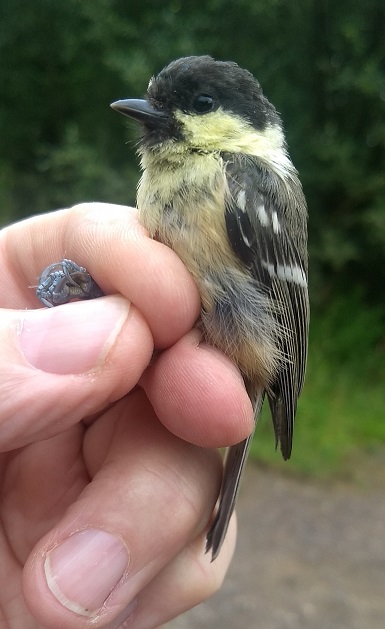
This is not to say that it was not an interesting catch: the juvenile Coal Tit and Goldcrest are the first of the year. I knew it was the first juvenile Coal Tit, so took a photo, but didn’t realise it was the first juvenile Goldcrest, and so I didn’t.
As the wind started to get up at about 10:00 and few birds coming in, we packed up and left site just before 11:00. We didn’t manage to put Anna off – she is joining me to check some Barn Owl boxes tomorrow. I am pretty confident she will get a chance to ring her first Barn Owl chick.
I have decided that I must stop moaning about the low catch totals at my CES this year. It is pretty clear what has happened: Blue & Great Tits have had a bad year; summer migrants just kept moving away from the rain in May, so they are not on site. Something that was very obvious this morning when I didn’t catch a single Blackcap, Whitethroat, Lesser Whitethroat or Willow Warbler.
So, what was good about this morning? The stand-out for me was the first juvenile Green Woodpecker of the year:
Mind, I am not sure it was impressed as it poked its tongue out at me:
It flew off strongly over the tree-tops when released. What particularly pleased me about this bird is that I caught an adult female with an extremely well-developed brood patch at my session on the 16th June. Both birds were caught in the same set of nets and I am hopeful that this means she has successfully reared her brood. I don’t catch many Green Woodpeckers: only 15 since 1st January 2013. Of those, all bar one, caught at Somerford Common in August 2016, have been caught at Lower Moor Farm. All of those, bar one, has been caught in the Wildlife Refuge area. This is not really surprising, as the refuge area is absolutely dotted with ants’ nests. The mounds make walking around there quite a trip hazard but massively attractive as a food source for these specialist feeders.
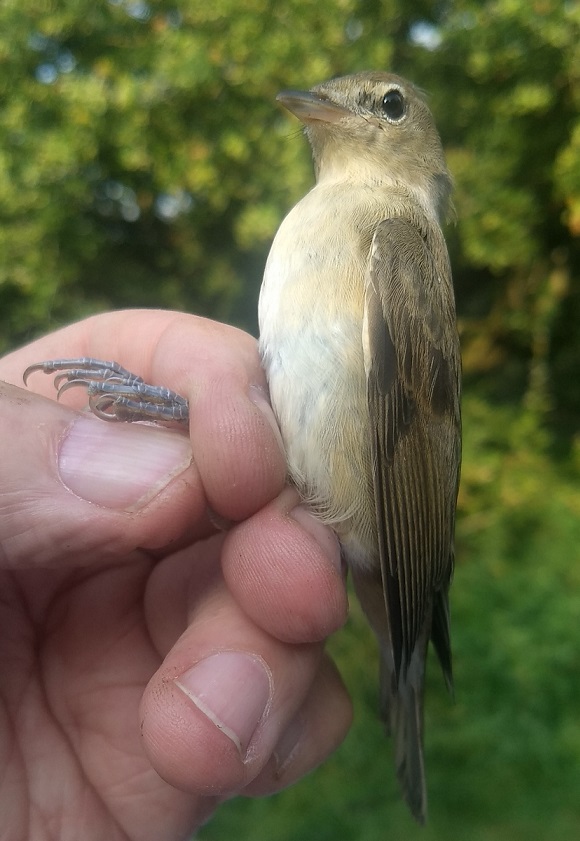
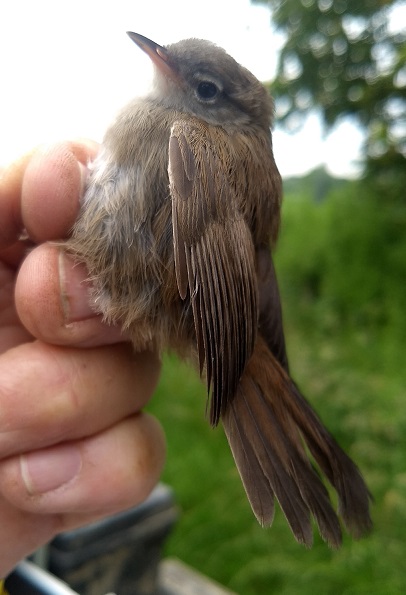
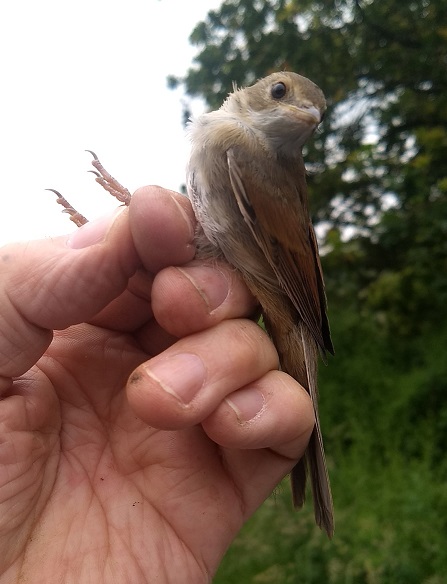
The other pleasing catch was my second juvenile Garden Warbler of this season at Lower Moor Farm:
I love the haughty expression. This bird, very unusually, sat on the palm of my hand for 30 seconds before flying off when I released it. Bullfinches will do that but not many others and this was a first for me with this species. This is a key reason for ensuring you put a hand under the bird when you release them: sometimes they don’t realise that they have been released.
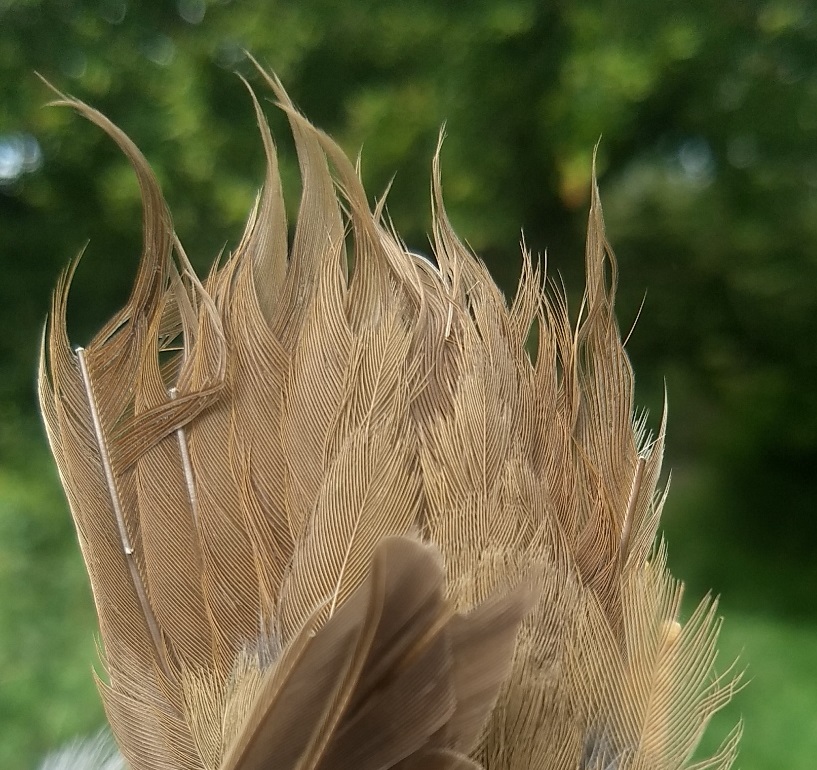
One of the other catches was my first juvenile Song Thrush of the year. If anyone needs to know how hard it has been for some species, this photo is not one of Jedward having a bad hair day, this is its tail:
As you can see, every tail feather has broken at about half-distance. This will be along a line of weakness that we describe as a fault bar. Usually this is caused by a disruption to the food supply, quite often due to inclement weather.
The list for the day was: Green Woodpecker [1]; Treecreeper [1]; Great Tit [1]; Wren [4]; Dunnock (2); Robin [2](1); Song Thrush [1](2); Blackbird 1; Cetti’s Warbler [1](1); Reed Warbler 1; Garden Warbler [1]; Chiffchaff 1[2](1). Totals: 3 adults ringed from 3 species, 14 juveniles ringed from 9 species and 7 birds retrapped from 5 species, making 24 birds processed from 12 species. So nice to see that there was a good proportion of juvenile birds in the catch. It does, however, compare with 75 birds processed from 19 species in CES 9, 2019.
The final part of my session found me showing a group of teenage, male, school children and their teacher a Cetti’s Warbler. I love the way that something as simple as showing these lads a bird in the hand excites them and piques their interest. It doesn’t matter how “cool” they are, they get involved. The lad who got to be shown how to hold and release the bird could not believe his luck! It was a shame that I was closing up and it was the penultimate bird out of the nets. By the time I got to the final bird, the juvenile Treecreeper, they had moved on.
After last week’s CES trip at Lower Moor Farm, this week I had two sessions planned. On Wednesday I was joined by Ellie Jones and Michael New from the Wiltshire Wildlife Trust at Ravensroost Meadows. We met at 5:30 and set my usual nets, hoping for a reasonable haul. Unfortunately, that didn’t happen. Three birds and three hours later we packed up, disappointed. To be fair, the breeze got up early on and the nets were very visible, the pockets blowing out and I thought it could possibly be dangerous for the birds, so we shut them and took them down. Our catch for the morning comprised adult Whitethroat and Blue Tit and a juvenile Blackcap. All were new birds.
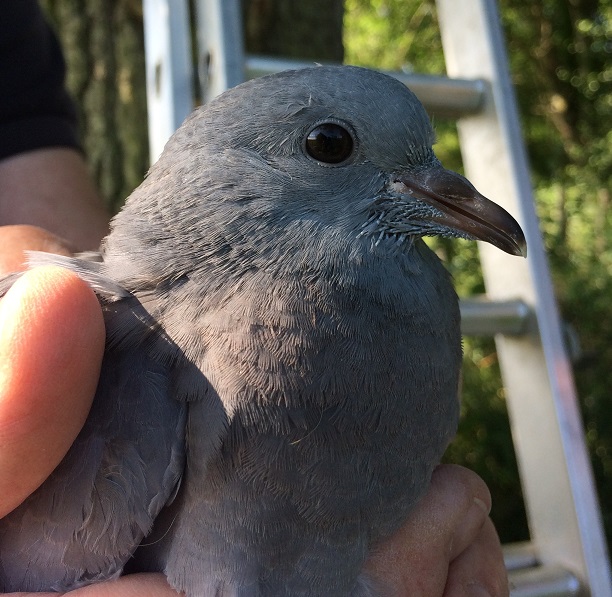
My intention had been to check on the Stock Doves and Barn Owl brood in the Ravensroost / Avis Meadows complex afterwards, so I had brought my ladder with me. With Michael and Ellie on hand to help, we were able to do just that. The first Stock Dove we checked is very close to fledging. Its wings are almost completely full grown and its plumage was extremely well-developed:
The beak hasn’t developed its pink colouration yet but you can see it underlying the grey. The second bird, which had been naked, feathers short, when we ringed it, has grown significantly. When I weighed it it was actually much heavier than the older, more developed, bird but, as you can see from the photo, its crop was very full:
This bird doesn’t look like it will be ready to fledge for a couple of weeks. Its wing feathers still have some serious growing to do being currently only at the two-thirds stage.
Having checked that these two are making good progress, we went over to Avis Meadows to check on the Barn Owls. This time there were only 4 in the box. At my last visit, when I ringed the fifth chick, I knew it was very close to fledging. The simple fact that it was caught outside of the box, and fluttering around on three-quarter grown wings when I ringed it, I knew it was likely to be off by the time I came back – and it was. The other 4 were well developed and looking on course to fledge within the next couple of weeks.
So, a satisfying end to a slightly disappointing session. Then to Saturday at Lower Moor Farm for CES 8. It started badly when the night before I found out I would be working solo (again) as my help had to cry off (these things happen, not criticising). So I knew I would have to start 30 minutes earlier. Up at 4:00, ready to go, when this occurred:
Just came apart in my hands whilst cleaning the lenses. As a fan of “The Blues Brothers” I am not averse to wearing sunglasses and driving in the dark. Just as well, as that is the only option I had, not having a backup pair of varifocals and my new ones not arriving until next Thursday!
I set my nets as usual and was pleasantly surprised to get six birds in my first round. That’s a big improvement! Unfortunately, it soon reverted to type and I ended up with a catch of 21 birds. Comparing with CES 8 in 2019, that is one-third of what I caught back then. There were a few juveniles, and the highlight of the catch was my first juvenile Kingfisher of the year. I have attached a short video of weighing the bird: we just lay them down, on their back, on the scales, and they stay quiet. Last time I posted a photo of this process someone reported to the BTO that the bird looked dead. It wasn’t. They, being uber-cautious about social media, asked me to remove it, which I did. Just watch and you will see, as my two witnesses did (a couple who happened to turn up whilst I was processing the bird and took lots of photos, including one of it flying away at the end of the process – watch for the Lower Mill Estate Newsletter as they will be publishing them in that), that this bird was pretty laid back during this experience.
Furthermore, I actually had to extract it again, this time from the very last net as I was taking down at the end of the day. I couldn’t believe my luck when I thought I had a second for the session, soon turned out that I was right to be sceptical. That said, the net it was retrapped in was at the opposite end from where I caught it originally and, when I released it after processing, it flew off across the lake towards the farmhouse, directly away from where my nets were set.
The catch for the session was: Kingfisher [1]; Treecreeper [1]; Blue Tit [1]; Wren [3]; Dunnock 1[1]; Robin [1]; Song Thrush (1); Blackcap 2[2](1); Garden Warbler (2); Chiffchaff [2](1); Bullfinch 1. Totals: 4 adults ringed from 3 species; 12 juveniles ringed from 8 species and 5 birds retrapped from 4 species, making 21 birds processed from 11 species.
I was excited: back into Ravensroost Wood after 6 months away. Really looking forward to it. On Wednesday I went down to site and cleared the ride that I was going to use. There are some restrictions as to where I can work but we have agreed a number of the paths through the site where I can set my nets. One of the downsides of lockdown has been the massive increase in footfall through the nature reserve and, to avoid incidents, I have been working in areas on Wiltshire Wildlife Trust sites that are either not open to the public or where I can prevent access. This is as a result of the vandalism done to my nets back in July of last year. They got away lightly, paying £100 to replace my net in order to avoid going to court and getting a criminal record. However, their actions brought to a halt a project that had been running for 9 years, providing valuable information on the changes to the birdlife at the site as a result of the coppicing activities there. There is no compensation for that.
Whilst I will still be avoiding Ravensroost Wood at weekends, it has been agreed that I can return there on weekdays and that I can put up “No Entry” signs at either end of the net rides, to (hopefully) prevent unwanted, and unwarranted, interference. So on Thursday morning I arrived on site just after 6:00 and had my nets open by 6:30 and sat down to wait to see what would arrive. The first bird arrived at 7:25: it was a Song Thrush. Second in the nets was a Blackbird, which was caught at 8:35. Thereafter: nothing – not another bird so at 9:35 I decided to take down and go home. I am not sure what this says about the birds in Ravensroost Wood this year. We know it has been difficult for Blue and Great Tits but, to be honest, they are not the primary catch there at this time of year. It is usually Blackcap and Chiffchaff, with the odd Blackbird, Song Thrush, Robin, Nuthatch, Treecreeper, Great Spotted Woodpecker or Garden Warbler thrown in for good measure.
So to Lower Moor Farm this (Friday) morning for CES7. I was already concerned, as my last CES session there delivered only 38 birds compared to 96 in the equivalent session in 2019 (I was unable to carry out the CES last year due to restrictions on activity imposed by the BTO in response to Covid-19).
CES7 in 2019 delivered 86 birds, made up as follows: Treecreeper [1]; Blue Tit 1[3](1); Great Tit [2]; Long-tailed Tit (2); Wren [10](4); Robin [3](1); Song Thrush 1(1); Blackbird 1; Cetti’s Warbler [5](2); Blackcap [19](5); Garden Warbler [2]; Whitethroat 1[1]; Lesser Whitethroat [2]; Chiffchaff 1[14](2); Willow Warbler 1. Totals: 6 adults ringed from 6 species, 62 juveniles ringed from 11 species and 18 birds retrapped from 8 species, making 86 birds processed from 15 species.
So how did CES7 in 2021 compare? Treecreeper (1); Blue Tit [2]; Great Tit [1]; Dunnock [1](1); Robin [2]; Blackbird (1); Cetti’s Warbler [1]; Blackcap 1(1); Whitethroat (1); Chiffchaff (2); Bullfinch [1]. Totals: 1 adult ringed, 8 juveniles ringed from 6 species and 7 birds retrapped from 6 species, making a total of 16 birds processed from 11 species. These are worrying results: where are the Blackcap and Chiffchaff young? Did the adults keep moving in May, to get away from the bad weather, or did their first broods fail? Hard to know, unless we get some retrap information on Lower Moor ringed birds being caught elsewhere. Hopefully there will be an improvement with second and possibly third broods.
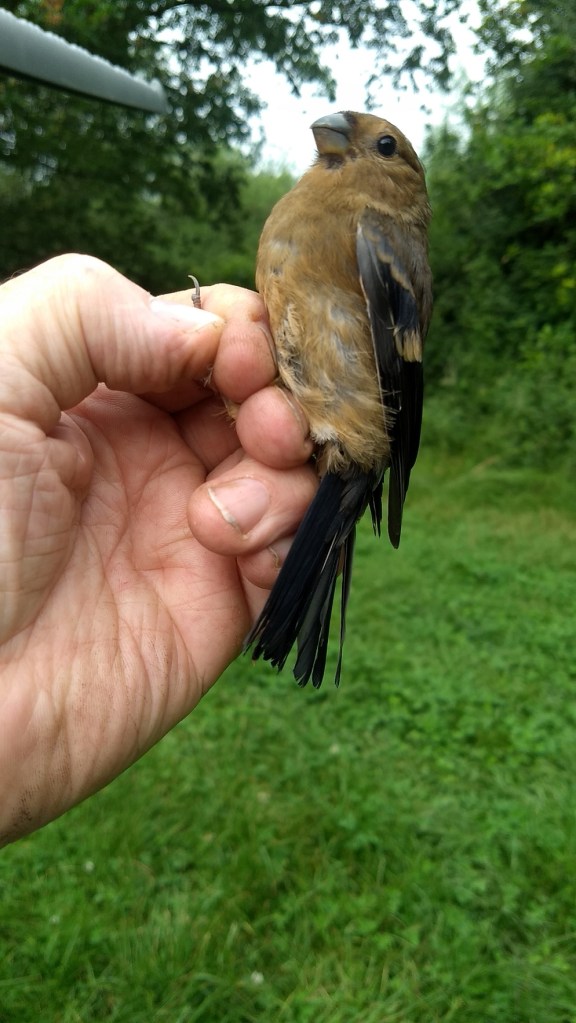
I hate to be unremittingly negative so let’s finish on some high notes, my first juvenile Bullfinch of 2021:
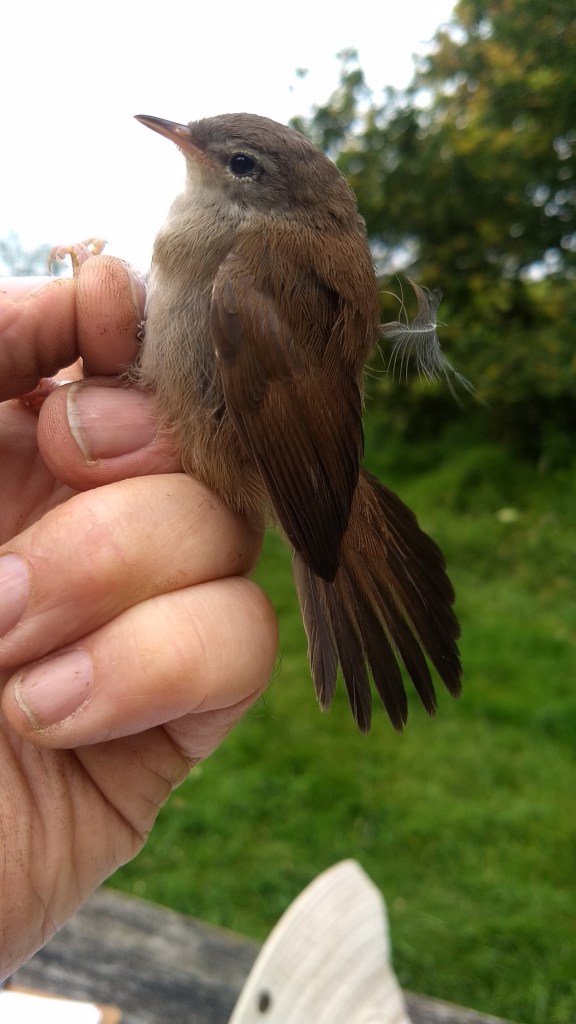
My second juvenile Cetti’s Warbler of the year:
I don’t know where that odd feather came from!
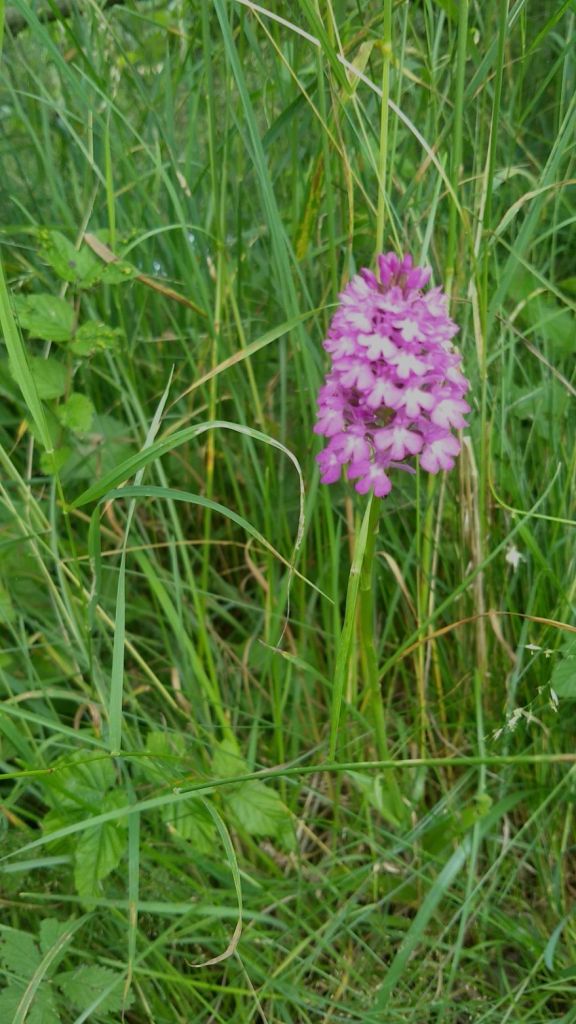
And a lovely Marsh Orchid – the only one that I found on the site:
It was a darker purple than the photo shows – I have tried to enhance it but failed. Must dump the phone and take the proper equipment!
Another interesting month. Overall it is our best catch since the group constituted in its current form but we actually ringed 153 fewer birds than last year’s previous best June, but retrapped 170 more. The vast bulk of this month’s catch has come from Jonny’s efforts at Langford Lakes, Meadow Farm and the Western Way Balancing Ponds. Given that he spent one of his sessions helping out Graham and Phil with their CES for the North Wilts Group, and last weekend away in Bristol (okay, on the lash), that is quite some considerable effort on his part. His Reed Warbler retrapping number is phenomenal.
For my part, my CES has been pretty bad compared to 2019, with an absolute dearth of young Blackcap, Chiffchaff, Blue and Great Tit. In 2019 I caught and ringed 45, 26, 50 and 15 juveniles respectively. Last year was unavailable because of Covid restrictions and this year I caught 5 Blackcap; 3 Chiffchaff, 4 Great and 0 Blue Tit juveniles during my CES sessions at Lower Moor Farm in June. That the numbers appear similar are thanks to Jonny’s catches. Imagine what the figures would have been like otherwise!
This was the catch and comparison with last year:
Notable amongst the results are the 2 Stone-curlew. These are the first and only records I can find for the species for our group in Demon. I have been told that the colour-ringing project has come to an end, hence these now appear on our group rings, rather than on the project rings. I am not sure if this means that the Wessex Stone-curlew project itself has ended or just the colour-ringing phase.
Following last year’s hiatus I was pleased to be able to get out and monitor some Barn Owl boxes in June. Firstly, I was pleased that so many of the team were happy to volunteer to help and, secondly, that we have had such good results. We have checked 18 boxes and have ringed 5 broods of Barn Owl, totalling 15 young; 1 box had 4 naked young Barn Owls that were too small to ring, 2 boxes had roosting adults in them and we ringed 1 adult female Barn Owl from one of those boxes and we ringed 1 brood of 2 Jackdaw nestlings. Two of the boxes have Barn Owl eggs in them and another 2 have Stock Doves nesting, each with a clutch of 2 eggs. So, of the 18 boxes we checked there was activity in 13 of them and breeding activity in 11 of them! Steph and I revisited the previously unringed brood and ringed the remaining 3 youngsters this morning. They have a well-stocked larder, which is the same thing that I am finding all over the Braydon Forest area:
Dead Rodents and Owl Pellets and poo – lovely
There were 4 dead rodents amongst that mess! It is absolutely astonishing that the adults always look so pristine (they live in equally squalid conditions) and that every photo you always see of them, adult or young, they look so clean!
See what I mean – doesn’t it look clean?
I hope to check another dozen boxes this month and then to do the whole lot again in August and, who knows, if it stays as good as this, maybe October.
So a very interesting June. I have little hope for the Blue and Great Tits this year, but with some good weather the warblers should produce at least one additional brood of youngsters, possibly even a third brood if the weather holds.
Working solo at Lower Moor Farm this morning, I was on site just after 4:00 and had the main nets open by 5:00 and all open by 5:30. Typically the first birds didn’t decide to put in an appearance until 6:15.
Apologies (not really) for the punning title but Wrens made up just under 25% of the catch, which is quite unusual for this site. It wasn’t my biggest catch of Wrens here: that was on 19th July 2019, when an astonishing catch of 14 of them went into the net (10 new, 4 retraps), but they made up only 16% of the total catch. Blackcaps (24) and Chiffchaffs (17) were the largest contributors in that 2019 catch.
It was an easy morning, as the birds came in dribs and drabs, but well rounded out with a lot of public interaction. I was joined for a while by a group from the new school set up in what was the Visitor Centre, plus one highly autistic lad from the Care Farm. The two youths from the school were fascinated by what I was doing and absolutely delighted to be shown how to safely hold and then release a wild bird. It is something I try to do whenever I get the chance: for wildlife to thrive we need future generations to be involved, not just people like me who are old enough to remember the last time England beat Germany in a tournament competition! (I am 66 – how appropriate.)
It was a good morning bird-wise as well. I have been hearing Cetti’s Warblers on and off since I started this year’s CES but catching them is very uncertain at the site, so I was delighted when I caught my first for the year at 7:15. It was an adult male – almost certainly one of those that had been declaring his territory with their explosive song all morning. Straight away after I caught another adult male in an adjacent net: possibly checking out the competition. This was a Cetti’s that I had ringed 2 years ago. Nice to know it had survived. Then, at 9:35 I caught my first juvenile Cetti’s of the year:
There were two other ringing highlights this morning: only my third ever Marsh Tit for the site. My nets are not set within the woodland, bar a 12m net on the edge of the wood, which is where I caught it.
I also got my first juvenile Whitethroat of the year for any of my sites:
This ties with the earliest catch I have had of a juvenile Whitethroat at Lower Moor Farm, matching 2016.
The list for the day was: Great Tit [3]; Marsh Tit 1; Wren [6](3); Dunnock 1[1](1); Robin [2]; Blackbird (1); Cetti’s Warbler 1[1](1); Blackcap [5](2); Garden Warbler 1[1]; Whitethroat [1]; Chiffchaff 2[2]; Bullfinch 2. Totals: 8 adults ringed from 6 species, 22 juveniles ringed from 9 species and 8 birds retrapped from 5 species, making 38 birds processed from 12 species.
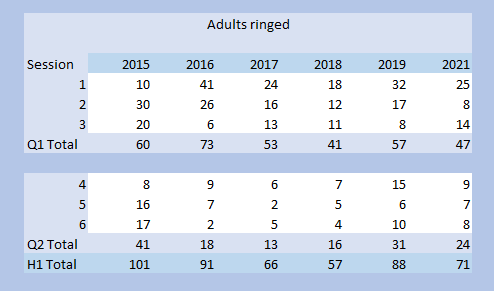
The point of doing a CES (Constant Effort Site) is that it shows year on year how things are changing or otherwise. last year was a washout, due to the BTO’s restrictions on our activities in the face of the pandemic, so I have done a comparison with previous years. I had been under the impression that this year had, so far, been a disaster. The truth is a little different. The number of adults ringed in the first 6 sessions is reasonably on a par with previous years:
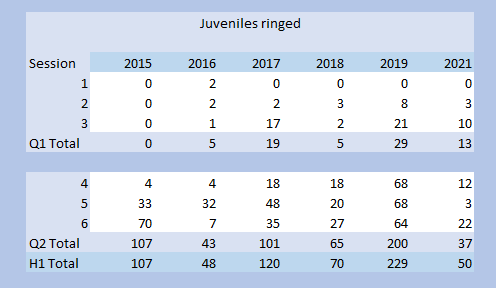
Not the best, but certainly not the worst and not too far away from 2019’s total. However, the real difference comes when you look at the numbers of juveniles ringed. This is clearly a reflection of the impact of May’s bad weather on breeding success so far:
Our worst year for juveniles since 2016. Again, the weather in May 2016 was comparable with this year: wet, cold and miserable for a considerable part of the month. This year we have caught 4 juvenile Great Tit in our CES sessions and no Blue Tit at all. In 2019 we had 15 Great Tit juveniles and 50 Blue Tit! That was exceptional, but that is one heck of a difference. Even in the limited catch in 2018 we caught 7 juvenile Great Tit and 10 juvenile Blue Tit. Blackcap and Chiffchaff numbers were also well down on 2019, but they will have second, and possibly, third broods and have a chance to recover numbers.
I closed the nets at 12:00 and left site about 13:30. It’s hard work, but doable, working solo.










 Ringing In The Braydon Forest & Beyond