The last few sessions have been at my usual woodland sites, with feeding stations in place. This has meant that they have been based very heavily on large catches of Blue and Great Tits.
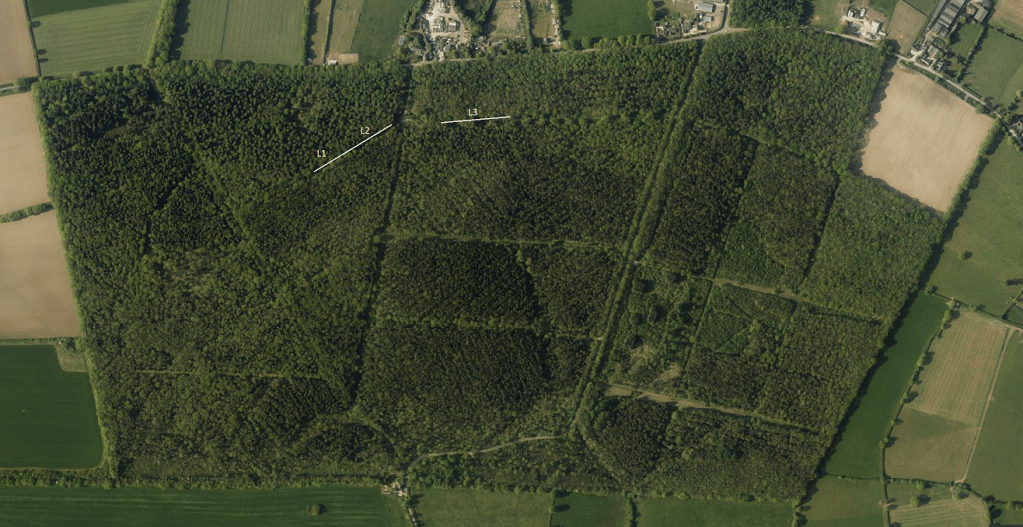
As it was forecast to be a bit windy this morning I knew I would be woodland based. To be honest, I wasn’t really looking forward to another big catch of Blue and Great Tits: you can have too much of a good thing. So I took the decision to head for the north western area of Somerford Common. This part of the site is on the edge of the large commercial conifer plantation. Being an ad hoc visit, there are no feeders set up.
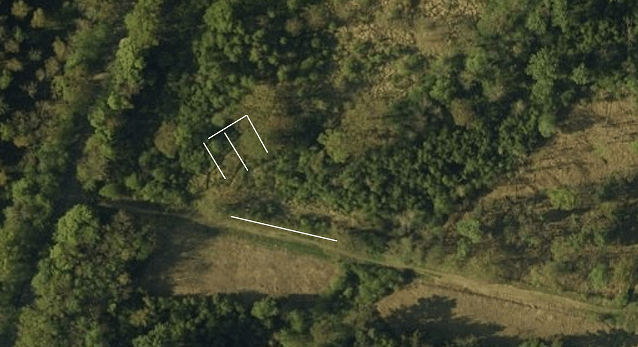
The underfoot conditions were appropriate for a re-enactment of the third battle of Ypres, also known as Passchendaele, so I was a little apprehensive about being too busy, as I was working solo. Because of that, I set up just 2 rides: 2x 18m and 3x 18m, and put on lures for Redwing (L1, L2 and L3). Just like at Red Lodge on Thursday, we didn’t catch a single one.
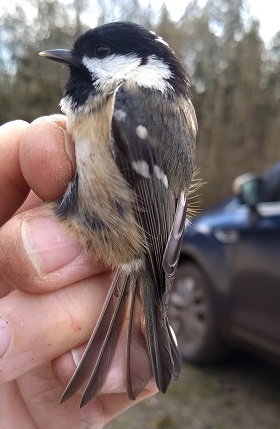
In fact, it was a really slow start: I didn’t catch any birds between 7:30 and 9:00, and was thinking that I should have stayed in bed. Instead I changed the lures: L1 to Coal Tit and the others to Lesser Redpoll. I didn’t catch any Lesser Redpoll but the Coal Tits did respond.
At 10:15 I changed L1 and L3 to Goldcrest, and they started to arrive in reasonable numbers. In the end it was a decent catch of Blue Tit 2; Coal Tit 13; Wren 3; Robin 1; Blackbird 1; Goldcrest 11. Total: 31 birds ringed / processed from 6 species.
So not the biggest or most varied of catches, but a good relaxed session and an excellent opportunity to practice ageing Coal Tits (it’s all in the greater coverts!).
I packed up at 11:30 and was off site by 12:15. I have a feeling that this will be my last session before Christmas.
On Friday last I went to set up a feeding station at the Forestry Commission site at Red Lodge, planning to get out to the site this Thursday. The weather in the run up to Christmas is pretty bad, with Tuesday, 15th and Thursday, 17th currently looking like the only days likely to be dry and not too windy before Christmas Eve. Unfortunately, on arriving at the Red Lodge site I found that the standard padlock was not in use, and there was a combination padlock in place.
Rob, the Beat Forester, sent me the code and so, after my session at Lower Moor Farm on Tuesday, I went over to Red Lodge and set up the feeders: peanuts in two and a seed mix in the other two. Ironically, had I looked closer on Friday I would have seen that the contractor for whom it was set up hadn’t actually used it to lock the barrier, had just balanced the barrier on the lock post and I could have got access on Friday.
For this morning’s session I was joined by Lucy and Alice. We had a late start: 7:30, but were only setting up a few nets, which we had managed by 8:00. I warned them that, with the feeding station only being set up Tuesday lunchtime, the catch probably wouldn’t be huge. 101 birds later my bluff was called!
The first two birds out of the nets were a couple of Blackbirds. Needless to say, the bulk of the catch was made up of Blue and Great Tits, but the catch was a bit more varied than that. However, pretty well uniquely for my sites this winter, there wasn’t a single Redwing in the catch, despite 2 lures playing for most of the morning.
At 9:50 we had a small feeding flock of Long-tailed Tits caught in one net. We processed them and returned them to the catching bags so that they could be released together. I love watching them fly off, buzzing their contact calls as they disappear into the trees.
At 10:30 I changed the Redwing lure for a Goldcrest one, and we immediately caught a small number of them. They do come readily to the lure, so I never start it off before 10:30, until they have had plenty of time to get a feed in. Not that I have ever had a problem with Goldcrest’s being adversely affected by being caught and processed, but I never want to.
The list for the day was: Nuthatch 1; Blue Tit 39(14); Great Tit 13(2); Coal Tit 3(2); Marsh Tit (2); Long-tailed Tit 7(1); Wren (3); Robin 7; Blackbird 3; Goldcrest 4. Totals: 77 birds ringed from 8 species and 24 birds retrapped from 6 species, making 101 birds processed from 10 species.
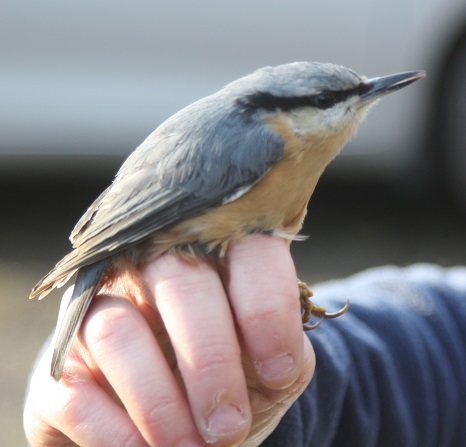
The last bird out of the net was a Blackbird, immediately preceded by a Nuthatch.
Nice to top and tail the catch with some Blackbirds.
We started to pack up at just gone 11:30, just as the wind got up and were off site by midday (the benefits of not setting lots of net and having a crew to help).
With the forecast being pretty unsettled for this week, I decided to take advantage of the dry forecast for today and paid a visit to Lower Moor Farm. I was working solo – but I didn’t spend the morning on my own.
I was joined, all properly socially distanced, by some of the children from the Care Farm, with their carers for the day. One youngster was very keen on birds. He backed that up by identifying several of the species I was able to show him. He told me that it was his birthday in 5 days and that this was his early birthday present! Unfortunately, because of the precautions I couldn’t show him how to safely hold and release a bird.
His younger brother was also there, and his carer told me that he had never stayed that still for that long: which was evidenced by his sheer dynamism as they left. I know it is a cliché but children benefit so much from being out in nature.
I set up just 5 nets in 2 rides: it wasn’t going to be a big catch as I don’t set up feeding stations at Lower Moor, but it was a decent catch. The highlight had to be my first overwintering Chiffchaff of the year:
The obligatory Blue and Great Tits dominated the catch, but it was of reasonable variety. The Redwing were present, not in such good numbers as elsewhere, but there are probably better feeding areas for them on other parts of the site.
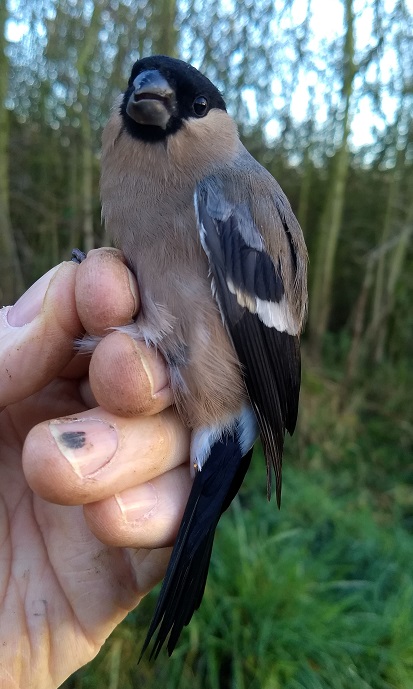
A female Bullfinch was another highlight. The biggest gripe of the photographers at Lower Moor is that they can never find a Bullfinch to photograph that doesn’t have a ring on it. This is one more they won’t want to photograph:
Today’s catch was: Blue Tit 3(3); Great Tit 4(4); Long-tailed Tit 2(1); Wren 1; Dunnock 1; Redwing 3; Blackbird 2; Chiffchaff 1; Goldcrest 3(3); Bullfinch 1. Totals: 21 birds ringed from 10 species and 11 birds recaptured from 4 species, making 32 birds processed from 10 species.
I started to pack away at 11:30. Quite astonishingly, whilst absolutely surrounded by clear blue sky, a small cloud decided to drop its bounty of rain exactly on my ringing station and I got wet putting it all away. Typical!
This was my first Forestry England site session since the end of lockdown. As with the Wildlife Trust, I had to spend some time putting together updated risk assessments and having them accepted by FE before I could resume. Saturday started at Somerford Common. I had planned to go midweek but the weather put paid to that. I had set up a feeding station on Friday, 4th December, and topped it up on Tuesday and again on Friday, during a break in the rain. There are three feeders: one contained a seed and grain mix, one peanuts and one containing nyjer seed.
One of the benefits of the new risk assessment is that it is no longer a 1 + 1 basis. To ensure that social distancing can be met, I don’t plan to do more than me + 2 until the all clear is given. I was joined for the day by Jonny Cooper and Alice Edney, two of my C-permit holders. We set nets around the feeding station, within the paddock, and just along the main path:
The nets were all 18m, except on the main path where the 18m was joined with a 12m net. I played lure for Redwing on the main path until 10:30 and then Goldcrest until we packed up at 11:30. Funnily enough, all Redwing and Goldcrests were caught in those nets. Apart from a couple of Blue Tits and a Wren also in those nets, the rest of the birds were caught around the feeding station. As I had help with my 2 C-permit holders, they had their own equipment and did all of the processing, whilst I did the data recording. This is a simple way of ensuring that all appropriate Covid-19 precautions can be taken.
The session started brilliantly: two new Marsh Tits were the first birds out of the nets. This takes the year’s total to 22 ringed in the Braydon Forest so far this year, showing that the species is still doing well in our area, especially as one of the strongholds, Ravensroost Woods, has been unavailable to me to work until very recently, due to the site becoming very busy post-lockdown, restricting activity to those small areas that can be closed off from the public.
The Redwing started coming in early on, soon after dawn, and continued throughout the morning in twos and threes. Our catch ended up as follows: Great Spotted Woodpecker 1(1); Nuthatch 3; Treecreeper 1; Blue Tit 19(16); Great Tit 9(8); Coal Tit 2(2); Marsh Tit 2(3); Wren 2; Robin (1); Redwing 16; Goldcrest 3; Chaffinch 7; Lesser Redpoll 1. Totals: 66 birds ringed from 12 species and 31 birds retrapped from 6 species, making 97 birds processed from 13 species.
This is my biggest catch of the year so far, and is what happens once you set up feeding stations: fewer nets and more birds from more species, but easier to manage.
Jonny and I had arranged to meet up at Blakehill Farm at 15:00, to set a couple of net sets to try luring for Redwing and Starling coming in to roost. As usual, Jonny was late, his reason (excuse): to pass the time he had gone over to the Cotswold Water Park and seen a funny looking bird on one of the lakes. Mind, to be fair, I think if I had been with him we would both have been late: it is a while since I have had the pleasure of watching a Black-necked Grebe.
I was setting the second net set when Jonny arrived. We set the lures going and waited to see what would happen as the light went. The first incident of note: two Woodcock flew over from goodness knows where into one of the fields on the edge of the nearby industrial estate.
It wasn’t long before the Redwing started to arrive and we had a regular catch of a couple of birds each time we checked the nets over the next hour. We didn’t have a huge catch but another 9 Redwing for the day was worthwhile. Unfortunately, the Starling lure drew an absolute blank. Although we do see a lot of them flying around the site, it is clear that they are not roosting in this particular area.
Once the Redwing stopped moving we decided to take down the nets. I sent Jonny off to close them while I moved the car adjacent to them, only for him to come back with an unexpected bonus: a nice male Stonechat. A lovely bird to finish the netting sessions on.
Having cleared away the nets, Jonny got out his thermal imager and we went for a wander around the perimeter track to see if we could locate the Woodcock. We couldn’t. Then we went for a wander over the plateau to see what birdlife we might be able to find out there. I had a hand net and my dazzling torch. Apart from the abundance of Hares, signs of birdlife were very few and far between. In fact, the only bird we found was a Robin roosting in a bush out on the centre of the plateau. We left it in peace.
We then headed over to the ponds, to see if there were any Snipe or Jack Snipe over there that we might dazzle. There weren’t, and so we packed up and went home, leaving site at 18:30.
Whilst restricted to my Wiltshire Wildlife sites (hopefully we will get good news from Forestry England today or tomorrow) I am visiting them on rotation and today was the turn of the Firs. I was joined for the morning by Steph as, previously mentioned, I am also rotating my trainees during this difficult period.
I will be setting up feeding stations this week for my other sites, but have not yet done so for the Firs. The catch was fairly predictable: heavy on the Paridae, light on everything else. The site is always low on finches for some reason and today was no exception. What was unusual about this session was that two-thirds of the catch were retrapped bird.
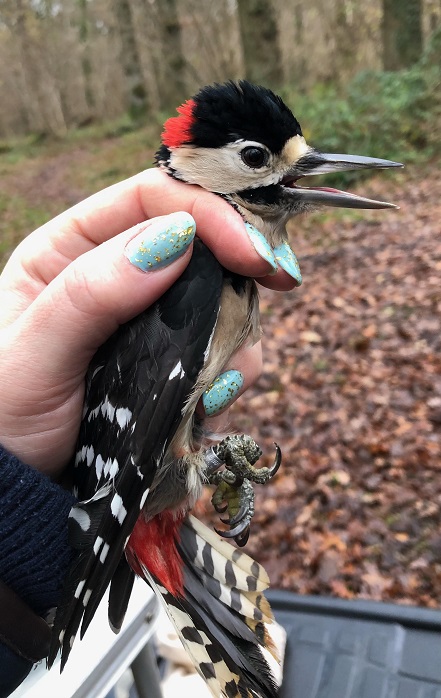
Among the new birds caught was this rather stunning Great Spotted Woodpecker:
The photo was taken by Steph – and the nails are hers as well (just in case you were wondering).
The list for the morning was: Great Spotted Woodpecker 1; Blue Tit 3(4); Great Tit 2(8); Marsh Tit (1); Long-tailed Tit (1); Robin (1); Blackbird 1; Goldcrest 1(1). Totals: 8 birds ringed from 5 species and 16 birds retrapped from 6 species, making 24 birds processed from 8 species.
We packed up at 11:30 after a nice relaxed session and cleared site just as the first spots of rain started to fall.
November has been a bit of a challenging month. When lockdown 2 was announced most of the regional offices for Forestry England, including our own, were happy to accept the BTO / JNCC / NE decision that ringing constituted “outdoor recreational exercise” and could continue. Unfortunately, a week later the central administration decided to overturn their regional offices and ban all volunteer activities, including ringing, on their properties. Absurdly, that meant I could spend the day birding at any of their sites, but not set any nets. I just love bureaucracy! That has impacted on my activities, with sessions focused on the Wildlife Trust sites at Blakehill Farm, the Firs, Ravensroost Wood and Lower Moor Farm. The only place that I have a feeding station set up is in Ravensroost Wood.
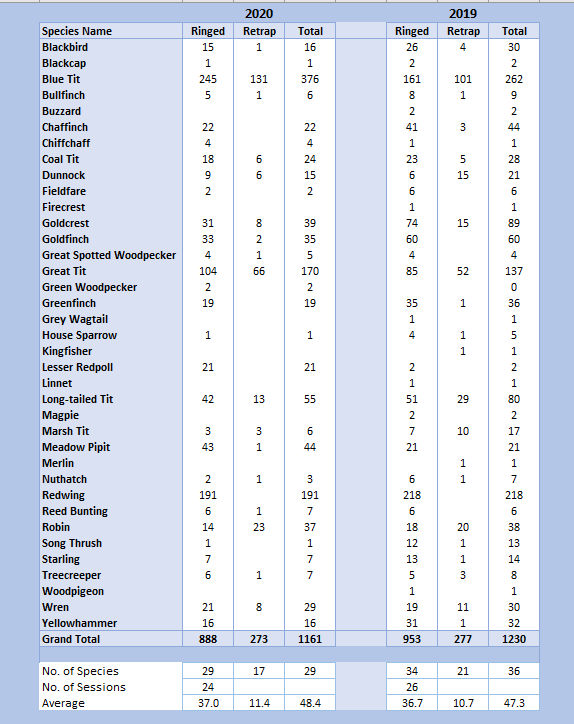
This November was never going to compete with last year for quality of catch, what with Ian and Andy retrapping a Merlin at Battlesbury and my team mist-netting two Buzzards at Somerford Common and our first Firecrest at Red Lodge, (although the last was actually ringed by a member of the North Wilts group, who I was assessing for a C permit at the time (he passed)) and only our second in the Braydon Forest. We have averaged out at slightly more birds per session than last year, and it is our second best November catch since the split at the start of 2013.
The difference in the catch is that the numbers of Blue Tit, Great Tit, Meadow Pipit and Lesser Redpoll are up, and the numbers of Goldcrest, Goldfinch, Chaffinch, Blackbird and Song Thrush are considerably down. The increase in Blue and Great Tit numbers is mainly down to Jonny’s new site at Biss Wood: large catches heavily skewed towards those two species. By contrast, the Chaffinch and Goldfinch numbers being down is almost certainly the result of my not being able to work at Somerford Common, where the winter catch at the feeding station has been good for these two species in the last couple of years. Meadow Pipit numbers are up because Jonny has started using a Mipit triangle at his farmland sites and being successful with them. Interestingly, last Thursday saw Jonny and I set a Mipit triangle at Blakehill Farm. A flock of about 20 of them came towards the lure and then flew away. Perhaps they are less inclined to seek out additional companions as winter draws on.
Sadly I will almost certainly not be doing any more work at Tedworth House. Help4Heroes has, essentially, mothballed the site, and has made 140 staff redundant! In fact, it seems the only person on site is my friend and fellow ringer, Jack Daw, doing essential maintenance.
He has been having trouble getting out to ring on his Salisbury Plain sites recently, as they seem to be favoured for the current set of military training exercises, so he asked if I would object to him doing some ringing at Tedworth. I have just handed the site over for him to use as his patch going forward. I ringed there because the Wildlife Trust and the charity asked me to, and because it might have been of some help to what they call the beneficiaries. They have cancelled their agreement with the Trust and as there are now no beneficiaries, and are unlikely to be throughout 2021, it would have been churlish to say “No”, so I have just handed it over, no strings attached.
It has always been a funny site: you never knew what you would catch. Apart from the usual woodland suspects it is where I have caught the majority of my less usual birds: Black Redstart being the stand out capture but also Firecrest, Mistle Thrush, Kestrel, Sparrowhawk and these beauties to name a few:
And perhaps the most unexpected catch in one of my mist nets:
Anyway, that’s it for this month except to say that last year was exceptional for us, this year we have already surpassed last year’s total. It is probably because A’s and C’s have done more individual sessions due to coronavirus but, nevertheless, the group is certainly more active now than it has been since the end of 2012.
Part 2 was scheduled for Friday but a bit of illness on Thursday night and freezing weather on Saturday meant that it was put back until today. The idea was to contrast what we caught on the north-east side of the reserve on Thursday with what was to be found in the south-west corner. I was joined for the session by Ellie Jones. My hope was that there might be some Snipe around but, apart from one that was put up as we were setting nets in the dark, we didn’t see any others. The nets set up on a just in case basis caught one bird: a same day retrap Redwing. I got excited when I saw the net moving, and deflated when I realised what it was.
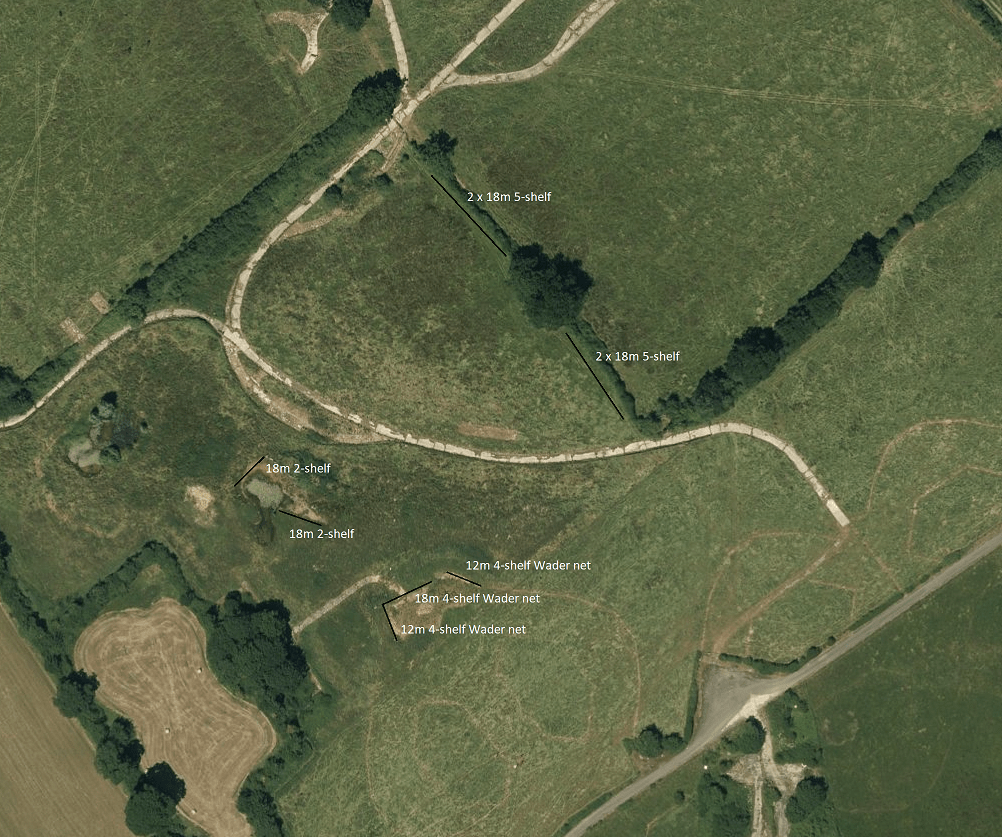
Apart from the pond nets, we went for a very simple net setup, just 4 x 18m along a hedgerow:
The wader nets have a larger 30mm x 30mm net strand length, whereas the standard nets have a 16mm x 16mm strand length. In this set up we put on lures for Snipe on the pond nets and Starling and Redwing on the hedgerow nets. After a couple of hours it was clear that the Starling lure was having no effect, so we replaced it with another Redwing lure, which was working much better.
The first round delivered a Robin, Blue Tit, two Blackbirds and half-a-dozen Redwing. Thereafter it was pretty much Redwing all the way: Treecreeper 1; Blue Tit 3; Great Tit 1; Wren 1; Robin 1; Blackbird 2; Redwing 30. Total: 39 birds ringed from 7 species.
For the first two-and-a-half hours the sky was overcast but visibility was good but then a cold mist started to develop and by the time we closed the nets at 11:30 everything was damp and dank and much colder and it was nice to get away.
So, how did the 2 sides of the reserve compare: the key difference was the absence of any Long-tailed Tit in the catch. However, it could have been an almost identical catch, as a flock of them flew along the line of the hedgerow, but at tree-top height, not hedgerow height, and avoided the nets. What was noticeable was that, although they did not come to the lure, there were a significant number of Starlings flying around in small to medium sized flocks.
Having spent as many sessions as possible giving my T-permit trainees the chance to join me in these 1 + 1 times, it was good to have my longest suffering trainee, and C-permit holder, Jonny Cooper out with me this morning.
We had a two-fold target: primarily Redwing, secondarily Meadow Pipits. The former we were very successful with, the latter was a complete failure. When we arrived on the site the temperature was just below zero but as the sun broke through the mist it warmed up quite nicely.
We set up 6 x 18m nets along the perimeter track and put a lure for Redwing in place midway along. Within a few minutes we had the first few Redwing fly in. Apart from a flock of 15 at 9:00, they came in small groups throughout the morning, ending up with a good total of 37 ringed in the session.
Once the peri-track nets were set up, we then set up the Mipit triangle. Unfortunately, all it caught was a solitary Wren. About 10:30 I changed the lure to a louder version, almost immediately a flock of about 30 flew around the nets and then pushed off elsewhere.
At 10:30 we caught and extracted a decent proportion of a foraging flock of Long-tailed Tits: nine of eleven ended up in the nets. We caught a couple of Wrens and Robins and a few Great Tits. All were new birds. The list was: Great Tit 3; Long-tailed Tit 9; Wren 2; Robin 2; Redwing 37. Total: 53 birds ringed from 5 species.
With Jonny having to leave for work at midday, the birds kindly stopped moving at 11:30, giving us just enough time to take everything down before he had to leave.
Part 2 will follow tomorrow, when I will be working with my second longest suffering C-permit holder, Ellie Jones, on the other side of the Blakehill site. Again I will be targeting Redwing and Meadow Pipit so that we can compare and contrast.





 Ringing In The Braydon Forest & Beyond