Lower Moor Farm: Saturday, 21st and Monday, 23rd November 2020

On Saturday Ellie spent a couple of hours trying out her new MP3 player with the “Latvian Love Song” lure for Redwing. This is her brief report:

“I’ve been consistently getting 10-15 birds in my two 18m nets, which pro rata doesn’t work out too badly, but on Saturday, given the very calm forecast, I decided to site them along a shrubby field margin.  I’d previously seen a lot of ‘action’ in those bushes, but the heavy mist, which persisted until mid-morning, meant that it was a very quiet start.  It was a rather sparse session, with a total of only 7 birds – 4 redwing and 1 each of Blackbird, Robin and Great Tit; however, it was great to see the lure working on its first outing.”  

Come Monday and Andrew Bray and I had a scheduled session in the wildlife refuge area on the edge of Mallard Lake.

The weather was cold and misty at the outset and, to be honest, it didn’t properly warm up until we started taking down at 11:45am.   We set the usual nets in the refuge, plus an extra 9m just inside the gate (the estates team have kindly expanded that ride into something more usable than I had done myself and also refreshed the other rides) and an extra 18m over at the back, along the streamside bushes.  That last I often set up, even though it rarely produces much of a catch.  We did get four birds out of it today: a Robin, two Wrens and a lovely male Bullfinch:

Bullfinch.jpg

We did actually catch a second Bullfinch: a female, but she had advanced Fringilla Papillomavirus, nasty encrusted warts in the legs and feet, so I just extracted and released her and disinfected my hands.

For me the highlight of the catch was an overwintering Chiffchaff:

chiffchaff.jpg

The catch was Blue Tit heavy, as one would expect at this time of year, but there was enough variety to be enjoyable. 

In total we caught exactly 40 birds, made up as follows: Blue Tit 10(5); Great Tit 1(1); Long-tailed Tit 1(2); Wren 2(1); Dunnock (1); Robin 3(1); Redwing 5; Blackbird 2; Chiffchaff 1; Goldcrest 3; Bullfinch 1. Totals: 29 birds ringed from 10 species and 11 birds retrapped from 5 species, making 40 birds processed from 11 species.

We spent the morning being regaled by Cetti’s Warblers. There had to be at least 5 territories in the area in which we were set up. Unfortunately, we didn’t manage to catch any of them.

One other interesting catch was a five-and-a-half year old Blue Tit, ringed as a juvenile in June 2015.

Ravensroost Woods: Sunday, 22nd November 202

With Forestry England’s central body having overridden their regional offices and imposed a blanket ban on volunteer activities on all of their sites during this second lockdown, I am rather restricted to the sites available. Thankfully the Wiltshire Wildlife Trust have followed the decision of the BTO / JNCC / Natural England and continued to allow access to their sites on a 1 + 1 basis.

This morning I went back to Ravensroost Woods. I was expecting a titmouse heavy session, as I set up a feeding station on Thursday. It will boost the number of birds caught, and attract in some other species that are less frequently caught during the rest of the year. My plus one for the session was David, one of my T-permit holders. A word in praise of the BTO. T-permit holders are the lowest level of permit and are not allowed to ring without supervision. The next level up are C-permit holders, who are still trainees but can manage their own sites and ring independently, whilst remaining the responsibility of their trainer. Lockdown 1 clearly hit T-permit holders very hard. The interval between lockdowns has allowed 1 + 1 working, as is the case in lockdown two. This has severely reduced the ability of trainees to get out and ring, so the BTO has agreed that they will waive next year’s renewal charge for those trainees genuinely affected by this. David is one of those so affected.

One benefit of a feeding station is that you can cut down on the number of nets set. We set 7: 4 x 18m in the main ride and then one each of 6m, 9m and 12m set around the feeders. The feeder nets caught most of the birds, the ride nets caught most of the more “interesting” birds.

We started with the obligatory Blue and Great Tits, and then, as the session went on, we had a few Coal Tits and a couple of Marsh Tits turn up, together with a couple of Chaffinches and Nuthatches, all in the vicinity of the feeders.

The ride nets produced a couple of Redwing, a recaptured Bullfinch and, during our last round, 3 more Lesser Redpoll.

The list for the day was: Nuthatch 2(1); Blue Tit 13(9); Great Tit 6(2); Coal Tit 4(1); Marsh Tit 1(1); Long-tailed Tit (1); Wren 1(1); Robin (3); Redwing 2; Goldcrest (1); Chaffinch 1; Lesser Redpoll 3; Bullfinch (1). Totals: 33 birds ringed from 9 species and 21 birds recaptured from 10 species, making 54 birds processed from 13 species.

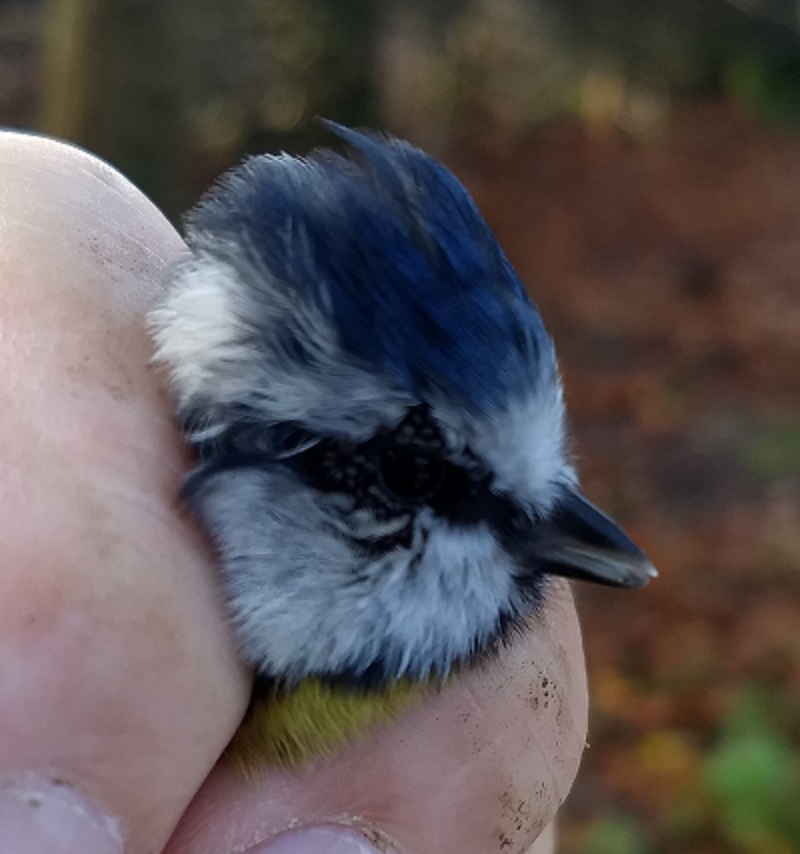
In amongst the Blue Tits was this poor beastie:

The little grey dots around its eyes are ticks. I have never seen as many as there were on this bird. Not just around the eyes but under its feathers all around the face. There had to be 100 or more of them. It is a frequent point of argument amongst ringers as to whether or not we should interfere and remove ticks or let nature take its course. The BTO’s position is that they have no position, but if you are competent to remove them they won’t object. I have been removing ticks from various animals since I was 20 years old and working with livestock (a very long time ago) and I usually do so. In this case the load was so great that I thought the bird was unlikely to survive without a large reduction in its burden, so I set to and removed as many as I could. What always amazes me about removing ticks from Blue or Great Tits is that throughout the ringing process, from extraction to ringing, measuring and weighing, they will peck at you at every opportunity but when you start to remove ticks they stop. It is almost (he said anthropomorphically) as if they know you are helping.

We had a very sociable morning. Since lockdown this site has become a big favourite with families looking for exercise in the great outdoors and today was no exception. When people stop and ask about what we are doing it is very rare for anyone to express any reservation about the process or the value of ringing. I make a point of explaining the whys and wherefores and people rarely object to getting a close look at our birds. There was a dozen or so groups who stopped for a chat. One young girl (6 years old) has expressed a wish to train to become a ringer!

Of course, readers of this blog will be aware that those that don’t bother to find out, and take things into their own hands, can be a problem. Pleased to say that on Thursday of last week I received a cheque for £100 from one of the two joggers who damaged one of my nets. They had the choice of paying to replace the net they damaged or get a criminal record, as the police tracked them down. I have thanked the police for their help.

Fortunately, for the future the Wildlife Trust have provided me with No Entry signs, and the authority to use them to close off rides when I am actively working on their sites. Personally, I think a Go-Pro will be at the top of my letter to Santa!

The Firs: Tuesday, 17th November 2020

With the weather being as volatile as it is, I am trying to get out whenever there is a break in the weather. Unfortunately, along with the bad weather, Forestry England centrally have overridden their regional offices and banned all volunteer activities on their sites. Clearly they see birding as outdoor recreational activity but not bird ringing. That contrasts with the JNCC, Natural England, the BTO, the MoD and the Wildlife Trusts. It is hard to understand how they can come to such a different interpretation of the rules. All of which is a long-winded way of saying that, instead of going to Somerford Common for Redpoll and Siskin, I spent the morning in the Firs.

It was dull and overcast all morning, with passing moments of mist which eventually became fine rain as I was just about finished packing up.

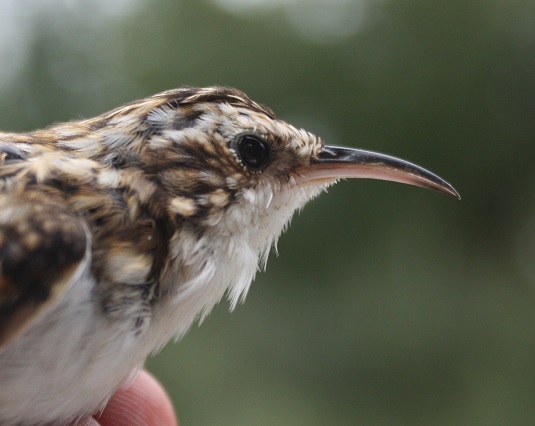
The first bird out of the nets was a Redwing. Unfortunately, it was the only one of the morning. In fact, the catch was totally predictable for this wood at this time of year: Blue and Great Tits and little else: Treecreeper 1; Blue Tit 7(5); Great Tit 4(5); Long-tailed Tit (1); Wren (2); Robin (2); Redwing 1; Goldcrest 1. Totals: 14 birds ringed from 5 species and 15 birds retrapped from 5 species, making 29 birds processed from 8 species.

Disappointingly, as at Webb’s and Ravensroost recently, no Marsh Tits, either new or recaptured. The adult Treecreeper was the highlight of the session. They are difficult birds to photograph: not because they struggle but because, with their decurved beak and their tendency to hunch up, they tend to look thoroughly miserable – and we don’t post photographs that might be hijacked by the antis to suggest that ringing is stressful for the birds processed.

A Red(poll) Letter Day: Ravensroost Wood, Thursday, 12th November 2020

Taking advantage of what is forecast to be the last dry day before next week, I decided on a session at Ravensroost Wood. My plus one for the day, as per government guidelines, was Andrew Bray. One of the nice things about woodland ringing is that, unless you are targeting owls, excessively early starts are not necessary. Andrew and I met at 7:00 and erected 3 sets of 2 x 18m nets in the same positions as on my last visit to Ravensroost.

Having set up the nets I drove the car up to the Shooter’s Hut (not that anybody has shot in this wood (at least, not legally) since the Wildlife Trust purchased it) as it is the only place where there is room to turn the car round and drive back to the ringing station. As I drove off a small flock of Lesser Redpoll took flight from a Hazel bush in the coppiced area to my left (coupe T1 for those who know the map). As a result, we put on lures for Lesser Redpoll, as well as Siskin and Redwing, just in case.

It was a slow start. The first bird to hit the nets was a female Chaffinch at 8:15. Thereafter we caught the odd bird until 9:20 when we found a flock of 12 Lesser Redpoll in the nets adjacent to that lure. Over the course of the rest of the session we caught another 5 – much to the delight of several groups of passers by who got to have a socially distanced close up view of these lovely birds.

The catch for the session was: Blue Tit (3); Great Tit 1(1); Wren 2(1); Robin (2); Redwing 4; Blackbird 1; Chiffchaff 1; Goldcrest 4(2); Chaffinch 2; Lesser Redpoll 17. Totals: 32 birds ringed from 8 species and 9 birds retrapped from 5 species, making 41 birds processed from 10 species.

The Lesser Redpoll catch was a great surprise and the best catch of this species that I have had at Ravensroost since I took over the site in October 2012.

Today’s was a decent and varied catch, even if we didn’t manage to catch some of the standard woodland species we might normally expect to catch there (Coal Tit, Marsh Tit, Long-tailed Tit, Nuthatch, Treecreeper, Great Spotted Woodpecker and Song Thrush). I expect that, once I set up the supplementary feeding station, we will have plenty of opportunity to process them as well.

Whilst we were sat at the ringing station we were joined by a Robin, whose territory we had clearly set up in. He spent the morning flitting around the trees and bushes within a few feet of us. As well as that, there were a number of Goldcrests foraging in the trees and bushes around us. Not having masses of birds at any one time gave us ample opportunity to watch their antics. I love the way they can hover briefly as they pick off an insect from the underside of a leaf.

I was looking along the path when a Robin suddenly shot up into the air, wings flapping and legs pushed forward. The next thing there was another: they were having a vigorous territorial dispute. Our national bird is a pretty confrontational character with others of its species. They kept it up for a good two minutes before they went off, one chasing the other into the bushes.

At 12:15 the breeze picked up and we took down and were away from site just after 13:00, very satisfied with an extremely relaxed and pleasant session.

Webb’s Wood: Wednesday, 11th November 2020

Unlike the first lockdown, the BTO have allowed us to continue ringing at local sites, either solo or on the government’s 1 + 1 allowance. To be fair, this is how we have been working on Wildlife Trust and Forestry England sites since the first lockdown was lifted anyway. Fortunately, both the Trust and Forestry England have adopted the same strategy.

I had planned to go to Webb’s Wood yesterday but when I woke at 6:00 it was raining, so I went back to bed and tried again this morning. It was dull and overcast all morning with a slight breeze. There were a few drops of very light rain from time to time but this morning’s real issue I will discuss later.

I only set 6 x 18m nets in 3 rides, as I was working solo. I haven’t set up feeding stations yet, so the catch can be hit or miss. It started with a couple of Great Tits but then the regular trickle of Goldcrests that I seem to be getting at my woodland sites started up and by the end of the session they were, once again, the commonest bird in the catch.

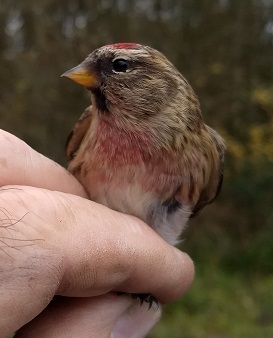
My highlight of the session was a really well marked male Lesser Redpoll:

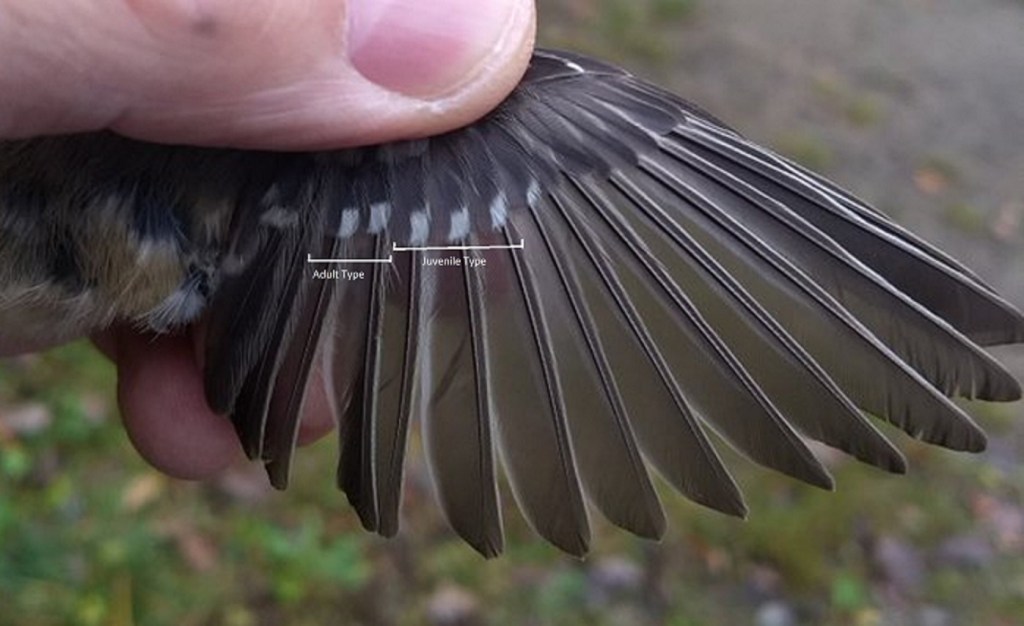
One of the more difficult bird species to age is the Coal Tit. It is done on differences in the greater coverts. The adult variety are darker and greyer than the juvenile feathers and are fringed grey, whereas the juvenile feathers are fringed a sort of yellow brown colour. It is not always easy to distinguish the difference (particularly for male ringers apparently). So it was good to catch one with a very obvious break between the adult and juvenile feathers:

The fringing colour difference is not obvious but the break between different generations of feathers and the difference between base colours is very obvious.

The list for the session was: Treecreeper (1); Blue Tit 4(3); Great Tit 2(1); Coal Tit 1; Wren 1; Robin 1(1); Redwing 1; Goldcrest 7(4); Lesser Redpoll 1. Totals: 18 birds ringed from 8 species and 10 birds retrapped from 5 species, making 28 birds processed from 9 species.

All in all, a decent session. However, it all went very badly wrong from about 2 hours in. Recommendation: avoid deciduous woodlands in the autumn until they have completed abscission. After weeks of high winds you would have thought it would have removed all of the leaves from the trees but, no, it chose today to drop them. Worse than that, although it is mainly a beech wood, it has a lot of oak in it. Their leaves seem to be specially designed to stick in mist nets and to stick mist net shelves together. At times the nets were in a brown blizzard, as leaves poured down and into the nets. I started taking down at 11:30. By 13:30 I had managed to clear 2 nets! I gave up: the rest have been loosely bundled up to be emptied at a later date: this weekend when it is chucking it down!

So my new resolution: leave the woods alone until the leaves have left the wood alone.

The Pre-Lockdown Rush: 2nd to 4th November 2020

The irony: two weeks of dreadful weather finally clears and lockdown looms. At least this time the government are encouraging people to engage in outdoor recreational activities, either solo or plus one which, in theory, should allow for bird ringing to continue. That will, of course, depend upon how the BTO and the landowners interpret that information. The Wiltshire Wildlife Trust and the Forestry Commission have already banned any volunteer activities, including ringing, on their land for the duration of lockdown. The irony being that I can go wandering around their nature reserves and sites with my telescope and binoculars, looking at wildlife for as long as I like, I just cannot put my nets up to catch any birds to ring: no matter how private the site. I am going to get very bored! My garden it will have to be.

As there were a couple of good days between the end of October and the onset of lockdown several of us managed to get out and do some ringing. Andrew Bray opened a net in his garden and got in a session at Lacock Abbey Allotments. Jonny Cooper managed to get in a session at his new site, Biss Wood WWT Nature Reserve, and at Bailey’s Farm and I managed to get in a session at Blakehill Farm. These are the reports on each of these sessions:

Andrew Bray: Garden Ringing, 3rd November 2020

Today I put out my 6m net in the garden for 51/2 hours.  It was a slow day as it was very cold first thing; there was even ice on the bottom part of the pole. My first two birds were ringed: Robin and Blue Tit so I was expecting a lot more of them to turn up but in total 15 birds were processed which were: Blue Tit 3(2); Great Tit 6(3); Robin (1).

Andrew Bray: Lacock Abbey Allotments, 4th November 2020

Even though the Lacock gardens were open I was the only one in the allotment.  It was very cold and the fog did not burn off until I had finished ringing at midday.  My feet did not defrost until I was home. My fingers were sore from being pecked. 

It was a good session but no Nuthatches.  Instead I had a Great Spotted Woodpecker which I had ringed previously and a new Goldcrest that was very small. I do not think he will survive the winter. He was a bit fluffed up so I put him down my front to warm him up. He then flew off okay once I had finished warming him. 

I had a total of 46 which were Great Spotted Woodpecker (1); Blue Tit 19(5); Great Tit 4(7); Coal Tit 1(2); Dunnock 2(2); Robin (1); Goldcrest 1; Chaffinch 1.  Totals: 28 birds ringed from 6 species, 18 birds retrapped from 6 species, making 46 birds processed from 8 species.

23 were fledged this year, with the others being born previously : a 50:50 split which is the first time I have had that.  As you can see there were lots of tits – hence the pecked fingers!

Jonny Cooper: Biss Wood, 3rd November 2020

Biss Wood is a 21 Ha Wiltshire Wildlife Trust Reserve located to the east of Trowbridge. The site was originally a plantation from the 1940’s and 50’s. Ringing will be used as a tool for monitoring birds using the site during the winter months. I have been providing food for the birds within the wood for a couple of weeks. With a second lockdown looming I decided to do a taster session for a couple of hours in the afternoon.

The plan was for a relatively quiet session to get a feel for whether the birds had found the feeders and what species were present. I arrived on site and set up three 18m nets by 2pm; birds started hitting the nets immediately. This pace carried on for the nest couple of hours.

The catch for the afternoon was: Treecreeper 2, Blue Tit 85, Great Tit 28, Coal Tit 6, Marsh Tit 2, Long-tailed Tit 11, Wren 1, Blackbird 1, Goldcrest 2(1), and Chaffinch 3. Giving a total of 141 birds from 10 species and 1 re-trap from 1 species. 

As was to be expected the catch was dominated by Blue and Great Tits. But it was nice to catch two Marsh tits showing that this red listed species is still present on site.

The highlight was the re-trap Goldcrest. This bird was originally ringed at Spurn Bird Observatory, Yorkshire, in October 2019. A nice movement across the U.K for a bird that almost certainly breeds in Scandinavia.

A fantastic first session for the site showing the number of birds that are present within the woodland. It will be interesting to monitor the site going forward.

Jonny Cooper: Bailey’s Farm, 4th November 2020

Following on from the successful session at Biss Wood I decided to take advantage of the break in the weather before lockdown to undertake a session at Bailey’s Farm. Unfortunately, the session corresponded with the first real frost of the Autumn and a very cold fog. The low temperature stopped a lot of the bird movement first thing, meaning the session got off to a slow start. However once things warmed up birds started moving around.

The catch for the day was: Blue Tit 11(7), Great Tit 9(1), Long-tailed Tit 1(1), Wren 1, Dunnock 3(1), Meadow Pipit 7, Chaffinch 4, Goldfinch 5 and Yellowhammer 1. Giving a total of 42 birds from 9 species and 10 re-traps from 4 species, making 51 birds processed from 9 species. 

A quieter session compared to the last few I have had at the site but nice, nonetheless. After the busyness of the day before it was nice to be able to ring at a more relaxed pace.

Simon Tucker: Blakehill Farm, 4th November 2020

I was joined for this session by Lucy, my most recent recruit. After a very disappointing session in Red Lodge on the 28th October in between rain storms, I wanted to see if the rain had had a similar impact on the more open terrain at Blakehill Farm. The Red Lodge session delivered just 10 birds in the morning, at a time where last year alone October delivered two catches in excess of 60 birds from 11 species. I can only presume that the torrential rain and high winds had driven the birds off elsewhere in search of food and more substantial shelter.

As luck would have it, and as Jonny noted above, it coincided with the first hard frost of the year. On days like that you appreciate having a heated windscreen in your car, so I wasn’t held up for long defrosting the vehicle. Arriving on site at 6:30 we set our usual nets around the bushes on the plateau edge and moved our Mipit triangle back to its normal position, as opposed to the position for the last session. The ground around that position was very uneven and risked turning an ankle if you ran at the setup. Where we usually set it is actually across the concrete track that heads out to the middle of the plateau: much easier for chasing them into the net. We also set just 2 x 18m nets on the perimeter track, by the tallest tree on there, which is always a magnet for winter thrushes, and put on the lure for Redwing. There were not hundreds about but there were some.

It was a slow start, because of the cold, and it wasn’t the biggest catch, but it was a very enjoyable session, and certainly worthwhile for Lucy who added three new species to her ringing list: Meadow Pipit, Redwing and Reed Bunting.

The catch for the day was: Blue Tit (2); Great Tit 1(2); Long-tailed Tit (2); Wren 4; Meadow Pipit 12(1); Robin (1); Redwing 7; Blackbird 1; Reed Bunting 1. Totals: 26 birds ringed from 5 species and 8 birds retrapped from 5 species, making 34 birds processed from 9 species.

The only slight downside: when checking the site on Tuesday prior to our session I had seen several Stonechat about. I had hoped that we might catch one for Lucy to add to her experience, because there are lots of variables to take into account when ageing and sexing either Stonechat or Whinchat but it was not to be. Throughout the morning we had a Buzzard moving around the site, often sitting on top of the perimeter hedge 100m or so away from our ringing station, so we had really good views. Shame we couldn’t persuade it to visit our nets!
West Wilts Ringing Group: October 2020 Results

For a month so seriously affected by the weather, we didn’t do badly, with our second best October. I only managed to get one session in between the 19th and the 31st of the month, in between rainstorms, on the 28th, and it would have been better if the crew had stayed at home: only 10 birds in Red Lodge at a time when last year we processed 158 individuals in two sessions: one at the beginning and one at the end of the month.  Despite that the group managed to process over 1,000 birds in October:

It is pretty clear where the reductions are, compared with last year: Blue, Great, Coal, Marsh and Long-tailed Tits, Robin, Treecreeper, Yellowhammer, House Sparrow and Greenfinch numbers all down significantly, Goldcrest numbers also depressed.  

On the plus side, the Meadow Pipit catch was phenomenal.  Could the two situations be related?  Possibly not, as the vast bulk (about 290) of them were caught at Jonny’s sites at Bailey’s and Meadow Farms, where last year he had the majority of the Greenfinch catch. Similarly, the vast bulk of last year’s Yellowhammer catch was in 4 sessions on Salisbury Plain and all of them this year were caught in 3 sessions at the same place, so the numbers are definitely down.

I compared the number of woodland sessions this October with what I did last year, as I thought that might have some bearing on it, but I did 6 last October and 6 this.  However, last year I processed 80 more Blue Tits in those same 6 sessions as I did this.  One bonus for me was that the Wildlife Trust have allowed me to work in Ravensroost Woods again and to put up No Entry signs at either end of my net rides to keep the general public out, and avoid any potential repeat of the issues in July. This I did on the 15th October and had a good 45 bird catch in just 4 nets.

Unfortunately, it doesn’t look as though we will be able to test out the missing resident species for the next month or so, with the imminent reinstatement of lockdown.  That said, with the government saying that outdoor leisure activities will be allowed on a 1 + 1 basis, it will be interesting to see what the BTO guidance will be, and how the various landowners interpret that.

East Tytherton: Sunday, 19th October 2020

This is a blog post by Jonny Cooper:

The site at East Tytherton was my first proper solo ringing site after achieving my C-permit. Since I first started ringing there it has proven itself to be a good site for wintering flocks of finches and other farmland birds. With the weather feeling more autumnal I decided to undertake a session to see how things are progressing this year.

Recently I have become slightly obsessed with catching Meadow Pipits so, in addition to my normal nets, I set a Mipit triangle in one of the fields. The first round delivered around 20 birds, including 11 Meadow Pipits. For the next couple of hours things continued at this sort of pace. However, I noticed some large flocks of Gold and Greenfinch flying around.

Typically, if I see finch flocks on site I tend to catch good numbers of them late morning so, when I went to check the nets just after 10am, I was bracing myself. I was right, over the next two hours I caught almost 80 birds: mostly finches.

The list for the day was: Blue Tit 17(3), Great Tit 9(4), Long-tailed Tit (1), Dunnock 1(1), Meadow Pipit 41, Redwing 6, Goldcrest 2, House Sparrow 1, Chaffinch 5(1), Greenfinch 20, Goldfinch 28 & Yellowhammer 1. 131 birds ringed from 11 species and 10 re-traps from 5 species, giving a total of 141 birds processed from 12 species.

41 Meadow Pipits is a great catch, as well as good numbers of Greenfinch and Goldfinch. Half a dozen Redwing also gave the morning the distinct feel of Autumn and, of course, Yellowhammers are always a joy to see up close.

I have mentioned this before, but this farmland is brilliant for birds. The land is managed in a very sympathetic way for wildlife and it is really paying dividends.

A fantastic session and it has left my very excited to see what the rest of autumn and this coming winter has in store.

Blakehill Farm: Sunday, 18th October 2020

With the weather forecast showing it would be a virtually windless day I decided to head for Blakehill Farm. I was joined for the day by Ellie, who just happens to be the Wiltshire Wildlife Trust’s manager for the site, as well as being one of my C-permit holders.

We were on-site for 6:30 and as dawn began to break it revealed that we were sharing the plateau with 30+ cows with their calves. It is often the case that they are on the plateau when we are, but they have never shown any sort of interest in the past. I spent the next hour and a half trying to divert them away from where we were setting the nets. There was a group of nine of them that just kept coming back, no matter how far I moved them away. After an hour, out of the gloom, another cow came wandering down the path from the centre. It seems that these nine were looking to join up with their friend and, once they had done so, they wandered off and left us in peace. Unfortunately, this meant that we were very much behind in setting up, and so we decided to forget about setting nets along the perimeter track and just focus on the plateau nets. We also set up a bit differently to recent times, moving the Mipit Triangle alongside the other nets on the plateau bushes. We also set a dog-leg around a very square, solid bush on the other side of the path from our normal layout:

We didn’t get to do our first round until 9:00 and in all only had 3 productive rounds, between 9:00 and 10:30. Thereafter the catch died right away and we started to pack up at 11:30.

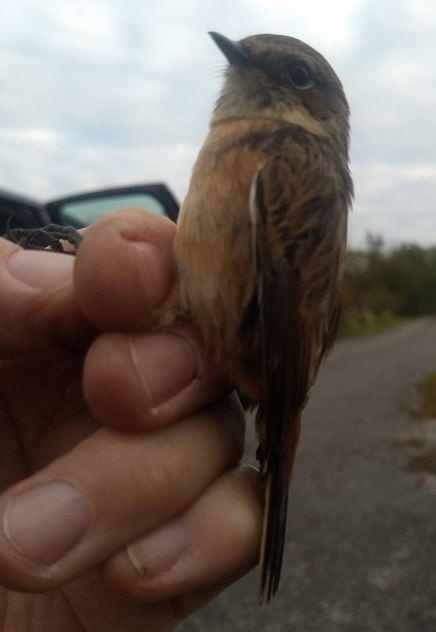
It was a frustrating start but we had a very pleasant morning with a decent haul of birds: not many species and mainly Meadow Pipits, but a good looking juvenile male Stonechat and a lovely haul of Reed Bunting:

The list for the day was: Wren 1(1); Meadow Pipit 36; Stonechat 1; Reed Bunting 14(1). Totals: 52 birds ringed from 4 species and 2 birds retrapped from 2 species.

In amongst the Meadow Pipits there were a couple showing abnormal swellings around where the claw joins the foot. They didn’t look like pox pustules but it would be interesting to find out what causes it. One of them had an outer primary feather that looked in poor condition and it, too, had a growth where the feather erupts from the limb:

This was my fourth outing of the week: Friday was spent cleaning out Barn Owl boxes with Lucy & Steph. It is astonishing just how deep the layers of pellets and muck can get very quickly. Clearly, from the number of skulls we found, the last couple of years have been good vole years in our area. We collected a good number of pellets for the children of the Wildlife Trust’s Watch group to dissect.

First Winter Visitors: Somerford Common, Saturday, 17th October 2020

This week there has been lots of sightings of Redwing around the area. On Thursday at Ravensroost we tried luring for them but with no sign of them. Today we were at Somerford Common looking to try again. I was joined by Alice and David for the morning and I decided to keep it simple. We set just 6 nets:

We set the track ride up first and put on a lure for Redwing whilst we set up the other nets. Part way through I went back to check on the nets and took out 2 Wrens and our first Redwing of this autumn / winter.

10 minutes later I sent David back to check again: another Redwing plus a Long-tailed Tit, some Blue Tits and Goldcrests plus a new Marsh Tit.

The woodland nets had another lure for Redwing, Lesser Redpoll and Marsh Tit (which usually brings in lots of other titmice as well). The woodland nets were very quiet: first round producing a solitary Goldcrest. That was it in there for the next couple of rounds and then I opted to go and check them whilst Alice and David took a few birds out of the other nets. I was delighted to find a couple of Lesser Redpoll in the net immediately adjacent to the lure:

That was pretty much it for those nets. We did catch another Lesser Redpoll, a Great Tit and a Wren but nothing else. No doubt that will change significantly once I set up the feeding station there next month!

Until about 10:30 we had quite a few Redwing flying around the site, sitting in the big old oak tree adjacent to our net ride but, in the main, avoiding the net. That said, we were happy with what we caught. At 10:30 I changed the lure from Redwing to Goldcrest. I am always mindful of not luring Goldcrest until later in the morning, and only if the weather is warm enough. I am pleased to say that all bar one of the Goldcrest caught this morning weighed in at more than 5g, with one actually scaling at 6g. These are good weights for Goldcrest in the Braydon Forest.

The list for the morning was: Blue Tit 3(1); Great Tit (1); Marsh Tit 1; Long-tailed Tit 1; Wren 3(2); Redwing 5; Goldcrest 8(4); Lesser Redpoll 3; Bullfinch 1. Totals: 25 birds ringed from 8 species; 8 birds retrapped from 4 species, making 33 birds processed from 9 species.

It was a quiet and very relaxed morning and, despite not being inundated with birds, I have to admit, very enjoyable. We were accompanied all morning by a Robin (unringed) who spent the entire time hopping or flitting around our ringing station. When we arrived we saw that someone had spread some bird food on the granite blocks that Forestry England have used to replace the vandalised gateways, that they got fed up with replacing, and are pretty well convinced it had been done to benefit this Robin.

One of the beauties of not setting up masses of net is that taking down is a quick and easy task. The birds stopped moving by 11:00, we gave it another 30 minutes and started to take down. As the odd Goldcrest was still coming to the lure we left the ride on the path to last. I did have an ulterior motive: I only had 4 AA size rings left on that particular ring string and I wanted to catch enough to finish it off. By the time we had the woodland nets down, three Goldcrest had obligingly dropped into the remaining net ride. We processed them, resigned to having one left on the string. At midday David’s dad turned up to take him home. Almost immediately after he left, a very helpful Goldcrest flew into the net so we could tidy up that particular ring string. We closed those nets and took them down and were away from site by 12:30.