Ravensroost Wood: Tuesday, 21st July 2020

This was my first visit back to Ravensroost Wood since March: which turned out to be my last visit before lockdown. We have been holding off ringing on the site as it has become very busy since the easing of lockdown. There has been a big increase in footfall and also, apparently, it has been turned into something of a mountain bike track. After discussion with the Trust I decided to run a test session. It won’t be repeated until team working is allowed again.

On the whole, it was a pleasant session with lots of public interaction. Unfortunately, it was spoiled when two women joggers decided to ignore my sign and proceeded to rip a bird out of the net, causing significant damage to the net and goodness knows what damage to the bird. As this is now the subject of a police investigation I shall say no more about it for now. Unfortunately, I have decided that in future I will not be able to ring in public areas whilst working solo.

It wasn’t the biggest catch ever, but it was perked up by the ringing of our tenth Braydon Forest Marsh Tit of the year. If you see a Marsh Tit with an orange ring over a white ring on its right leg, that is the bird. It is a juvenile. There were several others around, as they were calling throughout the morning, and one was calling as I was extracting the youngster that I ringed.

The catch for the day was: Treecreeper 1; Blue Tit 2; Great Tit 1; Marsh Tit 1; Wren 3; Robin 5(1); Song Thrush 1; Blackbird 1. Totals: 15 birds ringed from 8 species and one retrap. The retrapped Robin, the Great Tit, Song Thrush, Blackbird and one of the Blue Tits were adult birds, the remainder were juveniles from this year.

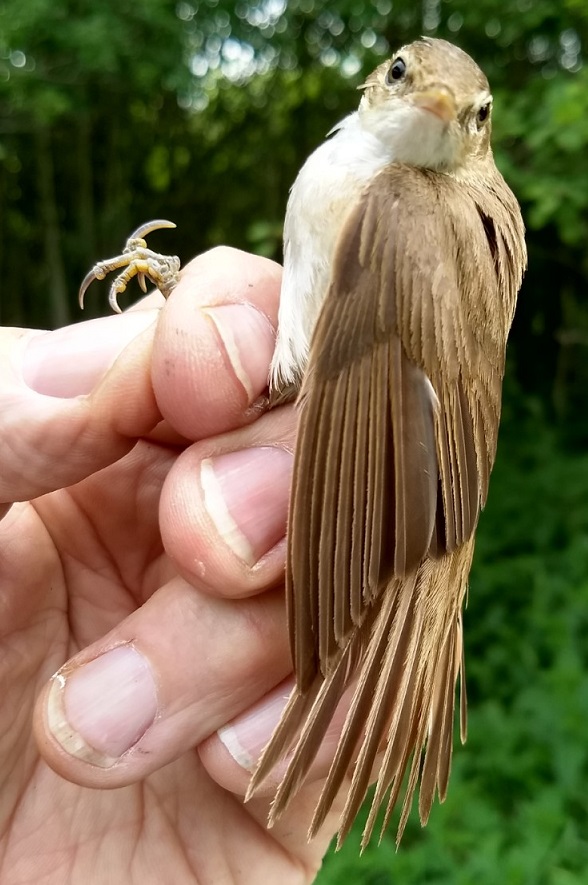
It is not often that I can post photos of Treecreepers: their long down-curved bill and hunched shoulders can make them look so miserable. Fortunately, I managed to take a half-decent shot of this bird:

They are one of my favourite birds. Ageing them is quite easy. If you look at the primary coverts you will see that they are tear-drop shaped. When they moult into adult plumage the tear-drops are replaced by either small dots or no dots at all. After 10:30 the nets went quiet, so I took down an 11:00 and went home.
Barn Owl checking: Friday, 17th July 2020

Jonny Cooper and I finally managed to get out to check on our fist batch of Barn Owl boxes for the year. Having contacted all of the relevant landowners for permission on Thursday, we checked a total of 10 boxes: 3 on farmland in Upper Waterhay; 2 at Blakehill Farm; 1 each at Avis Meadows, Echo Lodge, Home Farm, Drill Farm and Plain Farm.

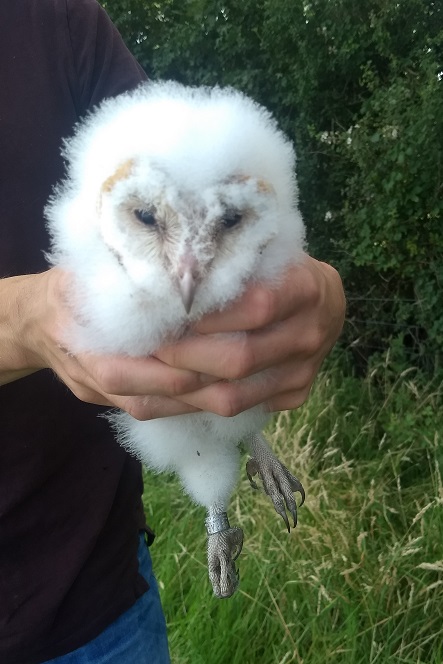
We started at the civilised hour of 9:15 at Upper Waterhay Farm. The first box checked is in a tree adjacent to the Chancel (which featured briefly in an episode of Poldark). Last year I ringed 3 chicks in this box in August. This time we disturbed 2 adults who were roosting in the box. Hopefully this is a precursor to another late nesting effort. However, we later visited the box behind the horse paddock at the farm. As we were walking the ladder over to the box a stunning male Redstart hopped out of the hedgerow and obligingly gave us a lovely view before flying off. In this box we found and ringed 2 youngsters at a relatively early stage of development: very downy and with little primary feather growth:

The question we had between us was whether these were the parent birds day roosting away from their young. The habitat close by was much more likely to be vole-rich than the paddock and the field where the box was, as they had both just been cropped for hay and gathered ready for baling and the fields near the Chancel were largely uncut. In between times we had checked the box in the fields behind the Chancel. That proved to be empty, whereas last year Andrew Bray and I ringed 3 chicks in that box.

After Upper Waterhay we made our way to Blakehill Farm. I have ringed Barn Owls there ever since I started this project. The Poucher’s Field box is usually productive. This time two free-flying, probably adult, birds emerged as we approached the box. We don’t know if they were keeping a look out, or if it was the sudden mini-stampede of the Dexter cattle and their calves that spooked them, but we were a good 20m distance away before they flew off. We checked the box and, whilst the signs of occupancy were there, lots of pellets and muck, unfortunately no sign of breeding (yet). After a brief chat with Ellie Jones, the Northern Reserves Manager (and one of my valued C-permit holders), who was doing a botanical survey at her site, we went off to check the other box, in the Allotment field. This was also devoid of Barn Owl activity but there was one sad, dead, desiccated Jackdaw chick in the box. It had started to grow its primary flight feathers but was pretty small: the runt of the clutch possibly?

From there we went to Avis Meadows, another Wildlife Trust site, adjacent to Ravensroost Woods & Meadows. The barn is about to be pulled down. In preparation they have removed the new Barn Owl box that was situated there but left the old, dilapidated one that always has something in it. The adults always seem to roost in the new box but rear their young in the old, falling apart, if it was a building it would be condemned, one. It is pretty much the same with the Chancel box, also dilapidated, but used every year. We had hoped to replace the Chancel box earlier this year but a combination of, firstly, bad weather and, secondly, coronavirus restrictions, has meant that it did not happen.

Since last year a chunk of wood has fallen from the back right corner of the Avis box, leaving a nice hole a small chick could fall through. Fortunately, there were no small chicks in there: there were 4, all of which were doing very well. Flight feathers were at medium length and the facial disk was well-defined and, whilst they have retained a fair amount of down, their body feathers are growing through strongly.

The boxes at Echo Lodge, Home and Drill Farms were empty. Somehow the back had come off the Drill Farm box, so Jonny reattached it. Hopefully we will have a brood there later in the year, as it does regularly produce. We were accompanied by a large group of Friesian heifers whilst visiting this box! They seemed to enjoy chasing after the car.

The final box was at Plain Farm. It is a swine to check because the tree it is is situated in sits in the middle of a bramble and blackthorn hedge. You have to get your ladder and equipment through the outer hedge layer into the ditch in the middle to get access to the box: definitely not shorts and T-shirt habitat: so we both got well scratched and bloodied. It was worth it. They were the most advanced nestlings of the morning and fully capable of flying off. However, Jonny managed to catch them before they could. We ringed them and returned them to the nest box and, once returned, they showed no inclination to move off to pastures new. We packed up at 13:00, with 10 boxes checked, 5 of which were occupied and 3 of which had a total of 8 chicks between them: 2 x 2 and 1 x 4. Very satisfying.

Lovely bird, nearly appropriate T-shirt! Photo courtesy of Jonny Cooper

Jonny Cooper’s “Big Weekender”: 11th to 13th July 2020

With life becoming increasingly busy, and a house move on the horizon, I thought I would take advantage of the calm weather over the weekend to get some ringing in before life gets too hectic. Below are the accounts of the sessions I undertook:

Part 1: Meadow Farm:

The weekend kicked off with a session at the ever-reliable Meadow Farm. The thermometer in the car read a balmy 6 degrees when I arrived on site. The cool morning meant that the session took a little while to get going, but once it warmed up the birds started moving and I started catching in good numbers. The totals for the session were as follows:

Kingfisher 3(1), Blue Tit 9(8), Great Tit 6(10), Long-tailed Tit 2, Wren 3(1), Dunnock 2(1), Robin 1(2), Cetti’s Warbler 1, Sedge Warbler 1(1), Reed Warbler 5(2), Blackcap 10(4), Whitethroat 5(2), Chiffchaff 6, Chaffinch 2(1), Greenfinch 8, and Goldfinch 3. Overall, 67 new and 33 re-trap: a total 100 birds processed from 16 species.

A good session all round but catching the third Cetti’s Warbler for the site was excellent. The bird was a male in post-breeding moult. I suspect it is the same bird I have heard calling on site over the past few months. It will be interesting to see if any juveniles turn up over the next few sessions. Catching 7 Whitethroats was also good. Numbers on our sites elsewhere in north Wiltshire seem to be down this year. However, the four Kingfishers stole the show, with 3 being caught next to each other in one net.

Part 2: Bailey’s Farm:

On Sunday it was the turn of Bailey’s Farm for a session. I have a soft spot for this site as it was my first solo ringing site (not counting the back garden). Previously I have focussed ringing on site to the winter months and the associated flocks of farmland birds. However, this year I am also carrying out sessions in the summer, to look at the birds breeding on site. There was a constant flow of birds across the morning, with each round producing 5 or so birds. The catch can be seen below: 

Blue Tit 4(4), Great Tit 4, Long-tailed Tit 1, Wren 7, Dunnock (1), Robin (1), Blackcap 2, Whitethroat 2, Chiffchaff 5, Starling 1, House Sparrow 7, Chaffinch 1, Greenfinch 2, and Goldfinch 2. Overall, 36 new and 6 re-trap: a total 42 birds processed from 14 species.

There isn’t really a standout bird from this session. but what is excellent to see is the variety of species that are breeding in the local area. It is becoming apparent that the farming techniques used on the land are good for supporting a variety of birds across the year, with tall thick hedgerows for breeding and areas of fields left to go to seed to provide food for them.

Part 3: Langford Lakes:

Monday saw me undertake the second session of my project to monitor the birds using the reed bed at Langford Lakes. The morning started with an auspicious sign: as I got out my car on site I was treated to a Curlew calling as it flew over.

The morning was once again a little cool to start and with birds were moving in small numbers. After the first 3 rounds I had processed 27 birds. Not masses but nice.  At about 6:30 the sun came out and the session really started to kick off with the next two rounds producing 50 birds between them. The catch for the day was as follows:

Kingfisher 2, Blue Tit 2, Long-tailed Tit 9, Wren 2(1), Song Thrush 1, Cetti’s Warbler 2(2), Sedge Warbler 9, Reed Warbler 23(9), Blackcap 3, Whitethroat 1, Willow Warbler 3, Chiffchaff 9 and Reed Bunting 7. Overall, 73 new and 12 re-trap: a total 85 birds processed from 13 species.

The catch was considerably more diverse than the June session; the majority of the birds were juveniles.  It was apparent that local breeders were also being joined by birds that had started their southwards migration. This reed bed is an area of very high-quality habitat used by breeding birds and attracting those on migration. To catch four Cetti’s Warbler was excellent but the standout birds are once again the Kingfishers: a juvenile and an adult caught together in a net.

Overall a fantastic end to what was a brilliant, if very tiring, weekend. I will probably spend the next 3-5 working days asleep.

A Lot of Flocking Lotti’s: Tuesday, 14th July 2020

I had planned to go Barn Owl box checking today but, having pulled a muscle in my hip, I felt I needed to rest it for a few days, so rescheduled with Jonny Cooper for the end of the week. However, I didn’t want to do nothing, so I thought I would open the nets and have a nice quiet garden session.

I opened the nets at 10:00, no need to rush. At 10:15 I caught my first bird: a Woodpigeon. By the time I had it bagged up prior to processing, three Starlings and a Greenfinch landed in the nets and by the time I had processed them two Blue Tits had been caught. One was a juvenile and the other was a retrap. When I checked the ring, I didn’t recognise it, it wasn’t one of mine or anyone else in out team, so I shall look forward to finding out where it was ringed. That was a good start to the morning.

To be honest, that was it for the next three hours, except at 12:30 a couple of Blue Tits were processed. Come 13:30 I had another two Blue Tits in the nets but I could hear Long-tailed Tits calling. Then they started hitting the feeders. By the time I had extracted the two Blue Tits, the Lotti’s had started to hit the nets. As fast as I was extracting them, others were flying in, with a few additional Blue Tits for good measure. At 13:30 I extracted 21 Long-tailed Tits, 7 Blue Tits and a solitary Robin. I shut the nets as I cleared them, to ensure that I could find time for some lunch!

I opened the nets again for a couple of hours later in the afternoon and caught a few more birds, including very young second brood Blackbird and Goldfinch. The list for the day was: Woodpigeon 1; Blue Tit 10(1); Long-tailed Tit 21; Robin 3; Blackbird 1; Starling 5; Greenfinch 4; Goldfinch 1. Totals: 46 birds ringed from 8 species and 1 retrap. It is easier to say which birds were adults, instead of juveniles: the Woodpigeon, 2 each of Blue Tit and Greenfinch and 4 of the Long-tailed Tits.

I shut the nets again early evening, the last bird to be processed being a juvenile male Greenfinch. As for resting the hip: epic fail, still hurts like heck. Interestingly, this is the largest catch I have had, either solo or with my team, since the middle of February. Also, although not my largest ever catch of Long-tailed Tits (that was 40 birds at Somerford Common on the 5th June 2015) it was the single largest group to be extracted of any one species at one time in a ringing session – and it was in my garden! (the Somerford birds were in groups of 10, 10, 14 and 6 at decent intervals, although that was also a solo session).

Brown’s Farm: Sunday, 12th July 2020

This has been my first opportunity to get out to Brown’s Farm this year. It is very exposed to wind, being at the top of Postern Hill, south of Marlborough, and whilst Savernake Forest lies to the east of it there is very little to act as a windbreak anywhere. So throughout January to lockdown the weather was just never right for a session and, as we have come out of lockdown,. it has been pretty windy. Yesterday was forecast for practically zero base wind speed, gusting up to 4 mph. It started like that at 5:00 when I arrived on site, but by 9:00 it was just too windy for where I had agreed with the farmer to set my nets. On top of that, and something I should have predicted, the sun came out early and the nets were in full glare all session. Both of these are a roundabout way of saying, it was not a very good catch.

That is not to say it was a total waste of time and effort: anywhere that you can sit and watch and listen to Skylarks singing their hearts out, with Yellowhammer song filling the gaps in between, is not a waste. I see more Skylark at this site than at any of my others, and that includes Blakehill Farm, Also, anywhere where you can sit and watch Hares and their antics is wonderful, and I got to do a lot of that!

Whilst the catch size was disappointing: just 11 birds in 10 x 18m nets in 4 hours is never going to be a fulfilling session, it was not a dead loss. I caught my first juvenile Chaffinch of the year and my first juvenile Yellowhammer:

You will notice the open beak gape: the only birds I find that regularly do this are Yellowhammer and Bullfinch. I think it is probably a threat posture.

The list for the morning was: Blue Tit 1; Dunnock 3; Whitethroat 1; Chiffchaff 1; Chaffinch 2; Yellowhammer 3. All were new birds, so 11 birds ringed from 6 species. Of these the Blue Tit and Chiffchaff, one each of the Chaffinch and Yellowhammer and two of the Dunnocks were juvenile birds.

The Firs: Friday, 10th July 2020

The Wildlife Trust have allowed me back into the Firs, as lockdown eases, and so I scheduled a session for this morning. An early start, with the nets just down the central glade of the site, 6 x 18m and 1 x 12m, set in 2 lines to cover the whole area. I had them open by 5:30 and started catching straight away. As is usual for this time of year, it wasn’t a huge catch but quite satisfying.

The list for the session was: Blue Tit 1(2); Marsh Tit 1(1); Wren 4; Robin 7; Song Thrush 2; Blackbird 1(1); Blackcap 7; Chiffchaff 2. Totals: 25 birds ringed from 8 species and 4 birds retrapped from 3 species, making 29 birds processed from 8 species.

Although it was a better catch of Blackcap than I have had recently, disappointingly only one of them was a juvenile bird. It begs the question of what has happened to the first brood birds. The other juveniles were one each of Blue Tit, Marsh Tit and Song Thrush, plus the two Chiffchaff, three of the Wrens and all seven of the Robins.

The highlight was our ninth Marsh Tit of the year, and the third juvenile. Given that the Braydon Forest sites have been out of commission for the last three-and-a-half months this is encouraging.

It pretty much died off after 9:00 but I kept the nets open for another hour. Unfortunately, I had the nightmare scenario of a bird flying into a net that I was taking down. It had to be a Blue Tit: it grabbed so much net, twisted it around itself and crawled through multiple pockets, because the net was slack. Still, I like a challenge, and the bird was extracted safely, although it made sure my fingers took a considerable battering from its constant pecking.

Otterly Brilliant! Lower Moor Farm: Tuesday, 7th July 2020

15 years ago today I woke up in a Minneapolis hotel to the news of the bombs going off in London. I was exhibiting at a Microsoft trade show. They laid on large numbers of telephone lines so UK people could phone home to check that all was okay. Their generosity and their concern was astonishing and I have had a soft spot for them ever since. I was lucky, all of my friends and family working in London were safe.

I digress, today was looking like the weather would hold for long enough to get a session in. The wind had dropped from the high speeds of the last few days, although there was a breeze forecast to get up after 9:00. So I started early and was on site for 4:15, nets open by 5:00. I used the same net setup as at my last visit. My new net was less successful this time, returning a single juvenile Dunnock. However, the session as a whole was very rewarding, if patchy. Between 5:00 and 6:30 it was steady; between 6:30 and 8:00 it was very quiet, before picking up again between 8:00 and 9:00, thereafter I caught 3 birds in 45 minutes as the wind picked up.

The reason for the punning title: as I was extracting a particularly difficult Wren: they have a knack of finding unwanted extra holes in the net, going into a pocket, through the hole, spinning, finding another pocket, getting tangled in that and spinning some more for good measure, a pair of Otters appeared on Mallard Lake. Fortunately I had a good view of the lake from where I was stood and, for the entire time I was busy with the Wren, and then extracting the other two birds (Blue Tits) from the net, I could see the two Otters playing out on the lake. They disappeared just as I managed to get down to the lakeside to take a photograph – so you will just have to put up with the ones of birds!

All of the really good stuff occurred in the 8:00 to 9:00 period. First to brighten my day was this:

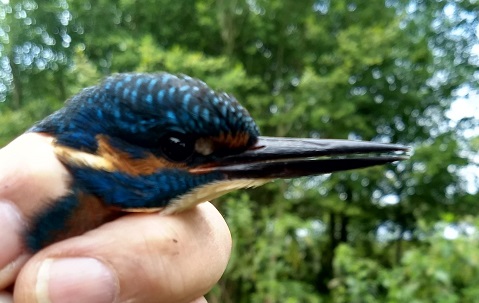
Juvenile Male Kingfisher

This was closely followed by not just the star bird of the day but my bird of the year so far:

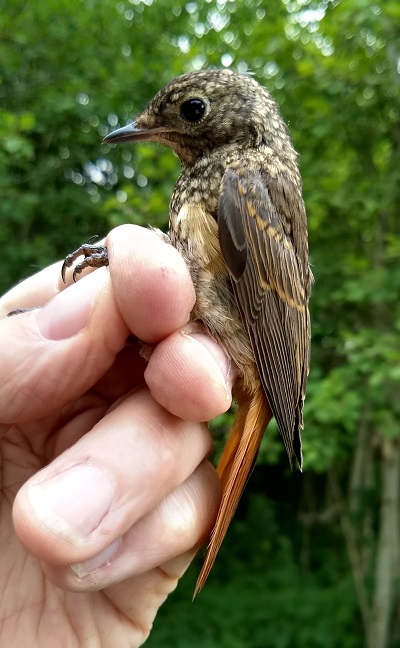
Juvenile Redstart

This is the eleventh Redstart that I have ringed and the first I have caught at Lower Moor Farm since I started ringing there in 2013. It is only the third that I have caught at my sites (the others was at Blakehill back in 2014, on passage). Others have been on Salisbury Plain or Waterhay in the Cotswold Water Park on autumn passage. What is particularly exciting about this bird, which had not yet started its post-juvenile moult, is the possibility that it is a product of the local area.

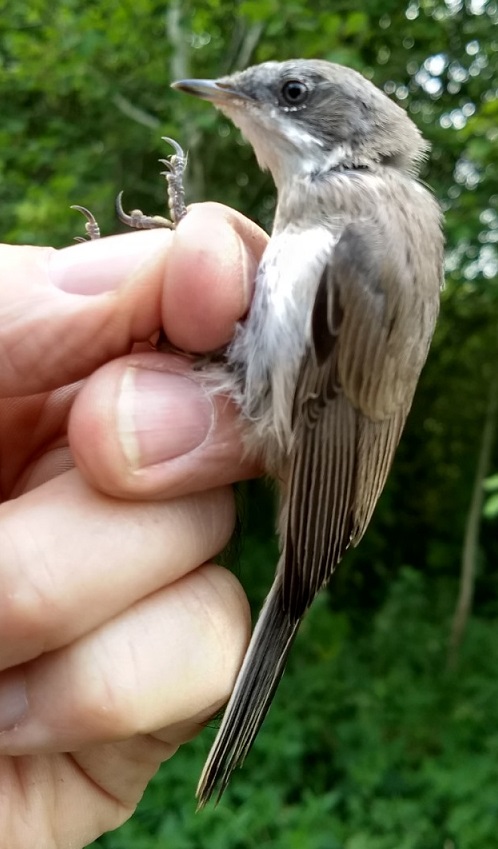
In that same round I caught a juvenile Lesser Whitethroat:

Juvenile Lesser Whitethroat

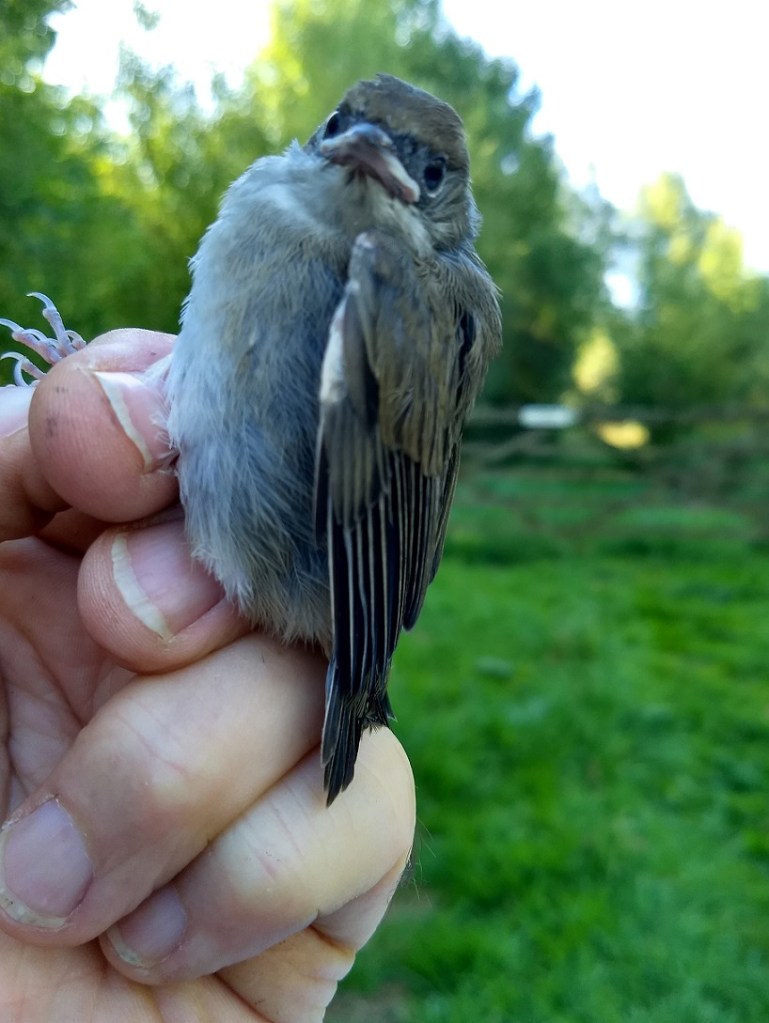
Perhaps the most poignant catch of the morning were two very, very young Blackcaps. They were so young that I suspect they have been flushed from the nest by an intruder / possible predator.

Both the wings and the tail were very short and have a lot of growing to do. Because they were so young I just fitted the ring and then returned them to the area in which they were caught and placed them safely in a bush, hopefully out of immediate danger.

One thing we have noticed this year is the continual churring of Reed Warblers from a small clump of Reed Mace and other reedy type plants in the corner of Mallard Lake, so it was nice to catch a couple of them, both males:

The list for the day was: Kingfisher 1; Treecreeper 1; Blue Tit 3; Wren 4; Dunnock 3(2); Redstart 1; Robin 3; Song Thrush 1; Reed Warbler 2; Blackcap 4(4); Lesser Whitethroat 1; Chiffchaff 6(1); Bullfinch 1. Totals: 31 birds ringed from 13 species and 7 birds retrapped from 3 species, making 38 birds processed from 13 species. Of these 22 were juveniles, all were ringed and not retrapped and they were the Kingfisher, Treecreeper, Redstart, Song Thrush and the Lesser Whitethroat plus three each of the Wren, Dunnock, Robin and Blackcap.

With the wind getting stronger from 9:00, and the number of birds dropping to one every 20 minutes, I decided to take down and was off site by 10:30 – the beauty of only running 6 nets.

Somerford Common: Friday, 3rd July 2020

After a frustrating week of high winds and / or rain, I finally managed to get out yesterday. My original plan was to go to the Firs. Some wind was predicted but not too bad and to be coming from the south-west. Of the sites currently available to me, the rides at the Firs run north to south, so it seemed like the best bet. Unfortunately, the Wildlife Trust’s Estates team had earmarked it for some major management work, making safe trees felled by the winds and working on a new minimal intervention area (sic) that has been created. So I decided to have a go at Somerford Common. The area I chose I have not worked in for some considerable time and, after yesterday’s results, it will probably be a longish time before I do so again.

The red line represents 12 x 18m nets going up and down a slope over pretty chewed up terrain. It is a mix of deciduous and coniferous trees of varying heights and with a reasonable amount of thinned woodland either side of the path.

The first two rounds were actually quite encouraging but then the wind actually started to blow a bit harder and the nets started to billow and the birds stopped moving. As a round consisted of walking approximately 250 metres there and 250 metres back, each net check was a good half a kilometre, with erecting the nets, checking and taking down, I estimate I walked a good 7 kilometres for 18 birds over 4 hours before I had to shut the nets, because it was just blowing too hard and I didn’t want to endanger anything that might have wandered into them.

The list for the morning was: Blue Tit 2; Great Tit 2; Wren 1; Robin 5; Song Thrush 3; Blackbird 2; Chiffchaff 2; Goldcrest 1. Total: 18 birds ringed from 8 species. Of the 18 birds caught the Great Tits, two of the Robins, one of the Blue Tits and Chiffchaffs were juveniles, the rest were adults.

There were some interesting birds in amongst the adults. One of the Blackbirds was an adult female who had clearly finished breeding for the year in that her brood patch was nearly covered with newly-grown feathers. It was definitely an adult: wings tips were either very ragged and some primaries broken and the tail was broad. Perhaps she lost her mate and has not managed to find another or it could simply be that she was not in fit condition to breed, although her weight was fairly standard for an adult Blackbird at 89g.

One benefit of not having too many birds to process is that I could spend a fair amount of time looking at the moult in those adults that were undergoing their post-breeding replacement of wing and tail feathers. The Goldcrest, an adult male, had dropped the right side of its tail and those feathers were beginning to grow back, whilst those on the left of the tail were complete and all old. Whether it had lost the part of its tail due to mechanical accident or avoiding a predator, who knows, but it looked unusual. Also one of the Robins was having an odd tail moult: the innermost right tail feather was a nearly full-grown replacement, whereas the nest right was a retained old feather and the remaining four were new feathers at the expected stage of development (i.e. going larger to smaller from the inside out to the edge). All curious, all worthwhile seeing how, whilst you can generalise about overall strategies, individuals can always vary.

West Wilts Ringing Group: June Results

Another good, if truncated, month (I had 2 sessions planned and postponed by the weather for the end of the month, no doubt others had sessions planned as well).  It was our best June since the group as currently constituted was formed on 1st January 2013.

The highlight was undoubtedly Jonny getting to start his reed bed project at Langford Lakes, massively boosting the number of Reed Warbler in this month’s haul. His first catch includes a Spanish ringed recapture (for which we haven’t yet received a report) and he caught another at his Melksham site that was ringed as a Juvenile at Marsworth Reservoir, near Tring, last year.

The restrictions we still had in place are reflected in the numbers of House Sparrow and Starling being caught: the glut of House Sparrows is mainly down to Andy Palmer and Jonny catching in their gardens. I think they should share their catching secrets. There are a lot around me but I catch very few. The other notable increase is in the number of Blackbirds in the catch, to which Jonny and I made the largest contributions. 

Two significant falls though: Blackcap and Blue Tit. I am not sure what is behind the reduction.  Although I have been locked out of both Ravensroost Woods and the Firs, due to the Trust’s restrictions as a precaution against Covid-19 (now lifted for the Firs and Ravensroost Meadows, but not yet for Ravensroost Wood), they aren’t big Blue Tit catchment areas in the summer, but they are for Blackcap. Also, I remain restricted to the wildlife refuge area at Lower Moor Farm, and the numbers there have been quite disappointing so far.

The first 6 months of the year have delivered record months in March, May and June. This has meant that we have had our best second quarter and best first half of the year so far. Let’s hope it continues.

New Zealand Farm: Thursday, 25th June 2020

This blog post is by Andrew Bray:

On June 25th I visited the scrub near New Zealand farm on Salisbury Plain Training Area (SPTA) West. The site was originally worked by Ian Grier, but he and the SPTA Authorities have allowed me to ring there once a month.

My first trip was in May and this was my second visit. I was there at 4:00 am and had the nets set up by 5:00 am, as I used some nets that I had not used previously and one caused me problems. I set up two 2 x 18 m  nets as shown on the map: 

There were lots of Whitethroat, plus a a family of young Blue Tit that were all in Juvenile plumage with no pin showing. The Whitethroat were the largest part of the catch and a mix of moult and age.  This is not surprising, as the height of the scrub suited these birds. 

The list for the day was: Blue Tit 4; Great Tit 1; Wren 1; Dunnock 1; Robin 1; Blackcap 2; Whitethroat 9. 19 birds ringed from 7 species. Of these birds the Blue Tits, Dunnock, Great Tit and 5 of the Whitethroat were newly-fledged juveniles.

It was rather breezy on arrival and by 8:00 am was blowing the nets from a strong easterly, so I reluctantly took them in and was finished by 9am.  A cup of tea later later I drove away until July.  I hope to catch the Grasshopper Warbler that was calling from the scrub by the second set of nets.