Curlew in the Braydon Forest: 2019 Project Summary and Next Steps

The Braydon Forest has historically been a stronghold for Curlew in Wiltshire. Throughout the 20th century the area was identified, again and again, as holding a significant proportion (potentially up to 80%) of the county’s breeding Curlew. In 1994 a full survey of the Braydon Forest was undertaken and located 23 pairs. In the intervening 25 years anecdotal evidence suggested this number had fallen, so in 2019 the Wiltshire & Swindon Biological Records Centre (WSBRC) and Wiltshire Wildlife Trust (WWT) decided to undertake another survey to get an up-to-date population estimate.

With the help and co-operation of many local farmers and landowners, plus a number of volunteer observers, over 9000 Ha of land across the Braydon Forest was surveyed for breeding Curlew from late March until the end of April. Similarly to the 1994 work; surveys were targeted on areas where there were previous records of breeding Curlew and any suitable areas of habitat close by. When Curlew were observed then the location, behaviour, date and habitat were recorded. Breeding pairs were then monitored to look at nesting success.

This work revealed that there are just 5 pairs of Curlew remaining in the Braydon Forest, with no successful nesting in 2019. It is very clear that immediate action to understand and protect these birds is needed.

This is where the West Wilts Ringing Group comes in. WSBRC has secured grants totalling £5500 from Wessex Water and the British Birds Charitable Trust to undertake tagging work on the Braydon Forest Curlew. Ringers from the group will be key in helping to catch, colour ring and tag these birds. The lightweight tags will remotely send data on bird’s movements to base stations that will help us identify key sites areas of habitat for breeding Curlew in the Braydon Forest and safeguard these sites. Re-sightings of colour ringed birds will help identify wintering areas and allow us to monitor return rates of the breeding population. This will feed into work with local landowners to improve the habitat for Curlew.

The future of Curlew in the Braydon Forest looks uncertain, but by taking action now there is still time to save these birds.

West Wilts R G Annual Report 2019

This has been a phenomenal year for the group, with our most productive year since the North Wilts crew split away at the end of 2012.

However, there is only one place to start: the Eastern Olivaceous / Booted / Sykes Warbler caught and processed by Ian and Andy on 19th October on the Imber Ranges.  The bird is logged with the BBRC, and we are waiting on their decision over the species identification.

Second place in the remarkable birds of the year were the group’s second ever Merlin also caught on Salisbury Plain. The previous Merlin capture was near Beckhampton back in July 2003, over 16 years ago!  Two Buzzard caught in mist nets in the same session at Somerford Common was also quite extraordinary!  One Buzzard would be brilliant, two is definitely remarkable.

There was an excellent supporting cast, and I suspect that others will have their favourites. For me, to get 3 ringing ticks on my local patch after 10 years ringing there, the first being a Jack Snipe in January, followed by a Skylark in August and then the Buzzard in November, made it an excellent year.  Catching the first Skylark (1); Snipe (3) and Jack Snipe (1) in the Braydon Forest is a bonus. For Andy, catching his first Swift, and the first for the group since 2006, must have been right up there.

We also caught our second Firecrest in the Braydon Forest: the only one caught by the group this year. It was a first for Red Lodge and caught in the last round of the day.  I was assessing Ian Sheriffs, of the North Wilts group, for his C-permit: he wasn’t expecting to get an extraction and ringing tick, as well as approval for his advancement.

The year has shown some remarkable surges in numbers, but none more so than Greenfinch and Chaffinch.   Most of the species had a poor year in 2016, just as the group was becoming more active, with the new C-permit holders: Andy, Andrew and Jonny getting and working their own sites, but the weather wrecked the breeding season and the subsequent knock on effect has shown a slow recovery.

Greenfinch:

Grrenfinch

Chaffinch:

Chaffinch

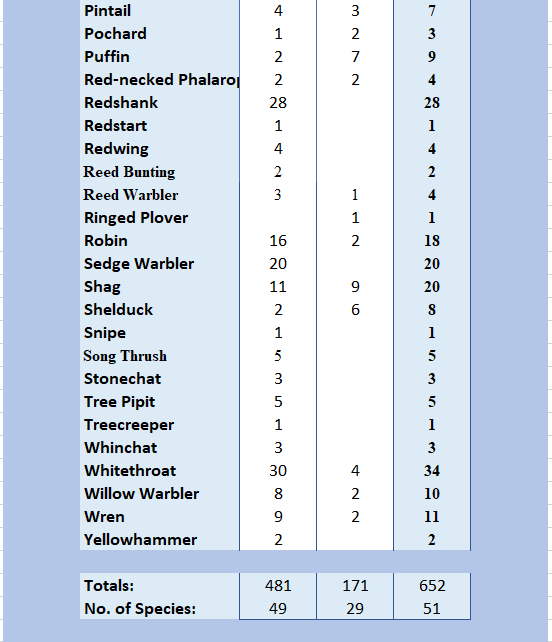
The list for the year was:

list 1list 2

As well as our in-group activities, several of the group are involved in other projects in other locations. The results of these activities are summarised below:

list 3list 4

Summary:

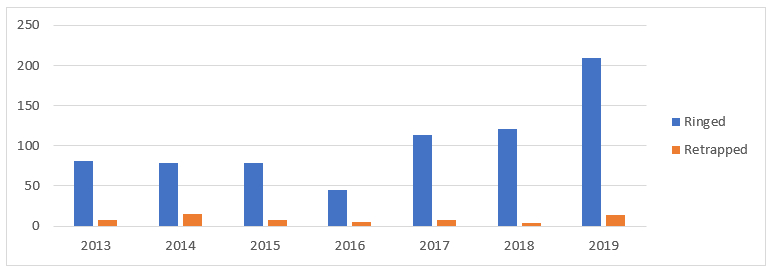
Our best year since 2012 by some degree.  The catch on West Wilts Ringing Group rings was our best yet:

list 5

We had our highest ringing totals in 6 of the 12 months and, as our efforts on our established sites continues, our highest recapture rates in 8 of the 12 months.

When you add in the extra-curricular catches we end up with 6,791 ringed from 81 species; 2,094 retrapped from 55 species, making 8,885 birds processed from 83 species.

Not “Men Who Stare At”, but “Women Who Walk With” Goats: Lower Moor Farm, Friday, 10th January 2020

This is not something that you see every day; in fact, this is something I have never seen before and didn’t expect to.  At about 10:00 this morning, just after we had finished processing some birds, we were more than a little surprised to find three goats come wandering into the ringing station area. They were followed by two adults and two girls.  Apart from a joking “Oi! Put them goats on a lead!”, we had a chat about what they were doing. During the winter, when the goats cannot be put out to pasture, the staff and some of the children from the Care Farm take the goats for a walk around the nature reserve, to ensure that they get some exercise and to help keep their feet in good order.   They were quite stubborn in the face of good grazing, but seemed far more willing to respond to commands than the average dog we find off the lead at Lower Moor.

So to the ringing session.  I was joined by Alice and Tony for the morning.  We set up our nets in the Wildlife Refuge.  The layout was the two CES net rides in that area, plus two extra net sets placed along the hedge lining the stream and along the edge of Mallard Lake.  The extra nets were not very productive: but 3 Goldcrests in the stream edge net was a bonus.

The first bird I extracted was my first Kingfisher of the year, whilst Alice was busy extracting half-a-dozen Long-tailed Tits from the entrance nets.  Apart from that the catch was pretty well standard fare: Blue and Great Tits, but at 10:30 Alice was delighted to extract, and then ring,  her first Siskin. This is only our third caught and ringed at Lower Moor Farm: following the two caught back in October of last year.

20200110Siskin

The list for the day was: Kingfisher 1; Treecreeper (1); Blue Tit 6(4); Great 2(3); Coal Tit 1; Long-tailed Tit 1(6); Wren (1); Blackbird 1; Goldcrest 2(1); Siskin 1.  Totals: 15 ringed from 8 species, 16 birds retrapped from 6 species, making 31 birds processed from 10 species.

As this was Alice’s first visit to Lower Moor Farm, she stayed behind after we had cleared away, to have a look around the site, and was rewarded with a sighting of an Otter swimming across the lake.

On Saturday we spent a few hours in Webb’s Wood, after the forestry clearing operations.  Just like at Red Lodge a few years ago, the immediate impact after the operations seems to be that the birds have become somewhat dispersed.  Also, we had no feeding station set up, because of the lack of access, and the catch was correspondingly small: Treecreeper (1); Blue Tit 5; Great Tit 2(4); Marsh Tit 1; Long-tailed Tit (1); Blackbird 1; Goldcrest 2(5). Totals: 11 birds ringed from 5 species and 11 species retrapped from 4 species, making 22 birds processed from 7 species.


Happy New Year: Blakehill Farm, Wednesday, 1st January 2020

With the forecast being for light winds, a reasonable temperature and no rain, Jonny Cooper and I decided to go for quality over quantity this morning.  Although it was a disaster last time we ran a session, with only 8 birds caught and none out of the ordinary, we decided to have another go at the pond area at Blakehill Farm. It is the only site we have where there is a realistic chance of catching the odd wader.

Actually, I had a bad night last night and still felt nauseous this morning and, if I hadn’t arranged to meet up with Jonny, would have crawled back into my pit. Unbeknown to me, Jonny was sat in his car in Chippenham feeling pretty similar: wondering whether to call me and cry off as well. However, neither of us wanted to let the other down, so we soldiered on and both turned up on site at the agreed time.  It didn’t help that our agreed start time was 6:30! Just to be clear: none of this was alcohol related. Hard to believe, given the dates, but true!

Given the state we were in we only set a few nets: 3 wader nets in a horseshoe in pond 2; a Mipit triangle in the rank grass outside of the pond area and 4 x 18m nets along the hedgerow at the back of Rook Tree Ground field.  We set a lure for Meadow Pipit in the Mipit triangle (it didn’t work – we caught none).  In Rook Tree Ground we set a lure for Redwing: that did work a bit.

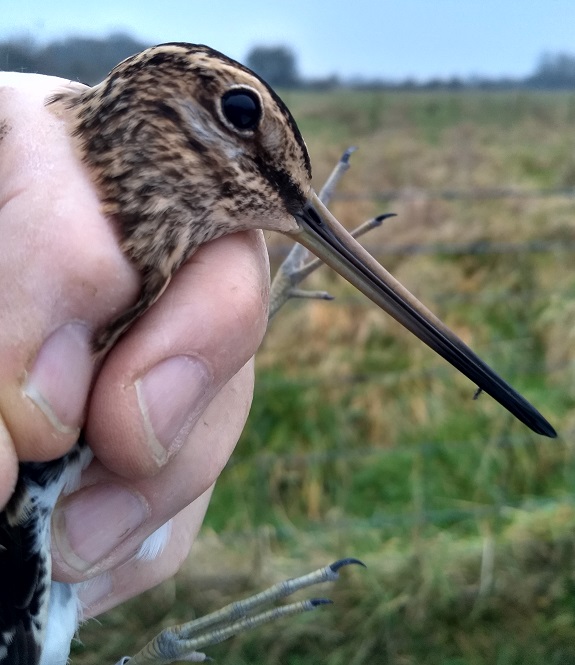
The wader nets were the first ones we set up: well before dawn, and they were the first nets to catch birds,  Our first bird extracted in 2020 was a Snipe.

Snipe

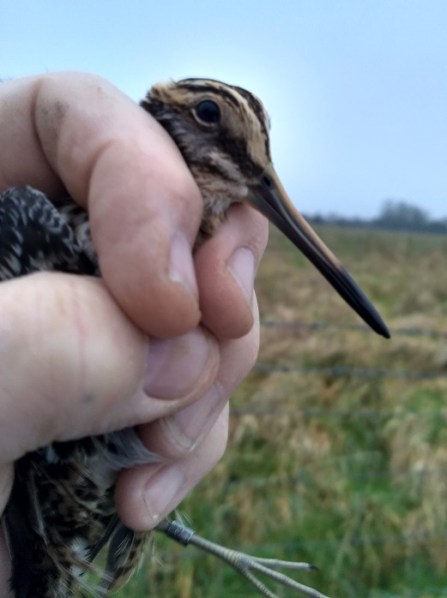
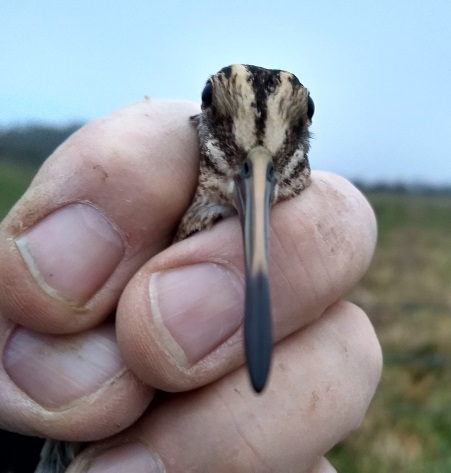
 This was followed by two Jack Snipe.  Our first bird ringed of 2020 was a Jack Snipe.


Jack Snipe 1Jack Snipe 2

The list for the morning was: Snipe 1; Jack Snipe 3; Blue Tit 1; Great Tit 2; Redwing 5.  Total: 12 birds ringed from 5 species. Not a large catch but excellent quality!  Given that my team has only ever previously caught a single Jack Snipe to catch three was a phenomenal result.  The third Jack Snipe was fortuitously caught.  For each net round each of us approached the pond from different directions: from the west or the east. As I was walking towards the pond for the third round, I accidentally flushed the Jack Snipe from where it was feeding and it flew off but straight into the net!

There were relatively few birds flying around and, after a couple of empty rounds, we took down at 11:00 and left site at midday. An auspicious start to 2020!


Somerford Common: Monday, 30th December 2019

As we missed a few sessions due to adverse weather (and a week away) in December, I decided to throw in a last ringing session for 2019 at Somerford Common on Monday.  I had my newest and oldest trainee with me, Tony Marsh, (the only one of my trainees who is actually older than me, and I am ancient, and the most recent to join the team).  As he is not yet extracting birds, I only set a few nets adjacent to the feeding station.  Tony has been a big help in reporting resighting of colour ringed Marsh Tits in Webb’s Wood over the years, and the least I can do by way of thanking him, is help him achieve his wish to become involved in ringing.

There is still no sign of any numbers of Redpoll, Siskin or Brambling turning up at Somerford yet: with just one caught at our last trip to Somerford, over the other side of the wood (and completely overshadowed by the two Buzzards).  They will come in the next two months (I hope).

As usual, Blue Tits dominated the catch, but there was also a good number of Chaffinch. In fact, we ringed as many Chaffinch as we did Blue Tit, and four times the number of Great Tits ringed.  However, both of those Tit species had good numbers of retrapped birds.

The list for the session was: Great Spotted Woodpecker 1; Blue Tit 8(6); Great Tit 2(6); Coal Tit 1; Marsh Tit (2); Redwing 2; Blackbird 1; Chaffinch 8.  Totals: 23 birds ringed from 7 species; 14 birds retrapped from 3 species, making 37 birds processed from 8 species.  Not the most striking of catches – although the Redwing were an unexpected bonus, as they have rather disappeared from the area after the recent wet weather.

At about 10:00 we were joined by Tom Blythe.  Tom is the Beat Forester for Forestry England and covers a ridiculous amount of territory: all of the FE estate in Gloucestershire and Wiltshire.  He is very helpful, keeping me informed of what FE are doing in our local woods and on how they might impact on our activities. As an example, on the western side of the wood, alongside the Stopper’s Hill road, they have been harvesting the conifers that have come to maturity, ready for market.  He let me know that the plan is to let that harvested area regrow naturally, with native tree species, rather than re-use it for another conifer crop.  That should provide us with an excellent opportunity for a project to monitor how the birdlife recolonises the area.  Another good thing about Tom (and Kate Wollen, the assistant ecologist for the area) is that they are vocal in their appreciation of the reporting they get from us – both our session reports and the annual Braydon Forest report.

Mud and Blue Tits: the Firs, Saturday, 28th December 2019

The Firs Wiltshire Wildlife Trust nature reserve is known locally as “the Braydon Bog”, and it is certainly living up to its name at the moment.  One of the locals who came over to walk her dog said that it was in the worst state that she had seen it in the 17 years she has lived opposite and used it to walk her dogs.  I had a team of four with me today: Ellie, Jonny, Andrew and David – and we all ended up absolutely filthy and mud-spattered.

I set up a feeding station down the main central glade on Christmas Day: a bit of postprandial exercise. A work party has recently strimmed back the bramble and dog rose and extended the wildlife ponds. It will be good to see what impact the larger ponds have next year.  On checking the feeding station yesterday, I was encouraged to see good numbers of birds on and around the feeders. This did bode well for the session this morning – and it proved to be a busy session.

It is not surprising that the major part of the catch was Blue Tit. The only disappointment is that there is still no sign of Lesser Redpoll or Siskin around yet.  The list for the session was: Great Spotted Woodpecker (1); Blue Tit 24(30); Great Tit 9(5); Coal Tit 7(2); Wren (1); Dunnock 1; Robin 1(1); Goldcrest 2(2).  Totals: 44 birds ringed from 6 species and 42 birds recaptured from 7 species, making 86 birds processed from 8 species.

So, not the most exciting catch we have ever had, but it does give the lie to the anti-ringing propaganda that claims that so few birds are retrapped that ringing delivers very little science.

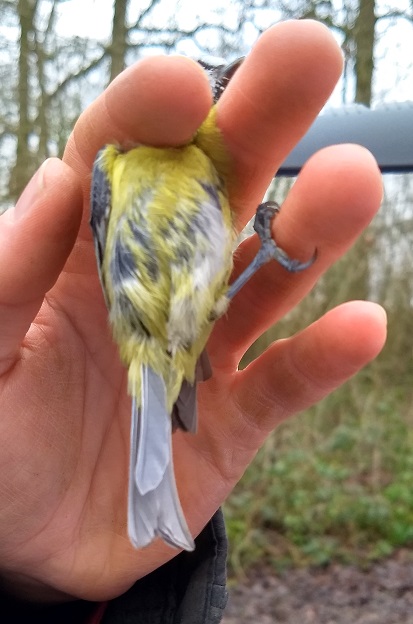
One oddity in the catch: a one-legged Blue Tit:

Blue Tit

We checked it thoroughly: there was no stump, no sign of any damage to the area where the leg should be, so it rather looks as though it is a birth defect.  I have not seen that before (and I have handled over 20,000 birds in the last 10 years).  It was perfectly healthy and weighed in at a respectable 10.5g, so it is clearly not being negatively impacted by it.

At 11:30 we decided that we had trudged up and down the hill through enough mud for one day and so closed the nets and packed away.


Normal Service Is Resumed: Ravensroost Woods, Saturday, 21st December 2019

After the low numbers of the last two sessions I was rather hopeful that we would have a better return at our scheduled session at Ravensroost Woods.  We have been asked not to take vehicles into the reserve as, with the continual wet weather, the main track has become severely rutted and there is no budget available for repairs at present.  Besides, there would be little point until the area dries out sufficiently for the repairs to take and remain solid.   Obviously this has an impact on the deployment of nets and the siting of our ringing station: there is a limit as to how much kit one wants to carry and how far one wants to carry it.

On Thursday morning I set up a feeding station along one of the rides. A big thank you to the Swindon Wildlife Group for a generous contribution of funds to enable me to purchase feed for Ravensroost and the Firs reserves.  This meant that we could focus on a small area of the wood, limiting how much effort was needed to get set up.  I decided on 4 x 18m nets along the ride and 2 x 9m and 1 x 6m nets in a triangle around the feeders.  Jonny and Alice joined me for the session.  The forecast was for rain until 7:00, so we arranged to meet at 7:30 and had the nets open by 8:30.  Birds started arriving before we had finished setting up.

What surprised me was that, although the station had only been up for just under two days, one of the two peanut feeders was completely empty, with no sign of squirrel activity, and the seed feeder was half empty.  This was clearly a good sign, and it proved to be a portent of the decent catch to come.  Early on, I put on the usual lure for Redwing. There were a few about, and we quickly caught 2 of them and a Song Thrush: but that was an end to our Thrush catch for the day.

The highlight of the session was a pair (I use the word advisedly) of Great Spotted Woodpeckers. They were both adults, a male and a female, within a couple of feet of each other in the same net.  I am not aware of whether they pair up seasonally or for life. Time to do some exploration.

We know that Blue Tits are going to make up the vast bulk of the catch.  Survey results always have either Wren or Chaffinch as being our commonest species but certainly in our woodlands it is the Blue Tit.  The list for the session was: Great Spotted Woodpecker 2; Blue Tit 28(20); Great Tit 1(11); Coal Tit 1(3); Marsh Tit (1); Wren 1; Redwing 2; Song Thrush 1; Goldcrest 2(2); Chaffinch 3.  Totals: 41 birds ringed from 9 species; 37 birds retrapped from 5 species, making 78 birds processed from 10 species.

One of the benefits of a site like Ravensroost is that when it is windy outside the wood, and there was a strong southerly breeze today, it is sheltered in the wood itself.  Anyway, the forecast was 100% correct and we had a good, sunny morning. We packed up at 12:30 and were off site by 13:15 – an upside of setting so few nets.

What, no birds? Blakehill Farm, 4th and 18th December 2019

Our last three sessions at Blakehill Farm had been extremely productive with 13th and 30th September delivering 72 ringed each session, 1 and 3 recaptured respectively, 10 and 8 species respectively, and then on the 24th November, 62 ringed and 6 retrapped from 11 species, so we were looking forward to our next session there on the 4th December.

Our target for that session was to try and catch the Snipe and possible Jack Snipe at the pools on the west side of Blakehill.  I did a reconnaissance visit on the 3rd and saw 8 Snipe on their usual feeding site.  I had Ellie, Alice and Andrew join me for the session. The first issue: it froze overnight.  This meant that the feeding site was covered with sheet ice. We set the nets anyway: ironically a Woodcock flew through exactly where we were about to place our first wader net and disappeared onto the plateau.

Over the next two hours we watched as a thick, cold mist enveloped the nets and rimed them with frost. Eventually, the sun came out, the mist dissipated and the nets defrosted. It didn’t do much good: we caught a miserable total of 8 birds from 6 species, with no retrapped birds: Blue Tit 3;  Great Tit 1; Robin 1; Song Thrush 1; Redwing 1; Blackbird 1.

Today I was working solo and so I decided to have another go at Blakehill, this time along the Chelworth side perimeter track hedgerow and the Meadow Pipit triangle, where we take our largest catches.  The weather was so much better, but I think the lousy weather of the last couple of weeks has moved the large flocks on. This catch was every bit as disappointing as the previous: Blue Tit 1(1); Wren 1; Meadow Pipit 3; Redwing 4; Chaffinch 1. 10 birds ringed from 5 species and 1 bird recaptured, making 11 birds processed from 5 species.

We will be back in the woodlands over the next couple of weeks, so it will be interesting to see if they are similarly down in number.

Buzzing at Somerford Common: 30th November 2019

With Webb’s Wood being off-limits until the Forestry Commission finish clearing the conifers at the eastern end of the wood, the forecast being for it to be windy, we needed another woodland site to visit.  We have been to all of our woodland sites quite a lot recently and I really wanted to go somewhere different, so I went to check out the western side of Somerford Common. This is very different from where we have our feeding station set up. It is, essentially, a commercial conifer plantation interspersed with tongues of broad-leaved trees.  Some three years ago it is since I last ringed that part of the site.  My hope was that we might catch some Lesser Redpoll and Siskin plus guaranteed to get a decent number of Goldcrest.

I stopped going there because the Forestry Commission had blocked the entrance with large granite blocks, as they have done at the gateways to many of their properties, as theft of timber and vandalism of the wooden gateways they usually use are real problems in this area.  This just made the setting up and management of the ringing rides too onerous. So, when I turned up to find that they had put a new security gate in place, which uses the standard local Forestry Commission padlock to secure it, I thought we would give it a go.  I doubt anybody could predict what happened.  This is where we set our nets:

Somerford

I was joined by Jonny, Andrew and Alice for the session.  The underfoot conditions were horrendous: I had suggested that everyone bring waterproof over-trousers.  It was the right thing to do: so muddy and wet that everything got filthy.

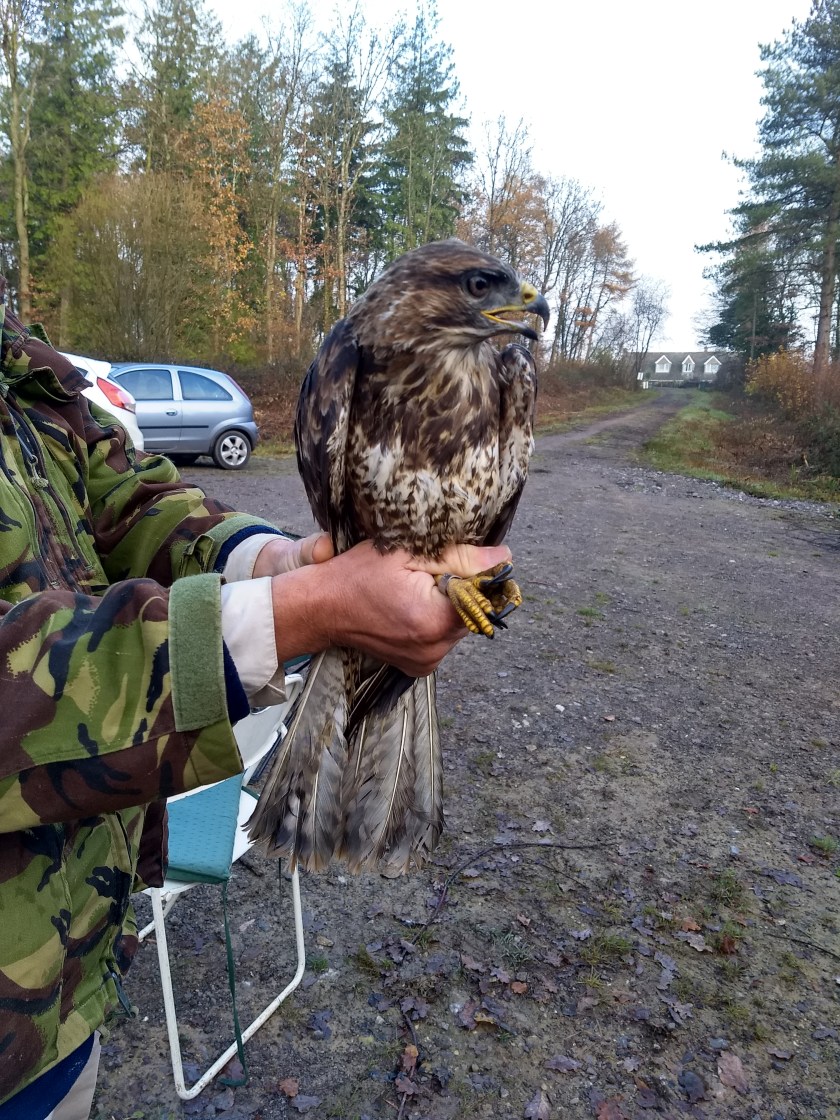
So to the session itself.  Ride 3 was a complete waste of time: not a single bird all morning. The first round was a couple of Coal Tit and Robin and a Long-tailed Tit.  The second round was even quieter: just one bird and then round three. Not lots of birds but, as I was checking ride 2, Andrew went to check ride 1.  He was taking his time and so I went to see if he needed any help, only to find him walking down the ride towards me with this in his arms:

IMG_20191130_093619741_HDR

He asked if I had a bag big enough to put it in, so we could weigh it.  I do, it is a pillow case with a pull cord sewn into the neck.  In over 10 years of ringing I have never seen a Buzzard in the hand. It was such a shock: you just don’t expect it!  It was so unexpected that I thought that Jonny was going to have a seizure and Alice just refused to believe her eyes!

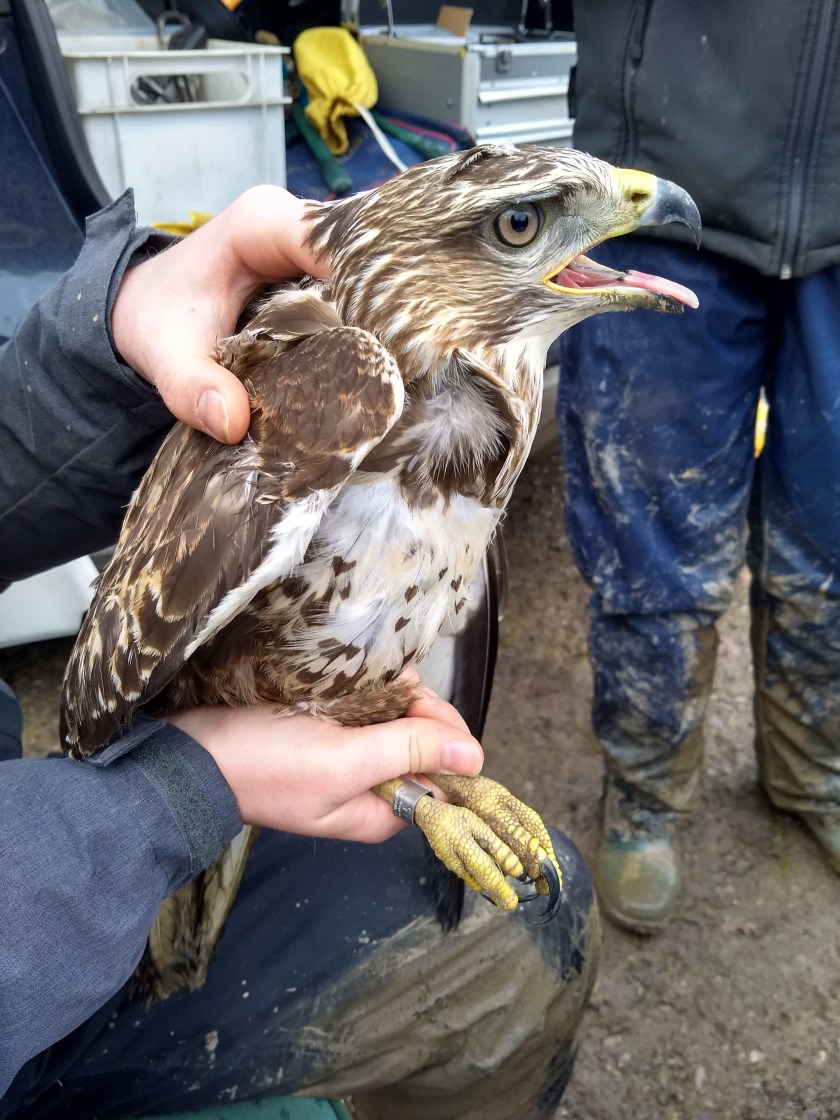
So, to the next round and Alice picked up the big bag and I suggested that she really didn’t need it because there was no way we were ever going to catch another bird that would need a bag of that size.  Alice and Jonny went off to check rides 3 and 4.  What do I know? Jonny returned with this in his arms:

IMG_20191130_110608972_HDR

This is quite ridiculous: to catch one Buzzard in a mist net is a real surprise; to catch two? You must be joking, but we did!  I will stress: we did nothing to try to attract Buzzards into our nets. It was just because I was feeling a bit jaded with our other woodland sites and the Forestry Commission have re-instituted the access that we were there at all. Brilliant! Nobody currently active in our group has ever caught a Buzzard in Wiltshire – and we caught two by complete serendipity.

The catch was a good and varied one even without the Buzzards.  It was: Buzzard 2; Blue Tit 5; Great Tit 2(3); Coal Tit 13; Marsh Tit 1; Long-tailed Tit 10; Wren 2; Robin 2; Blackbird 1; Goldcrest 8; Chaffinch 1; Lesser Redpoll 1.  Totals: 48 birds ringed from 12 species and 3 birds recaptured from 1 species, making 51 birds processed from 12 species.

Apart from the obvious Buzzard highlights, I was pleased to find that our largest catch was Coal Tit, followed by Long-tailed Tit then Goldcrest: exactly as I expected.  Catching our thirtieth Marsh Tit of the year was also a bonus.

After a couple of empty rounds we packed up and were away from the site by 13:00. Very happy, very satisfied.

Lacock Allotments and Bailey’s Farm: Friday, 29th November 2019

This blog uses content provided by Jonny Cooper and Andrew Bray.

Jonny Cooper: Bailey’s Farm: Redwing Round 2

Regular readers of the blog will know that my last session at Bailey’s Farm (just outside Chippenham) delivered 44 Redwing and overall was the biggest session ever for the site. It was a brilliant, if tiring, session. Having noticed that there were still good-sized flocks of Redwing, Chaffinch and Greenfinch on site and the forecast set for low winds all morning I decided I would give the site another go.

Working solo means getting on site pretty early to ensure the nets are up in plenty of time to begin catching at first light. I timed it to perfection and finished setting up just as it got light. As usual the first round was the busiest, producing 35 birds. After this each round reduced a regular 15 or so birds.

The catch for the day was as follows: Great Spotted Woodpecker 1; Magpie 1; Blue Tit 13(8); Great Tit 7(3); Long-tailed Tit (1); Dunnock 2(2); Meadow Pipit 3; Robin (3); Redwing 26; Song Thrush 3(1); Goldcrest 1; Starling 7; Chaffinch 15(3); Greenfinch 20; Yellowhammer 2; Reed Bunting 3.  Totals: 104 birds ringed from 14 species and 21 re-trapped from 7 species. A grand total of 125 birds processed from 16 species.

Another fantastic catch overall; 26 Redwing takes the total ringed on site this winter to 84. The Magpie was a good bird. Some people often unfairly and unjustly vilify them for no good reason, but they are beautiful birds close-up. Catching two Yellowhammer were also a highlight. So far, they have been missing from the catch this winter and I haven’t seen any on site; so catching these two was reassuring that they are still present in the area.

It is always amazing to see the number and variety of birds thriving on this farmland site. I have said this time and time again, but farmers like this are a shining example of how to farm effectively but in a way that in sympathetic to wildlife. It is a pleasure to be able to help monitor the birdlife on site.

Andrew Bray: Lacock Allotments

I set up a single 12m net in the dark and started my round shortly afterwards but there were no birds in the net until 07:40.  There were only 2 Robins then, but the day got better thereafter.  The sun started to shine through, but it remained very cold.  At 08:00 I ringed a new male Nuthatch and retrapped another later.  They were clealy males: the colour under the wing and on the under-tail coverts is brick red.  As usual there were a lot of Blue and Great Tits!

The list for the day was: Nuthatch 1(1); Blue Tit 9(5); Great Tit 8(4); Coal Tit 2(2); Dunnock 1(1); Robin (2); Blackbird 1.  Totals: 22 birds ringed from 6 species; 15 birds retrapped from 6 species, making 37 birds processed from 7 species.