Red Lodge: Thursday, 28th November 2019

We were scheduled to be in Webb’s Wood this week. I had to push the session back to Thursday for a number of reasons.  One of the team, Tony, was out walking in Webb’s on Wednesday and found that the Forestry Commission’s contractors have started their conifer removal at the eastern end of the wood. This is part of the new 10 year plan.  They are working immediately adjacent to our ringing site. As nets, personnel, birds, heavy machinery and noise do not make for successful ringing sessions, I decided to move the session to Red Lodge.   After a chat with Tom, the Beat Forester, we agreed that  we would hold off on any sessions there until the work is completed.  That is expected to be within two weeks.  Also, excellent news, the entrance road to the car park is going to be resurfaced as the final part of these operations.  Anyone reading this blog who knows and uses Webb’s Wood will be pleased about this: a relief to the suspension of all of the cars that are taken to site.

I was joined by Alice and Andrew for the Red Lodge session.  Although it rained overnight, the sky cleared quite quickly and the temperature dropped sharply. As a result, the number of birds moving around was very much reduced compared with recent sessions.  A couple of the rides warmed up as the sun came through but the sun never got high enough in the sky to get over the tree line and most of the site stayed cold all morning.

The first round produced a Redwing, a couple of Bullfinch and four Goldcrest, and that level of catch was how it went for most of the morning: a few birds at a time. It didn’t reach the numeric levels of recent catches, but it was a decent catch with a good spread of species.  The list for the morning was:  Nuthatch 1; Treecreeper 1(1); Blue Tit 2; Great Tit 2(1); Long-tailed Tit (3); Wren 2(2); Robin (1); Redwing 4; Song Thrush 2; Goldcrest 6(4); Chaffinch 1; Bullfinch 1.  Totals: 22 birds ringed from 10 species and 12 birds retrapped from 6 species, making 34 birds processed from 12 species.

You will notice that I mentioned we caught two Bullfinch but only processed one. Unfortunately the male of the pair was suffering from the Fringilla Papilloma Virus (FPV) and could not be ringed. Its legs were already warty and damaged.  It has been a while since I have seen a Bullfinch with this problem: I hope it is a long time before I see another!

Once again, Goldcrest was our main catch in the wood.  We caught a few titmice but nothing that could be considered a tit flock: which explains why the numbers were somewhat down. I suspect they were frequenting the bird feeders in the adjacent gardens.  As the numbers dwindled significantly after 10:30 we decided to pack up, go home and get warm, and left site by midday.
Blakehill Farm – At Last: Sunday, 24th November 2019

We last managed to get a session at Blakehill Farm on the 30th September.  Since then I have made half-a-dozen abortive attempts to run sessions there. On three occasions I have actually got to site before having to concede defeat.  With the weather forecast being for this morning to be flat calm and misty for most of the morning,  I was confident we would get there. And so it proved.

I was joined for the day by Alice, Steph, Lillie and Andrew. We set our usual nets along the hedgerow, with Redwing lure playing; a Mipit triangle, with Meadow Pipit lure playing, and the nets around the bushes on the edge of the plateau.  We might just as well have not bothered with the plateau nets.  They are normally very good for Dunnock, Reed Bunting, Linnet and the occasional Stonechat but, bar a Dunnock and  Wren or two, we could have saved ourselves a lot of time and effort. However, the other nets were a different proposition.

As we finished putting up the hedgerow nets I drove along the perimeter track to the turning area and was encouraged to see good flocks of Redwing around.  I set the Redwing lure playing and within 10 minutes we started catching them.  The Meadow Pipit lure took somewhat longer to start its work: perhaps the mist was keeping them from being too active, but eventually they started to arrive and, although we didn’t catch as many as the numbers around would suggest we should, there was still a reasonable catch.

The list for the day was: Blue Tit 6(3); Great Tit 4(1); Wren 2(1); Dunnock (1); Meadow Pipit 13; Robin 1; Redwing 30; Song Thrush 2; Blackbird 2; Starling 1; Goldfinch 1.  Totals: 62 birds ringed from 9 species; 6 bird retrapped from 4 species, making 68 birds processed from 11 species.

As well as the high numbers of Redwing around there were several large flocks of Fieldfare flying around. Unfortunately, and entirely predictably, they never came anywhere close to being caught in any of the nets.

On another note, Ellie had her first solo session this morning (having had an effort on Thursday spoiled by the weather).  She was as sensible as I knew she would be: opening just a single net in the garden of the farm house at Lower Moor Farm. Remarkably, the first bird she extracted and processed was a Magpie.  Apart from the scarcity of catching them (just 10 by the whole team in the last 5 years), this was her first experience of extracting and processing this species.

Her catch for the day was: Magpie 1; Blue Tit 2; Wren 1; Blackbird 3(1); Goldcrest 1(1); Bullfinch 3(1). Totals: 11 birds ringed from 6 species; 3 birds retrapped from 3 species making 14 birds processed from 6 species.

As a trainer it is always extremely gratifying when one of your trainees steps out on their own: fledging I suppose.  Ellie is the third of my trainees to take that step.

Meadow Farm: Tuesday, 19th November 2019

This is a post by Jonny Cooper:

With the forecast suggesting that the weather is going to take a turn for the worse until the weekend I decided to take the opportunity to put in a session at Meadow Farm.  I was greeted by the first frost of the winter when I left the house and the car told me it was a balmy -2oC; and setting up the nets it certainly felt it.

I put on the Latvian love song and it dutifully produced 8 Redwing in the first round: it is certainly the most reliable lure we use. The morning carried on at a steady pace, somewhat slower than some of my sessions of late, but with it being so cold it was good to not have large numbers of birds sat in bags.

The catch for the day was as follows: Kingfisher (1), Blue Tit 5(18), Great Tit 3(3), Dunnock (2), Redwing 11, Blackbird 1, Chaffinch 2, Greenfinch 5, Goldfinch 8 and Reed Bunting 1. Giving 36 new birds from 8 species and 24 re-traps from, 5 species. A total of 60 birds from 10 species.

A pretty standard session for the site. Catching a Kingfisher is always a highlight, this site is very reliable for them. The Reed Bunting was only the third ever for the site which is odd as the site contains lots of suitable breeding habitat and is adjacent to arable fields where they flock during the winter.

Overall a good session, I was packed up and off site by 12:30 ready to warm up.

Tedworth House: Tuesday, 19th November 2019

With tomorrow looking to be very windy I moved this month’s Tedworth House session forward by a day.  Andrew came along to help out, and Dave Turner provided the essentials (sausage sandwich for me, bacon for Andrew).  The day started with the first hard frost of the year: thank goodness for heated windscreens and a decent air-con system.  It took a fair while for the frost to lift but the day stayed clear and virtually windless (until we decided to take down, when the wind got up and the trees started shedding their leaves and our nets did a great job of catching them!).

There are two reasons for doing the Tedworth House sessions: firstly, to evaluate how the Wildlife Trust’s management of the wood is impacting on the bird population and, secondly, to involve the beneficiaries, staff and volunteers with the birds and bird ringing.  Today we were joined by one of those beneficiaries and his carer.  Without divulging his personal details, this person suffered a traumatic brain injury whilst on active service. He has gone from being an active, intelligent, highly skilled engineer to a slow-moving, slow-responding individual in need of the support of a permanent carer. We spent about an hour and a half with him, before he became tired and his carer took him home. He was given the chance to see a decent number of species close up, and we taught him how to handle and release birds safely.

The first birds extracted were: a recaptured Wren, which flew in as we were finishing our set up and a Song Thrush.  This Song Thrush was more of a rescue than a capture.  We went to set up our nets by the Hero Garden feeding station and as we reached it we could hear a Song Thrush making a lot of noise, rather like they can do when you are extracting them from a mist net.  The garden is surrounded by a miniature, close-cropped box hedge which is bounded on the outside by a chicken wire fence. The Thrush had evidently gone under the hedge looking for insects and could not understand why it could not get out the other side. It was continuously trying to force its way through the chicken wire instead of turning round and going back whence it came.  I walked around behind it and picked it up: the easiest catch of the day.

Our first round proper was quite surprising: 10 birds in one net ride.  They were all Great Tits.  Usually Tit flocks are quite mixed, with a combination of at least Blue and Great Tits. I cannot remember catching a single species flock like this before.  We then had a steady catch for the rest of the session, ending up with 50 birds from 14 species. It is our second largest catch at Tedworth House, the largest being 51 in February of this year, but from only 10 species.  The catch was: Nuthatch 1; Treecreeper (1); Blue Tit 7(3); Great Tit 8(6); Coal Tit 2(1); Long-tailed Tit 4; Wren (1); Dunnock (4); Robin 2; Song Thrush 1; Blackbird (1); Goldcrest 5; Chaffinch 1; Goldfinch 2.  Totals: 33 birds ringed from 10 species and 17 birds retrapped from 7 species.

We started packing up at midday, taking our 50th bird out of the last net left open toward the end of the take down. I do like a nice round number!


Somerford Common: Monday, 18th November 2019

On my quest to catch a few Lesser Redpoll this autumn, as opposed to their normal arrival in the later winter, I arranged another session at Somerford Common this morning.  I was joined by Andrew and Tony for the session.  We got there whilst still dark and set a couple of 12 metre wader nets across the main path with a lure for Woodcock.  Last time we visited the site, we flushed one in the area where we set the net this time.  We did see a Woodcock – as it flew over the nets heading for its daytime roost. Once the light came up we changed the lure to the Latvian love-song for Redwing: it worked its magic straight away.  We ended up with 12 of them.

The first round was very busy: mainly Blue Tit, but we caught two new and two recaptured Marsh Tit.  Later in the morning we recaptured another 2 Marsh Tits.  This is, so far, our second best year for the species in the Braydon Forest with 26 of them ringed. Another 4 in the next 6 weeks and it will be the best to date!

We didn’t manage to catch any Lesser Redpoll but we had a good catch of 10 Goldfinch. The total catch for the session was: Blue Tit 14(12); Great Tit 7(4); Marsh Tit 2(4); Robin 1; Redwing 12; Chaffinch 4; Goldfinch 10.  Totals 50 birds ringed from 7 species; 20 birds recaptured from 3 species, making 70 birds processed from 7 species.

Not the most exciting catch, no Lesser Redpoll, but buried in the recaptures were two long-lived birds. Z446672 is a Marsh Tit, ringed 27th January 2015 as first year bird, recaptured  on three further occasions before today.  Mind, it needs to survive another 5 years before coming close to the current longevity record. The other was a Great Tit, TT86480, which was ringed as a first year bird in February 2013.  Venerable, but needs another 8 years to get close to the current longevity record.  However, it was ringed on just my third visit to the site.  It has only been retrapped once before today: 4 years ago.

The catch died off at 11:00, so we were packed and away from site before noon. Next time!


Mixed Fortunes: 16th & 17th November 2019

I had scheduled to visit Blakehill Farm on Saturday but, due to an adverse weather forecast for that day all week leading up to it, and an excellent forecast for Sunday morning, I agreed with the Wildlife Trust to move the session to Sunday.  Waking up Saturday morning to rain, I felt justified, but it cleared by 9:00 and the rest of the day was perfect ringing weather.  I opened the nets in the garden and had a relaxing few hours ringing the following: Blue Tit 8(1); Great Tit 1(3); Starling 2; Goldfinch 7.  Totals: 18 birds ringed from 4 species and 4 birds retrapped from 2 species.

I love Starlings! They are one of my favourite birds. Their plumage is spectacular and the fact that their throat, breast and flank feathers enable you to age and sex the birds is an added bonus.

So, to Sunday morning: the perfect weather for ringing at Blakehill. Only it was damp. Never mind I thought, it will clear. So I drove over, the rain stopped, I started erecting nets.  The first one up, about to start the second: the rain started again. I took down, sat in the car for 20 minutes until the rain stopped. This time it let me set up two nets before the rain started again.  That was enough, I packed up and went home.  The rain stopped so I opened the nets in the garden for an hour: 3 more Blue Tit and 5 more Goldfinch.

Fortunately for other group members, the forecast held true for them and Jonny got out to one of his farmland sites and Ian and Andy to SPTA West. Could they repeat their mind blowing catch of last time?  Watch this space.

This is Jonny’s account of his session:

It is just over 2 years since I started ringing at Bailey’s farm. Although not that long compared to some sites it is long enough for me to get a good idea of the sort of birds and numbers to expect when I do a session there. But of course one of the great things about ringing is that you never quite know what you are going to catch.

The forecast was for calm weather all morning, there was a brief shower for about 5 minutes when I got on site but other than that it was dry.

The session kicked off nicely at 7:30 with a first round of 36 birds and stayed busy all morning. Each round providing good numbers of birds from a variety of species; never so many that I was overwhelmed but enough to keep me busy (I didn’t eat my breakfast until 10:00).

The catch for the day was as follows: Great Spotted Woodpecker 1, Blue Tit 13(12), Great Tit 5(2), Long-tailed Tit 7(2), Goldcrest 3, Wren 1(1), House Sparrow 1, Dunnock 2(3), Grey Wagtail 1, Meadow Pipit 5, Robin 2(1), Redwing 44, Song Thrush 1, Blackbird 1, Chaffinch 12, Greenfinch 7 and Goldfinch 2.  Totals:  108 birds ringed from 17 species and 21 retraps from 6 species, giving 129 birds processed from 17 species.

There are a couple of highlights, both Meadow Pipit and Grey Wagtail are new birds for the site. I had seen both species a few times on previous visits but up until now they had evaded my nets, and two new species or a site in one session is always nice.

The second highlight is the sheer number of Redwing. Being November I had dutifully put on the Redwing lure we like to call Latvian love song. A catch of 44 Redwing would suggest that it worked. Oddly enough, I didn’t actually see any Redwing fly over all morning, but they must have been coming from somewhere.

Overall this was another incredibly pleasing morning, beating the site record by 9 birds (which was set last session). I’m not really sure why there are so many birds on site this winter, clearly the farmer is doing something right. Regardless, it could certainly be a busy winter is these size catches keep happening.

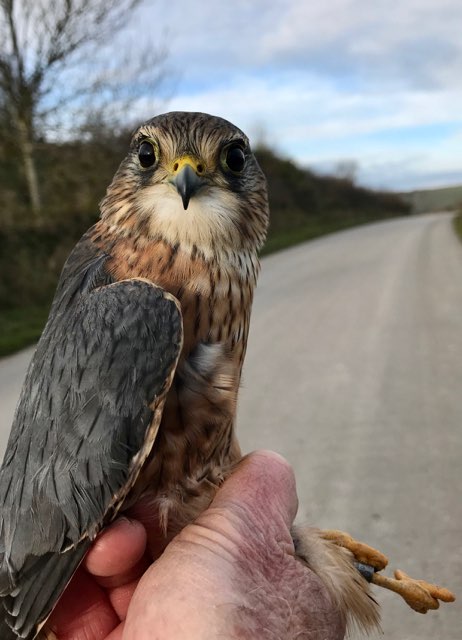
Ian and Andy went out onto their Salisbury Plain site and managed a decent haul of 33 birds.  They didn’t manage another first for Wiltshire (currently with the BBRC for adjudication) but they did catch this beauty:

80received_2872301836138103

This is only the second Merlin caught by our group.  The first was in July 2003.  Both were retrapped birds and we are looking forward to finding out where this beauty was ringed. (Photos courtesy of Ian.)

Their list for the session was: Merlin (1); Blue Tit 3; Wren 1; Robin (2); Redwing 8; Blackbird 1; Goldcrest 1; Chaffinch 2; Linnet 1; Bullfinch 3; Yellowhammer 9; Reed Bunting 1. Totals: 30 birds ringed from 10 species; 3 birds retrapped from 2 species, making 33 birds processed from 12 species.

So, as I said in the title to this blog: very much mixed fortunes: from thee cracking Merlin to Jonny’s huge solo catch, where the number of Redwing outnumbered the total catch of titmice! Oh well! I will get back there one day!

The Firs: Wednesday, 13th November 2019

This morning’s scheduled session at the Firs coincided with a visit from Devizes School pupils, as part of the Wiltshire Wildlife Trust’s Well-Being programme.  Jonny, Tony and I arrived on site for 7:00 and set up the nets, with the school party arriving shortly after 9:15.  These sessions are always a pleasure: getting a small group of teenagers, who are taken out of school for some reason or other, and getting them involved in the great outdoors, always generates a positive response. It doesn’t matter how “too cool for school” they might start out, it is very rare that we cannot get them to join in with our activities.  Today was no exception: every single one of them was persuaded to help out and release our birds.  The challenge “Who’s brave enough to be bitten by a Blue Tit?” usually appeals to the more extrovert teen, which sparks the others to get involved.  It worked for the umpteenth time this morning.  Mind, the lad did keep saying that he wanted to be bitten by birds, which is a little concerning!

Our first round, at 8:00, yielded a good sized flock of 12 Long-tailed Tits, 9 Blue Tits and a couple each of Great and Coal Tits and Goldcrests and a Treecreeper.  The next few rounds were not as busy, and a couple were actually empty, but we had a good number of birds overall to show to the visitors.  Not that they were sitting around doing nothing whilst we were working: they were setting up a camp site, with hammocks and canopies in amongst the trees, and boiling up their billy for tea, coffee and soup: it was very cold first thing and hot beverages were definitely necessary.

We worked through until 11:00 whereupon I uttered the fateful words “We’ll make this the last round and close the nets as we go.”  This guaranteed another dozen birds to the total – mainly Blue Tits, but also our only Robin of the morning.  The list for the session was: Treecreeper 1; Blue Tit 10(9); Great Tit 1(4); Coal Tit 2; Long-tailed Tit 11(1); Wren 2; Robin (1); Redwing 1; Blackbird 2; Goldcrest 8(1).  Totals: 38 birds ringed from 9 species and 16 birds retrapped from 5 species, making 54 birds processed from 10 species.

This catch has taken the number of Long-tailed Tits ringed this year to 111: it will be our best year for the species since 2016, with just 77 and 79 in the last two years.   As for the continuing regularity of Goldcrest catches, at 145 so far, this is our best year since I started ringing independently in 2103.

The only downside to the morning: we drew a blank on Marsh Tit during the session, despite running lures for them. Naturally, whilst we were taking down the last two nets a couple of them started calling at each other from either side of the central glade.


First Lesser Redpoll of the Winter: Ravensroost Woods; Tuesday, 12th November 2019

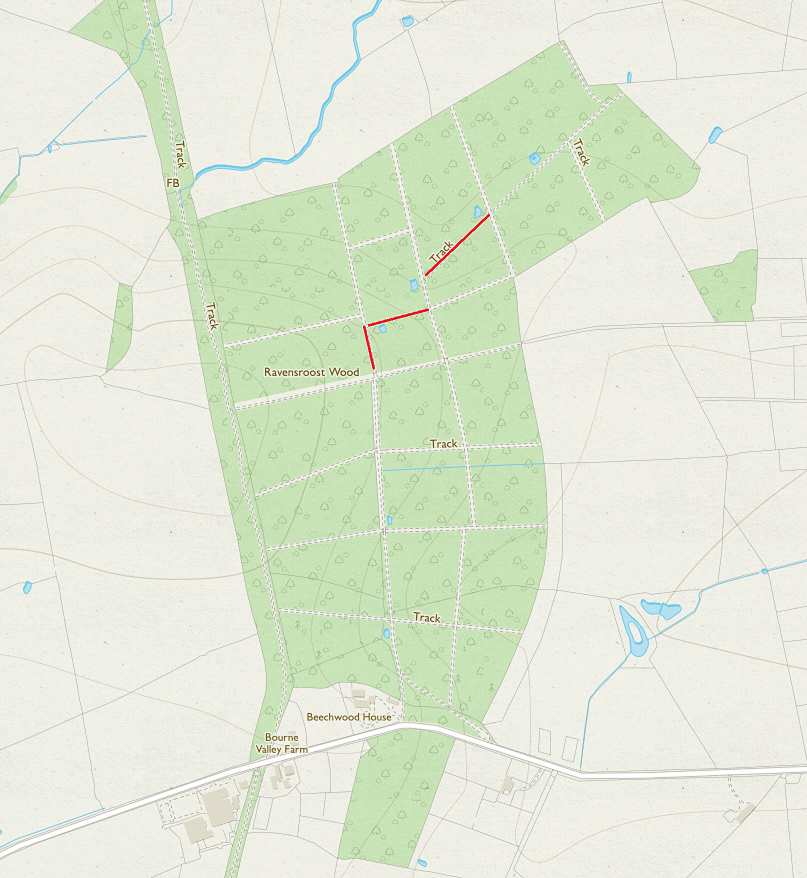
It is at least 3 years since I have run a session that took in the north end of Ravensroost Woods.  The catch in the area had reduced significantly, and it is hard work managing both ends of the wood.  However, as I had a good sized, and experienced, team out with me today: Ellie, Jonny and Alice, we decided to focus on this rather neglected part of the wood. It turned out to be a really good session and I won’t be neglecting it for that length of time again.

Obviously with the problems further north in the country, it would be churlish to complain about the weather, but the rain forecast for 14:00 arrived at 11:30, and the wind really got up from the opposite direction from which it was forecast and which influenced where we set out nets, whilst we were extracting several hundred leaves from the nets and packing away. It seems that weather forecasting is now so inaccurate that looking out of the window is the only way to tell what is going on.

We set up our nets along the main paths (nice not to have to wear wellies for once) as shown below (the red lines):

Ravensroost

It was very quiet for the first hour and a bit but then picked up for the next 2 hours, before we packed away.  There were two significant highlights.  We caught another 4 new Marsh Tits for colour-ringing and recaptured two more ringed earlier this year. Extracting and ringing one was a first for Alice: they are red-listed but Wiltshire woodlands do seem to be strongholds for them.

The second highlight was our first Lesser Redpoll of the year:

20191112Lesre

The list for the session was: Great Spotted Woodpecker 1; Nuthatch 1; Treecreeper 1; Blue Tit 5; Great Tit 2(1); Marsh Tit 4(2); Long-tailed Tit 7(5); Robin (2); Redwing 3; Blackbird 2(1); Goldcrest 5(1); Lesser Redpoll 1.  Totals: 32 birds ringed from 11 species and 12 birds retrapped from 6 species, making 44 birds processed from 12 species.

It is a rare session where you capture more Long-tailed Tits, Marsh Tits and Goldcrests than Blue and / or Great Tits in one of the Braydon Forest woodlands.  One of the retrapped Long-tailed Tits was originally ringed on the  20th September 2014: that is a good age for a bird with an expected lifespan of 2 years!

A Lovely First for Red Lodge: Sunday, 10th November 2019

Several weeks ago I was asked to carry out an assessment of a trainee from another ringing group, to confirm that they were proficient enough to be advanced to C-permit level. Our every effort subsequently has been thwarted by the weather. Most recently, we had planned to meet up yesterday but, with rain scheduled at 9:00, and arriving soon after, it was cancelled.  I agreed with the rest of the team that yesterday’s scheduled session would be moved to Tuesday. As the forecast was considerably better for today, with rain scheduled to pour down overnight, but peter out during the morning, clearing by 9:00, I agreed with the trainee, Ian, that I would keep an eye on the weather and, if it stopped early enough, I would call him and we would carry out a session at Red Lodge.  The Firs was the next on the schedule, but that was already scheduled for Wednesday, so Red Lodge was the logical choice.

The rain actually was stopped by 6:30, so I was on site by 7:00, with the nets open by 7:40.  Birds started arriving almost immediately, and we had a steady run throughout the morning.  There was a couple of early Redwing in the catch and the usual titmice and a few Goldcrest.

After 10:00 we put on a lure for Goldcrest. I always wait until 3 hours after sunrise before luring for them. They come to the lure readily, and I want them to have had plenty of opportunity to feed before we start catching them in any number.  We had a good initial catch, and then a lull in their numbers, until I uttered the fateful words: “We’ll make this the last round, and close the nets and take down!”.

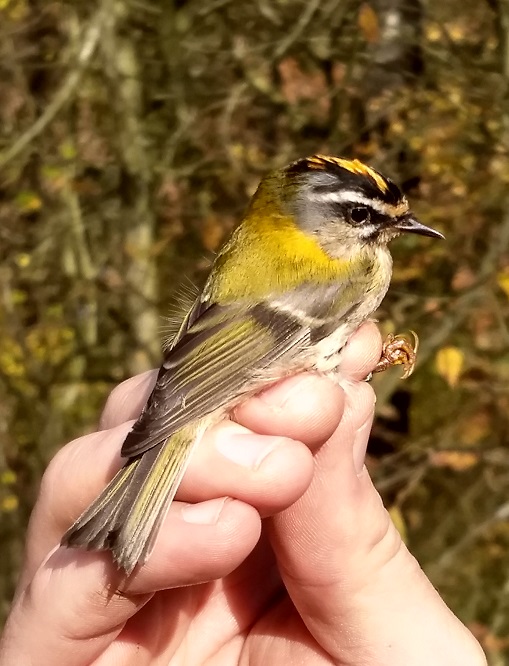
The last round yielded another group of Goldcrest, several Long-tailed Tit, Blue Tits and this beauty:

20191110Firec

This is only the second Firecrest caught in the Braydon Forest. The first was in Ravensroost Woods in November 2015.  As Ian hadn’t seen or handled one before, I gave him the opportunity to extract and process the bird.

All in all, it was a very satisfactory session, resulting in the following catch: Treecreeper 1(1); Blue Tit 13(6);  Great Tit 5(6); Coal Tit 1; Marsh Tit (1); Long-tailed Tit 2(2); Wren 1(2); Robin 3; Redwing 2; Blackbird 2(1); Goldcrest 13(3); Firecrest 1; Chaffinch 1.  Totals: 45 birds ringed from 12 species and 22 birds recaptured from 8 species, making a total of 67 birds processed from 13 species.

The result of the session is that Ian is a competent ringer and I have recommended his advancement to a C-permit.

Somerford Common: Wednesday, 6th November 2019

Given the weather recently it has been quite some achievement to get out to all five of our Braydon Forest woodland sites in the last three weeks.  Somerford Common is, perhaps, our most varied woodland site. It is certainly the only one that is home to a wallaby!  On Monday I optimistically set up a feeding station in the paddock area, hoping that some of the Lesser Redpoll might find it before Wednesday. Forlorn hope! A couple of Blue and Great Tits did but nothing else. Next time!

I was joined for the session by Andrew and Alice, and Steph joined us after the school run.  Our first bird of the day, not caught unfortunately, was a Woodcock which was put up from its roost as we went to set up the first couple of nets.  They usually roost inside the paddock, not adjacent to the path.

Despite the lack of Lesser Redpoll, it was good morning session.  Once again, Goldcrests were present in good numbers.  This is looking like being our best ever year for them in the Braydon Forest, already matching the previous best with two months to go.

Although we caught two of them, they were not the Marsh Tits that were conspicuously calling adjacent to our ringing station!  Hopefully next time.

The list for the session was: Blue Tit 4(3); Great Tit 3; Coal Tit (1); Marsh Tit (2); Wren 1(3); Song Thrush 1; Goldcrest 12(2).  Totals: 21 birds ringed from 5 species; 11 birds recaptured from 5 species, making 32 birds processed from 7 species.