Wellbeing at The Firs: Wednesday, 11th September 2019

We do a lot of sessions for the Wildlife Trust’s Wellbeing teams, whose focus is on providing opportunities for vulnerable people suffering from anxiety, depression or stress. As someone who used to be a stressed out, anxious, depressive, I understand the value of getting into the natural environment as a great method of alleviating those conditions.  The issue has always been getting everyone to site at a time when there will be a lot of bird activity for us to show them. The Wildlife Trust’s team pulled out all of the stops, arranged new pick up points, and managed to get 20 or so beneficiaries to the Firs by 9:00 this morning.

Birds in woodlands are most active in the few hours after sunrise, so the later we start the process the fewer birds we catch. My last session with the Wellbeing team resulted in just 6 birds caught in 3 hours.  Also, my last ringing session at the Firs, on the 25th July, was the morning after the fantastic electric storms and torrential downpour the night before and yielded just 15 birds in 5 hours.  I approached today’s session hopeful that we would have enough to show them.  I was joined by Ellie Jones, for the session. As she is the Northern Reserves Field Officer for the Wildlife Trust (as well as being one of my extremely capable C-permit trainees), this really was a Wiltshire Wildlife Trust event!

We set the nets down the central glade at the Firs and had them open by 7:30. We took a Robin out of the net that had managed to blunder in before we had actually opened them, and processed that. The thing about the Firs is that the nets are set in two long lines, so we empty them on the way down and take any others that wander in on the way back up, guaranteeing that the birds spend the minimum time in the nets.  Next round we took 6 birds out and thought “Hopefully there will be a few more than this by the time the Wellbeing groups arrive”. We processed them, had a coffee, and went for the next round: 35 birds, mainly Blue and Great Tits, on the way down. By the time we had extracted them, another 20 had entered the nets for the journey back.  I left Ellie to finish extracting birds, and to shut the nets (we didn’t need any more birds for this session) whilst I went back to the ringing station to start processing the birds and show them to the group who had, by now, assembled.

It was a really good morning’s work. We had a lot of interest from the group: lots of questions, and they had lots of opportunities to get close to a good number of common woodland species.  Part way through the morning the weather turned a bit damp: with some very fine rain. Fortunately the team had brought a portable gazebo with them (I must invest) which they moved over to cover the ringing station.  Although the rain was light and stopped quite quickly, the water had collected on the leaves of the trees in the wood and so, every time the wind blew, we had another shower – so the gazebo was a great help.

The list for the day was: Nuthatch {1}; Treecreeper 1[1]; Blue Tit 1[19](2); Great Tit [18](3); Marsh Tit [1]; Long-tailed Tit {3}; Wren 1[2](1); Robin 1[1](1); Chiffchaff [4]; Willow Warbler [1].  Totals: 4 ringed, unaged, from 2 species; 4 adults ringed from 4 species; 47 juveniles ringed from 8 species and 7 birds recaptured from 4 species, making 62 birds processed from 10 species.

We didn’t reopen the nets: we had a good catch and the weather had turned damp, the time was approaching 11:00, so the Wellbeing crew all disappeared off to Blakehill Farm for bacon sandwiches, tea and coffee, Ellie went to work and I packed up the site.  Thanks to Jo, Chelsie, Keeley and Emma for organising their people, for the coffee and to Keeley especially for the fabulous Dorset apple cake!


Ravensroost Meadows: Saturday, 7th September 2019

After a super week away in Pembrokeshire, I was looking forward to getting out ringing.  However, my last session at Ravensroost Meadows was on the 5th August and delivered the princely catch of 6 birds, so there was a little trepidation as to what we would find there this morning. Jonny Cooper and I arrived on site at 6:00, got our nets set up quite quickly, and started catching at 7:00.  By 7:30 we had more than trebled the previous catch, so all concerns disappeared.

Autumn migration is well underway and, although this is not a prime migration hot-spot, we always get a good passage of migrant birds heading south.  It is our most regular site for catching Swallows. In the middle of the main ringing area is a small pond with a causeway bisecting it, and is just right for a 12 metre net. There is also a short spit of land at the east of the pond that takes a 9 metre net.  These are often our best nets for catching Swallows or House Martins, as they come into the pond to grab a drink.  Today the causeway net delivered our first Swallows of the year.  We did watch a large flock of House Martins fly around the meadow, hawking insects, before disappearing into the distance, never coming close to the pond for a drink. Small numbers of Swallow were flying through all morning, one pair being chased, ever so optimistically, by a female Sparrowhawk.  In the event we caught 3: less than we hoped but absolutely better than nothing.  They were all juveniles:

20190907 Ravensroost Meadow 2

It was a good day for birding, as well as ringing, with a juvenile Sparrowhawk making his presence felt on the edge of the wood: calling for food and flying back and forth quite regularly.  A Kestrel was present, hunting over the meadow, for most of the morning.  There was a Spotted Flycatcher moving along the hedgerow away from us: a shame it didn’t mover the other way and end up in a net.

But the ringing was very worthwhile: Swallow [3]; Blue Tit 1[5]; Great Tit [3]; Wren [6](1); Dunnock 1[2](1); Robin 1[3]; Blackcap [18]; Whitethroat [2]; Chiffchaff [10]; Willow Warbler [1]; Chaffinch [1]. Totals: 3 adults ringed from 3 species, 54 juveniles ringed from 11 species and 2 birds recaptured from 2 species, making 59 birds processed from 11 species.

One of the juvenile Dunnocks had some skin tags around the eyes:

20190907 Ravensroost Meadow 3

I have not seen this before. I know that Dunnocks do get avian pox and wonder if this is an early stage of it.

Jonny had to leave at 11:00, but I stayed around for another couple of hours, extracting a couple of Swallows and a few Blackcaps, Dunnocks and Wrens, enjoying the bird life. However, my most difficult extractions of the day were a Brown Hawker and several Ruddy Darters, including one copulating pair, that got entangled in the nets.  Extracting dragonflies is becoming something of a speciality for me: I do get lots of practice here and at Lower Moor Farm.  It isn’t easy: their heads are attached by a very thin neck and it can easily become detached. I have found that the best thing to do is to start by pushing them through the net from behind and then pull them the rest of the way through once you can get a grip on the thorax.

The Last CES Session of 2019: Lower Moor Farm, Wednesday, 28th August 2019

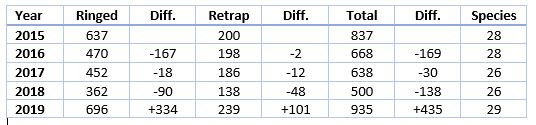
A Constant Effort Site (CES) comprises 12 sessions between the beginning of May and the end of August / first week of September. Each session is scheduled within a window of 10 days predetermined by the British Trust for Ornithology (BTO).  Nets are set in the same positions, and are left open for the same length of time (6 hours), for every session year on year.  This the fifth year that we have run a CES at Lower Moor Farm and it has reversed the trend of decline observed over the first four years.  With the exception of last sessions blip, every session has been a significant improvement on last year.  It has become the best year so far, as the following table shows:

CES Summary

Essentially, the site has recovered significantly, even surpassing the opening year of 2015. Today’s was session 12 of 2019.  I had expected to be joined by Andrew Bray and David Williams for the session only over the course of Tuesday afternoon and evening I got messages that Jonny Cooper, Ellie Jones and Henny Lowth wanted to come along.  Last year this session delivered 39 birds so, whilst I didn’t want to put anyone off, I was worried whether we would have enough of a catch to make it a worthwhile venture for them all.  I needn’t have worried. 

The list from today was: Kingfisher (1); Woodpigeon 1; Great Spotted Woodpecker 1; Green Woodpecker (1); Nuthatch {1}; Treecreeper [2](2); Blue Tit 2[4](3); Great Tit (1); Long-tailed Tit {2}[3](4); Wren [1](1); Dunnock (2); Robin [2](1);  Blackbird (1); Blackcap [33](4); Garden Warbler [1]; Whitethroat [1]; Lesser Whitethroat [1]; Chiffchaff [9]; Goldcrest [2]; Bullfinch 1[2]. Totals: 3 birds from 2 species ringed unaged (Nuthatch and Long-tailed Tit); 5 adults ringed from 4 species; 61 juveniles ringed from 12 species and 21 birds recaptured from 11 species, making 90 birds processed from 20 species.  Of the recaptured birds 14 were also juveniles.

Andrew did a great job of getting to the Woodpigeon before it managed to escape the net.  Large birds can be pretty adept at getting out of the nets, particularly the 5 shelf, as opposed to 4 shelf, nets we use.  This gave David the opportunity to ring his first Woodpigeon.  He found out that there are different skills needed to handle a bird of that size and strength, but with a bit of help and direction he handled it well. Henny was also delighted to be able to process her first Kingfisher and Green Woodpecker, although they were already ringed, she carried out the ageing, sexing and biometric measurements.

Given that we have only 12 metres of net within woodland for the CES, the vast majority being within the scrub that lines the lakeside and the trees that line the stream marking the boundary between Wiltshire and Gloucestershire, it has always been a surprise how many Treecreepers we catch at the site. Today we caught our first Nuthatch for this side of the site. Two caught in March 2016 were in the vicinity of the Visitor Centre / Education Area. Couple that with two of our three woodpecker species, it was quite a woodland catch for a non-woodland site!

We were joined for the morning by Tony Marsh. Tony, along with Robin Griffiths, are the two people who regularly send me sightings of my colour ringed Marsh Tits. This is a project I have been running, now in its seventh year, for this species. On the left leg they have a BTO metal ring with its unique number plus either a red, blue or green colour ring. On its right leg it will have a combination of two coloured rings. If you should see one of these birds and send me a sighting through the comments section of the blog, I will send you the details of that bird (when ringed, how many times it has been recaptured / seen) and be eternally grateful.  I know that Tony enjoyed getting some close encounters of an avian kind!


Sherston and Nest Boxes: Monday, 26th August 2019

I went out with Andrew Bray to check a few Barn Owl boxes before it got too hot this morning. Two were new boxes, close to the village of Sherston in west Wiltshire, we had been invited to check by Geoff Carss, a one time ringing trainee and good bloke.  Geoff’s friend, Kevin Noble came along to direct us to the first box. He was responsible for getting it put up there in the first place!

This first box was situated within the grounds adjacent to Pinkney Park.  This is the highest box we have looked at – and it took all three sections of my 9 meter ladder, fully extended, to reach it. It proved to be empty, except for the desiccated carcass of a Tawny Owl.  From what I could gather from the carcass, it was a young bird which would have been close to fledging, as its primary and secondary feathers were at medium length, about two-thirds grown.   Goodness knows how long it has been there: it might have been from this year but it was very, very dried out.  Anyway, we met with the landowner and he is very keen for us to monitor the box in future.

The second box was just outside the village to the west.  It was situated in a tree on a ridge running alongside the river Avon.  This was a longer distance to walk with the equipment but only a two-section climb.  This box, put together by local Scouts,  yielded two Stock Dove pulli, just ready for ringing.

2019_08_26STODO2

Their crops were hugely distended: Mum and Dad are clearly keeping them very well fed.  Stock Dove numbers have declined significantly in the last 20 to 30 years, and the species is now amber listed in the UK.  They do like nesting in holes, and the prevalence of Barn Owl boxes is certainly helping provide them with nesting places.

On the way back we stopped off at Avis Meadows to check the box that had 2 warm Stock Dove eggs in it three weeks ago. We were concerned that no adult left the nest as we approached, as they are usually very quick to fly off, and on checking the box it was empty, presumably the eggs / young have been predated.

Finally, we stopped of at our Drill Farm site to check the box that had two young and two unhatched eggs three weeks ago.  This time we found three youngsters, two of which were ready for ringing and no sign of the other egg or chick.  So, a bit of a mixed bag, but as Andrew ringed his first ever Stock Dove he felt teh drive up from Potterne was worthwhile.

I don’t know if any Aussies read this blog (actually, I do because WordPress publish those statistics for me – you would be surprised to know how far afield this blog is read: from Canada / USA to New Zealand and many points in between) but we had the BBC’s Ashes podcast playing on repeat all the time we were in the car. Bliss!

Ravensroost Woods: Saturday, 24th August 2019

My last visit to Ravensroost Woods was on the 27th July and was hugely disappointing, with just 14 birds caught from 7 species between 2 of us in over 5 hours in 200 metres of net.  So it was with a little trepidation that I set off to Ravensroost this morning at 5:30.  I was flying solo today – I think my team saw how bad the last session was and decided a lie-in was a better use of their time.  I set 3 net rides, 210 metres of net and crossed my fingers.  I am not obsessed by numbers, but when you have people travelling 30 to 40 miles to join you for a session you want them to feel it was worthwhile.

The catch started immediately with a little influx of Robins – in fact, the first 6 birds I took out were all Robins and then I caught no more.  By 9:00 I had already passed the previous total and by 11:30 it had doubled; so I decided, as it was getting quite hot, that I would take down. As so often happens: one of the small flocks of Blue and Long-tailed Tits that had been flitting around the tree tops all morning decided to come down to net level, and I extracted 6 Blue Tits and 4 Long-tailed Tits whilst trying to pack away.

The Long-tailed Tits were one of the highlights of the session: they are such lovely birds but since their numbers in the Braydon Forest plummeted, alongside those of Blue Tits, in 2016, catching them has become much less regular.  Interestingly, I was able to age all 4 of these Long-tailed Tits as juveniles.  Although they were close to finishing their post-fledging moult (whereupon they become indistinguishable from the adults) they all retained enough juvenile plumage to be able to do so confidently.  I ringed 2 juvenile Song Thrushes, taking this year’s total ringed to 24: which is the total we ringed in the whole of 2018.   There were 25 ringed in 2017 – but we have a way to go before reaching the 41 ringed in 2016.  They are almost certainly having a better year this year than the last two.  I also caught and ringed my ninth Marsh Tit of the year.  Ravensroost is a stronghold for this species, and catching juveniles every year is always welcome.

The list for the day was: Blue Tit 1[9]; Great Tit [2]; Coal Tit [1](1); Marsh Tit [1](1); Long-tailed Tit [4]; Wren 1[2]; Dunnock [1]; Robin [6]; Song Thrush [2]; Blackbird (1); Blackcap [5]; Chiffchaff [1].  Totals: 2 adults ringed from 2 species; 34 juveniles ringed from 11 species and 3 birds recaptured from 3 species, making 39 birds processed from 12 species.

All in all, a much better session in the wood than the previous one. It could have been better: I had a couple of birds bounce off the net rather than drop into a pocket and the Nuthatches and Great Spotted Woodpeckers that were calling around the wood managed to stay in the tree tops and avoid the nets.


CES 11, Lower Moor Farm: Wednesday, 21st August 2019

Our CES sessions so far this year have been much more productive than the equivalent sessions last year: until today.  Last year’s session delivered 64 birds, 56 ringed and 8 recaptured from 15 species; this year’s was 40 birds ringed and 17 recaptured from 16 species.  Fewer birds from more species.  The differences can be summed up in two birds: Garden Warblers and Blue Tits. Last year we caught 9 Garden Warblers: 1 adult and 8 juveniles, this session, none.  Blue Tits were down from 10 processed to 5: 3 juveniles and 2 adults this year compared with 8 juveniles and 2 adults last year.

However, it would be churlish to complain about a catch that included our first Green Woodpecker of the year at Lower Moor Farm (our most regular catching site for the species – 9 of 13 caught since 1st January 2013 have been caught at Lower Moor Farm) and our third Kingfisher of the year at this site:

2019_08_21Kingf1

The three caught so far this year is our second best annual catch (5 in 2016) with 4.5 months to go.  They are lovely birds to work with. I don’t know another species that will actually lie down on the scales when you weigh them.  This is the standard method that I was taught for weighing a Kingfisher. It has the benefit of not trying to fit that long beak into a pot.  The bird can flip over onto its belly and escape before you get a reading sometimes but, on the whole, they lie still until you pick them up and turn them over.

2019_08_21Kingf2

This one sat on Andrew’s hand for a minute before flying off across Mallard Lake (i.e. just long enough for me to get my camera out of the bag, not long enough for me to get a photo), completely unharmed by its experience.  The team today was Andrew Bray, David Williams and, for her first taster, Sunny Jones: Sunny by name and, very definitely, sunny by nature.  She will fit right in with the team if she decides she would like to become a regular.

The list for the day was: Kingfisher [1]; Green Woodpecker [1]; Treecreeper 1[2]; Blue Tit [1](4); Great Tit (1); Long-tailed Tit {2}; Wren 1[5](2); Dunnock [1]; Robin [3](1); Song Thrush [1](1); Blackbird [2](2); Cetti’s Warbler (1); Reed Warbler [1]; Blackcap [12](2); Chiffchaff 1[5](2); Bullfinch (1).  Totals: 2 unaged birds ringed; 3 adults ringed from 3 species; 35 juveniles ringed from 12 species and 17 birds recaptured 10 species, making 57 birds processed from 16 species. Of the retrapped birds, 10 were juveniles, so 45 of the 57 birds were juveniles from 14 species.

CES 10, Lower Moor Farm: Sunday, 11th August 2019

Originally scheduled for Saturday, but postponed for very obvious reasons, Jonny Cooper and I met up at Lower Moor Farm at 5:00 Sunday morning.  It was still pretty windy, but all bar about 2 metres of one net was sheltered from it.  In fact the weather was pretty good right up to the point (midday) when I started to take down. Jonny had left at 11:00 for a prior commitment, so he missed the absolute (unforecast) downpour that means my nets are currently hanging over the washing line in the garden trying to get them to dry off. A shame because this Monday morning would have been perfect for an ad hoc ringing session.  Still, that is a minor complaint against what was another really good session: our best CES 10 since we started.

It was clear that Saturday’s high winds had an effect on the catch: birds that might have moved on passage having to stay put.  This manifested itself in the first round where there was a decent haul of Chiffchaff in the most sheltered part of the site.

The list for the day was: Kingfisher [1]; Blue Tit 2[7](2); Great Tit 1[2]; Marsh Tit [1]; Long-tailed Tit {2}[1](3); Wren [1]; Dunnock [2]; Robin [3](2); Song Thrush 1; Blackbird [3](1); Reed Warbler [3]; Blackcap [30](3); Garden Warbler [4](2); Whitethroat [1]; Chiffchaff 1[20](1); Willow Warbler [4]; Bullfinch [1].  Totals: 2 birds ringed as unaged from 1 species; 5 adults ringed from 4 species; 84 juveniles from 16 species and 14 birds recaptured from 7 species, making 105 birds processed from 17 species.  Of the 14 retraps 8 were juvenile birds, so the total number of juveniles in the catch was 92 from 105 birds.

It is always good to catch a Kingfisher, especially as they have been largely missing from the site for a couple of years.  This, like our previous one this year, was a juvenile female.  It was in the last catch of the morning, 20 minutes before the rain started. However, perhaps the best bird of the morning was this one:

2019_08_11Marti

This is only the second Marsh Tit that we have caught at the site, since I started my ringing activities there in 2013. The previous ringer on site, John Callinan, used to catch a few but his ringing activities were largely in the woodland on the Gloucestershire side of the site and ours is almost exclusively in the lakeside areas on the Wiltshire side of the reserve.

This was our second largest catch of both Blackcap and Chiffchaff, the largest catch for both being on 20th August 2014 (CES 11).   All in all, it was a very satisfying session. with a good catch, well spaced and nicely paced. We were never under any pressure from the number of birds we were catching.


Barn Owls: 17th June; 2nd & 8th August 2019

Over the last couple of years I have been taking over the monitoring of Barn Owl boxes in north and west Wiltshire.  It was previously done by a group led by Paul Darby, a stalwart of voluntary work for the Wiltshire Wildlife Trust. Paul had a regular team of helpers but, unfortunately, when Paul packed it in so did his team.  Since then I have been helped by various  of my ringing colleagues to get around and check boxes.  It is a little hit and miss, fitting it in with other commitments, but we are determined to do as much as possible.

Because of the protected nature of the species, when Paul checked the boxes he had to do so in October, after the breeding season has ended.   This meant that he had to estimate whether or not boxes had been occupied, which was fairly easy to do, as there would be layers of pellets and other detritus.  What was not easy was to decide whether or not the box had been used for breeding and whether that breeding was successful.  Unlike Paul I have a schedule 1 licence from the BTO / Natural England to check the boxes during the breeding season.  We started quite late this year, when team members became available.

Our first session was on Monday, 17th June when I was joined by Jonny Cooper.  We restricted our check to the Wiltshire Wildlife Trust reserve at Blakehill Farm an Avis Meadow. .  There are three boxes on site at Blakehill: Poucher’s Field, Allotment Field and the Moat.  At our  first box, Poucher’s Field, we found two chicks in the nest.  They were developing nicely and were large enough for us to ring them.  The other two boxes were empty, although the box in Allotment Field was full of twigs and leaves and was probably being used as a roost by Stock Dove or Jackdaw.

When we arrived at Avis Meadows there was a large Well Being event going on. We checked the boxes, which were both empty.  The odd thing about Avis Meadows is that there are two boxes: one is old, dilapidated and falling apart and is usually occupied by either Barn Owl or Stock Dove. the second is a new, A-style box which has never been nested in but is used as a roost by either species.

The second session, due to a whole host of factors, was not until Friday,  2nd August when I was joined by Andrew Bray.  Again, we started at Blakehill Farm.  As we set up to check the box at Poucher’s Field a Barn Owl and a Stock Dove flew out from the box. There was no sign of the youngsters: which we are confident means that they fledged.  The Allotment Field box had a roosting Stock Dove and the Moat box was empty, except for several Barn Owl feathers.

We moved on to Upper Waterhay farm.  The farmer is very keen to support his local Barn Owls and has three boxes spread around his farm.  In the first box we disturbed two Barn Owls that flew off.  There was, however, no sign of recent breeding in the box and they may have just been roosting.  In the second box we had better news: as we approached an adult Barn Owl flew off.  When I checked in the box there were 4 warm eggs.  This is almost certainly a second brood for the year.  I shall be back to check again in 4 weeks time.  The third box realised total success: there were three juvenile Barn Owls ready to fledge.  One flew off, but I managed to gather two of them and we could ring them, identify their sex (both female) and take the wing length and weight bio-metrics.

20190802 Upper Waterhay

My third session took place on Thursday, 8th August, when I was joined by Henny Lowth.  We started in Avis Meadows where 3 Stock Doves exploded out of the barns as we approached.  We found signs of roosting in the A-box, and I collected a number of pellets for the Wildlife Trust’s Watch group. In the old box there were 2 warm Stock Dove eggs. We will be back to check up on these in a couple of weeks.

After Avis we went to check the two boxes at Plain Farm and Drill Farm.  The Plain Farm box had two roosting Barn Owls and signs that there had been successful breeding (broken egg shells).  In the Drill Farm box, which tested Henny’s mettle, as the field had a fairly large herd of Friesian heifers who were very curious about these two people carrying a ladder across their field.  It is definitely not for the faint-hearted or those unused to large farm animals.  Anyway, the only downside for me was the volume of cow dung spattered around the base of the tree holding the box.  When checked, we saw an adult fly off and, when I opened the box this is what we saw:

2019_08_08YBO

The two little pink bundles are recently hatched Barn Owl chicks, to the far right are the broken egg shells, and in front of them are two warm, unhatched eggs.  We shut up the box and moved on to the last two boxes at Home Farm and Echo Lodge Farm.  The Home Farm box is always active and the owners are keen observers of the owls on their property.  We checked the box, which contained one roosting Barn Owl but no sign of a second brood.  When we went over the road to the Echo Lodge box another adult flew off, and when I checked the box there was one warm egg.

It looks like the Barn Owls in the Braydon Forest area are having a successful year: we will keep an eye on these boxes and more over the next 6 weeks to see how things develop.

Meadow Farm: Thursday, 8th August 2019

This is a post by Jonny Cooper:

Regular, consistent ringing at a site is a brilliant way to build up a picture of the bird species that use the site across the year, and how the populations change over time. At Meadow Farm this is achieved by carrying out at least one session every month,  with more if possible.  The weather forecast for Thursday seemed to suggest a break from the relatively high winds we have been experiencing recently, so I made the decision to carry out a session.

The session followed the trend of recent ones at the site: kicking off the catching of half a dozen birds as the nets were being opened, and then taking off rapidly from there. Over the next 6 hours I caught and processed 120 birds exactly. The catch was as follows:

Blackbird (1), Blue Tit [37](2), Bullfinch 1[3], Chiffchaff [6], Dunnock [1], Goldfinch 1[3], Great Tit [12](9), Greenfinch 3[19], Kingfisher [1], Long-tailed Tit [1], Reed Warbler [5](1), Robin [3], Sedge Warbler [2](1), Whitethroat 2, Willow Warbler [1], Wren [4](1). Totals: 7 adults from 4 species; 98 juveniles ringed from 14 species and 15 birds retrapped from 7 species, making a total of 120 birds from 16 species.

To catch another Kingfisher was great. This was the tenth new specimen caught here since I began ringing the site in January 2018.  In fact, it is the tenth in just under a year, as the first was caught on the 31st August last year.  Of the 10 caught, 7 have been juveniles, suggesting that they have found a good breeding site.

However the real highlight was the catching of 22 Greenfinch, this is the biggest single catch of Greenfinch since 1st January 2013, when the West Wilts ringing group began in its current form.  That 19 of these were juveniles, many newly-fledged, suggests that they are having an excellent breeding season.  Nationally this species’ numbers have dropped markedly over the last decade or so due to the disease Trichomonosis, hopefully this large catch is a sign the numbers are now bouncing back.

One species notable by its absence was Blackcap, at this time of year you would expect to catch good numbers as they start to move through on migration but today none got into the nets.

I closed the nets and packed down at about 11:30, by that time the temperature had risen and most bird movement had ceased.

In Between the Showers: Webb’s Wood, Wednesday, 7th August 2019

Why is it so difficult to forecast the weather? It seems that none of the usual suspects can get it right. Before deciding on this session I checked the Met Office, xcweather, Meteo Group and, just for luck, because they now take their weather from Meteo, the BBC.  All of them said dry and windy with only the Met Office suggesting any chance of rain before midday.

I met with Jonny and Henny at Webb’s Wood for a 5:00 start and we set up 4 rides of nets. My last two woodland sessions had been hugely disappointing, after the Tuesday night storms of last week, so I was hoping that this would be better.  It kicked off okay, with a juvenile Willow Warbler, a Blue Tit, a Robin and a Wren in the nets as soon as they were opened at 5:45. Cue the first sharp and forceful downpour. Everything, including my record sheets, was soaked in seconds.  We shut the nets.  That lasted a mere 15 minutes but caused a lot of mess.

We then had 45 minutes of calm before the next “shower” hit: this lasted until 8:00 and was, again, very heavy.  Again, the nets were furled until it passed.  Thereafter, every once in a while we had a fleeting light shower.  Why do they spend all that money on super-computers and satellites? Seaweed is cheaper and every bit as accurate!  The wind did finally get up: about 30 minutes before we decided to pack up for the day.

To be fair, given the weather, it was a half-decent session: twice as good as our last two woodland ringing trips.  The list for the day was: Nuthatch {1}; Blue Tit [1](1); Great Tit 1[1]; Coal Tit [1](1); Long-tailed Tit [3]; Wren [3]; Robin [3](1); Blackbird [2]; Chiffchaff [2]; Willow Warbler [1]; Goldcrest [4](1); Bullfinch 2.  Totals: 1 unaged ringed; 3 adults ringed from 2 species; 21 juveniles ringed from 10 species and 4 birds recaptured from 4 species, making a total of 29 birds processed from 12 species.  Good variety and it would have been better had a Song Thrush not managed to extricate itself from the net just as I stepped up to extract it.

The Nuthatch is “unaged” because adults and juveniles both go through moult in the late summer and autumn and moult into full adult plumage. This Nuthatch had completed its moult and so cannot be reliably aged at this time.  In another month or so the same will apply to the Long-tailed Tits.  The three juveniles processed today are getting close to the end of their moult and, although the eye-ring of the juveniles is usually red and that of the adults usually orange, this characteristic is not reliable enough to accurately age birds post-moult.

We were joined at just gone 6:00 by a grandmother and grandson combo, Glenda and Brendan, who had enquired of the Wildlife Trust about seeing ringing.  The Trust put them in touch with me and we arranged for them to attend this session. It was good that we had plenty of variety to show them. They were both keen and attentive and will be welcome back at any time.

In between the showers there was a great deal of insect activity: Black-tailed Skimmers and Emperor Dragonflies were seen, as well as a good selection of butterflies, including this Brown Argus female who posed for an age whilst I fiddled around with exposure times to get the best balance of colour:

Common Blue

What a stunning little butterfly it is!  We packed up at 11:30, with the weather throwing one final, but light, shower at us as we were packing the stuff away in the car.