Brown’s Farm: Wednesday, 23rd October 2019

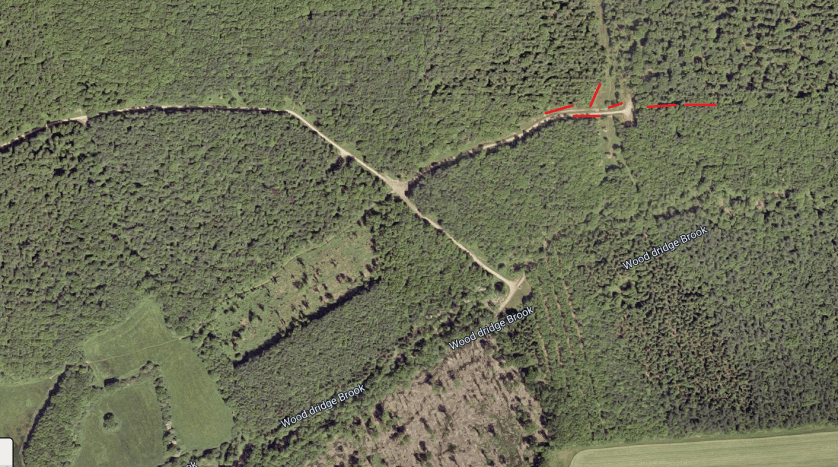
We have been trying to get out to our site at Brown’s Farm since our last visit in early July.  It is a very exposed site and the weather has just been too wet, and when not too wet, too windy, until today.  This morning was predicted to be flat calm – and it was.  Not just that, but the morning started very foggy, gradually thinning to mist, which only started to lift at just after 9:00.  This gave us plenty of time to get the nets up and open before the birds started to move around.  I restricted the number of nets to just 10: 9 x 18m and 1 x 9m set in 4 rides along the hedgerows.  My help for the morning was Tony Marsh. As this was only his second session with me, I would be the only person extracting and was wary about the potential for there being a large catch.  In the event it was a decent catch and very manageable, even the last round.  I really must learn not to say out loud “As it is quiet now, we’ll make this the last round” because it is always a prelude to the largest catch of the morning.  Later in the morning we were joined by Glenda Smith and her grandson Brendan Hicks. Brendan lives in north Kent and is a keen 15 year-old.  They have been out with us once before. This time Brendan ringed his first birds and Glenda overcame her trepidation and learned how to safely hold and release a bird.  Brendan is now going to try to find a ringing trainer in his local area.  Another one hooked!

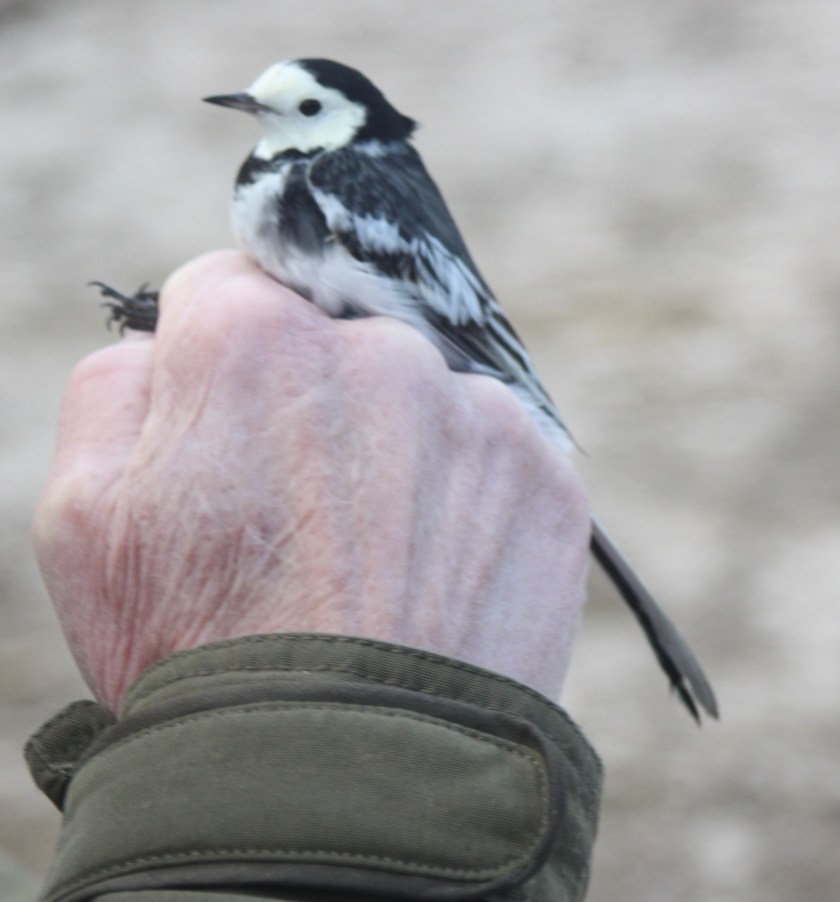
Once the mist lifted there was a lot of movement around: it would have been nice to have had a bigger team and more nets out, as there were flocks of Pied Wagtail, Meadow Pipit, Linnet and Goldfinch very much in evidence.  However, we were very happy with what we caught.  The star bird of the morning for me was only the second Pied Wagtail that I have caught since I started managing my own rings.  I had ringed 28 Pied and 13 White Wagtails as a trainee but it is always nice to have them on your own ring sets. Tony was very happy to get an opportunity to ring such an uncommon catch for our team:

20101023Piewa

As well as this species he was able to add Chaffinch, Linnet, Yellowhammer and Meadow Pipit to his list. Obviously when you first start out every species is potentially your first.  He also did his fair share of the grunt work: Blue and Great Tits.

The list for the day was: Blue Tit 10; Great Tit 3; Dunnock 2(1); Pied Wagtail 1; Meadow Pipit 3; Robin 4; Chaffinch 5; Linnet 4; Yellowhammer 12.  Totals: 44 birds ringed from 9 species and 1 bird recaptured.

The highlights are pretty obvious: the Pied Wagtail.  However, any session where Yellowhammer outnumbers Blue Tit is a good session.  This is only the second time that I have caught Meadow Pipit at the farm and catching 5 Chaffinch, all of which had clean legs, which meant we could ring them, is a bonus.  Linnets are a regular catch there but they are always a nice catch.

With our largest catch coming in our 11:45 round, we didn’t get packed away until 13:15 and off site by 13:30.


Garden Ringing: 22nd October 2019

For the last 16 years I have been a member of the BTO’s Garden Birdwatch Scheme.  We keep a diary by the kitchen window and record every bird, mammal, amphibian, reptile and invertebrate that we see in our garden.  I enter the data into the central database every other month.  It is a great scheme and provides a fantastic volume of data for one of our least monitored, and most common, habitats.  You might ask what this has to do with bird ringing?

On Tuesday morning we had a lot of activity in the garden: lots of Redwing and House Sparrow flying around, Goldfinch, Greenfinch, Blue, Great and Long-tailed Tit on the feeders.  The thing is that the most we saw of any of the Tit species at any one time was three individuals.  So I decided to set a few nets and see just how many individuals were really there.

Over the course of just 2.5 hours, from 11:30, I caught the following: Blue Tit 17(2); Great Tit 4; Long-tailed Tit 8(1); Dunnock (1); Chaffinch 1; Goldfinch 3.  Totals: 33 birds ringed from 5 species, 4 birds recaptured from 3 species, making 37 birds processed from 6 species. I have had smaller catches in some of my largest sites.

The reason for this post is this: birding is a great tool for the qualitative analysis of birds but if you want any meaningful quantitative analysis then the best currently available tool is ringing.  The standard method of calculating population sizes in biological systems is to capture a subset, uniquely mark them, re-release them into the general population then carry out another catching exercise. The proportion of the second catch that is already marked allows you to work out the approximate size of the population.  This is exactly what ringing does.  The recapture rate across my regular sites is over 30%, which gives a good indication of the size of the population of the resident bird species.  With mortality rates of 0.1% and accidental damage rates of less than 0.05% (i.e. statistically insignificant to the point of non-existence) within our team’s ringing activities, plus the reports and management suggestions we make to the owners, who often act on our recommendations, I feel that is all the justification needed for continuing our work.  Fortunately all of the landowners of my sites agree.

A First for Lower Moor Farm: Monday, 21st October 2019

On the 26th October 2017 I was lucky enough to catch and ring a Yellow-browed Warbler: only the second ever in Wiltshire.  As the weather forecast for this morning was for it to be clear, dry and with a low northerly wind, I thought I would put in an extra session, to see if lighting might strike twice in the same place. Unfortunately it didn’t, but it did turn out well.

Not only that, the weather forecast was hopeless. Andrew Bray and I met up at the site at 7:00, and spent 30 minutes sat in my car drinking tea and coffee and bemoaning the reliability of weather forecasts.  We managed to get the nets up by 8:00; just 4 rides, comprising 165 metres of net, in the wildlife refuge area of the reserve.  The weather was still miserable, but damp not raining.  I set a few lures up, including the Yellow-browed Warbler and Redwing.  The Redwing lure worked its usual magic and we quickly caught 9, plus a couple of Goldcrests, a Great Tit, Robin and a Dunnock. When we got back to the ringing station it began to rain again: very light but annoying. We moved into the nearby hide to process the birds.  By the time we had finished the rain had stopped again and we did another round.  We were then joined by Steph (and Beatrice) and had a small catch of birds – we also had a rain shower, so we shut the nets to save any birds getting soaked.

The rain eventually stopped at about 10:00 and the sun came out and everything dried up quite quickly. We continued to carry out rounds and extract birds.  I put on a couple of other lures: a bit pot luck as I couldn’t remember what I had loaded on the SD cards (I really must label these things).   We caught a few more Redwing, Steph got to extract her first Great Spotted Woodpecker and then to ring her first ever Kingfisher.  This is definitely our best year for this species, with 10 ringed so far (4 at Lower Moor Farm, 6 at Meadow Farm).  Steph had to leave after that, but I suspect she found the visit worthwhile!

The title of this post is because of this species:

20191021Siski2

One of the “pot luck” lures I put on was for Siskin.  We do catch them regularly in the late winter, at the woodland sites, but we have never caught them here in the 6 years we have been ringing at Lower Moor Farm.  It was a complete surprise as we have never caught them this early in the autumn in the north of the county. In fact, all of our Siskin in the Braydon Forest have been caught in either February or March, so this is a first on two levels.

The list for the day was: Kingfisher 1; Great Spotted Woodpecker 1; Treecreeper 2; Blue Tit 1(1); Great Tit 5(3); Long-tailed Tit (1); Wren 1(2); Dunnock 2; Redwing 12; Song Thrush 1; Blackcap 1; Goldcrest 4; Siskin 2; Reed Bunting 1.  Totals: 34 birds ringed from 13 species and 8 birds recaptured from 4 species, making 42 birds processed from 14 species.

We packed up at 12:30, having weathered another brief shower, having had a thoroughly gratifying session, despite the weather.

The Braydon Bog: Saturday, 19th October 2019

The Firs Wiltshire Wildlife Trust reserve is locally known as the Braydon Bog.  It was so dry last year that even this area dried out but, with the regular downpours of the last month, it is growing back into its local reputation.  This has been made more noticeable because, since our last visit on the 11th September, the Trust have had a digger in to reestablish and extend the two ponds down the central glade.  Very happy about the work on the ponds – but it has left the area rather looking like the Somme in 1916.

The dampness means that it is the only part of the Braydon Forest that sustains a reasonable population of ferns.

I was joined for the session by Jonny Cooper.  We set a large mesh net with a lure for Redwing, as there are a few around now. Unfortunately, it didn’t attract any, but it did catch a Chaffinch and a Great Tit, which was not the intention.  It is not the right sort of net for them either: they can get very badly tangled, as the Chaffinch did. Fortunately, it was extracted without mishap, ringed and flew off strongly.

It was a typical Firs morning. There was not a lot of bird song, which did not bode well and we processed 12 birds in the first two hours. At our 9:45 round we extracted 40 birds: mainly Blue Tits but quite a few Goldcrest, Long-tailed Tit and Great Tit.  In our 11:00 round we extracted 15 birds, and closed the nets as we emptied them, as there was some rugby that needed watching.

The list for the session was: Blue Tit [28](5); Great Tit [10](5); Coal Tit [1]; Marsh Tit (1); Long-tailed Tit {6}(1); Wren [2](2); Blackbird 1; Goldcrest [8](1); Chaffinch 1.  Totals: 6 birds ringed unaged from 1 species; 49 juveniles ringed from 5 species and 15 birds recaptured from 6 species, making 72 birds processed from 9 species.

The biggest surprise of the session was the lack of Robins in the catch.  They have been the most regular part of our woodland catches all year so to catch none this session was very unusual.

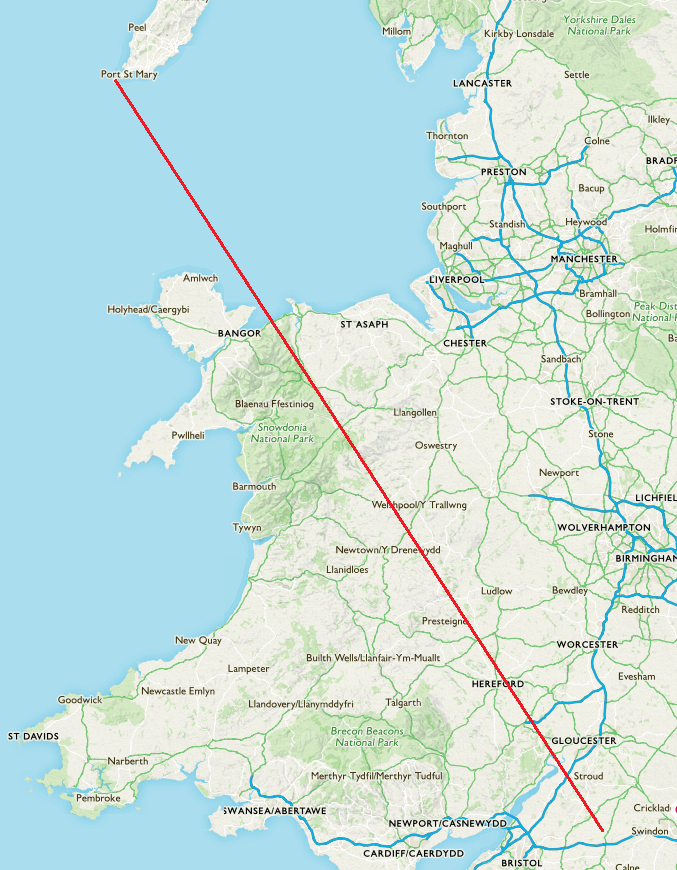
The highlight of the session was a recaptured Goldcrest which, although ringed in the UK, was not on one of our rings. It will be interesting to find out where it was ringed and I will update the blog when I get the feedback.

Tedworth House: Tuesday, 15th October 2019

The weather at the moment is making ringing very difficult.  We could not get a suitable day for last month’s session and this month’s session, scheduled for Wednesday, had to be brought forward by a day to ensure it could go ahead.  I find that I am often having to make decisions on the fly about if, where and when we can fit in a session.  I was joined by Andrew Bray for the day. The omens did not look good: each of us, coming from north and south respectively to converge on the House, drove through rain on our journeys. Then we had to sit and drink tea and coffee for half-an-hour until the unforecast rain stopped.  We set the nets at 7:30 and, although the weather was never any better than miserable, it didn’t rain again and we had a reasonable catch of birds.

The catch was: Jay 1; Blue Tit [2](1); Great Tit [3]; Coal Tit [1](1); Wren [3]; Dunnock 1[3](1); Robin [2](1); Blackcap [1]; Chaffinch 2[1].  Totals: 4 adults ringed from 3 species; 16 juveniles ringed from 8 species and 4 birds recaptured from 4 species, making 24 birds processed from 9 species.

Not the biggest catch but nice to be able to ring all of the Chaffinches we caught, with no sign of any Fringilla papillomavirus.  Also, the juvenile Blackcap we caught weighed just 16g.  If this bird was on outward migration it is far too light, so we rather thought that this might be an inward migration from central Europe, to overwinter in the UK.  This is a known phenomenon with Blackcaps, where their migratory habits have changed in the last 50 years to establish a winter population in the UK.

The Jay provided me with some amusement, at Andrew’s expense.  He was diligently clearing the netting from the birds feet. As soon as he had cleared one foot and went to the next, it grabbed hold of the net again with the cleared foot.  I wandered over and just picked the bird out of the net in the ringer’s grip and it just let go of the net and came away.

We had the opportunity to show the birds to a number of the site’s beneficiaries, who were pleased to see their first Dunnock, Blackcap and Chaffinch close up. It was also nice to have some interested and interesting questions on the birds.  How the Dunnock got its name was of particular interest to some of the people there.

We closed the nets at 11:30 and headed home.

Redwing Return: Somerford Common, Thursday, 10th October 2019

With the weather being dreadful yesterday and looking bad for the weekend, I took the opportunity of a break in the weather today to get in a visit to Somerford Common.  After our juvenile Marsh Tit captures in Webb’s Wood, and then three in Red Lodge, I was hoping we might have a clean sweep of them in the Forestry Commission properties. As they have made the Marsh Tit their priority bird species in their new 10 year plan for the Braydon Forest I am hoping to show that their efforts are being rewarded.

I was initially going to be joined for the session by Tony Marsh.  Tony, along with Robin Griffiths, is a regular supplier of sightings of my colour-ringed Marsh Tits. He came along for a taster session, to see whether he would like to become involved in the ringing programme.  As I was preparing to leave for site I got a text from Jonny Cooper.  He had planned to ring at one of his farmland sites, only arriving there he found the place flooded and the wind was too strong for the open area, so he diverted to come and help out with me.  It was just as well: the catch was every bit as large as the one at Red Lodge last Saturday.  We got another pair of helping hands at 9:00 when Steph arrived, with 7 month-old Beatrice, and helped with the extracting and processing (Steph that is, not Beatrice (yet)).

I put on a lure for Redwing, in hope rather than expectation.  They have been coming in along the east coast and making their way inland but I tried at Red Lodge on Saturday without success so wasn’t hopeful.  I left Jonny and Tony putting up nets along the top line to check on the first net set and get my warning signs for the net rides. That first net had 20 birds in it already: including this beauty:

20191010Redwi

Our first Redwing of the year! Delighted.

The morning just improved from there and we ended up with an excellent catch of 76 birds.  The highlights, apart from the Redwing, were: a Blackcap, from its weight and amount of fat, a migrant bird on the way south; three new Treecreepers and a recapture but, best of all, four new juvenile Marsh Tits.

The list for the day was: Nuthatch {1}; Treecreeper [3](1); Blue Tit 2[18](3); Great Tit [12](1); Coal Tit [2]; Marsh Tit [4]; Long-tailed Tit {2}(2); Wren 1[4](1); Robin 2[3]; Redwing 1; Blackbird 1; Blackcap [1]; Goldcrest [9](1); Bullfinch 1. Totals: 3 ringed unaged from 2 species; 8 adults ringed from 6 species; 56 juveniles ringed from 9 species and 9 birds recaptured from 6 species, making 76 birds processed from 14 species.

Catching at this level in the woods at this time of year is unusual for my sites: it makes me wonder just how large our catches are going to be when I set up the feeding stations at the end of this month!

We packed away at noon, just as the wind finally got up and the first spots of rain arrived. We managed to get everything packed away and leave site without getting wet. Result!

Flocking Titmice: Saturday, 5th October 2019

With none of the team making themselves available to help today (just like last Saturday: hmmm!) I decided to be a bit conservative with my net setting. I restricted myself to just two net rides: one comprising 3 x 18m nets and the other comprising 2 x 18m and 1 x 12m net set at right-angles to the 18m nets.  It is a bit of a funny time of year for ringing: there is the tail end of the autumn outward migration and the beginning of the winter inward migration.  You never know what you are going to catch.  In the event, I caught one Chiffchaff and no winter visitors.

Most of my catch was made up of a number of small flocks of titmice, the sort of catch that I would expect to get at my feeding stations during the winter.  However, I have just checked my records and, on the equivalent session at Red Lodge last year, the catch was incredibly similar: I just didn’t catch as many Goldcrest as last year (because I didn’t lure for them).

The catch today was: Treecreeper [2]; Blue Tit 2[30]; Great Tit 2[13](1): Coal Tit [6](1); Marsh Tit [3]; Long-tailed Tit {8}; Wren [2](1); Robin [1]; Blackbird [2]; Chiffchaff [1]; Goldcrest [3].  Totals: 8 birds ringed unaged from 1 species; 4 adults ringed from 2 species; 63 juveniles ringed from 10 species and 3 birds recaptured from 3 species, making 78 birds processed from 11 species.

The session started well: with 2 juvenile Marsh Tits in the first round. Numbers had been a bit down this year but they are now on a par with the catches in previous years, excepting the freakish result in 2017. A third caught in the third round took the total to 4 for the week.  As my next two sessions are in woodlands that have been notable strongholds for the species (Somerford Common and Ravensroost Woods) I am hoping that we will gain a few more to the total.

Alongside the catch, there was a lot of other bird calling going on. Nuthatches and Great Spotted Woodpecker were very much in evidence.  A constant refrain throughout the morning was a juvenile Sparrowhawk calling to be fed.  It does seem late for it to be still expecting to be fed by a parent.

Webb’s Wood: Wednesday, 2nd October 2019

The summer is over, autumn migration is winding down and winter is just around the corner.  Actually, with a temperature of 6°C first thing this morning, it felt wintry already.  Jonny and I met at the entrance to Webb’s Wood at the civilised time of 7:00. We set our usual nets, along the main path and side paths at the eastern end of the wood.

At this time of year catches in the woodlands can be a bit hit or miss: there are tit flocks around, but they are not concentrated in any particular area: you either catch a flock or you don’t! It can make a huge difference to the size of the catch.  Naturally, the most frequent time to catch a large tit flock is usually just after you have decided to finish for the day!  Equally, there might be a few Redwing around, some finch flocks maybe, but there is no definite pattern at this time of year.  As luck would have it, we had no flocks of any description in the nets today.

Being out of the breeding season we are allowed to use sound lures, which we did this morning.  However, they were singularly unsuccessful in luring in any of the targeted species until, at 10:00, I put on a lure for Goldcrest.  I am always careful about luring such a small bird, hence the late start time for it. They weigh between 4.5g and 6.0g and I want them to have had plenty of time for breakfast before trying to catch them.  Exactly as expected, they responded very quickly to the lure and we extracted 13 of them: the biggest catch of the morning.  All processed safely and released without harm.

In the event we had a very reasonable catch for this wood at this time of year: 39 birds from 10 species. The list was: Blue Tit [1](1); Great Tit 1[1](1); Coal Tit 1; Marsh Tit [1]; Long-tailed Tit {2}; Wren [4](1); Robin [7](2); Blackcap [1]; Chiffchaff [2]; Goldcrest [10](3). Totals: 2 ringed unaged from 1 species; 2 adults ringed from 2 species; 27 juveniles ringed from 8 species and 8 birds recaptured from 5 species.

The highlight of the session was the juvenile Marsh Tit: they have been a bit light in the catch this year, and this was a welcome addition: the first for the site this year.

Blakehill Farm: Saturday, 30th September 2019

Since we got back from Skokholm  on the 19th September every effort we have made to get out ringing has been thwarted by the weather. Despite favourable weather forecasts for last Monday and Saturday, the reality was high winds (Monday) and pouring rain (Saturday).  The forecast for this morning was that it would rain overnight, dry up early morning and be dry by 6:00, with low winds until 11:00 and rain from 13:00.  Astonishingly, it was 100% accurate and I watched the rain roll in from the comfort of my car on the way home.

So to Blakehill Farm at 5:30 this morning. As I was going to be working solo, I decided to only set nets by the plateau bushes, and a Mipit triangle, as per the diagram below:

Blakehill

A Mipit triangle is the standard way of catching Meadow Pipits: 3 x 12m nets set as an open triangle.  They are set with the bottom shelf low to the ground, with a lure playing in the middle of the nets. Meadow Pipits fly slowly and, as a result, are very adept at flying over and around nets.  With the triangle, they are tempted in by the lure, and when ringers approach the nets, they tend to forget to fly over or around but fly into the nets.  It worked superbly today: 47 caught in 5 net rounds.  Blakehill has become our regular site for numbers of Meadow Pipits, and it seems to have coincided with massive irruptions of crane-flies.  The beauty of the site is that the only fertiliser it ever gets is from cattle and sheep. No pesticide: lots of insects, good numbers of birds!

The list from today was: Swallow [1]; Blue Tit [9]; Wren [1]; Dunnock [1](2); Meadow Pipit 5[42]; Stonechat [3]; Lesser Whitethroat [1]; Chiffchaff [1]; Goldfinch [1]; Reed Bunting 4[3](1). Totals: 9 adults ringed from 2 species; 63 juveniles ringed from 10 species and 3 birds recaptured from 2 species, making 75 birds processed from 10 species.

The highlights of the catch were the 3 Stonechat and a totally unexpected Lesser Whitethroat.  This bird is the latest ever capture of a Lesser Whitethroat by the West Wilts Ringing Group, checking all records as far back as the BTO database goes.

The only downsides at Blakehill this year have been the complete lack of Whinchat in the catch and the dearth of Swallows.  Unfortunately, still no Whinchat this session, at our most regular site for them. Also, despite having a huge fly through of Swallows for the first time this autumn, I was not set up for catching them, although one juvenile did fly into a net.  Usually we catch them flying along the perimeter track hedgerow but I had more than enough to manage without any additions.

I kept an eye out for the change in the weather but needn’t have worried: the wind got up at 11:30, so I closed the nets and took down.