Brown’s Farm: Saturday, 13th July 2019

Brown’s Farm sits at the top of Postern Hill, south of Marlborough.  It is the least sheltered of my sites and can only be ringed when the weather is expected to be more or less flat calm. The forecast was for it to become breezy as the morning wore on but I decided to take a risk on a session, as the results from my two Breeding Bird Survey (BBS) visits have been very encouraging,   The wind was forecast to come from the north, with nothing to block or mitigate its passage over the Marlborough Downs, so net positioning was important.  One of the key things about Brown’s Farm is the fantastic hedgerows they have surrounding the fields.  These hedgerows are primarily hawthorn and blackthorn kept trimmed to just above head height  and threaded throughout with dog rose, bramble and many other species of wild plant. As well as that, there are plenty of weedy, seedy edges to the fields, as you can see from the photograph below.

IMG_20190713_103345805_HDR

This enabled us to set some nets which were a little sheltered from the breeze.  I was joined by Jonny Cooper and Henny Lowth (my latest volunteer and, yes, that is spelt as she spells it). The wind did get up earlier than I was expecting and we did have to pack up early, as the wind became untenable at about 9:30.  By then we had already caught over 50 birds from a decent selection of species.

It was a good diverse catch: Blue Tit 1[8]; Dunnock 2[3]; Blackbird [1]; Blackcap [1]; Garden Warbler [1]; Whitethroat [1]; Chiffchaff [3]; Chaffinch 2; Linnet 4; House Sparrow 6[12](1); Yellowhammer 3[3](1).  18 adults ringed from 6 species, 33 juveniles ringed from 9 species and 2 retraps from 2 species, making 53 birds processed from 11 species.  The only disappointments were that we didn’t catch any juvenile Linnet or Chaffinch, and that there was no sign of the Yellow Wagtail seen on my last BBS visit.]

However, it was lovely to get our first juvenile Yellowhammers of the year:

2019_07_13Yelha

The surprise catch of the morning was a juvenile Garden Warbler.  We catch them regularly at Lower Moor Farm and the Ravensroost complex but this is miles away from what I think of as their normal habitat: scrub and woodland edges.  Instead it was on an arable farm with fields full of wheat, barley, oats, oil-seed rape and maize, a couple of horse paddocks and the aforementioned fabulous treeless blackthorn / hawthorn hedgerows with weedy seedy edges to the fields.  It was a juvenile so I expect that it was dispersing from more suitable habitat: perhaps the water meadows along the river Kennet running through Marlborough.

All in all a very satisfying session. Henny, on only her second outing with us, has already shown that she can extract birds with enough care to bode well for her future as a bird ringer.


Cetti’s Bonanza: Lower Moor Farm; Wednesday, 10th July 2019

This was session 7 of our Constant Effort Site activity for 2019.  We had a good sized team out this morning: Jonny Cooper and Andrew Bray, with David Williams joining us at 8:00. Also, we were joined by Henrietta Lowth (Henny) for the first time.  She has some limited ringing experience, working with Blue Tits and Flycatchers.  The former and their aggressive behaviour in the hand clearly hasn’t put her off.   To date Henny hadn’t done any work with mist nets so, after a couple of hours watching the extraction techniques, she got to extract her first bird.  I was kind, it was a Blackcap: one of the nicest birds to handle, and certainly one of the best to start someone’s training on extracting birds from mist nets.  That she is prepared to drive from near Bath to work with us is very flattering: especially as we are starting at 4:30 in the morning at the moment.

Last year in the equivalent session (7th July 2018) we caught 36 birds from 16 species (26 ringed, 10 recaptures).  After the first two rounds I was convinced that we would be exceeding that total.  The catch was pretty solid between 5:00 and 8:00, and then tailed off, until we had an unexpected highlight at 9:15.  It tailed off again subsequently.  The hotter it gets the less the birds move around.

Since I started the CES at Lower Moor Farm in 2015, and prior to the start of this year’s CES sessions, we had ringed a total of 11 Cetti’s Warblers (including one in March of this year). Before today’s session we had ringed another 3, 2 of which were juveniles fledged this year.  Our first round delivered up another Cetti’s juvenile, which was pleasing. However, our 9:15 round provided another 4 youngsters. They were all in the same net, at the same height, three were evenly dispersed and one was a little further away.  They were so young that we thought that they might have been flushed from the nest by a potential predator.  For the absence of doubt: nothing to do with us.  The net they were caught in was at least 10m from the nearest potential nest site, and we do not flush birds from nests: it is illegal to do so.  We processed them and returned them to the place from which they were extracted and where we could hear, what we presume was, an adult Cetti’s contact calling. They all flew off strongly and safely in that direction.  So this year has definitely been our best ever for Cetti’s at the site: a total of 9 ringed, all bar two are juvenile birds fledged this summer and we have had 3 other birds recaptured several times.

The rest of the catch was also extremely satisfying.  It was: Treecreeper [1]; Blue Tit 1[3](1); Great Tit [2]; Long-tailed Tit (2); Wren [10](4); Robin [3](1); Song Thrush 1(1); Blackbird 1; Cetti’s Warbler [5](2); Blackcap [19](5); Garden Warbler [2]; Whitethroat 1[1]; Lesser Whitethroat [2]; Chiffchaff 1[14](2); Willow Warbler 1. Totals: 6 adults ringed from 6 species; 62 juveniles ringed from 11 species and 18 birds recaptured from 8 species, making 86 birds processed from 15 species.

Wrens are having the most astonishing breeding season: in the last month we have caught 37 newly-fledged juveniles, with 10 in this session being the icing on the cake.

All of the summer visitor warblers are showing signs of a successful breeding season, with a fine catch of juveniles from both Blackcap (78) and Chiffchaff (53), and smaller but significant catches of Willow Warbler, Whitethroat, Lesser Whitethroat and Garden Warbler, all caught in the last month.  As this is just the start of the fledging period, and many of these will already have gone on to have a second brood, and might even stretch to a third, this could be a bumper year for them.

Over the course of the morning we had quite a few visitors: a member of teh Care Farm staff taking one of her young charges for a walk; a grandma taking her grandson out to enjoy the sunshine; a photographer looking out for dragonflies, who was lucky enough to be with us when we made the catch of the Cetti’s family, and a large group of infants and their parents doing forest school with staff from the Trust, who turned up when we didn’t have any birds to show: but I took them around the nets and did manage to show them a superb Brown Hawker dragonfly (Google it) that had become trapped in the net. I successfully extracted it without damage, and was able to show him off to the children before releasing him to hunt for smaller insects for food.

We closed the nets at about 11:20 and took down and were away from site by 12:15. A cracking, good session.

Garden Ringing: Monday, 8th July 2019

I haven’t done a garden session for nearly a year but sitting in on Steph’s first session prompted me to set up the nets and have a go.  I had my moth trap out in the garden last night, and thought it would be good to do a bit of ringing whilst checking what I had managed to attract to the light.  What I didn’t expect was that in a three-hour stint with 4 short nets set up I would trap more birds from more species than I did in Red Lodge on Saturday, from 4 times as much net and over a period of 6 hours.

Red Lodge is usually a very reliable site but, for whatever reason, Saturday was a very disappointing session.  There were lots of birds around but, unfortunately, they were around the tree-tops. I heard plenty of Great Spotted Woodpecker, Nuthatch, Marsh Tit and Long-tailed Tit, but caught none of them.  The list for the session was: Blue Tit 1[4]; Great Tit [3]; Coal Tit [1]; Wren [5]; Robin [3]; Song Thrush 1; Blackbird 2[1]; Blackcap [1]; Chiffchaff 1[2].  Totals: 5 adults ringed from 4 species and 20 juveniles ringed from 8 species, making 25 birds processed from 9 species.

The only species that the garden catch had in common with Red Lodge were Blue Tit, Coal Tit and Blackbird.  Of course, catching a Coal Tit in my garden is rather more unusual than it is catching them in Red Lodge.  However, the absolute highlight of my catch was a true first for my garden: a Whitethroat.  I have been studying the birds that come into my garden for nearly 11 years now and I have never seen a Whitethroat in the garden, let alone catch and ring one:

2019_07_08 Pavenhill

In addition, a newly fledged Goldcrest was good catch. I have seen and caught Goldcrest in the garden before, but this was the first juvenile.  The list for the session was: Blue Tit 2[8]; Coal Tit 1; Long-tailed Tit [2]; Dunnock 1[3]; Robin 1[2]; Blackbird [1]; Whitethroat [1]; Goldcrest [1]; Goldfinch 1[2]; Greenfinch 1[5].  Totals: 7 adults ringed from 6 species and 25 juveniles from 9 species, making 32 birds processed from 10 species.  It would have been 11 species but a Woodpigeon managed to extricate itself just before I got to it.

Anyway, as a different footnote, here are a few of the moths I caught last night:

Poplar Hawk Moth

Poplar HM

Privet Hawk Moth:

Privet HM

Yes – it is that big. Finally: a Sharp-angled Peacock:

Sharp-angled Peacock


Meadow Farm: Friday, 5th July 2019

This is a post by Jonny Cooper:

It generally takes a year or two after you start ringing at a site to understand how the site works and the best places to put nets to catch the birds using the site. Over the past few months I have been ringing regularly at Meadow Farm, near Sutton Benger, to monitor the bird species using the site and to locate and develop new net rides. So far the catches have reflected this effort with good numbers of birds being caught; for this session the extra effort put in to develop the site really paid off.

The forecast for the day was to be almost flat calm with temperatures rising to the low 20’s by lunchtime; good weather for ringing. Nets were set the night before and I arrived on site to start the session at 5:00 am. Whilst opening the nets 12 birds were caught, this was very much a sign of things to come. The first round proper delivered 58 birds, after extracting the birds I closed the nets to allow me to focus on processing them safely and to ensure that no birds were caught during this time. Once they had been processed I reopened the nets and caught a pretty regular 20 birds per round over the next few hours. The catch was as follows:

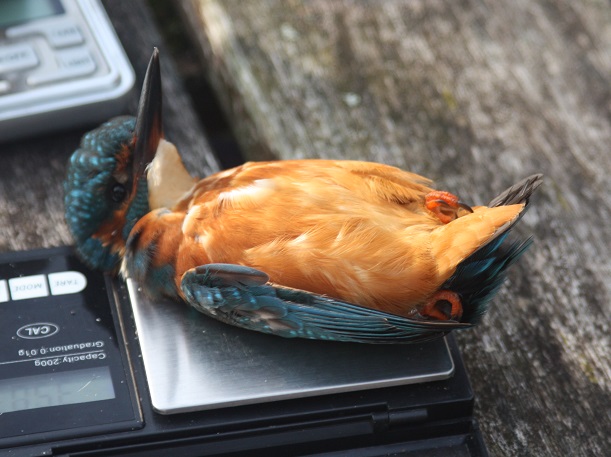
Blackbird 1[1]; Blackcap 8[6]; Blue Tit [19](1); Bullfinch 1; Chaffinch 1[2]; Chiffchaff [5]; Dunnock [2]; Goldfinch 3[1](1); Great Spotted Woodpecker [1](2); Great Tit [40](9); Greenfinch 1[2](1); Kingfisher [2]; Reed Warbler 5[3](3); Robin 1[1](1); Sedge Warbler [3](1); Song Thrush (1); Whitethroat 1(1); Wren [3](2). Totals: 22 adults and 91 juveniles ringed from 17 species with 23 birds retrapped from 11 species; making 136 birds from 18 species.

Catching 2 Kingfishers is the obvious highlight, but catching juveniles of both Reed & Sedge Warblers was fantastic; I have caught adults of both species on site previously but to get proof of breeding was excellent. Other highlights were the number of Blackcaps and the Whitethroats. Most of these birds were caught in the new nets rides.

Overall it was a great, but busy session, the temperature started to rise late morning and the birds stopped moving. I closed the nets at 11, took down and went home for a well-earned rest.

Going Solo: Down Ampney, Thursday & Friday, 4th & 5th July 2019

When people start bird ringing the first thing they have to do is to find a trainer.  Anybody who wants to become a qualified ringer must have a permit issued by the British Trust for Ornithology who administer the scheme on behalf of (eventually) DEFRA.  Trainees start on a T-permit.  They are only allowed to ring if accompanied by their trainer, or another ringer with a permit endorsement allowing them to train.  The next step is called a C-permit. This allows trainee ringers to work unsupervised, but they are still responsible to their trainer for their activities, who are, in turn, responsible to the BTO.  This is an important step for any trainee, as they start to work solo.

My trainee, Steph, has been working with me for 2.5 years and is a truly competent ringer. When she became pregnant she was concerned that she would not be able to get out ringing for a long time. However, I knew she was skilled and reliable enough for me to recommend her for her C-permit, which was duly granted by the BTO.  This enables her to ring in her garden.

The garden backs onto fields along the long edge, with scrub running along between the field and the garden. There are a few small trees along either side of the garden and plentiful bird feeders.

Garden 2

If you have a good garden then garden ringing is the best of all worlds: all the amenities on tap, birds to ring and you can keep an eye on baby.  Thursday was Steph’s first go in her garden.  I popped over to support for the first couple of hours, but she had already caught her first birds, and processed them, by the time I arrived.

Over the course of the morning she caught Dunnock 2; Robin 1; Blackbird 1; Chaffinch 1; House Sparrow 12.  All were new birds, as you would expect, the Robin, one of the Dunnocks and two of the House Sparrows were juveniles.  This morning she caught two Blue Tits: one a juvenile.

So a nice, quiet start to Steph’s solo ringing career: here’s to many more!


What no Titmice? Somerford Common: Wednesday, 3rd July 2019

Okay, a sightly misleading title, but only just.  To run a session in the Braydon Forest at any time of year and not catch a single Blue or Great Tit is remarkable.  Given that we have been catching extremely good numbers all over the Forest and at Lower Moor Farm, particularly juvenile birds, this was really surprising.  We did ring our sixth Marsh Tit of the year, a juvenile, which bodes well for this species this year.  Our catch tends to be one third in the first six months of the year, two thirds in the remaining six months, so hopefully we will get close to the 19 we ringed in 2017, our best year to date.  There was also a Long-tailed Tit, but they are not really titmice, being a completely different bird family. (Titmice belong to the family Paridae; Long-tailed Tits belong to the family Aegithalidae or Bushtits.)

I was joined by Jonny Cooper for the session.  It wasn’t the busiest we have ever been but the weather was fine and the birds came in quite regularly.  We were surprised to catch a flock of 6 adult Goldfinches.  They were all together in one net: 4 males and 2 females.  Two of them (one each of the males and females) were already ringed.  One of them, the female, had a ring number that I didn’t recognise but which sparked off something in Jonny’s consciousness: that it might have been one of the birds he had ringed at one of his sites near Chippenham.  The data recording system now in use at the BTO is a browser-based on-line system and so, if you can get a signal on a smart phone, you can check the database.  The signal for both of us (two different providers) was awful but eventually I managed to get a signal and check the number. The bird had been ringed by Jonny in February if this year at a site near Sutton Benger, about 11 miles south west of where we caught it today.  We know that Goldfinches, for a resident species, are wide ranging: the furthest journey we have trapped through ringing was a bird ringed near Hungerford in Berkshire, recaptured in Webb’s Wood, a distance of 25 miles or so.  What surprised me, though, was why there was a flock of Goldfinch together at this time of the year.  We expect them in the winter, when foraging for food, but fully expected them to be paired up and breeding at this time of year.  All of them were in breeding condition: perhaps they were between broods, as Goldfinches will have 2, sometimes 3, broods in a year.  Mind, according to BTO Bird Facts the latest a first brood has been started is the 19th July, so perhaps they are still just working out who is going to pair with whom.

The catch for the morning was: Marsh Tit [1]; Long-tailed Tit [1]; Wren 1[1]; Dunnock 1[1](2); Robin [4](1); Song Thrush 2; Blackbird 3; Blackcap 1[2]; Garden Warbler [1]; Chiffchaff 1[5](3); Willow Warbler 1(1); Goldfinch 4(2); Bullfinch 2.  Totals: 16 adults ringed from 9 species; 16 juveniles ringed from 8 species and 9 birds recaptured from 5 species, making 41 birds processed from 13 species.

As you can see, when comparing this to recent catches, the proportion of juveniles is much lower: which comes back to the original title of this blog post.  We could hear them in the woodlands around us but they just did not come into the nets.

There was some pretty spectacular other wildlife around: fabulous butterflies, from the commonplace Meadow Brown, to large numbers of Ringlet, a couple of Comma and Small Tortoiseshell and two stunning White Admiral and a Silver-washed Fritillary. However, the absolutely stunning invertebrate was a dragonfly: a Brown Hawker. It was sunning itself against one of our net poles. Needless to say, it posed for as long as it took me to get my phone out and enable camera mode before flying off. Always the way!

We had a nice chat with a couple of dog walkers who were interested in what we were doing but, unfortunately for them, they arrived during our quietest round of the morning, when we had no birds and, therefore, nothing to show them. As the birds had stopped moving around by 11:00 we took down and headed home.


Potterne Wick: Tuesday, 2nd July 2019

Andrew Bray, after a couple of months of leading wildlife tours around Europe, set up for a ringing session in his garden in the hamlet of Potterne Wick in middle Wiltshire.  The day started bright and sunny, with the nets open at 6:00.  By 10:00 the wind had got up and so Andrew closed the nets.

The list was fairly predictable for a garden session: Blue Tit 1[17]; Great Tit [11]; Dunnock [6](1); Goldfinch 1. Totals: 2 adults from 2 species; 28 juveniles from 3 species and 1 retrap, making 37 birds processed from 4 species.

There is no doubt that Blue and Great Tits have had an excellent breeding season.  Perhaps the most surprising catch though were the 6 juvenile Dunnocks.   That is an excellent number for a garden session.  The recaptured Dunnock was ringed in the garden almost exactly 1 year ago and is Andrew’s first garden retrap.

Better & Better: Lower Moor Farm, Sunday, 30th June 2019

In order to avoid Saturday’s scorching temperatures, Jonny Cooper and I agreed to move CES session 6 to Sunday.  It was considerably cooler, broken cloud and light to breezy winds. Fortunately, our nets are largely sheltered from the prevailing wind direction and so the activity is not compromised.

We started at the unearthly hour of 4:00, had the nest open pretty sharpish and were processing birds by 4:45.  The catch was steady for the first 6 rounds and then we had a flock of juvenile Blue Tits drop into our net set along the main track between Mallard Lake and the two smaller lakes.  After that the catch rather fell away, as is usual over the course of the morning.

About 8:00 we were treated to the dog Otter turning up again, swimming across Mallard Lake towards the link to Swallow Pool / Cottage Lake.  Not as spectacular as last time but good to see again.  A little later I was lucky enough to see a Kingfisher flying north to south across Mallard Lake.  We caught one last session, the first for two years, so any sightings are very welcome.

As has been the case so far this year, we caught more than double the number of birds taken in the equivalent session last year (87 compared to 39).  The list for the day was: Blue Tit [23](1); Great Tit [5]; Wren [8]; Dunnock 1[2](5); Robin [4]; Cetti’s Warbler [1](3); Blackcap 4[9](2); Garden Warbler [2](1); Whitethroat 1(1); Lesser Whitethroat [1];  Chiffchaff 1[5]; Willow Warbler 2[4]; Greenfinch 1. Totals: 10 adults ringed from 6 species; 64 juveniles ringed from 11 species; 13 birds retrapped from 6 species, making 87 birds processed from 13 species.

The highlights of the session were: retrapping the juvenile Cetti’s Warbler ringed last session, plus ringing a second juvenile Cetti’s of the year.  We also heard male Cetti’s singing from 4 different locations during the course of the morning, with a first being heard along the ride on the Gloucestershire side of the stream.  Garden Warblers are also putting in a good showing this year, with 8 juveniles ringed between 1st May and 30th June, compared to just 4 in this period last year, 4 in 2017, 3 in 2016 and 4 in 2015.  However, my absolute highlight was this:

2019_06_30Leswh

This is our first juvenile Lesser Whitethroat of the year. It is not that I am greedy but I am looking forward to catching a few more and hoping for our first juvenile Whitethroat of the year next session.  Having started half-an-hour early we closed the nets at 11:00, half-an-hour earlier than usual but necessary as the light breeze had turned into quite a strong breeze and it was now interfering with the nets.  There are three reasons for shutting the nets when it gets windy:

  1. The billowing of a net removes the pockets, so the birds can escape the net;
  2. The nets will seek out any nearby vegetation to become entangled in, their preference being brambles and blackthorn and,
  3. most importantly, the possibility of damage to the birds, due to shear forces along the horizontal net lines and tethers.  This has never happened in one of our sessions because I don’t allow the nets to stay open in adverse conditions. We are very careful.

I am extremely hopeful that this excellent summer will continue.  The mix of weathers seems to be working well for our local birdlife, as evidenced by the proportion of juveniles to adults being ringed.

More Fledglings: Ravensroost Woods, Wednesday, 26th June 2019

One of the key benefits of the Ravensroost Woods site is that, when the wind is blowing hard elsewhere, in the middle of this wood it usually remains calm. It can be quite odd to sit at the ringing station watching the tops of the trees blowing backwards and forwards whilst remaining unaffected by it. This was how it worked out this morning.  I was joined for the session by Jonny Cooper, Andrew Bray and David Williams.

The catch was sporadic, with good rounds often being interspersed by two empty rounds. My usual rule is that if I have two empty rounds I will pack up and go home. Today I waived the rule and it paid dividends.  Mind, if I had stuck to it we would have packed up at 9:00.

There were several highlights in the session: unfortunately, no photographs were of sufficiently good quality to include, except this highly cropped one of our first juvenile Willow Warbler of the year:

2019_06_26Wilwa

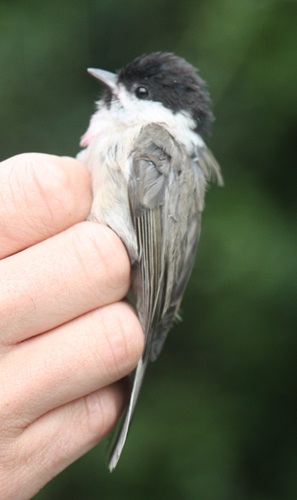
One of the key projects for my team is the Braydon Forest Marsh Tit project.  Marsh Tits are seriously in decline, almost certainly due to habitat loss and fragmentation.  They are a highly sedentary species: with fewer than 5% of individuals moving more than 5km from their natal woodland.  For example, we have ringed over 120 Marsh Tits in the Forest since we started the project in autumn 2012.  Only 1 of those birds has moved to a different woodland: it was ringed in Webb’s Wood and recaptured in Red Lodge.  We colour ring Marsh Tits so that they can be identified  in the field by birders / casual observers.  This morning we caught our first juvenile of the year.  Hopefully we will catch a fair few more in the next couple of months.

Our third new fledgling species for the morning was a Nuthatch. This brings the number of species confirmed breeding at our sites, from which we have been able to ring newly-fledged juveniles, so far this year to 22 species.  Our complete list for the day was: Nuthatch [1]; Treecreeper [2]; Blue Tit [2](1); Great Tit [3](2); Coal Tit [1]; Marsh Tit [1]; Long-tailed Tit 1[1](1); Wren [3]; Robin [8](2); Song Thrush [1]; Blackbird 3[2](1); Blackcap 1[2](2); Garden Warbler [1]; Chiffchaff 3; Willow Warbler 1[1].   Totals: 9 adults ringed from 5 species; 29 juveniles ringed from 14 species and 9 birds recaptured from 6 species, making a total of 47 birds processed from 15 species.  To capture 15 species of bird in a relatively small part of a medium sized wood with no lures or inducements (like feeding stations) speaks well of the structure and quality of the habitat.

As the period within which we have been ringing in Ravensroost Woods grows, it is always good to catch birds that have been ringed on the site and have survived four or more years.  This morning we recaptured a Robin, ring number D983334, which was ringed as a juvenile on the 24th June 2014.  It has presumably inhabited the wood during that time, but this was the first time it had been recaptured since it was ringed as a newly fledged juvenile back then.   It needs to survive another 4 years and 4 months if it is to surpass the current longevity record for a bird of this species, that was set in 1977.  However, they typically live for 1 years and the annual mortality rate of second year plus bird is 50%.

With the catch having decreased significantly, we packed up at 11:00 after a satisfying session.  In the equivalent session last year we ringed only 14 birds and recaptured 5, so this was a significant improvement.


Tedworth House & Webb’s Wood: 20th & 22nd June 2019

A challenging couple of sessions, for all sorts of reasons, but with some highlights.  Having been doing my monthly Help-4-Heroes session for 6 years now, what I do and how I involve the beneficiaries, staff, visitors and volunteers is well known within the House.  I had to move the session from Wednesday to Thursday because the weather forecast for the scheduled session was not good.  Unfortunately, this information was not passed on to the staff by my contact and, as a result, nobody was informed at morning muster that I would be on site.

Andrew Bray was going to join me on site. I sent him the start time of 6:00. Unfortunately, I inadvertently sent it to his Facebook Messenger account, not his mobile or email account and he didn’t see it. He assumed we were using the normal 4:30 start time and waited for me until 5:45, whereupon he went home. I rolled up 15 minutes later.  Dave Turner helped me set up and provided the bacon sandwich.  I was also joined by one of the non-resident beneficiaries, dealing with PTSD, who spent the morning with me, getting a good close look at the birds in the hand and being taught about ringing and how to handle the birds.

Everything went quite well until just after 9:00 when I went to check my nets adjacent to the Hero Garden.  As I got to the nets I saw that the bottom shelf of my 9m net was flapping in the breeze. Stood there with a Blackcap in his hand, along with a considerable part of my net, was one of the beneficiaries. I was not happy, for so many reasons.  Fortunately, the bird was undamaged, which is more than could be said for the net.  The staff members were all very apologetic, but they sanctioned the action.  In that closed environment I cannot understand why they didn’t check with management before taking any action.  They have agreed to replace the net.  I will have to make sure that I put up signs there, as I already do everywhere else, in future.

Anyway, the significant upside to the session was the ringing of my second Grey Wagtail at the site. Although I had previously ringed 9 Grey Wagtails, this was the first newly-fledged bird of the species that I have ringed. All of my others were caught at Marlborough Sewage Works during winter sessions, when I was a trainee.  It wasn’t a big list for the day, just 14 birds: Blue Tit [3](1); Great Tit (1); Wren (1); Dunnock (1); Grey Wagtail [1]; Blackbird [1](1); Blackcap 2[1]; Goldfinch 1. Totals: 3 adults ringed from 2 species; 6 juveniles ringed from 4 species and 5 birds recaptured from 5 species, making 14 birds processed from 8 species.

So to Saturday morning and Webb’s Wood. I was going to be joined by Jonny but he got a last minute invitation to go with the Wildfowl and Wetlands Trust team going to ring Greylag Geese in the Lake District. Annie was also going to join me but she called off sick first thing.  So that left me working solo.  I set 4 net rides comprising a total of 12 x 18m nets.  It was quite cold early on (between 4:00 and 6:00) with few birds moving around. It got progressively hotter as the morning wore on until, by 10:00 it was very hot and the birds again stopped moving around.  I took down at 11:00, after a decent catch of 47 birds.

The highlights were two of these:2019_06_22Jay

They were the first two that I have caught in 2019, and the first for nearly a year.  I love the colour of the coverts:

2019_06_22JayWing

The second one was in a serious post-breeding moult and a good third of her coverts were missing.

The list for the day was: Jay 2; Blue Tit 1[14]; Great Tit [7](2); Coal Tit [1]; Wren 1[2]; Robin 1[3]; Song Thrush (1); Blackbird (3); Blackcap 3[3]; Chiffchaff 1(1); Goldcrest 1. Totals: 10 adults ringed from 7 species; 30 juveniles ringed from 6 species and 7 birds recaptured from 4 species, making 47 birds processed from 11 species.

Several of the adult birds were in post-breeding wing moult, including the Goldcrest, Blue Tit, both retrapped Great Tits and the previously mentioned Jay.