Brambling ambling in at Somerford Common: Monday, 11th February 2019

On Sunday I planned a session at Webb’s Wood. The forecast was for the rain to stop at 7:00 and for it to stay dry until midday.  I thought I would have a bit of lie-in and go for a 7:30 start.  I had the nets up and open by 8:15. At approximately 8:16 it started to rain: not heavy but persistent drizzle, so I took down again.  Very annoying: a solitary Blackbird, who blundered into a closed net, got a nice new ring.  That was disappointing. However, I had arranged with Jonny Cooper that we would be having another session at Somerford Common on Monday.

Having set up a feeding station at this part of the site two weeks ago, and carrying out the previously blogged about test session last week, Jonny suggested some slight changes to the net rides, and they paid dividends.

The southern end of Somerford Common always used to be my go to place for Lesser Redpoll, not that we ever caught that many but it was regular, with 10 being the largest catch. For a number of perfectly valid reasons (improving the habitat for Marsh Fritillary being a key one), the Forestry Commission carried out some significant clearing work which reduced its attractiveness to birds, so catching 3 Lesser Redpoll and a Siskin last week was encouraging. Catching 14 Lesser Redpoll and another 2 Siskin this morning is evidence that this site has recovered significantly.

However, the real highlight was unexpected, if not tried for. We had heard a few Brambling around the area but these birds have never been caught and ringed in any part of the Braydon Forest. There is no reason why not: most of the Forest is beech wood and they are regularly caught in the woods to the east of Swindon and in Savernake Forest and the surrounding woodlands but they just never seemed to get to the woods west of Swindon. I had spread some seed on the floor for Chaffinch and put on a lure for Brambling just in case. It worked: a male and a female dropped in and were caught and ringed.

2019_02_11Bramb

In addition, we caught another Great Spotted Woodpecker, 3 new Nuthatch, and another new Marsh Tit at the site and recaptured the Marsh Tit ringed last week.  Amongst all of the other birds caught, we did recapture a Blue Tit that was ringed as a juvenile in October 2017, and has been recaptured on several occasions, most recently in April of last year. On each of those occasions we noticed nothing out of the ordinary. This time it was sporting a huge avian pox pustule. Its weight was fine and it was feisty enough. We gave the weighing pot a thorough clean out with alcohol rub after weighing it: We don’t want to be culpable in spreading the infection.

2019_02_11Bluti Pox

The list for the day was: Great Spotted Woodpecker 1; Nuthatch 3; Blue Tit 16(7); Great Tit 4(8); Coal Tit 3(1); Marsh Tit 1(1); Robin 1; Chaffinch 6(1); Brambling 2; Goldfinch 4(1); Lesser Redpoll 14; Siskin 2. Totals: 57 birds ringed from 12 species; 19 birds recaptured from 6 species, making a total of 76 birds processed from 12 species.

On returning home, looking out the kitchen window, I couldn’t understand why there were no birds on the feeders and then I saw this fellow sat on the garden fence:

2019_02_11Sparr

I couldn’t get close enough to get a better photo but you can see what it is.


Somerford Common: Wednesday, 6th February 2019

After Thursday’s and Friday’s snowfall, I decided not to go ringing last weekend, as I felt the birds had enough to deal with, finding food and staying warm.  I set up a new feeding station in the old paddock area at Somerford Common before the snows fell last Thursday.  This large area is now going to be run on a coppicing regime by the Forestry Commission.  Most of the bushes have been cleared, plus a huge number of trees.  What is left is a sparse landscape with odd min-copses of either conifers or silver birch.  This area was always our best spot for Lesser Redpoll, so I selected the nearest mini-copse of silver birch to where we used to set our nets and put up a few feeders and cleared the regrowth around the edge for nets.

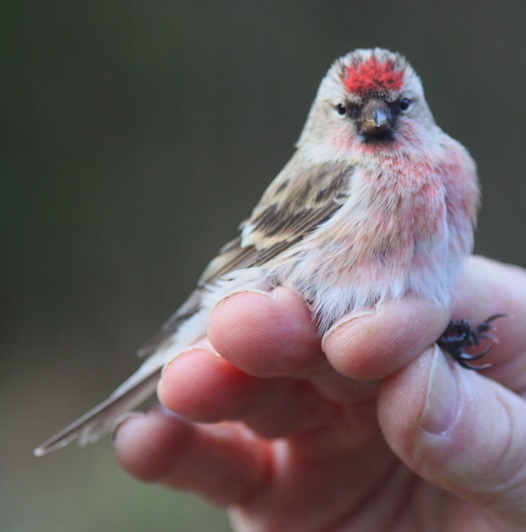
I went out on Tuesday to fill the feeders on my sites and was pleased to see a couple of Siskin at the Somerford Common feeding station.  This morning I was joined by Jonny and Andrew and we surrounded the copse with nets, hoping to catch the birds coming into or leaving the feeders.  There were small groups of Lesser Redpoll and Siskin and, we are pretty confident, Brambling in the area.  It was an experiment. It worked to a degree, but we did find that the Siskin and Redpoll were coming in through the treetops, dropping down and then leaving near to vertically from the feeders.  Not having canopy nets we are going to have to find a better solution.  At Webb’s Wood, which is my usual Siskin catching haunt, we have the nyjer seed feeder set in a narrow ride, with a net immediately adjacent to it.  We will cut something similar at Somerford and, hopefully, have two Siskin catching stations.  The degree to which our experiment worked was 3 Lesser Redpoll and 1 Siskin.  We caught no Siskin at all last year and only 2 Lesser Redpoll, so this was a thoroughly pleasing catch. This male Redpoll was the first one caught: an absolutely stunning bird.

2019_02_06Lesre

The Siskin was a juvenile female:

2019_02_06Siski

The list for the session was: Great Spotted Woodpecker 1; Blue Tit 5(4); Great Tit 7(3);  Coal Tit 2; Marsh Tit 1; Robin 1; Chaffinch 5; Goldfinch 1; Lesser Redpoll 3; Siskin 1.  Totals: 27 birds ringed from 10 species; 7 birds recaptured from 2 species, making 34 birds processed from 10 species.

Catching our second new Marsh Tit of the year was also a bit of a bonus: especially given that the habitat was completely wrong for this species.   The catch died off at 10:30, so we packed up at 11:00, leaving the birds to feed in peace.

The Firs: Saturday, 26th January 2019

Andrew Bray and I met up at the Firs this morning. The weather forecast was for it to be dry until mid-afternoon.  Unfortunately, the weather was dank and fairly miserable: not raining but very grey.  We set just six nets in three rides adjacent to the feeding station.  At several points during the morning the weather deteriorated into very light rain but it never lasted for more than about 10 minutes and, by checking the nets every 15 minutes and shaking the moisture off after each net was emptied, we managed to keep going. Unfortunately, at about 9:45 the rain became a bit heavier and more persistent so we closed the nets and packed away. I now have 6 wet nets hanging up in the garage to dry off but no birds were discomfited by getting wet as a result of our activities.

The catch was typical of these woods in winter: lots of titmice and not a lot else. We did catch one Chaffinch but, unfortunately, it had a growth on its right foot which had already resulted in the loss of two claws. It might have been FPV, it certainly wasn’t mites, but we decided not to put a ring on it.

The list for the day was: Nuthatch (1); Blue Tit 9(5); Great Tit 3(5); Coal Tit (1); Marsh Tit (2); Long-tailed Tit 1(1); Robin 1(1); Blackbird 1(1).  Totals: 15 birds ringed from 5 species; 17 birds recaptured from 8 species, making 32 birds processed from 8 species.  Another session where the number of recaptured birds is greater than the number ringed, which underlines the conservation value of ringing sites regularly.

We are recapturing a good number of Marsh Tits, which we expected after a stellar year for the species in the year to 31st March 2018, but are disappointed in the number we have managed to ring so far this year.  Hopefully we will get a glut in the next two months.

Tedworth House: Tuesday, 22nd January 2019 & Ravensroost Woods: Wednesday, 23rd January 2019

Last week’s session at Tedworth House had to be postponed due to various work parties carrying out thinning exercises in the woodland, lots of chainsaws, noise and activity, so I rescheduled for this Tuesday.  It also rained a lot. Unfortunately, the feeding station which acts as the magnet for most of my catch has had to be closed, due to a problem with rats.  However, the other parts of the site did better than usual. It wasn’t a huge catch, but there was an encouraging haul of 6 Chaffinches, all healthy with no sign of FPV or mite infestations.

It is not often that the commonest species ringed is Chaffinch.  The list for the session was: Blue Tit 5(2); Great Tit 3(2); Coal Tit 1; Dunnock 1(1); Robin 1; Blackbird (1); Chaffinch 6.  Totals: 17 birds ringed from 6 species; 6 birds recaptured from 4 species, making 23 birds processed from 7 species.

There was plenty of other activity: it seems a lot of birds are reacting to the relatively mild winter by getting territorial.  There was plenty of song from Nuthatch and Great Tit, and the Ravens were in fine voice throughout the morning.

For Wednesday’s session I gave Jonny choice of venue. We were scheduled for Blakehill Farm but the forecast was for it to have low base wind speed but gusting to 20mph, which makes Blakehill impossible.   He suggested Ravensroost Woods.  Although I hadn’t topped the feeders up since last Thursday I know that it doesn’t take long for the birds to check them out, so I filled them first thing. We set just four nets, to cover the area through which the feeders are set.

The catch was as expected: mainly Blue Tits, supported by Great, Coal and Marsh Tits plus a couple of retrapped Nuthatches.  The list for the session was: Nuthatch (2); Blue Tit 11(9); Great Tit 3(3); Coal Tit 1(4); Marsh Tit (3); Wren (1); Robin (1).  Totals: 15 birds ringed from 3 species; 23 birds recaptured from 7 species, making 38 birds processed from 7 species.

Okay, not the most exciting catch in the world. However, ringing studies are often accused of not being worthwhile because of the lack of recapture information.  This might be true at migration hotspots, but in a regularly studied wood, like Ravensroost, we often get sessions were the numbers of recaptured birds is greater than the numbers ringed.  The height of the breeding season and its immediate aftermath are the sessions where we ring the highest proportion of birds, as newly fledged birds emerge.  It is always nice to recapture Marsh Tits: knowing that the individuals inhabiting this part of the wood remain in situ.

We forgot that Wednesday is the day that the Ravensroost volunteer group do their winter work.  This winter they are coppicing the south west corner of the wood.   They were, as ever, very interested to see what we were doing and to get a close up look at the birds.  As ringers, doing hundreds of birds from common species every year, we tend to switch off a bit about the beauty of birds like Blue Tits.  These encounters are a helpful way of reminding us that they really are quite special.

West Wilts Ringing Group Review 2018

2018 has proven to be the group’s busiest year since the North Wilts group split off at the end of 2012:  with over 5,000 birds ringed and over 1,300 birds recaptured from 63 species.  The increase in numbers is almost certainly down to the increased activity of our C-permit holders Andrew Bray, Andy Palmer and Jonny Cooper.  Andy has been very busy with his Salisbury Plain sites and his garden; Andrew has done as much with the North Wilts group as he has with the West Wilts group and Jonny has added a touch of the exotic to our catch in a land-locked county, through his work with the Wildfowl and Wetlands Trust.

This year’s highlights have been: the quite astonishing number of Meadow Pipits caught at Blakehill Farm in the autumn: 98 in one session and a total of 155 ringed and 2 retrapped. Of the two retrapped birds, one had been ringed on Salisbury Plain, at West Down Plantation one week before we recovered it.  One of our birds was recovered in south Oxfordshire, at Westmill Farm, near Shrivenham, 5 days after being ringed at Blakehill.  We are reasonably confident that the numbers were a result of an exceptional irruption of crane flies in September.  The increase was not restricted to Blakehill: Andy caught 12 in one session on  Salisbury Plain and I caught my first for the site at Brown’s Farm, just south of Marlborough, in February, with a further 19 in one session in September.

Another species showing a huge increase in numbers was Redwing. The year started with our first recaptured Redwing, caught in the same net that it was originally caught in when it was ringed two years previously. This was the first time a Redwing has been retrapped in Wiltshire in different winters.  Then in the autumn the numbers went through the roof: 131 on Salisbury Plain and the majority of the rest in the Braydon Forest sites, plus 36 at Meadow Farm just north of Chippenham.

Yellowhammer numbers were also in the ascendant: the Salisbury Plain delivered 84 birds, Bailey’s Farm near Chippenham 45 and Brown’s Farm 32 out of a total of 166 birds (162 ringed, 4 retraps).  Other birds showing significant increases are: Reed Bunting, Reed Warbler and Whitethroat.  Both Blue and Great Tit numbers were also significantly up on last year as they continue to recover from the disaster of 2016.

Significant reductions were seen in Blackcap (-105); Chiffchaff (-226); Robin (-181); Wren (-96) and Blackbird (-44).

Ian and Andy continued their long-term commitment to the Wessex Stone Curlew project, with them monitoring several breeding pairs and ringing 11 youngsters over the course of the summer.

Birds processed on WWRG Sessions:

Species Name Pulli Ringed Recaptured Total
Barn Owl 6 1 0 7
Blackbird 3 138 51 192
Blackcap 2 223 24 249
Blue Tit 1020 375 1395
Brambling 2 0 2
Bullfinch 27 14 41
Cetti’s Warbler 2 0 2
Chaffinch 5 116 4 125
Chiffchaff 137 16 153
Coal Tit 114 102 216
Dunnock 137 80 217
Fieldfare 6 0 6
Firecrest 1 0 1
Garden Warbler 50 10 60
Goldcrest 87 15 102
Goldfinch 202 8 210
Grasshopper Warbler 1 0 1
Great Spotted Woodpecker 18 13 31
Great Tit 12 565 239 816
Green Woodpecker 3 1 4
Greenfinch 41 0 41
Grey Wagtail 2 0 2
House Martin 1 0 0 1
House Sparrow 118 20 138
Jackdaw 1 0 1
Jay 7 0 7
Kestrel 1 0 1
Kingfisher 10 2 12
Lesser Redpoll 2 0 2
Lesser Whitethroat 23 0 23
Linnet 14 27 0 41
Long-tailed Tit 169 77 246
Magpie 1 0 1
Marsh Tit 16 28 44
Meadow Pipit 191 2 193
Nuthatch 33 37 70
Redwing 302 1 303
Reed Bunting 67 6 73
Reed Warbler 55 1 56
Robin 189 79 268
Sedge Warbler 11 0 11
Siskin 12 0 12
Song Thrush 32 11 43
Sparrowhawk 2 0 2
Spotted Flycatcher 1 0 1
Starling 36 6 42
Stonechat 8 0 8
Swallow 14 0 14
Tree Pipit 3 0 3
Treecreeper 29 11 40
Whinchat 16 0 16
Whitethroat 5 94 14 113
Willow Warbler 57 8 65
Woodpigeon 4 1 5
Wren 139 52 191
Yellowhammer 162 4 166
Grand Total 48 4725 1312 6085

Birds processed by WWRG members at third party sessions:

Species Name Pulli Ringed Recaptured Total
Bewick’s Swan 1 1
Blackbird 7 7
Blackcap 133 12 145
Blue Tit 15 2 17
Bullfinch 2 2
Canada Goose 7 7
Chiffchaff 58 1 59
Dunnock 8 2 10
Garden Warbler 6 5 11
Goldcrest 2 2
Goldfinch 1 1
Great Tit 6 2 8
Greylag Goose 27 27
Kestrel 1 1
Lesser Whitethroat 2 2
Linnet 1 1
Mallard 36 36
Meadow Pipit 12 12
Pintail 14 14
Reed  Warbler 9 9
Reed Bunting 1 1
Robin 8 5 13
Sedge Warbler 17 1 18
Shelduck 11 11
Song Thrush 4 4
Stone Curlew 11 11
Stonechat 1 1
Tree Pipit 2 2
Tufted Duck 8 8
Whinchat 4 4
Whitethroat 31 3 34
Willow Warbler 9 1 10
Wren 17 2 19
Yellowhammer 1 1
Total 11 461 36 508

An excellent year for the Group with a lot to look forward to in 2019.

Blakehill Farm Ponds: Tuesday, 15th January 2019

I have been lucky enough to ring quite a few waders, mainly with the Wash Wader Group, but also a few as a trainee with Matt Prior, but haven’t really tried on my own sites in Wiltshire, mainly because they aren’t really that wader friendly.  The odd Snipe or Green Sandpiper might drop in at Lower Moor Farm, but they are not regular over-wintering birds.

However, the Wiltshire Wildlife Trust extended Blakehill Farm’s habitat, by way of a land swap, to include a couple of relatively recently dug ponds, and then added a third as a wader scrape two winters ago.  There have been reasonable numbers of Snipe and the occasional Jack Snipe seen there most winters.  I have wanted to try for Snipe at the ponds since I got access to the western part of the site.  The first time we tried, Jonny Cooper and I set our nets at the new wader scrape the night before, furled them and got up bright and early to open them. Unfortunately, there was a heavy frost overnight and they were frozen shut. By the time we got them open there was no chance of catching anything but a cold!  This time we were determined to get it right.

Over the last couple of weeks I have carried out two reconnaissance sessions, to find out where the Snipe were.  There have regularly been 5 to 7 Snipe and 2 Jack Snipe at the site.  It proved that they were using the middle pond, not the wader scrape, as their feeding site. So this morning Jonny, Andrew Bray and myself met at Blakehill at 6:00 am to set up a horseshoe of nets encompassing the feeding area. We weren’t confident, but if you never try you never do anything.

Once the nets were set we waited for dawn: the Blackbirds were heard first, followed by the Jackdaws and at 7:15 we heard our first Snipe, and then another.  At 7:30 we checked the nets, and were excited to see one white belly gleaming in the net.  When we reached the net and found not 1 but 4 birds in the net we were delighted.  As one of them was proved to be a Jack Snipe we were quite dizzy with excitement. Yes, it is potentially valuable data we collect, hopefully important in conservation work, but as I have invested in £thousands worth of equipment and spend over £1,000 on rings each year, I am going to enjoy what I do: and boy did I enjoy this session!

Three Snipe:

three musketeers

Snipe:

2019_01_15snipe

Jack Snipe:

2019_01_15jacsn

We didn’t catch anything else this morning and were packed up ready to go by 9:30.  On the way out we bumped into Buffy, from the Trust’s Well-being Team, who was just organising a work party to go and remove some of the bramble scrub that has started encroaching on the ponds. Hopefully it will make the habitat even more acceptable to more species of wader.


Webb’s Wood: Saturday, 12th January 2019

On a cool, blustery morning Jonny Cooper, Andrew Bray and I took ourselves off to Webb’s Wood. One of the benefits of woodland sites at this time of year is that they are relatively sheltered from the wind, depending upon the prevailing direction, so we can carry out ringing activities when other habitats would not be available.  The downside is that the variety will not be that great.  We were able to set up four short net rides plus nets by the feeding station.  The feeding station gave a good indication of what we were likely to catch.   I topped up the feeders on Thursday morning: the peanut feeder was half empty, the seed feeder hadn’t been touched.  True to expectation, those nets delivered just Blue, Great and Coal Tits.

However, it was a relaxed session with a reasonable catch and variety.  The list was: Nuthatch (1); Treecreeper 1; Blue Tit 6(4); Great Tit 1(3); Coal Tit 2(3); Long-tailed Tit 3; Robin 1(1); Goldcrest 8(1).  Totals: 22 birds ringed from 7 species, 13 birds recaptured from 6 species, making 35 birds processed from 8 species.

Any session where we catch 9 Goldcrests is a good session.  They are very attracted to MP/3 lures.  Being birds that weigh in the region of 5g, I am always mindful of their welfare and so I never put a lure on for them if the temperature is very low.  As it wasn’t too cold this morning, I did put on a lure, but not until 10:30 this morning.  I didn’t want to target them until they had a good chance to feed up.  We then caught 9 in the next hour: which just underlines how attracted they are to lures.  They were all processed and released without mishap.  It is what we expect, but always good to be able to report it.

There were several small flocks of Redpoll around, but they weren’t stopping, just flying through. Hopefully we will catch a few in the next couple of months.

We closed the nets at 11:30 and were away from site by just gone midday: with Andrew heading off purposefully to find the Smew at the Cotswold Water Park.


Lacock Abbey Allotments: Thursday, 10th January 2019

A post by Andrew Bray:

The first session of the year at Lacock Abbey Allotments started on a bright and sunny morning, which gradually clouded over as it progressed.  It started out very cold and seemed to get colder as the morning wore on.  My toes are gradually defrosting at home!

I filled up the on-site seed feeders and set one net nearby.   The catch was consistent and I was kept busy during the session.  All of the the recaptured birds were ringed by me at the site.

I was lucky enough to catch a Woodpigeon.  It was feeding on the ground and flew into the bottom shelf of the net when I approached.  They are large birds, and can get themselves out of the net more often than not.  However, I got to it before it could escape, and I was glad that it was the only bird I had to run for!

The list for the day was: Woodpigeon 1; Great Spotted Woodpecker 1; Nuthatch (1); Blue Tit 10(3); Great Tit 3; Coal Tit (1); Wren 1; Robin 2(3).  Totals: 18 birds ringed from 6 species; 8 birds recaptured from 4 species, making 26 birds processed from 8 species.

Brown’s Farm: Saturday, 5th January 2019

My last visit to Brown’s Farm, back in late September last year, was a busy session with 69 birds caught.  In anticipation of a similar catch, for this session I was joined by Jonny, Ellie and Emmeline (our latest recruit). Unfortunately, we did not have quite such a productive session, despite putting the nets in the same place as last time.  The hedgerow food must have become severely depleted.  Next time we will set along by the game cover.

That is not to say that, despite a lack of birds, it wasn’t an interesting session.  We only caught 13 birds but the list was Blue Tit 2(1); Robin 2(1); Blackbird 2; Linnet 3; Starling 1; Yellowhammer 1.  Totals: 11 birds ringed from 6 species; 2 birds recaptured from 2 species, making 13 birds processed from 6 species.

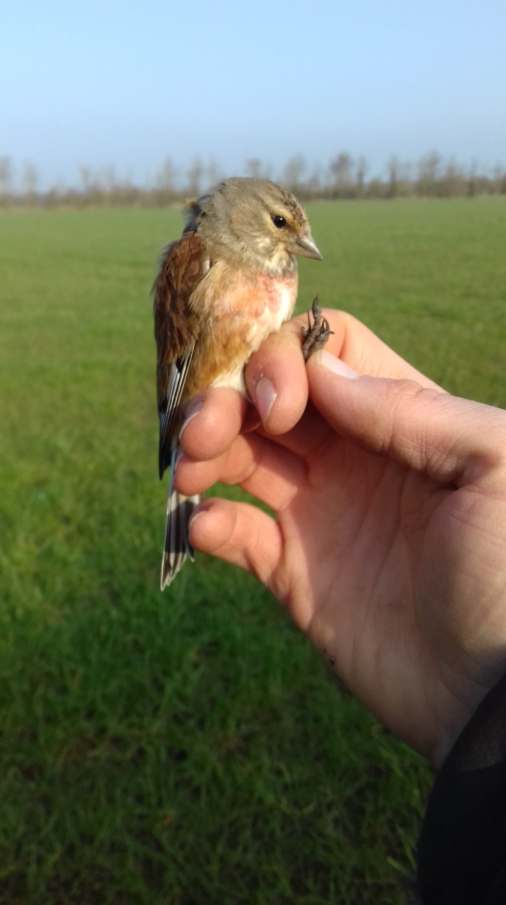
Two of the three Linnets were male.

2019_01_05linne

There are two ways of identifying male birds. The first, and most obvious, is the presence of pink on the breast, which becomes more obvious as they come into breeding condition.  The other criterion you can use is demonstrated on the second photo.  When you look at the primary wing feathers the innermost feathers have a white leading edge. If that white edge reaches close to the black feather shaft it is a male, if there is a gap of 1mm or more it is a female.

2019_01_05linne 2

The Starling was an adult male.  You can tell this because of the shape of the feathers on the side of the breast:

2019_01_05starl

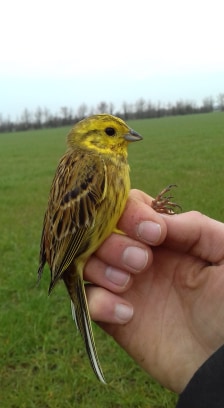
As you can see, they are thin and pointed with a central black shaft. That is diagnostic of an adult male.  Finally, the Yellowhammer was also a male. This one was a bird that fledged last year:

2019_01_05yelha

Over the next few months those brown tips to the head feathers will wear away revealing the familiar yellow head of the bird.

Red Lodge: Wednesday, 2nd January 2019

For our first session of the New Year we headed for Red Lodge.  I was delighted to be joined for the session by Fraser Bell.  Fraser and I have ringed together off and on for some 9 years, and he has progressed to his A-permit this year.  We were also joined by Jonny, Andrew and David for the morning.  It was a good experienced team and, despite only setting 11 nets, totalling 195 metres, we caught a creditable 100 birds from 13 species. We had an indication that we would have a decent haul: I had filled the feeders up yesterday lunchtime and the two seed-feeders were emptied and the peanut feeders had been reduced by a quarter.

What we hadn’t expected was the return of the Redwing.  Over the last couple of weeks they had definitely dispersed: one cold morning and there were flocks around again.  We saw plenty and managed to catch 16 during the morning.

My favourite catch of the morning was a Coal Tit (photograph below) which I ringed as an adult in February 2013, making it at least 7 years old and probably over 8 years.  The record is 9 years and 2 months, but the typical lifespan is just 2 years.

2019_01_02Coati

We also recovered a Blue Tit that was ringed as a juvenile in the Firs in November 2018.  We are used to recovering Blue and Great Tits that have moved around the Braydon Forest, but this is the first movement from the Firs to Red Lodge that we have established.

The list for the day was: Nuthatch (3); Blue Tit 25(23); Great Tit 4(5); Coal Tit 6(2); Marsh Tit 1(1); Long-tailed Tit 5; Wren 2; Dunnock (1); Robin (1); Redwing 16; Goldcrest 2; Chaffinch 1(1); Bullfinch 1.  Totals: 63 birds ringed from 10 species; 37 birds recaptured from 8 species, making 100 birds processed from 13 species.

*Update: In this catch was a recaptured Blue Tit, ring number S589485. It was ringed at Stansore Point, near Lepe Country Park in Hampshire on the 7th November 2016. It has travelled 99km NNW in just over 2 years.  Not the longest movement recorded but pretty impressive for a non-migratory species.