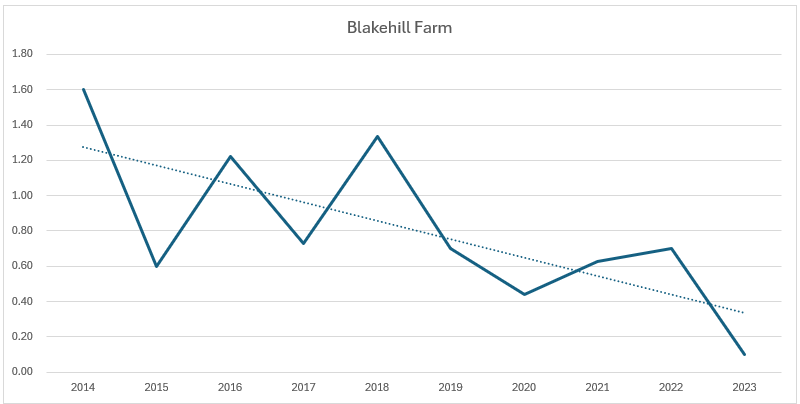
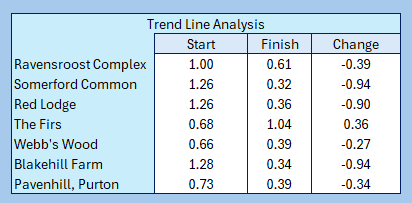
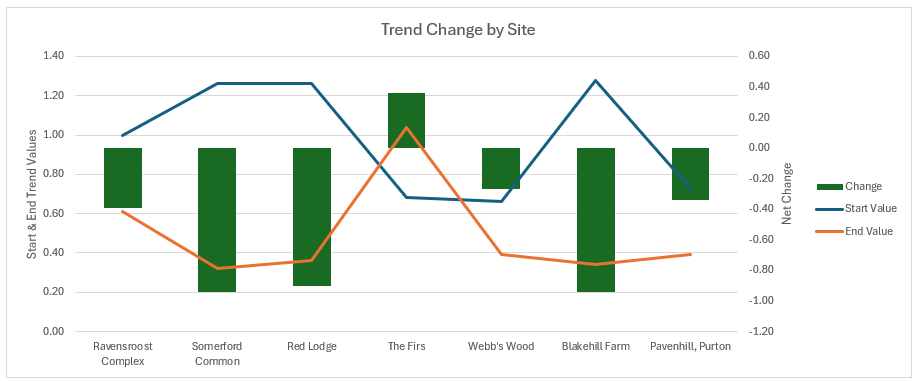
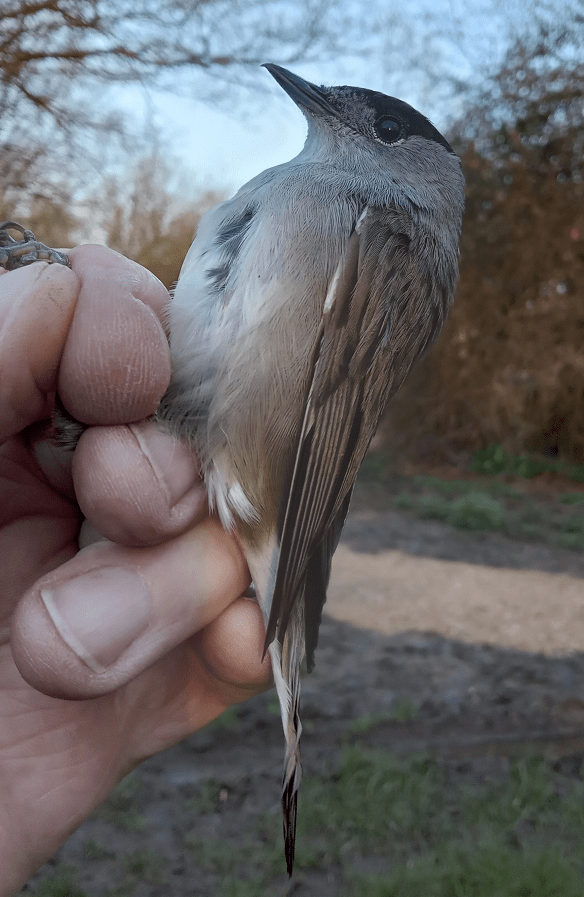
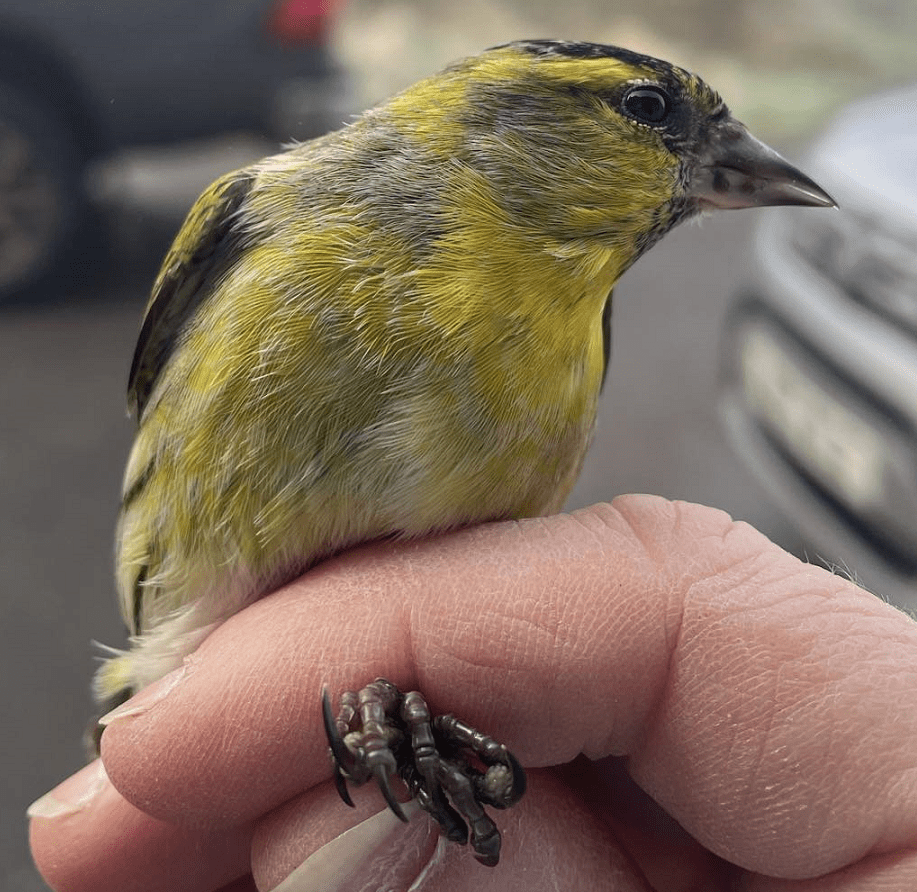
One of the more labour intensive aspects of bird ringing is the Constant Effort Site project. This requires 12 sessions to be run, approximately 10 days apart, with the same number of nets, set in the same places, for the same length of time on each occasion. The report that you can read from the link below is the preliminary result of last year’s efforts across the country:
A Change of Scenery: Saturday, 10th February 2024
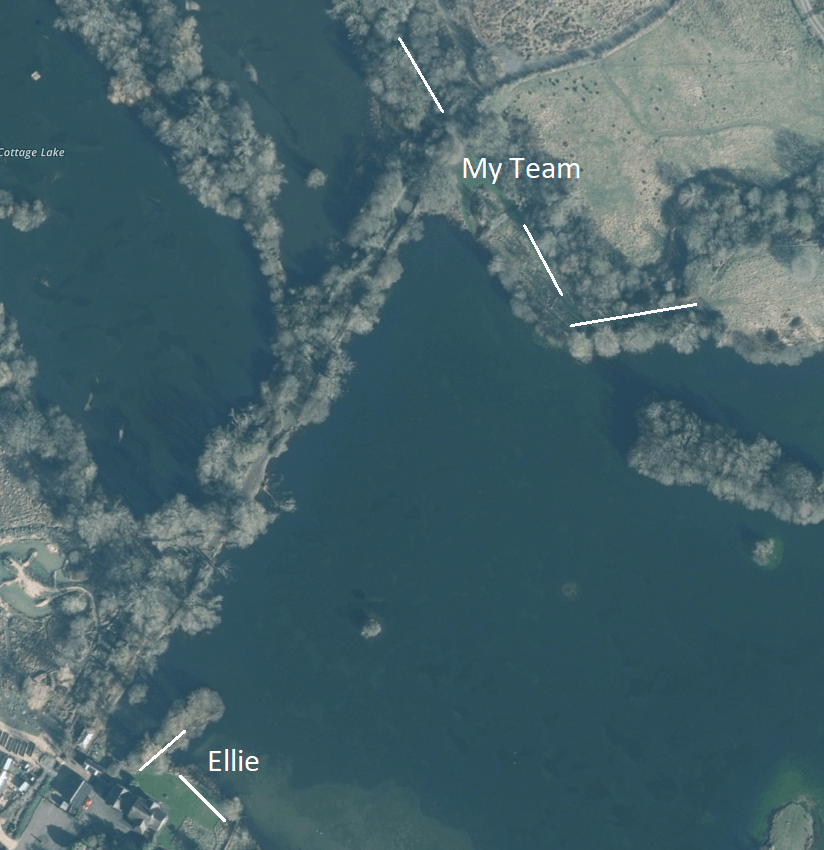
Having been confined to woodlands for the last few weeks, it was delightful to be able to get out to the wide open spaces of the plateau of Blakehill Farm! I was joined for the session by Justine and, delightfully, because I wasn’t expecting to see them Rosie arrived with Tanya. Tanya was a colleague of Rosie’s at the Wiltshire Wildlife Trust and came out ringing with me until she moved to a new job up in Shropshire. It was lovely to have her company again. They were with us from just after 7:00, but had to leave at 10:30 as they had other arrangements made. We met at the Chelworth Industrial Estate side of Blakehill Farm. The hedgerow on that side of the farm is currently undergoing a significant piece of maintenance: the hedge is being laid. It has just reached halfway through my usual ringing area and I will probably not make use of it there until there is a bit of regrowth. However, this work has been ongoing for a few years, until it was decided last year that it had to be completed by the end of 2024, which has sped up the process. That means that there is a considerable stretch that has been laid for a few years and I will spend some sessions this year looking at how that is being used by the local birdlife.
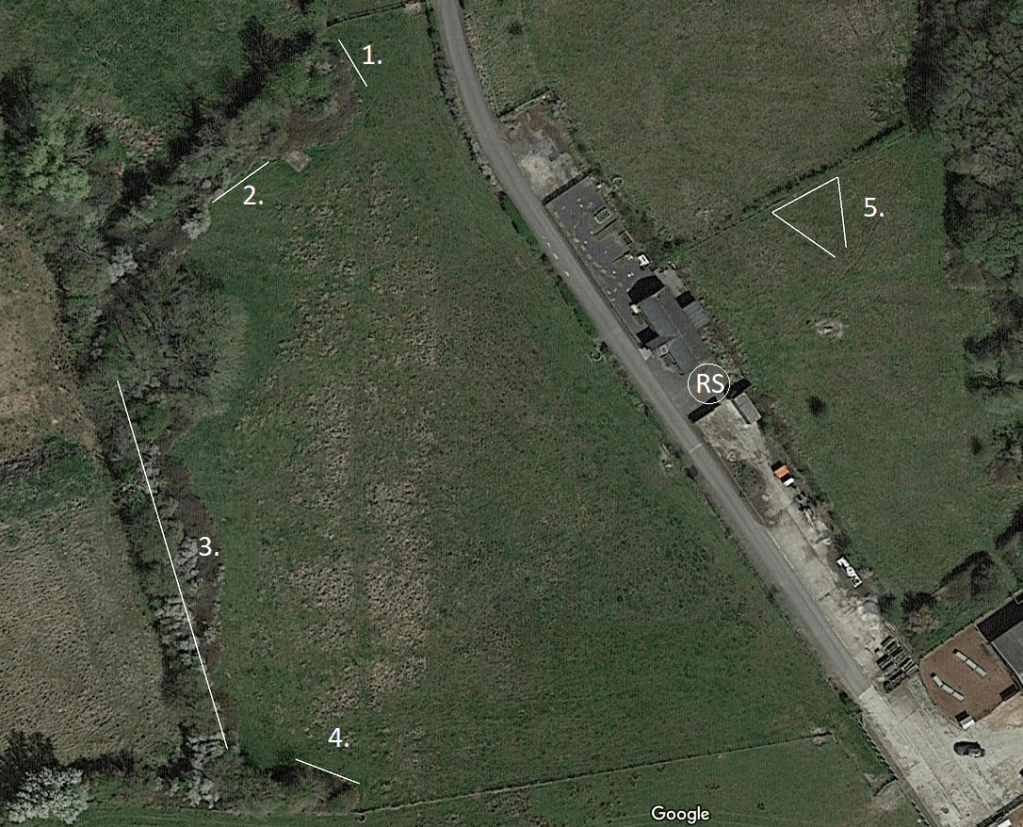
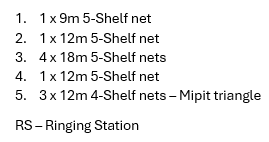
As of 10:00pm Friday night, the weather forecast was for it to be dry all day, with a breeze coming from the south-south-east as the morning progressed. Suffice to say, we had a few drops of rain whilst setting up the nets and until 8:00. To be fair, the forecast had changed overnight, but what is the point of a forecast which is, essentially, looking out the window and saying what you see. We set the following nets:


Net set 1. was set up along the plateau side of the hedgerow, on the basis of the forecast wind direction. More about this later!
After the over-abundance of Blue and Great Tits in all of our recent woodland sessions, I did say to Justine that I would love a couple of Stonechat today and that I would happily pack up if we were that lucky. Well our first round produced: two Stonechat, adult male and female, a Meadow Pipit and two Reed Buntings! I am delighted with that catch. To put that into perspective: we had only caught and ringed 33 Stonechat before today and we have never caught them this side of Christmas: all bar one had been caught in the September to November period.

Male Stonechat, Saxicola rubicola

Female Stonechat, S. rubicola
As for Meadow Pipits, we haven’t caught any in February since 2017, and that was two birds, so I was very pleasantly surprised to have this one.

Meadow Pipit, Anthus pratensis
Similarly, the last time we caught Reed Bunting in February was also back in 2017. Was this an auspicious start?
Well, the next four rounds produced another couple each of Meadow Pipit and Reed Bunting plus a Great Tit and a retrapped Wren. That was when Rosie and Tanya had to leave. They were both very happy: Rosie had her second ever Stonechat and Tanya her first. Tanya had her first Reed Bunting working with me, but she might have done a few with her current ringing group.
So, the next round after Tanya and Rosie left we were astonished: 17 birds. Our solitary Blue Tit of the day, another Reed Bunting and another 15 Meadow Pipits. That was astonishing: we have never had a catch of Meadow Pipit like that outside of the autumn passage. The breeze had started to get up and, disappointingly, it was a straight westerly wind: opposite to what was forecast. As a result, net ride 1 ended up with two of the three nets embedded in Blackthorn. The central net was absolutely the worst, and I had to cut the net out, taking a rather large number of off-cuts of Blackthorn with it. My good lady wife spent this afternoon going through that net, metre by metre, snipping out the Blackthorn twigs for me. That is love, whichever way you look at it!
We closed all of the nets at midday, extracting the last three Meadow Pipits of the day, ready to take down.
The list for the day was: Blue Tit 1; Great Tit 1; Wren (1); Meadow Pipit 21; Stonechat 2; Reed Bunting 4(1). Totals: 29 birds ringed from 5 species and 2 birds retrapped from 2 species, making 31 birds processed from 6 species.
Extracting net ride 1 took up a lot of time so, by the time we had extracted and packed up all of the nets and the ringing station, it was close to a 14:00 finish.
Whilst we were working we were treated to a number of excellent birding sites: we had a great catch of Meadow Pipits but there must have been well over 50 of them flying around. Alongside them, flying about on the plateau, were at least 30 Skylarks. When the sun came out the males were up and singing: you could almost believe it was Spring! But then, there were very large flocks of Starling flying around. As Justine described them “a murm” – not big enough to be a murmuration but still quite impressive (cue a morning of appalling puns between us). There were Fieldfare in evidence but no sign of Redwing. A Snipe flew through and we had both Red Kite and Buzzard flying around the site. All in all, it was a thoroughly enjoyable morning, despite the best endeavours of the weather forecasters and the Blackthorn, to sour my mood!
Red Lodge: Wednesday, 7th February 2024
Our run of ringing Great Spotted Woodpeckers came to a halt today: what a shame! With foul weather forecast for the week, when Tuesday showed a change and a break in the wet and windy weather I hastily got a team together. It was still predicting wind, so I needed to use a woodland site. Red Lodge was the next on the list so Rosie, Miranda, Teresa and I met at 7:00.
When I arrived to open the site someone had parked across the entrance, not quite entirely blocking it, thankfully. I could see these blue lights bouncing up and down on the path: it was a woman with her dog, and the dog’s collar had half-a-dozen blue LEDs on it. I opened the gate and waited until they had passed through. On passing she asked if I was opening the gate to allow the hunt to pass through. I replied “I ***** hope not!”: apart from my abhorrence at this barbaric pastime, nets do not mix well with hounds or horses (nor the individuals you find on them).
It wasn’t as busy as the last two sessions but, after Rosie left for work, it was still busy enough for the three of us. As expected, it was titmouse heavy. Unfortunately, Red Lodge is not the most varied of sites, and so it proved this morning. Finch catches are not usually very high and today we caught a single Chaffinch. To be fair, we do seem to be just getting singles of any finch species this winter at our sites.
The list for the morning was: Nuthatch (1); Blue Tit 19(9); Great Tit 10(9); Coal Tit 3(5); Robin 1(1); Chaffinch 1. Totals: 34 birds ringed from 5 species and 25 birds retrapped from 5 species, making 59 birds processed from 6 species.
It really wasn’t the most exciting session that we have ever had: I need this weather to improve so we can get out to some of the farmland sites! We packed away at 11:00 and were off-site by 11:45.
Ravensroost Wood: Friday, 2nd February 2024
This session was originally scheduled for last Tuesday but, unfortunately, I was ill and so I put it back to Thursday, only my car decided that it too would throw a sicky, so I had to put it back again to Friday. It is a shame, because it would have added to what has been a spectacular January for the West Wilts group.
The forecast was for it to be dry but windy. Ravensroost Wood is, in areas, quite resistant to wind interference. It did mean that I had to change my net setup, but that was going to happen anyway. Significantly, I have managed to persuade the Wiltshire Wildlife Trust and Natural England to allow me to set up my feeding station again. There has been restricted winter feeding in the wood since the winter of 2009 / 2010. As a precautionary measure against HPAI, last winter the Wiltshire Wildlife Trust ceased all supplementary feeding on their sites. The site is a SSSI, and so Natural England have to give permission for it to resume. I have now been given that permission so, for the first time this winter, Ravensroost Wood has a feeding station set up. I set it up on Monday, whilst in the throes of becoming ill, and went to top it up on Thursday, after my car was fixed and I was feeling a bit better. The squirrels had already vandalised one of the feeders: it had been ripped off the branch and one of the feeding ports had its retaining nut unscrewed. How dexterous are these little furry (expletive deleted)? I topped them up, ready for this morning. When we arrived this morning, the feeders were about half empty, so we knew it was going to be busy.
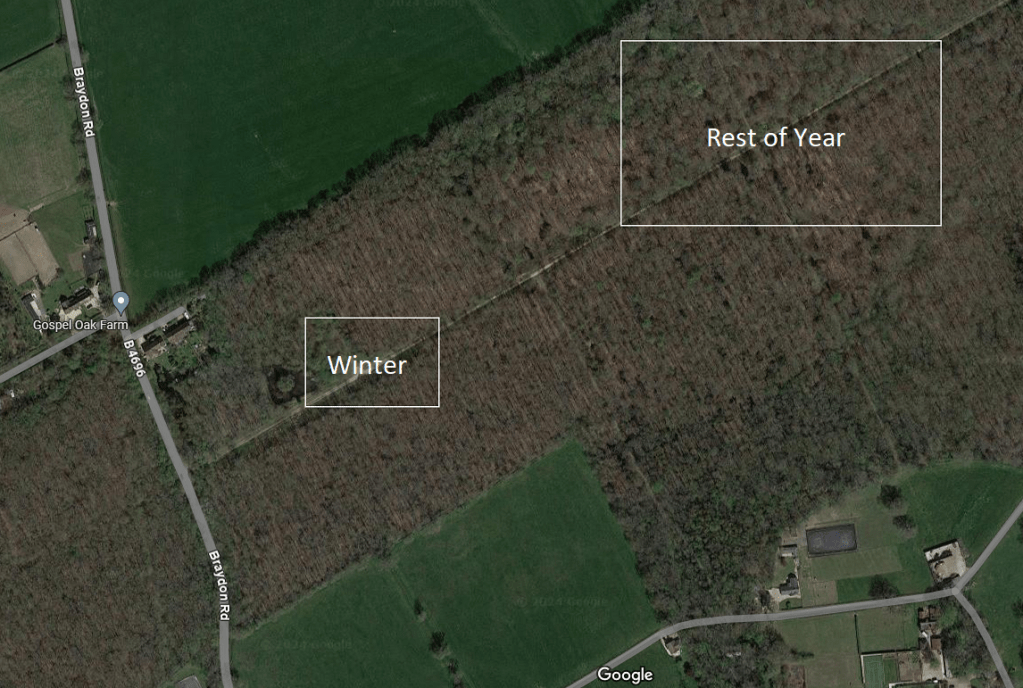
I was joined by Rosie, Teresa and Andy at 7:30. For those who don’t know the site, this is the spatial relationship between the entrance to the reserve and where we were working:

We set the following nets:


It was very much as expected: we had Blue, Great and Marsh Tits hitting the nets before we had even opened them, The first round was just 11 birds, but that was followed by a couple of very heavy rounds, before it died down again. Funnily enough though, the two last, and quietest, rounds produced the variety in the catch.
Today’s catch was: Great Spotted Woodpecker 1; Nuthatch 4(1); Blue Tit 35(5); Great Tit 11(5); Coal Tit 4(1); Marsh Tit (2); Long-tailed Tit (1); Robin 1(1); Redwing 1; Chaffinch 1. Totals: 58 birds ringed from 8 species and 16 birds retrapped from 7 species, making 74 birds processed from 10 species. If you compare that with the last session in Ravensroost on the 4th January: Blue Tit 1(1); Great Tit 2(1); Coal Tit 1; Long-tailed Tit (3); Wren 1; Robin 1; Blackbird (1); Goldcrest (1). Totals: 6 birds ringed from 5 species and 7 birds retrapped from 5 species, making 13 birds processed from 8 species. What a difference a feeding station makes!
What I was surprised about was the number of unringed Blue Tits we caught. Prior to this the largest catch of unringed Blue Tits caught at this site was 28, back in December 2019. It is our third best ever catch of them (both ringed and retrapped combined) at this site. In fact, it is the second best catch of unringed Blue Tits of any of my sites in the Braydon Forest. The biggest was at a site adjacent to Webb’s Wood on the 14th May 2014. That was because the owner of that site fed constantly throughout the year and was constantly inundated with titmice. It was a fairly big factor in my decision to stop working there. Mind, at the time I had to weigh that against my first ever catches of Mistle Thrush, Fieldfare, Green Woodpecker and Jay!
There are two stand outs from this session: our seventh straight Braydon Forest woodland session in which we have ringed a Great Spotted Woodpecker. That has never happened before. The consistency is phenomenal and, at the risk of boring everyone with repetition, we only ringed four in the whole of 2023. Had I not been ill that would have been seven in January.

First winter female Great Spotted Woodpecker, Dendrocopos major
The second stand out was the catch of five Nuthatch! We have caught six before: three ringed and three retrapped. Today’s catch was four ringed and one retrap. The only other times we have caught and ringed four Nuthatch in a session were on the 23rd October 2015 and 29th August 2016, both times with no retrapped birds. Funnily enough, both of those catches were also in Ravensroost Wood. However, they were also both post-breeding autumnal catches, not half-way through the winter.

Nuthatch, Sitta europaea (photo courtesy of Teresa)
We actually shut the nets early. Although, as previously mentioned, Ravensroost is generally good in windy weather, by 10:30 it was too windy, with huge gusts hitting the ringing station. It wasn’t so bad around the nets, but bad enough, and we shut the nets and took down. We were off site by 11:30.
West Wilts RG Results: January 2024
With the filthy weather during January I wasn’t expecting that we would be as busy as we were this month. The results were quite astonishing really – especially the number of sessions we managed to carry out: 34. It seems we must have got out on nearly every available day. Ironically, I do not remember last year’s weather being anything like as bad, but we only got out to do 15 sessions. However, on closer inspection, whilst both Jonny and I did increase our sessions, unlike last January, Ian, Andy, Rob and Ellie also braved the weather and got a number of sessions in.
As you can see from the figures: we actually averaged slightly fewer birds per session, so number comparisons are meaningless, unless the results for 2023 outshine the results for 2024. What is clear is that we tallied eight more species this year than last. It isn’t just that we added to last year’s list, there were nine species not found in 2023 and one found in 2023 that wasn’t found in 2024. Those added this year were: Blackcap, Brambling, Corn Bunting, Fieldfare, Jay, Kingfisher, Tree Sparrow, Woodpigeon and Yellowhammer. Missing from last January was the solitary Meadow Pipit caught at one of Jonny’s East Tytherton sites. The overwintering Blackcap came from one of Ian’s sites. This is only our fourth ever January Blackcap: the other three being two in 2019 and one in 2020, all in Jonny’s parents’ back garden! The Brambling was a nice surprise that we had last Saturday in Somerford Common West: a first for the site, and the last remaining, currently available, woodland site in the Braydon Forest to produce the species. Jonny had his first ever Corn Bunting at his Hilmarton sites: a great first to have, given that the species is more commonly found on Salisbury Plain and the Marlborough / Winterbourne Downs. It also produced the Woodpigeon and the Yellowhammers this month. Andy’s Imber site seems to be a regular over-wintering site for Fieldfare, and it produced again this January. They are notorious for being difficult to catch. To underline that, these five are the first January catch of the species since I caught one 10 years ago at a site on the outskirts of Webb’s Wood. We have only caught a total of 42 since 1st January 2013. The solitary Jay came from Wiltshire Wildlife Trust reserve at Biss Wood, near Trowbridge. The Kingfishers were both caught at Langford Lakes. Jonny continued to exploit his new found access to Tree Sparrow sites, ringing another five and retrapping two.
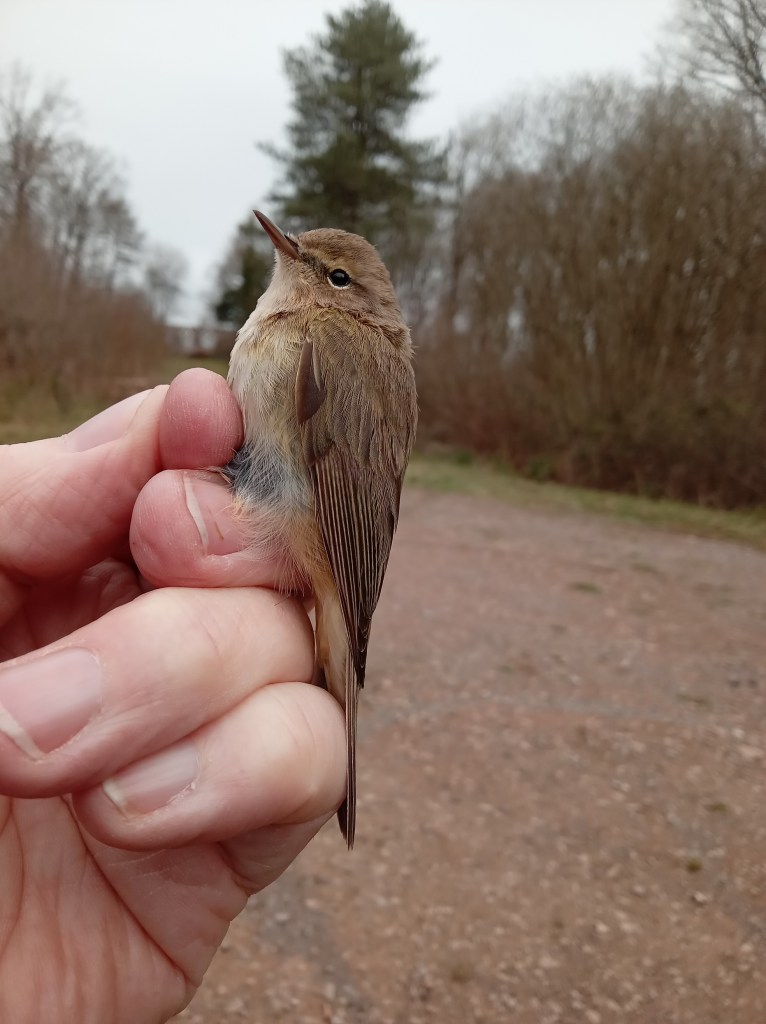
One other notable catch (Mr Cooper has had a quite outstanding month, it would seem) were the overwintering Chiffchaffs at Langford Lakes. The other records for Chiffchaff in January are quite recent. I had one at Lower Moor Farm in 2017, but the rest are two at Langford Lakes in 2021, two more at Langford Lakes and two at East Tytherton in 2022, just one at a farmland site in 2023 and now this catch.
We did have some decent recaptures this month. Jonny’s Hilmarton site produced two interesting Reed Bunting recoveries. One came from Bridgnorth in Shropshire: a distance of 114 km in 180 days, the other came from Stanford Reservoir in Northamptonshire, travelling 116 km in 186 days (I always thought that Salop was further north than Northamptonshire). Finally, my team caught a Chaffinch that had travelled down from Austerlands in Greater Manchester to Somerford Common West – a distance of 220 km in 104 days.
The figure of 1,235 birds processed is our highest ever catch in January, with both the highest numbers ringed and retrapped, and is actually our fourth largest monthly catch ever.
Big Garden Birdwatch 2024
I have been a member of the RSPB for over 50 years and have taken part in their Big Garden Birdwatch (BGW) for as long as I can remember. It is a fascinating snapshot of what can be seen in our gardens in the last weekend of January. This is my set up:

I don’t use a bird table, too difficult to keep clean. There are two seed feeders filled with sunflower hearts, one peanut feeder, a fat ball feeder, a tray and an apple-shaped dispenser for meal worms plus a water bowl. They are kept clean and disinfected. For the record, I have not seen an obviously unwell bird in my garden for over three years.
Alongside this I have a number of trees: a long established aspen, two apple, one each of crab apple, flowering cherry, pear, plum, greengage, quince, hawthorn and holly; a wildflower border, a number of different shrubs, together with ivy and honeysuckle. Oh! and there is a decent wildlife pond with no fish allowed but it gets plenty of frogs, toads, newts, dragonflies (including Emperor) and damselflies, plus all of the other insects one would associate with the habitat. We are also lucky enough to have slow worms in our garden.
This year’s survey, carried out on Friday, 26th, and was pretty standard for recent birding in the garden. We saw: Blackbird, Blue Tit, Chaffinch, Dunnock, Goldfinch, Great Tit, Greenfinch, Jackdaw, Magpie, Robin and Woodpigeon, together with an over-flying Red Kite. One thing missing this year was House Sparrow. That is unusual, but we have noticed that they have become much less frequent in our back garden: we do still find them roosting in our, and our neighbour’s, loft and using the bushes at the side of the house, but they didn’t put in an appearance this year, for the first time ever.
The most frustrating experience I have had whilst doing the BGW was a flight of 15 Snipe that flew around and over the garden before disappearing into the fields three houses over, where I wandered around to, and had great views of them. My first GBW in this house (this is my twenty-sixth year here) started a bit quietly: which turned out to be a Sparrowhawk sitting in a plum tree. After it flew off I got to see my first Goldcrest for the garden.
Whatever good birds I have seen whilst doing the GBW pales into insignificance with what turned up in the garden of my ringing trainee, David. I am lucky to live in a rural location with a lot of fields and woodland around us. David lives in Moredon, Swindon. There is some greenery close by (a golf course, school playing fields). However, there are some species that prefer urban environments and this is what turned up in David’s garden (with David’s apologies for the quality of the photos: it was a toss up between grabbing some shots on his phone through the window or scaring the bird off opening the window or missing it going to get a proper camera):


Female Black Redstart, Phoenicurus ochruros
GBW is a valuable exercise for comparison over the years. However, it is a single snapshot in time and says nothing about the rest of the year. In 2003 I became aware of the BTO’s Garden Birdwatch scheme. I have been a member ever since. This is very different. It is a recording scheme for, not just birds, but all animal life in your garden. The recording period is from Sunday to Saturday inclusive, every week of the year.
So far I have recorded 60 species of bird in my garden. The commonest recorded are Woodpigeon (96%), Starling (88%); Goldfinch (84%); Blue Tit (82%) and Jackdaw (81%). We have had some real mind-blowers as well: Snipe, Yellowhammer, Reed Bunting, and even Skylark, on one occasion each. The raptors seen in the garden has also provided a pretty good listing: Hobby on two occasions, Kestrel, Buzzard, Sparrowhawk and Red Kite – which actually sat on the fence you can see in the photo. As you also might have noticed from the photo, I have my nets set up in the garden. I don’t ring in there very often: there seems to be a bit of a wind tunnel up the drive and through the gap into the back garden, but it does turn up some excellent results. So far, it is at 28 species, the most surprising being a Whitethroat in 2019 and a Stock Dove in 2020.
One of the clear benefits of a weekly survey is that you can see trends, and one of the best trends I have seen recently is the recovery of our local Greenfinches. Last week wee had our best observations of Greenfinch since 2009: with 13 being seen at one time in the back garden. The numbers have been growing quite consistently over the last couple of years, with no sign of Trichomonosis affected birds. (Trust me, I have seen enough of them to recognise the signs.)

Greenfinch, Chloris chloris (I know I have used this picture before but it is my favourite of the species)
So, finally, if you are not a contributor to the BTO’s Garden Birdwatch scheme, please consider joining. If you become a paying member you will receive a whole load of information and an excellent quarterly magazine. However, you can just become a non-paying contributor, with access to your own data. If you are interested, just follow this link:
A Corny Footnote: Saturday, 27th January 2024
When I say a footnote, I mean it so, if that is all you are interested in you had best skip to the bottom of the post!
I had planned to go to Lower Moor Farm this morning but, with a large team making themselves available, I decided to go back to Somerford Common West. With the astonishing catch that I had there two weeks ago I felt that it would provide a better experience for the team, even if they were being put at risk of yet more Blue Tit biting. We met at 7:30, just as it was beginning to get light, and set up the same nets as last time. From next Saturday it will be 7:00 starts! Such fun!
It was a good session. The weather was initially fine: dry, overcast and virtually no wind. However, at 11:00 the weather suddenly turned much colder, so we shut the nets to avoid cold-stressing the birds after so much poor weather recently.
The catch was regular throughout the morning and we did catch some interesting birds. Firstly, at 9:15, Adam extracted, and then ringed, his first ever Brambling:

Adult female Brambling, Fringilla montifringilla
Brambling are an uncommon catch in the Braydon Forest. There is plenty of beechwood, so why that should be the case I have no idea. Prior to our first catch of the species, four of them at Somerford Common and one in Ravensroost in February 2019, none in 2020, two each in 2021 and 2022, with a blank again in 2023, there had only ever been a single report, of one flying over Ravensroost Wood, for the Braydon Forest. This was our tenth Brambling ringed. At the same time, Daniel got to ring his first ever Chaffinch, a cracking adult male, and his first ever Treecreeper. Then, at 10:00, Laura extracted her first Great Spotted Woodpecker and Adam ringed his first. This is getting to be quite a remarkable catch of this species: ringing our sixth of the month, when we only ringed four in the entirety of 2023. These have been caught, one at a time, in six consecutive woodland sessions! We then also retrapped a female ringed at our last session here.
Then, at 10:45, we caught another Chaffinch, ring number APX3919. That is not one of our group rings. I shall be very interested to find out where it was ringed.
The list from today was: Great Spotted Woodpecker 1(1); Treecreeper 1; Blue Tit 13(7); Great Tit 7(6); Coal Tit 4(8); Marsh Tit (2); Blackbird 1; Goldcrest 1; Brambling 1; Chaffinch 1(1). Totals: 30 birds ringed from 9 species and 25 birds retrapped from 6 species, making 55 birds processed from 10 species.
As mentioned, it turned cold at 11:00, so we closed the nets, extracting and processing the last half-dozen birds, and took down. With three sets of us taking down three net sets, it took very little time. Everybody else got away at midday – only my car decided that the battery was flat (it is less than three months old!). Fortunately, I invested in a wonderful little gizmo that gives your battery a boost and it worked beautifully, as did Justine revving the engine so it didn’t stall, so we were away by 12:15.
So, to those of you who have made it to the end: Jonny Cooper has found himself a number of rather excellent farmland sites in the area to the north and east of Chippenham, across to Calne, and today he landed himself a cracking catch at one of his sites near Hilmarton:

Corn Bunting, Emberiza calandra
They are seen regularly on the Marlborough and Winterbourne Downs and Salisbury Plain and, to date, those places are where the vast majority are caught and ringed. The first bird I ever ringed was a Corn Bunting caught at Ogbourne St Andrew. Recently some have been caught on the group’s Salisbury Plain sites, but this is the first time, as far as I can find out, that any have been caught and processed in this area.
Webb’s Wood: Friday, 26th January 2024
With the weather stopping any ringing activity since the 17th January, I grabbed the first opportunity to get out and set my nets. The forecast was for it to be wet and windy overnight but, with the weather scheduled to settle down by 6:00, and forecast to be dry with low winds for the rest of the morning, Friday looked good. I had gone out and topped up all of the various feeding stations on Wednesday, so was confident of a decent catch.
I was joined by Miranda, Rosie, Teresa and Andy at Webb’s Wood at 7:30 and we had the usual nets up and open by 8:30. The first bird out of the nets was a retrapped Marsh Tit, this was followed by a number of Blue, Great and Coal Tits.
The catch was slow and steady throughout the morning, manly titmice, with little outside of that until we caught a Lesser Redpoll at 10:00:

Ault male Lesser Redpoll, Acanthis cabaret
We did have another one get into the nets, but it escaped the net as Miranda went to extract it. Apart from this we did ring our fifth Great Spotted Woodpecker of the month. This makes this the equal best monthly ringing total for this species in the Braydon Forest with March 2017. However, four of those ringed are females, and that is twice as many as we have ever ringed in a single month before. If we catch another tomorrow, in Somerford Common West, then it will be a new record for us. That we have already, in one month, caught and ringed more Great Spotted Woodpeckers than we did in the whole of 2023 is, in itself, quite astonishing.
The list for the day was: Great Spotted Woodpecker 1; Blue Tit 16(10); Great Tit 7(4); Coal Tit 5(4); Marsh Tit (1); Goldcrest 1(1); Chaffinch 1; Lesser Redpoll 1. Totals: 32 birds ringed from 7 species and 20 birds retrapped from 5 species, making 52 birds processes from 8 species.
This winter there does seem to have been a considerable resurgence of two particular diseases within the local bird populations: Fringilla papillomavirus in the Chaffinches and Avian pox in Great Tits. Today we were blessed not to find any Chaffinch with FPV, hence we could ring the bird, but this poor bird we did catch:

Adult male Great Tit, Parus major
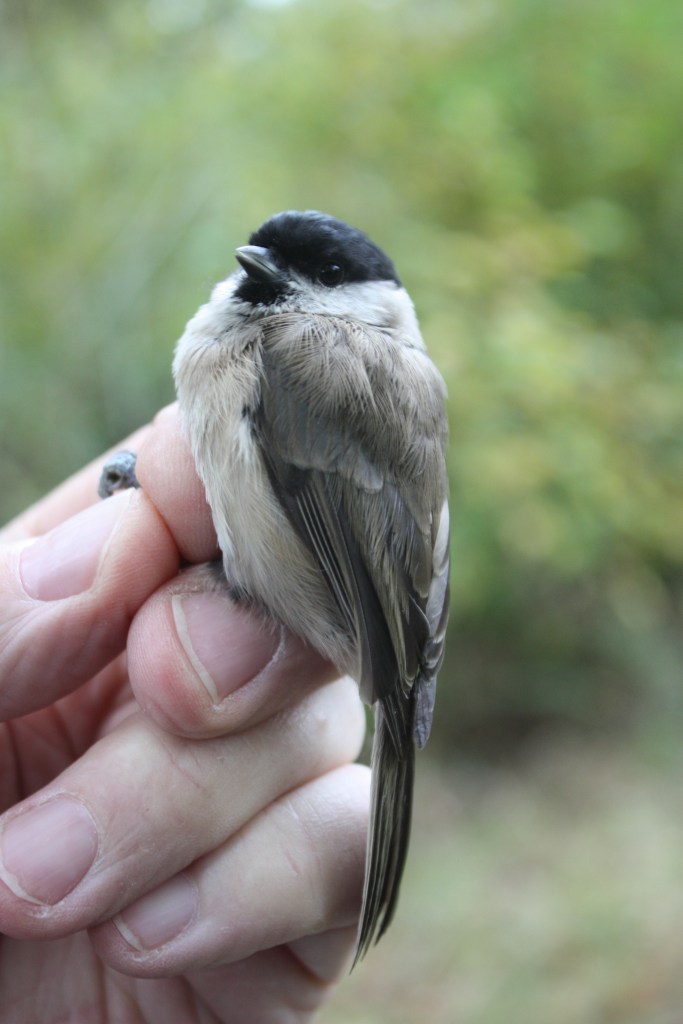
We didn’t ring the bird, just released it. One interesting point about it: I extracted it from the net along with a female Great Tit. They were at the same height and within twenty centimetres of each other. I would be reasonably confident that they were a pair, which definitely goes to show that beauty is in the eye of the beholder!
We closed the nets and took down at 11:30 and were off site by 12:30.
One footnote: this is our best January ever in the Braydon Forest, and this is on the basis of the number of birds ringed. That this has been achieved without access to one of our heavier catch sites (the Firs), and no feeding station in another (Ravensroost Wood – permission has just been granted to set the feeders up there this weekend, so hopefully we will have a decent catch there on Tuesday when it is next scheduled for a session). With another two sessions to go it can only get better. Another 75 birds and it will be our best month in the Forest ever: without the driver of any sort of bird migration.
For Data Nerds Only!
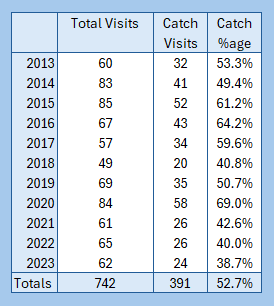
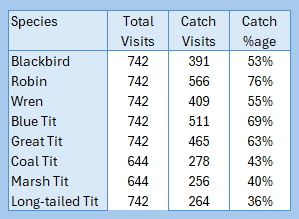
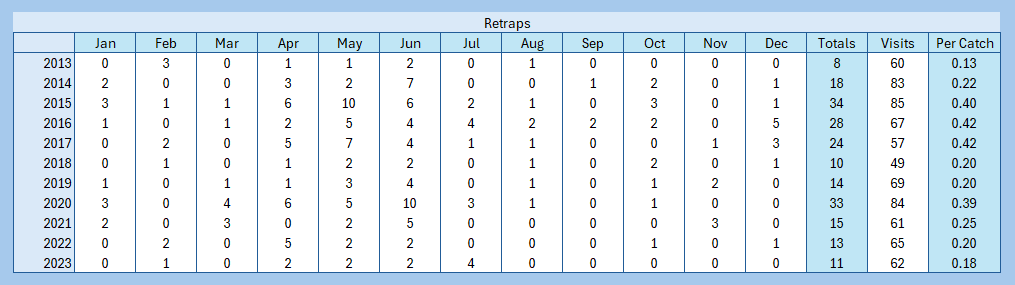
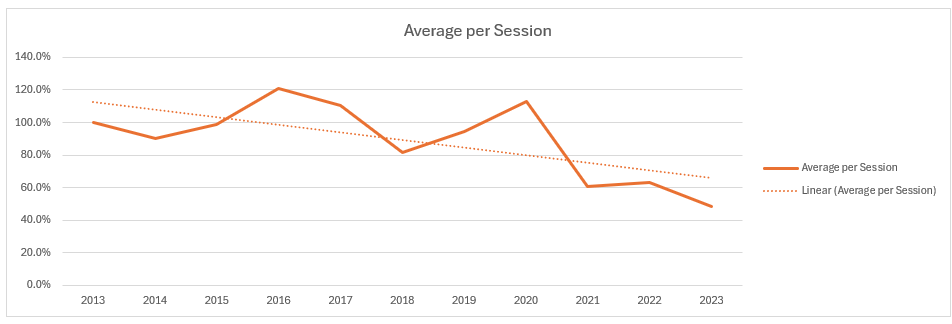
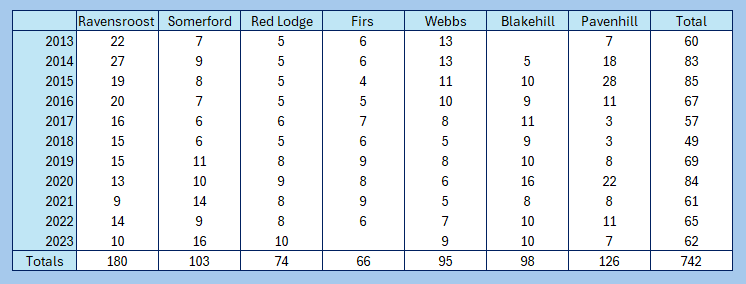
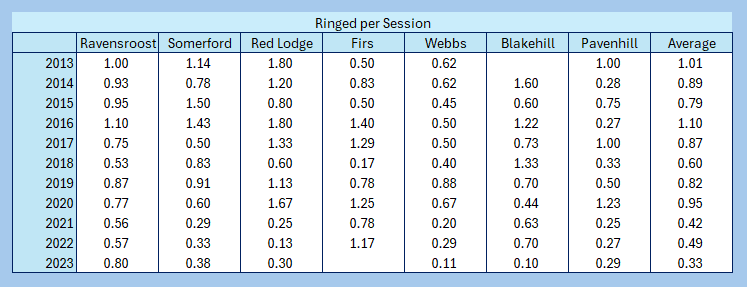
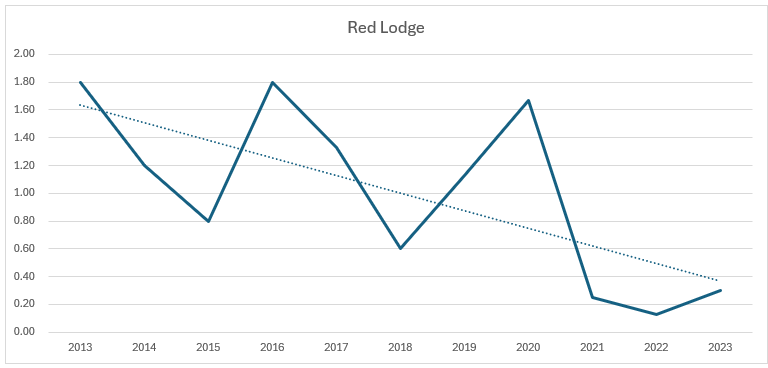
With the weather playing havoc with potential ringing sessions last week, and projected until Friday of this week, I needed something to fill the time. I decided to have a look at our activity levels in the Braydon Forest and how that reflected in the catching of our commonest small resident species, namely the Paridae: Blue, Great, Coal and Marsh Tits, plus Long-tailed Tit, Robin and Wren.

Graph 1: showing visits per annum plus the trend over the period
As you can see from the graph, although there are annual fluctuations in the number of sessions, the overall trend is pretty constant. The initial series of tables and charts show simply the proportion of the total number of catches in which each species is caught:

Table 1: Frequency with which each species was caught

Graph 2: Frequency with which each species was caught

Table 2: Frequency with which each species was ringed

Graph 3: Frequency with which each species was ringed
What do these tell us? Before looking at the data there is a caveat regarding Coal Tit and Marsh Tit. Neither have ever been caught at Blakehill Farm nor has Marsh Tit ever been caught in the village of Purton: it is down to a lack of appropriate habitat. Because of this I have not counted those sessions in the analysis of these two species. What surprised me was that, as per table 1, we actually catch the Robin more frequently than any other species: anecdotally I would have put money on it being Blue Tit. Equally, to find that the frequency with which we ring Robin is the same as the frequency with which we ring Blue Tit is also interesting.
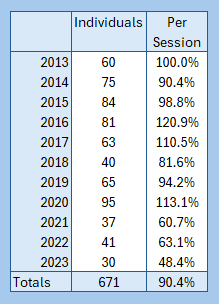
So to actual numbers caught. It is no surprise that the Blue Tit has the largest catch size. When talking about numbers, instead of adding the number of birds ringed to the number of retrapped birds, which gives a false reading because many birds are caught multiple times, I counted the actual number of individual birds processed each year. These are the results:

Table 5: Number of individual birds processed by species by year

Graph 4: Number of individual birds processed by species by year
So, looking at the bald numbers, Blue Tit is far and away the largest catch, as expected. Unsurprisingly, Marsh Tit is the lowest catch. However, what proportion of each species caught is ringed?

Table 6: Frequency of birds ringed vs total number of individual birds processed by species by year

Graph 5: Frequency of birds ringed vs total number of individual birds processed by species by year
As is clear: the number of birds ringed is pretty similar across most species. The two that have the lowest proportion of ringed to caught is the least common species and the one that is slowly declining.
That has passed a few hours and I have found it quite interesting. Certainly the outcomes were not as I expected from gut feelings, based on experience of each session. Hopefully I will have something somewhat more interesting to report on in the next few days.
Somerford Common, Winter CES 6: Wednesday, 17th January 2024
Back to Somerford Common today for the sixth of ten winter constant effort site visits. The same nets were set in the same places as usual. I only got to top up the feeders on Tuesday morning, doing all four of my Forestry England sites, so was expecting there to be some fall off compared with the previous sessions but it turned out okay despite that.
I was joined for the morning by Rosie, Justine, Teresa and Andy. Rosie was doing her usual: helping set up and ringing a few birds before heading off to work. We met at 7:30 and had the nets open by 8:15 and started catching straight away. As expected, it was both Blue and Great Tit heavy, but we did end up with a decent variety.
We had flocks of both Redwing and Fieldfare flying around the site: only one Redwing and no Fieldfare deigned to drop in. The Great Spotted Woodpecker mini-glut continued, with our fourth for the year ringed and another retrapped. That my team has ringed as many in this month as we did in the entirety of last year is quite remarkable (to misquote the late, great David Coleman). Making a nice return to the catch was a solitary Lesser Redpoll. I am so used to them coming in small flocks but the last two captures, both at Somerford Common, have been singles.
The list for the day was: Great Spotted Woodpecker 1(1); Nuthatch (1); Blue Tit 3(8); Great Tit 2(9); Coal Tit (5); Marsh Tit (3); Robin 1(2); Redwing 1; Chaffinch 1; Lesser Redpoll 1; Bullfinch 1. Totals: 11 birds ringed from 8 species and 29 birds retrapped from 7 species, making 40 birds processed from 11 species. Comparing to previous sessions, on the 6th January we had 52 birds from 9 species (21(31)); on Boxing Day it was 49 from 9 (27(22)), 22nd November was 46 from 10 (23(23)). Basically, very similar catches throughout. The only one that was different was the very first on the 11th November: 81 birds from 11 species (55(26)). However, the number of retrapped birds was the most consistent factor.
The weather was a bit weird: not as cold as we had expected at the start, which was good thing. If it had been sub-zero we wouldn’t have opened the nets but it felt much better than that: probably because there was a complete lack of wind. At odd times throughout the morning the temperature would suddenly drop for 10 minutes or so before recovering back to how it had started. This coincided with a few light gusts of a northerly wind. At 11:30 we did a final round, processed the last few birds and closed the nets. We did get one last bird just after the nets were closed, just to hold us up a bit. After processing that, taking down and packing everything away, we got away from the site just after 12:30.