Red Lodge: Wednesday, 10th January 2024

I was joined for the session today by Teresa, Andy and Justine. We met at 7:30 and set the same nets as last time, adjacent to the feeding stations. We did add one extra 18m net to the east of the ringing station, on the main path. It only caught one bird: our only Goldcrest of the session. Talking of feeding stations, I went to all of my sites yesterday to top up the bird feeders I put up during the winter. I provide a premium seed mix (no wheat, oats or barley) and peanuts. Arriving at Red Lodge I found that some vandal has cut through the chain holding the padlock in place. It is totally mindless: it still doesn’t give them vehicular access, presumably for some fly-tipping. At least, unlike last time, they haven’t (yet?) taken a chainsaw to the gate supports to get in. 

We had all of the nets open by 8:30 and were extracting birds straight away. The definition of insanity is doing the same thing over and again and expecting a different result. Last time we were there, on the 15th December, we caught 61 birds from 8 species: today we caught 62 birds from 8 species! This is how they compared:

So, a little variation in the species: Great Spotted Woodpecker and Nuthatch this time, Long-tailed Tit and Treecreeper last time. One similarity between this session and the session before last, the 15th November, was catching another Great Tit with well-developed avian pox. This was definitely a different bird: there were just two pustules, a huge one behind the right eye and a large one in front of that eye. We didn’t ring it. It has been so many years since I have seen it in my local birds, and now two in three sessions at the same site. I wonder why.

Although the numbers of Blue and Great Tits are similar, it is quite surprising how little overlap there was in the actual individuals caught. Take Blue Tits: only four of the Blue Tits caught today were caught in the previous session and they were all ringed in that session. Amazingly, that is exactly the same for the Great Tits: four recaptured today were ringed at the last session. None of the other Blue or Great Tits caught today were caught in the previous session. The two Coal Tits caught today were the two ringed at the 15th December session. So, the 123 birds caught cross two sessions comprised 113 individuals.

The Chaffinch story continues to be a bit depressing: we did catch eight of them, but three were showing signs of FPV, one very badly (it’s leg looked like a particularly spiky pineapple, although the other leg was absolutely clean).

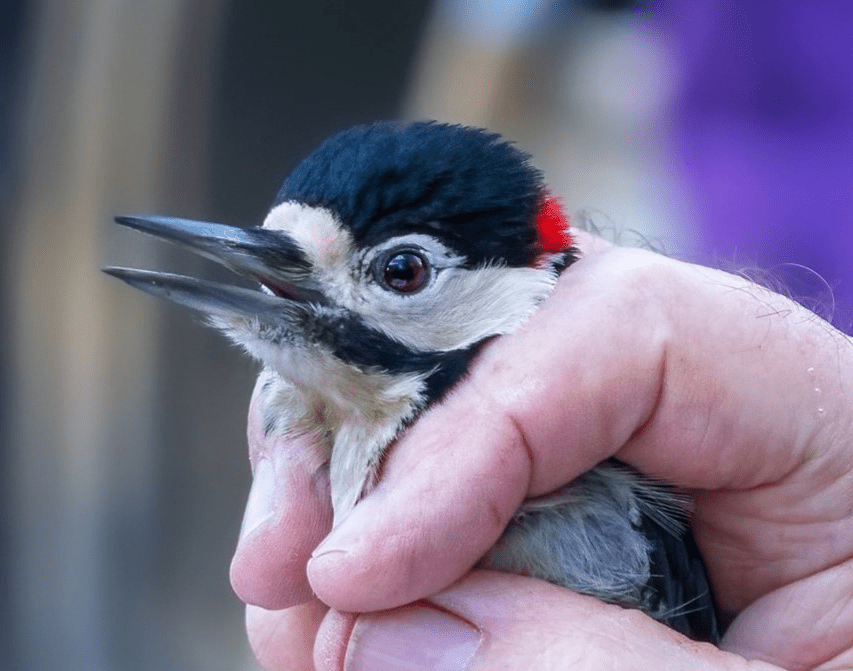
Teresa got to extract and process her first Great Spotted Woodpecker – and she has the wounds to prove it. 

Female Great Spotted Woodpecker, Dendrocopos major (photo courtesy Teresa Farr)

Justine, on only her third session out with us, ringed her first Coal Tit and Nuthatch.

Although the ambient temperature was okay, especially when the sun broke through on occasion, there was a very cold northerly wind and we began to get very chilled, so we cleared and shut the nets at 10:45, ready to take down. Unfortunately, whilst we were processing the few birds we had taken out, another three decided to get themselves entangled in the closed nets! I mean, why do they fly into a solid black line in broad daylight? So I extracted those and we got on with taking down. As I was just finishing my second net Andy came down to say that another two had landed in the closed nets! Teresa extracted them whilst we continued to remove the nets. It shows how well her extracting is developing: taking birds out of closed nets is not something we do for fun. In the end, we didn’t get away until just before midday.

It was a decent session, reasonable catch and plenty of time for training on ageing and moult patterns in juvenile birds: primarily looking at great coverts, primary coverts, alula and tail.

West Wilts RG 2023 Review: Part 1: the Numbers

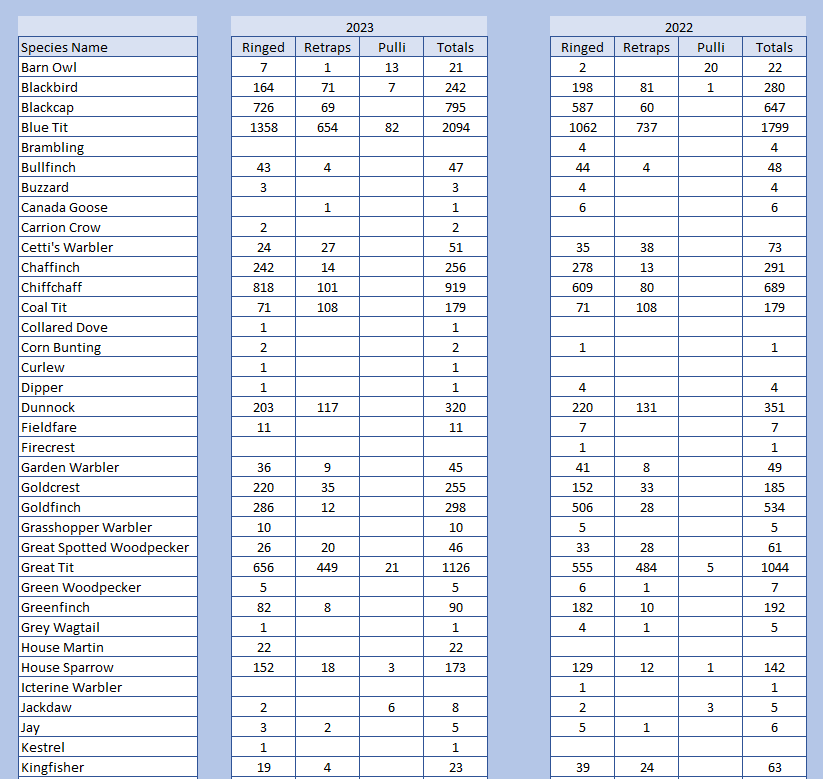
Carrying on from last year’s review, there have been some personnel changes this year. We are still a small group of independently minded ringers, with myself being the only trainer actively taking on new trainees. The group comprises four A-permit holders, four C-permit holders and I currently have five T-permit trainees registered to me, plus one other T-permit holder who has moved to the area and is working with me, but hasn’t transferred into the Group yet. Incidentally, Adam, who became a T-permit trainee this year, we were told by the BTO, is the second youngest licensed ringer in the UK.

To the numbers:

As you can see, this year we started to do a lot more on nesting birds, which is why I have split out pulli from ringed and retrapped. Jonny Cooper took on a tranche of Tree Sparrow nest boxes, alongside a number of woodland nest boxes, and also took on a number of Barn Owl boxes as an agent under my Schedule 1 licence. I continued with the Barn Owls in my local area plus, at the invitation from one of my local farmers, additional open nests, primarily Swallows.

And so to the birds that we processed:

Winter CES 5: Somerford Common, Saturday, 6th January 2024

Given how awful the weather has been recently, I am somewhat surprised that we have managed to get out as many times as we have since the weather prevented us from carrying out Winter CES 3 in mid-December. Since then we have managed to get out just once a week, instead of the usual twice until this week. This was our third session since, and inclusive of, our session on New Year’s day. 

The team today comprised myself, Rosie (for once able to stay for most of the session), David and Laura, with both Adam and Daniel. It was a decent session: we met at 7:30, had the nets open by 8:30 and started processing birds straight away. The first bird out of the net was a male Chaffinch. Although it didn’t have any sign, that I would recognise, of Fringilla papillomavirus (FPV), it’s left leg was withered, black and had clearly been broken previously and not healed properly. I showed the bird to the team, so they could see that it was an old injury, but I also decided that, even though the right leg was fine, if I ringed it, somebody else seeing it might decide that ringing had been responsible for its injuries, so I released it some way away from the ringing site, as I didn’t want to catch it again.

We had a steady supply of birds throughout the morning, particularly around the feeding station. As expected, the majority of the birds were Blue and Great Tits. Unfortunately, there was no sign of any Redwing, Lesser Redpoll or Siskin. At least, unlike Thursday at Ravensroost, we weren’t taunted by Redwing flying around the site but not hitting the nets. However, unlike Monday at Webb’s Wood, where we did have 47 birds but from only six species, we did have a bit more variety.

Rosie got to extract her first Great Spotted Woodpecker. We did hear a couple about the place, as we have pretty much at every site for the last few months, but without us catching any. There were also Nuthatch calling, and doing their slow, occasional, staccato drumming, but we didn’t manage to catch any.

The list for the day was: Great Spotted Woodpecker 1; Blue Tit 7(13); Great Tit 5(11); Coal Tit 4(2); Marsh Tit (3); Wren 1; Dunnock 1; Robin 1(1); Chaffinch 1(1). Totals: 21 birds ringed from 9 species and 31 birds retrapped from 6 species, making 52 birds processed from 9 species.

For once, my highlight of the day was a Blue Tit: S395508 was ringed as a juvenile on the 6th July 2016. It has been retrapped on four further occasions, the last being today: making it 7.5 years since it was ringed. The oldest known Blue Tit was 9 years and 8 months since ringing, so it has a couple of years to go yet to beat the record. It is four years since we last recaptured the bird. Every capture has been at Somerford Common, so one wonders where it has been in the interim.

Having started on a sad Chaffinch story, I am going to finish on another. The retrapped Chaffinch that I processed was ringed three years ago. We are very careful about ringing Chaffinch, because of FPV. If there is any sign of the infection, anything other than fresh, healthy, pink legs, we do not ring them. Unfortunately, since ringing this bird has developed the disease. Both legs are affected. I decided not to try to remove the ring, as this would almost certainly have caused some damage to the bird above and beyond what it is currently having to deal with. One thing about FPV: it does not seem to adversely affect the birds until it reaches the end stages and it starts to lose the limbs. I actually measured the wing and weighed the bird: both were well within expected norms. The bird weighed in at 21 grams: the same weight as the healthy bird that we ringed during the session. Some ringers choose not to ring Chaffinch at all, in case they get FPV. My personal view is that if we catch them, and they are clean and showing no signs of infection, we should ring them. Even if they subsequently develop FPV, the ring is not going to adversely impact any more than the infection and, if one wants to potentially study survival in birds affected by FPV, there has to be a means of identifying the individual birds.

Anyway, we started closing the nets at 11:30, as numbers had tailed off again, took down the nets and packed away the ringing station and were off site by 12:30.

All Quiet on the Ravensroost Front: Thursday, 4th January 2024

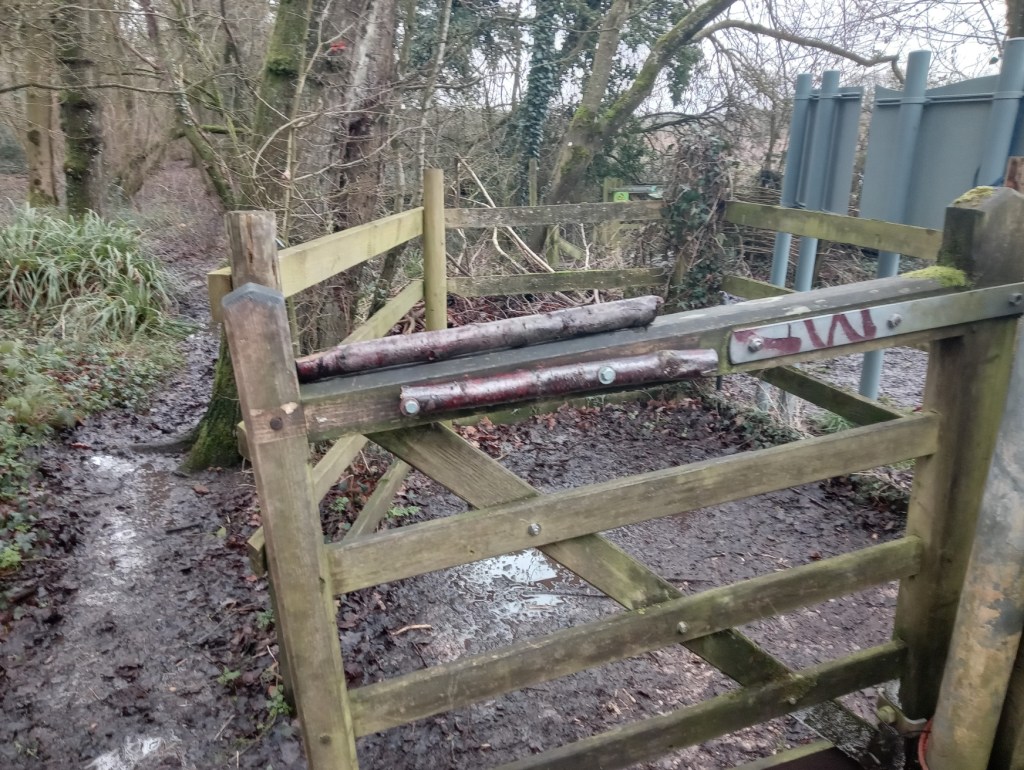
With storms raging all around, I was interested to know how we would fare (i.e. how the birds have fared) when we arrived at the site. The first thing I saw on arriving was not weather damage but another piece of petty vandalism of the front gate:

This is the third time that this gate has been vandalised, as far as I am aware. The bar along the top is continually being broken off, for no good reason. It is there to stop the gate flapping backwards and forwards. Vandalism is a regular feature at this nature reserve: from dog owners ripping down signs asking them to keep their dogs on a lead and to clean up after them to trashing the lovely, old Shooter’s Hut deep in the wood and the car park is continually blighted by fly-tipping. Rant over!

I was joined for the session by Laura and her two boys, Adam and Daniel, Teresa and Rosie dropped in to help set up before heading off to work at the Wildlife Trust. We set the usual nets along rides R28 and R38 and I set sound lures for a variety of winter visitors. Unfortunately, it didn’t attract in a single bird from any of those species. We did see a few Redwing flying around but that was about it. Having caught 62 birds from 12 species there, working solo the last time I ringed there, I was hoping for a decent catch. Unfortunately those hopes were quickly dashed.

In fact, between 8.30 and 11.00 we caught only 13 birds: Blue Tit 1(1); Great Tit 2(1); Coal Tit 1; Long-tailed Tit (3); Wren 1; Robin 1; Blackbird (1); Goldcrest (1). Totals: 6 birds ringed from 5 species and 7 birds retrapped from 5 species, making 13 birds processed from 8 species. Ironically, whilst we did catch 57 birds in Webb’s Wood on Monday, it was from only 6 species.

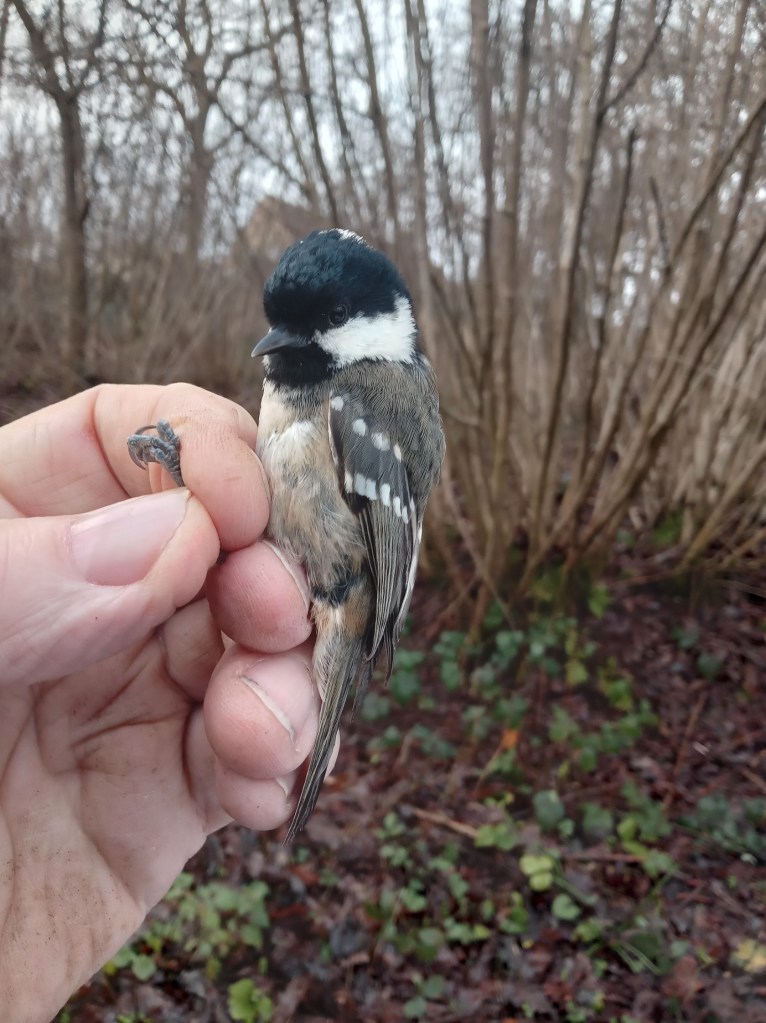
That is not to say that we didn’t have a good time of it: just lots more time to chat, plus plenty of time to focus on the birds we did catch. One of the more difficult birds to age are Coal Tits:

Coal Tit, Periparus ater

The key ageing criterion is the colour of the greater coverts:

The trick is in identifying the difference between the outer, older feathers, which tend to be browner with a brownish / yellow distal fringing and the inner, newer, feathers that are darker, greyer with greyish distal fringing. The outer three feathers of this bird were what we used to identify this bird as a juvenile.

We were treated to more Ravens flying around and croaking, Carrion Crows croaking in a higher key and a Song Thrush that sat in the tree adjacent to our ringing station and refused to put a cork in it nearly all morning. 

One other interesting birding event: a Kestrel hunting within the wood. We saw it on several occasions throughout the morning and it was definitely hunting.

We met a lot of dog walkers this morning and, for once, they all had their dogs on leads – possibly to ensure that they didn’t get absolutely plastered in mud. Whilst not as much of a quagmire as Webb’s Wood, ride R38 was extremely muddy and, by the time we had walked back and forth along it a dozen times, it was an absolute morass. 

At 11:00, after a couple of empty rounds, we decided to call it a day and took down the nets. With two teams working at it, we had the nets down and everything packed away by 11:30.

West Wilts Ringing Group Results: December 2023

An interesting December: despite the weather we managed to get in as many full sessions (17) as we did in December 2022.  The total numbers were relatively similar but the make up was very different.

image.png

This year we had two fewer species than last year but three of the species in 2022 were Buzzard, Barn Owl and Tawny Owl, when I ringed four of the former and one each of the latter two species at the RSPCA Oak & Furrows Recovery Centre.  Anyway, in our catch this year, missing last year, are Bullfinch, Linnet, Meadow Pipit, Sparrowhawk and Tree Sparrow.  The addition of Tree Sparrow this year is down to Jonny taking over monitoring a number of sites containing their nesting colonies and taking on ringing around these sites. Missing from our catch this year, as well as the three rehab species, were Green Woodpecker, House Sparrow, Jay, Pied Wagtail and Starling.

As well as this, the balance of catches is quite astonishing.  In the ascendant in December 2023 are:

  • Blue Tit: 122 ringed in 2023 vs 80 in 2022, whereas the numbers retrapped were very similar (81 vs 85).
  • Great Tit: 106 processed vs 58 processed, with 56 ringed in 2023 – nearly the same as the total processed in 2022.
  • Lesser Redpoll: 20 ringed vs 2.
  • Redwing: 129 processed vs 64 (funnily enough, Jonny and I had coffee and a chat on Friday and were actually moaning about how few Redwing we were currently catching!)

In the descendant in December 2023 are:

  • Blackbird: 28 processed in 2022 vs 17 this December
  • Goldfinch: 40 vs 17 
  • Long-tailed Tit: 32 vs 17, with the key difference being only 7 ringed this year vs 19 in 2022.
  • Robin: 22 ringed last December, just 11 this.
  • Wren: 17 ringed last December, only 2 this.

I would love to know the reasons behind these changes. The only one that I have any knowledge about is the Goldfinch numbers: it was too windy to open the nets in my garden this December, which contributed 11 Goldfinch to the total last December and none this month.

New Year’s Day 2024: Webb’s Wood

With this being the first dry day, with tolerable wind speeds for mist netting, since our Boxing Day session, I decided to run a session at Webb’s Wood to celebrate the New Year. There was a good team turnout: Ellie (my longest serving / longest suffering C-permit holder), Teresa and Adam for ringing & extracting duties; Laura for extracting & scribing duties, Andy for scribing duties & Mark (to give me someone to talk to, because everybody else was doing all of the work). The whole team joined in with setting up and taking down the nets in what can only be described as a quagmire. Needless to say, the only person who managed to actually measure their length in the mud was yours truly: via a bramble tripwire! Fortunately, that was right at the end of the session, because I was very mucky afterwards.

We met at 7:30 and, despite a bit of messing around with the last two nets, with shelf strings breaking on both, one immediately retrievable thanks to Laura’s dexterity, the other having to be replaced, we had all nets open by 8:30 and were immediately catching birds for processing.

It wasn’t the most exciting catch: unfortunately there were no Lesser Redpoll to be seen this time, and neither did any Redwing put in an appearance. However, we did catch a decent number of birds, mainly Blue and Great Tits attracted in by the feeding station. Despite the lack of variety, Adam got to ring his first ever Chaffinch and Goldcrest and Teresa to ring her second ever Goldcrest, so I think they were happy with their morning’s work.

The list for the session was: Blue Tit 15(9); Great Tit 13(10); Coal Tit 3(2); Blackbird 1; Goldcrest 3; Chaffinch 1. Totals: 36 birds ringed from 6 species and 21 birds retrapped from 3 species, making 57 birds processed from 6 species.

Whilst the rest of the team were extracting birds at 9:30, Mark and I had the pleasure of watching a Raven circling around above our ringing site, calling constantly. It then perched in the top of one of the taller conifers left at the site and we had lovely views as it continued its calling from its perch. It then flew off and a few minutes later we had a pair of Ravens fly past: whether it had been calling for its mate and this was the result, or not, is open to conjecture. What we did see, a little later on, was a Raven flying through with what looked like nesting material in its beak. They nest early, so it is entirely feasible that what we saw this morning was all part of pair bonding and preparation for nesting.

At about 10:00 we were treated to an overflying Goshawk. We know that they arrived in the area a few years ago, and I am aware of two sites where they are thought to have nested last year. I am hoping to find the nests this year and see about monitoring them and their young (once I have filled out the appropriate paperwork for a Schedule 1 licence). 

With the weather turning decidedly chilly, the wind increasing in strength and, perhaps more decisively, the catch numbers having died off, we decided to pack away the nets, carrying out the last round at 11:20. We had everything packed away and were off site by just before 12:30.

Boxing Day: Somerford Common, 26th December 2023

It was Boxing Day – but I think Mud-Wrestling Day would be a more appropriate name at the moment. The water table is clearly now so high that any additional rain water, and there was plenty of rain last night, is just sitting on top of the substrate. I was joined for the session by my two latest recruits: Justine and Claire. We met up at 7:30 and set up the usual nets for the winter CES and were expecting a reasonable catch. I had got out in between rain showers and high winds to top up the feeding stations across my sites on Friday and, sure enough, the peanut feeder was emptied and the 8 litre seed feeder was over three-quarters empty. Since the last time I topped up the feeders I have started using a new premium seed mix this time (the Luxury Bird Feed from Food 4 Wild Birds if you are interested, and I don’t get paid to advertise) and the birds are certainly much more appreciative: much less spillage this time.

As expected, the birds, mainly titmice, started arriving straight away and the catch was regular thereafter. It was good that we were never under a lot of pressure as Justine has not started extracting yet and Claire is very competent but it has been a while since she has done a lot of extracting.

What was somewhat surprising was the continuing numbers of Chaffinch turning up at our catches. Unfortunately, as in other recent catches, a significant number of those caught have had to be released unringed as they are suffering from Fringilla papillomavirus. Today we caught eight Chaffinch but could only ring five of them. This year is certainly considerably the worst for FPV in Chaffinch that I can remember in a decade. In contrast, I cannot remember having a single Bullfinch with the infection this year whereas, in the previous three years, they have been the more prone to suffering from it.

I was delighted to have another Marsh Tit to ring, and another four retrapped this session. It has been a good year for the species in the Braydon Forest. Given that I haven’t had access to one of my regular sites for the species for over a year now, and have had limited access to one of my stronghold sites for it for most of this year, I am pleased with the return that I have had. Claire’s highlights were two-fold: she got to extract and ring her first Redwing and extracted her first two Nuthatch, and ringed her first of them. Justine got to ring several new species but her absolute highlight was her first Lesser Redpoll.

The list for the day was: Nuthatch 1(1); Blue Tit 8(4); Great Tit 7(10); Coal Tit 1(2); Marsh Tit 1(4); Robin 2(1); Redwing 1; Chaffinch 5; Lesser Redpoll 1. Totals: 27 birds ringed from 9 species and 22 birds retrapped from 6 species, making 49 birds processed from 9 species.

Claire had to leave at 11:30. Justine and I did one more round after she left (which delivered the single Lesser Redpoll), shutting the nets as we went. After processing those birds from the last round, we took down and packed away, leaving site at just after 13:00: covered in mud but pretty happy.

Lower Moor Farm: Wednesday, 20th December 2023

With Saturday being a wash out I was rather desperate to get out so, despite a weather forecast that said it would be gusting to 40mph, with a base speed of 20mph, I decided to risk it and head for Lower Moor Farm. I was joined by Rosie and Teresa on the ringing side, Andy to help set up and, for the first time, Emily and Justine. Emily has done a little ringing whilst at University and Justine is a raptor specialist, working with a group on the west side of Salisbury Plain, who has done virtually no mist netting and, as a consequence, no small Passerines or near-Passerines. This was an introductory session for both of them.

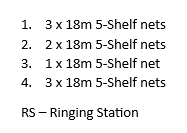
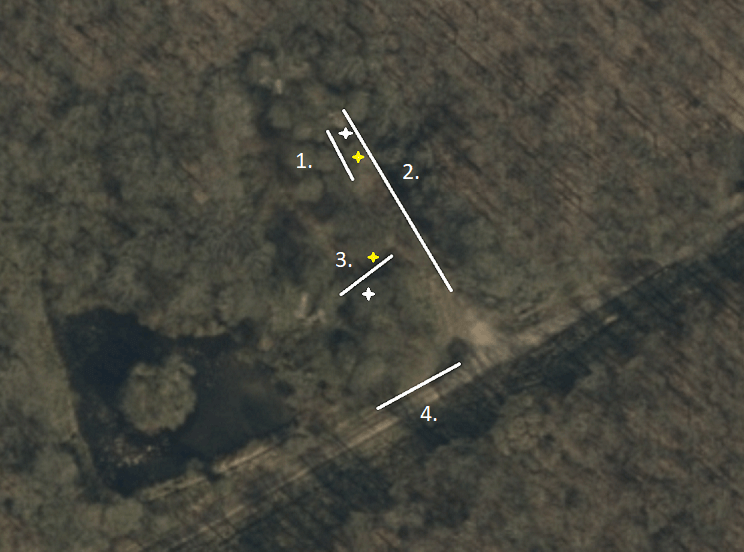
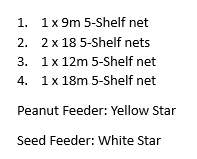
We met at 7:30 and set the following nets:

With two teams setting up the nets they were up and open quite quickly. As forecast, it did start out quite windy but, fortunately, the gusts were intermittent and the gaps between gusts got longer as the morning progressed. In the event it meant there was very little interruption to the ringing between 9:00 and 11:00 and we had a reasonable catch for this site for this time of year. We don’t have feeding stations set up there, so I don’t expect the level of catch like we experienced at Red Lodge last Friday.

The list for the session was: Nuthatch (1); Treecreeper 1(1); Blue Tit 4(3); Great Tit (1); Long-tailed Tit (2); Wren (1); Redwing 1; Blackbird 2; Goldcrest 4(1); Bullfinch 3. Totals: 15 birds ringed from 6 species and 10 birds retrapped from 7 species, making 25 birds processed from 10 species.

Our run of Bullfinch captures continued, with another three ringed this morning. Unfortunately, a fourth had to be released unringed as, like several of the Chaffinch we have caught recently, it had early signs of the Fringilla Papillomavirus infection on its legs. We did have a couple of males this time:

Male Bullfinch, Pyrrhula pyrrhula

One of the most beautiful of our resident birds. Alongside these, we had another small catch of Goldcrest: much to Justine’s delight, as she got to ring her first of the species. She also got her first experience of ringing / being bitten by Blue Tits. As someone used to dealing with Kestrels, Barn and Tawny Owls, she was somewhat surprised at how bitey, and how painful, they can be. 

Emily also got to experience Blue Tits for the first time and also her first Bullfinch.

With the wind finally getting strong again, we closed the nets at 11:30 and took down, leaving the site just after midday. All in all, a small but enjoyable session and a couple more people interested in doing more bird ringing with me.

A Quiet Morning?? Red Lodge: Friday, 15th December 2023

I had planned to run this session on Thursday but, with rain forecast between 7:00 and 9:00 that day, I moved it to Friday. The intention also was originally to run it at Somerford Common, as part of the winter CES plan. Unfortunately, moving it to Friday meant that Miranda couldn’t make it, leaving just myself and Teresa. Although Teresa is making excellent progress as a new trainee, I thought that the potential for an 80+ bird catch would be pushing her limits a bit. So, I swapped Red Lodge from Saturday to Friday, knowing that I have a full team out tomorrow to do Somerford Common, and, having only set up the Red Lodge feeding stations on Tuesday, I thought it would be a lot quieter and less pressured for Teresa.

We set the following nets:

We met at 7:30 and had the nets open by 8:30. By 9:00 the nets were full. So much for a quiet morning! The pair of us got on with it and extracted the birds as quickly as we could. In order to ensure control, we shut each net as it was emptied. It was, of course, an absolute Tit-fest: primarily Blue and Great Tits.

The list for the day was: Treecreeper 1; Blue tit 27(3); Great Tit 15(7); Long-tailed Tit 1(1); Coal Tit 2; Robin 1; Goldcrest 1; Chaffinch 2.  Totals: 50 birds ringed from 8 species and 11 birds retrapped from 3 species, making 61 birds processed from 8 species. We did have a third Chaffinch but it had scaly-leg syndrome, so I just released it. There was also a third Coal Tit but he went a bit droopy on me, so I did my usual: popped it in a bag and put if down my front, against my skin, to warm it up. I am delighted to say that it did the trick. In fact, it did the trick so well that, as I went to take it out of the bag, it escaped my grasp and flew off! 

It was hard work and, although the ambient temperature didn’t drop, a cold breeze did get up, I got cold, and so we never did reopen the nets: 61 birds caught in 75 metres of net with no lures playing was way more than I was expecting. I was impressed at Teresa’s composure, given that this was only her fourth or fifth session actually extracting birds. She just got on with it, asking for help where necessary (which wasn’t very much).

We packed up and left site soon after 11:00 after a much busier session than expected.

Webb’s Wood: Monday, 11th December 2023

As luck would have it, on the only decent day since our freezing session on the 2nd December (Wednesday of last week) I had a major family commitment (mother’s 93rd birthday, absolutely couldn’t be missed). Friday was too windy and the rest of the time was wet, windy and totally miserable so, benefit of being retired, I arranged for a session at Webb’s Wood for Monday morning as the weather was looking possible.

I was joined for the session by Teresa, Laura and Andy. Laura and Andy helped setup and take down, Andy scribed, Laura extracted and Teresa did a bit of everything except scribing. We met at 7:30. The drive up to the ringing site was fun: several Robins and Song Thrushes and two Woodcock were quick to move out of the way. We did not catch any Robin or Song Thrush in the session (I wasn’t expecting to catch Woodcock, so wasn’t disappointed). Missing out on Robin is most unusual: since I started ringing at Webb’s we have managed 69 sessions and Robins have been caught in 65 of those sessions. So, an unusual missing species.

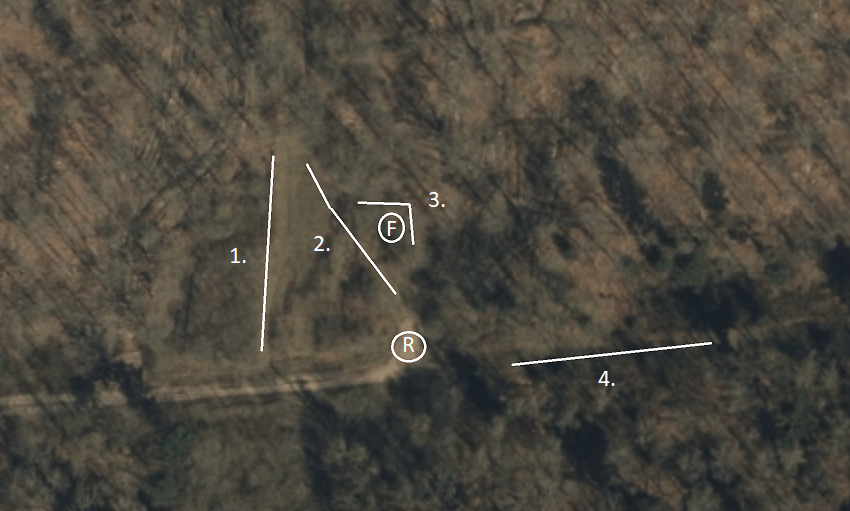
It was pretty windy when we got to the ringing site and, at first, I was unsure whether we would be able to set all of the intended nets. However, after setting up two net sets in sheltered areas, the wind dropped and I could set all of the nets that I had planned. That included two nets around the feeding station that I set up last week, before the weather turned horrible. The set up was:

We had the nets open by 8:15 and I put a number of lures on the net rides: one to three had mixed finch calls on the lures (Lesser Redpoll, Siskin & Brambling) whilst ride four had Redwing and, from 10:00, Goldcrest, Firecrest, Long-tailed Tit & Chiffchaff). Things didn’t actually get going until 9:00 and, apart from the lures, it was very quiet, with very little other bird noise about. However, at 9:00 the Latvian love song did its job and we had three Redwing in ride four, which was followed 15 minutes later by a female Bullfinch. This is our fourth Bullfinch ringed in the last four weeks: all of which have been female! Where have all of the males gone?

Whilst Teresa was processing this bird we couldn’t help but notice a large flock of small birds flying around the tops of the trees around the ringing station. It became clear that they were Lesser Redpoll responding to the lure and, sure enough, they came lower and started to hit the nets in rides one and (mainly) two. We sat back to see how many were going to catch. By 9:30 we decided it was time to get them out: 15 Lesser Redpoll and three each of Blue and Great Tit. The next round produced another three Lesser Redpoll. That was it with that species, until our last round at 11:30 when we ringed another one and retrapped two from our last Webb’s Wood session on the 5th November. It is good to know that they are staying around. The 15 in one haul is our largest individual flock catch of Lesser Redpoll and the 21 processed is our largest in any one session in the Braydon Forest. The previous largest session catch was 20 on 5th December 2021, with a single largest haul of 11 birds.

The list for the morning was: Great Spotted Woodpecker 1; Nuthatch 1; Blue Tit 9(4); Great Tit 8; Coal Tit 1; Redwing 3; Chaffinch 1; Lesser Redpoll 19(2); Bullfinch 1. Totals: 44 birds ringed from 9 species and 6 birds retrapped from 2 species, making 50 birds processed from 9 species.

What is remarkable about this catch is the absence of any Goldcrest, Robin or Wren in the catch. Teresa’s highlights were the Nuthatch that she processed and this beauty:

Adult male Great Spotted Woodpecker, Dendrocopos major (photo courtesy of Teresa)

This has been our quietest year yet for this species in the Braydon Forest: only our ninth this year: about 75% of the average annual catch.

We did catch three Chaffinch but, unfortunately, the two that I took out of ride four were badly infected with Fringilla papillomavirus and I released them unringed before applying liberal quantities of antiviral hand wash so that there was no chance of passing the virus on to other birds.

We missed out on a Woodpigeon that hit the net, settled in the pocket briefly, but then extracted itself and got away. We always heard and saw Jay and Raven flying around. There were also two sightings of Muntjac and, somewhat later, two rifle shots. As, on leaving the site, we found that the gate had been locked our assumption is that the shots came from one of the stalkers Forestry England use to control deer numbers. I will be having a chat and asking FE to tell the stalkers to leave the gate open when we are on site. Our ringing site is a long way from the car park and should, for whatever reason, we need the attendance of a medical unit they will have cut off access.

The wind got up again at 11:00, so we started closing the most exposed and taking them down. Everything was packed away by midday and we left site soon after (soon after I had opened the gate for the gang to get out!). I then spent another 30 minutes visiting the other Forestry England sites that I ring at, topping up the feeders there. It was nice to see some Crossbills flying around at both of my Somerford Common sites. If only! They don’t respond to lures particularly, but needs must! We will be there on Thursday, so fingers crossed.