Winter’s Here: Somerford Common, Saturday, 2nd December 2023

With the weather forecast for sub-zero temperatures, but with winter CES session 3 scheduled for this morning, I decided to got to site to see what the conditions were like. Fortunately, it felt warmer than forecast, probably because there was no breeze, and I determined that we could go ahead with the session. I was joined by Ellie for the morning. I knew that a couple of my other trainees were unavailable and that others are currently at the early stages of learning to extract. Fortunately, Ellie is my most experienced trainee, C-permit holder and extremely competent. As the key in cold conditions is to get the birds out of the nets as soon as possible, and to increase the number of checks on the nets to minimise exposure, that can be hard to do with inexperienced trainees, as you frequently have to step in to help them both in extracting and processing. Once in the bags the birds will be fine, but you don’t want them hanging around in the cold in the nets. Equally, in order to be able to process birds efficiently, and get on with net rounds in a timely manner, experience is key. In the event, I am pleased to say that none of the birds we extracted and processed this morning showed any signs of cold stress, and none had to spend time being warmed up before release.

Despite keeping the nets shut until they were all erected, we did have three birds in the nets before they were properly opened: a retrapped Marsh Tit and Great Tit and an unringed Chaffinch. Subsequent rounds were a bit busier but, around about 10:00, a freezing mist started to affect the nets, they became highly visible with a coating of rime, and the catch dropped right away. We closed the nets at 10:30 and attempted to take down. The nets were heavily rimed, frozen and very heavy and bulky. It was impossible to actually put them back into their net bags, such was the additional volume created by the coating of ice. Instead we tied the ends and then bundled them into our large carry bags. Back at the car I put them into the carry box I use for my bird bags. They are currently sitting in that box, in my kitchen and, four hours later, are still thawing out.

In the just over two hours we had the nets open we caught 34 birds: Nuthatch 1; Blue Tit 1(5); Great Tit 2(10); Coal Tit (3); Marsh Tit (4); Wren (1); Robin 1; Redwing 4; Blackbird 1; Chaffinch 1. Totals: 11 birds ringed from 7 species and 23 birds retrapped from 5 species, making 34 birds processed from 10 species. Not bad for such a short session.

It was good to ring our second Nuthatch in consecutive sessions for the site. That takes it to four ringed for the year: the average for this site. The four recaptured Marsh Tits were all ringed as juveniles at this site this year. In fact, two were ringed in CES 1 and one in CES 2. We did catch a second Chaffinch but, unfortunately, it was suffering with Fringilla papillomavirus (FPV), the legs were showing the warty excrescences and it could not be ringed. We did have a brief discussion about whether there could be some method for identifying individuals so that survival with this condition could be monitored. I have, in the past, weighed birds with FPV, and they always fall within the normal weight ranges, but it would be interesting to see how this disease affects survival.

With everything packed away we were off-site by just after 11:00, heading off for a well-deserved warming up.
West Wilts Ringing Group Results: November 2023

A slightly unusual month for us this November. We just did not get the sessions in that we would normally expect. No doubt the weather had a large part to play. Also, my car deciding to break down regularly, leaving me stranded in the middle of Somerford Common and Lower Moor Farm on separate occasions, and then being off the road for a week whilst it was sorted out, didn’t help.

On the face of it we processed over 300 birds fewer than in November last year. However, we did nine fewer sessions than last year.  So our average catch was two birds higher, and that was because the average retrapped was a couple of birds higher.  On the face of it, one key difference this year, in my neck of the woods at least, is that I have only one feeding station set up (at Somerford Common, for consistency in the winter CES)  whereas last year I had three set up in October.  That said, my catch this year (310 birds processed in 7 sessions) was only 48 fewer than last year (358 in 9 sessions) – and averages out at 44 birds per session as opposed to 38: perhaps I need to rethink my feeding strategy!

image.png

We did have slightly less diversity in the catch this year: 30 species processed versus 33.  Missing from the catch this year were Blackcap, Great Spotted Woodpecker (somewhat surprisingly), Green Woodpecker, Stonechat and, (totally unsurprisingly) the Merlin that Jonny caught this time last year.  We did, however, add Cetti’s Warbler and Sparrowhawk to the list compared with last year.

Notable differences are: the huge reduction in Redwing caught this year compared to last, and the increase in Lesser Redpoll this year compared to last.  All Lesser Redpoll, so far, have been caught in the Braydon Forest.  

Mud, Mud, Glorious Mud: Tuesday, 28th November 2023

This week’s session was scheduled for Ravensroost Wood. As the local volunteer group carry out their works on a Wednesday, and ne’er the twain shall meet (we all get on fine – just too many vehicles), we went in this morning. I was joined by Rosie, Miranda and Teresa at 7:00. I decided to try a new net position (it caught two birds, I won’t try it again), which turned out to be the only one that wasn’t ankle deep in mud!

Rides 1 and 2 were incredibly muddy and, as is my wont, I managed to become intimately involved with it, tripping over a guy rope and measuring my length in the mud. As I had a bird attached to the carabiner around my neck, and protecting that was my main concern, there is not a lot you can do to fall elegantly and minimise the mud spatter.

The first round started nicely, only five birds, but two Nuthatch and a female Bullfinch alongside two retrapped Great Tits ringed at my previous session there. Round two was somewhat larger, at nine birds. Key amongst them in the catch was a Marsh Tit. The eighteenth ringed so far this year, that this was followed three rounds later by our nineteenth means that this year is looking good for the species in the Braydon Forest. As I have done very little ringing in Ravensroost Wood this year, and all of it in the eight-year coppice area, that I have ringed four there (0ne adult, three juveniles) this year is quite surprising. My next session will be at the north end of the wood to see whether we can increase that number.

Between 9:00 and 9:30 we captured four Goldcrests, but none afterwards, which was a bit of a surprise as they are usually absolute suckers for the lure. Talking of birds that come to the lure: we did actually catch a Redwing immediately over the lure. In that round we caught the second Marsh Tit and two Lesser Redpoll.

At 11:00 we were joined by one of the Wiltshire Wildlife Trust’s well-being groups. As luck would have it, that was our only empty round of the morning. We agreed that if we caught anything in our last round I would give them a shout so they could come over and I could show them what it is all about. Fortunately, we caught a Blue Tit, a Great Tit and this little beauty in that round, so we did have something to show them:

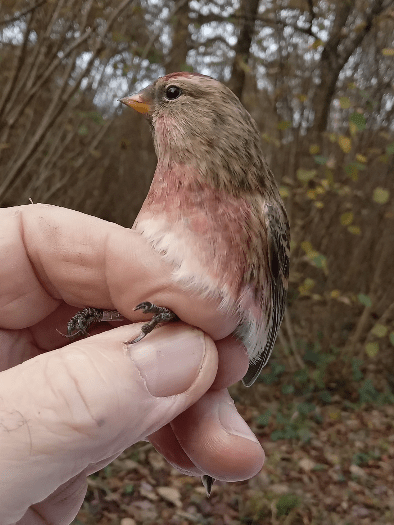
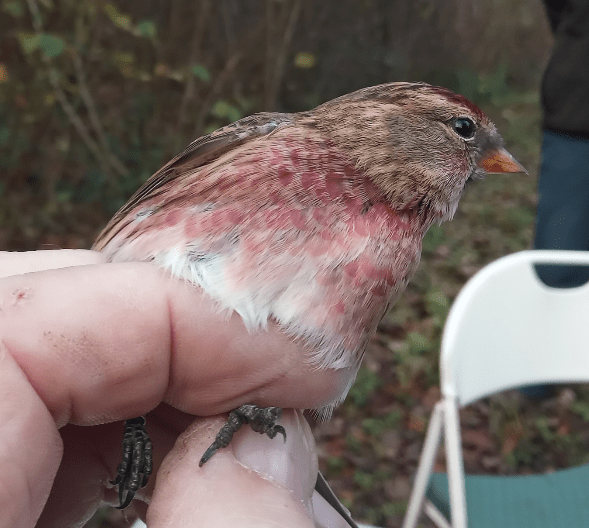
A beautifully marked juvenile male Lesser Redpoll, Acanthis cabaret.

Everybody was wowed by it. I was surprised at how well marked its plumage is. It was definitely a juvenile: the tail tips were very pointed, the classic identifier.

The list for the day was: Nuthatch 2; Blue Tit 4; Great Tit 2(2); Coal Tit 2; Marsh Tit 2; Long-tailed Tit (1); Wren 1(1); Dunnock 1; Robin 3; Redwing 1; Goldcrest 3(1); Lesser Redpoll 3; Bullfinch 1. Totals: 25 birds ringed from 12 species and 5 birds retrapped from 4 species, making 30 birds processed from 13 species.

I am quite surprised at the number of species, given the size of the catch, for this site. Even at my last session here, with 63 birds caught, it was 11 species, which was the most to date at that time.

Having finished my mini ringing demonstration we did the last round, closing the nets as we went: no more birds so we started taking down at about midday and were away from site by 12:45.

Brown’s Farm: Saturday, 25th November 2023

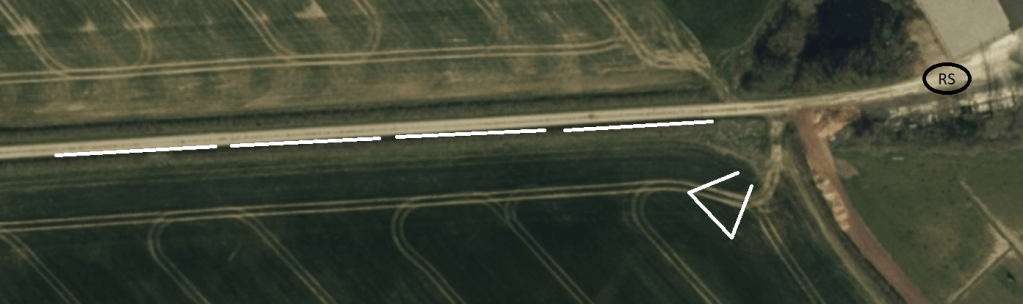
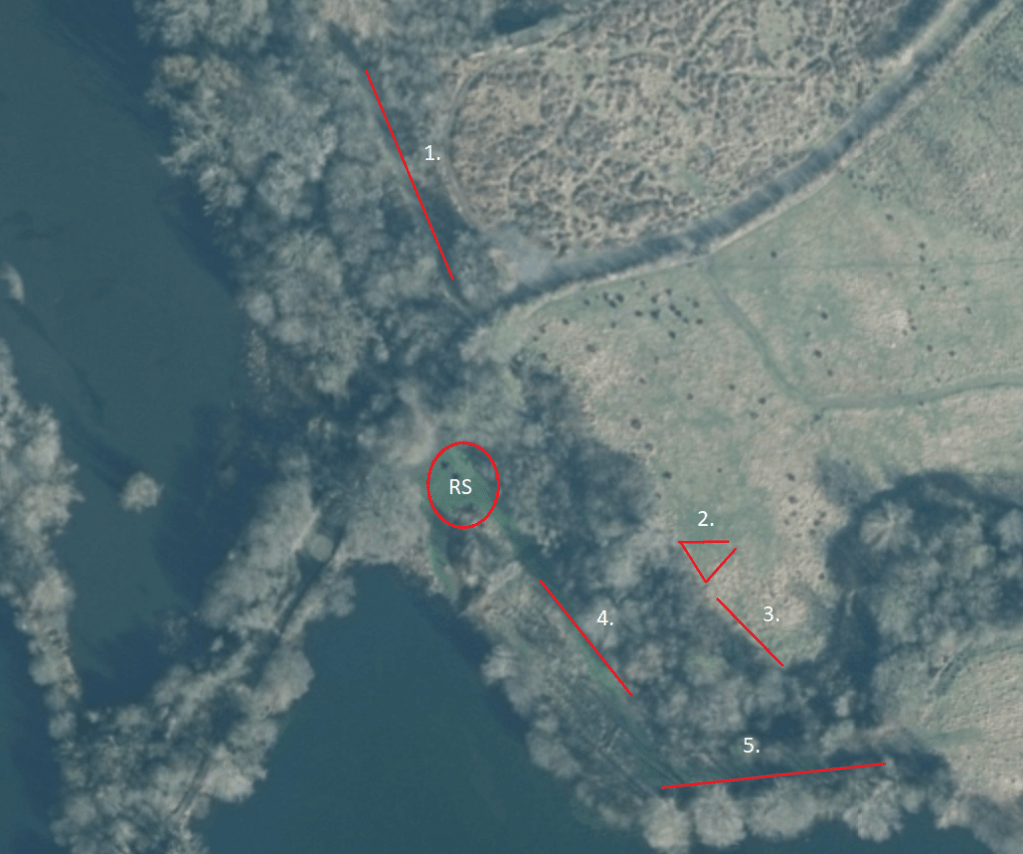
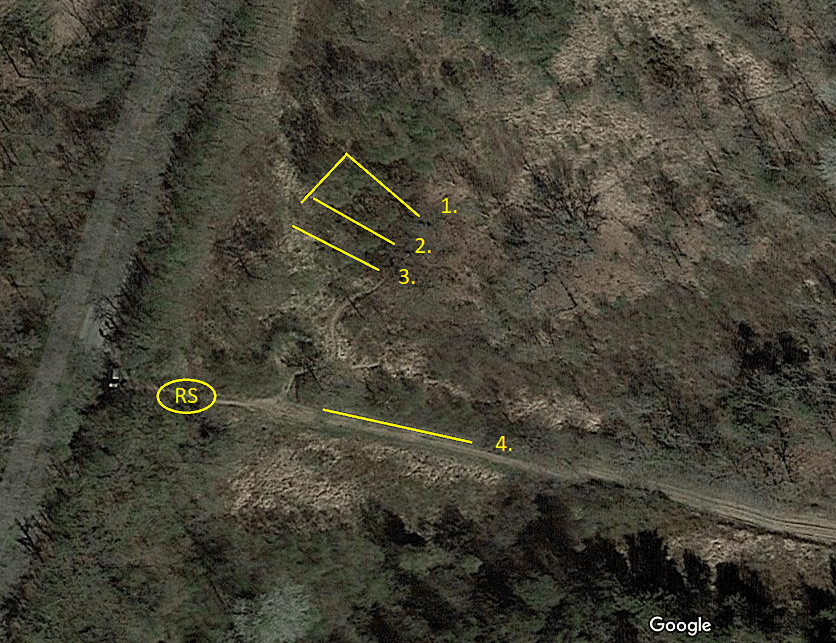
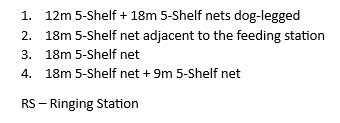
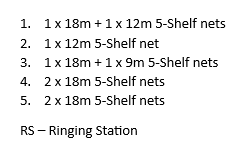
This is the first time that I have managed to get to Brown’s Farm this year. It seems that every time I have planned to go either the weather has turned sour, the car has broken down or I have been ill. Weather has been the biggest barrier: despite excellent hedgerows, the site is at the top of Postern Hill, just south of Marlborough, and any wind and it is unworkable. Windy conditions seem to have been a dominating factor in our local weather for the last three years. Last night things looked like I might have to cancel, but a couple of Imodium Instants and I was ready to go – so to speak! Just as well really, as I was being joined by David plus Laura, Mark and their two boys for the session and I really didn’t want them to miss it. We met at 7:15 and set the following nets:

These are 4 sets of 2 x 18m 5-Shelf nets plus the Mipit triangle. To be honest, this was not where I had hoped to set my nets but the track down to the usual site, alongside the game cover, was impassable for our vehicles.

This time of year I expect to catch 35 or so birds at the site, irrespective of in which area I decide to set the nets (36 last October and 35 in November). We set the Mipit triangle more in hope than expectation. In the event we didn’t catch any. After the blank at Lower Moor Farm Friday before last, it rather looks as though they have moved on from this area.

The weather was cold when we arrived: bang on freezing point, so there wasn’t a lot of movement early on. As it began to warm up, after 9:00, we hoped that there would be an increase in avian traffic. Unfortunately, it didn’t happen.

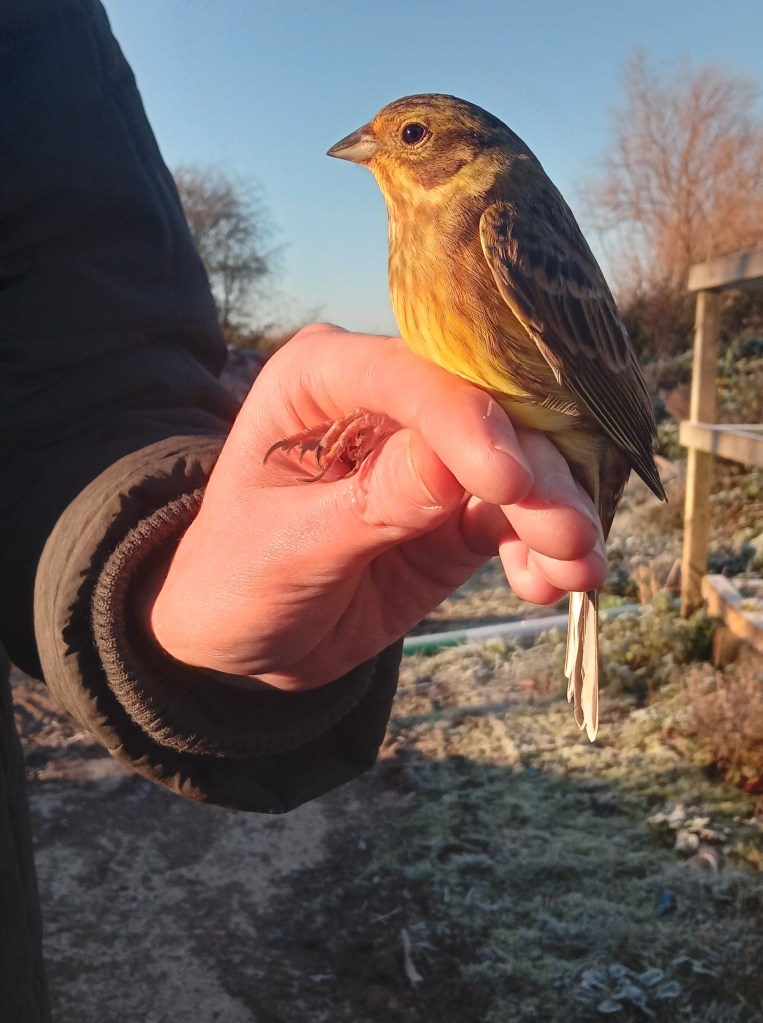
Once the nets were set I tracked back to put the lures on the net rides: Meadow Pipit in the triangle and a mix of Yellowhammer, Linnet, Reed Bunting, Redwing and Brambling along the eight 18m nets. In the end net I extracted a juvenile male Yellowhammer. Unusually, I decided that I would process the bird: my first of the year. We ended up with four Yellowhammers, which meant that David, Adam and Daniel all got to process their very first Yellowhammers of their ringing careers.

Juvenile Female Yellowhammer, Emberiza citrinella

The second bird out of the net was a Redwing. Somewhat surprisingly, nowhere near the lure that is so often successful.

After a couple of hours of the Meadow Pipit lure proving fruitless I changed it to Linnet. Quite soon afterwards a small flock of Linnets arrived and started flying around the Mipit net set. We eventually caught three of them in the triangle and another in the hedgerow nets:

Juvenile female Linnet, Linaria cannabina

Unfortunately, that was it. No more birds until we decided to pack up, which we did at 11:00. It was an enjoyable session, despite the small catch. With three of the trainees each getting their first Yellowhammer and Adam also getting his first Linnet, it was certainly good for them. Also, it made my day to ring my first Yellowhammer of the year, but also to be able to spend time showing trainees the dark arts of ageing and sexing both Linnet and Yellowhammer.

There was also plenty of time for chatting, drinking coffee and eating cake and biscuits. We did get plenty of birding in as well: Pied Wagtails were busy around the farmyard, a Kestrel was on the hunt, and there were plenty of other birds flying around. If there was any frustration it was the number of birds that hit the nets and bounced off. It is hard to know why it was happening: the nets were certainly not over-taught but somehow they managed to avoid the pockets. Oh well! I will give it a couple of weeks for the track to dry out (fingers crossed) and then have a go by the game cover.

Perversely: Marsh Tits in the Marsh – Wednesday, 22nd November 2023

Okay, it wasn’t actually a marsh but our site at Somerford Common has so much standing water that it might well become one. We haven’t had too much rain in the last few days, but Forestry England have had a rather large tractor on the site, carrying out the usual ride maintenance, but the under-wheel conditions (is there such a thing?) have resulted in a real mire, and left some pretty deep water-filled ruts, along the main ride.

Marsh Tit, though, is probably the wrong common name for Poecile palustris, as they are associated with, primarily, broad-leaved woodlands in the UK. As it says in “The Birds of the Western Palearctic”, they prefer their woods moist to dry, but not wet.

This was the second CES session for this winter. We were on site at 7:00. I was joined by Teresa and Andy and, after doing the school run, Steph. The same nets were set as in winter CES session one. Having set the nets, leaving them closed so that we didn’t get any unexpected early arrivals, Andy and Teresa went back to set up the ringing station whilst I opened the nets. Unfortunately, two birds had decided that they couldn’t wait for the nets to be open and had already entangled themselves. Fortunately, that meant they had to wait for me to free them and, doubly fortunate, two Marsh Tits: one new, one retrap.

Marsh Tit, Poecile palustris

That was the start of our best haul of Marsh Tits since an identical catch on the 27th December 20210: one new bird and six retrapped birds. One of the retrapped birds was over four years old, with another two being over three years old. Nothing near the species longevity record (11 years 3 months) but longer than the typical lifespan of 2 years. For a red-listed bird its population in the Braydon Forest is not just stable but showing a slight increasing trend. In the following graph, the trendlines show this to be the case. Even when the 2017 spike is removed, the trends on both ringed and retrapped are still upward:

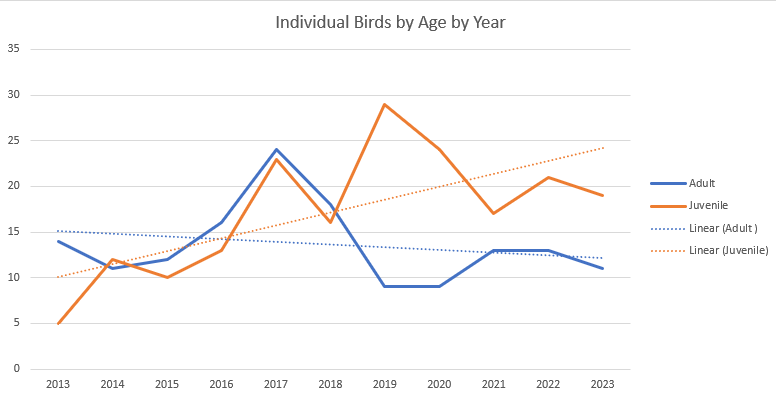
Retrapped birds can distort the picture, so I did a quick analysis of the numbers of individual birds by age group and year to give a better indication of how things are going for them:

As you can see, it is birds classified as juvenile that are driving the overall stability of the species in the Braydon Forest.

Obviously, Marsh Tits are a bit of an obsession for me, having helped persuade Forestry England to make it the priority bird species for their Braydon Forest management plans, but there was a lot else going on. Talking of Forestry England, we were joined by Sian from that organisation. She had driven past on her way to another site, saw the activity and stopped off to say hello. She spent a while with us, seeing what we do and learning how to safely handle and release a bird. She also found out what it is like to be bitten by a Great Tit (we spared her the Blue Tit experience – didn’t want to put her off). For the second session running we had a couple of Redwing drop in: unfortunately a fair few dozen flew over, some just missing the nets – as did a female Sparrowhawk. It was quite remarkable watching as she shot out of cover, noticed the net and did an almost vertical lift to get over it.

We are having a good year for Nuthatch, another four ringed this year will make it our best ever. Another Lesser Redpoll was caught, but several bounced off the nets, plus we had another small catch of Goldcrest. They are looking on target to be on par with recent year catches. For our woodland at the start of the winter it was a pretty good and varied catch:

The list for the day was Nuthatch 1; Blue Tit 5(6); Great Tit 6(9); Marsh Tit 1(6); Coal Tit 1(2); Redwing 2; Goldcrest 4; Chaffinch 1; Lesser Redpoll 1; Bullfinch 1. Totals: 23 birds ringed from 10 species and 23 birds retrapped from 4 species, making 46 birds processed from 10 species. It is not often that we get equal numbers of ringed and retrapped birds.

The catch dropped right away by 10:30. We shut the nets at 11:30, took down and left site by midday.

Lower Moor Farm: Friday, 17th November 2023

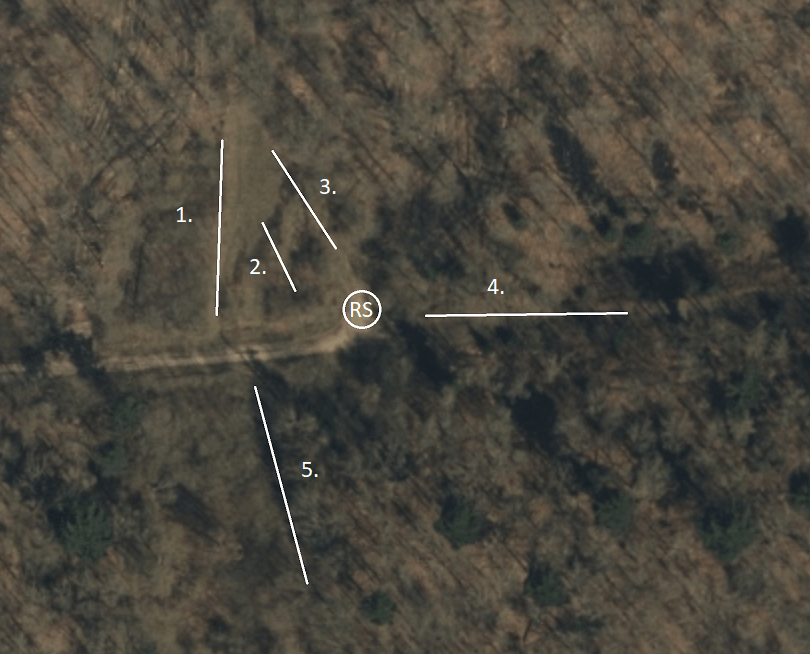
With the weather forecast for the weekend being rain, rain and more rain, I decided to move Saturday’s scheduled session back to Friday. Fortunately, David, Teresa and Rosie could come along to ring, and Andy to help set up, take down and scribe, as usual. Rosie was actually working at LMF today, so could stay pretty much up to 9:00, before setting off to do some cleaning and maintenance on the bird hides.

We set the following nets:

Rosie had noticed that there were large flocks of both Redwing and Fieldfare around the site. Fieldfare are notoriously difficult to catch, unless you happen to have a well-established orchard with plenty of windfall apples to set your nets in. Redwing are a lot easier to catch, particularly with the use of a superb sound lure that migrated to the UK from Latvia a good few years ago, and is known colloquially (okay, by me) as the “Latvian Love Song”. We did see a lot of Fieldfare over the course of the morning, all flying overhead. There weren’t so many Redwing around, but we di catch a few.

I set the Mipit triangle as at our last Lower Moor Farm session, on the 30th September, we managed to catch eight of them. Although we did see one of them sitting atop one of the poles, we didn’t catch it. In fact, net rides 2 and 3 did not catch a single bird.

The first round proper was rather good: we had 22 birds from eight species. The highlight had to be our first Kingfisher since September 2022. It was a juvenile female:

Juvenile Kingfisher, Alcedo atthis (photo courtesy of Teresa)

She was happy to sit on the hand for a short while before flying off strongly. Andy clearly has warm hands!

The second catch was a decent 16 birds, but then the catch died away to just three or four birds every other round. Mind, that did give us plenty of time to appreciate the Otter that was swimming around on Mallard Lake, giving excellent views from the side of the lake adjacent to our ringing station.

The list for the day was: Kingfisher 1; Treecreeper (2); Blue Tit 6(2); Great Tit 2(1); Long-tailed Tit 13(9); Wren 1(2); Dunnock 1(2); Robin (2); Redwing 4; Song Thrush 1; Goldcrest 6; Bullfinch 1. Totals: 36 birds ringed from 10 species and 20 birds retrapped from 7 species, making 56 birds processed from 12 species.

As you can see from the list, we had a really good catch of 22 Long-tailed Tits. Both the 13 ringed and the 9 retraps are the best ever in a single session since I started working there. Interestingly, the previous best was the previously mentioned session on the 30th September 2023. Interestingly, all of the retrapped birds were ringed as juveniles earlier this year.

As things had died off significantly after 10:30, we started taking down at 11:15. Shutting and taking down rides 2 and 3 first, leaving the others to catch, processing what was caught in the remaining open rides, shutting and taking down ride 1, whilst leaving 4 and 5 open until the end. We had everything packed away by 12:50 and everybody left. I finished tidying up, got into the car – and it wouldn’t start! Flat battery! Of course, getting a phone signal at Lower Moor Farm is a nightmare. I walked out of the site until I could get a signal and get my friendly local mobile mechanic to come and get me started. He did, and then me and his little helper had to push his van off the grass as its wheels just kept spinning and it couldn’t get traction! I tend to forget that my troublesome vehicle is a 4-wheel drive with hybrid tyres. Anyway, I got away at 13:45!

It was an excellent session, car problems notwithstanding!

Red Lodge: Wednesday, 15th November 2023

This has to be the wettest November that I can remember. We got out on Saturday, with two days of rain to follow, dry today, so we got to Red Lodge this morning, torrentially wet tomorrow but dry on Friday. With the weekend also looking very wet, I am moving Saturday’s scheduled session at Lower Moor Farm to Friday.

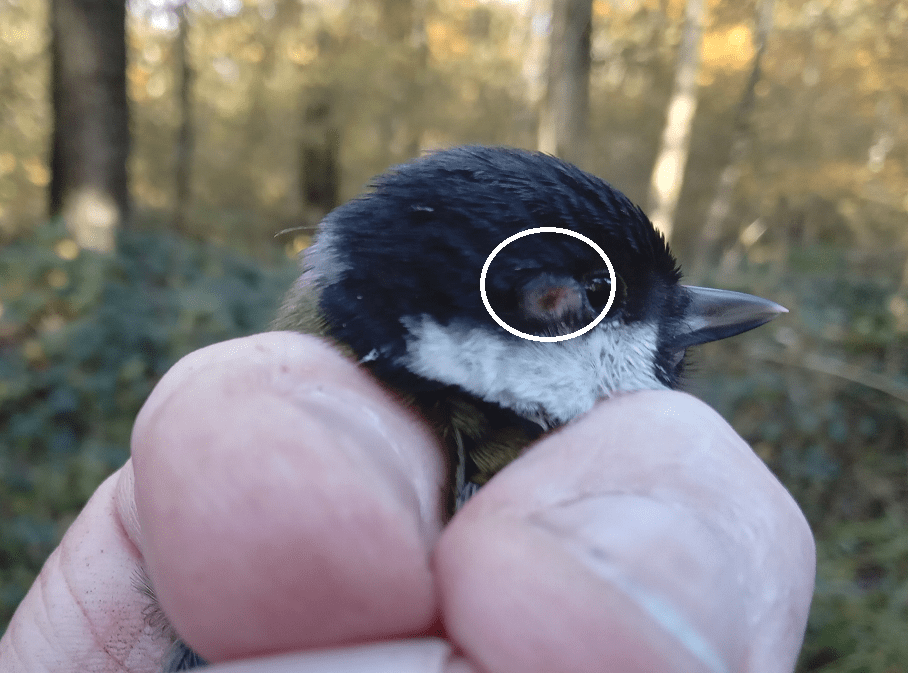
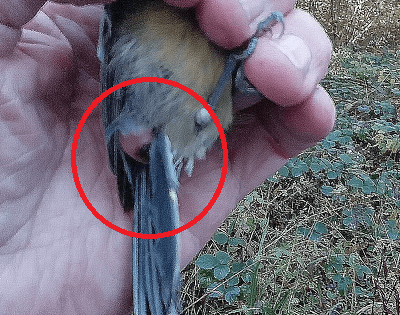
I was joined this morning by Rosie and Claire and then, slightly later, by Teresa and Andy. We set the usual nets in the places used for the last few sessions and I put on a variety of lures. It was a slow start with the first bird not out of the nets until 8:40. However, the next round delivered a small flock of Long-tailed Tits, a Goldcrest and a Wren. After that it went empty, four, empty, empty, three, empty and empty. I was getting pretty fed up with the lack of birds but then we had a surprising round of sixteen birds: mainly Great Tits, but our only Blue Tit of the day, a Coal Tit and three Goldcrests. However, we could only ring sixteen of the seventeen because one of the Great Tits presented like this:

A small Avian Pox pustule. It doesn’t look much, until you turn it around:

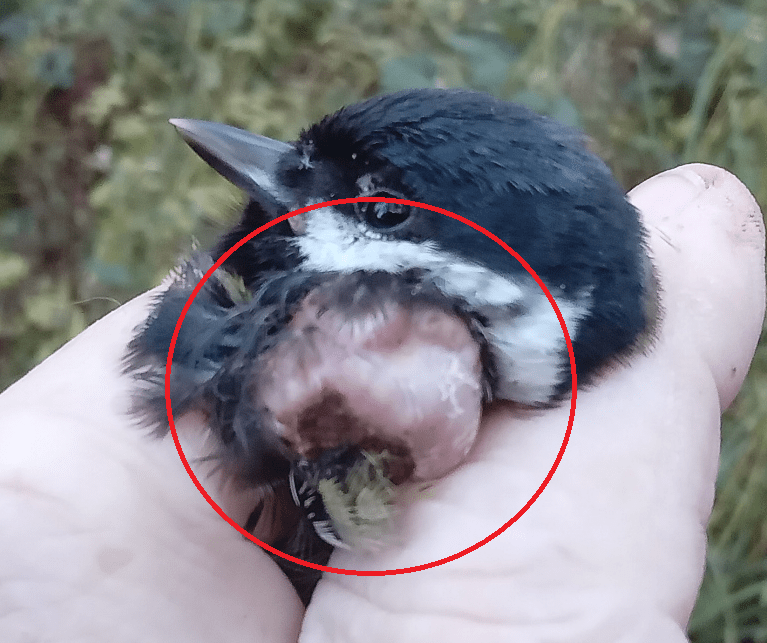
And then, its tail looked like this:

The pustule actually had a feather growing through it’s middle. It is the worst Avian Pox I have seen on a single bird. Needless to say, I didn’t put a ring on it and, after releasing it, I used copious amounts of anti-viral hand sanitiser before going near any other birds.

We did catch a few more birds after that, and ended up with a reasonable catch: Blue Tit 1; Great Tit 9(4); Coal Tit 3(1); Long-tailed Tit 5; Wren 1; Robin 3(1); Goldcrest 7(1). Totals: 29 birds ringed from 7 species and 7 birds retrapped from 4 species, making 36 birds processed from 7 species.

Not as good or as varied as the catch in October, with Redwing, Lesser Redpoll and Chaffinch missing from the catch. One upside though: only one Blue Tit to wreak havoc on our fingers! I will be setting up a feeding station there in the next week, so future catches will be larger but, almost certainly, mainly titmice.

Wind had been forecast for the day but it only really started getting up at just after 11:00. It was only affecting one of the rides but we decided to close the nets and take down at 11:30. We were packed away and off-site by 12:45 – a little slower than usual, but that was because I was letting the trainees do the bulk of the net take down, which is something that they need to know how to do.

Winter Ringing Project 2023: Session 1. Saturday, 11th November 2023

This is the second year of the BTO’s winter ringing project: a less constricted version of the breeding season Constant Effort Site scheme. The key differences are: fewer sessions further apart (eight sessions, two weeks apart) and recognition that supplementary feeding in winter can be necessary and is allowed. This year I have decided to use Somerford Common as the base now and going forward. On Saturday last I set up the feeding station. Originally I had planned to run the session on Wednesday, but my car had other ideas, breaking down again on Sunday evening. It took Ford Parts until Thursday to get the necessary replacement part, which scuppered that. Thursday afternoon I went over to site and topped up the feeders and cut the rides. It started to throw it down again just as I started clearing the last ride: so I got very wet.

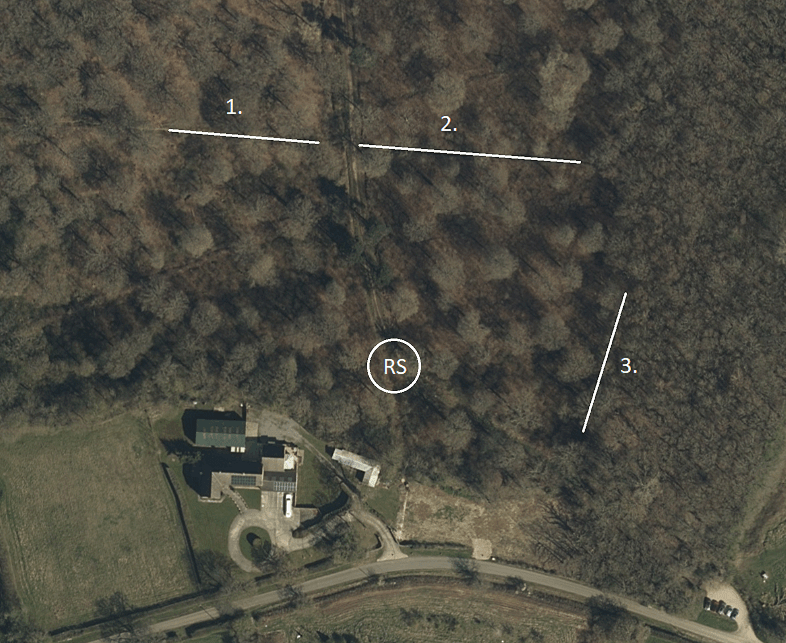
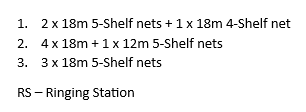
I was joined by Laura and Adam, Teresa and Andy at 7:00 and we set up the following nets:

We will be using these net rides for each of the next seven sessions. The feeding station comprises an eight litre seed feeder and a two litre peanut feeder. It has clearly been found by some of the local birds but I expect them to get busier. Unsurprisingly, the local Blue and Great Tits are already cashing in.

The birds started arriving as soon as the nets were open, and they just kept coming all morning. Our catch around the feeding station was primarily the aforementioned Blue and Great Tits but we also caught a couple of Marsh Tit and Chaffinch, plus both Goldcrest and Long-tailed Tit in those nets.

Net ride 4 produced a less Tit-focused catch with another nice catch of Lesser Redpoll plus, thankfully, a few Redwing, after they seem to have gone missing at my sites in the last month. The catch for the session was: Blue Tit 17(13); Great Tit 16(7); Coal Tit (1); Marsh Tit 1(1); Long-tailed Tit 4(2); Wren 2(1); Robin 1; Redwing 3; Goldcrest 3; Chaffinch 1(1); Lesser Redpoll 7. Totals 55 birds ringed from 10 species and 26 birds retrapped from 7 species, making 81 birds processed from 11 species.

With both regulars, Nuthatch and Great Spotted Woodpecker, missing from the catch, this was a good return. The Lesser Redpoll number is already our second best for November, and it is already our best October / November catch.

My highlights of the session were not what you might think: Teresa, on only her second session extracting birds, and Adam kicking off his extracting career, were both extremely good under pressure, by making sure that they didn’t allow themselves to be pressurised. They focused on what they were doing, asked for help when they needed it, and we had absolutely no issues as a result, despite a busy session. A big thank you to Laura who, whilst not wanting to be come a ringer, is a great helper and her extracting skills are first class: hopefully it is genetic! She and Andy also helped by scribing and with the setting up and taking down: valuable non-ringing members of the team.

We shut the nets as we carried out the last round: a Blue Tit and a Great Tit managed to get themselves into the closed nets before we could take them down. We ringed the Blue Tit and released the Great Tit, as it was one we had ringed earlier in the session. Despite that, we left site by midday, after a very satisfying session.

Webb’s Wood: Sunday, 5th November 2023

After an awful week of bad weather and a sick car, it was a relief to get out on Sunday morning. The forecast was for it to be dry but breezy. With the wind being forecast to come from the south-west, Webb’s Wood was the obvious choice, as the mass of the wood should act as a decent windbreak and the alternative was another trip to Ravensroost. I was joined by David, Teresa and Andy. We met at 7:00 and set the following nets:

I put on multiple lures for Lesser Redpoll, Siskin, Brambling, Redwing and Goldcrest. Two out of five worked. For the second session running there were no Redwing. This is a bit of a surprise: I am just wondering if the wet weather has prompted them to move on out of the Braydon Forest.

We had the nets open just before 8:00 and started catching immediately. Fourteen birds in the first round bade well for a good session, and it didn’t disappoint. It started with a small group of five Great Tits in nets 1 and 2 and a small flock of six Long-tailed Tits in net 4 plus a couple each of Coal Tit and Goldcrest.

Subsequent rounds didn’t reach that number, but the catching was regular and plenty interesting enough. Round 2 produced three Lesser Redpoll, and we caught one or two in most rounds thereafter. The turn around in the catch of this species in the wood is marked: it all dates from the massive thinning operation in the main beechwood in winter 2020 / 21. We ended up with a total of 11 in the session. With the encouraging catch of them in Ravensroost last Monday, perhaps we will be in for a good haul of the species this winter. The main catching site is at Somerford Common: which I hope to get to this week.

The list for the day was: Blue Tit 4; Great Tit 8; Coal Tit 6; Long-tailed Tit 7(2); Goldcrest 5(1); Chaffinch 1; Lesser Redpoll 11. Totals: 42 birds ringed from 7 species and 3 birds retrapped from 2 species, making 45 birds processed from 7 species.

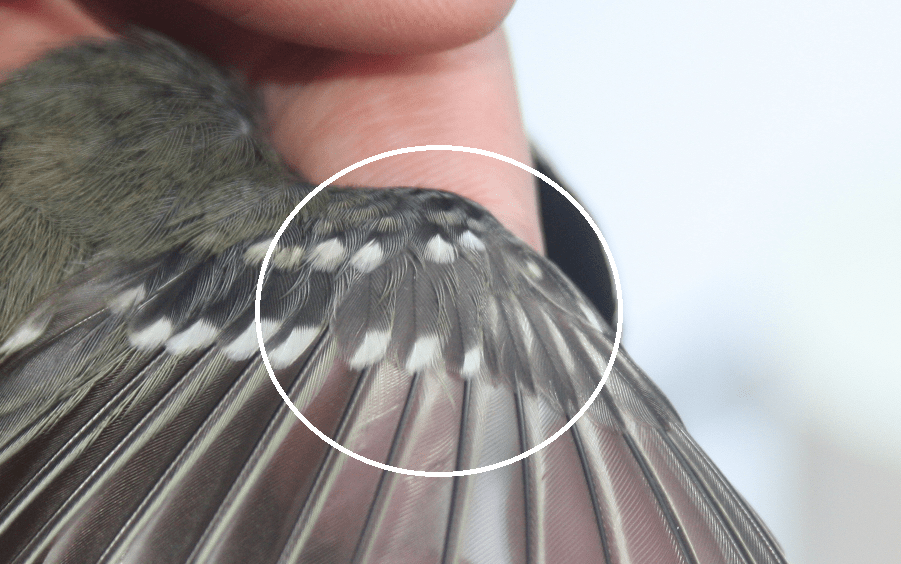
There were a couple of additional highlights to the Lesser Redpoll: nice haul of Coal Tits and a cracking juvenile male Chaffinch. Chaffinch are usually only caught when there is a feeding station set up and we average fewer than four each year at the site. We have had four so far this year (three back in March, inevitably at the feeding station), so perhaps we might be lucky enough to have a better than average year for them as well. Ageing Chaffinch can be a bit of a challenge. The two central tail feather of juveniles are narrow and very pointed. However, if the lose their tail it will be replaced by adult type feathers, which leaves you relying on retained greater coverts. Fortunately, this bird very clearly had two retained greater coverts:

Juvenile male Chaffinch, Fringilla coelebs

As you can see within the circle, the two outermost greater coverts are paler than the inner greater coverts (the reflection from the camera flash on the next two greater coverts next to the old ones notwithstanding).

If ageing Chaffinch is difficult then doing the same for Coal Tit can be a nightmare for some people. The difference can be subtle, and some people just cannot see it. Fortunately, usually I can:

Juvenile Coal Tit, Periparus ater

This one isn’t too difficult, as the three old greater coverts are very obvious. Apart from being paler and browner the fringing on the OGC’s is yellowish, the fringing on the adult feathers is a pale grey. It is not always that easy to identify.

It was an easy, enjoyable session, although the wind did not conform to the forecast. In fact, it seemed to veer all over the place but, fortunately, it didn’t particularly impact upon our session. We started closing the nets at 11:30, extract the odd bird and close the nets as we went, processing each bird extracted before moving on to take down the next set of nets. As a result, we left site just after 12:45. One final point: on leaving the site last time the supporting pillar for the pole gate came away at the base. It took ages to get it all set up so it was as secure as possible. I reported it to Forestry England. Not only have they replaced that pillar but they have also repaired the padlock (it had an annoying piece of metal that kept coming down and blocking the key access) but also cleared and repaired the rest of the support structure (it used to be a real struggle to open and close – and it is now very smooth and easy). A big thank you to them for sorting it out so promptly.

West Wilts Ringing Group Results: October 2023

Another good month for the team, with our best October to date, and some excellent catches to boot.  The stand out has to be Jonny’s capture and ringing of a Lesser Black-backed Gull that he rescued from a bramble thicket at Langford Lakes yesterday.  Rob is the only other one of our group to have processed them in Wiltshire: three recaptured at Langford Lakes in February 2012. These had arrived from Heligoland, a North Sea island about 70 km north of the German mainland, rather than the Cotswold Water Park where there is a pretty decent roost.  Andy had a Fieldfare at his SPTA site.  This is actually our first October Fieldfare!  Most are caught in November: but this one turned up a day early!

image.png

As well as the two mentioned previously, added to our list compared to last year were one each of Grey and Pied Wagtails plus six Stonechat: three at Blakehill (including one that was so heavy that DemOn queried it), two at Andy’s SPTA site and one at Langford Lakes.

Missing from the list this October were Brambling (the two last year were the earliest we have caught in the autumn, and the first for Webb’s Wood), Jay, Kingfisher and Whinchat.  Disappointingly we have caught no Whinchat this year. For the second year running Blakehill Farm had plenty on site on migration but they managed to avoid my nets.

There was a huge increase in the number of Meadow Pipits caught: more than double last year.  But then, last year I didn’t get to ring Blakehill in October, where a reasonable proportion of them are caught.  There were significant increases in Blackcap (hanging on or just arriving?), Blue Tit, Chiffchaff, Goldcrest, House Sparrow and Yellowhammer.  Goldfinch numbers were well down but not sure why: the same sites, the same number of sessions.

Here’s to a good November (if it stops raining and the wind calms down)!