Ravensroost Wood: Monday, 7th August 2023

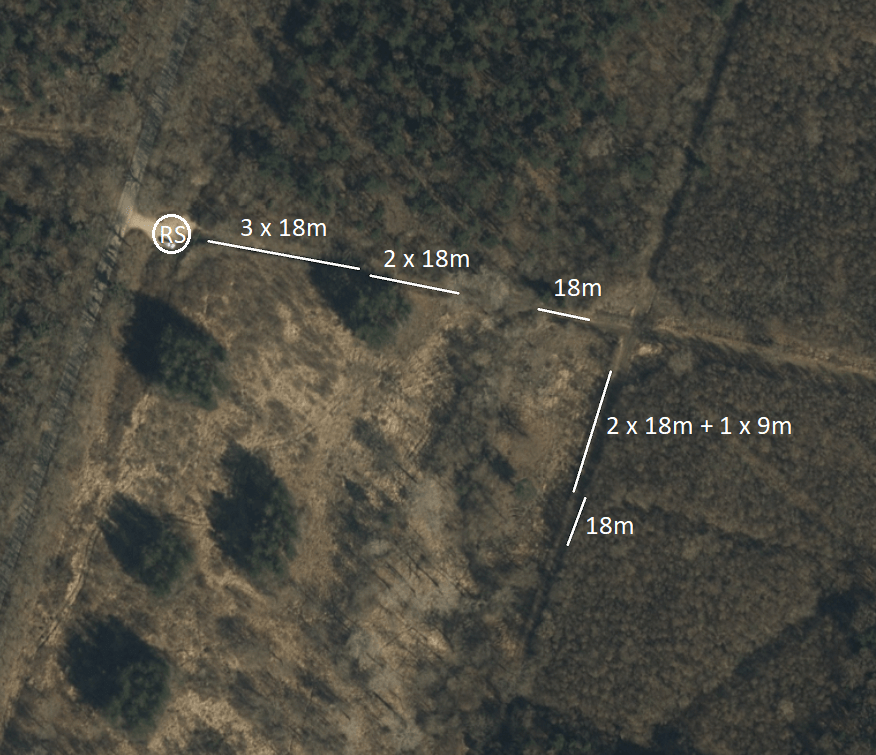
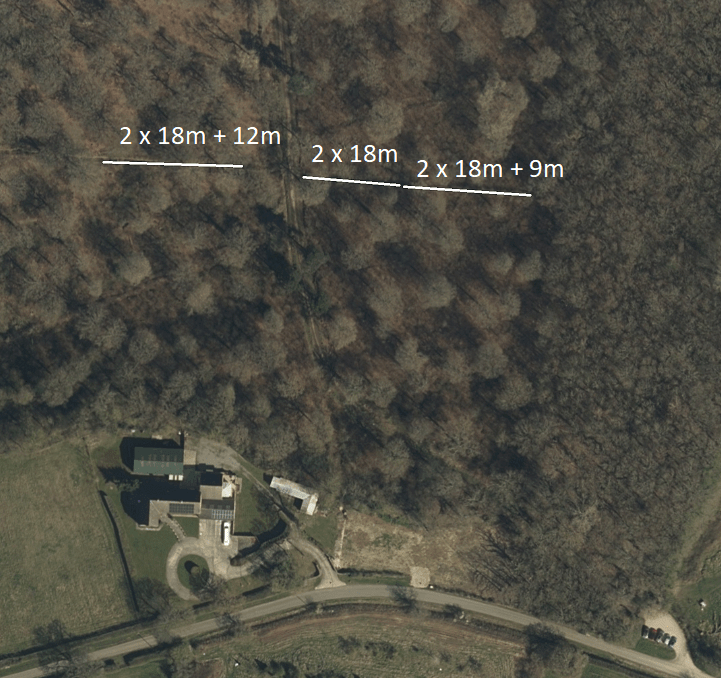
I haven’t been in this wood since June, and I didn’t get into it this year until April, whereupon the first session produced just seven birds. It was time to give it another go. Obviously, the Braydon Forest woodlands have given very poor returns in the last month: probably as a result of the awful weather we have been having. So I did have some trepidation about this session. That said, I did decide that I would not be up incredibly early, given the time that catches have been starting at other sites where I have been on site at 5:00 or 5:30, so I agreed 6:30 with Rosie. As is the way of these things, I woke up at 5:10, instead of the 6:00 my alarm was set for, so ended up at Ravensroost at 6:00. Rosie joined me to help set up at 6:30 and we had the nets open by 7:00, with the first birds in the net at 6:55! Oh yes! Two Great Tits, a Robin, a Long-tailed Tit and a Blackcap all decided to fly into the unopened nets! The net set up was:
Unfortunately, that was the best round of the day. We did catch one or two birds nearly every round but not large numbers. Rosie had to leave at 9:30 for a work meeting but I continued until I closed the nets at 11:30.

Unlike some of the recent woodland sessions, we did actually catch some adult birds: lots of moult going on, which I love analysing and scoring. All of the birds that fledged this year undergo a post-fledging moult, usually to infill the missing body feathers not required whilst in the nest. Both adult and juvenile Long-tailed Tits (and Nuthatch and House Sparrow) undergo a complete moult into the same / adult plumage so, by the end of September, it is nearly impossible to tell adults from juveniles on plumage. The Long-tailed Tit that we extracted in the pre-opened nets was an adult, which we knew from the ring number, but it had nearly completed its moult. There were just two primary feathers still growing and (it was a female) the brood patch was nearly completely feathered. Perhaps the most surprising find was that one of the juvenile Great Tits was moulting its tail feathers. In the past I used to think that they must have lost them through accident, but last year I found out that this is an actual moult strategy in juvenile Great Tits. Since then I have seen it quite a lot, but it still seems odd.

Talking of odd: the last Chiffchaff I took out of the net was very unusual. It had very dark brown, almost black, legs. It had the typical rounded head shape of a Chiffchaff and what I see as typical juvenile colouration: a couple of pale brownish patches at the sides at the top of the breast. However, when I checked the right wing the 6th primary feather, which should have been emarginated, wasn’t. It was just straight, as found on a Willow Warbler. However, when I checked the left wing, the 6th primary was very definitely emarginated. Goodness knows what species I would have ascribed it to had that not been the case. (For those not au fait with the term: an emargination is a shallow notch on the distal side of the outer fifth of the feather, and is the key, unambiguous, diagnostic feature for identifying Chiffchaff from Willow Warbler.)

The bird of the day for me was this:
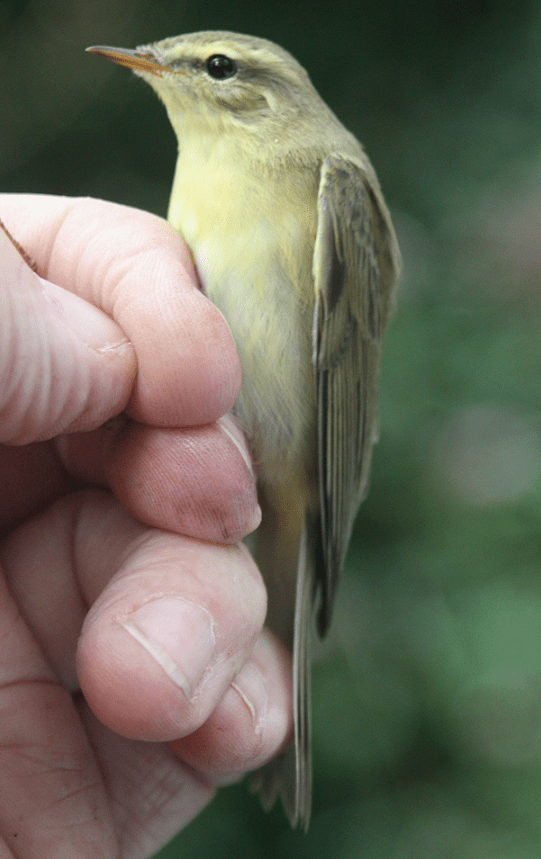
Juvenile Willow Warbler, Phylloscopus trochilus

It had completed its post-fledging moult and, unlike the one at Somerford Common on the 24th June, is probably a bird on autumn passage. The colouration was stunning, more so than this photo indicates.

The list for the day was: Treecreeper [1]; Great Tit [2]; Long-tailed Tit (1); Wren [3](1); Robin [2](2); Song Thrush 1; Blackcap [3]; Chiffchaff 2[2]; Willow Warbler [1]; Goldcrest [2]. Totals: 3 adults ringed from 2 species, 16 juveniles ringed from 8 species and 4 birds retrapped from 3 species, making 23 birds processed from 10 species. Of the retrapped birds just one was a juvenile.

As well as the birds caught there were quite a few other birds around, making their presence known: particularly Nuthatch, Green and Great Spotted Woodpeckers.

Whilst not processing birds, or torturing myself listening to the football, I spent a considerable amount of time watching the butterflies. There was still a decent contingent of Silver-washed Fritillary flying around. At one point two of them got into one of those dances where they spiral up into the air. I have seen it often with Speckled Wood but it was the first time I have seen it with this species. Is it the butterfly equivalent of a territorial dispute or a mating display? I have no idea. Alongside these there were Large White, Small White, Peacock, Brimstone, Speckled Wood and Small Copper. It was a pretty good show of species.

I shut the nets at 11:30, took down and left site at 12:15, astonished to hear that England had actually won. Having listened to the commentary I expected them to have been knocked out. So, not a bad session at all, all in all.

Webb’s Wood: Friday, 4th August 2023

After the diabolically poor result at Red Lodge on the 9th July, I was hoping that things would be somewhat better at Webb’s Wood. It was somewhat better – but only just. The whole of the last two months bird ringing has been hugely disappointing, not just in the Braydon Forest (six birds in Red Lodge, nine birds yesterday in Webb’s Wood, 19 birds in Somerford Common somewhat bucking the trend) but all of my sites. I can only presume that it is down to the weather, which has been just dreadful.

I was joined for the session by Miranda and David. We met at 6:00: working on the basis that we aren’t catching birds before 6:30, no matter what time we get to site, it seemed sensible. We had the first net ride, usually the most productive, open by 6:20. However, the place was so quiet and the first bird wasn’t caught until 7:45. That’s not quite true: we did have a Wren in the nets at 7:00. It did that thing that Wrens do, of burrowing through the net, twisting and basically making life difficult. I have one rule for my trainees: if it is proving difficult, call me to help. They are well-trained in that respect and Miranda duly called me away from net-setting to help with the extraction. Which I did, happily, only this klutz , having disentangled it, managed to let it escape.

We did have a very slow morning, lots of opportunity for catching up and chatting. The first bird out of the nets and brought back for processing was a juvenile Great Spotted Woodpecker. It was weighed, measured and released, only subsequently to look down at the table and realise that the ring was still sitting there! Oh dear! wasn’t what was said. Thereafter we concentrated somewhat better on the job in hand.

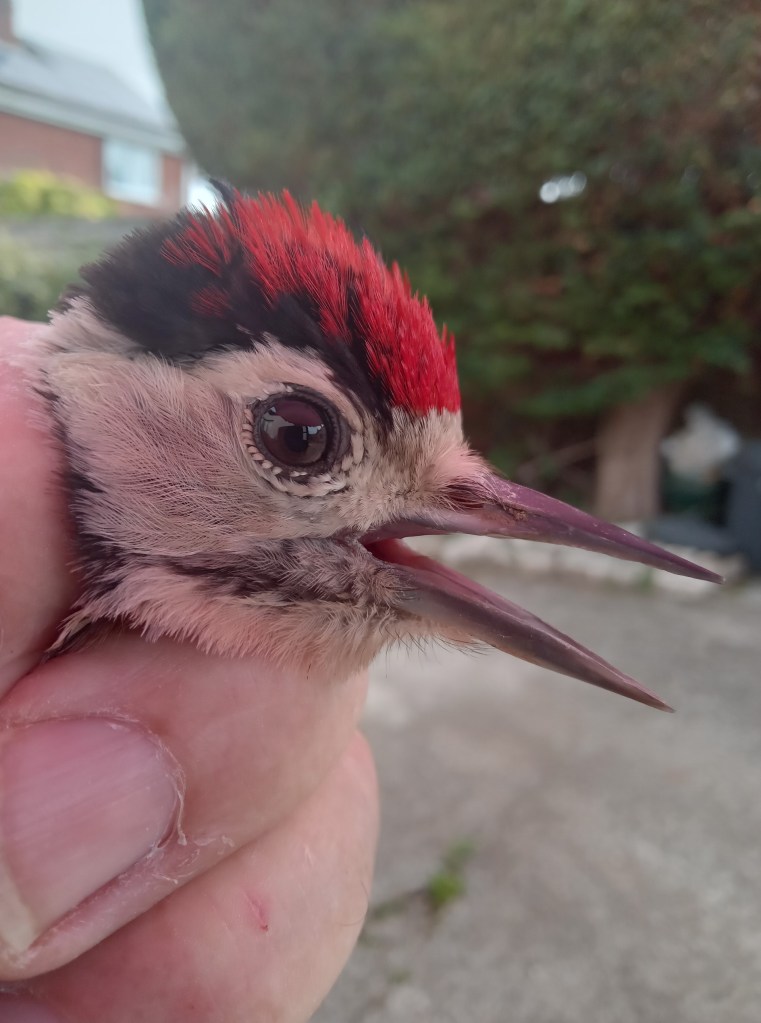
Although it was a small catch, it was a nice catch. The numbers are always decreased when there are no Blue or Great Tits. I really think that they have abandoned the woods for local gardens, especially if the observations and results from my garden are anything to go by. A more regular supply of food with less effort expended searching for it. The first bird processed was a juvenile Robin. All of the birds caught in the session were juveniles, with no retrapped birds. The second bird out of the net was this:

Juvenile Marsh Tit, Poecile palustris

Webb’s Wood, and the adjacent, but tiny, Firs are the least productive sites for Marsh Tit in my Braydon Forest woodlands. It shouldn’t be the case but, apart from the two years of 2017 and 2018, when six were ringed in each year, we have ringed just two in 2013, 2019 and 2020 and just one in every other year. We caught a second later in the session, which takes us to a total of three for 2023 so far. Hopefully it is a good sign and we will end up with a good year for them in Webb’s Wood.

Robins made up the most of the catch, with four of them taken. All were juveniles undergoing their post-fledging moult, but they were all in different stages of that moult: from one that had only just started moulting to the last out of the net that will probably have completed its moult in the next week or so.

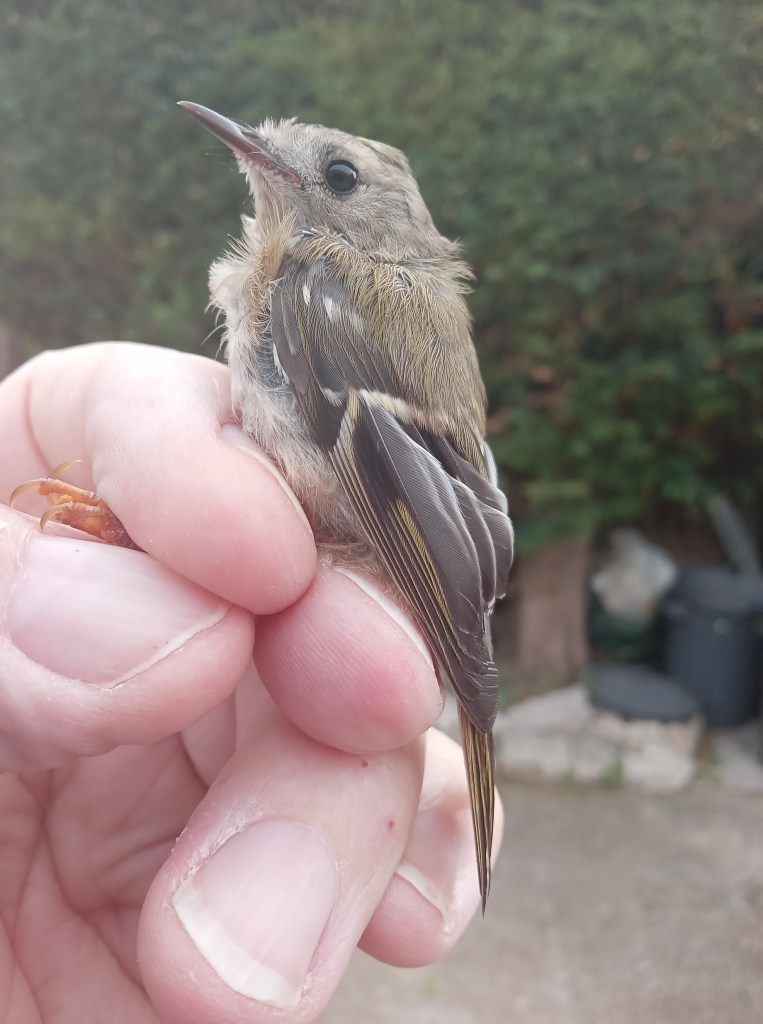
We caught two juvenile Chiffchaff, with the final Robin at 9:20 and the second Marsh Tit at 9:45. There wasn’t another bird in the net, apart from Marsh Tit two, who decided to work its way around the other net rides it hadn’t been caught in initially, until 11:20, when we had finally given up. Miranda had left at 11:00, as she was scheduled to spend the afternoon bat box checking with the Wiltshire Mammal Group. Like our bird ringing, all done under officially granted licenses. David and I agreed to shut the nets and take down at 11:15. In the first set I went to take down I extracted a juvenile Goldcrest. It was in the middle of its post-fledging moult, and was just developing its crown feathers, which enabled us to sex it as a male:

Juvenile male Goldcrest, Regulus regulus

You can see the three little orange feathers just emerging from the pin at the bottom right of the bird’s head. (For the benefit of those individuals who got their knickers in a twist when I posted a photo of the crown of a Firecrest ringed at Lower Moor Farm, this bird was being held vertically upright and I took the photo from above. The clue, like the grass in the previously complained of photo, but not by the BTO arbiters of these things, is the ground you can see below the bird.)

So, after a pleasant enough morning, but with disappointingly low numbers, the total catch processed was: Marsh Tit 2; Robin 4; Chiffchaff 2; Goldcrest 1, totalling 9 juveniles ringed and processed from 4 species.

CES 9: Lower Moor Farm, Tuesday, 1st August 2023

Quite possibly the worst CES session I have ever undertaken. I had to put if off on a number of days because of high winds and rain. Today was forecast to be dry with wind at a base of 12mph, gusting to 24mph. I decided to give it a go and hope that, with the wind forecast to come from the west, there would be sufficient cover to enable me to get through the session. I arrived on site at 5:00, having told Rosie 5:30, but I was awake at 4:30 and there was no point in just staying in bed. As has happened with virtually every CES session this year, the first birds to hit the nets started arriving an hour or more after the nets were opened. This morning it was two hours!

It started slow, and it stayed slow. The problem with carrying out a project like a Constant Effort Site is in those first two words: Constant Effort. The same nets open, in the same positions, for the same length of time, for every session. That means that, no matter how bad it is, I was going to be there for 6 hours before packing up!

Before Rosie had to head off to Morgan’s Hill Wiltshire Wildlife Trust Nature Reserve at about 8:45 to carry out her day job, we caught just half-a-dozen birds. Between then and when I shut them at 11:30, I caught another seven. The real problem was that I had forgotten to pack my book! There is no phone reception at Lower Moor Farm, so I was left with my own company and only nature to distract me.

Actually, I had a lovely morning. Although breezy, the weather was lovely, the sun came out and it was nice and warm, without being horribly hot. Apart from the constant sight of the Rainbow Trout in Mallard Lake leaping out of the water to catch insects, I had some excellent bird watching: before Rosie left, a Cetti’s Warbler spent a good few minutes searching for insects on the leaves of the undergrowth around the base of a large oak tree about 5 metres from where we were sitting. While she was out taking her spaniel, Poppy, for a walk, I was entertained by a Common Tern fishing on Mallard Lake. Soon after a Hobby burst through the tops of the trees lining the path between Mallard Lake and the other two ponds that make up the watery side of the complex. I had lovely views. Later on, a couple of hours later on, whilst chatting to a couple of birders / photographers, a second Hobby turned up chasing after a small flock of Swallows. It gave up and just spent a good five minutes circling overhead.

There was some excellent insect activity as well. The most extracted species of the morning was this:

Female Brown Hawker, Aeshna grandis

There were a lot of them about, as well as plenty of Common Darter, Common Blue, Azure and Red-eyed Damselflies. Extracting dragonflies is a real art: the head is fixed by a very thin, and not very strong, neck. You cannot pull them back through the net but have to either push them through from behind or pull them through if you can get hold of the thorax. I am delighted to say that I successfully extracted every one of the five that hit the nets, plus a female Common Darter.

The other really nice sighting was my first close encounter with copulating moths, in this case, a pair of Chocolate Tips:

Chocolate Tip Moths, Clostera curtula

Once they disentangled from each other they had no difficulty in disentangling themselves from the mist net that supported them throughout the process.

Back to the birds. Of the four net rides that we set, only two of them caught any birds at all. The catch for the day was: Wren [1]; Dunnock (3); Robin (2); Blackbird (1); Blackcap [2]; Chiffchaff 1[3]. Totals: 1 adult ringed, 6 juveniles ringed from 3 species and 6 birds retrapped from 3 species, making 13 birds processed from 6 species. Of the retrapped birds the Robins and two of the Dunnocks were juveniles.

There was quite a lot of frustration: I have never had five birds extract themselves from the nets, just as I reached them, before. Typically it would happen on a day when numbers were scarce. To see how bad it was, the following table shows the catch for CES9 for every year since it started in 2015, plus the nearest session in 2020 (27th July 2020), when the CES was suspended due to Covid:

It will be interesting to see how the final three CES sessions work out. Hopefully we will have a few more birds to process than we have done so far this year! I started packing up at 11:30 and was away from site just in time to hear England’s women score their third goal against China!

West Wilts Ring Group Results: July 2023

A pretty decent month July 2023 for the group as a whole, despite some awful weather impacting on activities on and off throughout the period.  I know that I had to miss a number of sessions and suspect that catch levels were impacted: I mean, 6 birds in 4 hours in 180 metres of net at Red Lodge was a real low for me.  There were some significant activities and catches though.  Two Corn Bunting were ringed at New Zealand Farm this month.  Since the beginning of 2013 we had caught just two of this species: both at the site on the Imber Ranges area of SPTA, one in January 2021 and the other in October last year. Catching two more on SPTA is certainly interesting.  I don’t know what their range is on Salisbury Plain but, to see them coming onto sites where they haven’t been caught before, does imply that their numbers might be increasing if they are genuinely spreading to new areas.

Jonny also continues to expand his activity: having taken on a host of Tree Sparrow nest boxes, they are certainly producing the goods.  That one of the Tree Sparrow sites is also hosting a number of Swallow nests has also helped increase the number of pulli being ringed by the group.  My contribution to the pulli this month were the four Barn Owl chicks. Two were in a box at a site that I only got access to this year. What was interesting is that the box was on the north side of the tree and one of the adults was roosting in a natural hole on the south side of the tree. There were three pulli in the box but one was too small to ring. Given the way the weather went, and what we found with intra-brood cannibalism in June, I decided to leave it for another couple of weeks before ringing it: wouldn’t want to give its siblings indigestion if push comes to shove. The results for July, compared to 2022, are:

image.png
image.png

The Imber Ranges site produced the Redstart, Grasshopper Warblers and a Tree Pipit: it would seem like some early migration is underway – trying to get away from this weather possibly?  

Surprisingly, we did actually get in quite a few more sessions than we did last year, so the numbers processed per session are down, but the number of species processed, 47 compared to 39, with 10 more species ringed than July 2022, is interesting.  This year we added Barn Owl (an adult plus 4 pulli), Buzzard (thanks to my work with RSPCA Oak & Furrows), Coal Tit, Corn Bunting, Grasshopper Warbler, Jackdaw (both adults mist netted in my garden), Marsh Tit, Nuthatch (one of the 6 birds caught in the abysmal session at Red Lodge), Redstart, Stonechat, Swallow (all pulli), Tawny Owl (Oak & Furrows again), Tree Pipit and Tree Sparrow.  Birds processed last July but not caught this year were: Green Woodpecker, Icterine Warbler (unsurprisingly), Jay, Meadow Pipit, Siskin and Spotted Flycatcher.

All in all, a pretty decent return, despite the weather.

From Garden to Woods: 25th & 26th July 2023

With the weather looking a bit unsettled for the rest of the week I opened the nets in the garden again yesterday. As ever, I was hopeful that some of the Goldfinch and Greenfinch taking advantage of the feeders would end up in the nets. As usual, the Blue Tits hit as soon as the nets were open! I have worked out why I am not catching the finch species: they have developed a vertical take-off and landing technique that enables them to avoid the nets arriving and departing. I have moved the feeders from the top of the rockery bank to a lower level in front of the rockery but it made no difference. I refuse to be outsmarted by some bird brains so I am going to have to come up with a novel solution!

The list for the day was: Blue Tit [7](7); Great Tit [2]; Dunnock 2(1); Robin (1); Blackbird (2); Starling [5]; Chaffinch 1; Greenfinch 1; Goldfinch [1]. Totals: 4 adults ringed from 3 species, 15 juveniles ringed from 4 species and 11 birds recaptured from 4 species, making 30 birds processed from 9 species. Of the retrapped birds 8 were also juveniles (six Blue Tit and one each of Dunnock and Robin). For once the Starlings were all caught in the nets and not in the walk-in Potter traps.

This morning saw Rosie, Laura, Adam and Daniel join me at Somerford Common at the relatively civilised time of 6:00. We set nets down the main track and to the right of the track at the first crossroads:

Rosie had to leave just before 9:00 to go off to work and Laura and Daniel had to disappear for an hour between 9:00 and 10:00 but it was good to have plenty of help setting up and taking down and good company all morning. I let Rosie process all of the birds caught between opening and the time she had to leave, and then I let Adam ring all of the birds whilst Laura and Daniel were away, which left a couple for Adam and Daniel to share upon Daniel’s return.

It was a bit of an odd morning with rounds producing alternately a single bird, followed by the next round producing three or four birds. It wasn’t a huge catch, but significantly better than our last woodland foray (Red Lodge, which produced 6 birds in 4 hours in 180m of net!). One reason that there were not greater numbers was the complete absence of any Blue or Great Tits. Most unusual in the woods at this time of year.

The list for the day was: Wren [2]; Robin [8]; Blackbird [1]; Blackcap [4]; Chiffchaff 1[1](1); Bullfinch 1. Totals: 2 adults ringed from 2 species, 16 juveniles ringed from 5 species and 1 retrap, making 19 birds processed from 6 species.

There was a superb collection of butterflies to be seen, reflecting the abundance of flowering plants along the rides that were opened significantly over the last couple of winters. We saw big numbers of Meadow Brown and Gatekeeper, plus smaller numbers of Red Admiral, Ringlet, Common Blue, Silver-washed Fritillary and Small Skipper:

Small Skipper: Thymelicus sylvestris

As mentioned, the preponderance of flowering plants along the rides was a pleasure to see, and there were grasshoppers and crickets everywhere (not to mention the odd Hornet – successfully extracted from one of my nets: successful in that it flew away and I didn’t get stung!) There was one plant that stood out from the rest: it was 30 to 40 cm tall, with lanceolate leaves. I didn’t recognise it but, having trawled through my wildflower guide, I am pretty certain it is Sneezewort:

Sneezewort: Achillea ptarmica

According to the various references I have looked at it is listed as becoming scarce in the UK, although there seem to be hundreds of wildflower vendors selling them. Anyway, they are in good numbers at Somerford Common.

With the wind getting up from 10:30, we decided to do one last round and then shut the nets and pack away. It didn’t take long and we were off site before midday.

CES 8: Lower Moor Farm, Friday, 21st July 2023

Finally, a CES session that produced more birds than the equivalent session last year (even if it was only by one more bird and two more species). I was joined by Rosie, who could stay until work demanded her attendance at 9:00, and later in the morning by Teresa and Adam. This meant that I had help to set up and help to take down!

As ever, we had the first nets open soon after 6:00, but the first birds didn’t arrive until just after 7:00. As we were walking back from the first round we were treated to a burst of song from a Grasshopper Warbler. I am not aware that the species has previously been recorded at this site.

The first bird out of the nets was our first juvenile Cetti’s Warbler of the year:

In the first hour we caught 14 birds in three net rounds. For the next 90 minutes we caught just three birds in four net rounds. It was looking like another disappointing session until, at 10:30, that round produced 19 birds. The next three rounds produced just one more bird and we shut the nets at 11:30.

The list for the day was: Blue Tit [3]; Great Tit [1]; Long-tailed Tit [3](1); Wren [3]; Dunnock [2](1); Robin [3](2); Song Thrush (1); Blackbird 1[1](1); Cetti’s Warbler [1]; Blackcap [3](3); Garden Warbler [1]; Chiffchaff [5]; Bullfinch 1. Totals: 2 adults ringed from 2 species, 26 juveniles ringed from 11 species and 9 birds recaptured from 6 species, making 37 birds processed from 14 species.

The only adults in the catch were the Bullfinch, the retrapped Blackbird, Song Thrush and Blackcap. All of the other recaptured birds were juveniles.

One of the most interesting facets of the morning were the trout in Mallard Lake. They spent the morning leaping out of the lake, presumably in pursuit of insects flying over. When you see the size of these full grown Rainbow Trout leaping clear of the water and splashing back down it really makes an impact!

There was one sad find right at the beginning of the session. As Rosie and were erecting the last of the nets she found a dead Whitethroat adjacent to where we were setting the net. It had clearly been there a few days as some of the soft parts had been scavenged. It wasn’t a ringed bird and we have not actually caught a single Whitethroat at the site this year, so nothing to do with us, and very sad.

Nets Open At Last: Tuesday, 18th July 2023

Finally, the rain has stopped and the wind has dropped and I could open the nets in my garden for a few hours this morning! Over the last week-and-a-half I have been hugely encouraged by the number of Greenfinch we have seen visiting the feeders: on one good day we had seven adult males, two females and two juveniles all together after the sunflower hearts. Similarly, we have had a decent throughput of Goldfinch over the same period. I was hopeful that we might catch a few of them this morning. Needless to say none, nil, nada: until I shut the nets at 11:30, whereupon a couple of Goldfinch flew in whilst I was still storm guying the nets. Such is life!

Totally dependable: Blue Tits arrived in reasonable numbers from the off and I had a steady trickle of birds throughout the morning, with some nice surprises. The first was my first juvenile Great Spotted Woodpecker of the year:

More Blue Tits and a couple of Great Tit and then this:

This was the first of two, and I was delighted to catch them, after years of providing them with fat balls it was the least they could do. I have done plenty of juveniles, but only two adults previously. The catch continued and at about 10:00 this blundered into one of the nets:

They are remarkably strong birds: a real handful. This was an adult female clearly still in breeding condition from the condition of her brood patch.
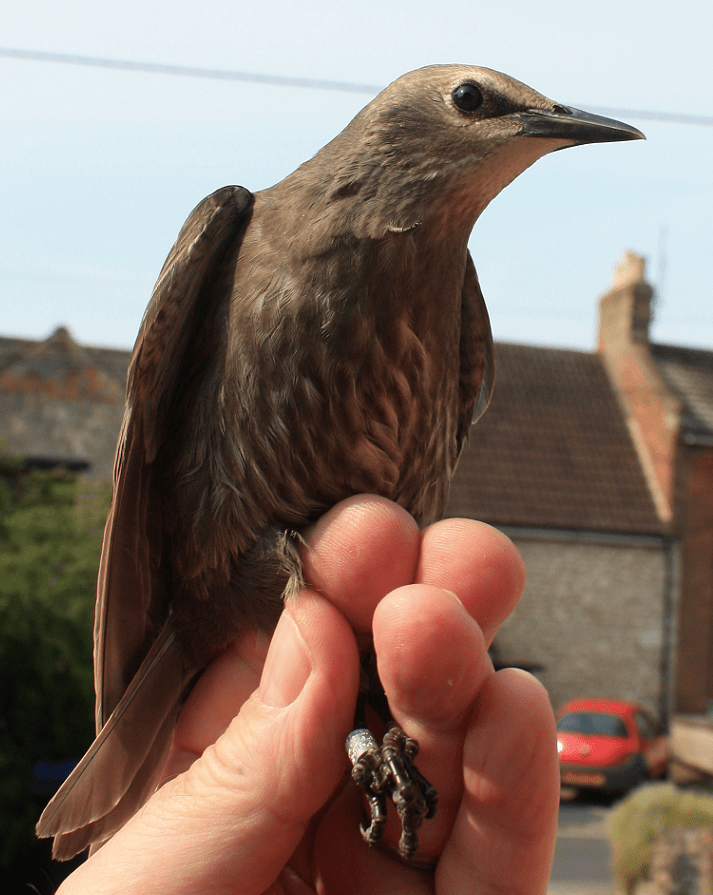
Then over the next 45 minutes I caught 5 Starlings: three in my nets and two walked into my Potter traps! It was turning into a decent session, with good birds interspersed with commoner species. Finally, just about the last bird out of the net was this scruffy little thing:

My second juvenile Goldcrest of the year but the first in my garden. For some reason they are very regular visitors to my patch.

The list for the morning was: Woodpigeon 1; Great Spotted Woodpecker [1]; Jackdaw 2; Blue Tit [10](2); Great Tit [3]; Dunnock [1]; Robin [1]; Blackbird (1); Goldcrest [1]; Starling [5]. Totals: 3 adults ringed from 2 species, 22 juveniles ringed from 7 species and 3 birds retrapped from 2 species, making 28 birds processed from 10 species.

One of the benefits of ringing at home is having food, drink and amenities on tap. Such was the way this morning went that it was 9:30 before I got breakfast! It was a good session, better than most of my external site sessions for a month or so, and some excellent birds in the catch. I had to shut the nets at 11:30 to get into Swindon to collect my son from the train station. Pleasingly, as I started to do so the wind got up, which would have forced me to close them regardless of any other calls on my time.

Willow Warblers: Disappearing from West Wiltshire?

After the publication of the last monthly results, one of the senior members of the group mentioned the ongoing decline we seem to be experiencing in the numbers of Willow Warbler we are catching and processing. I have had similar thoughts, so, as there is no chance of opening nets in this current weather, I decided to have a look at the figures to see if it is the case. The data set covered the full years from 2013 to 2022 inclusive.

At a gross level it doesn’t look as though there is an issue. In fact, it looks healthy:

However, the figures are distorted by a quite remarkable passage of 100 juvenile birds in August 2022. If you have a look at the split by month, it is pretty clear that our birds are mainly on passage, either in the Spring or the Autumn:

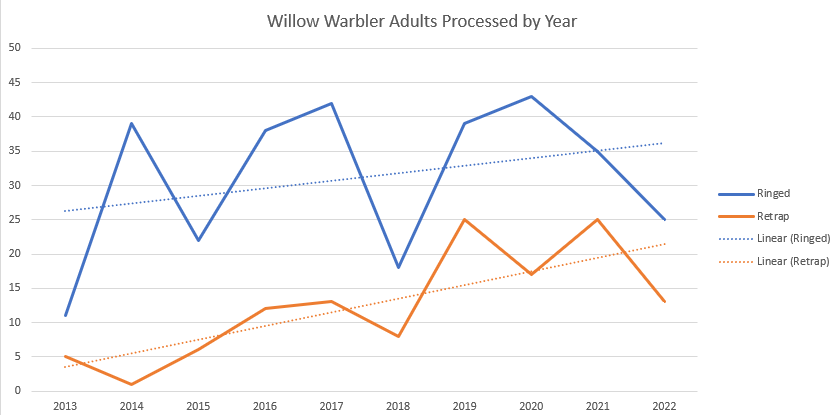
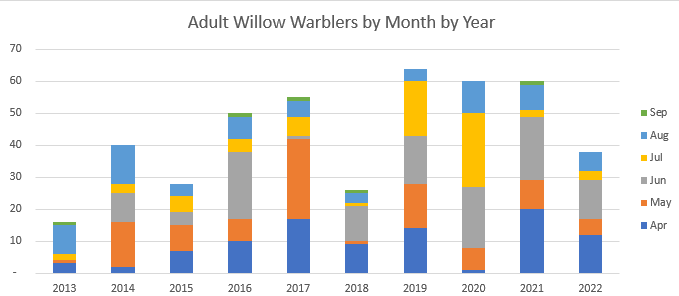
Of the 100 juveniles on passage last year, 72 of those were at the recently dormant Wiltshire Wildlife Trust reserve at Langford Lakes. It was revived for regular ringing in 2020. Also, another previously dormant site, adjacent to the Imber ranges on Salisbury Plain Training Area, was revived in 2018 and has been a significant contributor ever since. As juvenile passage had considerably skewed the trend, I had a look at the adults processed over the period:

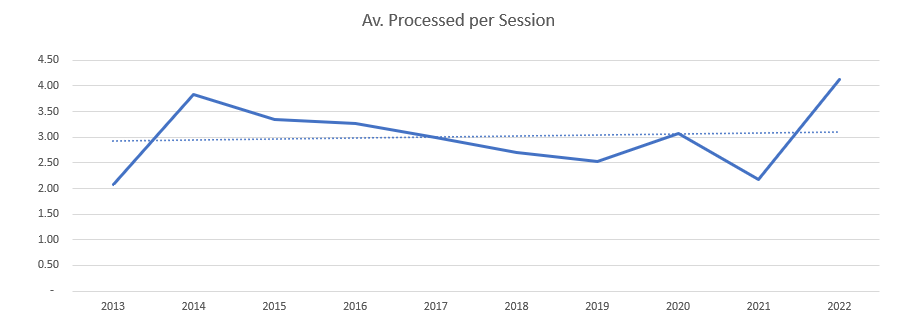
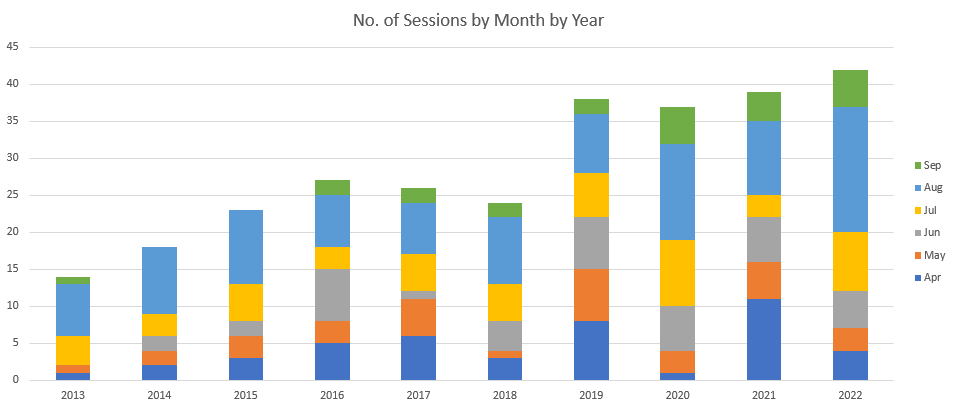
The trends are still upwards, which was definitely counterintuitive. However, one of the other things that need to be considered is the amount of effort put into catching and processing the species over the period. So I counted the number of sessions run between the beginning of April and the middle of September each month, whether Willow Warblers were caught or not, and worked out the average catch per session by year:

As you can see, there is still a slight incline.

As you can see, the effort has certainly increased over the years as other individuals got to carry out their own ringing sessions.

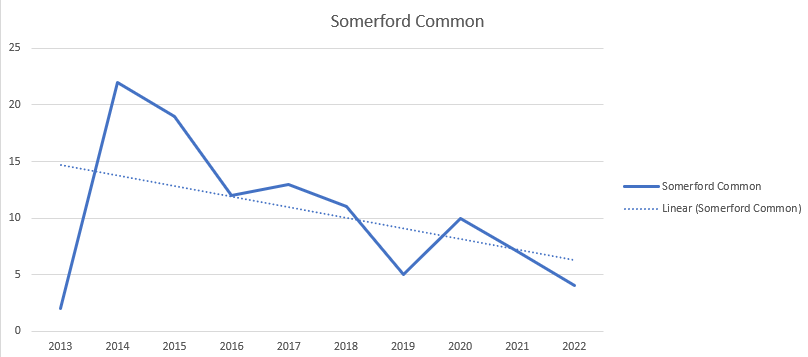
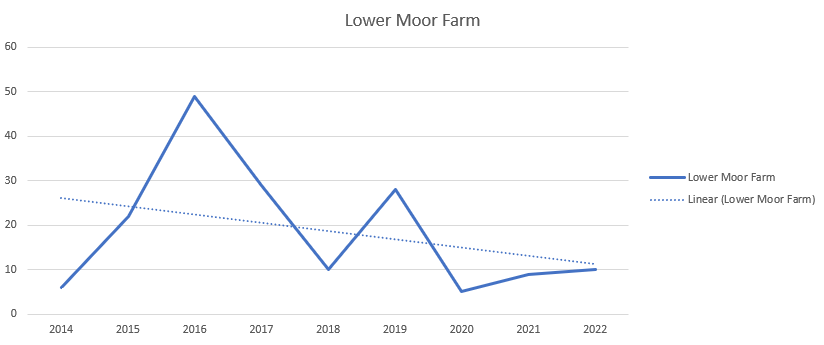
I did a review of each of the sites that have been in operation throughout the entire period, and got a clear indication of why it seems that we have a decline. The sites that I looked at in isolation were: the Ravensroost complex, Somerford Common and Lower Moor Farm. All of these sites have delivered Willow Warblers over the period, all have exceeded 100 birds caught.

As you can see: what were the mainstays of our Willow Warbler catches in the north of the county are in serious decline.

What is the explanation for the rise in numbers, as shown by the first two graphs? The simplest answer is the expansion of activities within the last 4 years, as new C- and A-permit holders have taken on their own sites:

They have added a considerable number of birds to the catch, whilst the older sites have definitely shown a decline.

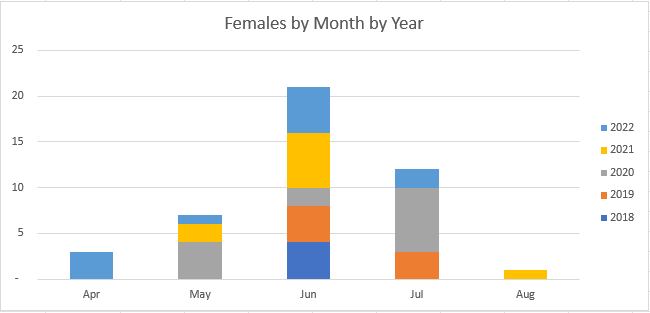
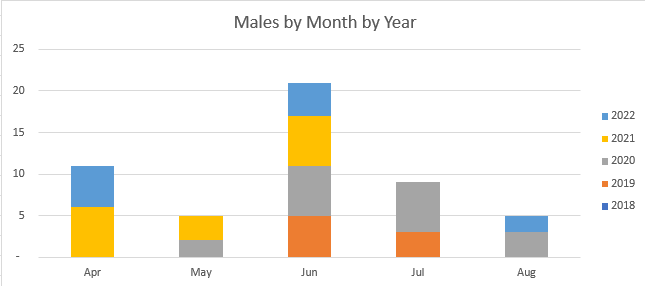
Perhaps the crucial questions are: are there changes to the breeding population or a change to passage movements? I had a look at the results for males and females in breeding condition. Unfortunately, prior to 2018 there is a dearth of records of the bird’s sexes. They aren’t easy: females can only be sexed by the development of a brood patch and males by the development of their cloacal protuberance. The results were as follows:

As is clear, the majority of results are in June. In my opinion, females are unlikely to be developing a brood patch whilst on migration into the country, as they probably don’t enter breeding condition until they are ready to breed. The individual female in August was on migration, with her brood patch in the process of feathering over. With males it is less clear, as they are looking to establish territories almost as soon as they arrive in a suitable location. However, the peaks in May, June and July do seem to indicate that there is a reasonably stable breeding population in our part of Wiltshire.

When you look at the overall numbers of adult birds coming into Wiltshire, compared to those that stay around to breed, you can see that passage is the key to numbers caught in and around our sites:

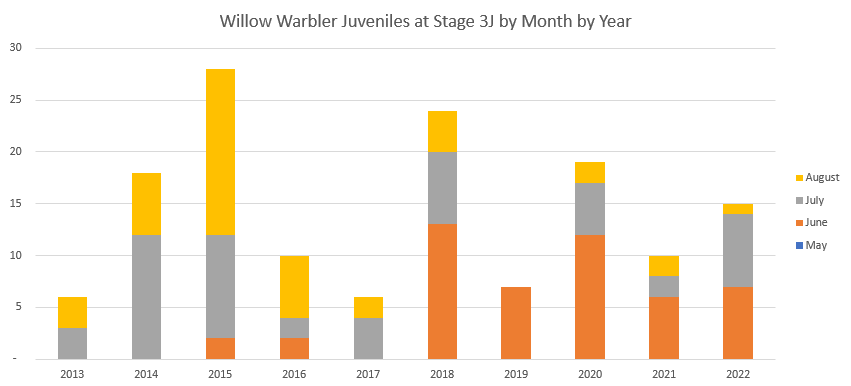
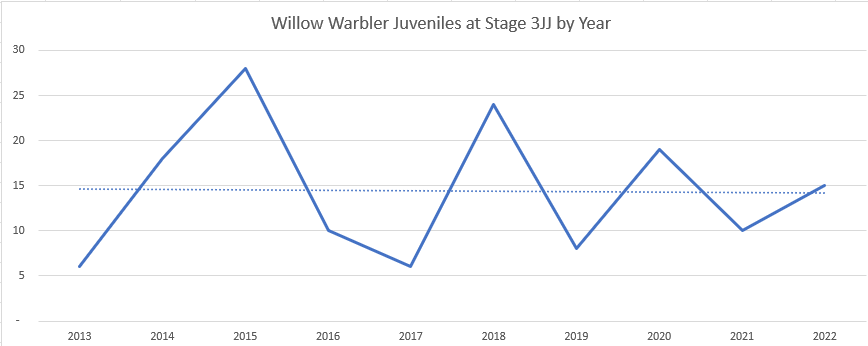
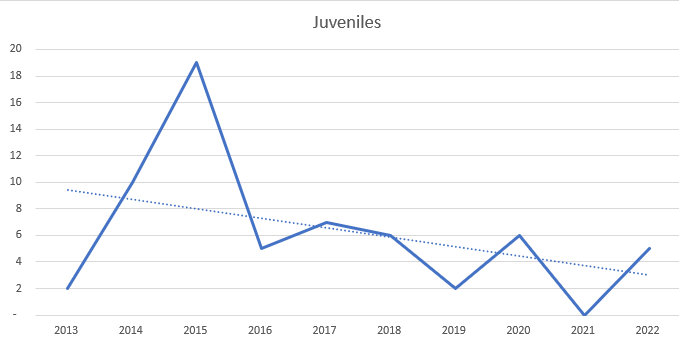
So, how about juvenile productivity? When juveniles fledge they are designated as age 3J in BTO coding. Looking at the data we get the following results:

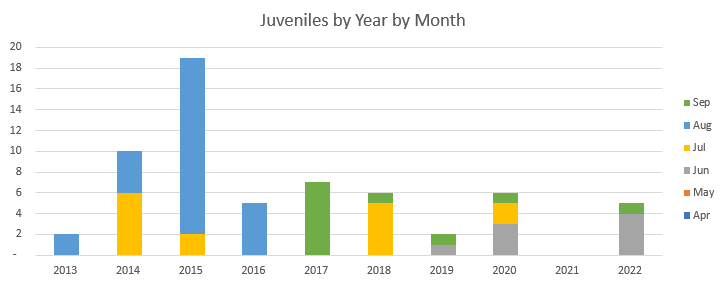
The trend line shows a very slight decline across a pretty volatile seasonal variation. If we look at the split by month by year:

There are a lot of juvenile captures in August. This raises the question of whether they are locally bred birds or autumn migrants. A similar question could be asked about July captures as well, but I tend to think that would be related to how far along the post-fledging moult path they are.

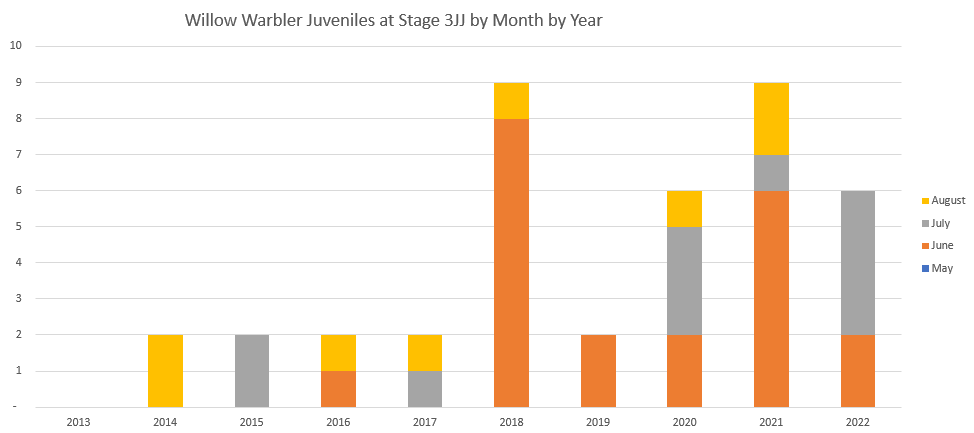
What do I mean by that? As well as identifying juveniles as 3J, there is a subdivision, based on moult, of either 3JJ or 3JP. 3JJ is a bird in full juvenile plumage, whereas 3JP is a bird undergoing post-fledging moult. I tend to the idea that a bird with a 3JJ moult code had to have fledged within the local area. Not necessarily at the site at which it is caught but certainly not yet on migration. Birds that are undergoing post-fledging moult have fledged somewhat earlier and could possibly be on migration. (Once they have completed their post-fledging moult, they lose the JP subscript and become simply an age code 3 (with a moult code of O for “Old”, somewhat ironically).) So I decided to have a look at the number of 3JJ youngsters caught at the sites:

That pretty well mirrors the overall picture for 3J’s. When I split it out by month, it looks somewhat different:

The key difference is in the significantly reduced number of this stage of juvenile bird (3J) being found in August. As one would expect: birds on migration might reasonably be expected to have substantially completed their post-fledging moult, so 3JP or 3O. The graph below shows all juvenile Willow Warbler designations (3JJ, 3JP and 3O):

Even though 2022 totally distorts the picture if looking at raw totals, with the exceptions of 2020, you can see that August is certainly the busiest month for juvenile birds. With so few in September it would seem that August is the key month for autumn migration for this species.

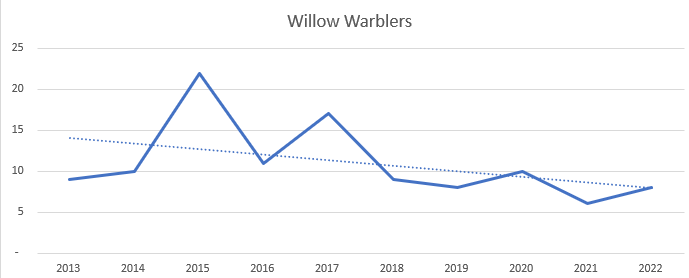
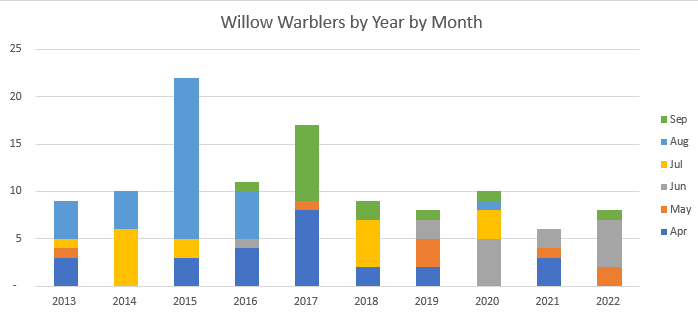
To examine what might be happening at the three sites I mentioned previously, which would explain why I think the species is in decline in my area, I did similar graphs for the Ravensroost Complex, being the site most frequently surveyed over the period:

Ravensroost Complex:

These two charts show the fluctuations over the years and the numbers by month. As you can see, Spring passage, April and May, was reasonable in 2013, 2015, 2016, 2017, 2019 and 2021 but the most significant change is to the Autumn passage, August and September, which drops off after 2017.

Looking to see whether the reductions are down to a change in the numbers of juveniles produces the following graphs:

From these charts it would seem that the issue with juveniles is on passage, with the numbers post-2018 well down. Interestingly, June and, probably, most July youngsters are likely to be locally bred, but none of them were moult code “J”. Ironically, given the reductions overall, the most likely positive breeding happened in the years 2019, 2020 and 2022.

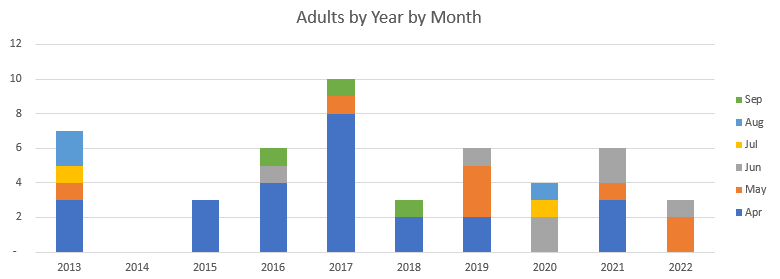
When you look at the picture for adult birds it is a little different:

There is a slight increase over the period, despite a blank in 2014, in which 14 sessions were carried out in the complex between the beginning of April and the end of September. Clearly Spring passage is the busiest, as shown for the figures for April and May in every year except 2020. However, that was down to Covid restrictions.

Conclusion:

Although there appears to be an increase in the number of Willow Warblers in our area, this is related to an increase in activity and expansion into different sites by those recently getting the chance for independent ringing. The older sites in the north of the county are showing significant decreases, for reasons unknown, but based around a fall off in Autumn passage.

Out Of The Woods: Sunday, 9th July 2023

The quality of the catches that I am getting in my woodland sites this year is diabolical. Today I went to Red Lodge, on site by 5:30, joined by Rosie, Laura and Adam, and we set 10 x 18m nets, as below:

In the next four hours we caught six birds! The list was: Nuthatch [1]; Treecreeper [1]; Robin [1](1); Song Thrush 1; Chiffchaff (1). Totals: 1 adult ringed, 3 juveniles ringed and 2 birds retrapped, making six birds processed from 5 species.

It was the worst return that I have ever had at this site, and compares with an average catch of 30 birds in July sessions over previous years, ranging between 25 and 33 birds. Thoroughly fed up with such a poor return, we decided to shut the nets at 10:00 so we could go home and do something more rewarding, like catching up on some sleep! We had been joined by the rest of family C, with Mark and Daniel arriving soon after 9:00, so taking down and packing away was quick and easy.

Getting home at just gone 11:00 I decided, instead of sleeping, to sit in the garden and destroy my nerves by listening to the cricket. As I wanted something to occupy my hands as well as my mind, I thought I might as well open the two 6m nets I have in the garden, and put out my Potter traps, baited with mealworms, on the off-chance that a few Starlings might drop in.

Within a few minutes I had my first two birds: a couple of juvenile Blue Tits and then, soon after, the Starlings arrived. One immediately walked into one of the Potter traps. I went to extract the Blue Tits and that Starling, which obviously spooked the others. They didn’t stay away long and, when the next group arrived, four Starlings, a female Blackbird, two House Sparrows, plus two more Blue Tits, ended up in the nets, nothing in the Potter traps. At just after midday the wind got up, gusting strongly, and I needed to shut the nets. I took out another two Blue Tits whilst doing so.

As the Potter traps are not affected by the wind I left them open. They worked well and I caught another five Starlings before the rain started at 13:00 and I closed them as well and packed up for the day.

All of the Starlings and Blue Tits caught were juveniles undergoing their post-fledging moult.

What a smart bird!

The garden list was: Blue Tit [6]; Blackbird 1; Starling [10]; House Sparrow 2. Totals: 3 adults ringed from 2 species and 16 juveniles ringed from 2 species, making 19 birds ringed from 4 species.

CES 7: Lower Moor Farm, 5th July 2023

It has been a bad couple of weeks. CES 6 was supposed to have taken place on Wednesday, 28th June. It was too wet and too windy so, with Friday’s forecast looking better, I moved it to Friday. We had everything set up and nets open by 6:00 when the first shower hit. After we waited that out, we managed to catch a few birds before another shower hit at 8:30. As that stopped the wind immediately strengthened and the session became untenable. We closed the nets at 9:30. I hoped to go back on Saturday morning instead, only it was blowing a gale and it was just unviable. That was the end of the available slot for CES6. The few birds we caught were: Wren [1](2); Dunnock [1](1); Robin [1]; Blackcap [2]. All of the birds caught were juveniles except for the two retrapped Wrens, which were both adult females in full breeding condition.

Unfortunately, the weather from Saturday onwards was far too windy for ringing, culminating in Tuesday with torrential rain and high winds.

Despite this not very encouraging run up to the day, but wanting to try and get a session within that particular window, I arranged to run CES 7 this Wednesday. The forecast was for it to be dry all day, with low base wind until midday, when the base would be 9mph, with gusts that would reach 20mph. We had first nets open just after 5:30 but, as has been happening regularly, we didn’t catch a bird until 6:40. As for the forecast, the first shower hit at 7:30 and the second at 9:00. Fortunately they were short and light, and the tailgate of the car kept the (few) birds and equipment dry. We took refuge in the car once they were processed. Fortunately, it then dried up.

We had an interesting morning listening to and looking for a family of Green Woodpecker. Having caught a male and female at the site in CES 4 and 5, Rosie came across a group of four whilst taking her dog for a walk. They called and were in the trees around the ringing station all morning. We did get views of a couple, definitely juveniles, as they flitted between trees. Unfortunately they didn’t go near the nets.

The highlight of the day was our first juvenile Treecreeper of the year. The list was: Treecreeper [1]; Blue Tit [2]; Wren 1[3]; Dunnock [2](1); Robin [1]; Song Thrush (1); Blackcap [4]; Chiffchaff (1). Totals: 1 adult ringed, 13 juveniles ringed from 6 species and 3 birds retrapped from 3 species, making 17 birds processed from 8 species.

The catch was disappointing when compared to the same session last year, which produced 47 birds: 2 adults and 38 juveniles ringed from 14 species and 9 birds retrapped from 8 species. However, it was actually numerically better than the equivalent session in 2021 (9 birds ringed and 7 retrapped from 11 species).

With the wind getting very strong and blustery, we closed and packed up the nets at 11:30, away from site a little after midday.

After lunch I set out to Avis Meadows where I was meeting Kevan Wind. Kevan has built some Barn Owl boxes suitable for internal barn sites. I have long wanted to replace the horribly dilapidated box in the derelict barn on site. There was once a plan to knock it down, which would have dealt with the box as well but it is now going to be allowed to deteriorate on its own timetable – which could be several more years, so we have replaced it with this:

We have two more that will get put up next week: at Clattinger and Morningside Farms. Possibly too late for this year but you never know: I have ringed Barn Owl chicks in September.

We did knock down the horribly dilapidated box: it had holes everywhere and it certainly was no longer safe for young Barn Owls: last year the brood of four youngsters were predated between discovering them having just hatched and going back a month later to ring them. Prior to that it had been the most consistent and productive of the boxes. Hopefully this one will become similarly successful.