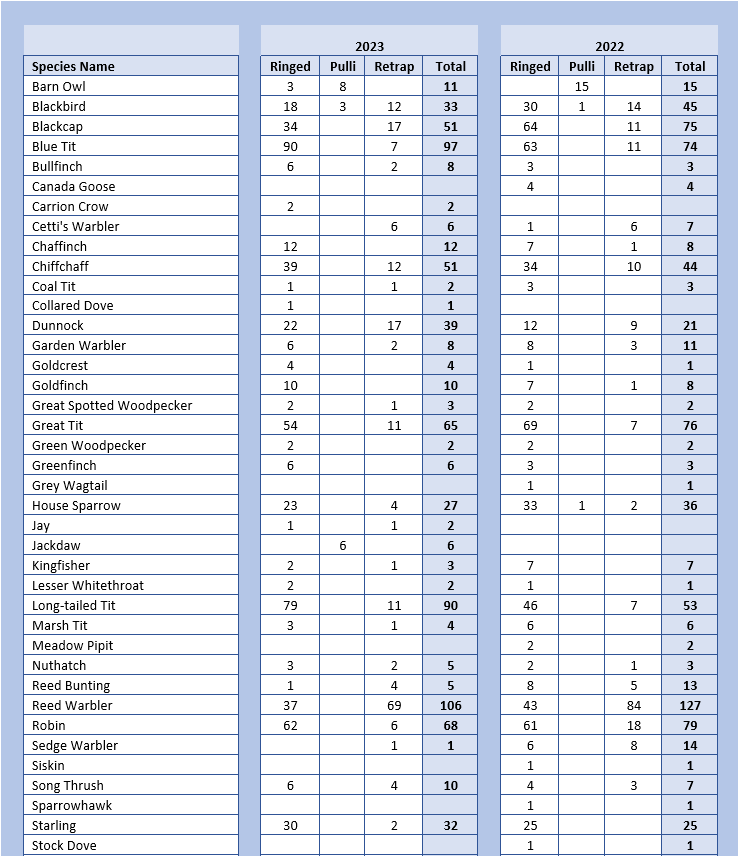
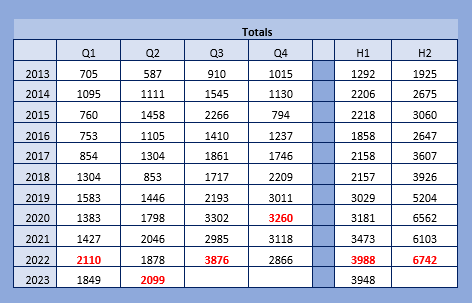
For the group, this month was almost identical to April 2022, only with three more species:
Lots of summer migrants have started to arrive. Hopefully the weather will be kind and they will hang around more this year than they did last.
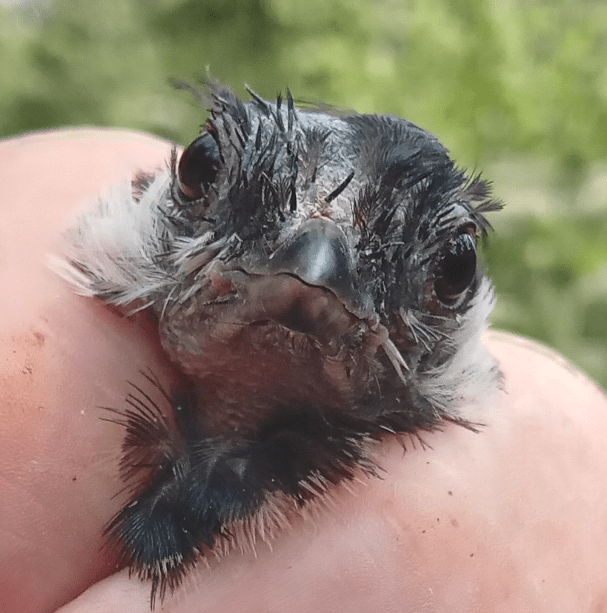
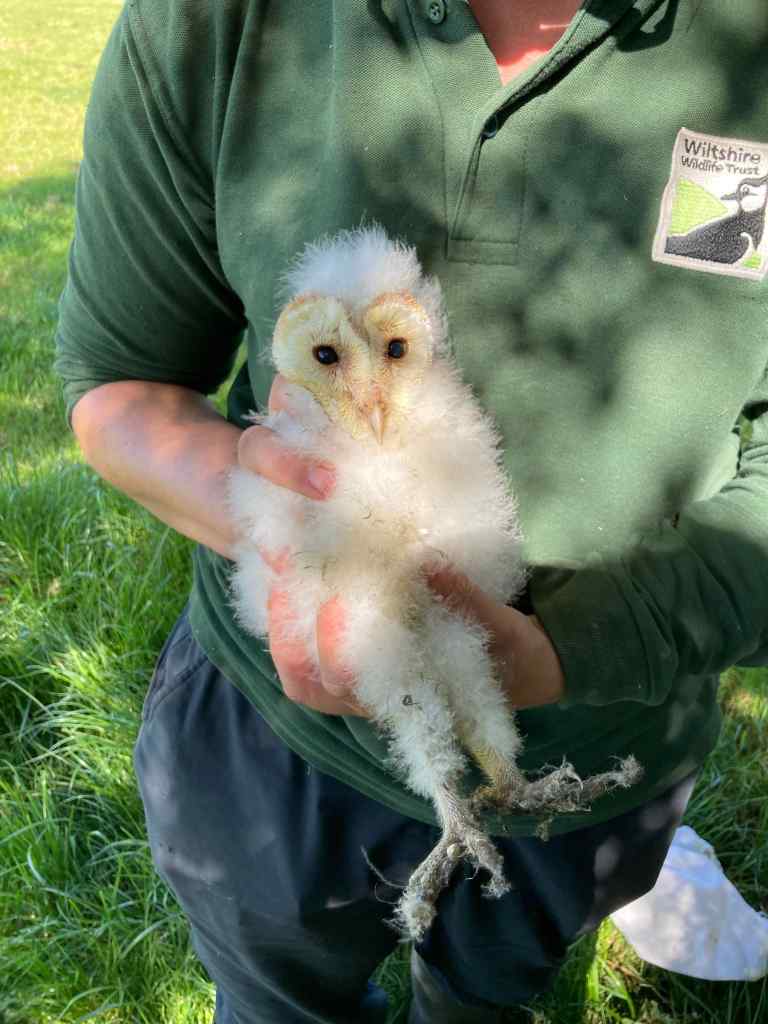
Of the additional species this April, one was Barn Owl and another was Buzzard, both ringed pre-release at Oak & Furrows. Yellowhammer, Great Spotted Woodpecker and Kingfisher were also additional to last April. Missing this April were Dipper (not for want of trying), Grey Wagtail and Woodpigeon. Jonny and I did have a go for Dipper last Thursday. Unfortunately, the Bybrook is still running hard, fast and high and there was no sign of Dipper where we set up, although the site is a known Dipper territory. We plan to try again elsewhere this week.
My highlight of the month was the other species that was different to last April: Curlew. As posted about on Friday last, Jonny organised that we would meet up with a couple of experienced Curlew catchers from the Wildfowl & Wetlands Trust: Kane Brides and Dan Gornall. We used a whoosh net, with a decoy and lure, caught one and were unlucky not to catch a second. I was lucky enough to ring this one: an adult male:
I start my Constant Effort site tomorrow: hoping it will be busier than last year.
Kane Brides and Dan Gornall from the Wildfowl & Wetlands Trust kindly offered to help Jonny and me try to catch some Curlew this season. When we last did it, two years ago, we used a combination of mist net and clap net, with a decoy and sound lure. This resulted in us catching and ringing the first adult Curlew in Wiltshire since 1992! Kane and Dan use a Whoosh net to catch their Curlew, and this was what we were trying out this morning.
We met at the entrance to Blakehill Farm at 8:00 and then headed down to the farm to setup the first attempt:
A whoosh net is a large net that is loosely gathered along its rear axis. A pair of bungee cords are fixed at a distance from the net, put under tension by being pulled up to the net line and then fixed in place to an angled pole at each end of the net by use of a pin fitting into a hole in the pole. The pins are attached to a cord and the whole thing is fired by yanking the cord to dislodge the pins, leading to the release of the bungees that spreads the net over the area it covers:
To finish the setup we placed a decoy together with a loudspeaker playing a variety of Curlew calls.
At site 1, as soon as we finished setting up and switched on the lure, a Curlew arrived. It was incredibly aggressive towards the decoy: flying around the setup just a couple of times before landing to explore what was happening. It very quickly attacked the decoy and knocked it over. After the attack it jumped over the back of the setup, so we couldn’t fire the net. Fortunately, it came back for a second go at the decoy a few minutes later, and this time was in a position where we could fire the net and the bird was caught. It was an adult male:
We took all of the usual biometrics: weight and wing-length, and also measured the head and bill length, the feather to bill-end length and the tarsus length. Kane also took a few flank feathers for DNA analysis. This is to monitor for possible inbreeding, as the population has shrunk over the decades this becomes more likely.
The bird was ringed with a standard BTO metal ring and fitted with a leg flag on the left leg. As you can see from the top photo, the flag is white, number 89. Our previously ringed and flagged Curlew has been sighted on 24 occasions since it was ringed, without it needing to be retrapped. This just shows the value of using these leg flags for providing information on the movements of these birds. We know that bird has spent the following two winters in Cornwall, at Porthcaro, returning first to the Cotswold Water Park, then back to Blakehill, and then commuting between Blakehill and the fields around Pound Farm on the Red Lodge estate and around Lower Pavenhill to the west of Purton.
After our successful first go we drove around to the Chelworth side of Blakehill and set up in area 2. Once we had set up and switched on the lure it took a bit longer for it to attract in another bird. This one was much less aggressive towards the decoy. It flew around for quite a while before landing to investigate / confront the decoy. After about 30 minutes of moving in and around the whoosh net it finally got into a position where we could fire the net.
Disaster! Well, not for the Curlew, as it escaped from the net. We could not understand how it got away until we checked the net. Unfortunately, the breeze had increased whilst we were setting up, and on firing it created a billow which caught on the decoy, so it did not fully deploy, leaving space for the Curlew to escape. It circled around for a few minutes before flying off to another part of the site. There is always next time.
It was a very enjoyable morning, especially for me, being able to add Curlew to the list of species that I have ringed. We were serenaded all morning by Skylark song: it seems to me that there are far more at Blakehill this year. I think my next project will be to see if I can map the nests on the plateau. One good thing about where they are, there will be no early silage cutting, as is already happening all over the country, to the detriment of ground nesting birds. I am always annoyed by the way that Corvids and foxes are blamed for the decline of ground nesting birds, whilst the carnage of early silage cutting is completely ignored, but is almost certainly a much bigger problem.
Talking of mapping, I couldn’t help but notice the extensive tracts of Cowslip all over the plateau. Looking more closely, as we were gathering grass to hide the bungee cords and net, I was surprised at the plants to be found in the mix: Plantain, Common Vetch, Meadow Cranesbill, Clover etc. That has to be a good thing.
I plan to run my weekend ringing session along the perimeter track at Blakehill tomorrow, having noticed a reasonable number of Linnet flying around the hedgerow this morning.
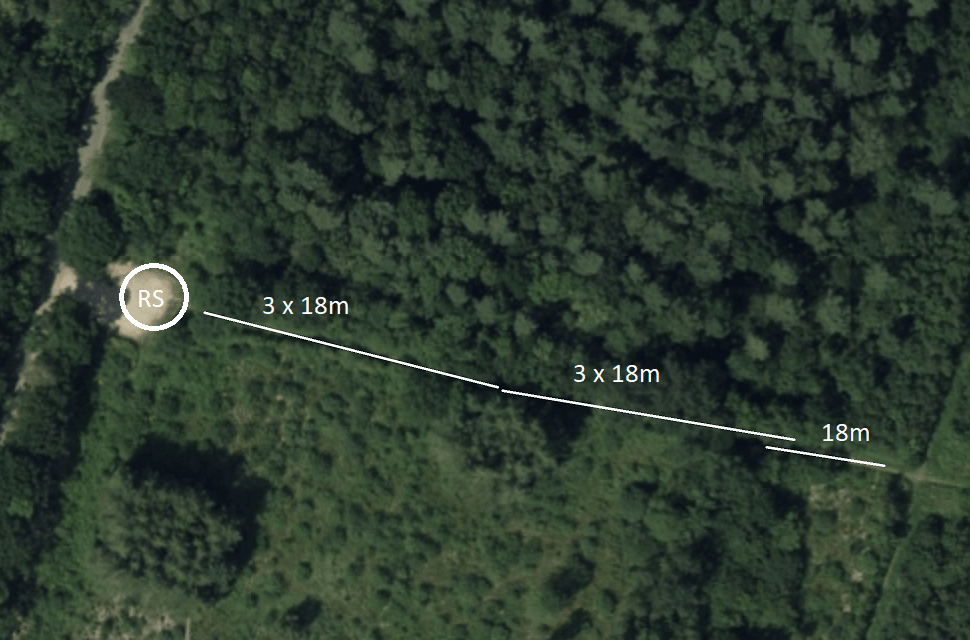
I started the morning at Red Lodge, meeting with Miranda at 6:00, and setting the nets in the usual place for our breeding season sessions. After another poor return I might have to rethink!
The only nets that caught any numbers were the three nets along the main path. We had the usual lures running for arriving migrant warblers but the numbers were just very low. To be fair to the site, April has never been the busiest month, but this was the third lowest catch at Red Lodge. Unfortunately, the second lowest was the catch made on the 5th April, also this year. The lowest catch was back in 2015. The weather was cold for this time of year and I am pretty sure that impacted on the catch, especially the 3 x 18m ride at 90o from the main path. This is usually our best net, but it is in cover and never warmed up.
The list for the morning was: Nuthatch 1; Blue Tit 2(2); Great Tit 1; Robin 1; Blackcap 3; Chiffchaff 1(2); Goldcrest 1. Totals: 10 birds ringed from 7 species and 4 birds retrapped from 2 species, making 14 birds processed from 7 species.
Miranda had mentioned that she would like to ring a Nuthatch and, as just about the last bird out of the net, she got her wish. All of the birds caught were showing signs of either coming into breeding condition or, in the case of two of the Blue Tits, ready to go. Interestingly, all four of the Blue Tits caught were females. Two had fully developed their brood patch and two had not only fully defeathered but were showing the skin folds associated with the raised blood vessels needed to brood their eggs and young. As our ringing station was no more than 20m from the nets, and with such a small catch, no bird was inconvenienced for more than 5 minutes.
When the weather clouded over, and we felt a few spots of rain, we decided that was time to call it a day, so we packed up and were away from site shortly before midday.
After a quick trip home to unload the car, have some lunch and grab my waders, I was back on the road heading to Box, where I had arranged to meet Jonny Cooper. Last summer Jonny kicked off a project to monitor Dipper on the Bybrook, most of which runs through Wiltshire. The source of the Bybrook is near Burton (not the brewing hub, that is Burton-on-Trent, this is between Acton Turville and Nettleton, and just south of the M4), and it runs southwards, past Castle Coombe, before bending south-westwards to meet up with the river Avon at Batheaston. We met up just to the west of Box. Having arrived a bit early, I had time to stop for a welcome pint at the Northey Arms: Butcombe Original bitter is a fine brew, but a pint of that plus a packet of Tyrrell’s Cheese & Chive crisps, coming to £6.10, makes it a very occasional treat and not something to be done every day.
Anyway, we met at 14:00 and donned our waders and lifejackets (health & safety comes first), and headed down to the river. Jonny being considerably younger and fitter did all of the hard scrambling, whilst I lowered myself down to the river bank in a leisurely, if entirely ungainly, manner, and set a single 9m net across the water. The net was set in a stretch that was no more than 100m long between two bridges that could provide suitable nest sites. Last year this site was active, with at least one pair nesting. Unfortunately, this year their early efforts were washed away, but we were hoping that they would be trying again. The river was still in full spate but a few of the rocks on the edge were proud of the water and offered perching spots for them.
We retreated up the bank into cover and waited and hoped, and waited and hoped. Jonny went off to see if there was any sign near the western bridge, whilst I stayed put to monitor the net, just in case anything flew in. Unfortunately nothing showed, they must have moved on for now. After an hour we also decided to move on to check out a potential nest site near the centre of Box, underneath a railway bridge. As Jonny lowered himself into the brook it quickly became clear that it was too deep to risk the walk through the tunnel, so we brought a halt to the proceedings.
It just goes to show, there are no guarantees when working with wildlife. Hopefully the brook level will fall over the next few weeks and we will be able to carry out some more checks for nests and youngsters. It is an ongoing project and there is no rush.
It was nice to have a full team out this morning. I had Ellie, Rosie and David with me from 6:00. Laura and Adam joined us at 7:00. I moved away from our winter feeding area to the main carpark, where we set up our ringing station, and then set our nets along the main path, up the hill, and then to the left of the crossroads at the top:
Having arrived a little early for the session, I was waiting for the others when a couple of cars turned up that I didn’t recognise. It was a pair wanting to fly some drones over Somerford Common to do some aerial mapping. When I explained what we were there to do, they kindly decided to move over to the western area and do their mapping there. Not sure what they were likely to see: the mist was really quite thick.
I set lures for Blackcap, Chiffchaff, Willow Warbler and Whitethroat: they all worked! The catch wasn’t huge, but on a par with recent sessions at Lower Moor Farm and in my garden. It was a nice catch though. The highlight had to be our first Whitethroat of the year:
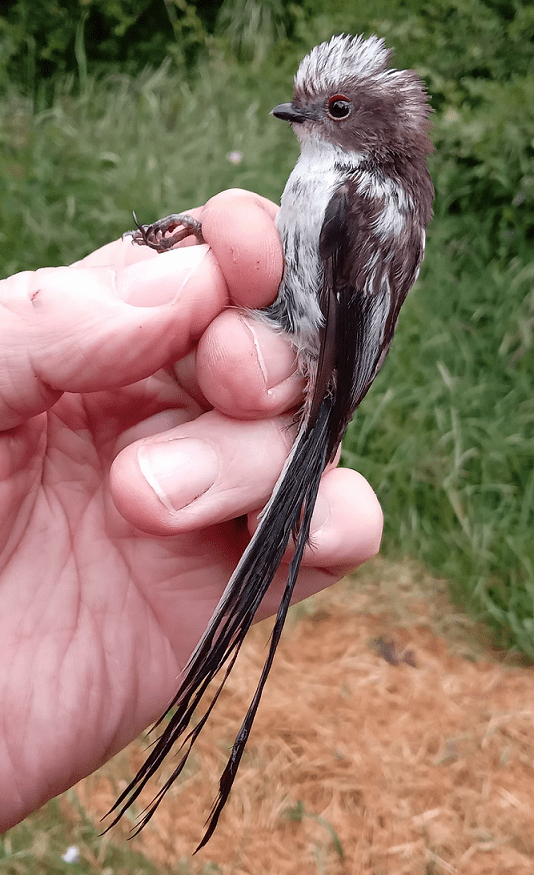
It was very much a migrant session, with both Chiffchaff and Willow Warbler making up the bulk of the catch. One point of interest was that we caught two Long-tailed Tits close together in one net. On examination, both were female, one with a well-developed brood patch, the other a developing brood patch. When released they originally flew off in different directions but then came back together. I am wondering whether it was an adult with a brood accompanied by a failed breeder from this year collaborating on rearing this year’s brood. We know it happen with this species, so why not?
The list from the morning was: Long-tailed Tit 2; Dunnock (1); Robin 3(1); Blackbird 1(1); Blackcap 2; Whitethroat 1; Chiffchaff 6; Willow Warbler 4(2). Totals: 19 birds ringed from 7 species and 5 birds retrapped from 4 species, making 24 birds processed from 8 species.
The two retrapped Willow Warblers were ringed as adults 3 and 4 years ago respectively: that’s a lot of miles they have covered in their migration to and from sub-Saharan Africa.
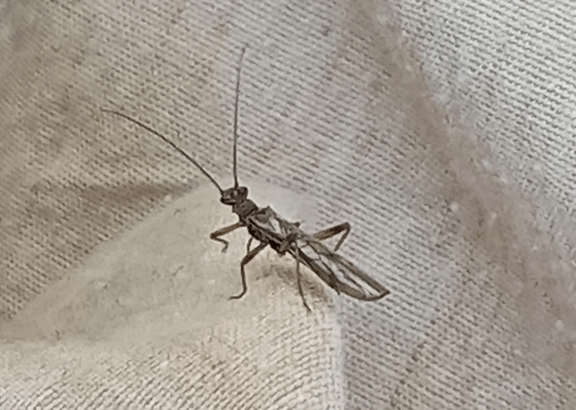
And so to the reasons for the title of this piece. As Laura and I were walking down on one of the net rounds, we both heard a grasshopper reeling – and then we heard a second one. This continued for several other net rounds. It was clear that we had two male Grasshopper Warblers in the scrub behind the 2 x 18m net set up being territorial. Unfortunately, I did not have a suitable lure for the species with me today. Adam managed to get a signal on his phone and downloaded an MP3 of Grasshopper Warbler, which he then proceeded to play close to the net. Unfortunately, whilst they showed some interest, they stayed out of the nets, but we did get some really good views of one of the birds. With a bit of luck, and a bit more preparation, I might be able to catch them next time. It all depends upon whether they are genuinely setting up territory there or just passing through.
With the catch dying off at 10:50, after the second empty net round, we closed the nets and took down and got packed away by midday. All in all, a satisfactory session, with not a Blue or Great Tit in sight to bother our fingers!
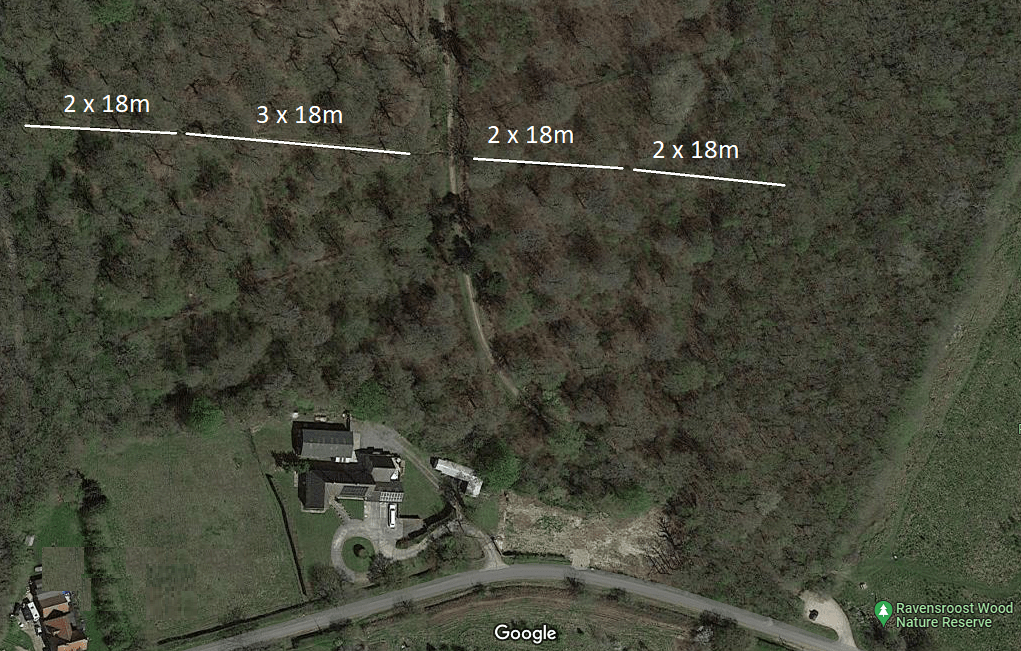
With the forecast for Wednesday to be dry but a bit breezy, I decided to try a session at Ravensroost Woods, now that it has been reopened. It has generally been the one of my sites that is largely windproof. With the wind expected to be from the East-North-East direction, I chose to set nets along rides R27 and R35:
I was joined by Miranda and Rosie, Miranda for the whole session, Rosie doing her usual selfless set up, hope to ring a bird and go to work. We met at 6:00, and a bit later we were joined by Teresa and Alan. Teresa is looking to develop her skills both as a photographer as as a naturalist, and I am happy to help: especially as she does take some excellent photos.
It was quiet but we did start catching birds. However, by 8:00 the wind direction had changed and it was playing havoc with the nets. In order to ensure the safety of the birds from any potential shear forces, I shut the nets at 8:15 with just seven birds caught: Great Tit (1); Chiffchaff 4(1); Willow Warbler 1. Totals: 5 birds ringed from 2 species and 2 birds retrapped from 2 species, making 7 birds processed from 3 species.
A small catch but the retrapped Chiffchaff was a nice find. It was ringed as an adult in April 2019, so it is at least 5 years since it fledged and four years since it was ringed. Not bad for a migratory bird that weighs in at less than 8g. It has not been retrapped in the intervening years.
It isn’t often that I am home from a ringing session at just gone 9:00 in the morning. Just in time for breakfast!
The last couple of months bird ringing have been rather frustrating for me. With an almost complete absence of the usual February / March winter visitors: no Siskin or Brambling to be found anywhere, and very few Lesser Redpoll at the usual sites, the unremitting diet of Blue and Great Tits does become a bit wearing. Coupled with the awful weather, particularly the wind, that has made my farmland sites unworkable, it has been a limited “same old, same old” for the last 6 months. Okay, the recent arrival of some of our summer visitors has helped lift my mood but, with yesterday being forecast to be wind free, I had hoped to get out to Brown’s Farm for some Yellowhammers and Linnets. Unfortunately, the forecast changed to rain between 6:30 and 8:30 and overnight I became unwell: so that was another session down the pan (literally)!
As the forecast for today was for low wind and no rain, I thought I might open my garden nets this morning. So, naturally, I woke up this morning to find it was raining. It was showery but the skies began to clear at 10:30, so I kicked myself up the backside and opened the two 6m nets at 11:30. I am so pleased that I did!
There are lots of benefits to garden ringing: one of the key ones today was carrying out my ringing to the background music of the frogs in my pond singing away for the whole time I was out there. Of course, tea / coffee on tap, food when wanted, other facilities available when needed (and in comfort) are major benefits. Being garden based in a rural village, I check the nets twice as often as I do in the woods, the neighbours have been advised about keeping their cat in when the nets are open, and I do have two effective electronic cat scarers as well, but I don’t take any risks.
I caught my first bird at 11:40: a female Greenfinch. As part of our BTO Garden Birdwatch Scheme observations, we have recorded pairs of Greenfinch coming to our feeding station (okay, for GBW notation, four Greenfinch maximum in the garden at any one time). Today’s results showed how different casual observation is from physically catching and noting what you find. By the end of the session I had caught and processed seven Greenfinch: four females and three males. Interestingly, of the four females, three were second year birds and the fourth was a fourth year bird. The three second year birds had extremely well-developed brood patches, ready to brood eggs, but the older bird was still defeathering her brood patch and looked as though she would need another couple of weeks before she would be ready to start laying. This is her:
One of the things I love about Greenfinches is the way they look at you with such a haughty expression on their faces. Without being too anthropomorphic, a sort of “Who do you think you’re looking at?” expression:
It reminds me of Sam the Eagle from the Muppets:
As usual, the major part of the catch was made up of Goldfinches: mainly males. All of them were second year birds, including the two retrapped birds that were ringed as juveniles last autumn.
Whilst loath to get carried away with pairing them all up, I did catch a male and female Robin in the same net. He had a well-developed cloacal protuberance (willy equivalent for the lay-people) and she had a well-developed brood patch and I suspect they were foraging to feed their young (it is okay – they were in the net and inconvenienced for just a couple of minutes). I also caught a beautifully plumaged male Chaffinch, alongside a female, both endowed with exactly the same descriptions as the Robins and both, thankfully, with good clean legs available for ringing. I also caught a male and a female Starling: both beautifully marked, striking birds. Astonishingly, neither of them made any fuss as I extracted and processed them.
Despite my best intentions, I did catch three Blue Tits: all retrapped birds originally ringed in my garden: one in the second round and two in the final round (I shut the nets at 16:45, so I could get on with cooking tea).
The list for the session was: Blue Tit (3); Robin 1(2); Chaffinch 2; Greenfinch 6(1); Goldfinch 7(2); Starling 2. Totals: 18 birds ringed from 5 species and 8 bird retrapped from 4 species, making 26 birds processed from 6 species.
During the session Woodpigeon did get into the nets on three occasions only, unfortunately, they all managed to get out before I could get to them. The local Jackdaws realised that something was amiss so, instead of coming down to the fat balls and peanuts as usual, they just sat in the Aspen and sulked. It was great to see a Rook back in the garden for the first time for quite a while. Again, it stayed out of the nets, despite their favourite half coconut shell filled with fat and minced peanuts having been filled for the occasion.
It was a really enjoyable session, with a reasonable selection of birds, and I actually caught more than in my most recent sessions in the woodlands, and the same number as at last weekend at Lower Moor Farm, but without the six o’clock starts and loads of nets!
I had hoped to be at Blakehill Farm this morning to have a look for some Spring migrants. Unfortunately, the forecast changed yesterday so that, although it would remain dry, it would be too breezy for us to risk spending several hours extracting nets from the perimeter track hedgerow. So I moved the session to Webb’s Wood. I was joined by David for the morning session, with Laura and family joining us later on.
David and I met at 6:00 and erected the nets. I have never seen the site so wet: every ride was, basically, a quagmire, except the one along the main track.
We had the nets open quite quickly and started catching almost straight away, with the first bird, a Chiffchaff, out of the net at 7:00.
It was never busy, and it was cold. There was a light breeze, which added to the cold feel. The sun appeared on a fairly regular basis, and in the sun it was warm, but it was never out for long enough to warm up the ambient temperature until, as per usual, we had started to pack away. I put on a variety of lures for migratory warblers: Blackcap, Chiffchaff, Willow Warbler and Whitethroat. The first three of the four worked.
The catch was light but it was pretty decent: by which I mean, we didn’t have to handle a single Blue Tit in the entire session. Following on from the initial Chiffchaff, we caught two recaptured Wrens, 20 minutes apart, and from then on the catch trickled through with just one or two birds over the course of 11 catching rounds, with a complete blank during three rounds between 9:00 and 10:00 (except for a few same day recaptures that we simply re-released) but we persevered and were rewarded with two Treecreepers, one each in consecutive net rounds.
The lures did their job and we caught Blackcap, Chiffchaff and Willow Warbler close to each lure. Every net ride caught something. The Blackcap was originally ringed at Webb’s Wood on the 24th April last year.
Highlights were definitely a couple of Willow Warblers and a couple of Treecreepers. We also caught a pair of Long-tailed Tits, and I do mean a pair. It was a male and a female taken out close together in the same net, in the 3 x 18m west-east ride. Not only that, after release, at the next round they were caught again in the 3 x 18m north-south ride. The female caught on the way in, the male caught on the opposite side of the net, just above her, when it returned to find its mate (or, at least, that is my interpretation).
The list for the session was: Treecreeper 2; Great Tit (1); Coal Tit 1; Long-tailed Tit 2; Wren (2); Blackcap (1); Chiffchaff 5(2); Willow Warbler 2. Totals: 12 birds ringed from 5 species and 6 birds retrapped from 4 species, making 18 birds processed from 8 species.
At 11:00 we started to take down. As ever, Laura and her family mucked in to help, David’s dad, Trevor arrived and did his bit, and we were all packed away and off site just before midday after a pleasant, if cold, not too busy, but nicely varied session.
Back in October 2016 I had one of the absolute highlights of my ringing career when I caught and ringed only the second ever Yellow-browed Warbler processed in Wiltshire, in the wildlife refuge at Lower Moor Farm. Whilst today does not equate with the importance of that catch for Wiltshire records, it is right up there with the best catches for me personally. More on that later.
With the weather forecast for today being for a low breeze and no April showers, I decided upon a visit to Lower Moor Farm. It started out very cold: -1oC. It started to warm up after 9:30 and by the time we started packing up just before midday it was T-shirt weather.
I was joined for the morning by Rosie and Anna. Rosie was working with a volunteer group at Blakehill Farm from 10:00, so would have to leave by 9:10 to get ready, and Anna was with me for the whole morning. We met up at 6:00 and set nets in the wildlife refuge area:
Jonny Cooper caught his first Willow Warbler of the year on the 30th March and his first Reed Warbler of 2023 on the 7th April, both at Wiltshire Wildlife Trust’s Langford Lakes reserve, so I thought I would have a look see what warblers might have arrived at our similar habitat in the north.
I put on lures for Chiffchaff, Willow Warbler, Blackcap and Whitethroat as they are only now arriving on these shores, whereas many of our resident species are already paired up and ready to breed (if they aren’t already: I have seen juvenile Collared Doves and Blackbird already this year). My expectation was not for a large catch: March and early April are always quiet times at my sites, but I was hoping for a few warblers today. We did start catching straight away and it became clear that Chiffchaff would form a significant part of our catch today.
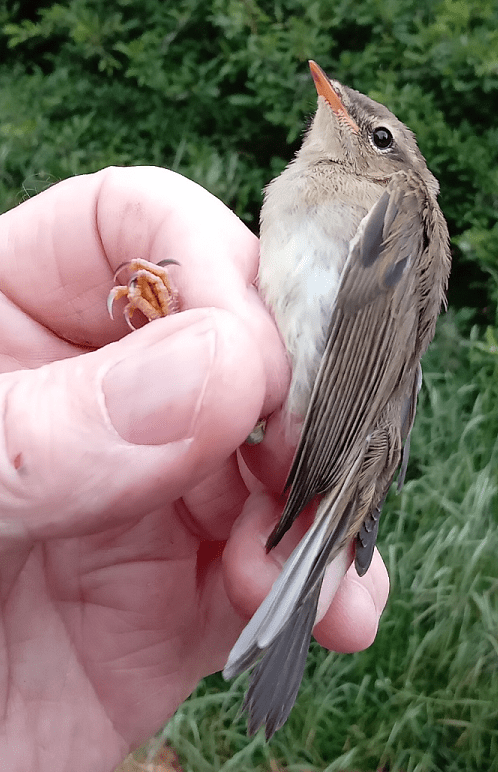
So what unusual bird did I catch? At 8:30, in the 12 metre net at the far end of our net setup, were two Phylloscopus warblers: one was a Chiffchaff and the other dwarfed it. Its head was about 50% larger than that of the Chiffchaff. To my mind, it was a Willow Warbler on steroids. Looking at the bird, I thought it had to be a Wood Warbler. I ringed it and then set about confirming my initial thoughts, using the biometric and plumage data from our two Passerine bibles: Svensson’s Identification Guide to European Passerines and Demongin’s Identification Guide to Birds in the Hand. From those I could compare what I had measured and could see on the bird with the parameters for both Willow Warbler and Wood Warbler.
This is my reasoning, with apologies for the technical jargon. When processed, the overall features of this bird say Wood Warbler: 74mm wing length, 56mm tail length & 10.6g weight. The measured wing length is beyond the extreme given for Willow Warbler, but the tail length and weight were within the given ranges for both species. According to both Demongin & Svensson for a Wood Warbler: wing length range = 70 to 81mm. Demongin gives a tail length range of 42 to 56mm and a weight range of 8 to 12g. However, comparing this bird with what they say for Willow Warbler: wing length: 60 to 71mm; tail length 42 to 56.5mm; weight is 7 to 12g. The wing length was the key diagnostic differentiator. The only thing that bothered me was that the colouration of the wings and back were duller than I expect for that species, not the bright olive green you see in every field guide. The throat isn’t bright yellow but the belly is entirely white, with no yellow streaking.
It was such a big chunky bird for a Phylloscopus. It was certainly greener than the photo shows (strong sunlight this morning), particularly the head colouration.
Wing point on Wood Warbler is 3, on Willow Warbler 3(4), P2 = 4 or 4/5 for Wood Warbler and P2 = 5/6 or 6 for the Willow Warbler. P2 on this bird = P5.
Although I have seen a reasonable number, both on breeding grounds in the Forest of Dean and on passage in a number of places, I have never held or seen one in the hand. That is not too surprising: the last Wood Warbler ringed in Wiltshire was back in 2016. So, before committing myself to a firm diagnosis of Wood Warbler and confirming the entry in the BTO database, I passed the details of the bird to my former trainer, Dr Ian Grier, and a former, long-serving, bird recorder for Wiltshire, Rob Turner, for their opinions. They also have over 80 years ringing experience between them and their depth of knowledge is exceptional. Ian confirmed by return that he would have no qualms about confirming it as a Wood Warbler, saying “The wing formula would have clinched it, with a noticeable long P2. The undertail coverts are white. The primary projection looks at least equal to tertial length. Aberrant brown and white colouration is well documented”.
If anybody has a different view on the identification of this bird, please don’t hesitate to contact me via the feedback system with your reasons.
The list for the session was: Blue Tit 1; Great Tit 1(3); Long-tailed Tit (2); Wren 1(1); Dunnock (3); Robin (1); Cetti’s Warbler (1); Blackcap 2; Wood Warbler 1; Chiffchaff 7(1); Goldcrest 1. Totals: 14 birds ringed from 7 species and 12 birds retrapped from 7 species, making 26 birds processed from 11 species.
Amongst the Chiffchaffs caught this morning was this punky little beast:
He has clearly been eating from a very sticky source to give him his pollen horn.
The only downside to this morning’s session was a female Bullfinch that we couldn’t ring. It was developing the warty excrescences on its legs caused by Fringilla papillomavirus.
It was a very pleasant morning, with lots of positive interaction with the general public, including a surprise reacquainting with Rob Werran and his partner. Rob’s a really nice bloke and came along for a few ringing sessions, but his work schedule just didn’t allow for him to keep at it.
As mentioned, we closed the nets by midday, took down and were away soon after 12:30.
This was my first ringing session since the 19th March as a combination of bad weather and a holiday to Scotland interfered / intervened. Unfortunately, this session was truncated by the weather. Again, at 10:00 last night the forecast was for it to be dry until at least midday, by 9:30 it was beginning to drizzle so we packed up and left site by 10:00. That is not to say that it wasn’t an interesting session, because it was.
Miranda and I met at 6:00 and had the nets open just before 7:00. Having packed away the feeding station before leaving for Scotland, we moved to the summer / autumn ringing area:
The following nets were set:
One Robin was so impatient to be caught that it flew into the net set along the main path before we had the nets open. Fortunately, it did not become entangled.
As usual at this time of year, between the departure of the winter visitors and the arrival of the summer visitors, it was a quiet morning. With the rain forcing an early termination of the session we ended up with just 12 birds: 8 ringed and 4 retraps.
First of the retraps was a female Chiffchaff, ringed as an adult in breeding condition in Red Lodge in June 2021, retrapped this time last year and now again this year. Our penultimate round produced a male Blackcap, ringed as an adult male in Red Lodge last April. Two nice examples of site fidelity in migrant warblers.
The list for the day was: Treecreeper 1; Blue Tit 2(1); Wren (1); Robin 2; Song Thrush 2; Blackcap (1); Chiffchaff 1(1). Totals: 8 birds ringed from 5 species and 4 birds retrapped from 4 species, making 12 birds processed from 7 species.
All birds processed, bar the retrapped Chiffchaff, were in breeding condition.
Footnote: yesterday I was contacted by Oak & Furrows RSPCA Rehabilitation Centre and asked to go and ring a Buzzard and a Barn Owl. The Barn Owl had been brought in underweight and unable to fly, the Buzzard had been brought in having been clipped by a car. Thanks to the great care and attention given to both birds, they are scheduled for release. Yesterday they were being moved out to the flight pens for a week, prior to their ultimate release.
The work they do is first rate. Since I started ringing their birds prior to release, they have successfully rehabilitated five Buzzards, three Barn Owls, one Tawny Owl and a Sparrowhawk.
An interesting month in many ways, and disappointing in others. When over 80% of the catch is down to a single individual, Jonny Cooper, it is a little concerning. My team managed just four sessions with me, plus two by Ellie working solo (even if we could wave to each other across the expanse of Mallard Lake on the 19th of the month) and one ad hoc garden catch from Andy. To be fair, the weather was really difficult, and I was away enjoying the rain in Scotland for the last 10 days of the month. That said, although this was only third in our list of March catch sizes, it was actually our best March catch per session average, particularly in numbers ringed.
There was a significant reduction in the number of species encountered, down from 34 to 26. Missing this year were Brambling, Cetti’s Warbler; Collared Dove; Dipper; Green Woodpecker, Grey Wagtail; Kingfisher; Meadow Pipit; Redwing; Siskin; Woodpigeon and Yellowhammer. Added this year were Bullfinch; Linnet; Stock Dove and Willow Warbler. The Willow Warbler is particularly notable: it is our earliest ever capture of the species and was caught at Langford Lakes on the 30th.
In addition to these birds, our leg-tagged Curlew, FJ18913 has returned from its winter quarters at Porthcarro in Cornwall and was seen again at the Cotswold Water Park on the 7th and on the 20th in the fields adjacent to Red Lodge. Also, one of the colour-ringed Dipper project birds was reported from the Bybrook near Selwyn Hall, Box on the 9th.
I ran another sold out ringing demonstration for the Swindon Wildlife Group on the 11th. We had to move it from Ravensroost Wood, as the contractors were still working there finishing the 25 year coppice and some Ash dieback removal. Apparently, the reserves management team and the events team don’t communicate so, although the ringing demonstration was booked at the end of October last, on the website and published in the “What’s On” leaflet since last November, reserves management were unaware of the arrangement. With the mooted changes to the way the reserves are managed, removing all ground staff, replacing them with contractors (and what a great job they have done with the Firs (still inaccessible) and Ravensroost Wood this winter!), and purely relying on volunteers for other work and activities, it will be interesting to see what happens with the Wildlife Trust reserves in the future.
As mentioned, I had a wet week+ in Scotland, on the shores of Loch Long. We managed to get some decent birding in whilst there, including one of my favourite birds:
Three of us are heading to Portland Bill for the beginning of May and I am hoping that Anna and Rosie will get the opportunity to ring a Rock Pipit, Anthus petrosus, whilst we are there.