Blakehill Farm: Tuesday, 29th August 2023

The best laid plans and all that…..

With my car scheduled for a service on my usual Wednesday session I decided to get a session in today. When I checked the weather forecast (Meteo and the Met Office) both said it would be dry all day but, far more importantly, that there would be very low wind speeds until lunchtime when a weather front would roll in and we could expect wind and rain. As I had agreed with Jonathan, the Wildlife Trust’s (excellent) farms manager, that I could resume ringing activities on the plateau area this week, as the cattle would have been moved off the area of the plateau that is left fallow all year round onto the areas that had recently been cut and baled for hay. I don’t have access to the plateau during the breeding season, to avoid any possible disturbance to the Curlew and Skylarks that nest in the area.

Having agreed to meet Miranda at 6:00, but waking earlier than expected, I was on site by 5:30 and started setting the plateau nets. Miranda joined me at 6:00 and, as we were putting the finishing touches to the third net she said “cattle”! Sure enough, a small herd of some 30 heifers came trotting across the plateau towards us and the nets. Fortunately, one look at the pair of us and they sped up and ran off into the northern area of the plateau and we didn’t see them again this morning. We must be very scary! I texted Jonathan, who apologised profusely. I mean, how dare his crew actually take advantage of the same bank holiday weekend the rest of us did, having worked all the hours available cutting, turning, baling and collecting the bales for the last couple of weeks! No harm done anyway.

I decided to see if any Meadow Pipits had arrived yet and set up a Mipit triangle net set. If I had checked my records beforehand I probably wouldn’t have bothered: I have never caught a Meadow Pipit at Blakehill Farm in August – and I still haven’t!

The nets we set were:
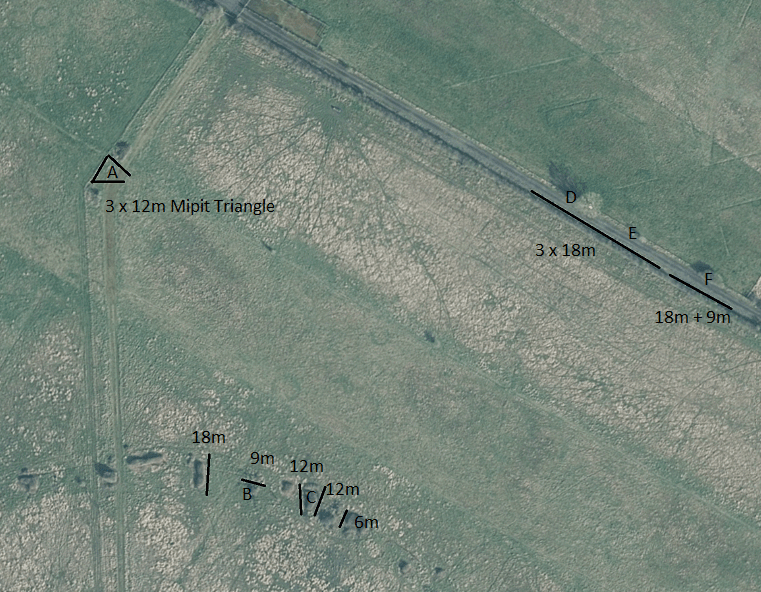
Now that we are out of the breeding season and, in this case, focusing on migrating birds, I set lures for Meadow Pipit (A); Stonechat (B); Whinchat (C,E); Blackcap (D) and Willow Warbler (E). True to form, the only lure that actually worked was that for the Blackcap. Whether the lure was instrumental in attracting in the few we caught is arguable.

We were pleasantly surprised to catch two Whitethroat, two Lesser Whitethroat and the obligatory first round Wren at about 7:30. Unfortunately, that was about it for the plateau nets. The wind got up much earlier than was forecast and the nets just stopped catching. Our Meadow Pipit net caught absolutely nothing until, at 10:30, with the wind so strong that we had to shut the plateau nets and the Mipit triangle, it produced a juvenile Great Tit.

Although the nets on the perimeter track were largely protected from the westerly wind, there was still quite a lot of billowing. With no sheer forces to endanger the birds, we left the perimeter nets open and I was pleased that we did, as two of these beauties flew into the nets at 10:00:
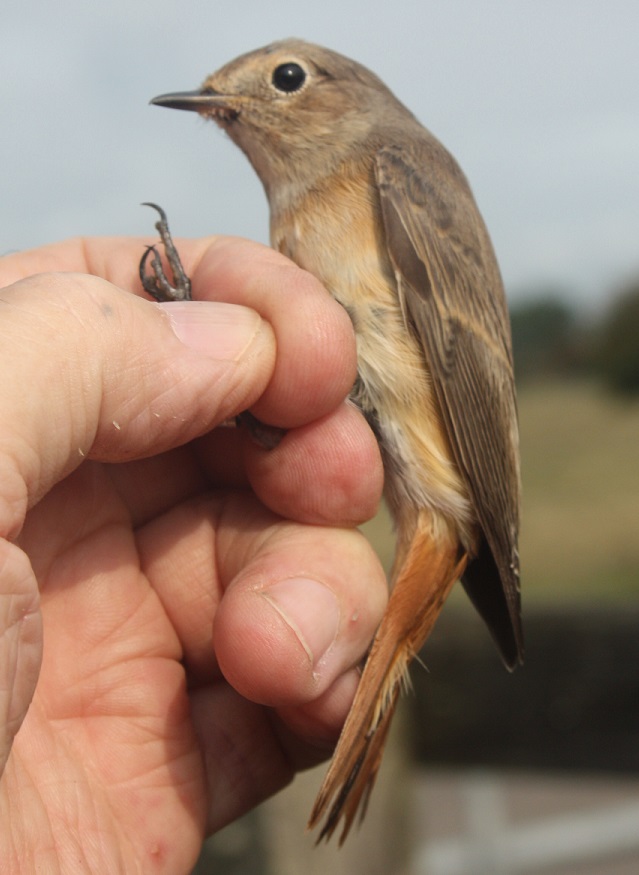
juvenile female Redstart, Phoenicurus phoenicurus
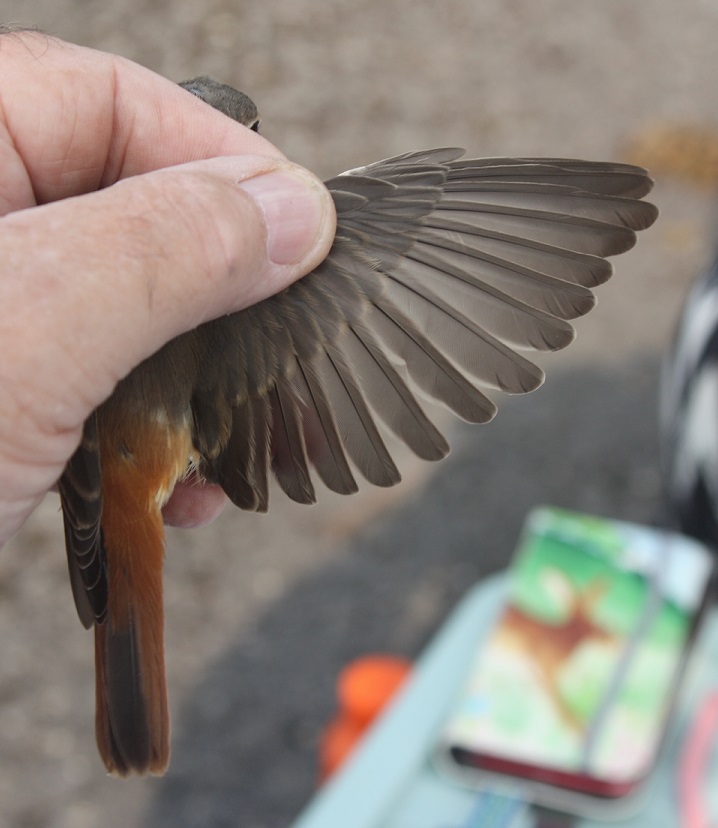
The central tail feathers on the Redstart are dark, those on the Nightingale are uniform across the tail, which is a handy identification point if you just catch a glimpse of a red-tailed bird. I had only caught five Redstart at my sites before today, and I had never caught more than one on any occasion.

We are certain that the wind was the key factor in the low numbers caught but, never mind the width, feel the quality! The list for the day was: Great Tit [1]; Wren [2]; Redstart [2]; Blackcap [2]; Whitethroat [3]; Lesser Whitethroat [3]. Totals: 13 juveniles ringed from 7 species. Definitely not my biggest catch but a nice selection of birds.

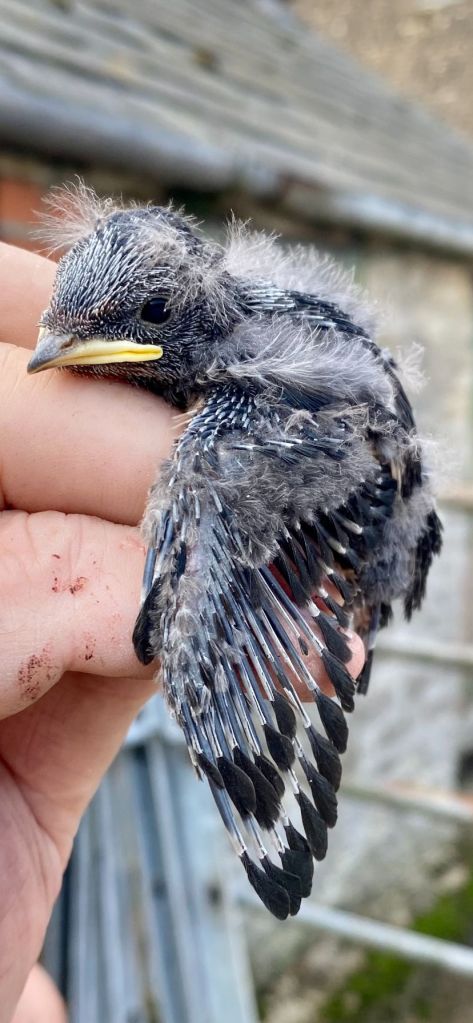
Once we had finished taking down I had an appointment with the RSPCA Oak & Furrows Rehabilitation Centre to ring this fabulous bird:
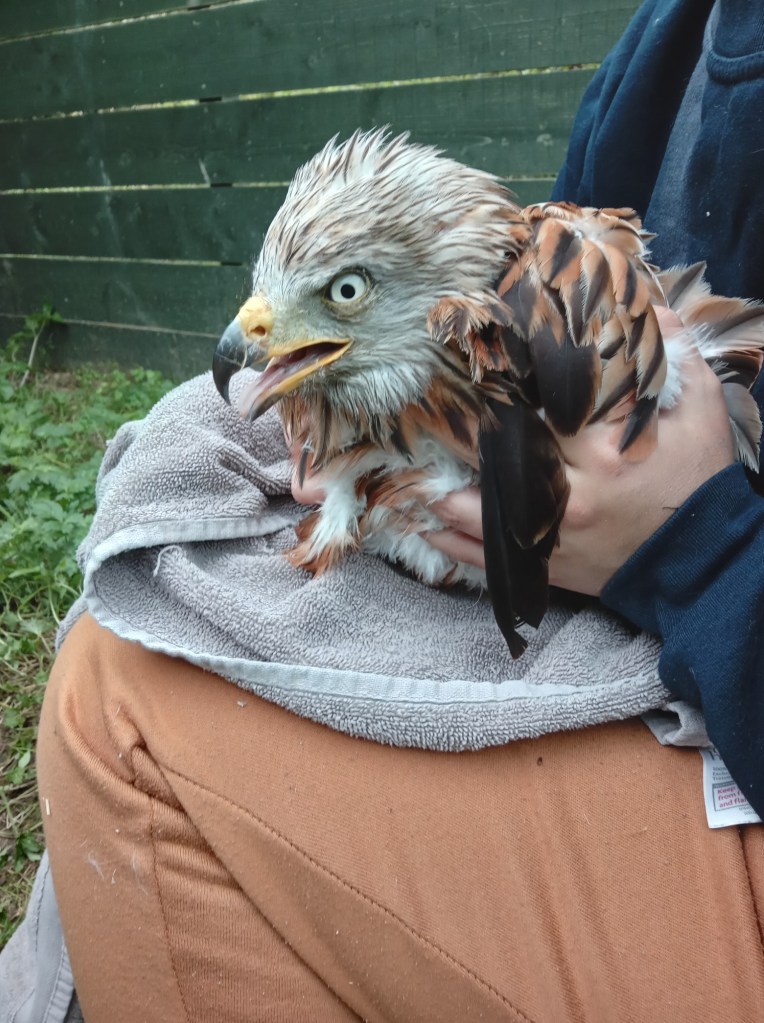
Red Kite, Milvus milvus

It is an adult male and is scheduled to be released back into the wild by the end of the week. He has made quite astonishing progress, if his weight is anything to go by: on the 20th August he was weighed at 750g. We weighed him again today, nine days later, and he weighed in at 1,040g. That is a staggering weight gain: nearly a 40% increase in just 9 days! Given its diet, it brings a whole new meaning to the term “chickenfeed”!

Whilst I was there I was asked to look at a juvenile Sparrowhawk that someone had brought in. It is already ringed so I have taken the details and did all of the usual biometrics and entered the data into the central database. Unfortunately, whomsoever ringed it has not yet entered the capture details into the database, so I haven’t had any feedback on it yet. I almost always enter my data on the same day, if not I do it the next day. It is an online system and, if used properly, it is fast and efficient. Not everybody does.

All in all, a very satisfying morning, despite the weather and the cattle!

Red Lodge: Sunday, 27th August 2023

The last time I went to Red Lodge, on the 9th July, I caught just six birds in 180 metres of net in four hours, so it was with some trepidation that I returned to the site. David and I were on site for 6:30, with Teresa and Andy joining us soon after. Finally, we were joined by Claire and her children at about 8:00.

I didn’t set quite so much net this time, as one of the rides had become extremely enclosed by the canopy having become heavily weighed down.

Things did not start auspiciously: we had to wait over an hour for the first birds to get caught in the net. When they did it was pleasing to start with two juvenile Marsh Tits:

Juvenile Marsh Tit, Poecile palustris

It is shaping up to be a good year for this species in the Braydon Forest. They were accompanied by a couple of Wrens and Blackcaps. That was the best round. Apart from that it was just ones and twos until we reached the grand total of 18 birds from nine species. I suppose a 300% increase on last time is something to be pleased with.

Actually, there was a lot to be pleased with, primarily this:

Juvenile male Sparrowhawk, Accipiter nisus (photo courtesy of Teresa Farr)

It was very obliging: it hit the net at speed, struggled and escaped, but had the good graces to try again. This time we were ready for it, and I managed to extract it without damage (especially to me, these birds are not exactly docile). The plumage was very fresh and the colouration stunning. Its very pale yellow eye colour is typical of a juvenile Sparrowhawk. The plumage colouration and biometrics (wing length and weight) were perfect for juvenile male.

The final bird out of the nets was an adult female Nuthatch. She was undergoing her post-breeding moult of wings and tail and had almost completely feathered over her brood patch. Another month and we will find it almost impossible to distinguish between adults and juveniles as both undergo a full moult into adult plumage post-fledging or post-breeding.

The list for the day was: Sparrowhawk [1]; Nuthatch 1; Blue Tit [1]; Great Tit [2](1); Marsh Tit [2]; Wren [3]; Robin [2]; Blackbird [2]; Blackcap [3]. Totals 1 adult ringed, 16 juveniles ringed from 8 species and 1 retrap, making 18 birds processed from 9 species.

There was an extremely sharp shower at just after 11:00, just as we were thinking about closing up, to help make our minds up and we started taking down. Many hands make light work, and everything was packed away pretty quickly. Fortunately, the rain stopped and we managed to dry most things off before putting them in the car. We were off site just after midday.

CES 11: Lower Moor Farm, Tuesday, 22nd August 2023

With the wind forecast for Wednesday being flat calm, I decided that I would try to get to Brown’s Farm (something I had planned for last Wednesday but illness put paid to that), as I have not been able to get anywhere near at all so far this year, because it is just so susceptible to the wind. As a result, I decided to bring forward CES session 11 to today.

Yesterday, Miranda and I went to Waterhay Farm to check on the breeding Swallows at the site. We found a dozen or so nests. There were a whole bunch of newly fledged Swallows sitting on the telephone wires outside the farm, and we did find several empty nests. However, we found two nests with more-or-less naked young, with their wing feathers emerged but completely in pin; one nest with the young feathered and their flight feathers one-third grown / emerged but, as surprising as it was when we found two nests with warm eggs at Clattinger Farm last Monday, we also found a nest here with five warm eggs. Say what you like, I think that this is beautiful:

Swallow pullus, Hirundo rustica (photo courtesy of Miranda)

So to this morning, Miranda joined me at 6:00 and we got the usual nets set up and open by 7:00. Unfortunately, she began to feel unwell and, at just after 9:00, had to leave the session. It was a shame, as we were having a decent catch (for once). What was a little surprising was the influx of Blackcaps. Having been scarce all summer, today we were taking one or two out each round.

The catch was: Treecreeper (1); Blue Tit [10](1); Wren [1](1); Dunnock 1(1); Robin [1]; Blackcap [17]; Chiffchaff [2]. Totals: 1 adult ringed, 31 juveniles ringed from 5 species and 4 birds retrapped from 4 species, making 36 birds processed from 7 species. Numerically that compares favourably last year, when only 29 birds were processed: 19 ringed and 10 retrapped, but that catch did have 12 species, so greater variety. On the positive side: 17 Blackcap is 10 more than any other catch of them at my sites this year. In fact, it is my second best catch of them at any of my sites. The best was actually at Lower Moor Farm on the 25th September last year. Hopefully this is a good omen for next month!

A couple of juvenile Chiffchaff were welcome but, again, the complete absence of Whitethroat and Lesser Whitethroat was a disappointment.

Unfortunately, at about 11:00 an unforecast wind started to get up. Although the rides here are pretty well sheltered from westerlies but by 11:30 it was blowing out the net pockets, and I had to shut the nets 30 minutes earlier than planned. With my last round and the nets closed but before I started taking down, I did spend quite a lot of time with a young family, introducing them to bird ringing, and was able to show them a few birds up close. I am not sure the baby will remember much, no matter how smiley he was, but hopefully their four-year old daughter will grow up to be interested.

After chatting and then packing up I left site at just after 13:00. A satisfying session at last!

Deja Vu? Saturday, 19th August 2023

I don’t think I have ever previously ringed the same site within 5 days of the previous session, until today. It was a bit of a mistake to be honest: but it turned out to be a pleasing one. We (this was a joint mistake) overlooked the fact that a bio-blitz was scheduled at Blakehill Farm on Saturday when we went ringing on Tuesday. Two good things came out of that (apart from our first two Lesser Whitethroat of the year): a net ride that had previously produced very little caught all bar one of our birds on Tuesday and the net rides that I would usually have set caught absolutely nothing. Mind, the wind forecast made those empty nets unusable anyway. As a result, I decided to set the net ride that had caught for this session again, and set another two net sets in the field on the opposite side of the track:

With the weather forecast threatening rain until 6:00 we agreed to meet at 6:30. I was joined by David and Rosie. Rosie would be running the bio-blitz volunteers, who were arriving at 10:00, and so managed to get a bit more ringing done than usual, which turned out to be fortuitous for her.

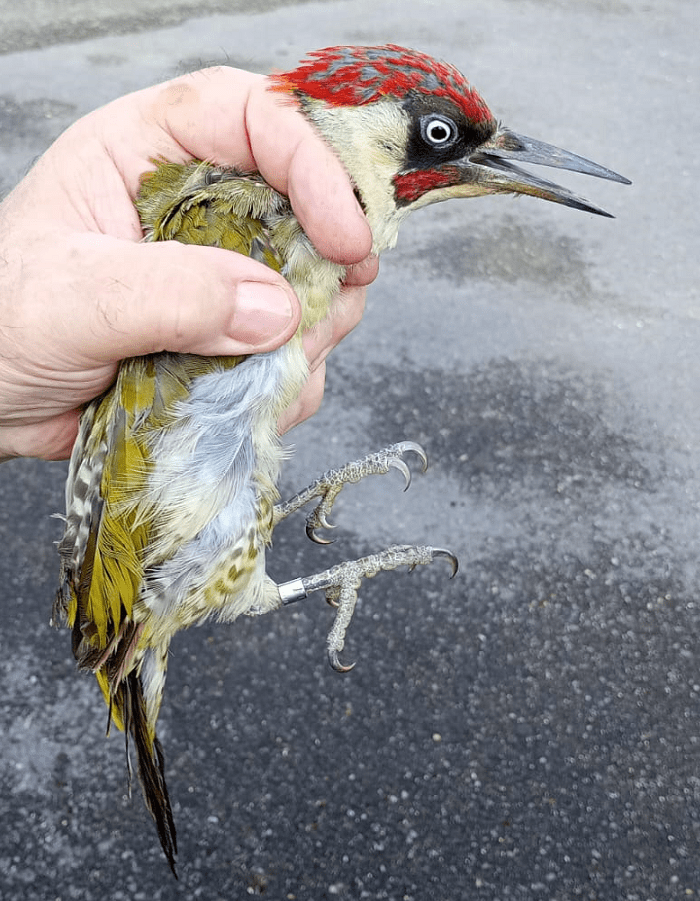
The first round that actually produced any birds, at 8:30, whilst I was getting close to tearing out what little hair I have left at the lack of any birds, delivered this beauty:

Second-year Male Green Woodpecker, Picus viridis (photo: Rosie Wilson)

It was in the net set that was successful on Tuesday. This is the first Green Woodpecker caught and ringed at this site, and was the first Green Woodpecker that Rosie has had the chance to process. The other birds in the round were more usual fare: a Blue Tit and two Dunnock. As we split off to do the next round Rosie went to check the nets where I had extracted the Green Woodpecker. Immediately I could hear the familiar calls:

Juvenile Green Woodpecker, Picus viridis (photo: Rosie Wilson)

So Rosie ringed and extracted her first Green Woodpeckers in consecutive net rounds!

The first bio-blitz volunteer arrived at 9:00 and the rest around about 10:00, which brought an end to Rosie’s involvement in the ringing this morning. In the interim we had a decent round of 11 birds, including our third Lesser Whitethroat of the week at the site (and of the year at any of my sites), and from the same net as the previous two. The list for the day was: Green Woodpecker 1[1]; Blue Tit 1[2]; Great Tit 1; Wren [2]; Dunnock [4]; Robin [4]; Lesser Whitethroat 1; Chiffchaff [4]. Totals: 4 adults ringed from 4 species and 17 juveniles ringed from 6 species, making 21 birds processed from 8 species. Once again, no retrapped birds.

I carried out a brief ringing demonstration to the bio-blitz volunteers, who were very keen to find out more about it and enjoyed seeing some birds close up. They then departed to start their blitzing. Immediately I was called over by them to see this beauty that they had found in the hedgerow:

Privet Hawkmoth Caterpillar, Sphinx ligustri

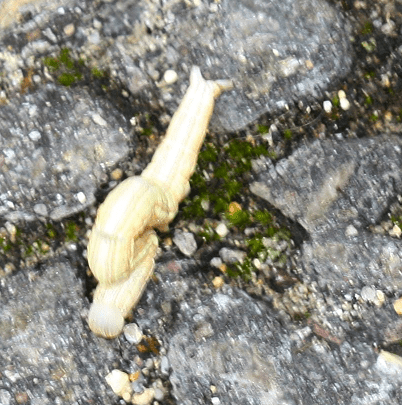
Soon after David and I had sat back down at the ringing station I noticed this crawling across the path:

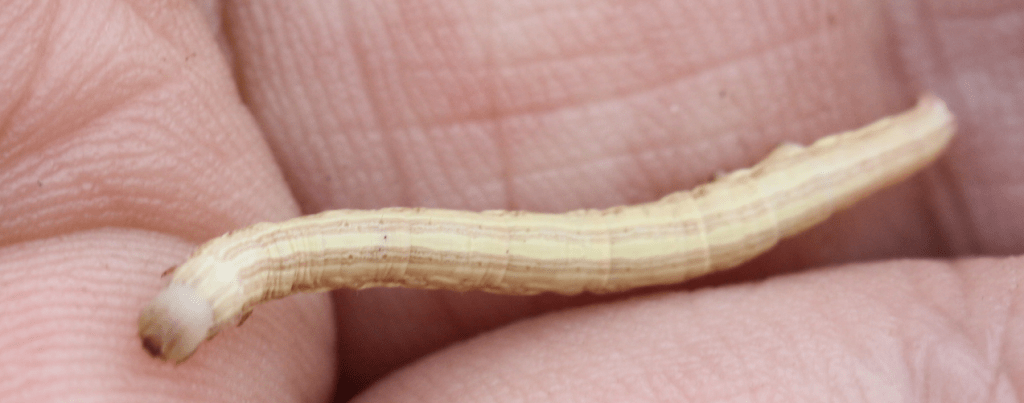
I have been told that this is the caterpillar of a Mother Shipton moth, Callistege mi

With the wind getting stronger from 11:00, we started to shut the nets at 11:30. For once there were no last minute birds. David’s dad, Trevor, joined us and helped make the process of taking down so much quicker. We were packed up and ready to go by 12:15.

As an aside, I will be heading back there for the evening with my moth trap, to provide some sort of finale for the bio-blitz.

Blakehill Farm: Tuesday, 15th August 2023

I had a quick trip to Clattinger Farm yesterday, to meet up with Rosie, check on some Swallow nests, and then ring a brood of five Swallows, all done under licence and as part of the BTO Nest Record Scheme. Interestingly, two of the nests contained four eggs in each. They were warm, so clearly being brooded. By my estimation they will be fledging towards the end of September (15 days incubation, 22 more days to fledging, according to the BTO Nest Record data). The birds we ringed will almost certainly fledge within the next two weeks, as their feathers were two-thirds grown.

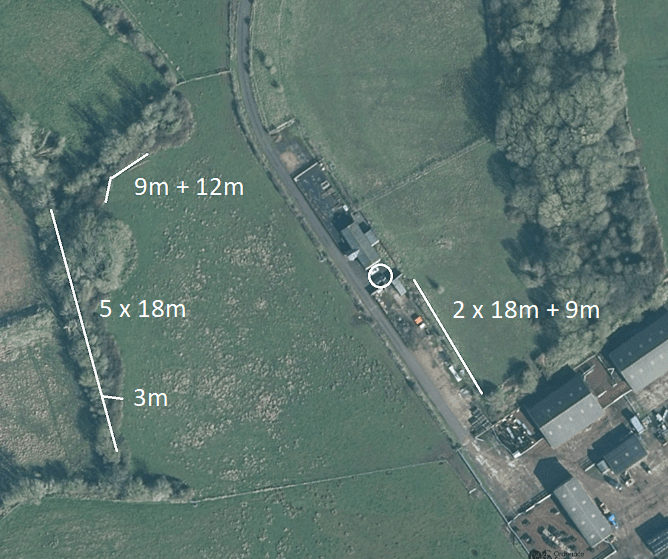
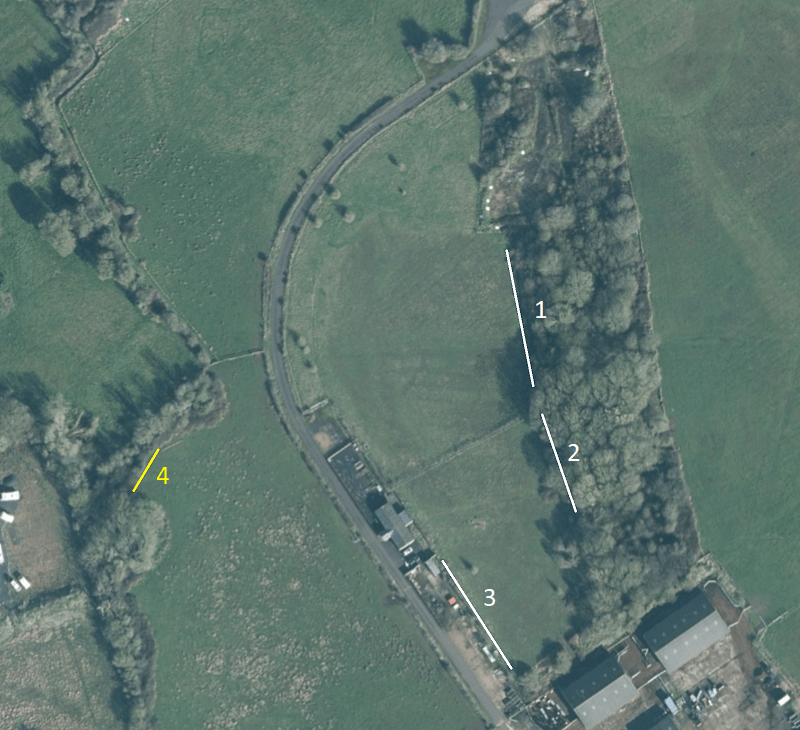
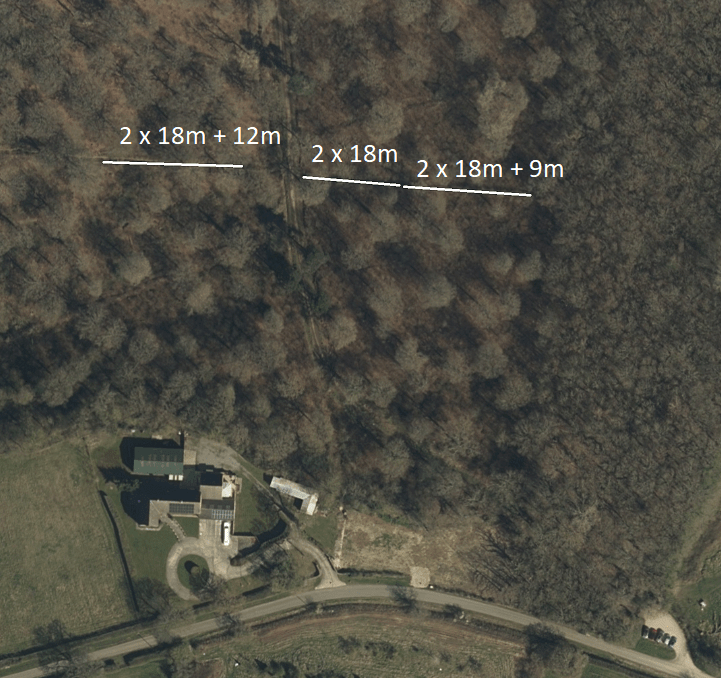
This morning I planned to carry out a session at Blakehill Farm in the fields behind the Whitworth Building. I was joined by Rosie and Miranda for the session and we all met at 6:00. Driving round the perimeter track to the Whitworth Building I firstly had a Kestrel take off from a post just in front of me and had lovely views as it flew away into the mist. This was then followed by a Wheatear that post-hopped along the track in front of me for about 200m, giving me brilliant views of the bird. My first of the autumn. We set the following nets:

To explain this diagram: 1 was 2 x 18m nets + 1 x 12m net; 2 was 2 x 18m nets; 3 was 2 x 18m + 1 x 12m net and 4 was 1 x 18m net. Net rides 1 to 3 were the nets we actually set for the start of the session, and used until 10:30. However, rides 1 and 2, set along the tree line produced just one bird: a Wren, right at the start of the session. The breeze got up, they were billowing and getting stuck in the trees and the brambles, so we closed them and took them down. Needless to say, as soon as we started to close them they caught another bird. However, it was the Wren that we had originally caught and ringed, so I just extracted it and released it. Net number 4 was set up subsequent to closing nets 1 and 2, just to test the position. It failed and didn’t catch a single bird.

As usual, Rosie had to leave for work soon after 9:00, having just had the opportunity to ring two birds. To the catch itself: it was not big but I am not going to complain. All birds, apart from the previously mentioned Wren, were caught in the 2 x 18m + 12m line along the hedgerow / path. There were no adults and no retrapped birds. The list was: Great Tit [2]; Wren [1]; Robin [2]; Whitethroat [1]; Lesser Whitethroat [2]; Chiffchaff [1]; Willow Warbler [1]; House Sparrow [2]. Total: 12 juvenile birds ringed from 8 species.

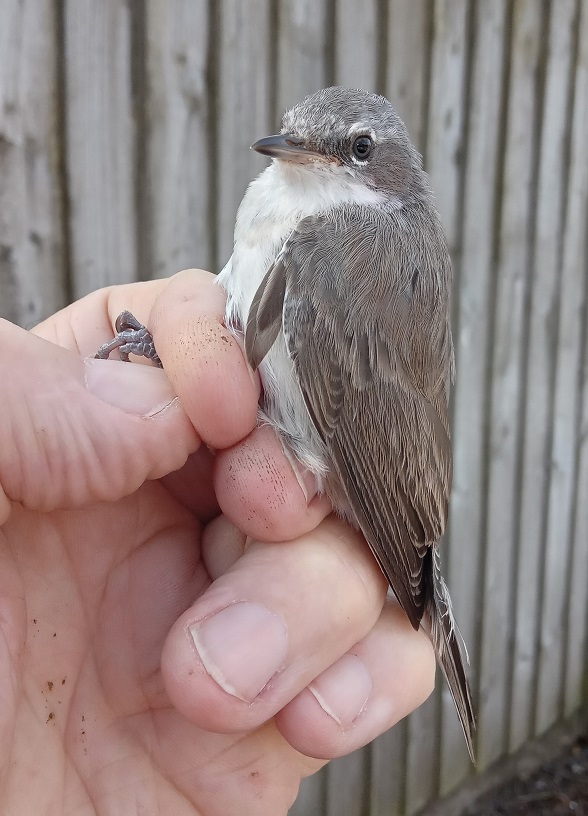
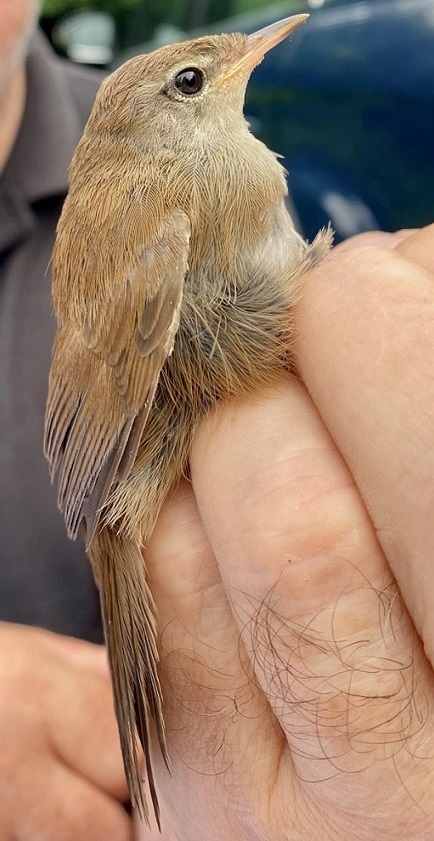
The two Lesser Whitethroats are actually my first two of the year. It has been a stunningly disappointing year for this species at my sites. They have been declining since 2020, coinciding with the overall declines in catches at Lower Moor Farm and Ravensroost Meadows, so to catch two today was very pleasing:

juvenile Lesser Whitethroat, Curruca curruca

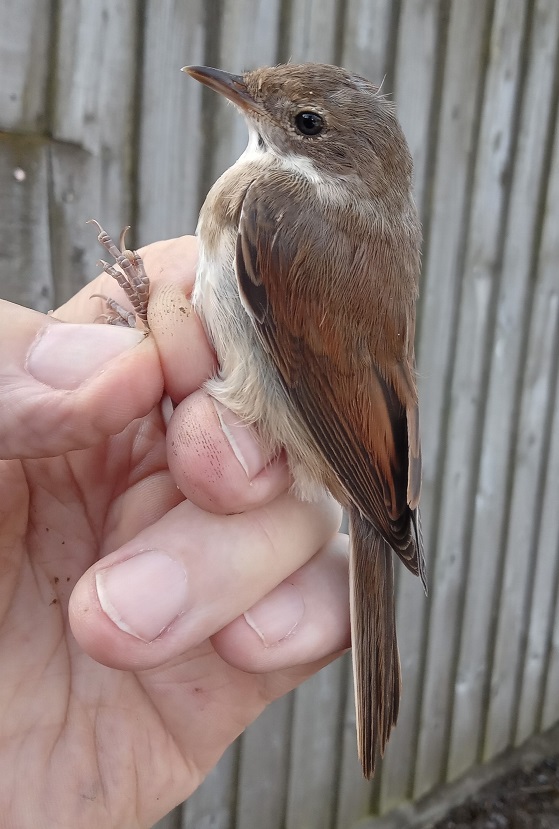
The first one was accompanied by a juvenile Whitethroat. Their numbers at my sites have crashed since 2021. This was our first juvenile of the year:

juvenile Whitethroat, Curruca communis

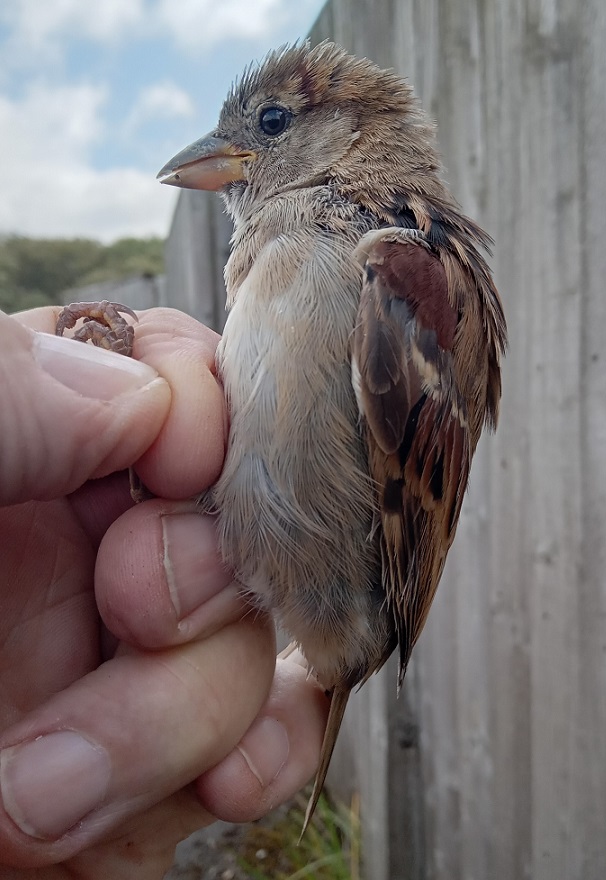
Although we have ringed some House Sparrow pulli this year we had not caught any fledged juveniles until the two today:

juvenile House Sparrow, Passer domesticus

The House Sparrow is one of the few Passerine species in the UK where the adults and juveniles both go through a full post-breeding / post fledging moult into full adult plumage, making it impossible to age them accurately as the autumn progresses. Others that have this moult strategy are the Nuthatch and Long-tailed Tit. This one was already able to be sexed: its head was developing grey feathers and its wing was developing the dark chestnut feathers typical of the male’s plumage:

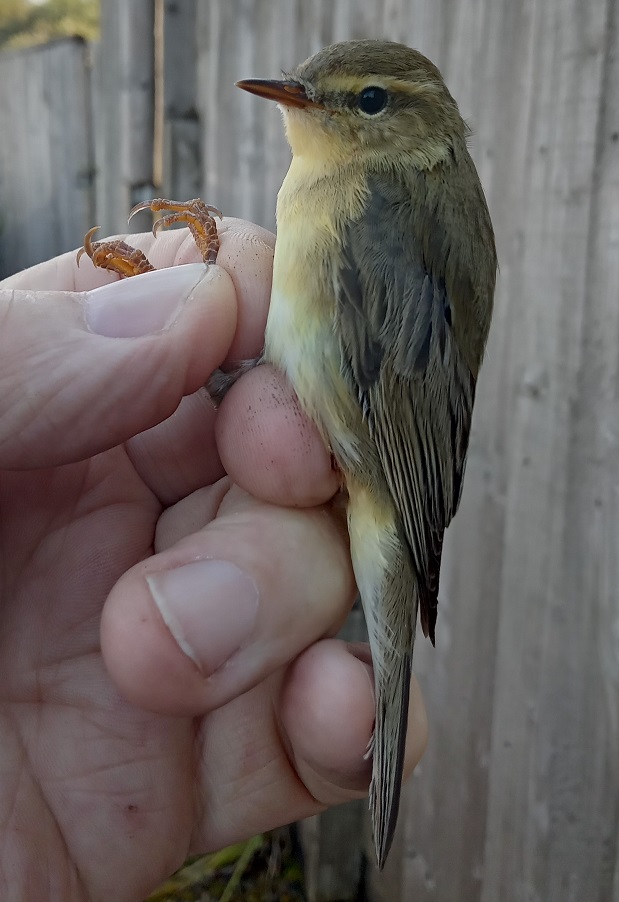
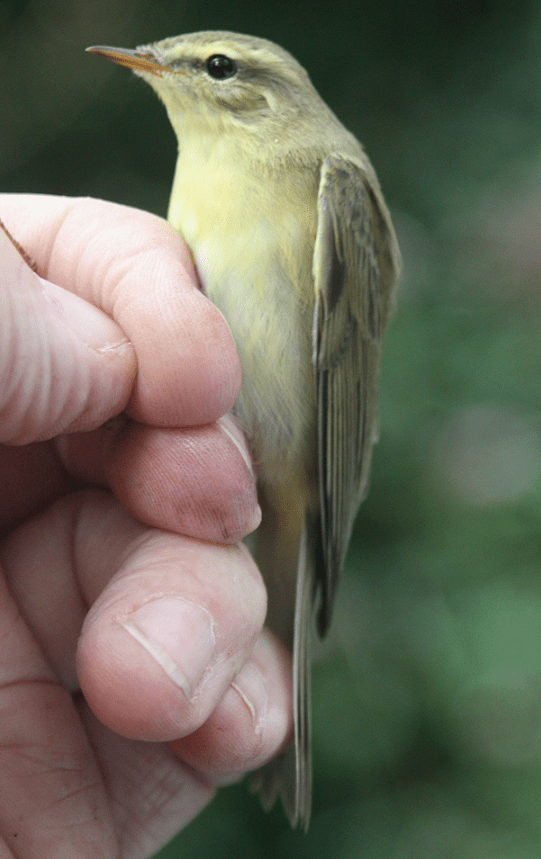
Unfair on the juvenile Robins, Great Tits and Wren that don’t make the picture gallery, but we did catch a very striking juvenile Willow Warbler:

juvenile Willow Warbler, Phylloscopus trochilus

With the wind picking up, and the catch having died off completely, Miranda and I shut the nets at 11:30 and took down. We were off site by 12:15.

CES 10: Lower Moor Farm, Wednesday, 9th July 2023

After another rainy day on Tuesday it was a relief to wake up to a dry day.  It started misty but the sun came through and burnt off the mist by 8:00. The moon, at about one-third full, was present in the north-western sky throughout the morning session: that always seems a bit weird. I was joined for the morning by Miranda plus Laura with Daniel and Adam at 6:00. With everybody pitching in, and with me being able to find the first few pole holes without having to re-establish them, we had the first nets open by 6:15 and the rest open by 7:00 and, like Monday, caught the first bird before the last net was opened.

It was a very pleasant session but, like almost all of them this year, the numbers were well down. In fact, they were exactly 50% of the same session last year! Indeed, both the number ringed and the number retrapped were both 50% of the equivalent number last year. We were taking birds out of the nets every other round, i.e. every 40 minutes we would have something to process. One of the benefits of not being rushed by larger numbers of birds is that there is time for personal development. Laura isn’t currently interested in actually ringing the birds but does want to be able to extract them. So we could take some time this morning to start her on that path. I am pleased to say that she got the hang of it quickly and has now extracted her first couple of birds.

Once again the catch was devoid of Chiffchaff. We could hear them all around us but only one came near the nets but managed to extract itself whilst I was extracting a Cetti’s Warbler.  We had a couple of those again this morning: as well as the Chiffchaff there was a Dunnock and a Wren. Unusually, these were in the Merlin nets, which are generally deeper pocketed than the Ecotones I use in more open area and, therefore, less likely to allow birds to escape.  The Cetti’s Warbler was our second juvenile of the year.

Juvenile Cetti’s Warbler, Cettia cetti

The list for the day was: Treecreeper 1; Blue Tit 1(3); Great Tit [1]; Wren 1[3]; Dunnock [2](1); Robin [2]; Cetti’s Warbler [1]; Blackcap [2]. Totals 3 adults ringed from 3 species, 11 juveniles ringed from 6 species and 4 birds retrapped from 2 species, making 18 birds processed from 8 species. That compares to 28 birds ringed and 8 birds retrapped from 14 species in the equivalent session last year. The catches have been declining for the fourth year in a row. This year perhaps it has been exacerbated by the bad weather but it is still a worrying trend.

As ever, there were squadrons of dragonflies and damsel flies around the area, including this lovely Common Darter:

Immature female Common Darter, Sympetrum striolatum

The Brown Hawkers and Emperors wouldn’t settle long enough for a decent photo, probably because this time I took my macro lens on the camera! With the session time coming to an end and five of us to take down, we were cleared away very quickly and off site by 12:30.

Marsh Tits in the Braydon Forest: an Update

Back in April 2020 I did a brief piece on the status of Marsh Tits in the Braydon Forest, as understood through my team’s ringing activities. A lot has happened since then, and I have also realised that some trend analysis might be useful. For example, in the first piece I reported simply on base numbers ringed and retrapped. What I didn’t analyse was how those numbers are affected by the effort put in. With the restrictions imposed by the BTO and the Wiltshire Wildlife Trust as a result of Covid, I thought I would fill the activity void, created by the dreadful weather recently, by doing some further analysis.

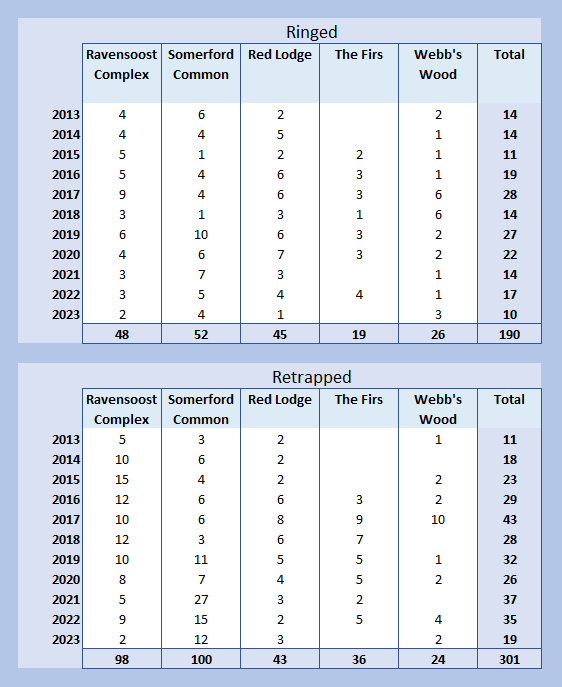
For this report I started with the data collected from 1st January 2013 up to the 31st July 2023. I didn’t take the earlier data as ringing in the Braydon Forest up until then was restricted to Ravensroost Wood and a couple of months in the Firs, so wasn’t representative of the work done in the forest over the last decade. What I do not pretend is that there is a huge Marsh Tit population in the Braydon Forest: what there is, is a stable population and it is that stability that I wanted to look at.

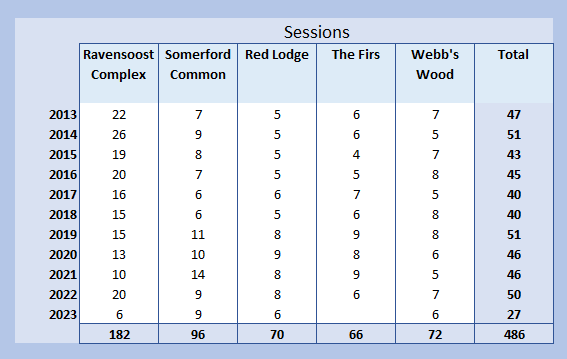
The first thing was to look at the number of sessions carried out in the forest by year. This was to use as a baseline for the ongoing analysis. Previously I have used the number of sessions in which the species was caught, but that isn’t truly representative of the return on the investment of time and effort. The number of sessions carried out by year was:

From this I then had a look at the numbers of birds processed by year:

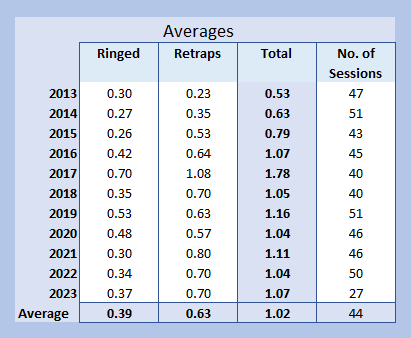
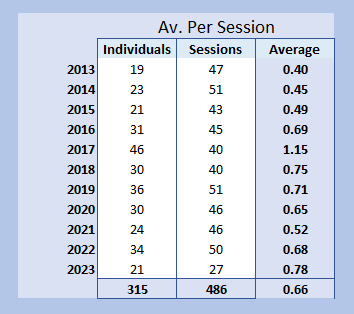
Following on from this, I looked at the average numbers caught per session:

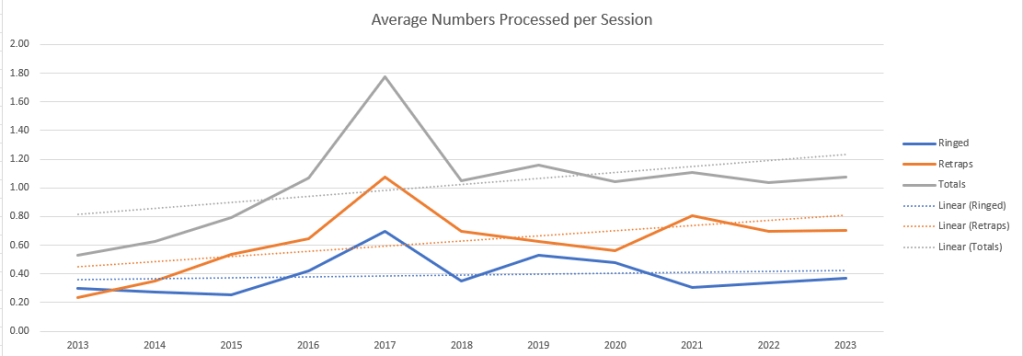
I was surprised to find that the catch averages out at a Marsh Tit being caught in every session. Obviously that doesn’t mean that we catch them in every session, but they are caught regularly. When put into graphical form it looks like this:

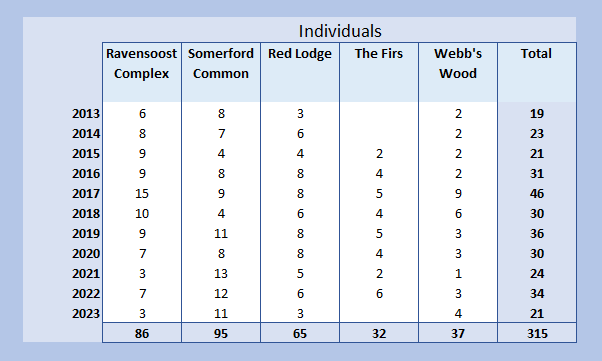
As you can see from the trend lines, the trend is slightly positive across each category. That’s a good start. However, one of the things that can distort the situation is multiple recaptures of the same bird within the year. For example, AAL0191 was caught and ringed in the Firs in February 2020, and then recaptured in July, October and December of that year. So four records representing one bird. So I then looked at the numbers of individual birds processed per annum. The results were somewhat different:

Working that out as average per session gives the following:

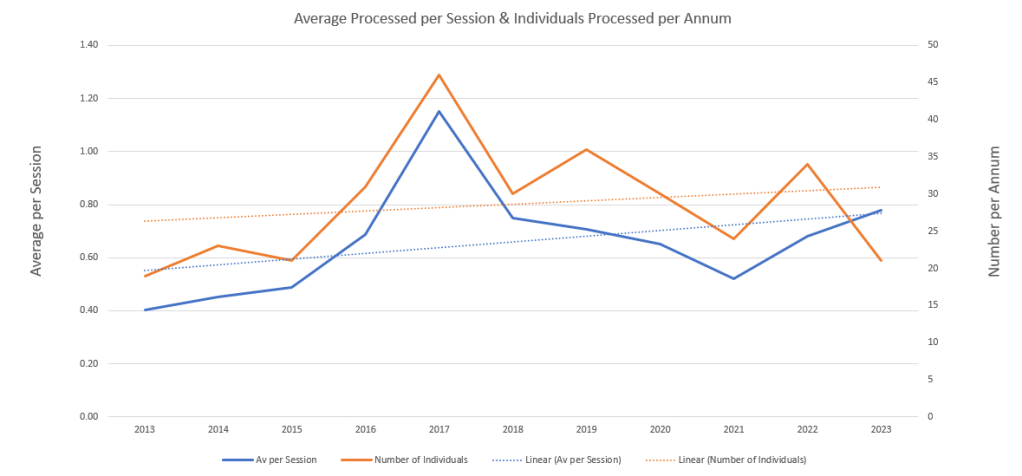
Graphically it looks like this:

Clearly it is what one would expect, but the linear analyses show a somewhat higher rate of increase than previously.

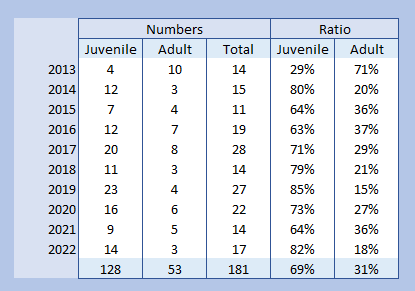
The next thing I looked at was the juvenile recruitment in the forest versus the number of adults. This I did by comparing the number of adults and juveniles ringed each year and the ratio between them, expressed as percentages. For this I didn’t include 2023 data as, although the year has started well, with 21 individuals processed, 10 of them ringed, it is too early to accurately compare numbers of youngsters ringed versus adults, as the fledglings only start to appear from approximately between the third week of May to the third week of June (BTO BirdFacts data).

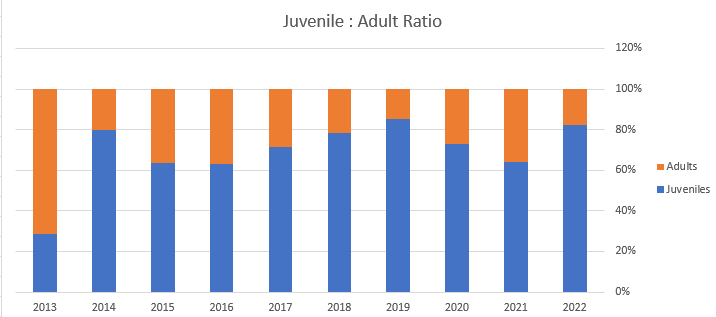
Graphically it looks like this:

Apart from 2013, and I have no idea why it should be that anomalous, as one would expect, over twice as many juveniles are ringed compared to adults each year. It should be said that, as the year progresses, it becomes increasingly difficult to distinguish juvenile Marsh Tits from adults. The primary distinction is based upon retained greater coverts present in the juvenile, the adults replacing all of theirs during their post-breeding moult. The other thing to be aware of is that, for this analysis, birds that fledged in one year are considered adult after 1st January of the next year, even if they can be identified as having fledged the previous year. i.e. a bird fledged in 2021 is considered adult on 1st January 2022.

What does all of this mean? I accept that the population is not huge but it does seem to be stable. Juvenile recruitment seems to be consistent.

As well as looking at these relationships, I had a look at a couple of other figures: longevity and movement. Movement is the easy one: of all of the records for the species only one bird has moved further than 1km from its natal site: D983277, ringed in Webb’s Wood on the 13th June 2014, retrapped on the 24th January 2015, 3.5km away in Red Lodge.

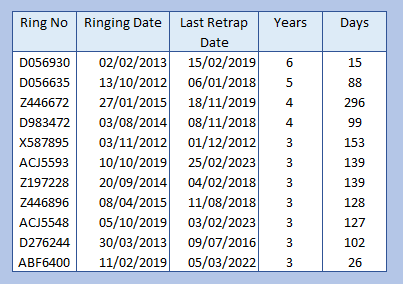
Longevity was somewhat different: the typical lifespan of a Marsh Tit is two years. The oldest known survived for 11 years and 3 months from date of ringing (and who knows how much longer after that!). I looked at the number of individuals that have survived for over three years from date of ringing. There are 11 individuals:

Ravensroost Wood: Monday, 7th August 2023

I haven’t been in this wood since June, and I didn’t get into it this year until April, whereupon the first session produced just seven birds. It was time to give it another go. Obviously, the Braydon Forest woodlands have given very poor returns in the last month: probably as a result of the awful weather we have been having. So I did have some trepidation about this session. That said, I did decide that I would not be up incredibly early, given the time that catches have been starting at other sites where I have been on site at 5:00 or 5:30, so I agreed 6:30 with Rosie. As is the way of these things, I woke up at 5:10, instead of the 6:00 my alarm was set for, so ended up at Ravensroost at 6:00. Rosie joined me to help set up at 6:30 and we had the nets open by 7:00, with the first birds in the net at 6:55! Oh yes! Two Great Tits, a Robin, a Long-tailed Tit and a Blackcap all decided to fly into the unopened nets! The net set up was:

Unfortunately, that was the best round of the day. We did catch one or two birds nearly every round but not large numbers. Rosie had to leave at 9:30 for a work meeting but I continued until I closed the nets at 11:30.

Unlike some of the recent woodland sessions, we did actually catch some adult birds: lots of moult going on, which I love analysing and scoring. All of the birds that fledged this year undergo a post-fledging moult, usually to infill the missing body feathers not required whilst in the nest. Both adult and juvenile Long-tailed Tits (and Nuthatch and House Sparrow) undergo a complete moult into the same / adult plumage so, by the end of September, it is nearly impossible to tell adults from juveniles on plumage. The Long-tailed Tit that we extracted in the pre-opened nets was an adult, which we knew from the ring number, but it had nearly completed its moult. There were just two primary feathers still growing and (it was a female) the brood patch was nearly completely feathered. Perhaps the most surprising find was that one of the juvenile Great Tits was moulting its tail feathers. In the past I used to think that they must have lost them through accident, but last year I found out that this is an actual moult strategy in juvenile Great Tits. Since then I have seen it quite a lot, but it still seems odd.

Talking of odd: the last Chiffchaff I took out of the net was very unusual. It had very dark brown, almost black, legs. It had the typical rounded head shape of a Chiffchaff and what I see as typical juvenile colouration: a couple of pale brownish patches at the sides at the top of the breast. However, when I checked the right wing the 6th primary feather, which should have been emarginated, wasn’t. It was just straight, as found on a Willow Warbler. However, when I checked the left wing, the 6th primary was very definitely emarginated. Goodness knows what species I would have ascribed it to had that not been the case. (For those not au fait with the term: an emargination is a shallow notch on the distal side of the outer fifth of the feather, and is the key, unambiguous, diagnostic feature for identifying Chiffchaff from Willow Warbler.)

The bird of the day for me was this:

Juvenile Willow Warbler, Phylloscopus trochilus

It had completed its post-fledging moult and, unlike the one at Somerford Common on the 24th June, is probably a bird on autumn passage. The colouration was stunning, more so than this photo indicates.

The list for the day was: Treecreeper [1]; Great Tit [2]; Long-tailed Tit (1); Wren [3](1); Robin [2](2); Song Thrush 1; Blackcap [3]; Chiffchaff 2[2]; Willow Warbler [1]; Goldcrest [2]. Totals: 3 adults ringed from 2 species, 16 juveniles ringed from 8 species and 4 birds retrapped from 3 species, making 23 birds processed from 10 species. Of the retrapped birds just one was a juvenile.

As well as the birds caught there were quite a few other birds around, making their presence known: particularly Nuthatch, Green and Great Spotted Woodpeckers.

Whilst not processing birds, or torturing myself listening to the football, I spent a considerable amount of time watching the butterflies. There was still a decent contingent of Silver-washed Fritillary flying around. At one point two of them got into one of those dances where they spiral up into the air. I have seen it often with Speckled Wood but it was the first time I have seen it with this species. Is it the butterfly equivalent of a territorial dispute or a mating display? I have no idea. Alongside these there were Large White, Small White, Peacock, Brimstone, Speckled Wood and Small Copper. It was a pretty good show of species.

I shut the nets at 11:30, took down and left site at 12:15, astonished to hear that England had actually won. Having listened to the commentary I expected them to have been knocked out. So, not a bad session at all, all in all.

Webb’s Wood: Friday, 4th August 2023

After the diabolically poor result at Red Lodge on the 9th July, I was hoping that things would be somewhat better at Webb’s Wood. It was somewhat better – but only just. The whole of the last two months bird ringing has been hugely disappointing, not just in the Braydon Forest (six birds in Red Lodge, nine birds yesterday in Webb’s Wood, 19 birds in Somerford Common somewhat bucking the trend) but all of my sites. I can only presume that it is down to the weather, which has been just dreadful.

I was joined for the session by Miranda and David. We met at 6:00: working on the basis that we aren’t catching birds before 6:30, no matter what time we get to site, it seemed sensible. We had the first net ride, usually the most productive, open by 6:20. However, the place was so quiet and the first bird wasn’t caught until 7:45. That’s not quite true: we did have a Wren in the nets at 7:00. It did that thing that Wrens do, of burrowing through the net, twisting and basically making life difficult. I have one rule for my trainees: if it is proving difficult, call me to help. They are well-trained in that respect and Miranda duly called me away from net-setting to help with the extraction. Which I did, happily, only this klutz , having disentangled it, managed to let it escape.

We did have a very slow morning, lots of opportunity for catching up and chatting. The first bird out of the nets and brought back for processing was a juvenile Great Spotted Woodpecker. It was weighed, measured and released, only subsequently to look down at the table and realise that the ring was still sitting there! Oh dear! wasn’t what was said. Thereafter we concentrated somewhat better on the job in hand.

Although it was a small catch, it was a nice catch. The numbers are always decreased when there are no Blue or Great Tits. I really think that they have abandoned the woods for local gardens, especially if the observations and results from my garden are anything to go by. A more regular supply of food with less effort expended searching for it. The first bird processed was a juvenile Robin. All of the birds caught in the session were juveniles, with no retrapped birds. The second bird out of the net was this:

Juvenile Marsh Tit, Poecile palustris

Webb’s Wood, and the adjacent, but tiny, Firs are the least productive sites for Marsh Tit in my Braydon Forest woodlands. It shouldn’t be the case but, apart from the two years of 2017 and 2018, when six were ringed in each year, we have ringed just two in 2013, 2019 and 2020 and just one in every other year. We caught a second later in the session, which takes us to a total of three for 2023 so far. Hopefully it is a good sign and we will end up with a good year for them in Webb’s Wood.

Robins made up the most of the catch, with four of them taken. All were juveniles undergoing their post-fledging moult, but they were all in different stages of that moult: from one that had only just started moulting to the last out of the net that will probably have completed its moult in the next week or so.

We caught two juvenile Chiffchaff, with the final Robin at 9:20 and the second Marsh Tit at 9:45. There wasn’t another bird in the net, apart from Marsh Tit two, who decided to work its way around the other net rides it hadn’t been caught in initially, until 11:20, when we had finally given up. Miranda had left at 11:00, as she was scheduled to spend the afternoon bat box checking with the Wiltshire Mammal Group. Like our bird ringing, all done under officially granted licenses. David and I agreed to shut the nets and take down at 11:15. In the first set I went to take down I extracted a juvenile Goldcrest. It was in the middle of its post-fledging moult, and was just developing its crown feathers, which enabled us to sex it as a male:

Juvenile male Goldcrest, Regulus regulus

You can see the three little orange feathers just emerging from the pin at the bottom right of the bird’s head. (For the benefit of those individuals who got their knickers in a twist when I posted a photo of the crown of a Firecrest ringed at Lower Moor Farm, this bird was being held vertically upright and I took the photo from above. The clue, like the grass in the previously complained of photo, but not by the BTO arbiters of these things, is the ground you can see below the bird.)

So, after a pleasant enough morning, but with disappointingly low numbers, the total catch processed was: Marsh Tit 2; Robin 4; Chiffchaff 2; Goldcrest 1, totalling 9 juveniles ringed and processed from 4 species.

CES 9: Lower Moor Farm, Tuesday, 1st August 2023

Quite possibly the worst CES session I have ever undertaken. I had to put if off on a number of days because of high winds and rain. Today was forecast to be dry with wind at a base of 12mph, gusting to 24mph. I decided to give it a go and hope that, with the wind forecast to come from the west, there would be sufficient cover to enable me to get through the session. I arrived on site at 5:00, having told Rosie 5:30, but I was awake at 4:30 and there was no point in just staying in bed. As has happened with virtually every CES session this year, the first birds to hit the nets started arriving an hour or more after the nets were opened. This morning it was two hours!

It started slow, and it stayed slow. The problem with carrying out a project like a Constant Effort Site is in those first two words: Constant Effort. The same nets open, in the same positions, for the same length of time, for every session. That means that, no matter how bad it is, I was going to be there for 6 hours before packing up!

Before Rosie had to head off to Morgan’s Hill Wiltshire Wildlife Trust Nature Reserve at about 8:45 to carry out her day job, we caught just half-a-dozen birds. Between then and when I shut them at 11:30, I caught another seven. The real problem was that I had forgotten to pack my book! There is no phone reception at Lower Moor Farm, so I was left with my own company and only nature to distract me.

Actually, I had a lovely morning. Although breezy, the weather was lovely, the sun came out and it was nice and warm, without being horribly hot. Apart from the constant sight of the Rainbow Trout in Mallard Lake leaping out of the water to catch insects, I had some excellent bird watching: before Rosie left, a Cetti’s Warbler spent a good few minutes searching for insects on the leaves of the undergrowth around the base of a large oak tree about 5 metres from where we were sitting. While she was out taking her spaniel, Poppy, for a walk, I was entertained by a Common Tern fishing on Mallard Lake. Soon after a Hobby burst through the tops of the trees lining the path between Mallard Lake and the other two ponds that make up the watery side of the complex. I had lovely views. Later on, a couple of hours later on, whilst chatting to a couple of birders / photographers, a second Hobby turned up chasing after a small flock of Swallows. It gave up and just spent a good five minutes circling overhead.

There was some excellent insect activity as well. The most extracted species of the morning was this:

Female Brown Hawker, Aeshna grandis

There were a lot of them about, as well as plenty of Common Darter, Common Blue, Azure and Red-eyed Damselflies. Extracting dragonflies is a real art: the head is fixed by a very thin, and not very strong, neck. You cannot pull them back through the net but have to either push them through from behind or pull them through if you can get hold of the thorax. I am delighted to say that I successfully extracted every one of the five that hit the nets, plus a female Common Darter.

The other really nice sighting was my first close encounter with copulating moths, in this case, a pair of Chocolate Tips:

Chocolate Tip Moths, Clostera curtula

Once they disentangled from each other they had no difficulty in disentangling themselves from the mist net that supported them throughout the process.

Back to the birds. Of the four net rides that we set, only two of them caught any birds at all. The catch for the day was: Wren [1]; Dunnock (3); Robin (2); Blackbird (1); Blackcap [2]; Chiffchaff 1[3]. Totals: 1 adult ringed, 6 juveniles ringed from 3 species and 6 birds retrapped from 3 species, making 13 birds processed from 6 species. Of the retrapped birds the Robins and two of the Dunnocks were juveniles.

There was quite a lot of frustration: I have never had five birds extract themselves from the nets, just as I reached them, before. Typically it would happen on a day when numbers were scarce. To see how bad it was, the following table shows the catch for CES9 for every year since it started in 2015, plus the nearest session in 2020 (27th July 2020), when the CES was suspended due to Covid:

It will be interesting to see how the final three CES sessions work out. Hopefully we will have a few more birds to process than we have done so far this year! I started packing up at 11:30 and was away from site just in time to hear England’s women score their third goal against China!