Christmas Holiday Ringing: Naughty & Nice

The Naughty:

After the sub-zero temperatures, followed by the wind and the rain, I hadn’t managed to get out for a proper ringing session since Thursday, 15th December. Christmas Eve morning was scheduled to be dry but a bit breezy, so I decided to try out Ravensroost Wood. Given how poor the results have been in different parts of the wood this year, I decided to set up in zone 1, just along from the car park, as identified in my previous post. The zone 1 area to the east of the main path is currently being coppiced by the Ravensroost volunteers group, so we were restricted to the site to the west of the path. Not that it should be a problem: it is where I have done most of my winter ringing in Ravensroost Wood in recent years. Of course, this year we are not allowed to put up a feeding station, as part of the Wiltshire Wildlife Trust’s response to the avian flu epidemic. I was joined by Anna, and we set up 5 x 18m nets as a line of 2 and a line of 3. Whilst we were finishing the setup, Laura and her two boys arrived. We sat down and waited, checked the empty nets and waited, and waited, occasionally taking a bird out of the nets! Between 8:00 and 11:00 we caught precisely 9 birds: Blue Tit 2; Great Tit 1; Wren 1; Robin 2; Blackbird (1); Goldcrest 1(1). Totals: 7 birds ringed from 5 species and 2 birds retrapped from 2 species, making 9 birds processed from 6 species.

The last time we ringed this part of Ravensroost Wood on Christmas Eve was in 2020, when we processed 48 birds from 10 species: only that time we did have a feeding station in place. Although in reality it has nothing to do with me, I always feel guilty when we have a poor session, as I am the person who has chosen the location.

The Nice:

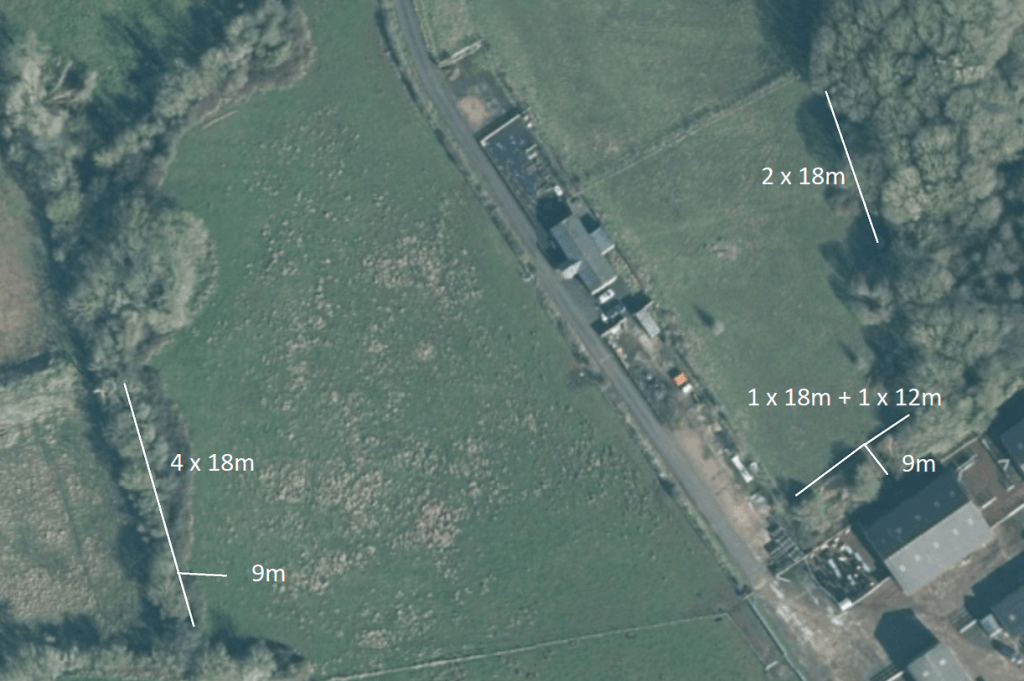
With the rest of this week looking horribly wet and windy going into the New Year, I decided to get out again today, the 27th December. Anna clearly hadn’t learnt her lesson as she joined me again this morning. We set up our usual nets around the feeding station (Forestry England have not banned their use, so I am maintaining feeding stations at Red Lodge, Webb’s Wood and Somerford Common, which I topped up after we closed up on Christmas Eve) plus two nets I haven’t used for some considerable time: a dog-legged 18m x 9m on two sides of a pond.

The + signs are the bird feeders.

This was a far more satisfying session. We met at 7:30 and had the nets up and open by about 8:30. The birds did not arrive straight away but, when they did, they came in decent numbers. We were busy pretty much from 9:00 until 11:30. Not only were the nets by the feeding station busy, but so was the dog-leg. I put a lure for Redwing on that net set and we caught anything but, until the final bird Anna took out of the net! The other nets had lures for Brambling, Lesser Redpoll and Siskin! Always an optimist! Having heard a Marsh Tit calling when topping up the feeders on Christmas Eve, I also put on a lure for that species. It did work: we retrapped one that we ringed earlier this year and caught an unringed bird that now sports a nice colour-combination so anyone seeing it can let me know:

I do get fairly regular reports to which I respond with the bird’s history, as far as I know it.

There were plenty of Blue Tits around the feeders, as one would expect, but overall there was reasonable variety of other species: although the only finch species we caught was a couple of Chaffinch. We ringed one, but the other looked as though it might be in the early stages of Fringilla papillomavirus. Its legs were not deformed but looked as though they had been coated in an off-white powder, so we released it unringed.

The list for the day was: Treecreeper 3; Blue Tit 15(7); Great Tit 1(1); Coal Tit 2(3); Marsh Tit 1(1); Long-tailed Tit 10(1); Wren 1; Dunnock (1); Robin (2); Redwing 1; Goldcrest 1(3); Chaffinch 1. Totals: 36 birds ringed from 10 species and 19 birds retrapped from 8 species, making 55 birds processed from 12 species.

I was extremely pleased with the results that we got from the dog-leg nets: the Treecreepers, seven of the Long-tailed Tits, the Goldcrests and the Redwing all came out of there.

As we were processing the last few birds it started to spit with rain. This was at 11:30, so we shut them, took down and left site just after midday, after a very pleasing session. Fortunately, it didn’t really start to rain hard until we had left site.

RSPCA Oak & Furrows Wildlife Rescue Centre

Following on from ringing a couple of birds at the Mere Falconry Centre (having being blown away at the chance to get up close and personal with a Peregrine Falcon), I have been lucky enough to be asked to ring birds at the RSPCA Oak & Furrows Wildlife Rescue Centre. It helped that the Centre Manager, Rachel, used to work for the Wiltshire Wildlife Trust, and came across my activities through that route.

So, my new project for 2023 is to ring the larger and more unusual birds that are brought into their centre (although I am writing this today because I have actually started this week). We have discussed how to proceed and agreed that I won’t ring the commoner small Passerine species. I have just notified the BTO of the project, and am waiting with bated breath to get stuck into the bureaucracy, to finalise the project details.

In the meanwhile, Rachel contacted me at the end of last week, as she has a number of birds almost ready for release. On Tuesday afternoon I went on site to ring a Tawny Owl and a Barn Owl. The Tawny was an eye-opener for me: it had arrived at the centre with a broken wing. They fixed it and the bird has fully recovered and was ready for release. I have always assumed that a broken wing would lead to the bird being euthanised. Clearly that is not the case. I was able to both age and sex the bird using the guide referred to at the end of this blog piece.

The Barn Owl had been found suffering from an infection that had affected its vision. It is coming to the end of its treatment, has already successfully flown without mishap and will be released soon. I could age and sex the bird based on its plumage. Female Barn Owls have black specks on the white underwing coverts. The number and size is variable, and males may have a few but they are few and tiny. This specimen was definitely female.

Today I was asked back to ring a couple of Buzzards: by the time I arrived there were four!

The first Buzzard that I ringed had been found on the ground in the Swindon area and was malnourished. Although it has no sign of physical injury, it is being fed up before release back into the wild. It is putting on weight, but it still needs to put on at least another 100g before it is released.

The middle two birds had been brought in each with one broken wing: one has healed completely and is capable of flight. It will be released very soon. The other’s wing is still splinted, but it is mending and expected to make a full recovery:

The fourth bird, the most recent arrival, has a hip displacement issue, but is in otherwise good health. It weighed in at a decent 1,050g, which identifies it as a female: males top out at a weight of 980g. It will be x-rayed tomorrow to establish what exactly the problem is.

All birds were capable of being aged, based on the pattern on their tail feathers using Jeff Baker’s guide. (Baker, J.: Identification of European Passerines – A BTO Guide, pp 192 -195). The two with broken wings were juveniles that fledged this year, the other two were adults.

I cannot understate how impressed I was with the work the staff at the centre are carrying out and how much they manage to achieve.

No Ringing: Something To Pass The Time: Saturday, 17th December 2022

Marsh Tits in the Braydon Forest

I was planning to go ringing at Somerford Common with Ellie this morning. It looked hopeful, with the forecast for a higher temperature than we have seen for over a week, and looking like our last chance before the wind and rain sweep in from tomorrow. We decided to start later, at 8:00, to give the birds time to wake up, warm up and get some feeding in before we started catching. I had filled up empty feeders on Monday, and they were empty again yesterday. Arriving on site this morning, they had already been reduced by one-third since 11:30 yesterday, so they are clearly being taken full advantage of.

I left home with the temperature at 0oC, but by the time I got to site it was down to -4oC and, after another 40 minutes, it was still -2oC, with no sign of the sun to warm the air. After this week of hard weather, we decided it would not be fair on the birds to set the nets and subject them to any additional stressor, no matter how small that stress might be. We had a good chat whilst waiting to see if the weather was going to warm up, and it was Ellie who first raised that we shouldn’t set the nets. Nice to know your trainees know what they are doing. So, rather than do nothing (or “household chores” as my wife refers to them), once I got home and thawed out, I decided to have a look at how things have been going with Marsh Tits in the Braydon Forest.

Since I got my C-permit and started ringing in the Braydon Forest mid 2012, I have been running a colour-ringing scheme across five sites. It has helped me to get a number of additional sightings from other local birders. However, the major contribution to the analysis has come from my team’s ringing activities. For the purpose of this analysis I have used ringing and recapture data only.

The first thing I looked at is, naturally, the numbers of Marsh Tits ringed by site by year:

Clearly it shows that the main sites for ringing Marsh Tits are Ravensroost Wood, Somerford Common and Red Lodge. They are three very different woodlands. Ravensroost comprises 40 hectares of primarily deciduous woodland. Of that 10 hectares is given over to an 8-year Hazel coppice cycle, with 4 coupes cut on two year rotations; 10 hectares given over to a 25-year coppice scheme, with the remainder being designated as ancient woodland. Somerford Common is more than twice the size of Ravensroost Wood, but over 50 hectares are given over to commercial conifer forestry, completely unsuitable for Marsh Tits. However, the eastern side of the complex is being returned to native deciduous trees and, as can be seen from the numbers, is as active as Ravensroost Wood. Coincidentally, since 2020, 10 hectares of this managed habitat is mulched on an 8-years cycle, in an attempt to encourage Marsh Fritillary butterflies. Red Lodge is an old commercial plantation, which is predominantly beech at the western end and oak at the eastern end. Our ringing is currently restricted to about 20 hectares of the beechwood area.

Webb’s Wood is a similar size to Somerford Common. It was clear felled soon after World War 2 and replanted by the Forestry Commission. It was previously split between a commercial conifer plantation and a commercial beechwood plantation. Most of the conifer has now been removed, with the land left boggy or planted with native species. During winter 2020 / 21 a major thinning of the beechwood was undertaken and there is very little under-storey. Bar two quite surprising years in 2017 and 2018, it has been a poor site for the species. Immediately north of Webb’s Wood, lies the Firs. This is the smallest woodland, at 11.5 hectares and is colloquially known as the “Braydon Bog”. This is because it sits on Oxford Clay and the lower reaches of the reserve are wet all year round. It was the first site that I ever ringed a Marsh Tit after I got my C-permit. It has a very mixed habitat only, unfortunately, this winter the owner has decided that all of the Ash has to be removed and that a lot of the Oak can be removed by way of payment, so it will be interesting to see what is left once I can get access again.

Giving the bald figures for numbers of birds caught can be misleading: it has to depend upon the amount of effort put into working at the site:

The reduction in the number of sessions in Ravensroost Wood was as a result of restrictions put in place following some issues after the Covid lockdown in 2020. Taking the effort into account enables you to get a more accurate picture of the number of birds ringed per session:

From this you can see quite clearly that the best performing sites for ringing Marsh Tits, in terms of effort expended are, Somerford Common and Red Lodge. The situation at Ravensroost Wood is actually reflected across all species for 2022: I have no idea what has depressed the catch in the wood. We might get another session in before year end.

Ringing them is one thing, but how many are being recaptured at each site. The crude figures are:

However, these can represent the same bird being caught multiple times, including those ringed that year. The best indication of how these sites are performing is to look at the number of individual birds caught. i.e. the number of birds ringed, plus birds from previous years recaptured and counted just once:

This, expressed as average number caught per session, shows:

The proportion of sessions in which Marsh Tits were caught is:

So, what does all of this mean: the catches are small but regular. Somerford Common and Red Lodge are the strongest sites for the bird, closely followed by Ravensroost Wood. I can’t help thinking that the performance for Ravensroost Wood has been adversely affected by the lack of activity in 2020 and the astonishingly low catches across the board in 2022.

I have had a look at the number of birds ringed in any particular year that have been caught in subsequent calendar years, i.e. those that have survived one or more winter period:

For a bird that, according to BTO BirdFacts, has a typical lifespan of just two years, that we have birds living to 3, 4 or 6 years is encouraging, especially when the survival rate for juveniles of the species in their first year is less than 20% (again, courtesy of BTO BirdFacts). However, the record age from date of ringing is 11 years and 3 months, set in 2015.

Of the two birds extant after 6 years had elapsed, D056930, it is one of only two Marsh Tits that has moved site. This bird was ringed in Webb’s Wood on the 2nd February 2013, recaptured in the Firs on the 21st April 2016, was subsequently caught again in Webb’s Wood on four more occasions, the last being the 15th February 2019: 6 years and 13 days after being ringed as age unknown. The distance moved is less than 700m, which fits with the proposition that Marsh Tits are highly sedentary. There was one other bird ringed that moved somewhat further: D983277, ringed on 13th June 2014 as a juvenile and retrapped in Red Lodge on the 24th January 2015, a distance of approximately 4km. Presumably this was a slightly longer juvenile dispersion.

The other long lived bird, D056635, was ringed, age unknown, in Ravensroost Wood on the 13th October 2012, and recaptured on 15 other occasions, the last being on 6th January 2018. It was only the third Marsh Tit I had ringed since getting my C-permit, and only the second in Ravensroost Wood.

Brief Encounter: Thursday, 15th December 2022

With this extended cold spell preventing any early morning ringing sessions, I have to admit to getting withdrawal symptoms. With it forecast to continue until Monday, when it is going to get wet and windy, it really doesn’t look as though we will get many opportunities for at least another week. So, when at 11:30 this morning the sun had melted the ice from the windscreen of my car, and unfrozen my nets, I decided to open them, on the off chance that some of the birds that have been gorging themselves on the sunflower hearts, peanuts and fat balls that they are clearing each day might just end up in the nets.

It was an interesting session, with the nets open for a few hours, until the sun disappeared behind the houses and things cooled down again. I started shutting the nets at 14:00 but two Blue Tits decided to fly in whilst I was doing so. I took the first one out at 14:10, processed it, released it, went back to the net to find another! This time I closed everything before processing it.

It was a reasonable catch given the situation, with just 2 x 3m nets and 1 x 6m. The nets are positioned around an apple tree, which sits atop a rockery, in which I hang the peanut feeder. Alongside it is a three pronged arch with two sunflower heart feeders and a fat ball feeder attached.

They are about 20m from the house, the other side of my pond. One thing that I have found is that many of the birds have got clever: the number of birds that went around the edges of the nets, or went through the gap in the join between the two three metre nets, would have doubled the size of the catch. I have taken down the nets to sanitise them, and will be changing the layout when they go back up! I will not be outsmarted by the birds! Firstly, I will replace the two 3m nets set at 45o with a single 6m, and take out the gap, and I plan to move the existing 6m net 1.5m to the west.

Everything has got far more complicated, and time consuming, with the latest BTO guidelines for avoiding the spread of avian flu. This is the requirement of the statutory authorities (DEFRA, Natural England etc) to allow bird ringing to continue whilst this pandemic is ongoing. This means sanitising nets and equipment in a way that we have never had to before: both in frequency and with anti-viral cleaning materials. Bird bags to be used just once per session and then put aside for cleaning. To be fair, the BTO have said that they will help with the purchase of additional equipment, like bird bags, whilst this is in force.

I understand that APHA have, finally, and about time, started logging incidences of H5N1 infections in wild bird populations. Currently there are no notified cases within 50 miles of my garden, but we still need to take all of the same precautions and restrictions just in case.

The list for today was: Blue Tit 3; Wren 1; Robin (2); Blackbird 2; Starling 1; Chaffinch 1; Goldfinch 10(1). Totals: 18 birds ringed from 6 species and 3 birds recaptured from 2 species, making 21 birds processed from 7 species.

What was frustrating about the session were the birds that got away: in particular was a Pied Wagtail. It spent the whole time I had the nets open flitting around the edges, under the bottom shelf and through the gap between the 3m nets. I have only caught one in my garden before, in January 2021.

Others to evade the nets were a Fieldfare, several Redwing, loads of Woodpigeon and plenty more Starlings. However, the most surprising thing to be seen today was a Snipe that flew past the nets and briefly landed by my neighbour’s pond.

Winter Ringing @ Blakehill Farm: Thursday, 8th December 2022

This morning was the first genuine winter’s morning of the year so far. With the night before showing signs of a hard frost, I was a little concerned that it might be too cold. At 6:30 it was -1o C but it was flat calm and actually felt warmer than recent days. I had arranged to meet Rosie at Blakehill Farm for 7:00. We arrived on site to a most glorious morning: the full moon started off silver, turning to yellow as the sun appeared over the horizon. At one point we had full sun due east and the full moon due west, and it looked fantastic.

Because it was cold our strategy was simple: few nets, increased checking frequency and luring only for larger species. We set two lines of 3 x 18m nets along the perimeter track and a 3 x 12m Mipit triangle in the usual position on the plateau:

We had the nets open by 7:45 and started catching pretty well straight away. The first catch was five Redwing and a Blackbird, the next another Blackbird, Redwing and a Wren. It was a good start. Then Rosie had to head off to work (counting trees in Ravensroost Wood) leaving me to carry on.

Unfortunately, the next hour produced just two Blue Tits and a Robin. I gave it another 30 minutes and two net rounds before deciding that the next round would be the last. As is often the case, that round was the best of the session, both in number and variety.

However, there was one major disappointment: not one Meadow Pipit hit the nets. In fact, the Mipit triangle didn’t catch a single bird of any species! Very disappointing, particularly given that the habitat seems perfect for them. For the last couple of years that part of the plateau has been lightly grazed by cattle (and Roe Deer) but otherwise left to its own devices. The insect numbers in the late summer and autumn are massive, and certainly coincided with the increased numbers caught there during the autumn migration / dispersal. There are plenty of weedy, seedy plants I think they have all decamped to Jonny’s sites at East Tytherton and Sutton Benger!

Anyway, the list for the day was: Blue Tit 2; Wren 2; Dunnock 1; Robin (2); Song Thrush 1; Redwing 9; Blackbird 2; Goldfinch 1; Reed Bunting 1(1). Totals: 19 birds ringed from 8 species and 3 birds retrapped from 2 species, making 22 birds processed from 9 species. Not the busiest session but thoroughly enjoyable.

Taking down was quick and easy, although the Dunnock did insert itself just as I started the take down process. I was off site by midday.

What is Happening in Ravensroost Wood? Saturday, 3rd December 2022

It was a cold and breezy morning, so Ravensroost Wood was the right choice for some sheltered net rides. This year the Wildlife Trust have banned the use of supplementary feeding at their sites, as a precaution against avian flu. On top of that, we have just had new directions from the BTO: we have to disinfect our equipment (all of our equipment: nets, bags, pliers, scales, clothing) between sessions. Each bag to be used just once per session: it’s a good job I have 80 or so bird bags!

To say that I have been worried about the drop off in catches at Ravensroost Wood is an understatement. Over the years it has been an excellent site for me. This is how the site is structured, with my various ringing areas marked up:

Area 1 is the most used part of the site. This winter the south east quadrant of that area is being coppiced, so I am avoiding it for now. Area 3 has been worked twice in the last two months: the first time delivered just two birds, the second delivered just three: which is remarkably poor for that area. I think that the issue is fairly simple: the trees have reached a height where the birds are flying over the nets rather than in to them.

Area 4 has been largely ignored since I took over ringing the site, as we were not allowed to take a vehicle down the path, and it was too much hard work to access the area, particularly when working solo. This year, with that restriction lifted, we did try a session there in October. Unfortunately, a few days before the session the volunteer group cleared the area around the pond, removing the cover needed for a successful mist netting session. I did not know until we arrived to set up and I felt it was too late to set up another set of rides. We caught just 14 birds.

My key project in the wood was covered by areas 1 and 2, as I monitored the effect of the coppicing on the distribution of birds in that area of the wood. Area 3 was used as the control site. The project lasted from 2013 to 2020 when Covid-19 disrupted the project, and negative interactions with a couple of members of the public made me decide I did not want to work in public areas. My plans for the wood going forward are to try out different areas and get a better map of the distribution of the birds within it.

I have done some analysis to see whether my concerns were justified:

As the chart shows, 2016 was the worst year for the wood. That was the result of awful weather in April and May, giving the titmice their worst breeding season since I started ringing Ravensroost and was able to monitor such things. That was repeated across my other sites, unlike this year where the others have performed as expected. Outside of that, both 2021 and 2022 are almost as bad: but without the dreadful weather as a reason. 2022’s figure is rather inflated by a single large catch of 101 birds at the feeding station in area 1 in January, otherwise things would have looked much worse. With no feeding stations set up at Wildlife Trust properties this winter, it will no doubt impact on catch sizes. It is, of course, possible that the tit and finch flocks will be larger, as they have to forage harder and further afield to find food. It is also possible that our catches at the Forestry England sites, where we continue to supplementary feed, might increase as the birds displace to those areas.

Saturday’s session was set up in area 2: along the two rides to the north of the 8-year coppice area:

I was joined by Anna and Rosie for the session and, later, by Laura and her family.

The area where we set up delivered the largest ever catch in Ravensroost Wood, almost 11 years ago to the day, on the 4th December 2011: 258 birds ringed and 59 retrapped from 18 species, including the only Lesser Spotted Woodpecker ever caught in the wood. There was a feeding station in place at the time, but you can always hope. As it was, the catch was pretty disappointing: Nuthatch 1; Blue Tit 2; Great Tit (1); Wren 1; Robin 2(1); Goldcrest 4(2). Totals 10 birds ringed from 5 species and 4 birds retrapped from 3 species, making 14 birds processed from 6 species. To be fair, throughout the coppice project this areas regularly produced the lowest catches, so it wasn’t too surprising that we weren’t inundated with birds.

Part of the issue was that it stayed cold all morning, although it wasn’t wet, it felt damp as well and, by the time we packed up early, at 11:00, we were all thoroughly cold, fairly disappointed and happy to go home.

West Wilts RG Results: November 2022

A small landmark achieved this month: we passed the 10,000 bird processed mark for the year for the first time since the group came into its current structure at the beginning of 2013.  Interestingly, it is already more than double in any year between 2013 and 2016 inclusive.  The majority of the catch, 60%, is down to Jonny’s activities. His sites seem remarkably consistent in their catch totals in the 50+ bird bracket.  Particularly Langford Lakes and his Sutton Benger, Melksham and East Tytherton sites.  I will do a full analysis at the end of the year.

So to November itself: fewer birds and species than 2021 but, apart from that, more than in any other previous November.

image.png

The key differences are in the lower numbers of Redwing (203 vs 320) and, to a lesser extent, Chiffchaff (4 vs 22).  There were increases in Long-tailed Tit (62 vs 49) and Goldfinch (60 vs 13).  The Goldfinch were largely down to Jonny’s East Tytherton site and my carrying out a couple of sessions in my garden.

The undoubted highlight has to be Jonny’s Merlin at the Sutton Benger complex I suppose it is now.  What an absolute stonker, the first ever ringed by the group, the only other two caught by members of the group being retrapped birds (Beckhampton 2003, Imber Ranges 2019).

Merlin.jpg

 Hard on the heels of that, though, has to be Jonny’s retrapped Redwing, again at his Sutton Benger site.  Ringed in Finland: it is the group’s only foreign recovery of this species since 1996!  In all there have only been five recovery records: as well as these two, two were ringed and then retrapped a week or so later in the same site, so that doesn’t really count. Another was ringed in Ravensroost in December 2016 and retrapped there, in the same net, in January 2018.  Our only other recovery was a Redwing ringed at Lower Moor Farm in October 2015 and shot by some psycho in  France in December 2017.

Another good catch was Ian’s three Fieldfare in an old orchard local to him.  Andy also caught one at his site on the Imber Ranges SPTA.  Andy’s site there has caught most of them: with 16 of the 23 caught. Two were caught at Jonny’s Sutton Benger site and I have had two: one in a Meadow Pipit triangle at Blakehill and another way back in 2014 at the Wood Lane site.  We don’t catch many, that’s for sure.  The only thrush that we catch fewer of, of those we catch (no Ring Ouzel records at all for the group at any time in our history in DemOn – I don’t know if there were any records on paper that haven’t been digitised yet), is Mistle Thrush – and I am only bringing that up because of the four we have ringed, I have done the lot!

It will be interesting to see how December shapes up: hopefully the fog will lift sometime soon!

Brown’s Farm: Wednesday, 30th November 2022

It is eight months since I last managed a session at Brown’s Farm. Once I recovered from the spinal surgery and the subsequent rehabilitation, the weather has just not been conducive to running a ringing session there. Brown’s Farm is at the top of Postern Hill,. south of Marlborough, and is even more exposed to any wind than Blakehill Farm (and that is bad enough).

It is the only site that I have that is a beef and arable farm: the only site where I can regularly catch Yellowhammer and Linnet. I was joined this morning by Rosie and, for once, by using up some of her TOIL (time off in lieu), she could stay for nearly the entire session. I was hoping that we could catch some Linnets, as Rosie hasn’t had the pleasure of extracting or ringing them yet. We met in the farmyard at 7:00, leaving Rosie’s car there, as access to the ringing area requires a 4×4 with decent ride clearance – and there is no point in getting both cars filthy!

We set three lines of net, each comprising 3 x 18m nets. Two were set on the leeward side of the hedgerow, with the third more or less at right-angles:

The ringing station was set just adjacent to the net rides. Like yesterday, the weather was misty and dull, but not quite as damp. Unfortunately, like yesterday, there were few birds hitting the nets at first. Unlike yesterday, there were large flocks flying around: Redwing, Starling and Linnet in the main.

A Wren got up to one of their usual tricks: flying into a net as we were still setting it up. They can be awkward enough at the best of times. Fortunately, I got to it before it had managed to bundle up lots of net, spin, crawl through into another pocket and extracted it without issue. We finished setting up just before 8:00. The first round, at 8:15, produced two Yellowhammer and a male Bullfinch out of the hedgerow nets. These were the only birds that came from those nets until we caught another three at 11:00.

The second round produced five birds, including two Blue Tits. I have always thought of Blue Tits as woodland and garden birds, but they are regularly caught here and also at Blakehill. At Blakehill they are not just found in the hedgerows but regularly out on the plateau.

After that round things fell off, with just four birds in the next two hours. We decided that, if the 11:00 round was as bad, we would cut our losses and shut the nets. Naturally, it then produced ten birds: a flock of House Sparrows hit the nets. Most bounced off, but six of them stuck. All were male. As previously mentioned, another three Yellowhammer came out of the hedgerow nets. Like the House Sparrows, all male.

The following round produced two Starling: which gave Rosie her first extraction and ringing record for that species.

That was Rosie’s last contribution to the session, as she had to head off to work. As luck would have it, having dropped Rosie back at her car and headed back to the ringing site, the next bird I took out of the net was a Linnet!

A couple more Blue Tits and a Wren finished the session and I took down and left site at just after 13:30.

The list for the session was: Blue Tit 8; Wren 2; Dunnock 2(2); Robin (2); Chaffinch 1; Linnet 1; Bullfinch 1; House Sparrow 9; Starling 2; Yellowhammer 5. Totals: 31 birds ringed from 9 species and 4 birds retrapped from 2 species, making a total of 35 birds processed from 10 species.

Misty, Murky Conditions: Tuesday, 29th November 2022

With a couple of days of low / no wind forecast I have decided upon a trip to Brown’s Farm for Wednesday, but thought I would open the garden nets this morning. It was one of those days that just never got beyond dank and dismal. The mist hung around all day and certainly impacted on the catch: although I still managed to catch far more than in my last two visits to Ravensroost Woods (combined).

I opened the nets at 8:00 and started to catch pretty well straight away. However, it worked out at two birds every 20 minutes or so before I shut the nets before lunchtime, to give everything a chance to feed unmolested for the rest of the day. It wasn’t the most exciting list: Blue Tit 6(1); Great Tit 1; Starling 1; Goldfinch 8(1). Totals: 16 birds ringed from 4 species and 2 birds retrapped from 2 species, making 18 birds processed from 4 species. This compares with 29 (19 ringed, 10 retraps) in better weather back on the 14th November.

Here’s hoping for a better haul tomorrow – although the weather is looking somewhat similar to today’s!

Somerford Common: Saturday, 26th November 2022

Wow! Out two days running: I haven’t done that for a long time. Unlike yesterday’s at Red Lodge, moved from Wednesday, this session was scheduled for today. I was joined by David and Anna for the full session, and Rosie came along to help set up and ring some birds before heading off to her work at the Trust (those trees won’t survey themselves!) just before 9:00. We met at 7:00 and set just the five nets used last time.

Whilst we were setting up, we were joined by another Simon. He is the professional deer stalking contractor for the local Forestry England. His concern was that we were on site and he hadn’t known. I know I change my sessions when the weather dictates, but this session was pre-booked with Forestry England, so there must have been a bit of a communications breakdown. Personally I am confident that he can tell the difference between me and a Roe Deer or Muntjac! I just made it clear where we would be working and he made sure he avoided the area. I wouldn’t have said “No” to the offer of some free-range venison!

Just as we were finishing setting the nets, we were joined by Laura and her sons, Daniel and Adam. They were gradually incorporated into the ringing regime: started off by releasing birds that had been processed, then graduated to taking wing lengths and, finally, ringing some birds, ageing and sexing them, where possible, taking the biometrics. Hopefully, two new ringers in the making.

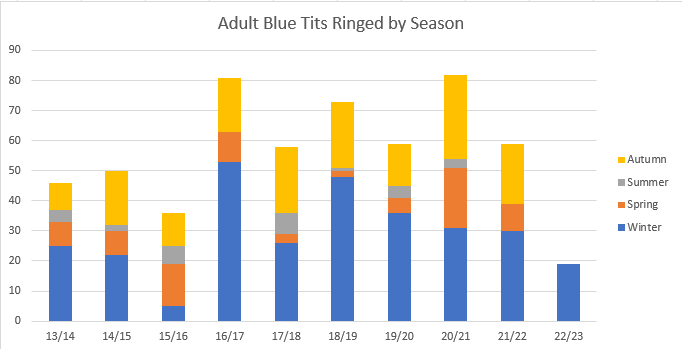
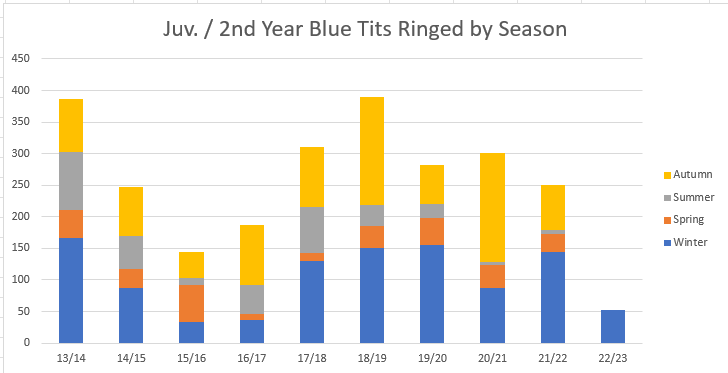
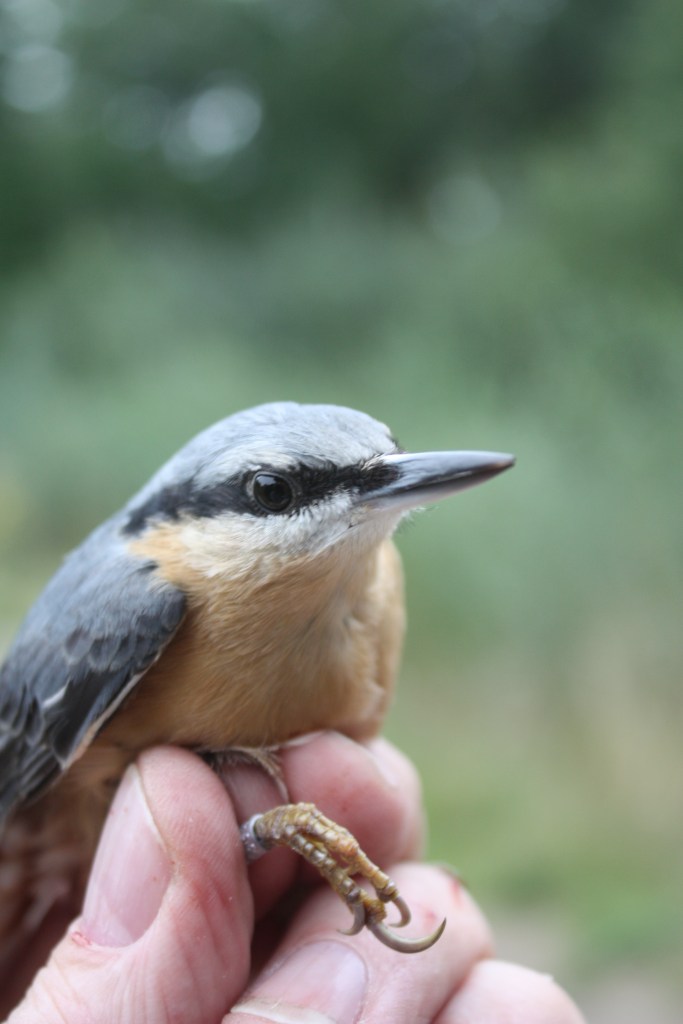
The first round, at 8:00, was the busiest of the day and, as expected, was Blue Tit heavy. In fact, we caught just under 50% of the day’s Blue Tits in that round (11 of 25). So, although that was a hard start to the session, it did mean that there were fewer sore fingers throughout the rest of the morning. For those of you who aren’t ringers, and aren’t aware of the nature of Blue Tits, they have two defining characteristics: firstly, they will grab huge swathes of the net with beak and claw, making them difficult to extract; secondly, they do not stop pecking at any point in the extraction or handling process. The only saving grace is that they are small: so their feistiness is irritating rather than damaging. It was also gratifying, after a five month drought broken yesterday, to catch and ring another Nuthatch. We also caught another new juvenile Marsh Tit in that round, caught a second later in the session, along with retrapping another 3 throughout the morning. This takes the total of Marsh Tits ringed in the Braydon Forest so far this year to 16, which is two more than in the whole of last year, and despite minimal bird ringing in Ravensroost Woods, the usual stronghold for the species in the Forest, so far this year.

There were several other highlights: after the complete failure to lure in any Redwing last time, in contrast to the good numbers caught at this period last year, it was pleasing to catch four of them this time. At 10:30, once things had warmed up a bit, we changed the lure to Goldcrest, which didn’t produce the same numbers as last time but our penultimate round at 11:00 produced three Goldcrest and two Long-tailed Tit in that net set.

At 9:30 we retrapped a female Great Spotted Woodpecker, ignoring the two caught in my garden, it is the first in the Braydon Forest woodlands since 5th March of this year. In the final round we caught a new male Great Spotted Woodpecker: again, the first ringed in the Forest since 5th March. This bird was well embedded in the net and both David and Anna were uncomfortable at trying to extract its wings, as it was in the double-angel position. I have one key rule on extracting for my trainees: if in doubt, give me a shout. They did, so I took it over. My two forefingers are now sporting the painful pin-prick indentations of the results of that extraction: give me a Blue Tit any day!

The other highlight has to be the three Chaffinch: all males, one juvenile and two adults. All had perfectly clean legs and so they were ringed. Our list for the day was: Great Spotted Woodpecker 1(1); Nuthatch 1(1); Blue Tit 12(13); Great Tit 6(6); Coal Tit (5); Marsh Tit 2(3); Long-tailed Tit 2; Wren 1; Redwing 4; Goldcrest 3(1); Chaffinch 3. Totals: 35 birds ringed from 10 species and 30 birds retrapped from 7 species, making 65 birds processed from 11 species.

One of the benefits of setting so few nets is that packing away is quick and easy. With the breeze getting up, we closed the nets as we did the final round at 11:45. Having processed the last haul, ironically, the second largest of the day, with 12 birds, we then took down. It was too windy by then to have left the nets open any longer. The last net set, the 18m + 9m along the main path, had already become entangled in the Blackthorn and Oak that they were set alongside, so that took a little longer to get down than the others. Even so, we were away just after 12:30.