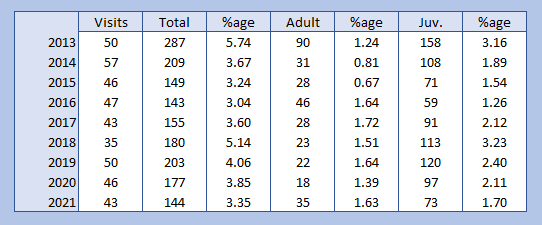
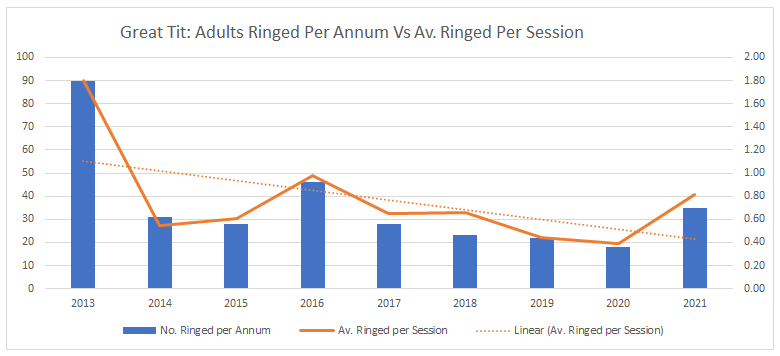
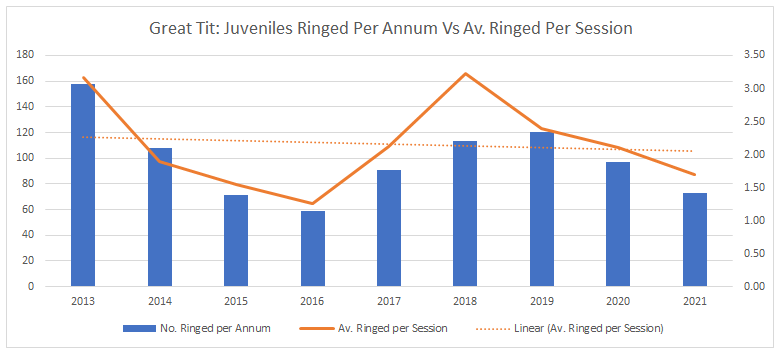
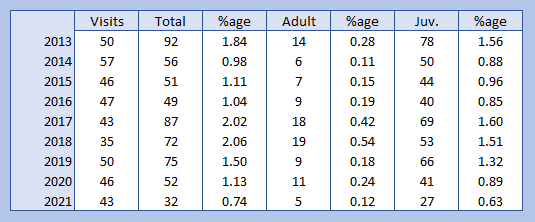
One of the things that we have noticed this year is that, during September, there has been a huge sexual imbalance in the number of migrating Blackcaps. So I had a look at the numbers in the Braydon Forest and at Lower Moor Farm in September over the years that I have been ringing there. These are the results:
We don’t work anywhere that could be described as a migration hotspot, so we don’t get huge numbers either in the spring or the autumn. The team has processed 2190 in the 11 years since I started operating at these two site groupings: 199 per annum, one sixth of which are processed in September.
My trainee, David Williams, just happens to be a very clever individual with a first class honours degree in Zoology (I only managed a 2:1) and he had a look at the Blackcap data and did some statistical analysis on it. We don’t have thousands of entries, but we have more than l’Oreal usually claim for their adverts. Anyway, I don’t pretend to understand it all, but this is what David came back with:
Overall, the observed numbers of female (122) and male (213) Blackcaps were significantly different from those expected under the hypothesis that both sexes are equally likely (chi-square goodness of fit test with Yates’ correction: χ2 = 24.179, d.f. = 1, N = 335, p < 0.001).
By year, there is considerable variation: in some years (e.g., 2018 and 2019), there are about equal numbers of each sex, but in others (e.g., 2021, 2022) there are more than twice as many males as females.
In 2021 and 2022, the observed numbers of female and male Blackcaps were significantly different from those expected under the hypothesis that both sexes are equally likely (chi-square goodness of fit tests with Yates’ correction, d.f. = 1 in all cases):
The mean (± 95 % confidence interval) numbers of female and male Blackcaps processed each September were significantly different from each other (paired samples t-test: t = 2.842, d.f. = 10, p = 0.017).
Back to my thoughts: essentially, over the last three years the sexual imbalance in the catch of Blackcaps moving through the Braydon Forest and Lower Moor Farm in September has become significant. What the reason for that is I don’t have any idea.
I had to cancel this morning’s scheduled session at Red Lodge because the forecasts (all three that I use: Meteo, Met Office and xcweather) were for rain for the morning, until gone 9:00. I had David and Anna lined up to help this morning, but it wouldn’t be right to bring them over for just an hour or so ringing, which is what we would likely to have had after we had set the nets, so I cancelled.
Without an alarm set, I woke at 9:30. The rain had recently finished, there was a clear blue sky and it was virtually windless. Whilst preparing breakfast, and looking out of the kitchen window, I couldn’t help but notice that there were a goodly number of Goldfinch visiting the feeders so, over breakfast, I decided I would open the three nets I have furled in the garden. They were opened just after 11:00 and, naturally, all of the birds disappeared.
The first bird out of the net was an adult female Chaffinch at 11:30. As I had 3 hours of recorded football to watch, I decided to leave the nets open, checking them every 10 to 15 minutes and processing anything that came along. It was never hugely busy, but over the course of the next four hours I managed to get through all of the football and a further 24 birds.
Of the 25 Woodpigeon that I have ringed before today since I was able to work on my own recognisance, 19 have been in my garden. Today I caught and ringed the 20th:
Woodpigeon, Columba palumbus
The fact is that I never target them: they just occasionally blunder into my nets. They have incredibly strong flight muscles and holding them still to process them takes effort.
The list for the day was: Woodpigeon [1]; Blue Tit 1; Dunnock [1]; Chaffinch 1; Goldfinch [20](1). Totals: 2 adult birds ringed from 2 species, 22 juveniles ringed from 3 species and 1 retrapped bird, making 25 birds processed from 5 species.
To be honest, I would have continued for longer, but I committed the cardinal sin of bird ringing: I ran out of A-rings. These are the commonest used rings for every day ringing. I knew that I was running out, so I ordered another 500 last Thursday: hopefully they will arrive before the next scheduled session, next Thursday.
It has been an age since I made my way into one of the Forestry England woodlands. After not getting out on Wednesday, not that I am complaining about spending time in the garden, I wanted to get into the woods. As I was going to be working solo, I decided that Webb’s Wood would be the best bet: flat and far enough away from the entrance to minimise contact with the general public: not that that has been an issue at Webb’s Wood.
The forecast for the day was that it would be dry with little wind until 11:30, when the wind would start to build, with gales by 16:00. Rain was supposed to arrive mid-afternoon, building up overnight into Saturday. So I decided I would ring until 11:00 and take down then.
I arrived on site for 6:30 only to find that I had managed to leave my guy ropes at home. It is one of those things that your younger self puts down to a moment of stupidity but when you are approaching 70 you start to worry about senility. Fortunately, it is only 10 minutes from my house to the site, so I was back on site just before 7:00 with the nets open by about 7:50.
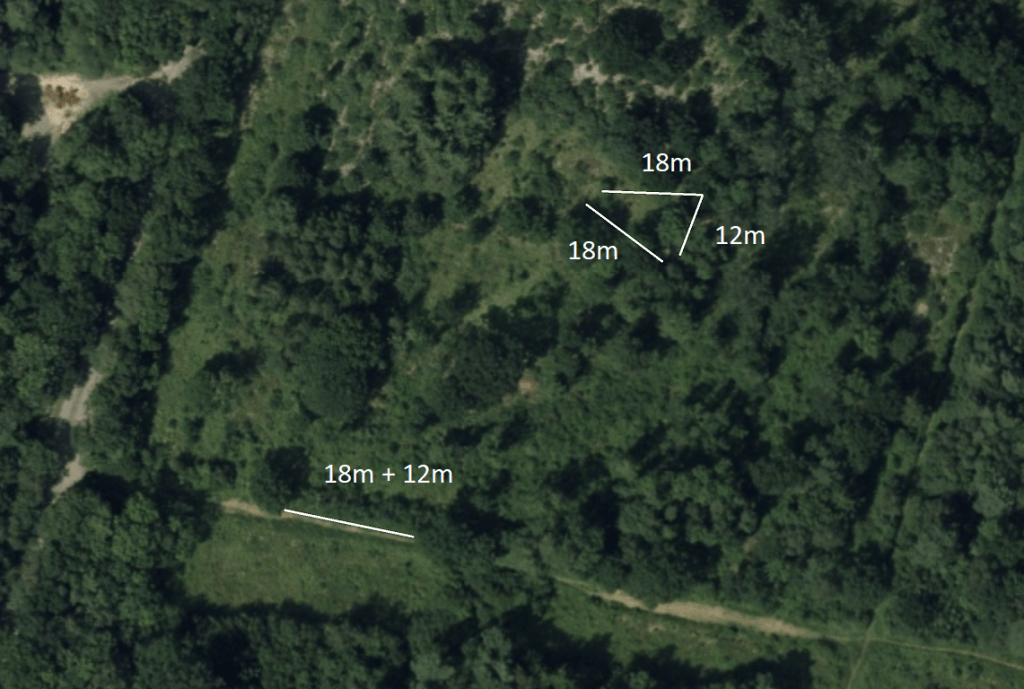
I set just three net rides:
I put on lures for Blackcap, Lesser Redpoll and Siskin just in case. We have caught all three species at this time of year in the Braydon Forest, so I was just trying it on. The only one that delivered was Blackcap, with a single juvenile male caught. Later, at 10:00, I put on a lure for Goldcrest and got immediate results.
The first round was surprising: a small flock of five Great Tit flew in and hit the two net sets forming the open triangle. This round also delivered our single retrap, an adult male Goldcrest, and the Blackcap.
Over the next couple of hours I caught small numbers on most rounds ending up with 24 birds by the time I closed the nets at 11:00. The totals for the session were: Treecreeper 1; Great Tit 2[7]; Marsh Tit [1]; Wren [1]; Robin [1]; Blackcap [1]; Chiffchaff [1]; Goldcrest [8](1). Totals: 3 adults ringed from 2 species, 20 juveniles ringed from 7 species and 1 bird retrapped, making 24 birds processed from 8 species.
The Blackcap and the Chiffchaff were the only clear and obvious autumn migrants. However, four of the Goldcrests weighed in at less than 5 grams. Perhaps they were new arrivals who have used up fat coming to Wiltshire? As they weren’t ringed before I caught them, we will never know.
As much as I enjoyed catching the Goldcrests, my highlight was a new Marsh Tit. For whatever reason, Webb’s Wood has been the least successful site for catching Marsh Tits within the woodlands of the Braydon Forest. Apart from 2017 & 2018, with 6 ringed in each year, in the other 8 years, 5 returned a single new bird and 3 returned 2 new birds, averaging out at 2.3 per annum. Somerford Common returns 5 new birds per annum on average, Red Lodge 4.5 per annum and Ravensroost over 10 per annum.
Juvenile Marsh Tit, Poecile palustris, showing appreciation for its new bling
For anyone birding in Webb’s Wood, this bird has a metal ring above a black ring on the left leg and a yellow ring above a grey one on the right leg. If you see it, please let me know through the blog feedback.
A while ago I put up a photo showing the teardrop markings on the primary covert tips of a juvenile Treecreeper. Today we caught an adult:
Adult Treecreeper, Certhia familiaris
To give a comparison, I photographed the wing of the adult and am going to post the picture of the juvenile wing again for comparison:
Adult Treecreeper wingJuvenile Treecreeper wing
The difference should be visible through binoculars.
As forecast, the wind started to pick up just after 11:00, so I started to shut the nets. A few “tail-end Charlies” (two Goldcrest and the Wren) held up the take down whilst I processed them, but everything was down and packed away by 12:30. As I am sitting here writing this it is blowing an absolute hooley outside and throwing it down with rain: that’s one forecast they got right.
With my usual midweek stalwart, Miranda, otherwise engaged, and Rosie on holiday in Cornwall, I was in two minds about how to organise my ringing for today. However, my mind was made up by the fact that, to top off the horrible end to yesterday’s Barn Owl session, I contrived to have a nasty fall and damage my knee as we left that site, making it painful to walk. I decided to open the nets in the garden again, having been encouraged by the last session there.
Unfortunately, my wife decided to pop out to nearby Wootton Bassett and I forgot that my ringing box was in the back of the car until 30 seconds after she had disappeared off to the shops. So I had to wait for her to return. In the end, I opened my nets at 11:00. I was not overly confident of catching many birds, having missed the morning rush, but decided to give it a go regardless.
No surprises to start with: a small group of Blue Tits, a Goldfinch, a Great Tit and a Dunnock were the first birds into the nets. Thereafter, I had repeats of these in differing numbers throughout the day. I shut the nets over lunch and then shut them completely at 17:00 in time for dinner.
Towards the end of the afternoon I heard a Chaffinch calling in the garden. They are uncommon in my garden catches: with just 23 processed in the last 10 years. Although it didn’t get caught straight away, two rounds after hearing it, it did get caught in one of the nets. It was a healthy juvenile female (no sign of mites / Fringilla papillomavirus or Trichomonosis):
Juvenile female Chaffinch, Fringilla coelebs
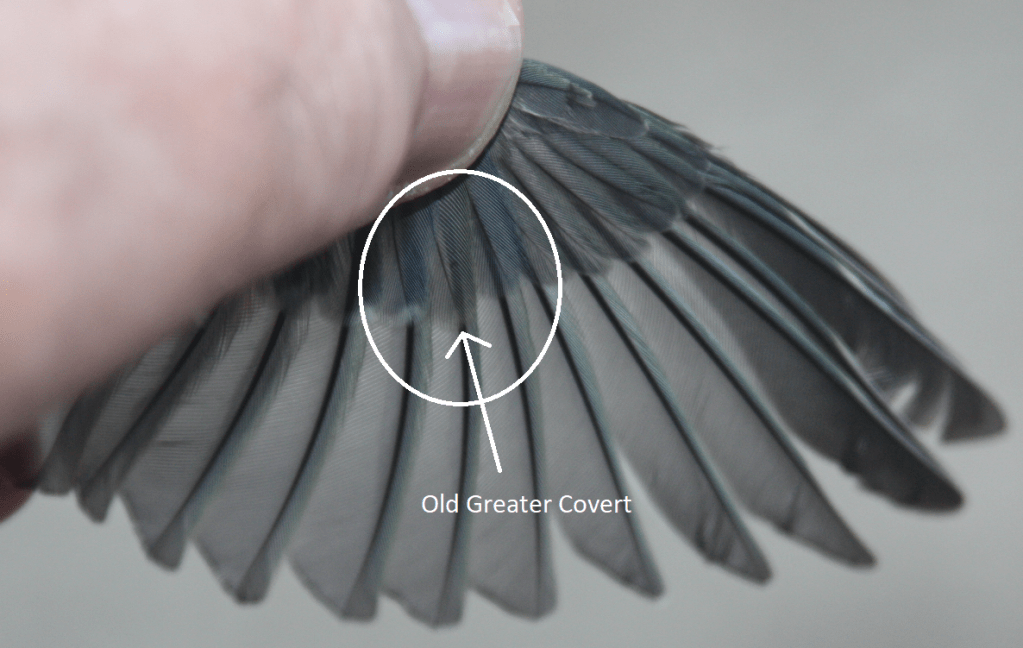
If you look at the wing you can clearly see the retained greater covert that helps identify it as a juvenile. What you can’t see are the narrow, very pointed central tail feathers, which are also diagnostic of a juvenile.
The last bird out of the nets today, extracted at 16:45, was this:
Juvenile Chiffchaff, Phylloscopus collybita
A key feature of juvenile Chiffchaffs, which you can see on this photo, are what my old trainer referred to as “rivers of yellow” running down the breast to the belly. This is only the third Chiffchaff I have ever caught in my garden, so I was extremely pleased with this final bird of the day.
The list for the session was: Blue Tit 3[8]; Great Tit [3]; Dunnock [2]; Robin (1); Chiffchaff [1]; Goldfinch [13](2). Totals: 3 adults ringed from 1 species, 27 juveniles ringed from 5 species and 3 birds retrapped from 2 species, making 33 birds processed from 6 species.
Last week local photographer Chris Snook volunteered to help me out with checking and cleaning out some of my Barn Owl boxes. We had a decent session: the four boxes around Upper Waterhay showed that the new box is being used as a roost site, the chancel box was being used by Jackdaws back in June, but hasn’t been used since. The other two boxes have fledged 5 young between them. Unfortunately for it, the smallest youngster in a box of 4 became food for its siblings.
After Waterhay we went to the Wiltshire Wildlife Trust reserve at Blakehill Farm. The box nearest the farm buildings was, unusually, empty and had not been used as a roost. When putting the ladder up to check the other box, in the Allotment Field, a Barn Owl flew out and away. What was astonishing about that was that, when I opened the box, it was filled from top to bottom with Jackdaw nesting material. I suppose that wasn’t that surprising, given that we ringed 3 Jackdaw young in that nest back at the end of May, what was surprising was that the owl had chosen to roost in there, given how full of twigs it was: it really was crammed full to the top.
So to today. We started at Drill Farm: box 1 had an active wasp’s nest, with plenty of wasp activity around it so, as it was empty when we did our first checks, I decided I didn’t need to find out what else might be in there. Box 2 was hosting a fledged Barn Owl. It flew off as we put the ladder up to check. The box had been empty when we first checked it, and there was sign of recent roosting (fresh pellets) but a possible explanation of why it didn’t have any owls nesting this year was the hornet’s nest in the top right corner of the box and the multiple dead hornets on the floor of the box.
The box at Echo Lodge was empty and the box at Home Farm showed that three of the four youngsters had successfully fledged. Unfortunately, we found bits of the fourth in the nest:
Photo courtesy of Chris Snook
No doubt, as at Waterhay, it had helped feed its siblings. They had, thoughtfully, left behind the leg with the ring attached. Moving on to the Somerford Farm area, we found that the birds in box 1 had fledged successfully, with one bird flying off as I was setting up the ladder. Chris finally managed to get some shots of a Barn Owl in flight. Unfortunately, the bird flying out from dark into sunshine, resulted in them being somewhat overexposed and not suitable for publication. The upside for me is that he will have to keep helping me out so he can finally get the record shots.
Box 2 was full of Jackdaw material. Although we didn’t ring any there this year, last year it was a successful nest for Jackdaws. As I started to remove their nesting material from this year, I came across the most beautiful, perfectly domed hornet’s net. Not only perfectly formed but very active and several hornets decided to investigate this intruder. Again, discretion, rather than valour, was the order of the day, and I beat a hasty retreat rather than hang around to get a photo.
Then we came to the horror story that overshadowed the entire session. Arriving at Plain Farm, where we had ringed three young back in June, we were greeted by an excellent flock of Chaffinches feeding around the calves that were in the field adjacent to their holding pens. There must have been at least 30 of them, and it is certainly the biggest flock that I have seen for at least a decade. Chris and I carried the ladder down to inspect the box, accompanied for much of the walk by the calves. As we got about 10m from the box, I noticed a white patch on the ground, about 15m away from it. Then there was another about 5m from the box. The recovered rings showed that they were two of the young from that box. Each had been stripped of its flesh, with the wings left attached to the spine, both heads were missing. Examining the carcasses, both had their flight feathers fully grown, and the birds were certainly capable of flight. Given the positions away from the box, I suggest that their predator was avian: either female Sparrowhawk or, possibly, Goshawk. Unfortunately, when I opened the box the remains of the third bird in that brood was found in pieces inside. A thoroughly depressing end to the morning. A slight upturn on the way out: another local farmer was on site and approached for a chat. His farm is about a mile away, close to Red Lodge, and he asked if we would be able to put a box up at his site. I shall look forward to doing so, and Chris has offered to help me.
This year we ringed 20 Barn Owl chicks in 7 occupied boxes. With one box, Avis Meadows, having 2 chicks and 2 eggs predated between the first and second visits (May and end of June), we have recorded 15 Barn Owls fledged and 7 predated for 2022. Also in the boxes, we have ringed, and have had fledge, 3 Jackdaws in 1 box and 3 Stock Doves in 2 boxes. Of the 7 other boxes checked this year, 3 had roosting Barn Owls, 1 had roosting Stock Dove and 3 were empty. Not quite as good as last year but still not bad (and I do have 2 boxes left to check).
On Saturday, 22nd September 2021 I held one of my best ringing demonstrations: the second of two held in short order at Lower Moor Farm. The second was held because the first was sold out instantly and could have been sold out twice over. The Swindon Wildlife Group asked if I was happy to do a second demo for them and the rest is history. We processed 80 birds that day, including a Kestrel and a Kingfisher. So, when I was thinking about where to go this weekend, I noticed the coincidence of dates and decided to head back to Lower Moor Farm.
I arranged a 6:30 start with David only, having awoken at 5:30, I was on site by just after 6:00 and started getting the nets set up. David arrived on time, and we had the nets set and open by 7:15. We only set the nets for our CES rides 2, 4 and 5, as I didn’t want us to be overloaded with just two of us extracting and processing. I had decided, from discussions with, and posts from, other ringers on Facebook, to lure for Blackcap. As I went to set up the lures, we found the first birds had been caught, and the first bird out of the nets was:
As I was walking back to the ringing station, I noticed a photographer paying attention to our nets. I started chatting and I asked him what he was hoping for. His answer was Kingfisher, so I told him he was in luck as I had one in the bag. That is his photo above: a juvenile female. Sean (didn’t get his second name, so British) stayed with us for the next couple of hours and took a lot of photos.
Attending the aforementioned ringing demonstration was a family group: Claire, with her son, Samuel, and daughter Zara. They had to leave before we had packed up the nets, and so missed the Kingfisher we caught at the end of the session. Subsequently Claire contacted me and asked if she and the children could come along to some other sessions. Of course, I agreed, and they have joined me on a number of occasions since. Unfortunately, most they have been able to make seems to have been at Ravensroost Woods, rather limiting their experience. Fortunately, they were able to make this anniversary session. Disappointingly for them, they arrived at 8:00, after we had processed and released the Kingfisher. One day!!
What with my ringing being restricted recently and other issues, it has been quite a while since Claire and co could join me again, so we took it slowly, reintroducing them to safely handling the birds. Zara is just eight-years old, and her handling skills are already excellent. All ringers know that Bullfinches will, on occasion, sit on your hand for quite a long time after you have released them. However, with Zara many species seem to like sitting in the palm of her hand after release. I have never seen anyone else with whom that happens. Later on in the session, I showed Zara how to take wing measurements. She then proceeded to “check” David’s wing measurements, with me being the final arbiter. I think it ended up 3-2 to Zara, much to David’s amusement / chagrin. There was only ever 1mm in it but fun for me, and ammunition to embarrass my (excellent) trainee for the foreseeable future. I have promised Zara that I will start her on her ringing career next time they can make a session. Start them young!
As expected, we had a good haul of Blackcaps. What was interesting was the sex imbalance. Of the 27 caught 22 were male. I really must check previous years and see if this is a common phenomenon.
A little less expectedly, at 10:50 we also caught a nice little flock of Long-tailed Tits. We are getting to that time of year when the Long-tailed Tits that fledged this year have completed their post-fledging moult and are now indistinguishable from adult birds, so in my list they are identified as age unknown. The actual list for the day was: Kingfisher [1]; Blue Tit [2]; Great Tit [3](3); Long-tailed Tit 7(1); Wren [2](1); Dunnock [2](2); Robin (2); Song Thrush (1); Cetti’s Warbler (1); Blackcap [26](1). Totals: 7 birds, age unknown, from 1 species; 36 juvenile birds from 6 species and 12 birds retrapped from 8 species, making 55 birds processed from 10 species.
One other bird that Sean mentioned he would love to get to photograph was Green Woodpecker. As I have blogged before, Lower Moor Farm is my most successful site for catching Green Woodpecker. Of the 20 caught in one of my sessions, 16 of them have been at Lower Moor Farm. During the same round that the Long-tailed Tit flock landed we caught a Green Woodpecker. Well, it landed in the net and sat there for a short while but, as soon as Zara said it was in the net and I made a move to extract it, it twisted itself round and got away!! You can’t win them all.
The one bird I actually felt sorry for in the session was the recaptured Song Thrush. I couldn’t help noticing that the head feathers above the cere were matted and had a huge, almost broad bean sized growth. As I took it out of the net the growth and some of the matted feathers came adrift. I collected it and took it back to the ringing station for a further look. It was the largest tick I have ever seen. So bloated with Song Thrush blood that it was huge and, I suspect, naturally disengaged from the bird as I was extracting it.
We closed the nets at 11:30, with David’s dad, Trevor, turning up in time to help us clear away. With just nine nets up it took very little time, and everything was packed away by about 30 minutes later. I actually stayed and watched and listened for another 45 minutes, just enjoying the place and the wildlife and chatting to some of the photographers.
On the 22nd November 2015 we caught and ringed a Goldcrest in Ravensroost Woods. On the 8th March 2021 this bird was recovered by another ringer on St Mary’s in the Scilly Isles. Although I blogged about it at the time, it was not confirmed until the BTO published the 2021 ringing & nest recording report. This was published on the 30th August 2022 and the BTO have confirmed that this is the longevity record for this species. One would have suspected that it would need to be something of a hero to have endured so long, migrating each year, covering goodness knows how many miles in the process. This is the record from the BTO site:
I spent yesterday morning checking and cleaning out Barn Owl boxes at Upper Waterhay Farm and Blakehill Farm, accompanied by local birder / photographer Chris Snook. Chris was hoping to get some photos of Barnies and, whilst he didn’t get any photos of them, he did get to see some. Better still, he got a fantastic picture of a juvenile Swallow being fed by an adult:
As we drove onto the site, we couldn’t help but notice Stonechat popping up at regular intervals. On our way back from checking the boxes where, annoyingly, I didn’t take my hand-net to the box in Allotment Field. Annoyingly because I thought, having seen it full of Jackdaw nesting material over the breeding season, that there would be nothing in the box, only for a Barn Owl to fly out as soon as I got the ladder against the tree. So, on the way back we stopped to look at the Stonechat and were surprised to see so many of them. My estimate is that there were at least 10.
I have never tried ringing birds in that area of the site, but the Stonechats were a big draw. We set nets in the area where the Wildlife Trust trialled seeding the area with weedy, seedy plants, which did not work out and has reverted to a lot of thistle and ragwort in the main area and the blackthorn is spreading in from the Blackthorn in the hedgerow. The area in question is the paler area in the diagram below, in which all of the nets were set, except the Mipit triangle:
This area fits between my regular ringing sites at Blakehill. The Chelworth Industrial Estate side is the main area, followed by the fields and ponds adjacent to the Whitworth building, as shown in the diagram below:
In an effort to attract in the birds we had come for, I set lures for Stonechat on every one of the four nets in the trial plot area and, unsurprisingly, put Meadow Pipit on in the middle of the Mipit triangle.
I was joined by Miranda and Rosie, doing her usual, helping set up, ringing a few birds and then heading off to work. As we drove down to where we were going to set up, there was at least twenty Skylark on the track. Perhaps I should get there earlier and try some dazzling for these birds of which I have only ever caught one previously.
The first birds into the nets landed in the 5-shelf 18m net: a Chiffchaff and a Great Tit. Whilst Rosie processed those, Miranda went and took the first few Meadow Pipits out of the triangle and our first Stonechat of the morning, a juvenile female:
Juvenile female Stonechat, Saxicola rubicola
We caught two juvenile females, neither of which responded to their lure, but which were caught in the Mipit triangle. I suppose it is possible that they are actually migrating with the Meadow Pipits.
The nets in the trial area were disappointing, with one caveat. The 9m net caught nothing, the 18m 5-shelf caught just four birds, one of which was a same day retrap. Next to that the 18m 2-shelf caught nothing and the furthest away 18m 2-shelf caught just one bird: another Meadow Pipit. Having said that: this Meadow Pipit was an adult that was ringed elsewhere in August 2020. I am looking forward to finding out where it has come from.
The list for the day was: Great Tit [1]; Wren [1]; Meadow Pipit 2[27](1); Stonechat [2]; Robin 1; Chiffchaff [4]. Totals: 3 adults ringed from 2 species, 35 juveniles ringed from 5 species and one bird retrapped, making 39 birds processed from 6 species.
Miranda and I decided to close the nets at 11:30 and, as so often happens, the weather turned as the decision was made, the wind got up and we had to get the nets closed and down quite quickly. We were away from site by 12:30. As I was driving back up the perimeter track, three male Stonechat sat on the posts of the fencing closing off the trial area, with another further afield, at the top of a prominent, dead Dock seed head. That rather underlines that there are good numbers of Stonechat at Blakehill this year. When you look at the last couple of sessions, Blakehill has done extremely well for me and the team.
Because today was a bank holiday, I thought some of the team might be available for a session this morning. As it turned out, nobody was available, so I decided to set up a few nets in the back garden. I set two x 6m and one x 3m nets in a triangle around the feeding station yesterday evening and opened them at 7:15 this morning. It was just as well, to be honest, as my arthritic right ankle decided to play up last night and into today and working one of my sites solo would have been no fun. Five minutes later I was extracting the first bird of the morning from the 3m net:
Juvenile female Goldcrest, Regulus regulus
This was followed by a Blue Tit and then a Goldfinch. Goldfinch became the predominant part of the catch. A slight digression: for the last dozen years I have taken part in the BTO’s Garden Birdwatch (GBW) scheme. For each day I count the maximum number of birds of each species seen in my garden at any one time. Today, for example, I have put down two Blue Tits and 14 Goldfinch for the GBW records. In the session I have ringed 15 individual Blue Tits and 31 Goldfinch. Interestingly, my GBW number for Goldfinch was recorded at 9:35 but, when I went out to extract those that had hit the net, I extracted 16 of them, so there were actually more than I had seen. Conversely, our GBW record for Woodpigeon for today is seven, but I caught just one.
Today’s catch has turned into the biggest to date for my garden. The nets were open until noon and then again from 14:00 to 17:30. The afternoon session was much quieter than the morning, with just 15 of the 60 birds caught. My previous highest catch was 50 birds, of which 45 were Goldfinch, on the 26th October 2016.
The Goldfinch catch was almost entirely made up of juvenile birds, with just a single adult ringed and two retrapped adults in the mix. One of those juveniles had seemingly fledged very recently, as it had not started its post-fledging moult. There were several in the very early stages of that moult, all the way through to those that had completed.
As well as the excellent numbers of Goldfinch and Blue Tit, there were several other highlights. The first two Greenfinch of the year at any of my sites arrived at 8:45. Two juveniles, a male and a female. It is over four years since I have seen any evidence of Trichomonosis in the local Greenfinch population. This year we recorded three possible breeding pairs visiting our garden: when you see six of them, three of each sex, all together on your feeders at the same time, you can be pretty confident that is a minimum number. To catch two birds that fledged this year and seem to have paired up already (they were in the same net, just a few centimetres apart, is pretty reasonable evidence) is pleasing.
At 10:45 I had a double hit of the unusual: firstly, a retrapped Woodpigeon from May 2020 and then this bad boy:
Juvenile male Sparrowhawk, Accipiter nisus
This is the second juvenile male that I have caught in my garden. The previous one was in October 2019, and I have now ringed 10 in total in my ringing career, not quite one per year.
The list for the day was: Woodpigeon (1); Sparrowhawk [1]; Blue Tit 3[12](1); Great Tit 1[1]; Coal Tit [1]; Robin [2]; Goldcrest [1]; Starling 1; Greenfinch [2]; Goldfinch 1[30](2). Totals: 6 adults ringed from 4 species, 50 juveniles ringed from 8 species and 4 birds retrapped from 3species, making 60 birds processed from 10 species.
There were a couple of small disappointments: a Stock Dove that bounced off the nets and a complete no-show of the Jackdaws. Normally when I put out fat-balls and mealworms they dive in straight away. Today: not a sign of them. It is almost as if they knew!!!
Although the catches haven’t been particularly good at the meadow pond recently, neither had they been at Blakehill until this Wednesday, when the migrants turned up: from 7 birds on the 20th August to 64 last Wednesday. I was hoping that we might get some of the same at this site. Blakehill is always boosted by the return of the Meadow Pipits. The hope for Ravensroost Meadows is House Martins and Swallows. We arranged to meet at 6:30, only I woke early and was on site by 6:00. Just as well: the recent change in the weather, providing a bit of rain alongside the warmth, has sparked a huge spurt in the growth of the vegetation: so, I spent a good 20 minutes doing some ride clearance. Rosie and David joined me at the agreed time, and we set up the usual nets plus one additional 18m net along the side of, what remains of, the pond. As usual, Rosie had to leave to go to work and organise a volunteer work party at 9:15, after processing four birds.
Once upon a time, the pond was a small pool and a larger pool split by a causeway on which we would set a 12m net and put on a lure for the preferred hirundine species. Unfortunately, this year the area of the larger pond in front of the causeway has sprouted a fine collection of reeds. This has broken the natural flight path and, so, despite having hundreds of House Martins and tens of Swallows swooping around the meadows and the pond all morning, we didn’t catch a single one. If I removed the Meadow Pipits from Wednesday’s catch, we would have caught 23 birds. Today at the meadow pond area we caught 24 birds: if only!
The list for the day was: Treecreeper 1; Blue Tit 3; Wren 2(3); Robin 5; Blackcap 6; Chiffchaff 3; Willow Warbler 1. Totals: 21 birds ringed from 7 species and 3 birds retrapped from a single species, making 24 birds processed from 7 species. All of the birds caught, including the retrapped birds, were juveniles.
Every session at the meadows this year we have set the 9m net on the spit in the small part of the pond. So far this year it has caught absolutely nothing. In the past it has always caught one or two birds and, occasionally, a decent haul. Today, it caught absolutely nothing until we had closed and taken down the other hedgerow nets. Our last catch comprised five birds, all in that net: two Blue Tits and three Blackcaps.
It isn’t often that I get to say this but, one of the Blue Tits was interesting:
Juvenile Blue Tit, Cyanistes caeruleus
This bird is still very much in juvenile plumage and currently undergoing its post-fledging moult. According to the BTO’s Bird Facts, the latest date of laying is 11th May. The maximum length of incubation, plus maximum length to fledging is a total of 36 days, making the latest possible fledging date the 16th June. For this bird to be still undergoing so much of its post-fledging moult three months later seems unusual.
David, his dad Trevor, and I started taking down at 11:30 and, with the interruption of the five birds to be processed, we had everything taken down and packed away by 12:30.