The First Winter Visitors: Somerford Common, Sunday, 16th October 2022

Not our biggest catch but an interesting one. The key reason it wasn’t a big catch was the complete absence of Blue Tits this morning. They can usually be relied upon to bulk out the catch. That is very unusual for this site: prior to today, out of 83 visits to the site Blue Tits have been caught on 78 occasions.

I was joined for the session by David, Rosie and Anna. Unusually, Rosie was able to stay for the whole session and Anna had to leave at 9:30 to carry out a Dormouse survey with the Wiltshire Mammal Group. Actually, that survey was also at Somerford Common, led by Claire Neal from the group, and also joined by my midweek helper, Miranda. Later in the morning, about 8:00, we were joined by Zara and Samuel, plus Mum and Dad, and Samuel’s friend, Adam, and his Dad. That is three children who know how to safely handle wild birds and Zara continued her ringing career, ringing a couple of Robins. It would have been three but in taking one out of the bird bag, I managed to let it escape! We took over the main car park, and set up the ringing station amongst the cars as well.

We set up along the ride from the main car park (for the first time in) ages:

On the way back from having set the nets, we took the first bird out of a net: a Robin, from the net nearest the ringing station. The first bird is usually one of Robin, Wren or Blackbird. Given the potentially fluid situation, with birds migrating in and out, I put on a fairly eclectic mix of lures: Redwing, Lesser Redpoll and Siskin for species coming in, Blackcap for species currently going out. Two of the four worked.

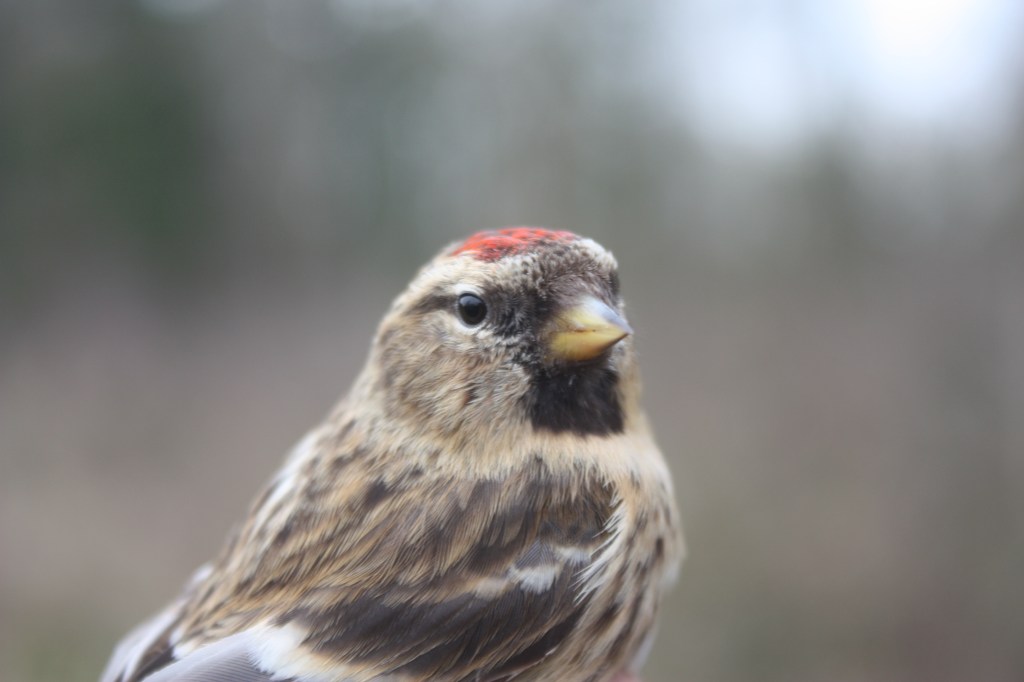
The second round produced eight birds from seven species: the double being a couple of Long-tailed Tits. Our third round produced another eight birds, this time from four species: three of which were Bullfinches, making four for the morning. But then came the third round: only five birds, but three Lesser Redpoll in the first net set (it should have been four, but one took advantage of a slight stretch of the net, as it was pulled down, to enable the top two to be extracted, to extract itself):
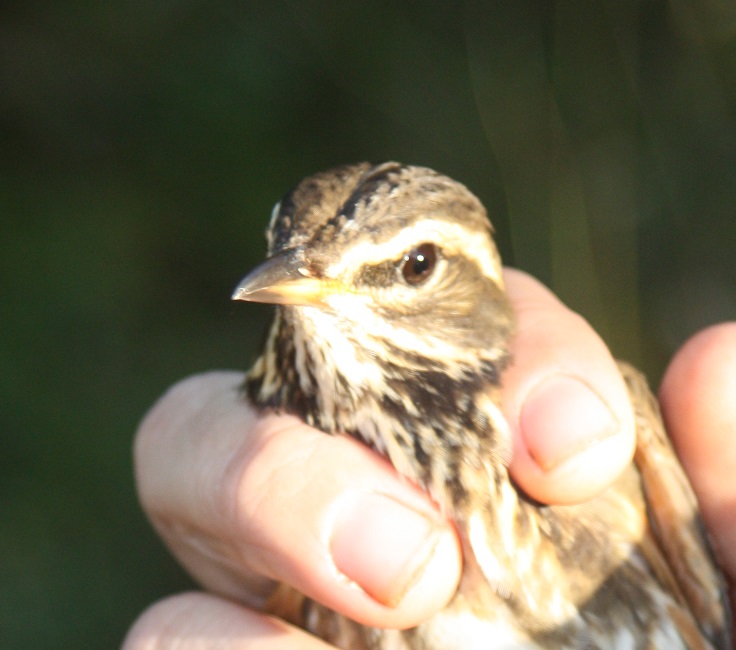
We then caught a Song Thrush in the single 18m net and a Redwing alongside the lure in the final net set:
After that the catch pretty well died off, with singles in three of the next four rounds so, at 11:00, we decided to shut the nets and take down. By then, Rosie had needed to leave, and the two families had also taken off, so it was down to David and me to clear up the site.

The list for the day was: Treecreeper [1]; Great Tit [2](2); Coal Tit [1]; Long-tailed Tit 2; Wren [1]; Robin 1[4](1); Song Thrush [1]; Redwing 1; Blackbird [1]; Goldcrest [4]; Lesser Redpoll [3]; Bullfinch 2[2]. Totals: 6 adults / full-grown ringed from 4 species, 20 juveniles ringed from 10 species and 3 birds retrapped from 2 species, making 29 birds processed from 12 species.

So, not huge numbers but good variety, considering we were missing four of the usual woodland species for this site: Blue Tit, Marsh Tit, Nuthatch and Great Spotted Woodpecker. I will be using this location for the test winter constant effort site being pushed by the BTO: but it will be back in the paddock area where I set the feeding station last year.
Blakehill Farm: Wednesday, 12th October 2022

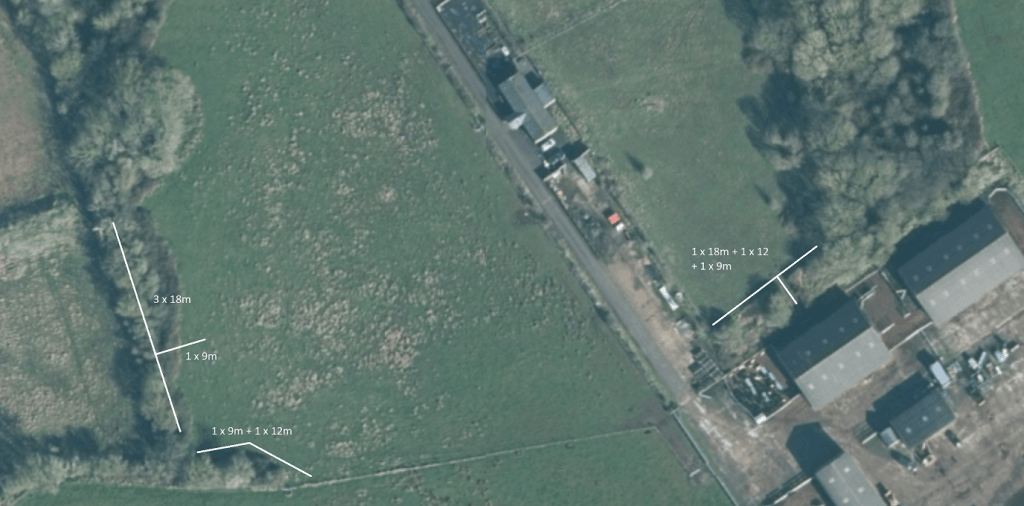
With a lot going on at some of my Wildlife Trust sites: the Firs is closed whilst contractors are removing diseased Ash trees (good job I got in there on Sunday as I was unaware of the closure); the coppicing of Ravensroost Wood’s 25-year coppice stand has started today, and the local volunteer group is also active there on Wednesdays, now that the breeding season is over and Lower Moor Farm is closed until the current avian flu epidemic has settled down, it leaves me with Blakehill Farm. With the forecast for the day to be rain free, with the wind picking up after noon, but virtually wind free for the morning, I decided to see what might be about on the western side of Blakehill Farm, in the fields either side of the Whitworth Building. We didn’t set too many nets – but it still seemed to take an age.

It was one of those mornings when twists, snags and general stupidity (on my part exclusively) conspired to make the whole thing tedious. Fortunately, I had Rosie and Miranda to help me and keep me stable! I had planned to set a Mipit triangle but, given how well the setup had gone, I decided to hold off and see how things developed over the next hour or so.

The first round produced three birds: a Blue Tit, Great Tit and a retrapped House Sparrow, all in the 9m net that sits in the gateway gap in the hedgerow from the farm buildings. That is the usual spot for catching House Sparrow but, today, that was the only one we caught. Instead, we caught five of the seven Robins in that net. Rosie processed the first three birds before heading off to Ravensroost Wood, to manage the aforementioned coppice work there.

The three 18m nets set today used to be set along the outside of the hedgerow. However, over the last winter the Trust replaced the fencing behind the hedgerow and, in doing so, created a decent straight ride for the nets. It also left a gap into which we could set a 9m net across the hedgerow.

It was a quiet start, but at 9:30 this new net position paid dividends: a large tit flock plus a few Wrens, a couple of Robins and a Blackcap hit the net: 35 birds in total. Miranda and I got busy extracting them. Fortunately, the Wrens were well behaved for once, and only one of the Blue Tits double-pocketed and spun. As a result of this catch, I decided to forgo setting up the Mipit triangle.

We got them out in pretty good time: a little over 30 minutes, ran another check of the other nets in the fields, and got on with processing them. The next couple of rounds were quiet, just a couple of birds in each. At about 11:00 the wind arrived, at least two hours earlier than forecast. Typically, the three nets by the farmyard produced another good haul, this time 12 birds: a Blackcap, Chiffchaff and half-a-dozen Long-tailed Tits.

We decided that would be the last round, only when we went to shut the nets, they were full of Field Maple and birch leaves. After half-an-hour trying to get them out, we gave it up as a bad job, shut them and took them down. I will look forward to a couple of hours cleaning them out of my nets over the next couple of days.

Prior to listing, just a reminder: both Long-tailed Tit and House Sparrow adults and juvenile go through the same moult strategy, at the same time and, by this time of the year, are inseparable on age. Hence, they are referred to as “full grown”. Most are probably juvenile, simply on the law of averages, but there is no consistent way of telling them apart. The list for the day was: 17 full grown birds ringed from 1 species, 8 adults ringed from 3 species, 33 juveniles ringed from 7 species and 1 full grown bird retrapped, making 59 birds processed from 9 species.

Although we regularly get large catches on the other side of Blakehill, this is the second largest catch on this side of the site. The biggest was 61 birds, but that was in August 2017 during autumn migration (that it happened to be the “Festival of Flight” public event run by the Wiltshire Wildlife Trust was a bonus (for them – I was working solo)).

We had the nets down and packed away by 13:00. I told Miranda to toddle off whilst I finished packing the car. In truth, I was knackered and needed a rest before I finished packing. I got away from site by 13:30 after a successful session.

One final note: I extracted a Great Tit with a severe left leg injury. It was very obviously an old injury: there was no blood, and everything was clean and dry. The foot was only connected to the rest of the leg via its tendons. By careful use of my extracting skills, and a pair of needle forceps, I managed to free it without new damage to that leg. I chose not to ring it: even though the right leg was perfectly healthy, but I am well aware that some people will dishonestly use any injury on a ringed bird as “evidence” of the damaging effect of the ringing process. A shame: otherwise we would have ended up on a nice round 60!

The Firs: Sunday, 9th October 2022

As of Monday, 10th October, the Firs will be out of bounds for a time while the Wildlife Trust remove the dead and dying ash trees suffering from the Chalara Ash Dieback, unnecessarily imported into this country from the European mainland.

This was our sixth visit to the Firs this year, but the first since June and the other four were in the January – March period. Essentially, the whole of the breeding season was missed. Most of that was down to my spinal operation and recovery, and the necessary focus on the Lower Moor Farm CES, and that was followed by autumn migration. Hopefully we will be able to get in a couple of additional visits before the end of the year.

The Firs can be very hit and miss at this time of year, depending upon whether I have set up the feeding station or not. This year it is very definitely “not”. The sessions in January and February were fuelled by supplementary feeding but they still didn’t match the numbers that we caught today, much to my surprise. Once the feeding station is set up the numbers do become more regular and higher, but this year that will not be happening. As part of their precautions to limit the spread of avian flu this winter, the Wildlife Trust have decided that there will be no supplementary feeding at their nature reserves, and no ringing activity at their Lower Moor Farm and Langford Lakes reserves at all, as they are the two sites that attract in over-wintering waterfowl.

I was joined for the session by David and Anna and later on by Claire and her children, Zara and Samuel. Zara is eight years old, and last time out I started training her on holding and measuring birds before release, prior to training her on ringing birds. One of the things that is quite remarkable about her is the number of birds content to sit in the palm of her hand after release. All ringers know that Bullfinch will do that, but Great Tits?

I haven’t seen anything like it before: so many birds of multiple species are happy to sit there. Today she started her ringing career , ringing five Robins and two Great Tits.

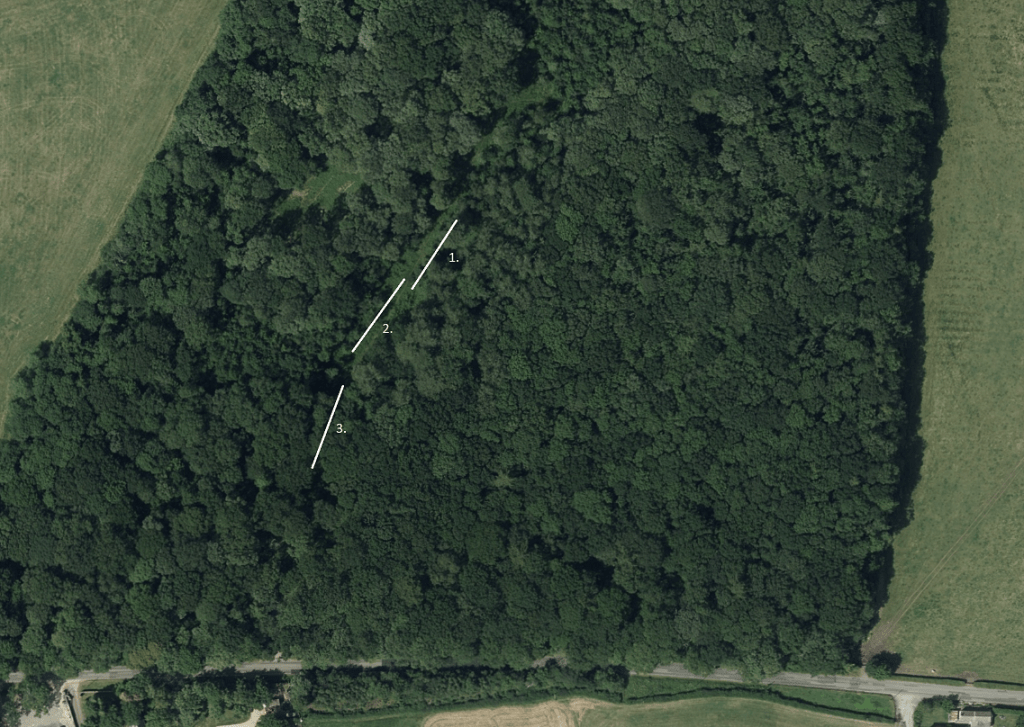
I have thought for a while about extending the net ride we use to include the slope down to the central glade. It was thinned out extensively a few years ago, but has now grown back to a reasonable height and thickness, so we set an extra set of 3 x 18m nets down the slope (No. 3 on the photo):

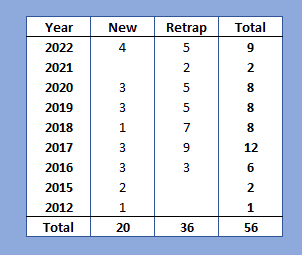
We had a decent first round with eight birds including singles of Chiffchaff, Long-tailed Tit and Marsh Tit. I was surprised that we only caught one Long-tailed Tit at this time of year, they are always in flocks, and I was delighted to catch a new Marsh Tit for the site. To put it into perspective: we didn’t catch any in the Firs last year. It has always been hit and miss for the species:

Marsh Tits, Poecile palustris, caught by year in the Firs

As you can see from the graphic: we ended up catching four this morning. So, in this one session we have exceeded our previous best annual total for them in the Firs. As for the Long-tailed Tit, I needn’t have worried: next round we caught the rest of the flock: another nine individuals ringed.

Between 10:00 and 11:00 the catch fell right away and we decided the 11:15 check would be the last. Our minds were made up by the wind that had started to build up, and the nets at 2 and 3 had started to billow significantly. The new nets at 1 were well protected from the wind and caught very well. Net 3 delivered a small flock of Goldcrests in response to the lure that I put on at 10:30.

On our last round we got excited when we caught another flock in ride 1 – only to be deflated by finding it was eight of the previous group. Mind, as is often the case with the Firs, it was our largest catch of the day. As well as the 8 we extracted and released, we extracted another 19 to process after closing the nets.

The catch for the morning was: Treecreeper [2](1); Blue Tit 1[13](4); Great Tit [7](6); Marsh Tit [4](1); Long-tailed Tit {10}(1); Wren 2(1); Robin [6](1); Chiffchaff [1]; Goldcrest [5]. Totals: 10 full grown birds ringed from 1 species, 3 adults ringed from 2 species, 38 juveniles ringed from 7 species and 15 birds retrapped from 7 species, making 66 birds processed from 9 species.

We had the nets down and everything packed away and off site by 12:30.

Red Lodge: Thursday, 6th October 2022

With Wednesday’s weather turning out to be as dire as forecast, I was relieved to find out that they had got it right two days in a row and we could get a session in this morning. It was forecast to be breezy so I decided it had to be a woodland and Red Lodge has not been visited for a considerable time. That it is within 5 minutes from my house is an added bonus:

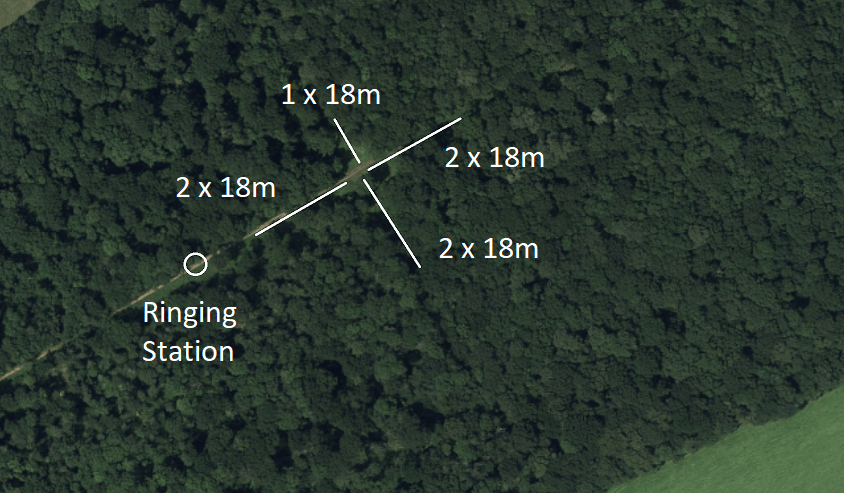
I had Rosie joining to help set up and Miranda joining for the whole session, with a 6:30 start time. Unfortunately, waking at 5:15 did not warrant trying to get back to sleep, so I was on site for soon after 6:00. We had the nets open by 7:30. As there would only be two of us for the majority of the session, I only set 4 net rides:

The first two birds out of the net were Great Tits, which Rosie got to ring before heading to work at 8:30. The next round produced two each of Great Tit and Blue Tit and Miranda and I were beginning to wonder whether we were going to get any sort of decent size of catch and / or variety of species.

Fortunately, the next round, at 9:10 produced 13 birds from six species – but six of them were Great Tits and three were Blue Tits. However, the addition of a Blackcap, Goldcrest, Coal Tit and Robin did help raise our spirits somewhat: only to be dampened again by catches of one, two and three birds respectively in the next three rounds.

The last of those, the three bird catch, consisted exclusively of Goldcrests, having switched the lure from Marsh Tit to Goldcrest at the end of the previous round. The next round, at 10:50, produced 15 birds from five species, including another seven Goldcrests and adding two Chiffchaffs and three Long-tailed Tits.

The list for the day ended with 47 birds processed from 11 species and comprised: Blue Tit 1[5](2); Great Tit 1[11](1); Coal Tit [1]; Marsh Tit (1); Long-tailed Tit {2}(1); Wren [1]; Robin [2]; Blackbird (1); Blackcap [1]; Chiffchaff [3]; Goldcrest 2[11]. Totals: 2 full-grown birds ringed from 1 species, 4 adult birds ringed from 3 species, 35 juveniles ringed from 8 species and 6 birds retrapped from 5 species.

What started out looking as though it would be a disappointing session ended up being very satisfying. It is astonishing how quickly Goldcrest will respond to the lure: which is one reason why I don’t put it on until after 10:00 during a session: to give them plenty of time to feed up before we focus on them. At less than 6g I like to ensure they have the chance of a hearty breakfast before trying to catch them. In cold weather I don’t lure for them at all.

Miranda and I shut the nets at 11:50. As so often happens, as we shut the nets the light breeze that had been there all morning suddenly picked up into a strong wind. We were packed up and away by 12:30.

West Wilts Ringing Group: September 2022 Results

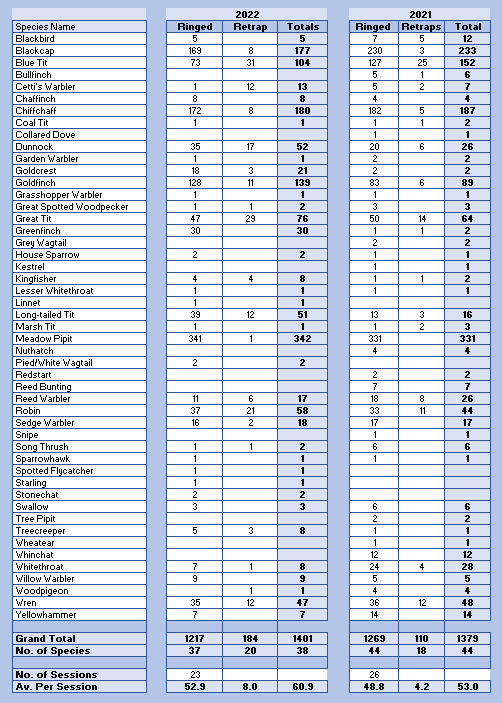
An interesting month: our best September so far numerically, despite the number of species being six fewer than last year (our previous best September).  Fewer birds were ringed this September (1217 vs 1269) so, obviously, more were recaptured (184 vs 110).  Amongst those recaptures were three notable recoveries at our sites: a Reed Warbler ringed near Knutsford in August of this year, recovered at Jonny’s Melksham site on the 2nd; a Blackcap ringed by the Alderney Bird Observatory in April 2021 and recovered at Ian’s site near New Zealand Farm on Salisbury Plain on the 17th and, finally, a Meadow Pipit ringed near Edinburgh in August 2020, recovered in a test session at a new part of my Blakehill Farm site on the 21st.  As Phil Deacon helpfully advised, Jonny’s Reed Warbler is a real find: the “first recovery of a Wiltshire Reed Warbler in Eastern France, indeed anywhere in Europe east of the meridian”. Essentially, most of our Reed Warblers migrate along the west coast of France and Portugal.

So, what was missing from the species list this year: Bullfinch, Collared Dove, Grey Wagtail, Kestrel, Redstart, Reed Bunting, Snipe, Tree Pipit, Wheatear and Whinchat.  I am not surprised that we didn’t catch any Wheatear, given that last year’s was the first for the team.  Whinchat was a far more surprising miss, as they are an absolute regular on passage at Blakehill.  None in either August or September is unusual.  Redstart similarly, as they are caught most years on passage at the Salisbury Plain sites.  The Snipe last year was also a fortuitous catch at Ravensroost Meadows, so I am not surprised that we didn’t catch another as January is our usual catching month and at Blakehill.  Equally, Ravensroost Meadow pond was very disappointing this entire summer for all species: particularly Whitethroat and Lesser Whitethroat.

The species caught this year, that were not caught last year were: Linnet, Pied Wagtail, Spotted Flycatcher, Starling and Stonechat.  The Pied Wagtails were at Andy’s Salisbury Plain site and are the first caught at either of the group’s SPTA sites.  I was delighted with both the Spotted Flycatcher and Stonechats.  Both were caught at Blakehill: the Spotted Flycatcher on the plateau, and a first for the site.  We have now caught Spotted Flycatcher in every site in the Braydon Forest except Webb’s Wood. The Stonechats were caught in my previously mentioned test plot.  This is the sparse hedgerow along the  perimeter track which had previously been used as a plant test plot by the Wiltshire Wildlife Trust.  Whilst checking Barn Owl boxes at Blakehill, my companion and I had noticed that there were at least ten Stonechat in that area.  Ironically, I set four nets with Stonechat lure on, and the two I caught ignored them.  Both the Spotted Flycatcher and the Stonechats were actually caught amongst the Meadow Pipits in the respective Mipit triangles.

Significant changes in numbers were seen, with reductions in Blackcap and Blue Tit and increases in Goldcrest, Goldfinch and Greenfinch.  The Goldcrests were mainly at Langford Lakes and, secondarily, Webb’s Wood; the vast majority of the Greenfinches and the majority of the Goldfinches were at Jonny’s East Tytherton site, but also a significant number were caught because, for the first time this year, I ran a couple of sessions in my garden, resulting in 48 of them.

Sexual Imbalance in Migrating Blackcaps

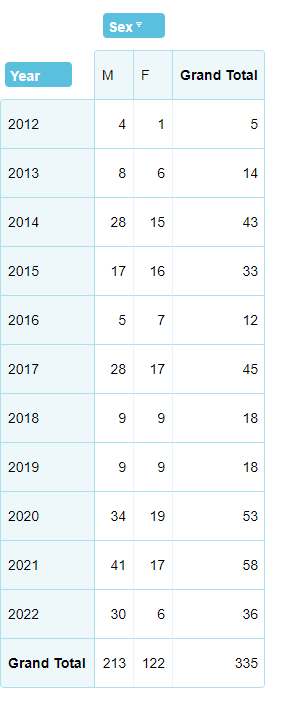
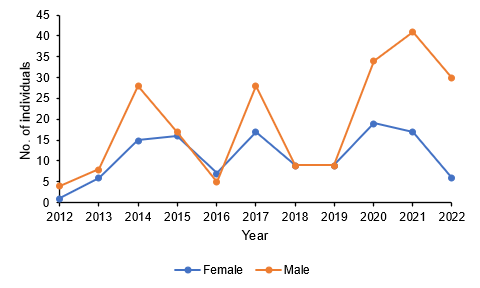
One of the things that we have noticed this year is that, during September, there has been a huge sexual imbalance in the number of migrating Blackcaps. So I had a look at the numbers in the Braydon Forest and at Lower Moor Farm in September over the years that I have been ringing there. These are the results:

We don’t work anywhere that could be described as a migration hotspot, so we don’t get huge numbers either in the spring or the autumn. The team has processed 2190 in the 11 years since I started operating at these two site groupings: 199 per annum, one sixth of which are processed in September.

My trainee, David Williams, just happens to be a very clever individual with a first class honours degree in Zoology (I only managed a 2:1) and he had a look at the Blackcap data and did some statistical analysis on it. We don’t have thousands of entries, but we have more than l’Oreal usually claim for their adverts. Anyway, I don’t pretend to understand it all, but this is what David came back with:

  • Overall, the observed numbers of female (122) and male (213) Blackcaps were significantly different from those expected under the hypothesis that both sexes are equally likely (chi-square goodness of fit test with Yates’ correction: χ2 = 24.179, d.f. = 1, N = 335, p < 0.001).
  • By year, there is considerable variation: in some years (e.g., 2018 and 2019), there are about equal numbers of each sex, but in others (e.g., 2021, 2022) there are more than twice as many males as females.

In 2021 and 2022, the observed numbers of female and male Blackcaps were significantly different from those expected under the hypothesis that both sexes are equally likely (chi-square goodness of fit tests with Yates’ correction, d.f. = 1 in all cases):

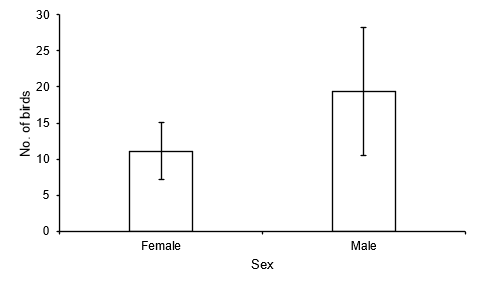
The mean (± 95 % confidence interval) numbers of female and male Blackcaps processed each September were significantly different from each other (paired samples t-test: t = 2.842, d.f. = 10, p = 0.017).

Back to my thoughts: essentially, over the last three years the sexual imbalance in the catch of Blackcaps moving through the Braydon Forest and Lower Moor Farm in September has become significant. What the reason for that is I don’t have any idea.

I Could Get Used To This: Sunday, 2nd October, 2022

I had to cancel this morning’s scheduled session at Red Lodge because the forecasts (all three that I use: Meteo, Met Office and xcweather) were for rain for the morning, until gone 9:00. I had David and Anna lined up to help this morning, but it wouldn’t be right to bring them over for just an hour or so ringing, which is what we would likely to have had after we had set the nets, so I cancelled.

Without an alarm set, I woke at 9:30. The rain had recently finished, there was a clear blue sky and it was virtually windless. Whilst preparing breakfast, and looking out of the kitchen window, I couldn’t help but notice that there were a goodly number of Goldfinch visiting the feeders so, over breakfast, I decided I would open the three nets I have furled in the garden. They were opened just after 11:00 and, naturally, all of the birds disappeared.

The first bird out of the net was an adult female Chaffinch at 11:30. As I had 3 hours of recorded football to watch, I decided to leave the nets open, checking them every 10 to 15 minutes and processing anything that came along. It was never hugely busy, but over the course of the next four hours I managed to get through all of the football and a further 24 birds.

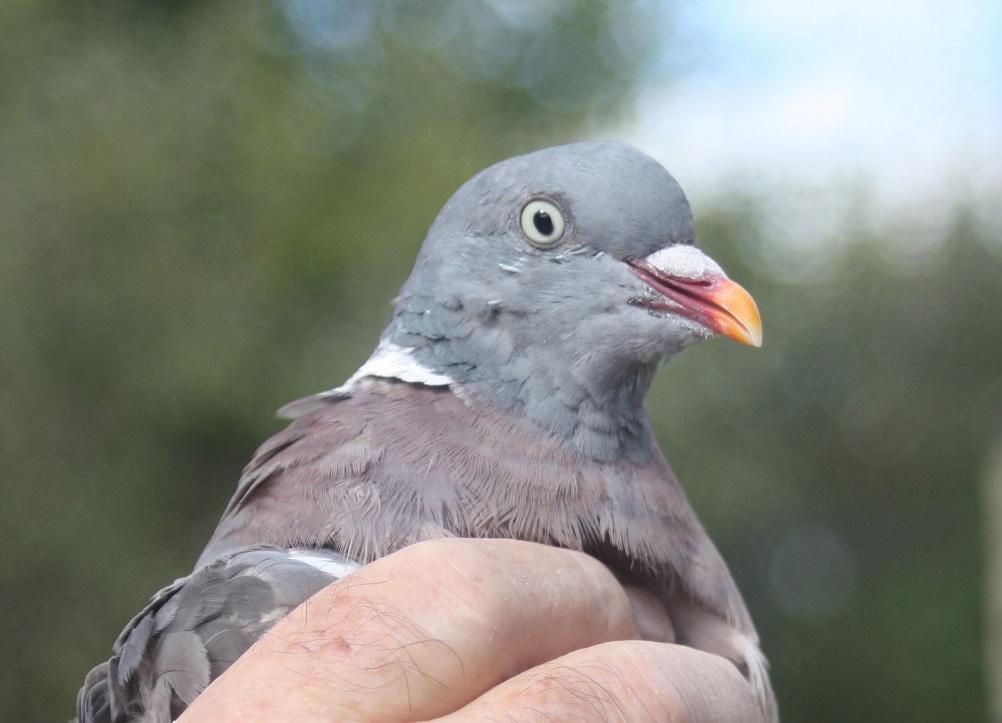
Of the 25 Woodpigeon that I have ringed before today since I was able to work on my own recognisance, 19 have been in my garden. Today I caught and ringed the 20th:

Woodpigeon, Columba palumbus

The fact is that I never target them: they just occasionally blunder into my nets. They have incredibly strong flight muscles and holding them still to process them takes effort.

The list for the day was: Woodpigeon [1]; Blue Tit 1; Dunnock [1]; Chaffinch 1; Goldfinch [20](1). Totals: 2 adult birds ringed from 2 species, 22 juveniles ringed from 3 species and 1 retrapped bird, making 25 birds processed from 5 species.

To be honest, I would have continued for longer, but I committed the cardinal sin of bird ringing: I ran out of A-rings. These are the commonest used rings for every day ringing. I knew that I was running out, so I ordered another 500 last Thursday: hopefully they will arrive before the next scheduled session, next Thursday.

Webb’s Wood: Friday, 30th September 2022

It has been an age since I made my way into one of the Forestry England woodlands. After not getting out on Wednesday, not that I am complaining about spending time in the garden, I wanted to get into the woods. As I was going to be working solo, I decided that Webb’s Wood would be the best bet: flat and far enough away from the entrance to minimise contact with the general public: not that that has been an issue at Webb’s Wood.

The forecast for the day was that it would be dry with little wind until 11:30, when the wind would start to build, with gales by 16:00. Rain was supposed to arrive mid-afternoon, building up overnight into Saturday. So I decided I would ring until 11:00 and take down then.

I arrived on site for 6:30 only to find that I had managed to leave my guy ropes at home. It is one of those things that your younger self puts down to a moment of stupidity but when you are approaching 70 you start to worry about senility. Fortunately, it is only 10 minutes from my house to the site, so I was back on site just before 7:00 with the nets open by about 7:50.

I set just three net rides:

I put on lures for Blackcap, Lesser Redpoll and Siskin just in case. We have caught all three species at this time of year in the Braydon Forest, so I was just trying it on. The only one that delivered was Blackcap, with a single juvenile male caught. Later, at 10:00, I put on a lure for Goldcrest and got immediate results.

The first round was surprising: a small flock of five Great Tit flew in and hit the two net sets forming the open triangle. This round also delivered our single retrap, an adult male Goldcrest, and the Blackcap.

Over the next couple of hours I caught small numbers on most rounds ending up with 24 birds by the time I closed the nets at 11:00. The totals for the session were: Treecreeper 1; Great Tit 2[7]; Marsh Tit [1]; Wren [1]; Robin [1]; Blackcap [1]; Chiffchaff [1]; Goldcrest [8](1). Totals: 3 adults ringed from 2 species, 20 juveniles ringed from 7 species and 1 bird retrapped, making 24 birds processed from 8 species.

The Blackcap and the Chiffchaff were the only clear and obvious autumn migrants. However, four of the Goldcrests weighed in at less than 5 grams. Perhaps they were new arrivals who have used up fat coming to Wiltshire? As they weren’t ringed before I caught them, we will never know.

As much as I enjoyed catching the Goldcrests, my highlight was a new Marsh Tit. For whatever reason, Webb’s Wood has been the least successful site for catching Marsh Tits within the woodlands of the Braydon Forest. Apart from 2017 & 2018, with 6 ringed in each year, in the other 8 years, 5 returned a single new bird and 3 returned 2 new birds, averaging out at 2.3 per annum. Somerford Common returns 5 new birds per annum on average, Red Lodge 4.5 per annum and Ravensroost over 10 per annum.

Juvenile Marsh Tit, Poecile palustris, showing appreciation for its new bling

For anyone birding in Webb’s Wood, this bird has a metal ring above a black ring on the left leg and a yellow ring above a grey one on the right leg. If you see it, please let me know through the blog feedback.

A while ago I put up a photo showing the teardrop markings on the primary covert tips of a juvenile Treecreeper. Today we caught an adult:

Adult Treecreeper, Certhia familiaris

To give a comparison, I photographed the wing of the adult and am going to post the picture of the juvenile wing again for comparison:

Adult Treecreeper wing
Juvenile Treecreeper wing

The difference should be visible through binoculars.

As forecast, the wind started to pick up just after 11:00, so I started to shut the nets. A few “tail-end Charlies” (two Goldcrest and the Wren) held up the take down whilst I processed them, but everything was down and packed away by 12:30. As I am sitting here writing this it is blowing an absolute hooley outside and throwing it down with rain: that’s one forecast they got right.

Who Needs To Get Up Early? Wednesday, 28th September 2022

With my usual midweek stalwart, Miranda, otherwise engaged, and Rosie on holiday in Cornwall, I was in two minds about how to organise my ringing for today. However, my mind was made up by the fact that, to top off the horrible end to yesterday’s Barn Owl session, I contrived to have a nasty fall and damage my knee as we left that site, making it painful to walk. I decided to open the nets in the garden again, having been encouraged by the last session there.

Unfortunately, my wife decided to pop out to nearby Wootton Bassett and I forgot that my ringing box was in the back of the car until 30 seconds after she had disappeared off to the shops. So I had to wait for her to return. In the end, I opened my nets at 11:00. I was not overly confident of catching many birds, having missed the morning rush, but decided to give it a go regardless.

No surprises to start with: a small group of Blue Tits, a Goldfinch, a Great Tit and a Dunnock were the first birds into the nets. Thereafter, I had repeats of these in differing numbers throughout the day. I shut the nets over lunch and then shut them completely at 17:00 in time for dinner.

Towards the end of the afternoon I heard a Chaffinch calling in the garden. They are uncommon in my garden catches: with just 23 processed in the last 10 years. Although it didn’t get caught straight away, two rounds after hearing it, it did get caught in one of the nets. It was a healthy juvenile female (no sign of mites / Fringilla papillomavirus or Trichomonosis):

Juvenile female Chaffinch, Fringilla coelebs

If you look at the wing you can clearly see the retained greater covert that helps identify it as a juvenile. What you can’t see are the narrow, very pointed central tail feathers, which are also diagnostic of a juvenile.

The last bird out of the nets today, extracted at 16:45, was this:

Juvenile Chiffchaff, Phylloscopus collybita

A key feature of juvenile Chiffchaffs, which you can see on this photo, are what my old trainer referred to as “rivers of yellow” running down the breast to the belly. This is only the third Chiffchaff I have ever caught in my garden, so I was extremely pleased with this final bird of the day.

The list for the session was: Blue Tit 3[8]; Great Tit [3]; Dunnock [2]; Robin (1); Chiffchaff [1]; Goldfinch [13](2). Totals: 3 adults ringed from 1 species, 27 juveniles ringed from 5 species and 3 birds retrapped from 2 species, making 33 birds processed from 6 species.

Barn Owls: A Depressing Day on Tuesday, 27th September 2022

Last week local photographer Chris Snook volunteered to help me out with checking and cleaning out some of my Barn Owl boxes. We had a decent session: the four boxes around Upper Waterhay showed that the new box is being used as a roost site, the chancel box was being used by Jackdaws back in June, but hasn’t been used since. The other two boxes have fledged 5 young between them. Unfortunately for it, the smallest youngster in a box of 4 became food for its siblings.

After Waterhay we went to the Wiltshire Wildlife Trust reserve at Blakehill Farm. The box nearest the farm buildings was, unusually, empty and had not been used as a roost. When putting the ladder up to check the other box, in the Allotment Field, a Barn Owl flew out and away. What was astonishing about that was that, when I opened the box, it was filled from top to bottom with Jackdaw nesting material. I suppose that wasn’t that surprising, given that we ringed 3 Jackdaw young in that nest back at the end of May, what was surprising was that the owl had chosen to roost in there, given how full of twigs it was: it really was crammed full to the top.

So to today. We started at Drill Farm: box 1 had an active wasp’s nest, with plenty of wasp activity around it so, as it was empty when we did our first checks, I decided I didn’t need to find out what else might be in there. Box 2 was hosting a fledged Barn Owl. It flew off as we put the ladder up to check. The box had been empty when we first checked it, and there was sign of recent roosting (fresh pellets) but a possible explanation of why it didn’t have any owls nesting this year was the hornet’s nest in the top right corner of the box and the multiple dead hornets on the floor of the box.

The box at Echo Lodge was empty and the box at Home Farm showed that three of the four youngsters had successfully fledged. Unfortunately, we found bits of the fourth in the nest:

Photo courtesy of Chris Snook

No doubt, as at Waterhay, it had helped feed its siblings. They had, thoughtfully, left behind the leg with the ring attached. Moving on to the Somerford Farm area, we found that the birds in box 1 had fledged successfully, with one bird flying off as I was setting up the ladder. Chris finally managed to get some shots of a Barn Owl in flight. Unfortunately, the bird flying out from dark into sunshine, resulted in them being somewhat overexposed and not suitable for publication. The upside for me is that he will have to keep helping me out so he can finally get the record shots.

Box 2 was full of Jackdaw material. Although we didn’t ring any there this year, last year it was a successful nest for Jackdaws. As I started to remove their nesting material from this year, I came across the most beautiful, perfectly domed hornet’s net. Not only perfectly formed but very active and several hornets decided to investigate this intruder. Again, discretion, rather than valour, was the order of the day, and I beat a hasty retreat rather than hang around to get a photo.

Then we came to the horror story that overshadowed the entire session. Arriving at Plain Farm, where we had ringed three young back in June, we were greeted by an excellent flock of Chaffinches feeding around the calves that were in the field adjacent to their holding pens. There must have been at least 30 of them, and it is certainly the biggest flock that I have seen for at least a decade. Chris and I carried the ladder down to inspect the box, accompanied for much of the walk by the calves. As we got about 10m from the box, I noticed a white patch on the ground, about 15m away from it. Then there was another about 5m from the box. The recovered rings showed that they were two of the young from that box. Each had been stripped of its flesh, with the wings left attached to the spine, both heads were missing. Examining the carcasses, both had their flight feathers fully grown, and the birds were certainly capable of flight. Given the positions away from the box, I suggest that their predator was avian: either female Sparrowhawk or, possibly, Goshawk. Unfortunately, when I opened the box the remains of the third bird in that brood was found in pieces inside. A thoroughly depressing end to the morning. A slight upturn on the way out: another local farmer was on site and approached for a chat. His farm is about a mile away, close to Red Lodge, and he asked if we would be able to put a box up at his site. I shall look forward to doing so, and Chris has offered to help me.

This year we ringed 20 Barn Owl chicks in 7 occupied boxes. With one box, Avis Meadows, having 2 chicks and 2 eggs predated between the first and second visits (May and end of June), we have recorded 15 Barn Owls fledged and 7 predated for 2022. Also in the boxes, we have ringed, and have had fledge, 3 Jackdaws in 1 box and 3 Stock Doves in 2 boxes. Of the 7 other boxes checked this year, 3 had roosting Barn Owls, 1 had roosting Stock Dove and 3 were empty. Not quite as good as last year but still not bad (and I do have 2 boxes left to check).