Jonny once again stepped in to run my CES for me whilst I continue my recovery. Ellie joined him first thing, until she had to leave for work at 9:30, and I put in an appearance between 9:00 and 10:00, thanks to my lovely wife, Lilian, driving me to site.
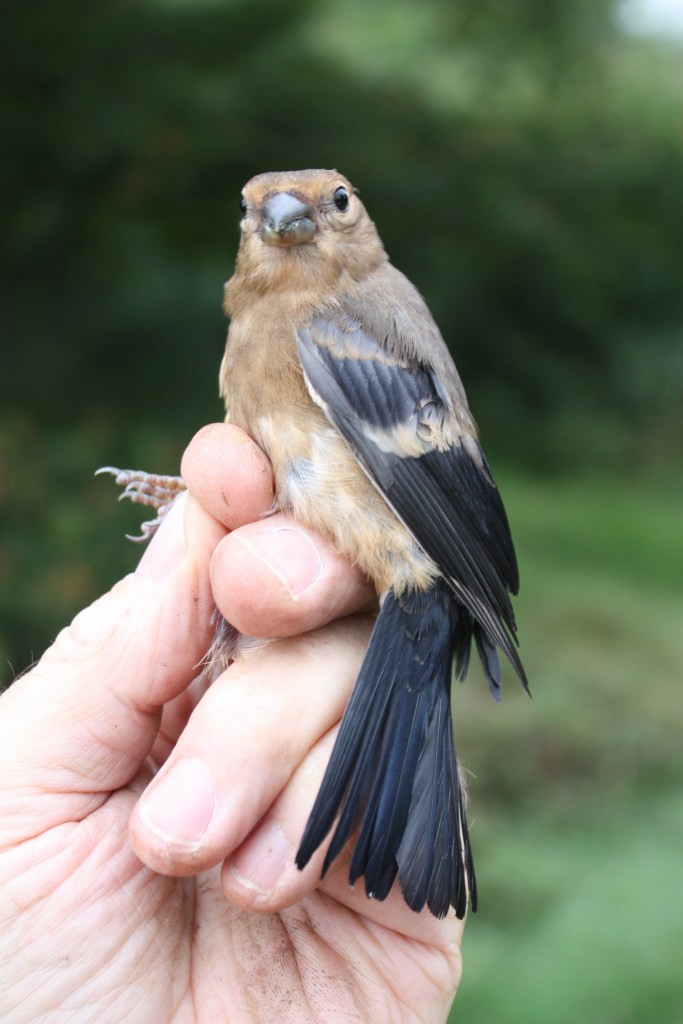
It was nice to ring a few birds again, especially when one of them was my team’s first (of two) newly fledged Bullfinch for the year. Jonny beat us to it, with one on his Sutton Benger site 5 days ago, but it is always a good catch.
Juvenile Bullfinch, Pyrrhula pyrrhula
I love the way they look at you, so indignant.
This year’s catch was considerably better than the equivalent session last year (24 birds from 12 species) compared to this year’s 55 birds from 16 species. The list was: Treecreeper [2](1); Blue Tit 1[2](2); Long-tailed Tit [1](1); Wren [2]; Dunnock [1](1); Robin [1](2); Song Thrush 1[1]; Blackbird (2); Cetti’s Warbler (1); Blackcap 1[5](1); Garden Warbler [1]; Whitethroat [1]; Chiffchaff 1[16](2); Willow Warbler [2]; Chaffinch [1]; Bullfinch [2]. Totals: 4 adults ringed from 4 species, 38 juveniles ringed from 14 species and 13 birds retrapped from 9 species, making 55 birds processed from 16 species. Of the retrapped birds, 6 were juveniles from 4 species, so the total number of juveniles processed was 44.
We left Jonny to it and wandered over to the Dragonfly Cafe for coffee and cake – only the cakes hadn’t arrived yet! I had to settle for a toasted teacake, which was very nice. As we were getting ready to leave, the cakes arrived! I resisted!
Jonny carried on for the rest of the session and packed up by midday. Hopefully, I will be able to do the next few myself, as I plan to start ringing again on Saturday: which should mean I can start doing some proper blogs again, instead of waffling on!
Jonny was ringing this weekend at one of his sites. The site is not open to the public, and the landowner does not want the site named. As, according to the records, this is only the fourth record for the species in Wiltshire and it is a sensitive site, the caution is warranted.
The other records are interesting. Wiltshire’s first record was near Salisbury on the 11th June 1944. This bird was identified by song, rather than by observation or catching for ringing. Our second record was a bird caught and ringed in August 2009 near Longbridge Deverill. Most recently, one was caught and ringed by the North Wiltshire group on the Salisbury Plain Training Area on the 16th August 2020. Thanks to Rob Turner for providing this information.
So to this bird. I was sitting at home, unfortunately still housebound after my operation, when I saw I had a missed call from Jonny. I called him back and, after a bit of phone tennis, we had a chat. He was, rightly, so excited. As he put it, he was extracting birds, a number of Phylloscopus warblers, when he noticed that one was somewhat larger and, although the plumage was superficially similar, different to what he had handled before.
He had already done the hard work, taking all of the appropriate biometrics, as follows:
Wing Length: 79mm (75 – 83mm)*
Weight: 14.2g
Tail Length: 54mm (49 – 55mm)*
Tail / Wing Ratio: 68.4% (62 – 71%)*
Bill Length: 16.2mm (15 – 17.5mm)*
Distal Bill Length: 9.2mm
Proximal Bill Length: 5.0mm
Tarsus length: 21mm (19.5 – 22mm)*
* Reed and Bush Warblers: Peter Kennerley and David Pearson, illustrated by Brian Small. Helm Identification Guides, 2010
Jonny and I had a long discussion about ageing the bird and hadn’t come to any firm conclusions. He then sent me over a number of his photographs, a selection follows:
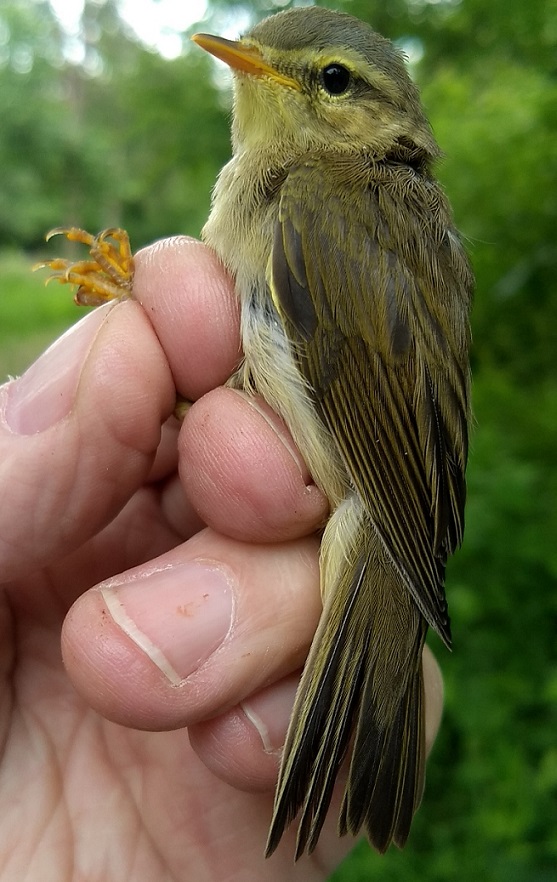
Fig. 1: Icterine Warbler
I have to say that this first photograph gave me some concerns regarding ageing the bird: is that barring a natural part of its plumage or are they fault bars. If the latter, it would strongly indicate that it is a bird of this year. However, there is also a fair amount of wear on the retrices, which would indicate adult. However, Jonny then sent over a picture of the wing:
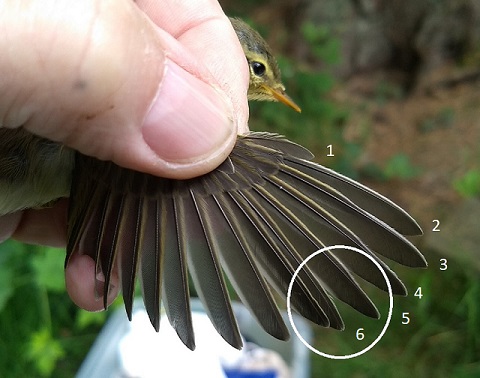
Fig. 2: Wing showing primary & secondary feathers
This photograph is almost identical to the photograph of a post-breeding adult Icterine Warbler in Jenni & Winkler’s second edition of “Moult and Ageing of European Passerines”, Fig. 233 pp 146, with wear on P5 to P9, counting descendantly from the outside. Interesting, but we settled on it being an adult bird. If anyone with more experience of the species (this is only the second I have seen: the other was one I ringed on Skokholm in 2015) has any information regarding ageing of this bird, please contact me through the blog feedback.
Fig 3: Head Shape, typical of Icterine WarblerFig. 4: Underside
A great find and hopefully ringing it will generate more data on its future movements. It would be too much to hope that it might be recaptured next year.
This is a truncated report, as I wasn’t there to join in. After several months of pain, I was in hospital yesterday having a wonderful procedure called a lumbar decompression of L4 and L5. They were going to carry out a discectomy, if it wasn’t too badly fused, as I also have a prolapsed spinal disc in that region. Unfortunately, it remains but the pain has gone. The story of how I got to the point of being operated on is the stuff of nightmares and not for a nice blog about bird ringing. All I will say is that the recent introduction of a clinical pathway for spinal pain seems designed to delay diagnosis, start treatment before they have diagnosed the problem, possibly making things worse, and making you suffer as long as possible before treatment.
Jonny Cooper very kindly has offered to carry out the next couple of CES session whilst I recover, as I am not allowed to drive for a couple of weeks and not allowed any heavy lifting for 6 to 8 weeks. With the weather looking too hot for the end of the week, he decided to carry out the session Wednesday. He was worked solo, and was active by 5:45, having driven over from Chippenham to get set up, and proceeded to catch a smallish haul for the day. The key difference between this session’s catch and the last catch was the complete absence of Blue, Great and Long-tailed Tits from this catch. However, it was a much better catch than the equivalent session last year, when only 21 birds were caught. The key is that there are more juvenile birds around this year.
The catch this session was: Treecreeper 1; Wren [7](1); Dunnock [1](1); Robin [6](2); Blackbird [1]; Cetti’s Warbler [2]; Reed Warbler 1; Blackcap 1[4](2); Garden Warbler [1]; Chiffchaff 2[1](1); Willow Warbler 1. Totals: 6 adults ringed from 5 species, 23 juveniles ringed from 8 species and 7 birds retrapped from 5 species. Of the retrapped birds, the Blackcap and the Robins were also juveniles.
Jonny brought the session at 11:45 because only mad dogs and Englishmen stay out in the midday sun. Hang on – he’s English, clearly not mad though. Thanks Jonny.
Before getting into the meat of today’s session, just a couple of small updates.
Ravensroost Wood: Monday, 4th July 2022: my plan for the wood this year is to do sessions in different parts of the wood, as I now have more access to other sections of the wood now. This Monday, Rosie and I set 5 x 18 m nets along ride 30. I used to set nets along this ride regularly and the catch was always decent. However, things change over time and after three birds in three hours I knew that horse was well and truly dead and any additional flogging would be a waste of time.
I arranged with Alice to meet up Tuesday afternoon to put up a delayed Barn Owl box. It is a new one in a completely new position on Lower Pavenhill Farm. I had also agreed to put up a Little Owl box built by the owner of Somerford Common, and we planned to do that as well. I had also hoped to check a couple of Barn Owl boxes but the famer contacted me to let me know that he had just moved livestock into the areas where the boxes are, so could I hold off for a few days. Alice was still happy to make the trip done from Oxford to help with the boxes. We got the boxes up. For the Barn Owl box we were accompanied by a significant number of horses. Not a problem, except for the wanting to bump into the ladders and lick the car to death. I now have some very nice slobber patterns on the windows and bodywork. In comparison to the Belted Galloways I would say the horses are better: the Belties also like to give your car a good rubbing with their hairy coats and are not particularly careful about where they poo. As a potential reward for her help, I remembered that one of the Barn Owl boxes we had checked a few weeks ago, whilst having one failed brood of Stock Doves, had actually a warm egg in the nest, so we went to check on that to see if the bird had hatched and was of a size whereby it could be ringed:
Stock Dove pullus, Columba oenas, photo by Alice Edney
This is Alice’s first Stock Dove pullus. It had just started to grow its flight feathers and was quickly returned to the sanctity of its box.
So to this morning and CES session 7. I was joined by Rosie and Miranda for the session and, although the catch wasn’t as big as last weeks, it did follow a similar pattern with a few birds at the start and end of the session, with one big fall in the middle making up the bulk of the birds. It compared very favourably with the equivalent session last year, when a mere 16 birds were caught from 12 species. Rosie did her usual of helping set up and ringing a few birds before heading off to do a day’s work for the Trust.
What we are definitely seeing this year is that Blue Tits and Great Tits have had a decent breeding season. However, the highlights for me were threefold: the first juvenile Garden Warbler and Cetti’s Warbler of the year plus a retrapped female Green Woodpecker, ringed as an adult last year. She was caught in the wildlife refuge area: the ant hills we trip over whilst putting up the nets are clearly what attracts her in. Hopefully we will catch her youngsters later in the summer.
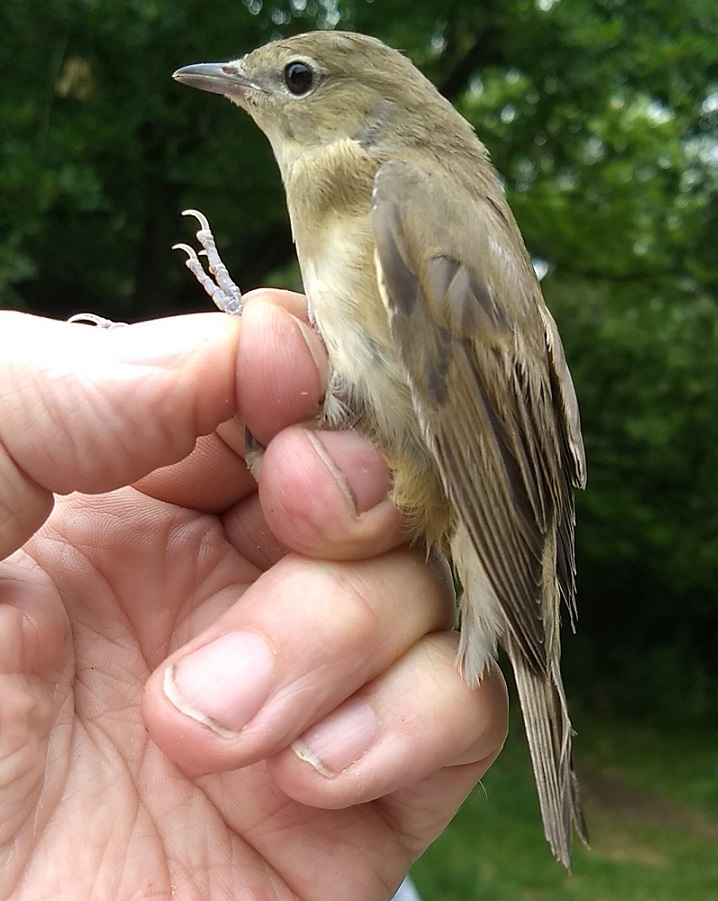
Garden Warblers are one of my favourite birds: they look so ordinary, with no flashy distinguishing markings, but I just think they look wonderfully understated, classy:
juvenile Garden Warbler, Sylvia borin
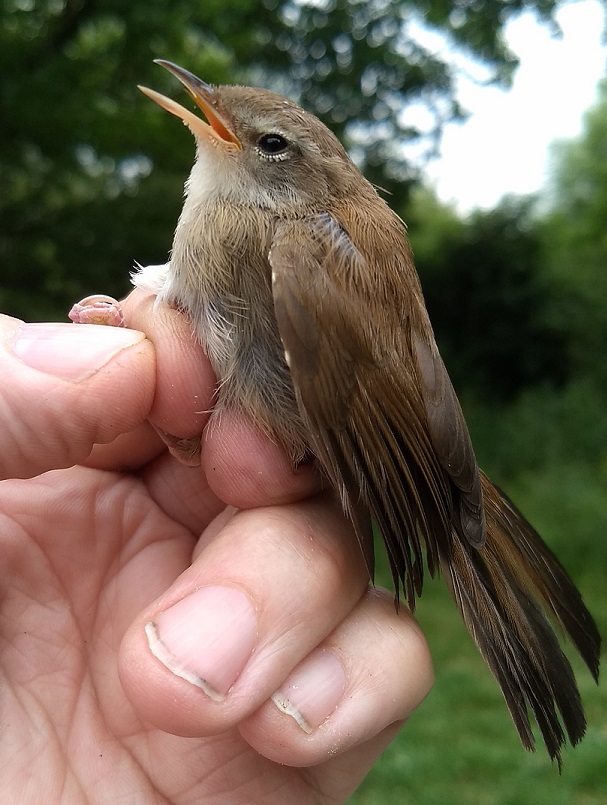
The first Cetti’s Warbler ever ringed at Lower Moor Farm was in July 2018. I checked with the previous ringer when we caught it and he had never heard them at the site, let alone caught one. Since then we had ringed 7 adults and 14 juveniles, so they are a consistent presence on the site now. This was our first juvenile of the year. It played a bit hard to get on the photograph, continually closing its eye so it didn’t have to look at me but, by repeated shooting, I managed to get one decent shot for the blog. It was only a couple of minutes before it was released and flew off strongly into the hedgerows:
juvenile Cetti’s Warbler, Cettia cetti
The list for the day was: Green Woodpecker (1); Treecreeper [2](1); Blue Tit [11](1); Great Tit [5](1); Long-tailed Tit [3]; Wren 1[2]; Robin [2](1); Blackbird [1](1); Cetti’s Warbler [1]; Blackcap [2]; Garden Warbler [1]; Chiffchaff [3](2); Willow Warbler [3]; Bullfinch 1(1). Totals: 2 adults ringed from 2 species, 36 juveniles ringed from 12 species and 9 birds retrapped from 8 species, making 47 birds processed from 14 species.
All in all, a very satisfactory morning’s ringing but, also, a very pleasant morning’s birding: Great White Egret; multiple Kingfishers buzzing around the site and, perhaps oddest of all, what I am sure was a Common Sandpiper that perched on a branch in full view on the island just in front of the Lower Moor Farm farmhouse. Visible through my binoculars but, for once, I wished that I had packed my scope!
Although the forecast for the day was for it to be clear and sunny, it was warm with quite a lot of cloud cover. It was fine for ringing but it was very sweaty when packing away at the end of the session. With the birdlife having dropped off at about 10:45, we started packing away at 11:30 and left site soon after.
Another little record for us this month – improving on last year’s catch which was, at that point, our best June result since the great schism in January 2013. It could have been a lot more but Jonny spent a week in Iceland in the middle of the month, Alice has been busy carrying out fieldwork for her PhD and, due to my recurring crippling illness episodes, I had to cancel four sessions this month. I had an MRI scan this morning so, hopefully, after 5 months they might be able to diagnose what the problem is and come up with an appropriate therapy, rather than just bouncing me around more and more addictive / strong painkillers (the morphine is my favourite so far). One downside of my condition is that, for the first time, I missed a CES session outside of the Covid restricted 2020.
The thing that stands out most to me is that we caught 44 different species this month. Normally we wouldn’t get near that except during autumn migration. Jonny got his hands on some more Canada Geese, and we had Sparrowhawk, Goldcrest, Meadow Pipit, Kingfisher and Siskin in addition to last year but were down one Water Rail, making a nett 5 species difference.
The main difference between this year and last is the improvement in the catch of our resident Blue, Great and Long-tailed Tits and Robins. Apart from Blackcaps, which showed a strong improvement on last year, all other summer visiting warbler species numbers were down on last year.
One major knockback this month was the loss of a brood of Barn Owls. Our most consistent, most dilapidated box in the condemned barn in Avis Meadows which has produced young every year. When checked at the end of May we found two naked chicks and two eggs, one of which was in the process of hatching, they were clearly not ready for ringing, so we left them alone. We went to check the box three weeks later, hoping to ring four chicks, only to find the box completely empty. I have no idea what predator would have carried that out. There were no obvious signs to indicate whether avian or mammalian. Despite that, we did manage to ring 14 Barn Owl chicks and one adult Barn Owl this month, we also ringed ten juvenile Swallows and one juvenile House Sparrow, all of which have subsequently fledged successfully.
To say that this year’s CES has been a bit of a struggle would be an understatement. I had to miss CES3 due to a combination of illness and bad weather. This morning we had to curtail our session early because the wind got up and rendered it potentially dangerous for catching birds, not to ignore the fun of extracting nets from the surrounding vegetation. However, in the short time we had the nets open (5:30 until 9:45) we actually caught and processed significantly more birds than in the equivalent session last year.
I was joined for the session by Rosie and two Lucy’s (or should that be “Lucies”?). Lucy M, back from her work on Ascension Island monitoring and working on turtle conservation, stopping off for a morning’s ringing, before heading north to take up her new role as a reserve warden at the Wildfowl and Wetlands Trust at Caerlaverock: just a wee jaunt up to Scotland. Also Lucy O who is currently volunteering with the Wiltshire Wildlife Trust and has joined in with some of the Barn Owl checking (see previous post) and Swallow nest checking in the last couple of weeks.
We had the nets open nice and early, with four sets of hands to help, and started catching immediately. The first couple of rounds were light and productive. Star bird of the morning was:
Sparrowhawk: Accipiter nisus
My team’s first Sparrowhawk of the year. Although it didn’t have particularly obvious heart-shaped markings on the breast, it was very definitely a juvenile male. The biometric measurements showed it was a male and the brown colouration, particularly around the nape of the neck, was indicative of its age. There were a couple of grey feathers on the upper tail coverts but nowhere else.
Everything changed at 8:30. In our net ride that runs along the edge of Mallard Lake we had a fall of, primarily, Blue Tits and Long-tailed Tits plus a few Chiffchaff, Willow Warbler and the odd other species representative: over 40 birds in three nets. The catch was: Sparrowhawk [1]; Treecreeper [1](1); Blue Tit [16]; Great Tit [6}; Long-tailed Tit [10](2); Wren [4]; Dunnock [1](1); Robin [2](1); Blackbird 1; Cetti’s Warbler (1); Blackcap [1](1); Garden Warbler 1; Chiffchaff [5](1); Willow Warbler [2]. Totals: 2 adults ringed from 2 species, 49 juveniles ringed from 11 species and 8 birds retrapped from 7 species, making 59 birds processed from 14 species. In fact, even the two retrapped Long-tailed Tits were juveniles, ringed at the last session there on the 15th June.
Once we had finished processing that lot, the breeze had got up and I decided we needed to shut the nets, bringing a premature end to the session. It was the right decision, the wind was just getting stronger and there were no pockets left in the nets. With three of us to take down, Rosie having left to actually go to work for the day, it didn’t take long to get everything sorted, so, we were off site by just after 10:00. At least that gave Lucy M plenty of time for her long journey north!
Last year was our best year for Barn Owls in the Braydon Forest and my part of north Wiltshire. I have a special Schedule 1 licence issued by the BTO, on behalf of Natural England, to monitor the nesting attempts of Barn Owls and to ring their offspring. We monitored 18 boxes of which 8 successfully produced 26 Barn Owl young that fledged. We also ringed one adult female in another roost box. We never found where she was nesting. One thing I learned about Barn Owls last year is that the parents occupy the nest whilst the young are small, but once they are fully downy the parents roost elsewhere. We also found two Stock Dove nests in new Barn Owl boxes, each with one chick, both of which were ringed and fledged. Two of the boxes were occupied by Jackdaws. We missed the youngsters at Blakehill Farm but ringed two youngsters that later fledged from a box near Somerford Common. We had five unoccupied boxes and one which had four cold Barn Owl eggs. We checked it again six weeks later and they were still there and cold. That was our only real failure of the year.
Over the winter I purchased a number of replacement boxes. The Wildlife Trust have done a great job of replacing worn out, falling apart boxes but these were for our private landowner sites. I did try for a grant to help finance it but, to be frank, the Community Landfill Trust really aren’t interested in dealing with an individual and, despite the BTO being extremely helpful, in the end it got so onerous that I decided to just fund them myself. At this point, a huge thank you to Vivara Pro who honoured the quotation they had given me way back in July 2021 when I started looking into this process.
We managed to replace eight of them before I was struck down with a crippling issue that has dogged my ringing activities ever since. The three boxes I have in the Wiltshire side of Waterhay, in the fields around Upper Waterhay Farm, were replaced and we added one new one. A big thank you to Andy Rumming, who not only helped me with the four boxes on their farm, but when he found out that I had paid for them myself offered to contribute towards the cost. When I demurred, he insisted on giving me a box of the grass-fed beef that he produces. What can I say? Definitely better than money – the best beef I have ever tasted: https://www.andyrummingsbeef.co.uk/
With the help of Tanya, then working for the Wildlife Trust, we managed to replace four of the boxes within the Braydon Forest before she departed for the wilds of Shropshire and a new job.
Jonny and I did a round at the end of May checking on the five boxes in the Ravensroost complex. The grotty, dilapidated box in the condemned barn did, as usual, have a brood. It comprised 2 naked young, plus one egg in the process of hatching and one egg. They were clearly in no position to be ringed so we secured the box and left. We caught an adult male in the vicinity in a hand net: unringed and therefore new to us.
Of the other boxes in the Ravensroost complex, one was empty, another had two Stock Dove eggs, but they were cold. We left them in place, just in case she hadn’t started brooding them yet, and the third had a couple of Stock Dove chicks in it. They were of a size to be ringed, so we did.
We then visited our boxes at Blakehill Farm. There had been a lot of reports that a Kestrel was using the box nearest the farmyard. Unfortunately, it was completely empty. The other box held a brood of Jackdaws, which we were able to ring. Their primary feathers were half-grown. By now they will have fledged. I will check on that quite soon. I will be hoping that the empty box is now hosting Barn Owls.
This year, as well as the Barn Owl boxes, we decided to monitor the Swallow nests in the stable block at Clattinger Farm. Rosie, Lucy and I did a check on the Swallow nests on the 10th June. There were five active nests, one of which was inaccessible. For three of them the young were all too small to be ringed yet, one nest enabled us to ring the three chicks (one for each of us). Whilst we were ringing those birds we noticed something scurrying along the floor. It turned out to be a fledgling House Sparrow who had departed the nest a bit prematurely. This drew our attention to another nest in which one remaining House Sparrow was sitting. We were able to ring it, but it then flew off quite strongly, which made me wonder how we managed to catch it in the first place.
After checking on the Swallows we headed off to check on the Waterhay owl boxes. The results were interesting. We approached the Chancel box first and two Jackdaws flew out. Checking the box it was clear that they had taken it over for the year. I didn’t know if they had already bred and their youngsters had fledged, or if they were preparing to lay, so we left it as it was. The next box, a couple of fields further over from the Chancel, was, as usual, occupied by Barn Owls. There were three small owlets in the box. Far too small for ringing. The third box, behind the paddock, had four owlets, one of which was large enough to ring:
Barn Owl nestling: photo courtesy of Lucy Ormsby
On the 14th June, Rosie and I visited the five owl boxes in the Firs / Wood Lane area. The Plain Farm box had three owlets which were ready for ringing. The Drill Farm boxes and the Echo Lodge box were all empty but the Home Farm Barn box never lets us down and we ringed four downy owlets.
Rosie and I returned to check on the Swallows again on the 20th June. They were much more developed. The birds from the inaccessible nest had fledged, as had the young from one of the other nests. They were either sitting on the rafters still waiting for their parents to feed them or out foraging but frequently returning to the stable block for a rest. We were able to ring the young from the other two nests, a total of eight ringed. They were at the stage known as “feathers medium”, i.e. the primary feathers were two-thirds grown, but they will be fledging within the next few days.
Having dealt with the Swallows, we then went back to the Ravensroost complex to check on the boxes to see how they had progressed. We first went to the box we knew had owls in it, and were devastated to find it completely empty: no sign of the chicks or the eggs, except for half an eggshell in the box. Clearly the entire brood had been predated. What by, I have no idea. The Stock Dove box with the two cold eggs still had those eggs but in another corner of the box was a warm egg. We removed the infertile eggs, leaving the other to, hopefully, produce a youngster.
On the 22nd June I met up with the owners of Gospel Oak Farm to check on his two boxes. One of those produced three young last year with the second box being used as a roost by the parents. This year is very different: the box with owlets had a Stock Dove fly out as we approached it and when I checked there were two warm eggs in the box. The box used as a roost last year was occupied by a female adult. There wasn’t much sign of multiple occupancy, but the owners did say that they had seen both adults roosting in the trees around the edge of the field, and that they had both been observed hunting across the fields.
Finally, for this post, Rosie and I revisited the Waterhay boxes. The new box is empty and clearly hasn’t been found yet. The Chancel box is deserted but was one-third full of Jackdaw nesting material, so I cleaned it out. Hopefully the Barn Owls might use it for a second brood. The next box still had three owlets, and some cached voles in the box. However, one of them was still very small and we decided it was likely to end up as food for its siblings so didn’t ring it. We did ring the three remaining owlets in the box behind the paddock.
It looks as though we might well be on the way to matching last year for Barn Owls, Stock Doves and Jackdaws. Regardless, there will be a lot to do between now and the end of the year.
As of this morning, I have been ringing at Lower Moor Farm for 6 days over 9 years. I have run it as a Constant Effort Site since 2015. That means 12 sessions over the months May to August each year (except 2020, because of Covid), to cover the breeding season and early autumn passage, plus various additional sessions. What I am saying is that I have done a lot of sessions at this site. This area, closed off to the general public, has been a mainstay of all of my ringing activities throughout this time. That is over 75 visits, with approximately 10 visits to that area in each session. This morning, whilst checking three empty nets, I saw something that stopped me in my tracks:
Bee Orchid Ophrys apifera
I have no idea how common they are, or whether they have been found in this area before, but it is a first for me. This is the second time I have found a decent orchid on one of my sites. Eight years ago I found Greater Butterfly Orchid on Somerford Common:
Greater Butterfly Orchid Platanthera chlorantha
Forestry England and the Wildlife Trust were both rather excited by it, as was I.
So, to the birding: I was joined by Rosie, doing her usual of helping me out, ringing a few birds before heading off to her work with the Trust, and Miranda, who was able to stay for the whole session. We didn’t have a massively busy session, with just 21 birds caught and processed. The list from the morning was: Treecreeper 1[2]; Blue Tit [2]; Long-tailed Tit [1]; Wren [1](1); Dunnock [2]; Robin [3]; Blackbird 1(1); Cetti’s Warbler (1); Blackcap (2); Garden Warbler (1); Whitethroat 1; Chiffchaff [1]. Totals: 3 adults ringed from 3 species, 12 juveniles ringed from 7 species and 6 birds retrapped from 5 species, making 21 birds processed from 12 species.
It was somewhat frustrating as the vegetation was full of birdsong. They just weren’t moving and, therefore, not getting caught in the nets. I suspect that a lot of them are working on second broods, defending their territory with song, and that is the reason that the bulk of what we caught were juveniles. Mind, despite the capture of two adult Blackcap, for the second session running, there were no juvenile Blackcap caught. There were at least half-a-dozen Whitethroat singing around the area and we caught one, but no sign of any juveniles. Ditto for Cetti’s Warbler.
Whilst we were there, the local fishing syndicate that leases Mallard Lake had a delivery of trout to restock the lake. The fish were much larger than I thought they would be: clearly they are not being delivered to grow in the lake but purely as stock ready for fishing. I am sure the Otters and Cormorants will appreciate them.
With the last two rounds being empty, we closed the nets at 11:45 and took down, getting away from site by just past 12:30.
I had intended to carry out this session on Saturday but, as seems to be the way with me at present, illness intervened. Having got over it, I decided to carry out the session this morning.
I arrived on site at 5:45 and set up two sets of nets down the central glade: 2x18m + 1x12m and 3x18m + 1x12m. The whole central glade is getting quite enclosed, with the undergrowth spreading across the path. A strimming session might be needed pretty soon.
It was never particularly busy, just 3 or 4 birds per round. What was surprising was the complete absence of Blue Tits or Long-tailed Tits. Although I caught two adult Blackcaps, unlike the other sites I have been to recently, no juveniles.
There was a decent haul of Robins, five juveniles ringed, plus two adults retrapped. Chiffchaffs were also much in evidence, with seven of them ringed. Of those seven six were juveniles. The only Paridae in evidence were a juvenile Great Tit and my first juvenile Coal Tit of the year:
Juvenile Coal Tit, Periparus ater
The list for the day was: Great Tit [1]; Coal Tit [1]; Wren 2; Robin [5](2); Song Thrush [1](1); Blackbird [3](1); Blackcap 2; Chiffchaff 1[6]. Totals: 5 adults ringed from 3 species, 17 juveniles ringed from 6 species and 4 birds retrapped from 3 species, making 26 birds processed from 8 species.
One of the highlights of the morning was an explosion of Wrens as they fledged the nest. I didn’t look for the nest, but it had to be adjacent to the path, because all of a sudden these little chestnut bundles were buzzing around in the understorey right in front of me (and nowhere near my nets!). They were still there when I came back from doing my net round, and again when I went for the next round. There is something almost Bumblebee-like about the way they fly when they leave the nest or, at least, that’s how it seems to me.
With the catch having fallen right away by 10:30, I closed the nets at 11:00, as they were empty, took down and was off site by midday. It was a little disappointing that the catch wasn’t larger and more diverse. There was plenty of noise from Nuthatch, Great Spotted and Green Woodpeckers. With Ravensroost having produced a good haul of Long-tailed Tits last week I fully expected to get a few in the Firs and I had hoped for another juvenile Marsh Tit or two. Not to be, alas.
It has been a long while since I have been back into Ravensroost Wood. In fact, the last date I was there was St George’s Day, when we had a fairly disappointing catch of just nine birds ringed and five recaptured. Six of those were new adult Blackcaps, so not totally disappointing. I had planned to go Wednesday but the winds were just too fierce for setting nets. Today was scheduled to be dry until the afternoon, and with little wind. They nearly got it right: the first drops of rain proper hit my head just as I was closing up the car, having packed away. There was the odd spit of rain during the morning, but it never developed into anything that could be called a shower.
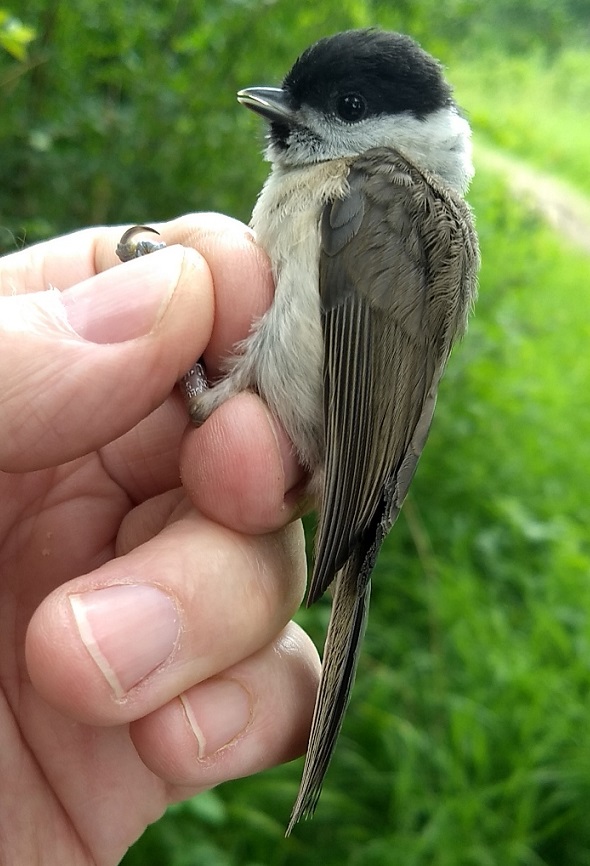
Rosie joined me at 6:00 and we set up three rides: 3 x 18m and 1 x 18m + 1 x 12m to the east of the main path and 3 x 18m to the west of the main path. Given the way the catch went, the western side will have a lot more net than the east next time. Those three nets caught 75% of the catch. As Rosie didn’t have to leave until 8:40 to get to work this morning, I let her ring almost all of the birds we caught between opening and when she had to leave. Today she got to ring a dozen birds before heading off: including the opportunity to colour ring her first Marsh Tit. It also happened to be the first juvenile Marsh Tit that we have caught this year:
Juvenile Marsh Tit, Poecile palustris
As I said, I didn’t let Rosie do quite all of the birds: when we caught a second juvenile Marsh Tit I did that myself. What was nice about both catches is that they came from opposite ends of our net setup. The likelihood that there are two Marsh territories in that area is nicely underpinned by where we caught these two recently-fledged youngsters.
After Rosie left the birds kept coming and this is where the post title comes from. I was joined by a photographer, Paul, who was very interested in what I was doing. We chatted whilst I processed some birds, I told him about the ringing scheme, how it works, and the costs associated with carrying out this work. He accompanied me on a net round, so he could see how birds are caught and watched me extract a Great Tit and a Chiffchaff, which I then processed. He went on his way but, before leaving, slipped a £10 note under my weigh scales to put towards my next ring purchases. I was taken aback, and very grateful. Totally unexpected generosity from someone I didn’t know. Anyway, he will be joining me on occasion again in the future.
It was a really decent catch, as well as the first juvenile Marsh Tits of the year I also caught my first juvenile Willow Warblers of the year:
juvenile Willow Warbler, Phylloscopus trochilus
In total there were four juvenile Willow Warblers processed. Two of them had me worried, nothing to do with their health, but they had 60mm wings. Those are the shortest wing lengths that I have personally recorded on a Willow Warbler. For a short while I was wondering if they could by a Willow – Chiffchaff hybrid. However, as you can see from the photo below, the 6th primary was not emarginated, so definitely Willow Warbler. The BTO Ringers Info app came in very handy for a quick reference, backed up by both Svensson & Demongin, in which the bottom end of the wing length range for a Willow Warbler is 58mm.
Willow Warbler wing showing lack of emargination at P6
The list for today was: Treecreeper [1]; Blue Tit [2]; Great Tit [1]; Marsh Tit [2]; Long-tailed Tit [7]; Wren 1(1); Robin [10](2); Blackbird 2; Blackcap 3[3]; Garden Warbler 1; Chiffchaff 2[1](1); Willow Warbler 1[4]; Chaffinch 2; Bullfinch 2. Totals: 14 adults ringed from 8 species; 31 juveniles ringed from 9 species and 4 birds retrapped from 3 species, making 49 birds processed from 14 species.
I closed the nets at 11:20 and left site an hour later, just as the rain started properly, after a thoroughly satisfying session: even the three dog walkers had their dogs on their leads!




 Ringing In The Braydon Forest & Beyond