Blakehill Farm: Saturday, 20th August 2022

Well, what can I say, a ringing demonstration in which there were three times as many attendees as birds and only two more birds than the number of your team that turned up to help! It was really good. I had Ellie, Rosie, David and Anna arrive (at various times) to help with the set up and the take down and to do each of the net rounds, whilst I entertained the public and drank coffee!

There was always a risk with scheduling a ringing demonstration at Blakehill: it is so open and susceptible to the wind. On the other hand, there is a lot of early autumn migration at the moment and the possibility of a few decent birds is highest at that site. Unfortunately, although the wind was forecast to be quite low until 10:30, it got up pretty much from the start. The speeds that the forecast said would be the gusting speeds turned out to be the base speeds. The nets on the plateau bushes were most at risk, and were blowing out quite early on. However, they did catch five of the seven birds caught in the session before we had to shut them to ensure the safety of the birds.

Yes: seven birds! All new, so all needed ringing, and all juveniles. They were Wren 2; Tree Pipit 1; Blackcap 1; Whitethroat 2; Lesser Whitethroat 1. Why was it really good? Because of this bird:
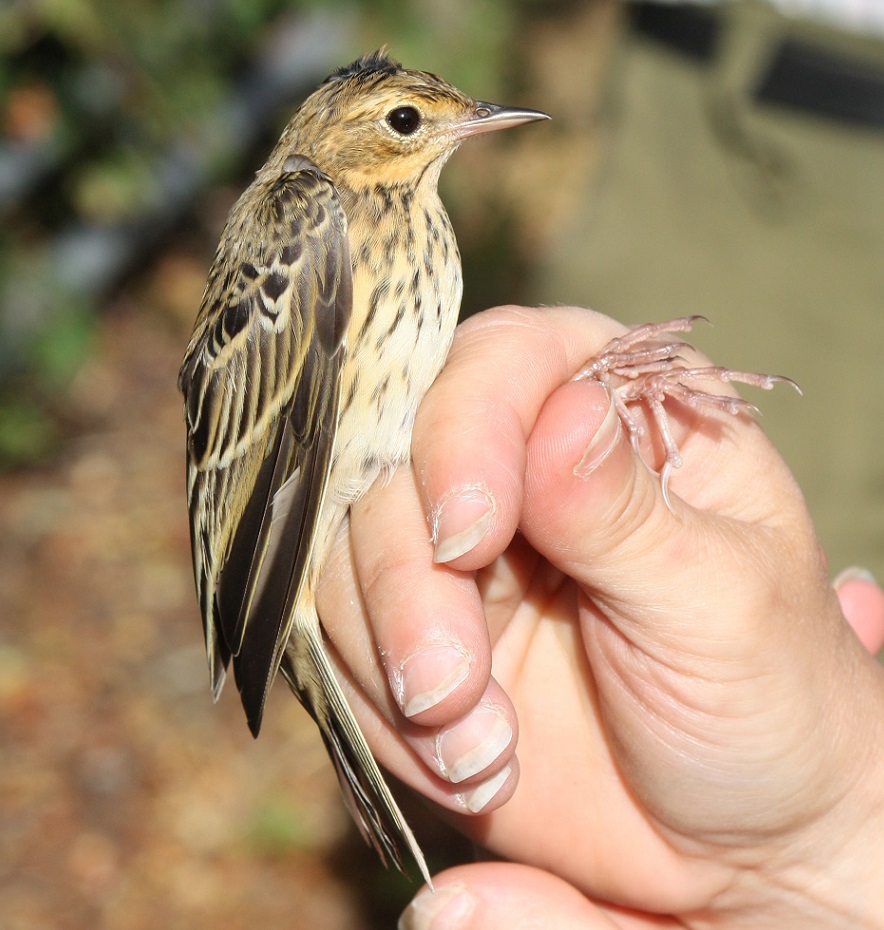
Juvenile Tree Pipit, Anthus trivialis

This is only the second Tree Pipit ringed at Blakehill Farm, and Robin Griffiths, who carries out more coverage of wildlife on north Wiltshire Wildlife Trust sites than anyone else, including any Trust employees, was delighted to see his first ion any of those reserves.

Anna was also pleased: on her first session out for a number of weeks, due to the demands of her job, she got to ring her first ever Lesser Whitethroat! That was the bird of the morning as far as the attendees were concerned. It was a beautifully marked juvenile bird and everyone was wowed by it.

We closed the nets at 10:30, earlier than intended, but we weren’t getting any birds in the more protected hedgerow nets and the plateaus nets were just unusable. Everything was packed away and we cleared the site by 11:30: time for an early lunch!
Lower Moor Farm, CES 11: Thursday, 18th August 2022

With rain forecast for Wednesday I decided to move this session to Thursday. It proved to be the right decision: when I got up at about 8:00 on Wednesday morning the bucket I had left outside the house had an inch of water in it and it had only just finished raining. Rosie joined me this morning at 6:00 and we had the nets open quite quickly. I had decided that, as I would be working and packing away solo, I would leave the least productive (and furthest away) of my CES rides in the car.

The first bird out of the nets was a juvenile Cetti’s Warbler. It was great that Rosie could stay until about 8:45, and that she started her morning’s ringing with ringing her first Cetti’s Warbler (she had previously processed a retrap in June, but not ringed it). We had a reasonable catch up to the time Rosie left. Unfortunately, after she left the catch numbers went down quite a lot, and what looked like being a 40 to 50 bird catch ended up a 29 bird catch. That is not to say that it wasn’t an enjoyable session, but there is still no sign of Whitethroat or Lesser Whitethroat on the site.

The entire catch, bar one retrapped adult Blue Tit, comprised juvenile birds and was: Treecreeper [1]; Blue Tit [4](3); Great Tit [1]; Wren (1); Dunnock [1](1); Robin [2](2); Blackbird [1]; Cetti’s Warbler [1]; Blackcap [5](2); Chiffchaff [1](1); Willow Warbler [1]; Bullfinch [1]. Totals: 19 juveniles ringed from 11 species and 10 birds retrapped from 6 species, making 29 birds processed from 12 species.

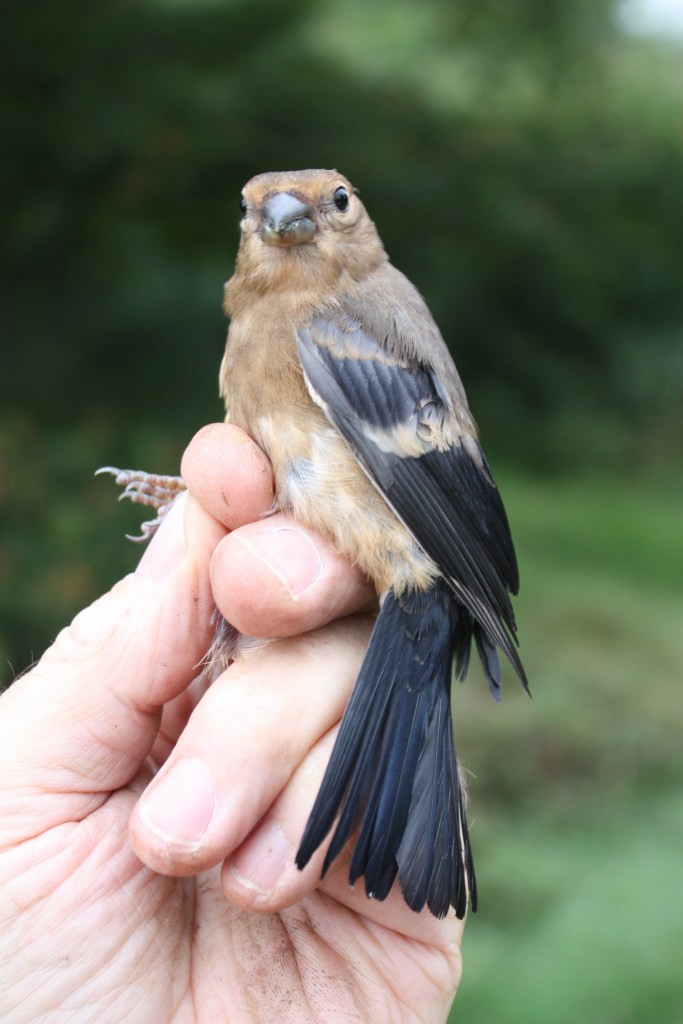
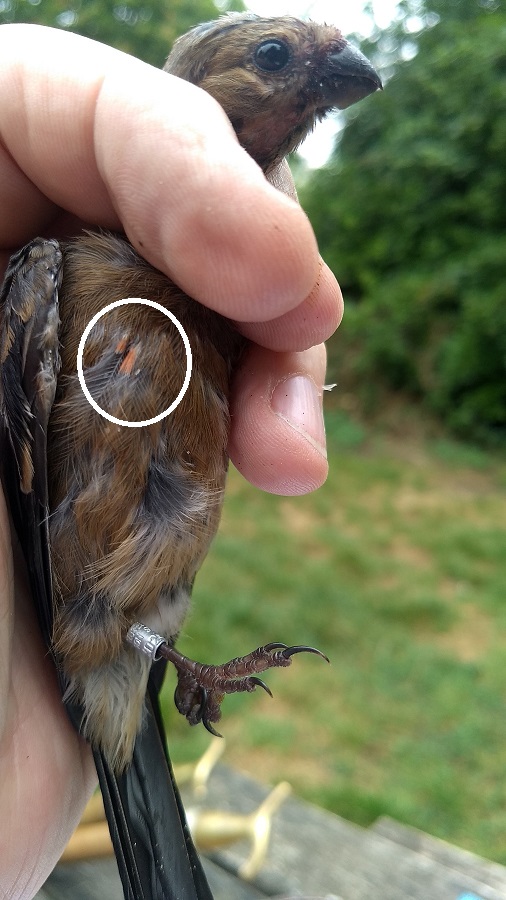
As with the last session, a lot of the youngsters of sexually dimorphic species are beginning to show what sex they will be. Last week it was Blackcap, which continued this week. Also this week we had this young chap:

Juvenile Bullfinch: Pyrrhula pyrrhula

He looks pretty tatty because, unlike juveniles of sexually monomorphic species, he is moulting a high proportion of his original body feathers. Within the white circle you can see two pink feathers, as the belly and chest feathers all start to be replaced, indicating clearly that it is a male.

One of the more surprising bird catches at Lower Moor Farm is the Treecreeper. Apart from one, now defunct, 12m net in a bit of woodland, the nets are generally set either stream-side or lake-side, with a thin lining of trees, mainly different varieties of willow, Since I started ringing there in 2014, I have carried out 139 ringing sessions. In those sessions we have caught Treecreeper on 64 occasions. Essentially, an average of 1.31 Treecreeper per session when caught and 0.6 Treecreepers as a proportion of all ringing sessions.

You would expect that the Braydon Forest woodlands would produce a much better return. In the same timeframe that I have been regularly ringing at Lower Moor Farm, in my five woodland sites I have carried out 399 ringing sessions. The number of Treecreeper ringed is 141 in exactly 100 sessions. So, that’s 1.41 in woodland compared with the 1.31 on the edges of the old gravel pits that make up Lower Moor Farm. So far, so unsurprising. What is surprising though is that the average number ringed in the woodlands, as a proportion of all sessions, is only 0.35. Anyway, hopefully that is of interest to someone out there!

I was away from site just after 12:30. The last CES session of the year will be Saturday, 27th August.

Something Different: The Firs; Saturday, 13th August, 2022

I took the decision that, given the hot weather, lack of rain and the potential impact of that on the birds, to stop bird ringing until there was a break in the weather. However, my interests are not confined to birds, I love all wildlife and I thoroughly enjoy mothing.

I took up mothing in 2011. Started with a Skinner trap with a mercury-vapour light. Very quickly I got a bit fed up with the Skinner trap’s inability to retain specimens, so went the whole hog and bought a Robinson set up, which I have used ever since. Interestingly, at the same time I upgraded the trap, I purchased a dozen MV bulbs, assuming they would last like usual old-fashioned bulbs. So far I have used two of them!

Anyway, the point of this blog is the Wiltshire Wildlife Trust’s “Take Action for Insects” project being run by Michael New, Ecological Officer at the Trust. There were five of us in action: Michael, Colin, Paul, his daughter Stevie and me. We met up around 7:00 to be set up before dusk. There were four mothing stations set up.

I owe them all a debt of gratitude as, post-op, Michael was insistent that they would carry my kit to and from my selected mothing site. I had decided to set up at the bottom of the hill, close to the ponds on the central glade, so everything had to be carried down and then back up at the end. At least, with my 90m extension lead, the “portable” generator didn’t have to be carried all of the way down. My system was set up and switched on just before 8:00 and almost immediately started attracting insects. Next time I will be taking a face mask. Before any moths started appearing, a whole variety of different fly species arrived and I became enveloped in a swarm of the things. Next time I am taking a face mask and my jungle formula spray! I have no idea how many minute flies I inhaled and otherwise ingested but I probably had my protein ration for this week.

The first moths that I saw were some grass moths that were disturbed by my walking to get away from the light to leave the flies behind. I had remembered to take my bat detector with me and was very pleased to identify both Common and Soprano Pipistrelle hunting around my part of the woodland.

The first moth recorded for the night was by Paul & Stevie, with a Square-spot Rustic. I don’t know what the others caught that night but I had an extremely satisfactory session. However, unlike in my garden, the bulk of what I caught were micro-moths and, so, sorting them out has been a challenge. My list is:

I have highlighted Metalampra italica because it is a relatively recent addition to the British list, first recorded in 2003, but spreading quite rapidly. It was thought to be endemic to Italy, hence the specific name, but it is not known if it is a range expansion north-west through Europe or an accidental introduction. Unfortunately, it is the worst photograph I took! Thanks to Robin Griffiths for identifying it for me.

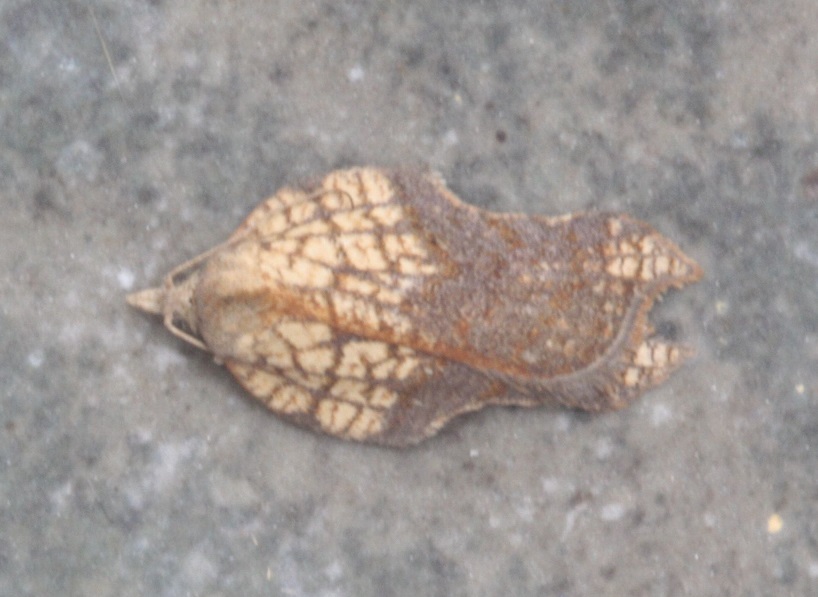
Anyway, here are a few photos from Saturday night, starting with some Micros:

Acleris cristana
Acleris emargana
Chequered Fruit-tree Tortrix
Strawberry Tortrix
Magpie
Metalampra italica (with apologies)

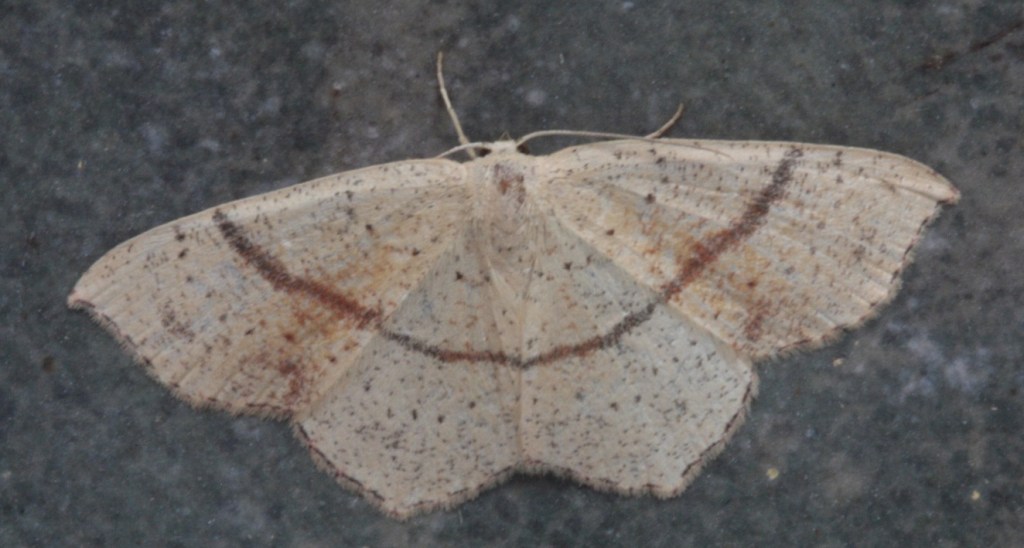
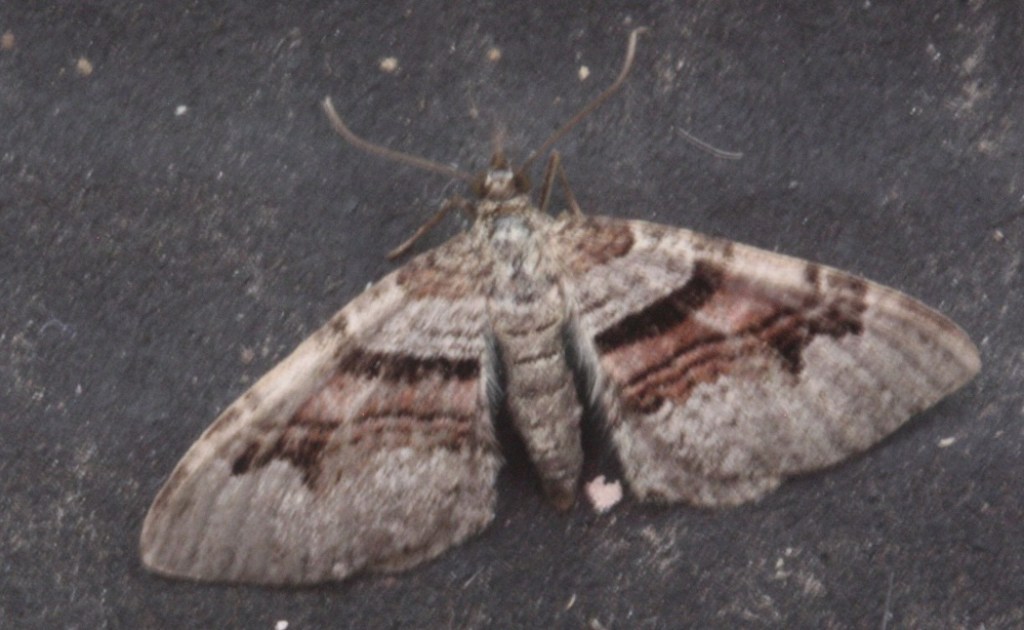
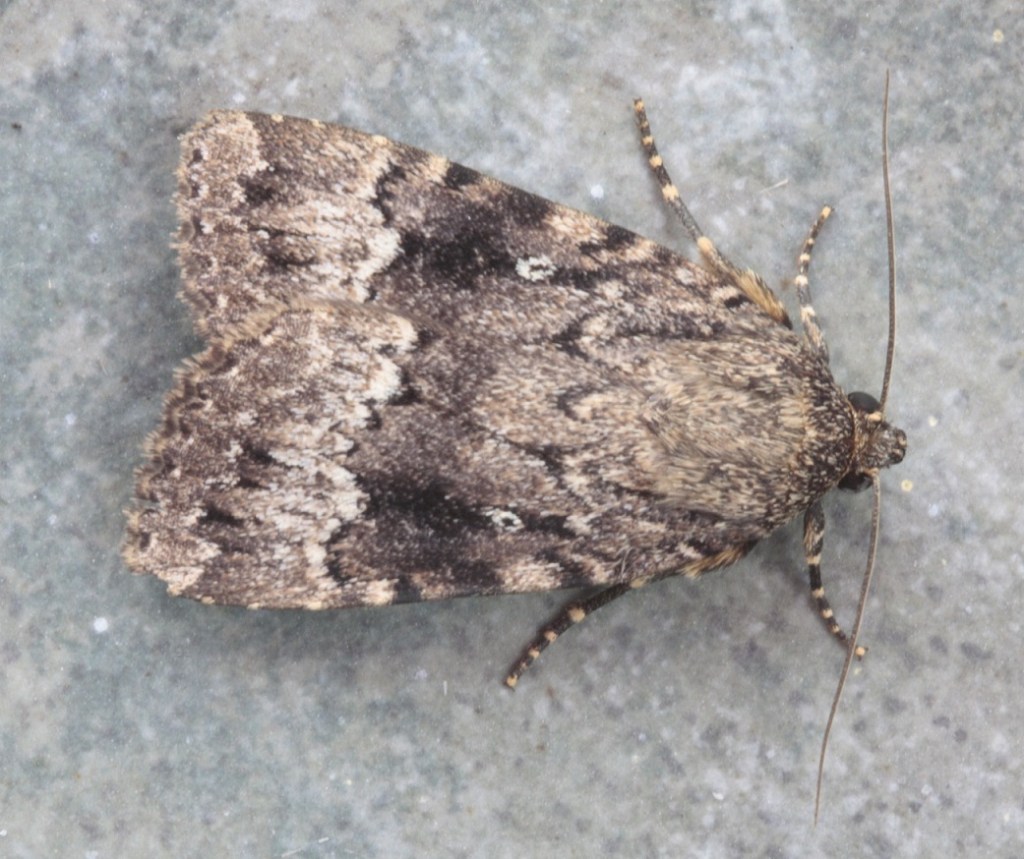
Now a few Macros:

Maiden’s Blush
Dingy Footman
Dun-bar
Flame Carpet
Copper Underwing
The underwing pattern indicates it is Copper Underwing not Svensson’s Copper Underwing
Common Wainscot

Once again, thank you to Michael and the team for helping me so mcuh on Saturday night. I started emptying the trap at 11:30 and, being the lightweight that I am, was away from site by quarter past midnight, leaving the others to continue their session.

It will be back to birds tomorrow – CES 11 at Lower Moor Farm.

Barn Owl Ringing the easy way: Friday, 12th August 2022

Although I have cancelled my bird ringing session for this weekend, because it is just too hot, and I think the birds don’t need any additional interference in their lives whilst dealing with this weather. Some are still rearing their last broods and / or fattening up for / starting their migration and I am happy to let them get on with it.

As the forecast is for it to be cooling down from Tuesday, getting some rain from Sunday, I am hoping for a session on Wednesday.

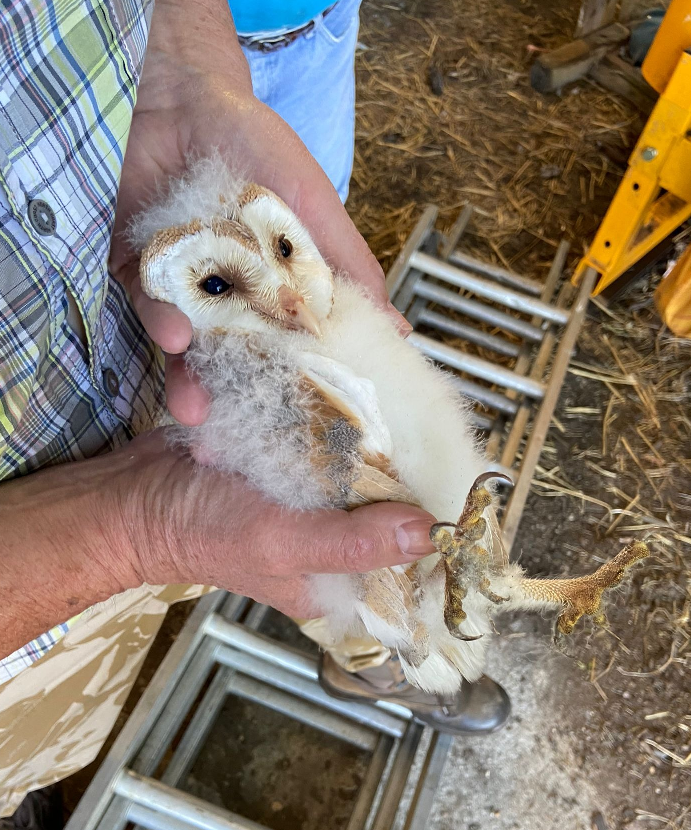
However, it was nice to get a call out of the blue from a local farmer and asked to go and ring the Barn Owl chicks in his box. I didn’t know him but he managed to find me through the Wiltshire Wildlife Trust and their “What’s On” pages. Thanks to Robin Griffiths, volunteer warden and wildlife surveyor par excellence, for putting him in touch with me.

I had a chat and we agreed to meet up on Friday at 8:30, before it got too hot. I turned up to be met by the farmer, his wife and son and his farmhand. Due to my recent operation I am not allowed to carry anything heavy for another three to four weeks. We had agreed that they would carry the ladder to the barn, which they did, but it turned out that they had a tractor with a cherry-picker front, so that made the whole procedure much easier. Apparently some people are more scared of working from that than from the top of a ladder!

The farmer has a camera on the nest and thought he had four chicks, but it turns out he had five. I love it when you open the box to be met with a chorus of hissing. For one thing, it shows they are of a good size to ring. All were in good condition, all still downy but have just started growing their primary feathers and the oldest two had their head feathers showing well. It seemed only right to get the farmer and his farmhand to hold the birds for me to ring them: which I know they enjoyed immensely.

The adults haven’t been seen in the daytime yet, which would often be a sign of a lack of prey, so, hopefully, stocks of short-tailed voles, field mice, etc are holding up well despite the weather.

Despite my having been out of action for the last 4 weeks, this takes this year’s total of juvenile Barn Owls ringed to 21, compared with last year’s total of 26 juveniles and one adult. Hopefully by the end of September we will have matched last year’s total: I do know I still have a number of other boxes to check and they could well be on second broods now.

Lower Moor Farm: CES 10, Monday, 8th August 2022

On Wednesday of last week, I decided that it was time I ran my first full session since my spinal operation. Not wanting to overdo it, I decided to set just 4 x 18m nets in Ravensroost Woods along the main track north of the public bridleway. Rosie, as ever, came along to help me set up, and stayed until she had to go off to work at 8:00. We met at 6:00 and had the nets open at 6:30. We caught three birds in between opening the nets and Rosie leaving for work : a Treecreeper, a Robin and a Blue Tit. Unfortunately, those were the only birds, caught until I got fed up and packed away at 10:00.

So to today. Nobody was available to help me over the weekend, but Ellie said that, as she was working from home on Monday, she could come and help me set up and do some ringing until just before 9:00 and, even better, come back at 12:30 to help me pack away at the end of the session, whilst having her various meetings in between. We met at 6:00 and had the nets open by 7:30. There was a bit of a wait before things started to move, and we didn’t catch our first birds until just before 8:00. It was never the busiest session: four or five birds per round but it was enjoyable, although the last hour, when packing away, was too hot. Next time I will start an hour earlier and finish an hour earlier.

Just before Ellie had to leave, she came back with a pair of juvenile Bullfinch from what is designated ride 2. The very next round, from the same ride and the same net, I extracted another couple of them. I am pretty sure that they were all four from the same brood.

It was a varied catch but, like my other sites this year, no sign of Whitethroat or Lesser Whitethroat. It is a little concerning. The top bird of the morning was a very fresh, young, Reed Bunting. It was the first of that age that we have caught at the site for over three years.

The list for the day was: Treecreeper [1]; Blue Tit [1]; Great Tit [2]; Long-tailed Tit 1; Wren [2](1); Dunnock (2); Robin [6](2); Blackbird (2); Blackcap [7](1); Garden Warbler [1]; Chiffchaff [1]; Willow Warbler [1]; Bullfinch [4]; Reed Bunting [1]. Totals: 27 juveniles ringed from 11 species; 1 bird ringed of indeterminate age (the Long-tailed Tit was too far gone through its moult to tell adult or juvenile apart) and 8 birds recaptured from 5 species. Of the recaptured birds the Dunnocks, Robin and Wren were also juveniles.

A couple of photos to finish. The first is a juvenile Blackcap in the last throes of its post-fledging moult: the head is showing black feathers coming through the juvenile brown on the head, identifying it as a male:

The second is a bird I find particularly difficult to photograph: a Treecreeper. I have settled on a wing shot to show up the key diagnostic feature for distinguishing juveniles from adults once they have completed the post-fledging moult:

The tips of the primary coverts are tear-shaped on a juvenile and pin-pricks or missing on adults.

The reason I find them so difficult to photograph is that, with their down-curved bill and habitually humped shoulders, they always look so miserable and I have had quite enough of others making negative comments about photos of birds in the hand (usually other ringers, they aren’t all as relaxed and easy going as me).

We got cleared away and left site by 13:15: in time for Ellie to get back to her first meeting of the afternoon and me to get home and realise I have a way to go yet before I am fully fit again.

West Wilts Ringing Group: July 2022 Results

What a month! The headline has to be Jonny’s Icterine Warbler at Langford Lakes.  An absolutely stunning catch: only the fourth record of the species in the county.  The first was a bird heard singing back in June 1944!  The second, and first one of the species ringed, was near Longbridge Deverill in August 2009.  The next was ringed by Graham’s team on SPTA in August 2020 and now the first for the West Wilts group was at Langford Lakes on the 23rd July.

Langford 230722b.jpg
Langford 230722c.jpg

The results for the month were:

jul22.png

As you can see, the average catches were much larger but the variety was somewhat lower.  Missing were Barn Owl, Carrion Crow, Grasshopper Warbler, Nuthatch, Skylark, Coal Tit, Grey Wagtail, Tree Pipit and Whinchat.  Interestingly, the Carrion Crow and Nuthatches were caught and ringed in Biss Wood, the Grey Wagtails at Langford Lakes, the Coal Tits at Webb’s Wood, the Tree Pipit at New Zealand Farm and the Grasshopper Warbler, Skylarks and Whinchat were all at Ladywell in the Imber Valley.  What I don’t understand is why this site is visited so rarely: just three times since 2017! In my mind there is a serious issue over the allocation and utilisation of sites on Salisbury Plain. I have asked the Defence Infrastructure Organisation on a couple of occasions what their strategy is for monitoring habitats and wildlife on the Plain. To me it is piecemeal and unstructured and pretty much worse than useless for managing the area. Their response was to complain to the BTO that I was harassing them. I won’t say any more on this other than to confirm that the BTO were not supportive and the likelihood of me ever getting the chance to carry out my usual consistent surveys, reporting and analysis to the landowners is not going to happen anywhere on Salisbury Plain any time soon.

The lack of Barn Owls is entirely down to my being out of action from the 7th of the month until I managed a small session at the Ravensroost Meadow pond on Saturday. That was a weird session: all of the Whitethroat and Lesser Whitethroat that were there in good number at the end of May were completely missing from the site. It is hard to understand when, given the weather, the site has excellent nesting habitat, water and insects galore to feed their young.  I wonder what the cause was?  Given that Lesser Whitethroat were missing from my site, it was one of the species caught this year that was not caught last July.

This year we added the aforementioned Icterine Warbler, more Canada Geese and Lesser Whitethroat.  Why the massive increase in numbers? Simply: Blackcap and Chiffchaff numbers were massively improved over last year.  Increased numbers of Cetti’s Warbler and twice as many Wren as last year,  Amongst the retrapped birds, the key increase was in the number of Blue and Great Tit recaptures. So we averaged nearly 20 birds more per session.

As mentioned, I have been incapacitated due to spinal problems, an operation, and then a bout of sciatica, which has just about gone now, but has severely impacted on my activities and will continue to do so for a few weeks yet.  So, thanks to Jonny for taking on two of my CES sessions.  Hopefully enough of my team will be available to help me through the three remaining sessions.

We are also saying au revoir to Alice.  I am delighted to say that she has been awarded her S-permit, and will be teaming up with Oliver Padgett to create the Oxford Ringing Group.  It has been an absolute delight having her as a trainee, and I am so pleased for her achievement. Who’s next?

Ravensroost Meadows: Saturday, 30th July 2022

This was my first session out since my spinal operation on the 12th July. It was a bit of an experiment to see how I / my body would cope. The first few outings I have had have been more than a little sore. My post-op regime, proposed by the hospital’s physio department, has been regular 20 minutes sitting and then a brief period of exercise, and repeat. That pretty well sums up a bird ringing session: 20 minutes sitting and processing the birds before carrying out the next extraction round.

I had the estimable Rosie come along to help me set up, before disappearing to work, and David joined me for the whole session. Trevor, his dad, arrived in time to help us with the taking down. All in all, I coped pretty well, except for the last 10 minutes of taking down the nets, which meant I was on my feet for about 40 minutes, and I felt it. That rather draws the line under what I am currently capable of.

To the session itself. It was rather odd: where have all of the Whitethroat disappeared to? They were very obvious by their presence in my last session there in late May. Lots of evidence for breeding and, on this date two years ago, we caught ten of them: nine juveniles and one adult. In fact, the same can be said for Lesser Whitethroat, same number at the last session in May and none around today.

The list was actually dominated by juvenile Wrens, as follows: Blue Tit [2]; Wren [5]; Dunnock 2; Robin [2]; Blackcap 2[1]; Chiffchaff 1(1). Totals: 5 adults ringed from 3 species, 10 juveniles ringed from 4 species and 1 bird retrapped, making a total of 16 birds processed from 6 species. Not the biggest catch but, as David hasn’t been out for over a month and me for two weeks, it was enough.

We had a lure of for Swallow, and there were plenty skimming the fields, but they weren’t dropping in for a drink and they missed the causeway net. That net did provide a Chiffchaff, two Blue Tits and a Wren. It also provided a Chaffinch, with the worst case of Fringilla papillomavirus that I have seen for a very long time.

After David and Trevor had carried all of the kit back to the car for me, I had a sit to enjoy the peace and quiet (and recover a bit) watching the Swallows, when the tranquility was disturbed by the agitated calling of a Jay. For the few minutes I was treated to this Jay making life very uncomfortable for a female Sparrowhawk. A very fine finish to a quiet but enjoyable session.

CES 9: Lower Moor Farm; Wednesday, 27th July 2022

Jonny once again stepped in to run my CES for me whilst I continue my recovery. Ellie joined him first thing, until she had to leave for work at 9:30, and I put in an appearance between 9:00 and 10:00, thanks to my lovely wife, Lilian, driving me to site.

It was nice to ring a few birds again, especially when one of them was my team’s first (of two) newly fledged Bullfinch for the year. Jonny beat us to it, with one on his Sutton Benger site 5 days ago, but it is always a good catch.

Juvenile Bullfinch, Pyrrhula pyrrhula

I love the way they look at you, so indignant.

This year’s catch was considerably better than the equivalent session last year (24 birds from 12 species) compared to this year’s 55 birds from 16 species. The list was: Treecreeper [2](1); Blue Tit 1[2](2); Long-tailed Tit [1](1); Wren [2]; Dunnock [1](1); Robin [1](2); Song Thrush 1[1]; Blackbird (2); Cetti’s Warbler (1); Blackcap 1[5](1); Garden Warbler [1]; Whitethroat [1]; Chiffchaff 1[16](2); Willow Warbler [2]; Chaffinch [1]; Bullfinch [2]. Totals: 4 adults ringed from 4 species, 38 juveniles ringed from 14 species and 13 birds retrapped from 9 species, making 55 birds processed from 16 species. Of the retrapped birds, 6 were juveniles from 4 species, so the total number of juveniles processed was 44.

We left Jonny to it and wandered over to the Dragonfly Cafe for coffee and cake – only the cakes hadn’t arrived yet! I had to settle for a toasted teacake, which was very nice. As we were getting ready to leave, the cakes arrived! I resisted!

Jonny carried on for the rest of the session and packed up by midday. Hopefully, I will be able to do the next few myself, as I plan to start ringing again on Saturday: which should mean I can start doing some proper blogs again, instead of waffling on!

Icterine Warbler, Hippolais icterina: Sunday, 23rd July 2022

Jonny was ringing this weekend at one of his sites. The site is not open to the public, and the landowner does not want the site named. As, according to the records, this is only the fourth record for the species in Wiltshire and it is a sensitive site, the caution is warranted.

The other records are interesting. Wiltshire’s first record was near Salisbury on the 11th June 1944. This bird was identified by song, rather than by observation or catching for ringing. Our second record was a bird caught and ringed in August 2009 near Longbridge Deverill. Most recently, one was caught and ringed by the North Wiltshire group on the Salisbury Plain Training Area on the 16th August 2020. Thanks to Rob Turner for providing this information.

So to this bird. I was sitting at home, unfortunately still housebound after my operation, when I saw I had a missed call from Jonny. I called him back and, after a bit of phone tennis, we had a chat. He was, rightly, so excited. As he put it, he was extracting birds, a number of Phylloscopus warblers, when he noticed that one was somewhat larger and, although the plumage was superficially similar, different to what he had handled before.

He had already done the hard work, taking all of the appropriate biometrics, as follows:

  1. Wing Length: 79mm (75 – 83mm)*
  2. Weight: 14.2g
  3. Tail Length: 54mm (49 – 55mm)*
  4. Tail / Wing Ratio: 68.4% (62 – 71%)*
  5. Bill Length: 16.2mm (15 – 17.5mm)*
  6. Distal Bill Length: 9.2mm
  7. Proximal Bill Length: 5.0mm
  8. Tarsus length: 21mm (19.5 – 22mm)*

* Reed and Bush Warblers: Peter Kennerley and David Pearson, illustrated by Brian Small. Helm Identification Guides, 2010

Jonny and I had a long discussion about ageing the bird and hadn’t come to any firm conclusions. He then sent me over a number of his photographs, a selection follows:

Fig. 1: Icterine Warbler

I have to say that this first photograph gave me some concerns regarding ageing the bird: is that barring a natural part of its plumage or are they fault bars. If the latter, it would strongly indicate that it is a bird of this year. However, there is also a fair amount of wear on the retrices, which would indicate adult. However, Jonny then sent over a picture of the wing:

Fig. 2: Wing showing primary & secondary feathers

This photograph is almost identical to the photograph of a post-breeding adult Icterine Warbler in Jenni & Winkler’s second edition of “Moult and Ageing of European Passerines”, Fig. 233 pp 146, with wear on P5 to P9, counting descendantly from the outside. Interesting, but we settled on it being an adult bird. If anyone with more experience of the species (this is only the second I have seen: the other was one I ringed on Skokholm in 2015) has any information regarding ageing of this bird, please contact me through the blog feedback.

Fig 3: Head Shape, typical of Icterine Warbler
Fig. 4: Underside

A great find and hopefully ringing it will generate more data on its future movements. It would be too much to hope that it might be recaptured next year.

CES 8: Lower Moor Farm; Wednesday, 13th July 2022

This is a truncated report, as I wasn’t there to join in. After several months of pain, I was in hospital yesterday having a wonderful procedure called a lumbar decompression of L4 and L5. They were going to carry out a discectomy, if it wasn’t too badly fused, as I also have a prolapsed spinal disc in that region. Unfortunately, it remains but the pain has gone. The story of how I got to the point of being operated on is the stuff of nightmares and not for a nice blog about bird ringing. All I will say is that the recent introduction of a clinical pathway for spinal pain seems designed to delay diagnosis, start treatment before they have diagnosed the problem, possibly making things worse, and making you suffer as long as possible before treatment.

Jonny Cooper very kindly has offered to carry out the next couple of CES session whilst I recover, as I am not allowed to drive for a couple of weeks and not allowed any heavy lifting for 6 to 8 weeks. With the weather looking too hot for the end of the week, he decided to carry out the session Wednesday. He was worked solo, and was active by 5:45, having driven over from Chippenham to get set up, and proceeded to catch a smallish haul for the day. The key difference between this session’s catch and the last catch was the complete absence of Blue, Great and Long-tailed Tits from this catch. However, it was a much better catch than the equivalent session last year, when only 21 birds were caught. The key is that there are more juvenile birds around this year.

The catch this session was: Treecreeper 1; Wren [7](1); Dunnock [1](1); Robin [6](2); Blackbird [1]; Cetti’s Warbler [2]; Reed Warbler 1; Blackcap 1[4](2); Garden Warbler [1]; Chiffchaff 2[1](1); Willow Warbler 1. Totals: 6 adults ringed from 5 species, 23 juveniles ringed from 8 species and 7 birds retrapped from 5 species. Of the retrapped birds, the Blackcap and the Robins were also juveniles.

Jonny brought the session at 11:45 because only mad dogs and Englishmen stay out in the midday sun. Hang on – he’s English, clearly not mad though. Thanks Jonny.