The Firs: Saturday, 19th March 2022

With the wind changing to an easterly and forecast to be quite strong, I changed venue from Blakehill Farm (one day!) to the Firs, because of its north-south ride axis, and the woodland to offer protection from the breeze. I was originally expecting to have quite a big team out, so packed plenty of kit in the car, only to have all bar Rosie drop out for one reason or another. Rosie joined me to help set up before heading off to work at 8:30. It was quite cold initially, but pretty quickly the sky cleared and the sun came out and began the warming process.

The feeding station hadn’t been topped up for a while, so I wasn’t expecting a huge catch. We did fill it, but it was a bit of a token gesture. I will be removing it next week, until next winter. We put on lures for Chiffchaff, Blackcap, Lesser Redpoll and Siskin: hedging our bets on which migrants might be around.

The first round produced three unringed second year Wrens. It never got busy but there were usually two or three birds per round. We had listened to several Chiffchaff singing away around the wood and the second round served up our first of the morning. Next round we caught LXL932, ringed in the Firs as an adult in April 2021. The following round we caught, in the same net, LXL931. We often catch sequential numbers of resident birds, but catching sequential numbers for a summer visitor is really encouraging.

Whilst extracting the birds for this round we were distracted by what was clearly the distress call of a Corvid. The next thing, a huge influx of Jackdaws were heading towards the source of the call. We didn’t have time to go and investigate what was going on but the distress call went on for several minutes and was quite disturbing.

There was a lot of birdsong all around the woodland, and we were also treated to a drumming display from two Great Spotted and one Lesser Spotted Woodpecker. The Firs is the one place that I regularly see and hear Lesser Spotted Woodpecker, but I have not yet found evidence of breeding, unlike in Ravensroost Wood where I have found both nest holes and seen newly fledged young in the past.

The list for the day was Blue Tit 2(3); Great Tit (3); Coal Tit 1; Wren 3(1); Chiffchaff 1(2); Goldcrest 2(1). Totals: 9 birds ringed from 5 species and 10 birds retrapped from 5 species, making 19 birds processed from 6 species.

Early signs of Spring: there were several Brimstone butterflies flying around the central glade.

The wind really started to pick up at just after 10:30, the net pockets were blowing out and the possibility of catching anything else was remote, so I decided to shut the nets and take down. I left site at just after 11:30.

Brown’s Farm: Thursday, 17th March 2022

It is so difficult to get sessions in at Brown’s Farm. Being at the top of Postern Hill, just south of Marlborough, it is totally exposed to the elements. The only time that I can get there is when the weather forecast is for it to be more or less flat calm, with gusts remaining as far under 10mph as is possible. With Wednesday’s session being rained off (f0r 0nce they got the forecast right: it started raining at just after 9:30 am and didn’t let up until 9:30pm), and the forecast set fair for a dry day with minimal wind, I headed for Brown’s Farm.

As ever, Rosie joined me to help set up before heading off to do her day job with the Wildlife Trust. Knowing that I was going to be working solo for much of the session, we only set four rides: three of 2 x 18m nets (1,2,3) and one single 18m net (4). The multiples were set along the leeward side of the main path hedgerow and the singleton adjacent to the pond:

James, the farmer, has done his biennial hedgerow maintenance, so the hedges were a bit lower than I had anticipated. It wasn’t particularly busy. There were several reasons. For one thing, it was much windier than forecast. With the positioning of the nets, the lower shelves were protected from the breeze, but the two upper shelves were blowing out and, subsequently caught nothing and probably put off a few other potential captives. Had I known about the wind and the reduced hedgerow height I would probably have gone with 2-shelf, as opposed to 5-shelf, nets. Equally, if I had had a team out with me all morning, I would have set more nets along the hedgerow.

Whilst we were setting the nets we had fantastic views of a Hare. It just ignored us whilst we were working: we were moving towards it and it was coming towards us. Eventually it came within 50m before deciding to skedaddle. We then had great views as it disappeared across the field at a rate. Later we had another couple of Hares appear further up the field. We watched them chasing around the field and were hoping for a boxing match but no such luck.

Although it wasn’t our biggest catch, we did have a very respectable 13 Yellowhammers. This is actually our second largest single session catch of Yellowhammer at this site: the largest being 16 in September 2018. The first of this morning’s catch was Rosie’s first ever extraction and opportunity to ring the species.

Second Year Male Yellowhammer

The only other species caught were Dunnock and an extremely haughty looking Goldfinch:

Second Year Male Goldfinch

This is only the second Goldfinch that we have caught at the site in the last 6 years, with the other one in September 2018. Over the entire time that I have worked this site, since February 2014, we have only caught 17 Goldfinch in total, so they are not a common catch here.

It took a while for the birds to start moving around and, once they did, each round did produce two or three birds. Six productive rounds produced 15 birds: Dunnock 1; Goldfinch 1; Yellowhammer 12(1).

Before we started catching, we did have some lovely views of various species: many of which were happy to come within a few feet of us, several of which were singing / advertising territory and for a mate. Among the species observed but not caught were Blackbird, Brambling, Chaffinch, House Sparrow, Moorhen, Pied Wagtail, Starling, Stock Dove, Woodpigeon, Wren, plus a crowd of Jackdaw, a single Carrion Crow and a wonderfully noisy foursome of Magpie.

As usual, we were also treated to some great bird of prey displays: a pair of Red Kite, two pairs of Buzzard and, best of all, a Sparrowhawk doing that fluttering, spiralling flight that they do in the Springtime.

As I was taking down, James came along in one of his tractors and, as he drove along the main path towards the farmyard, a flock of about 20 Linnets was put up from the hedgerow, just a few metres from where I had closed my last net! If only! We had a good chat, I gave him an update on what we had caught and seen, and then finished clearing away. I left site at just after 12:30 after a quiet, but thoroughly enjoyable, session.

Spring is in the air: Red Lodge, Saturday, 12th March 2022

So Spring is in the air: well, we did have a couple of very sharp showers, the second containing a surprising mini-hailstorm, interspersed by a couple of bright sunny spells, that brought an early end to our activities. Once again, we were failed by inaccurate weather forecasting. At 10:00 last night, on Meteo, the Met Office and xcweather, the forecast for today was for it to rain until 7:00, to be dry and breezy until midday, with a yellow warning for wind and rain this afternoon. I put the start time back to 7:00, from 6:00, to avoid the rain, only to wake to a clear morning and a dry car: clearly the overnight rain had cleared much earlier than forecast.

I was joined by David, Tanya and Rob. Tanya works with Rosie at the Wildlife Trust and, just like Rosie, arrived to help set up, ring a couple of birds and then went off to work. I had filled up the seed and peanut feeders on Thursday afternoon, so I was pleased to see that considerable inroads have been made into the seeds and the peanuts. Unfortunately, that optimism didn’t last long as the numbers coming into the nets were very low.

The only finch that we caught this morning was a juvenile male Chaffinch. We heard Brambling and saw a reasonable sized flock of Siskin, but they weren’t interested in the seed or the lure. Interestingly, one of the local residents, David, was walking his lovely black lab, Denver, and stopped to chat as usual. He described how, middle of last week, they had been walking along the north edge of the wood when they disturbed a flock of some 50+ finches foraging on the ground at that edge: sounded awfully like a flock of Brambling.

So, why “Spring is in the air”? There was a lot of bird song and, as we were putting up the feeding station nets, we heard our first Chiffchaff of the year singing. An hour-and-a-half later we caught out first of the Spring:

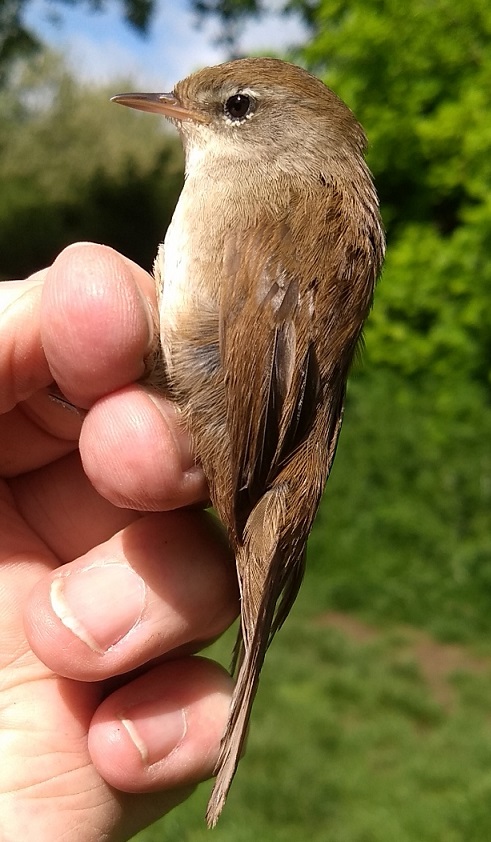
Chiffchaff: note the tiny pollen horn at the base of the bill

An hour later we caught our second of the year. As we were processing the catch from that round we felt the first few drops of rain, and then it started. At first I thought it might pass, so we went and shut the nets until it stopped, then the sun came out again. Just when I was thinking that we might reopen the nets, the rain started again, but harder, and it was obvious that there was more to come, so we took down and went home.

The list for the day was: Great Spotted Woodpecker 1; Blue Tit 4(2); Great Tit 4(2); Coal Tit 2(2); Chiffchaff 2; Goldcrest 2; Chaffinch 1. Totals: 16 birds ringed from 7 species and 6 birds retrapped from 3 species, making 22 birds processed from 7 species.

Quality Over Quantity: Somerford Common West. Wednesday, 9th March 2022

I had planned to try for a session at Blakehill Farm this morning but the weather forecast was for it to be too windy, so I decided to take a chance on the opposite side of Somerford Common from where we were on Saturday. The key difference is that this wood, whilst still mixed to a degree, is largely a mature conifer plantation. Previous catches there have been very variable, both in number and species. From Buzzards to Goldcrests and quite a lot in between.

Having stood and looked at Siskin and Lesser Redpoll in the trees above our feeding station on Saturday, with none ending up in the nets, and Crossbill calling in the conifers, I wondered whether there would be more opportunity to catch them if we went along to that site. We are also much more likely to catch Coal Tits and Goldcrests on that side of the wood, both usually outnumbering even Blue Tits.

I was joined for the morning by Miranda, Anna and Rosie – doing her usual stint if helping set up and hoping to ring a few birds before heading off to work. We met at 6:30 and had the nets set by 7:30.

We set two rides of 3 x 18m nets and one ride of 2 x 18m nets, along two of the major paths through the wood. Lures were set for Lesser Redpoll, Siskin, Brambling and Goldcrest.

To say that we weren’t busy is an understatement: the first birds weren’t caught until 8:45, an hour and fifteen minutes after we had opened the nets. The first birds came out of the nets furthest west of the ringing station. They were two retrapped Goldcrests originally ringed as youngsters in December 2020. Interestingly, they were a female and a male, and they had consecutive ring numbers: LXL 880 and LXL 881, i.e. they were almost certainly caught together when ringed. To confirm that, I checked the records and found that they were processed at the same time.

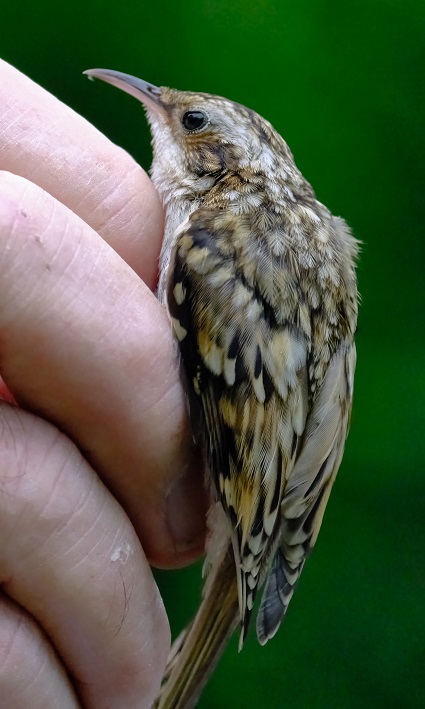
Almost immediately afterwards, in the net furthest to the east of the ringing station, we watched as a small flock of five birds flew in. They proved to be two Siskin, two Treecreeper and a Blue Tit. Unfortunately, one of the Siskin managed to escape before we could extract it, but we managed to get the others without mishap. This Siskin, it turned out, is actually our first from this part of the wood. Rosie kindly forewent the offered opportunity to ring it, and gave it to Anna to ring her first ever, before heading off to work.

We then didn’t catch another bird for over an hour. By 9:45 I decided that we would give it another 30 minutes and then pack up. At 9:55 Miranda and Anna both reacted to something that was going on behind me in the western nets. When I turned to have a look there was a small flock of birds hitting the nearer set of nets. A quick look through the binoculars confirmed that they were Siskin: another six of them. They were extracted and processed.

Male Siskin, photo courtesy Miranda Shirnia

Whilst we were doing this another bird flew in: a Robin. It turned out to be our last bird of the morning. The total catch was: Treecreeper 2; Blue Tit 1; Robin 1; Goldcrest 1(2); Siskin 7. Totals: 12 birds ringed from 5 species and 2 birds retrapped from 1 species, making 14 birds processed from 5 species.

As I said, not a big catch but to get our first Siskin for the site was extremely satisfying. Equally, the two Treecreeper were only the second and third for this part of the site. No Crossbill (in fact, we didn’t even hear them today) or Lesser Redpoll but still a nice quality catch.

Unfortunately, the wind began to get seriously strong after 10:30 and many of the nets started to blow out, losing their pockets for holding the birds, so we closed the nets, took down and were off site by 11:15.

Webb’s Wood: Monday, 7th March 2022

We had to cancel last Wednesday’s session at Webb’s, due to the wet weather, so I rescheduled it for this morning. I was joined by Rosie and Tanya. The net setup was as follows:

Fortunately, Rosie was working at the Wiltshire Wildlife Trust’s Echo Lodge reserve first thing this morning, right next door to Webb’s Wood, so she was able to stay with us until five minutes before going off to meet her team. Tanya was on her second session with me today. Last session she got comfortable handling birds and today I started her on her ringing career. Delighted to say that she seems to be a natural: she had no problem holding the birds and fitting the rings. Her measurements were almost all spot on with a couple just 1mm out. I know people who have been doing it far longer who aren’t that accurate. Next session I will start her on extracting the birds.

It wasn’t the busiest session, which actually helped. Because we weren’t under the pressure of numbers, I could let Tanya take the time she needed to be comfortable and confident in handling the birds. I was a little surprised that it was as quiet as it was: I filled up the feeders yesterday at about 14:00. I have two peanut and two finch seed mix feeders at the site, which were fully filled yesterday and they had all been reduced by about one-fifth in that relatively short time.

We started off with a few retrap Coal Tits, a couple of new Great Tits and a retrap Marsh Tit at the feeding station on our first round. That was actually our biggest catch of the morning. Thereafter it dropped off to just 2 or 3 birds per round until Rosie went off to work. It was good to get a couple of Goldcrest, so Rosie got to ring one before she had to go. They have been remarkable by their absence this winter.

Tanya and I then had a lull of an hour with no birds but, just as I was deciding that I was getting too cold, this dropped into the 18m net in the 18m + 12m dog-leg setup:

Lesser Redpoll

This is our 38th of the winter in Webb’s Wood: adding to what is already our best winter for them there. Funnily enough, we had been joined by a representative of the contractors who did the thinning at Webb’s in winter 2020/21. They have started removing the timber stacks from that operation and he was collecting up redundant signs from where the stacks have been cleared. Apparently they will all be gone by the end of March. He was interested to know if we had found any difference since the thinning and was genuinely pleased when I told him about the massive increase in Lesser Redpoll activity in the wood this winter.

Tanya and I decided to take down the line of 3 x 18m nets, because it caught absolutely nothing all morning, at 11:00. That was despite my best Brambling lure playing the whole time. We did another round and processed a couple more birds and decided to take down the 2 x 18m net ride only I noticed that a bird had just flown in. It turned out to be this:

Female Siskin

This is the first Siskin that we have caught in Webb’s Wood since March 2017. They have always been a bit hit and miss on the site: back in 2013 my feeding station used to be set up in the a stand of trees adjacent to a large crop of conifers and we caught 15 in a single catch, in 2016 it was 16, in 2017 it was 5, and then the conifers were removed and my feeding station area cleared and we didn’t see another one in the nets until this one arrived this morning.

It seemed that each net set we went to take down decided to have a final bird in it. We eventually got the nets down and left site at just after 12:30. Our total catch for the morning was: Nuthatch (1); Blue Tit 4(1); Great Tit 2(2); Coal Tit (4); Marsh Tit (1); Goldcrest 3(1); Lesser Redpoll 1; Siskin 1. Totals: 11 birds ringed from 5 species and 10 birds retrapped from 6 species, making 21 birds processed from 8 species.

Ringing Demonstration @ Somerford Common: Saturday, 5th March 2022

Originally scheduled for the 19th February, and postponed for obvious stormy reasons, this morning we ran the Spring ringing demonstration for the Swindon Wildlife Group. This is the first time that we have done this at a Forestry England site. Usually we hold them on Wildlife Trust premises. When I went to fill up the feeding station on Monday, I was treated to a Lesser Spotted Woodpecker drumming in the trees alongside the road through the wood. On Thursday, when I went to top up the feeders, the large 8 litre feed dispenser was half empty and the trees were full of birds: Chaffinch, Lesser Redpoll and Siskin were all noticeable. So I was hopeful that we would have a wide range of species to show. We set lures for Siskin and Lesser Redpoll at the feeding station nets, and one for Lesser Spotted Woodpecker drumming in a net ride we set behind the tree line parallel to the road:

Somerford Common Ringing Setup

The set up was as follows: FS = Feeding Station; RS = Ringing Station; 1 = 18m net; 2 = 12m net; 3 = 18m net; 4 = 18m net; 5 = 1 x 18m net + 1 x 9m net; 6 = 1 x 18m + 1 x 12m net. Nets 1, 3 and 4 all had lures for Siskin and Lesser Redpoll playing; net 6 had the lure for Lesser Spotted Woodpecker.

I was joined by Ellie, Anna and David for the morning. We met at 6:30 and had all nets open by 7:30, with the birds starting to arrive immediately. The public arrived at 9:00, and we did have birds to show them. Unfortunately, the hoped for finch flocks just did not hit the nets. We were lucky enough to see both Lesser Redpoll and Siskin on site. Indeed, the Siskin were sat in the tree above the feeding station for quite a while. Unfortunately, that was a bit later in the morning, by which time the wind was getting up and the nets were just too obvious, moving in the breeze, and the Siskin were reluctant to come close until we closed the nets. Alongside these species, we could also hear Common Crossbill calling in the conifer stands that have been left within the paddock.

Obviously, as ringers working regularly in woodlands in winter, we do get to handle loads of Blue and Great Tits. When doing a ringing demonstration, we tend to forget that the general public do not have that exposure and they were actually delighted to have the chance to see both species up close.

Our bird of the morning was our third Marsh Tit of the year: one in each month so far. Ironically, the scheduled colour combination for this bird was as follows:

Marsh Tit, AEX0972, showing support for Ukraine?

Unfortunately, both this bird and the retrapped Marsh Tit were caught before the public arrived. Still, we caught birds regularly all morning. I was able to show lots of variety in terms of ageing Blue Tits and Coal Tits, ageing and sexing Great Tits and sexing Nuthatch, as we caught a stunning male, and also why we can’t age them.

Nuthatch photo courtesy Robin Griffiths

When asked if anyone would like to be shown how to safely handle and release a bird, the response was extremely enthusiastic. When that was translated into how many people want to be pecked by a Blue Tit, the enthusiasm was undimmed. That is how it went all morning. From about 11:00 people started to leave, primarily because the temperature had dropped significantly, as the northerly wind started to become a factor, and they were getting cold. However, every single one of them thanked us for a really interesting and enjoyable session so, in that respect, job done. We had, by then, closed the feeding station nets, because they were the most affected by the breeze. Once everyone had left we finished taking down and actually were away from site just before midday.

The list for the morning was: Great Spotted Woodpecker (1); Nuthatch 1; Blue Tit 16(11); Great Tit 9(3), Coal Tit 2(1); Marsh Tit 1(1); Dunnock 1; Robin 1. Totals: 31 birds ringed from 7 species and 17 birds retrapped from 5 species, making 48 birds processed from 8 species.

West Wilts Ringing Group: February 2022 Results

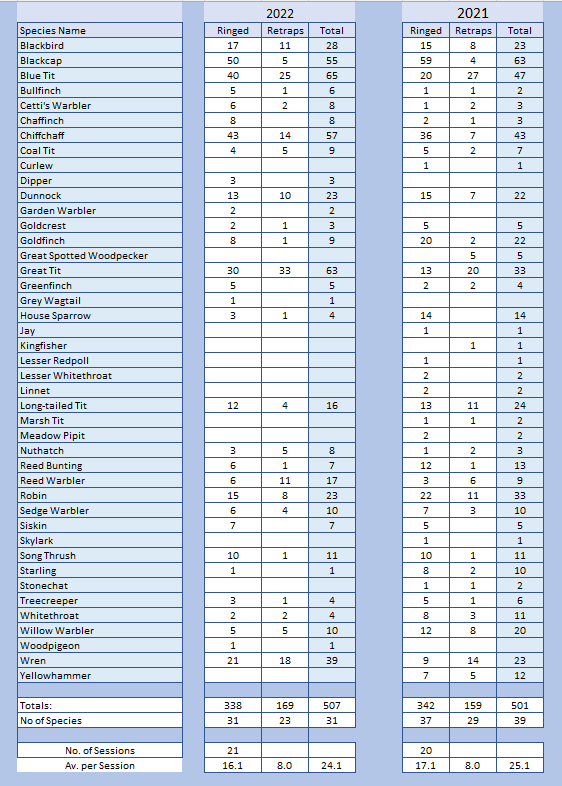
Despite the fortnight of storms, we managed to carry out just one full session less than in 2021.  Not that we did a lot in February 2021: just 14 sessions then and 13 sessions this year. Results were pretty similar:

feb22.png
Table 1: February 2022 Results

Our best February came in 2019, with 556 birds in 13 sessions. It does seem that 13 or 14 sessions is the norm for this month.

A few differences from last year: no Brambling this February, whereas David got to ring his first at Somerford last year.  We also managed a Snipe in February this year, Ellie’s first.  Another nail in the coffin of her claims to be a jinx on our catches together (although, to be fair, we did only catch two birds that morning – but we were only targeting Snipe).

snipe.jpg
Fig. 1: Ellie and her first Snipe

No Sparrowhawk or any Yellowhammer this year.  The Yellowhammer last year were at Jonny’s Sutton Benger site, but not this year.  He has a new, related, farmland site near Hilmarton and it was this that produced 38 of the Chaffinch ringed this month.  It looks like this could be a productive site, with 69 birds from 9 species in the first (only) session so far. 

Apart from the Snipe, my birding highlight was the first Siskin in Ravensroost Wood since February 2019.  

siski.jpg
Fig. 2: Male Siskin @ Ravensroost Wood

What is significant about this year is that we have already processed more birds from more species than in any Q1 since the 2013 reconfiguration, except for the number processed in 2019, when another 87 birds will take us past that milestone – and we still have one month to go.  It just goes to show how active the group has become within our own boundaries.  This graphic rather illustrates the point:

image.png
Table 2: Q1 comparisons

The spike in activity in 2018 coincides with Andy Palmer and Jonny Cooper getting their C-permits and getting on with working their own sites.

Lower Moor Farm: Saturday, 26th February 2022

After two really good sessions this one was very disappointing. Lower Moor is very hit and miss in the winter, because I don’t set a feeding station there.  I work in the wildlife refuges, using a cut-down version of my breeding season Constant Effort Site. There has been a problem of rats in front of the various hides, as a result of some photographers putting out food to attract birds and small mammals closer in for better photographs, and I have no wish to attract them in to these wildlife refuge areas.  I know that the Trust have asked for that practice to stop: one hopes that it has.

The weather didn’t help: it started out with a freezing mist between 7:00 and 9:00. When the sun broke through at about 10:00, the breeze started to get up and by 10:30 it was too strong to leave the nets open, so we closed them up and took down by 11:00. 

It was doubly unfortunate for my two trainees: Annie was making her first trip out for nearly a year, and David making his first visit for nearly 3 months, both for unavoidable reasons.

We managed a paltry 11 birds: Blue Tit 1; Great Tit (1); Long-tailed Tit 2; Wren (1); Robin (2); Redwing 1; Blackbird 1(1); Lesser Redpoll 1. Totals: 6 birds ringed from 5 species and 5 birds retrapped from 4 species, making 11 birds processed from 8 species. Still, with over 100 birds processed this week it would be churlish to moan too much.

It has been a long wait: Siskin @ Ravensroost Wood, Friday, 25th February 2022

We have seen Siskin in and around our woodland ringing sites since October but, unlike the Lesser Redpoll, they have remained stubbornly in the treetops all winter. They must have been finding enough food to sustain them – until today, that is.

I was joined by Rosie and Tanya at 7:00 and by Claire with her children Samuel and Zara at 8:00. It has been a couple of months since Claire et al have been able to join us, so we had to reintroduce Samuel to the delights of handling Blue Tits, before letting him take on ringing duties again. We started with him just getting comfortable handling the birds and, once he had got his ringer’s grip re-established to my satisfaction, he then shadowed the ringing process, checking wing lengths and weights, before getting to ring his first bird of the morning. I was kind, it was a Robin, not a Blue Tit (he is only young – I don’t want to put him off).

Recently I have just been taking just exactly the number of nets I want for the session, to save on packing too much stuff. That came back to bite me on the posterior this morning when my two 6m nets decided to fail. One broke a shelf-string, which meant I couldn’t use it. The second broke the link to the loop that goes around the pole. Fortunately I managed a running repair on that net so, by a slight reorganisation, we could still surround the entire feeding station area.

As expected, the first round was busy and very Blue Tit heavy, plus the odd Great and Coal Tit. What I am finding somewhat surprising is just how many second year Blue Tits we are catching and ringing. There is no doubt that breeding season 2021 was dreadful for Blue Tits. Everyone who was monitoring Blue Tit nest boxes confirmed full failures or low fledging rates, yet this winter, since the 1st November, we have caught and ringed 234 juvenile Blue Tits in the Braydon Forest, out of a total of 285 ringed in total, i.e. 82.1%. I have done a comparison with previous years to see if this is reflected in our ringing totals. Because of the Covid restrictions in place throughout 2020 and 2021, it has severely distorted the data for that period, so I have excluded it from this analysis:

Table 1: analysis of juveniles ringed overwinter and in the prior breeding season / autumn

What does this table show? Essentially, whatever happened in the breeding season is not reflected in what we have seen over this winter. Either the breeding season wasn’t as bad as first thought or, radical suggestion, perhaps with less intraspecific and intragenerational competition for food more young Blue Tits have survived than would otherwise be the case. Who knows?

Amongst all of these youngsters, today we recaptured Blue Tit S859712. This bird was originally caught and ringed as a juvenile on the 2nd September 2017. This was the eleventh time it has been recaptured, always in the same general area (the 8-year hazel coppice) so twelve times in all it has been handled – and it still pecks like a good ‘un every time! I love Blue Tits: birds with attitude!

The third round produced the bird of the day:

Fig 1: Male Siskin

This is my first Siskin since one at Somerford Common almost exactly one year ago (27th February 2021) and it was the first that Rosie has ever got to ring. Rosie and Tanya were actually scheduled to be working at Ravensroost this morning, so they had to go to work when the rest of their work party turned up at 9:30. On the penultimate round I found another Siskin, this time a female, in the nets by the feeding station. It looked nicely settled and there was a Blue Tit that was rather entangled, so I decided to extract that first. Unfortunately, she was nicely settled but, also, not particularly restricted and as I removed the Blue Tit she managed to escape the net. Fortunately, by then Claire and the children had left for the morning so I didn’t have to apologise for my language.

The list for the day was: Nuthatch (1); Blue Tit 13(11); Great Tit 2(4); Coal Tit 1(3); Marsh Tit (1); Dunnock 1; Robin 1(3); Siskin 1. Totals: 19 birds ringed from 6 species and 23 birds retrapped from 6 species, making 42 birds processed from 8 species.

We had convened at Ravensroost Wood, as opposed to Lower Moor Farm, because the weather forecast was for it to be a bit breezy. In the event, there was no sign of a breeze until 11:00, which was when I decided to start closing up the nets and taking down. It took a while, as I was now working solo, and I took down in stages, extracting the few remaining birds as I went. I left site at 12:15. It will be Lower Moor Farm tomorrow, as I finally catch up on the fortnight lost to the storms.

Back In The Bog: the Firs, Wednesday, 23rd February 2022

After two weeks of ringing inactivity, due to that unprecedented run of storms, I decided to kick off our activities again with a trip to the Firs. This was because the forecasts still suggested that there would be a gusting south-westerly wind. With the rides at the Firs running north to south, the wood offers better protection from the wind, when it is coming from that direction, than any of the other sites.

I was joined for the morning by Rosie, Miranda and Jonny. We set the usual nets down the central glade. Astonishingly, at first sight there was no sign of damage from the storms in the central glade. However, as we were setting the 12m net behind the feeding station, Rosie said “Has that tree always leaned that way?”. A mature tree, which my net runs in front of, with a near 1m diameter is now only staying upright because a couple of other trees are blocking its passage to the ground. Fortunately, it is falling away from our ringing area.

I ventured into the wood yesterday to top up the feeding station, having taken the sensible pills and not headed out whilst the wind was so fierce. Having watched the local news showing a film of the spire of St Thomas’ Church in Wells falling as a result of the winds, I decided it wasn’t worth the risk. Unsurprisingly, after all of the rain, the Firs had reverted to its local name: the Braydon Bog. It was filthy underfoot so I advised everybody that wellies were essential.

We arrived on site at 7:00 to find that the weather was better than forecast. In fact, the wind didn’t start gusting until we started to take down at 11:00. That was a definite bonus. Rosie managed to get a good number of birds processed before heading off to work, leaving the three of us to manage the rest of the morning.

The catch was exactly as expected: lots of Blue and Great Tits and more recaptures than new birds (28 to 21). There were two highlights for me: the fourth ever Lesser Redpoll for the site. Our first two there were caught in November 2016, then we had no more until our last session in the Firs, just about the last bird out of the net that day and another singleton this morning.

The second was a male Great Spotted Woodpecker. I thought that the ring number looked old so I logged in to the on-line system and did a search on that bird. It turned out that it was ringed as a second year bird on the 18th February 2017. This makes it a bird in its seventh year. Okay, it has another 4 years 3 months and a few days to go to get to the longevity record, but it is the oldest that my team has recovered so far.

The list for the day was: Great Spotted Woodpecker (3); Nuthatch (2); Treecreeper 1; Blue Tit 10(9); Great Tit 7(8); Coal Tit (3); Marsh Tit (2); Long-tailed Tit 2; Dunnock (1); Lesser Redpoll 1. Totals: 21 birds ringed from 5 species and 28 birds retrapped from 7 species, making 49 birds processed from 10 species.

With the number of birds declining as the morning wore on, and the wind beginning to get up, at just before 11:00 I announced that the next round would be the last, and we would shut the nets as we emptied them. Usually at the Firs that is a signal for a large influx of birds to hit the nets. This morning it didn’t! We had another 8 birds, not as many as usual, which is normally multiples of ten. As a result, we had the nets down and everything cleaned away by just after midday.

That got me home in time to unpack the replacement Barn Owl boxes that have, finally, arrived, for me to now work hard over the next couple of weeks to get them all erected. Many thanks to my wife for her help in getting the boxes sorted out and stored ready to go.