Somerford Common: Saturday, 22nd January 2022

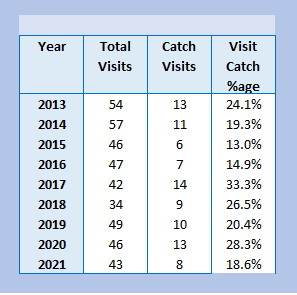
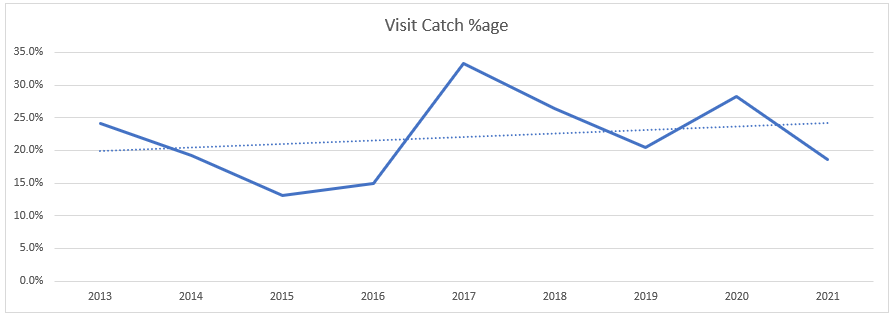
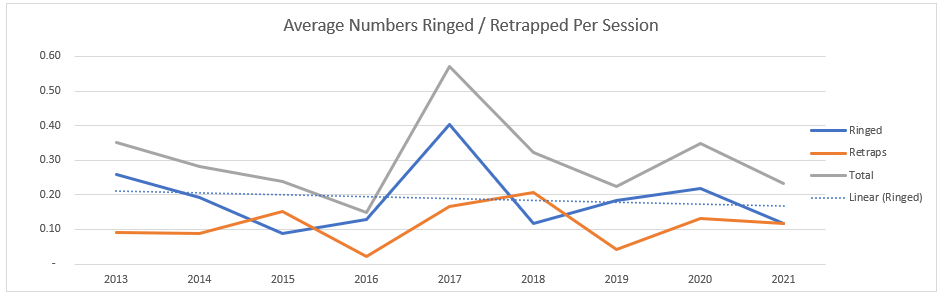
After the last session at Somerford I was rather excited at the prospects for today. I have a huge ten litre seed feeder on site and a normal sized peanut feeder. It was filled up on Tuesday with a finch seed mix and when I went to top it up yesterday, in readiness for Saturday’s session, it had been reduced by one-third. When we arrived on site this morning the level have been reduced by at least one-and-a-half litres, so I was quite confident of getting a repeat of last sessions excellent mix, if not better. Unfortunately, my confidence was somewhat misplaced. Despite setting nearly twice as much net, the catch was two-thirds the size of last session and the winter visitors were conspicuous by their absence.

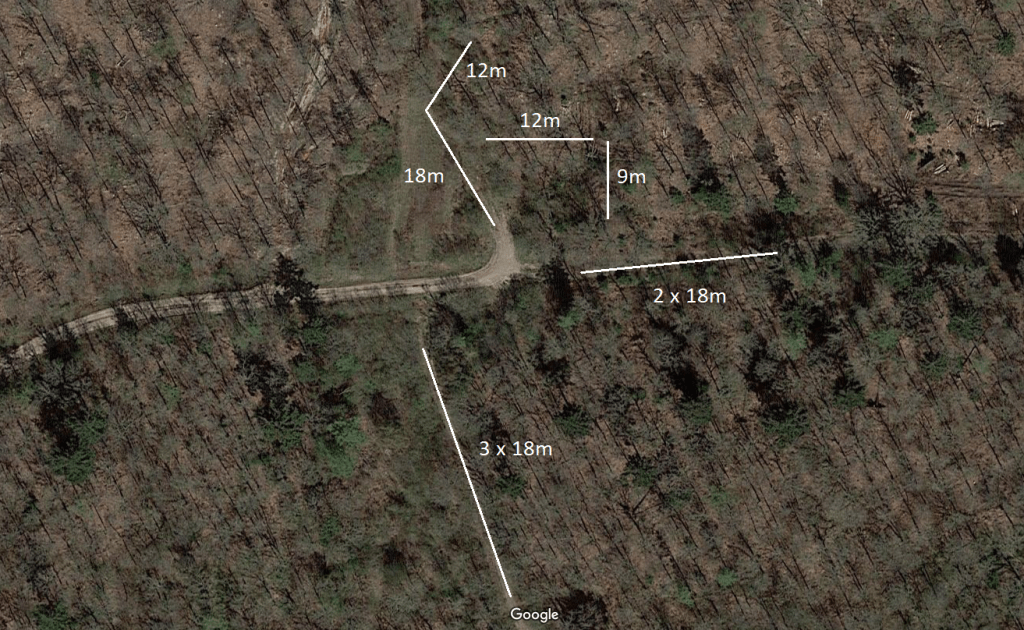
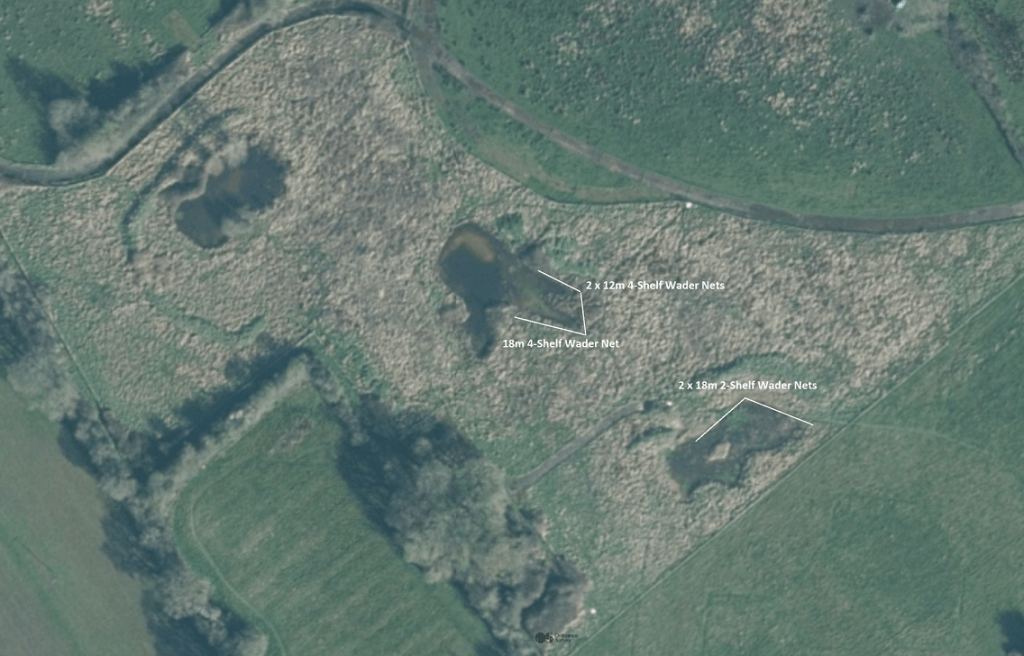
I have to admit, though, that it was still a very enjoyable session, as I was joined by Ellie, Alice and Anna, with Rob joining us for his second taster session. Good company, good conversation and a reasonable number of birds to process. The nets were set as follows:

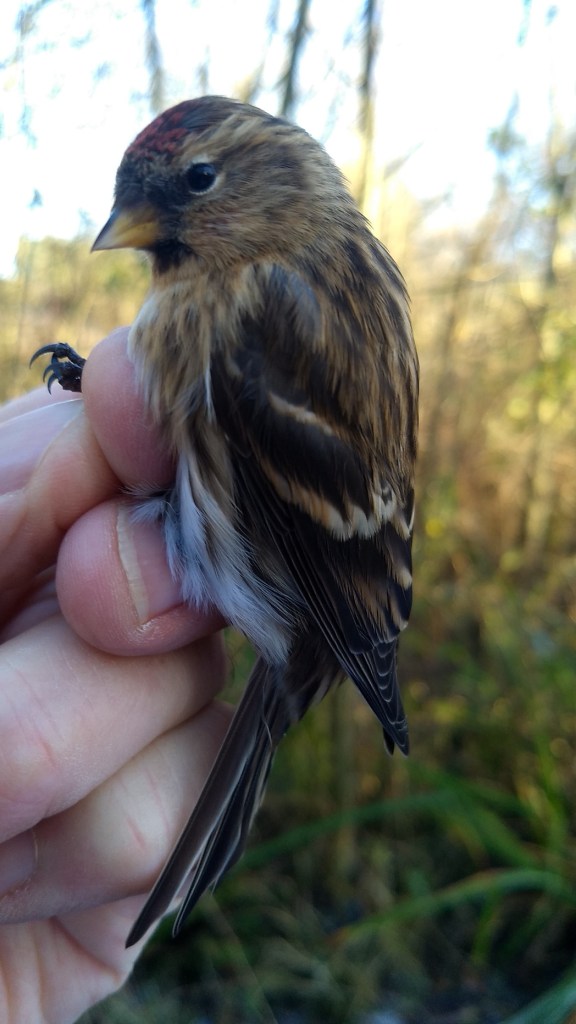
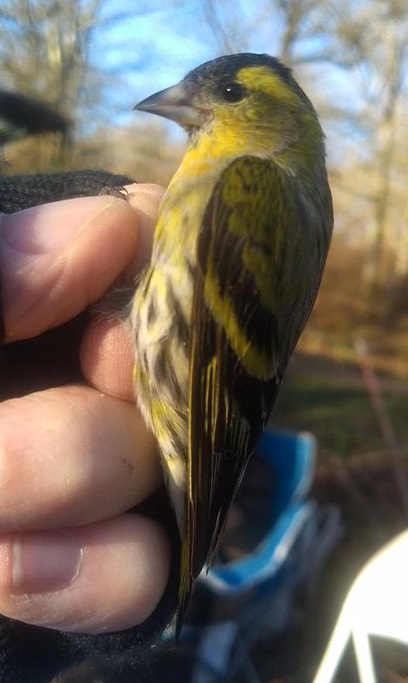
The yellow numbers indicate the lures used: 1,2 & 4 = Lesser Redpoll & Siskin; 3 = Brambling; 4 = Redwing until 10:00, followed by Goldcrest.

We had birds regularly throughout the morning but the only finches to get caught were two Chaffinch. One of those had to just be released without being ringed as it was infected with Fringilla papillomavirus. After a couple of years of not seeing this horrible infection it does seem to have made a comeback in the Braydon Forest this year.

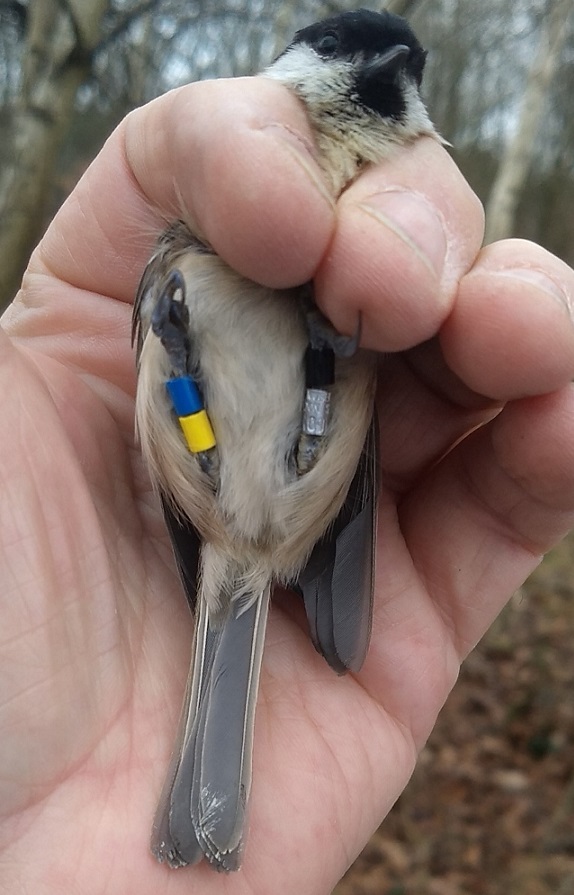
The bright spot of the morning was a lovely flock of Long-tailed Tits that dropped into the Redwing / Goldcrest net set at 10:30.

The list for the day was: Blue Tit 12(6); Great Tit 3(6); Coal Tit (4); Marsh Tit (1); Long-tailed Tit 7; Wren (1); Dunnock (1); Robin 2(2); Chaffinch 1. Totals: 25 birds ringed from 5 species and 21 birds retrapped from 7 species, making 46 birds processed from 9 species.

One thing that the relaxed pace of the morning gave was an opportunity for Rob to ring his first few birds, something he hasn’t done for over 4 years, whilst Alice could show her suitability to become a trainer when we advance her to her A-permit, which we are currently working on. Of course, being kind, his first birds processed were two Blue Tits and a Great Tit: nothing like exposing a new ringer to those two species to test their mettle. Another benefit of having an experienced team out was that taking down the nets at the end of the session was a quick and easy process. We processed our last birds at 11:45, then shut the nets and took down and got away from site by 12:45.

West Wilts Ringing Group Annual Review 2021

Another excellent year in 2021: in terms of quality if not necessarily quantity.  Actually, my little team and I had our worst year since 2013, my first full year as a C-permit holder, with just 2,588 birds processed, 700 fewer than last year.  The key problem for me was the weather: of 85 planned sessions, I carried out only 60.  Six of those cancelled were at the busy times for juvenile birds: last week of July, first week of August.  Four of my planned sessions over the Christmas period were also cancelled: one of them when David and I sat in the middle of a cloud at Brown’s Farm hoping it would lift. It didn’t.  The other nail in my coffin was, unfortunately, the outbreak of Avian Flu at Castle Eaton, which put Blakehill Farm and Red Lodge out of bounds from the 10th December (ongoing unfortunately). However, like several others this year, I also had firsts for the group since we came into the current structure, more of which later.  Fortunately, elsewhere in the county others were not so badly afflicted by the weather.

One of the key developments this year was Jonny Cooper getting his A-permit.  He is the driving force behind the increase in our catch numbers, this year being responsible for some 55% of our total.
These are the comparative results:

So to our group firsts. The Curlew is clearly a stand-out bird. The first adult ringed in Wiltshire since 1992, and only the second adult ringed in Wiltshire (as far as we are aware).  Without embarrassing him, it shows what a stellar individual Jonny is that, because it was at Blakehill, he offered it to me to ring. Being an equally stellar individual, I refused and insisted he ring it, much as I would have loved to add it to my list.

curlew.jpg

It has been re-sighted on several occasions at Blakehill (naturally) but also in one of the meadows at Red Lodge Farm and, most recently, as blogged, at a site in Cornwall, near to St Mawes.  Alongside that, Ian and Andy, after years of ringing Stone Curlew on the RSPB’s / Wessex Stone Curlew project rings, have started ringing them on West Wilts Group rings. The first two on our rings were, unsurprisingly, ringed as youngsters on sites on Salisbury Plain. Both were ringed on the 17th June.

_15A9474.JPG

Photo courtesy of Ian Grier
I am not sure why but Jonny decided it was a good idea to ring a trio of juvenile Canada Geese, at his Melksham site on the 2nd August.  Apparently others have been ringed by the group, but not since 2005!  Here’s looking forward to the next ones in 2037!.  
I had two little contributions to the year’s new variety.  First was a fabulous Yellow Wagtail caught at Brown’s Farm.  Almost the last bird out of the nets, and only the second time I have had an opportunity to ring them: the first being a few I did at Icklesham back in 2011. 

yelwa.jpg

Astonishingly, in the same session we caught a Firecrest: a first for the site, our only one of the year and in a completely wrong habitat for them. Presumably a dispersing youngster.   
My other first for the group was a Wheatear at Blakehill Farm:  This was on the 12th September on the Chelworth side of the site. Prior to this, the last group Wheatear were back in 2008 near Beckhampton: an astonishing catch of seven of them!Not firsts for the group but there were two other significant catches.  Johnny had his first Carrion Crow at Biss Wood: the first since I caught one at Lower Moor Farm in May 2014.  

cc.jpg

Photo courtesy of Jonny Cooper

I then had my first Brambling for Red Lodge on the 24th November.  Another first for site was a Snipe that I managed to flush into a net at Ravensroost Meadows on the 7th September:

snipe.jpg

As a result of these additions, we ended up with 68 species processed during the course of the year, compared with 63 species last year, despite the reduced numbers.  I am not going to go into details on the species reductions: they are there for all to see. Evidence of a poor breeding season for Paridae was there from the start. The absence of Chiffchaffs, Blackcaps and Garden Warblers at my sites in the north of the county, was bemoaned by me in my blog posts throughout the summer. Despite that, their numbers were significantly better than last year’s catch thanks to stronger performances elsewhere in the county and good catches of them on autumn migration.

Here’s hoping that the weather is better in 2022 and that Avian Flu disappears as rapidly as it appeared.

Where’s the fire? Lower Moor Farm: Wednesday, 19th January 2022

I was hoping to get to Blakehill Farm this morning but, despite the avian flu outbreak occurring on one farm on the 10th December, with no further outbreaks in the area, the restricted and surveillance zones are still in place, so no can do. Lower Moor Farm isn’t usually on my winter schedule, as I don’t go for waterfowl, and I don’t ring in the woodland there. However, I don’t want to be ringing any of my sites more than once per month, so I wasn’t left with too much choice.

I was joined for the morning by Miranda. We started at 7:00 and, after some fumbling about by yours truly (I am useless until I have my first coffee of the day), had the nets open just after 8:00. The likelihood of us having a large catch was remote, so we agreed that Miranda would start her extraction career today. I wanted to make sure that we had some suitable birds for a beginner, so I put on lures for Redwing, Lesser Redpoll, Siskin and Brambling. Finches, in particular, tend to be pretty straightforward extractions, so I chose three species we find in winter and which I would like to catch.

We had a 50% success rate, with Redwing and Lesser Redpoll. The first bird of the session, a Wren, decided to get into the nets before we had even opened them.

Our first round proper only delivered a Blue Tit and the next round a pair of Bullfinch. I say pair because it was a male and female found in the same net about 12″ apart. Unfortunately, the male is suffering from Fringilla papillomavirus, so it could not be ringed. We bagged it up regardless, so it could be released with the female once she had been processed. I then put the bag into my rucksack so we didn’t use it again before I could clean it. Copious amounts of hand sanitizer was also used. Up to this point, Lower Moor Farm was living down to my expectations of it in the winter. Alongside that, the weather was dreech and dreary: occasional bursts of very light drizzle but the light was just dull, dull, dull.

It took a while longer for the weather to improve but the catching certainly did. Round three turned up a Blackbird, another Wren and a Redwing. Oh, and this stunner as well:

Male Firecrest

This is a great catch: the first that I am aware of at Lower Moor Farm. Certainly I have not caught one there before (I have at Red Lodge, Ravensroost Wood, Brown’s Farm and several at Tedworth House and, as a trainee, in Savernake Forest). I have been ringing there since 2013. I know the ringer who worked there prior to my taking it on and will find out if it is a first for the site.

The next round Miranda started her extracting career with a Lesser Redpoll: the only bird of that round. After that, we had a cracking fall of Long-tailed Tits along the Heronry Ride and two more Lesser Redpoll just adjacent to the lure, which gave Miranda plenty of opportunity to do some more extracting. It was clear that the Long-tailed Tits were a flock so as each bird was processed it was returned to its bag until we had processed the lot, and then we released them all to fly off together, which they did. That took us to 11:00, we had a couple more rounds and then closed up.

Our list for the day was: Blue Tit 1(1); Great Tit 1; Long-tailed Tit 6(5); Wren 1(2); Dunnock 1(1); Robin (1); Song Thrush (1); Redwing 1; Blackbird 2(1); Goldcrest (1); Firecrest 1; Lesser Redpoll 3; Bullfinch 1. Totals: 18 birds ringed from 10 species and 13 birds retrapped from 8 species, making 31 birds processed from 13 species.

We finished taking down just as the sky turned very dark and very threatening: definitely time to leave. Both were away from site at 12:30. Very satisfying! Much better than I had anticipated.

Webb’s Wood: Saturday, 15th January 2022

It is a bit weird when one of your team is welcoming starting 30 minutes earlier, because it means they might get an opportunity to ring a few birds. That is the way it was this morning when Rosie, Adam and me met at Webb’s Wood.

Rosie, bless her cottons, came to help set up once again, before heading off at 8:30 to supervise volunteers hedge laying at Blakehill Farm. At least this time she got to process a few more birds than usual: a Robin, two Great Tits and three Redwing. We changed the net setup a little from the last session, and it worked.

I changed the single 6m net to a 9m at the feeding station and reinstated the 2 x 18m net run along the trackside. I could do the latter because Forestry England have been in tidying up the trackside vegetation. We put a lure for Lesser Redpoll in the feeding station area; a lure for Redwing on the 3 x 18m run, a lure for Lesser Redpoll and Siskin on the 2 x 18m run adjacent to the feeding station and the same on the trackside nets.

Adam and I then spent a slightly chilly morning, checking the nets on a very regular basis, every 10 minutes or so, so that no birds spent any time in the nets in the cold. Frustratingly, a Great Spotted Woodpecker spent less time in the nets than any other bird because three times it got into the net, and three times extracted itself before Adam could get to it (he runs, I don’t).

With the nets opened by 7:40, the birds started to arrive pretty well straight away. Between then and 9:20 we caught 27 birds, including all seven of the Redwing that came to the lure, plus our first Lesser Redpoll of the session. The next two hours each produced another 13 birds, leading to our total catch of 53.

The list for the day was: Blue Tit 11(9); Great Tit 3(6); Coal Tit 1; Marsh Tit (1); Robin 2(3); Redwing 7; Goldcrest 1; Chaffinch 2; Lesser Redpoll 7. Totals: 34 birds ringed from 8 species and 19 birds retrapped from 4 species, making 53 birds processed from 9 species.

Although we did catch and ring two Chaffinch, unfortunately the first one I extracted had to be released unringed, as it was badly affected by the Fringilla papillomavirus. Its legs were in pretty poor condition and extracting its legs without inflicting damage was a long and protracted operation. I have seen rather more of it in the last 6 months than I had in the previous 3 years. It is a worrying development.

The lures worked well, except the Siskin call. On a couple of occasions we had good sized flocks of Siskin fly into the trees around the feeding station, but we didn’t manage to attract a single bird down into the nets. However, what isn’t working for Siskin is definitely working for Lesser Redpoll. This winter so far has been the best so far for this species in the Braydon Forest, as the following table shows:

The definition of each column is October / November / December of the prior year and January / February / March of the following year. As you can see, with two and a half months to go, this winter has been the most productive we have ever had in the Braydon Forest. I probably shouldn’t include 2012/13, as I was still finding my way around most of the sites, having not long gained my C-permit so I could strike out into my own sites. Key to the increase this year is the improved catch in Webb’s Wood. Prior to this winter there had been just 15 Lesser Redpoll caught there, this winter there have been 33 processed so far. The thinning of the wood is the only difference that I can see.

About 11:00 a cold mist started to arrive. Adam and I started to shut the nets just after we had processed our 11:30 round, and were off site by 12:45 – heading home for some warmth!

Long Distance Blue Tit

Today I received a BTO Recovery Report for a Blue Tit, ring number AVF6109. “So what?” you might ask. Well, this is what: it is the second longest recorded movement of a Blue Tit within the UK!

It was ringed on the 31st December 2019 at Fort Augustus in Highland Scotland. We recaptured it in Ravensroost Wood last Sunday, 9th January, in amongst the rather large catch we had (f0r us) that morning. It is a movement of 642km in 740 days. To be honest, I hadn’t even picked up on the fact that it wasn’t one of our birds. With the online data entry system it will tell you the species but not flag up that it isn’t on your particular rings.

Approximate Route of Travel

The longest recorded movement is a juvenile ringed at Abberton Reservoir, near Colchester, in 2002 and recovered in Breakachy in Highland in 2006, a distance of 717km.

Whenever someone wants to criticise my bird ringing they almost always pick on the, to them, unnecessary practice of ringing Blue Tits! Indeed, I know of some ringers who refuse to ring them – but that’s because they object to the ~27p per ring it costs them. Apart from the fact that, having inconvenienced them by catching them, it would be rude not to put a ring on them, it is easy to see that we still have a lot to learn about Blue Tits. Why, for example, would a resident species that normally disperses over relatively short distances suddenly fly such a long distance? I don’t have an answer but one day we might if we continue to study them.

Brown’s Farm: Thursday, 13th January 2022

I don’t often kick myself out of bed early two days in a row but the forecast for this morning was perfect for a trip to Brown’s Farm. My last two planned visits were failures: firstly, David and I sat in the car for 45 minutes waiting for the cloud we were in to lift, it didn’t. Next time I was ill. Then the weather has just been too wet and windy for such an exposed site, so I jumped at the chance. Naturally, my alarm didn’t go off, so I started out later than intended, but I was determined to get there.

James, the farmer, had kindly spread some chopped maize around in his game cover to try and attract some birds in for me. As I drove up the metalled track, to turn down to the game cover area, the hedgerows were alive with birds. I should have stopped and set my nets there because, although I thoroughly enjoyed the session, the catch was quite small. It started off cold, the sky was perfectly clear and as the sun rose the air soon warmed up, but the land stayed frozen all morning: which was just as well because otherwise it would be a quagmire.

I got one of the species that I went for:

Female Yellowhammer

My first Yellowhammer of 2022. Unfortunately, the only one I caught today.

The catch was just a few birds each round but at 11:00 I was delighted, and surprised, to find this in my net:

First Winter Pied Wagtail

I catch very few of these. As a trainee, ringing at various Thames Water Sewage Treatment Works, I got to process a reasonable number of them (27 Pied Wagtails and 13 White (yes, White) Wagtails, mainly at Marlborough Sewage Works – not too far from where I was today). Since then, in 9 years, this is only the fifth that I have managed to catch. They fly slowly, have good eyesight and can generally avoid the nets.

The list for the day was: Blue Tit 5; Dunnock 2(3); Pied Wagtail 1; Robin 2(2); Blackbird 2; Yellowhammer 1. Totals: 13 birds ringed from 6 species and 5 birds retrapped from 2 species, making 18 birds processed from 6 species.

So not a huge catch but, as I say, a lovely morning. I was joined by the farmer for a good long chat. He is quite keen for me to carry out some ringing on his other farm, next door to, and west of Brown’s Farm. We spent 5 minutes watching Skylarks chasing each other in the field opposite where my nets were set. I have no idea why they should be so busy at this time of year. Surely they aren’t pairing up and establishing territories already?

As usual, I had excellent sightings of the local Buzzards and Red Kites. I suppose being adjacent to Savernake Forest this farmland is a happy hunting ground. There are plenty of rabbits and hares there. One of my favourite sights is when Sparrowhawks find a thermal and start circling up, with their short and rapid “butterfly” wing beats, so when one started doing exactly that whilst I was taking down the nets I just had to stop and watch. Eventually I managed to finish taking them down and left site at just after 13:00.

Next time I will change my net positions and hope to catch the species I didn’t get today: Linnet. There are so many of them on site. On one memorable occasion in April 2015, after 3 disappointing hours, the Linnets started to arrive and I ended up ringing 44 of them.

Curlew Update

Back in April, on the 22nd, as a result of Jonny’s hard work and diligence (and with a little help from my wader nets) we staked out one of the fields at Blakehill Farm and managed to capture the first adult Curlew in Wiltshire for nigh on 40 years.

Jonny got notification yesterday that, thanks to the leg tag fitted when it was ringed, it was sighted in Cornwall on the 27th December. It had travelled 272km from where it was ringed:

It was seen on the beach at Portscatho.

The Firs: Wednesday, 12th January 2022

A very pleasant session at the Firs this morning. I was joined by Rosie, Miranda and, the first time for a long time, by Alice. Alice is going to be put forward for her A-permit shortly, after a year of very busy and varied ringing activities in 2021.

When I went to top up the feeders, in preparation for today’s session, I found that the Wildlife Trust’s Well-Being group were on site. They were the group that spent time with me, getting close to the birds, at my last appearance at the Firs. The way I was greeted by them was lovely. I had a chat and found out that a different group would be there today, so I let them know that we would be happy to show them more birds if they wished. They wished.

We arrived on site at 7:30 and erected 2 rides of 3 x 18m nets down the central glade and a single 12m net to form a sandwich either side of the feeding station. Birds started being caught straight away. Unlike Ravensroost on Sunday, it was never excessive. This time, as Rosie had some work to do for the Trust on the site, she was able to ring a decent number of birds, including a lovely female Bullfinch.

Our second round didn’t produce a lot of birds, but it did produce our first Jay of the year:

I wonder how long it took to style that quiff?

The catch was steady all morning. What was notable was the proportion of retrapped birds: of 41 birds caught, 29 were recaptures. The list was: Nuthatch (2); Jay 1; Blue Tit 2(11); Great Tit 1(10); Coal Tit (3); Wren 1(1); Robin 1(2); Song Thrush 1; Blackbird 1; Goldcrest 1; Bullfinch 3. Totals: 12 birds ringed from 9 species and 29 birds retrapped from 6 species, making 41 birds processed from 11 species.

Whilst the Jay was the undoubted highlight, three Bullfinches in the session was a pretty close second. Two of them were almost certainly a pair: a male and a female within a few inches of each other in the same net is a pretty decent indicator.

The Well-Being group arrived at about 11:00 and, true to form, the next round was the only empty round we had all morning. Our final round at 11:30, however, did turn up four birds: the Goldcrest, a Great Tit, a Coal Tit and a Wren. The attendees loved the birds. The Great Tit spent her entire time, whilst holding her for a few seconds so people could take photographs, was the way that she would select which finger she wanted to have a go at, rather than just attacking the nearest. However, the bird that they all agreed was their favourite was the Wren. There is just something about the way they hold themselves that appealed to everybody in the group. Anyway, I am pleased to say that the people were so happy that several of them came and helped us take down the nets, which made our life very much easier.

We were packed up and left site by 12:30.

Ravensroost Wood: Sunday, 9th January 2022

At last! I have been trying to get back to Ravensroost Wood for a while but it kept getting rained off. Originally this session was scheduled for Saturday but, yet again, it rained nearly all day. At least this time it had been forecast so I didn’t get up early for no reward.

I topped up the feeders on Tuesday, when I did the other sites, and checked on Friday. The feeders were empty, so I topped them up again. This morning the peanut feeders were empty and the big multi-seed feeder was half empty, so we topped up again and girded our loins for a busy session. I was joined for the session by Anna (with her Mum, who came along to see what it is all about), Samuel and Mum Claire plus new arrival Rob: a professional ecologist who wants to expand his skill sets. Rosie also came along and did her usual trick: helping us set up, and then helping extract the first round before disappearing off to set up her morning volunteer group activity (hedge-laying since you ask).

The session was every bit as busy as I feared. It was Blue Tit heavy, and they were doing their best to make life difficult: double-pocketing, spinning and, in a couple of cases, fighting each other. We separated those combatants first and very quickly. They are so feisty, and their beaks so sharp, it is a good job they aren’t bigger!

The first round was very busy with Anna, Rosie and me extracting 22 birds, mainly Blue Tits. Rosie then had to leave. The next round produced 13 birds, again, more Blue Tits. Our last round proper, at 11:15, produced another 30 birds and we closed the nets as we emptied them. Quite remarkably, at 12:30, after we had processed those birds and went to take down, we found another two birds had blundered into the closed nets: a Great Tit and (hallelujah) a Lesser Redpoll, our only one of the session.

The session was notable for two Dunnocks. These are the first two caught in the wood since April 2019. In addition, three Great Spotted Woodpeckers: a male ringed in December 2019 and two adult females that we ringed today were a good catch. Unfortunately, we had some diseased Chaffinches in the nets. Two females with developing Fringilla papillomavirus and a male with the same on its left leg only. i.e. the one without the ring. This bird, S055209, was ringed in April 2016, so it has already had a good long life. According to the BTO Bird Facts database, the typical life span of a Chaffinch is 3 years, but the oldest recorded is over 13 years from date of ringing. Its FPV was a newly acquired infection, just showing the start of the warty excrescences. There were, however, two perfectly healthy first winter females that we could ring.

The list for today was: Great Spotted Woodpecker 2(1); Blue Tit 18(21); Great Tit 5(6); Coal Tit 2(1); Marsh Tit (2); Dunnock 2; Robin 2(1); Blackbird 1; Goldcrest 1; Chaffinch 2(1); Lesser Redpoll 1. Totals: 36 birds ringed from 10 species and 33 birds retrapped from 7 species, making 69 birds processed from 11 species.

After processing the last few birds, we took down and got away from site by 13:00.

West Wilts Ringing Group: December 2021 Results

Not our best month by any stretch – I blame the weather. For example, I scheduled 11 sessions for December and managed to carry out just 6.  The numbers were good and who knows what would have happened if we had managed to fulfil them all. On top of that, three of my main winter sites were out of bounds due to the outbreak of avian flu at Castle Eaton, as they fell within the 10km surveillance zone.  Anyway, the results were:

Not many highlights but Jonny’s Cetti’s Warbler at Langford Lakes was certainly one: the only December capture of this species since 2007.  Alongside that, the 10 Chiffchaffs is notable. The catch was split between Jonny’s sites at Sutton Benger (7) and Langford Lakes (3).

My highlight was the 26 Lesser Redpoll caught in Webb’s Wood. The catch of 20 on the 5th December is our largest capture since the great schism (1st January 2013 when the North Wilts Group was formed and split the West Wilts Group into its current structure).  Prior to this December most catches in Webb’s Wood were of single birds, with a couple of threes and a four.  I wonder if it is the impact of the thinning operations last winter? 

Mind, it is still not a patch on the extraordinary catch we had in Ravensroost Wood on the 4th December 2011 (a date etched in my mind for many reasons) when we caught and ringed 43 of the blighters.

Redwing numbers were well down and that seems to have been a general reduction across all sites, even allowing for the fewer sessions.  One thing, January is likely to be a big improvement on last year, as a full lockdown does not look likely.