A First for Red Lodge: Wednesday, 24th November 2021

Having had a wasted trip to Brown’s Farm on Saturday when, despite a dry weather, low wind forecast, the farm was wrapped in a blanket of mizzle. We waited, but it showed no signs of lifting after 45 minutes, so we gave it up as a bad job. I then opened some nets in my garden, adjacent to the feeders, and caught virtually nothing when it should have been 20 or 30 birds, so I really needed something to lift my spirits when heading to Red Lodge this morning.

Again, the forecast was dry, but there was definitely some low level moisture in the air when I set off. Red Lodge is only one mile from my house so I was pleasantly surprised when I arrived there to find it as forecast. I was joined for the morning by Miranda, and with Rosie doing her thing of popping in first thing to help set up before heading off to work. This time, for once, she did get the chance to ring a few birds. We only set four nets: just those adjacent to the bird feeders. The damaged gate, the fallen tree and the dumped waste are still blocking the path, so we had to carry all of our ringing station equipment up the track (and back again at the end). I don’t know what is going on in the Braydon Forest but, going to Webb’s Wood on Friday to top up the feeding station, someone has chosen to smash down the gate. I have been working these sites for ten years and, before this year, there has never been any trouble of this sort.

Anyway, to what turned out to be a really good session at Red Lodge this morning. This was the first bird extracted this morning:

juvenile Brambling

This is the first Brambling caught in Red Lodge. The first in the Braydon Forest were caught at Somerford Common in 2019, followed by another in Ravensroost that year. Another was caught at Somerford Common this February, but that is the sum total caught in the Forest since ringing started in 2009.

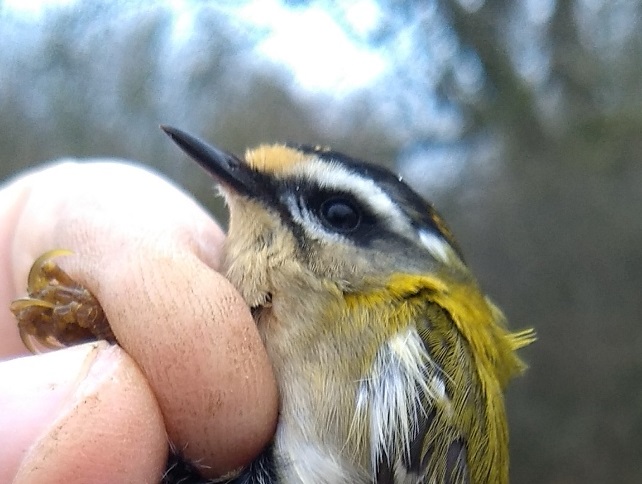
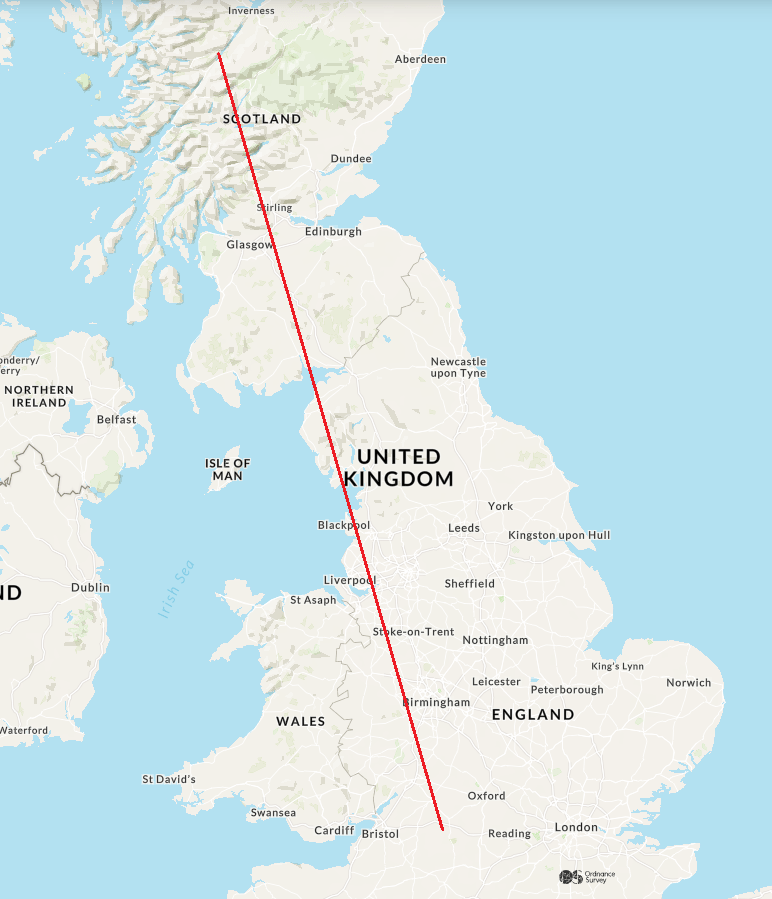
Just before Rosie had to leave to get to work we caught a couple of Lesser Redpoll. These are the first caught in Red Lodge for four years, so another bonus for the morning. We know, from ringing recoveries of birds we have ringed, that the birds of this species and of Siskin that we ring in the Braydon Forest are primarily migrants from up north, who pass through Argyll and Bute on their journeys, as opposed to the residents that inhabit the woodlands around Warminster and Longleat. One of the two caught today was ringed elsewhere, on another group’s rings. I am looking forward to finding out just where.

The morning was largely as expected: lots of Blue and Great Tits, with a sprinkling of different species. Our last, interesting bird of the morning was this:

Jay

This is the first Jay that we have caught in Red Lodge for over seven years: June 2014 being the last time.

Our list for the day was: Nuthatch 1; Jay 1; Blue Tit 17(9); Great Tit 4(3); Coal Tit (4); Marsh Tit (1); Robin 1(1); Brambling 1; Chaffinch 2; Lesser Redpoll 1(1). Totals: 28 birds ringed from 8 species and 19 birds retrapped from 6 species, making 47 birds processed from 10 species.

One of the last birds extracted was a Great Tit with a leg that had either suffered a break in the past or was born with a deformed right leg:

I had to decide whether or not to put a ring on it. Anti-ringers seeing such a bird would no doubt blame the ringing process for the damage, but I also want to know whether or not it would hamper its survival. I know that we have not damaged any birds in Red Lodge for more years than I can remember and, as this is a bird that fledged this year, I am 100% confident that the damage has nothing to do with our ringing activities. As a result, I took the decision to ring it on its left leg, and to take the photographs to show that the injury pre-dates the ringing process. Hopefully, as we get a good recovery rate on our ringed Great Tits, I will be able to follow the progress of this bird.

At 11:30 Miranda and I closed the nets. We had a couple of stragglers to process, which held us up a bit before we could start taking down. As we sat down to process the birds a flock of finches flew in and landed in the tree tops adjacent to one of the feeding stations. They were unidentifiable, as they were in silhouette and I didn’t have my optics with me. We hurried back, opened one feeding station net, and put on a lure for Lesser Redpoll and Siskin (hedging my bets) and hoped they might come down. We finished processing the stragglers, took down the closed nets and then visited the re-opened net: a solitary Blue Tit. I seem to remember that exactly the same thing happened at the end of our last session at Red Lodge. Clearly it is looking to wind us up at the end of each session! We left site by 12:45 after a very satisfying session.

Blakehill Farm: Wednesday, 17th November 2021

Yesterday I went over to Blakehill Farm mid-morning to do a bit of ride maintenance. I was greeted by the sight of several hundred Redwing and Fieldfare flying around the plateau area. With very light winds forecast for today I thought to take advantage of that and see what was catchable.

The only nets that I planned to set were 7 x 18m along the perimeter hedgerow and the Meadow Pipit triangle. Rosie did her usual of turning up to help set the nets and then having to go to work after ringing a single bird ( a Wren). I was also joined for the session by Miranda and her son Elliot. We met at 7:00 and the nets were open by 8:30 (it is hard work bashing holes into an asphalt track that is pretending to be a grass verge, particularly as the dislodged stones fall back in as you extract the hole maker!).

We put lures for Redwing and Linnet along the perimeter track and the Meadow Pipit lure in the triangle. Unfortunately, only the Redwing lure worked. To be fair to the Mipit triangle, an unforecast breeze did spring up, and very quickly the net pockets were blown out. Birds were flying into the net and flying straight out again. As usual, several used the poles and the top line as perching places. For a few minutes we had a Kestrel using one of the poles as a hunting perch. Unfortunately, we didn’t catch a single bird in the net.

Fortunately for our hedgerow nets, the direction of the breeze meant that the hedgerow itself acted as a windbreak, and it didn’t affect those nets at all. As previously mentioned, the first bird out of the nets was a Wren, but after that the bulk of the catch was Redwing.

As we were processing a few birds at the ringing station, we noticed a small flock of Long-tailed Tits fly across the gateway to the plateau and into the hedgerow where our nets were set. Sure enough on the next round we extracted eight Long-tailed Tits!

The list for the day was: Blue Tit 6; Great Tit 1(1); Long-tailed Tit 4(4); Wren 1; Dunnock (1); Robin 2; Redwing 29; Blackbird (1).

It was a good catch of Redwing. As usual, the vast bulk were juveniles, with only two adults in the mix.

Juvenile Redwing: note the diagnostic white fringing on the tertials, which resemble the logo of a certain sports clothing / footwear company

The only downside to the hedgerow windbreak was that by the time we were ready to pack up the nets were full of leaves! I love autumn! We closed the nets at 11:30 and left site, after emptying as many of the leaves as possible whilst taking down, just before 13:00! A clear indication of just how many leaves we removed: the tragic thing being how many more there are to remove!

Winter CES1: Somerford Common, Monday, 15th November 2021

For the second year running, the BTO are looking to trial the Constant Effort Site format, that is a keystone of their summer data collection, during the winter. There will be eight sessions, approximately two weeks apart, between November and the end of February. The key difference between the summer and the winter CES formats is that the winter one allows for provision of a feeding station. With the agreement of Forestry England, I have decided to trial it at Somerford Common.

This morning was my first session of the trial. For a number of reasons, not least that it is a Monday and some people have to work for a living, I ended up doing this one solo. Naturally that meant it would be the busiest session that I have had all year! A total of 85 birds were processed. I set the nets as diagrammed in my previous Somerford Common post: just 6 of them, 4 around the feeding station and two in a line along the main path (my Redwing nets).

The first round was a nice enough indicator of the morning: just four birds but one was a new Marsh Tit and another was a retrapped Marsh Tit, plus a Robin and a Blue Tit. However, the second round was crazy, with 51 birds extracted from the nets. Fortunately, they were all very accommodating, even the Wrens and the Blue Tits, and it did not take a huge amount of time to clear them. However, I did process them in batches (smallest birds first), so that I could keep a check on the nets within my preferred 15 to 20 minute timeframe.

During that second round, a decent catch of seven Redwing flew in to the main ride nets. I caught a couple more in the following two rounds and it also caught a small flock of Lesser Redpoll.

The third round brought in my bird of the day (possibly of the year) for she was the biggest female Sparrowhawk that I have handled for a long time:

She was lying in the bottom shelf of the Redwing net, with her belly facing out and when I first saw her I was somewhat dismayed, because it looked for all the world as though one of the hen pheasants, that had been conspicuous all morning, had blundered in. As I went over to remove it from my net (pheasants and mist nets do not go well together – and the net comes off the worse), I soon realised my mistake and my arthritic limbs were once again spurred into an uncommon action for them, called “running”. The extraction was not difficult, as she was just lying in the pocket of the net and could be simply picked up and out, and I managed to ring, sex, age, weigh and measure the bird without any damage to myself (or her). Without someone to hold the bird for photographs I have had to make do with this head shot.

Alongside that, it was good to catch and ring a couple of juvenile female Great Spotted Woodpeckers. Mostly this year we have been retrapping those ringed in previous years.

The list for the day was: Sparrowhawk 1; Great Spotted Woodpecker 2; Nuthatch (2); Blue Tit 20(13); Great Tit 7(10); Coal Tit (1); Marsh Tit 1(5); Wren 2(1); Robin 1(1); Redwing 9; Chaffinch 3; Lesser Redpoll 6. Totals: 52 birds ringed from 10 species and 33 birds retrapped from 7 species, making 85 birds processed from 12 species.

All in all, a very satisfying morning’s work. Any session in which we encounter 6 Marsh Tits is a good session. I closed the nets at 11:30, took down and was away by 12:30 – the benefit of only having six nets in your set up.

Ravensroost Wood: Saturday, 13th November 2021

We had hoped to have another farmland session at Brown’s Farm this morning but the forecast was for windy weather so I changed venue to Ravensroost Wood. I set up a feeding station, and cut the appropriate net rides, on Tuesday. Next time I really must remember to take my gardening gloves, as the dog rose fought back:

Loads of blood!

The net setup was as shown on the diagram below:

1 = 2 x 18m; 2 = 12m; 3 = 9m; 4 & 5 = 6m; 6 = 3 x 18m.

I was joined for the session by Ellie, Rosie and Anna and by Samuel and his mum, Claire. This was Samuel’s third session with me, and his first time actually processing some birds. So far he has been learning how to hold them and how not to react when Blue Tits and Great Tits let you know that they are displeased.

The feeding station did its job, and we had a good haul of Blue and Great Tits, but so did the bird seed dispensers, as we also attracted in both Chaffinches and Lesser Redpoll. On visiting Ravensroost yesterday to check on and top up the bird feeders, I noticed a large flock of Redwing, so we set the net ride number 6 with a lure playing for the first couple of hours. It did attract in a couple of Redwing and a Song Thrush. The only (slight) disappointment of the session was that there was a good sized flock of Long-tailed Tits flying around the woodland adjacent to net ride 6 and we didn’t manage to catch a single one.

The list for the day was: Great Spotted Woodpecker (1); Nuthatch (2); Blue Tit 21(4); Great Tit 7(3); Coal Tit (2); Marsh Tit (3); Song Thrush 1; Redwing 2; Chiffchaff 1; Goldcrest (2); Chaffinch 3; Lesser Redpoll 6. Totals: 41 birds ringed from 7 species and 17 birds recaptured from 7 species, making 58 birds processed from 12 species.

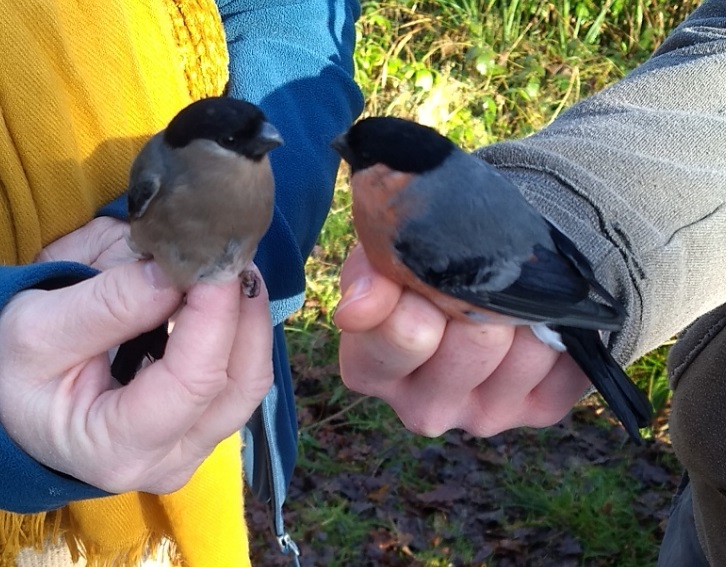
As much as it was very pleasing to recapture three Marsh Tits, the highlights for the team had to be the Lesser Redpoll. In particular, it was good to have some clearly marked adult males in the catch to contrast with an adult female:

Adult Male Lesser Redpoll
Adult Female Lesser Redpoll

Samuel started his ringing career by ringing two Chaffinch and a Blue Tit and processing a recaptured Great Tit and Coal Tit.

A couple of the team had to leave at 11:00 to get their Covid-19 booster shots and, as the number of birds had dropped off, we did a last round at 11:20, closed the nets and took down. We were off site by just after midday.

Barn Owls: 2021 Breeding Season Review

I started monitoring Barn Owl breeding in north-west Wiltshire in 2017. In that first year my team helped me check on 15 boxes. To be fair, we didn’t start until the September, so it wasn’t too surprising that we only ringed 3 broods comprising 8 chicks: at Drill Farm, Plain Farm and Blakehill Farm. We also managed to ring 4 Jackdaws in 2 broods at Blakehill Farm. It was a similar situation in 2018, but only 2 broods of Barn Owl chicks were ringed, plus one roosting adult. This time we had youngsters in one box at Blakehill and an adult in another there. The other brood was ringed in a condemned barn, in the worst box of our entire stock.

This box has been one of our most consistently productive but it won’t be there much longer. If it doesn’t fall down it will be pulled down. The Wildlife Trust, I am delighted to say, erected three new boxes in 2020, in the immediate area of this box.

2019 produced 10 youngsters and 2 adults from 15 boxes visited. It also produced one brood of 2 Stock Doves. 2020 was a bad year, primarily due to Covid restrictions imposed by the BTO, plus the need for social distancing and taking sensible precautions. We still ringed 8 young from 3 broods plus two broods of 2 Jackdaw chicks each.

So to 2021. Unfortunately, our nice Jackdaw nests, in the bug hotel at Blakehill Farm, were made homeless over-winter when the structure collapsed. However, we did get to check on 20 boxes. Of those 20, one box failed: there were 6 eggs laid but, on first checking, they were cold. On second checking six weeks later, they were still cold and unhatched. Eight boxes produced 26 young Barn Owls, one produced an adult Barn Owl, two of the new boxes erected by the Wildlife Trust produced a young Stock Dove each, and one box near Somerford Common produced young Jackdaws.

Some images from this year’s activity:

Newly hatched chick plus eggs (four hatched and fledged)
Fluffy chick stage: for such beautiful pale birds they do live in muck
Ready to fledge

Many of the boxes that we have been checking are very old and becoming extremely dilapidated, so I looked into if I could get funding to replace them. I approached one of the local landfill operators, Thomas Crapper & Sons, as I know they have been generous funders of developments for the Wildlife Trust, and they pointed me in the direction of Community First. I had to jump through a few hoops, filling in forms, getting quotations, so that they could put it forward to Entrust, who approve or deny such applications. I am delighted to say that I have received notification that the application has been successful and that the funding (hopefully) will be made available mid-November. That will set my team up for some hard work over the winter. The offer has been made to the team: the more help they give to get these boxes set up, the more opportunity I will give them to ring Barn Owls. Bribery is not always corruption.

Stock Dove a couple of weeks to fledging
Stock Dove ready to fledge

A Grey Day In Webb’s Wood: Saturday, 6th November 2021

Two types of greyness affected our session at Webb’s Wood. To start with, the three weather apps that I use (Meteo, Met Office and xcweather) all forecast a dry morning, with the wind getting up towards midday. When I stepped out of the house into a fine spray of mizzle, I was concerned. As Rosie was joining me for the session, and would be able to stay for the entire time, I was reluctant to call it off. I also had David back after a few weeks away and Anna coming a fair distance to join me, so I decided that we would see how it went. The mizzle was light enough for us to set up and go for it. There were patches of dry weather but it did not fully arrive until we started to take down and it stayed grey all morning. However, the mizzle never breached that barrier where it would have been inappropriate to continue.

I had set up a feeding station on Tuesday, and the fact that the peanuts had disappeared but the seed mix had been ignored let me know what sort of morning we were in for. It was a decent session for the first couple of hours, with 25 birds processed between 7:45 and 8:55. We then only caught one bird in the next hour and twenty minutes. As I am suffering with a painful, and sleep-depriving, neck problem, getting cold and miserable with no birds was more than I was prepared to put up with. I made the fateful statement: “If there are no birds in the next round we will pack up, go home and get warm”. Next round we extracted 27 birds.

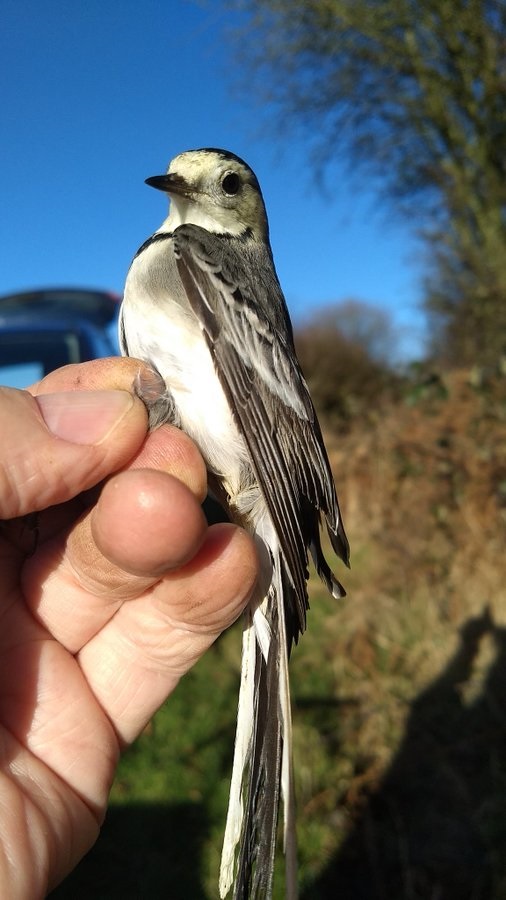
That is where grey became interesting. In all of my ringing in the Braydon Forest my team has never caught one of these:

Juvenile Grey Wagtail, photo by Anna Cooper

I have processed a good number as a trainee, but none of my sites regularly plays host to them. Anna extracted this beauty from one of the nets adjacent to the feeding station which, in turn, is nowhere adjacent to a water source: just a few puddles. Anna has now processed her first Grey Wagtail.

The list for the session was as follows: Great Spotted Woodpecker (1); Blue Tit 16(7); Great Tit 8(5); Long-tailed Tit 10; Wren 1; Grey Wagtail 1; Redwing 4; Goldcrest 12. Totals: 52 birds ringed from 7 species and 13 birds retrapped from 3 species, making 65 birds processed from 8 species.

We are getting good numbers of Goldcrest in the Forest at the moment. Interestingly, our last session at Webb’s Wood was on the 6th October and we caught 12 Goldcrest, exactly the same as we had today. I had better schedule a session for the 6th December!

After our bumper round at 10:25 the numbers fell away again for the next two rounds, and we decided to pack up and head home.

This year has been a cracking year for fungi all over my local area. I found this in the feeding station:

Yellow Stag’s Horn Fungus: Calocera viscosa

I might have a look to see if I can identify the lichen that is just to the left of the fungus.

We were off site just after midday after a surprisingly satisfactory session, despite the weather.

Red Lodge: Wednesday, 3rd November 2021

We last had a session in Red Lodge on the 4th September. I had planned to run a session mid-October but, when driving past a few days before, I noticed this:

The gate support had been sawn off. I went back to have a look and found a lorry load of rubble had been fly-tipped:

I contacted Forestry England to let them know. Due to holidays and staffing it took a couple of weeks to get it cleared. As I was planning on setting up my feeding station over last weekend, on Friday I went back to do some ride clearance. It was great to be able to drive up to our usual parking spot and get on with the task in hand. I went back on Saturday, just after lunch, to set up the feeding station, and found this:

Some deeply unpleasant individual had taken advantage of the fact that Forestry England hadn’t managed to fix the gate and had dumped a load of tree waste in exactly the same spot as the rubble had previously been dumped. I had a chat with David, one of the locals, who told me that when he had walked his dog there that morning, between 10:00 and 11:30, the path had been clear. So whomsoever did this, did it at lunchtime, in broad daylight, on a busy road. I went back on Monday to see whether it was worth me trying to clear it, or if there was sufficient room for the team to park safely away from the road, to find this:

At least this was a natural occurrence. I let Forestry England know again. They are, unsurprisingly, angry and upset about this vandalism and the incurred costs. There is an epidemic of fly-tipping in our area at the moment.

So, I decided that they weren’t going to stop me carrying on with my session. I was joined at 6:30 by Lucy and Miranda for the full session, and Rosie and her new Wildlife Trust colleague, Charlotte, for the start of it. We set nets by the pond and the feeding stations: just 6 nets: 4 x 18m and one each of 9m and 12m.

One thing I noticed immediately: the birds had found the feeders. They were all empty! We refilled them and had all of the nets open by 7:15 and had our first birds straight away. As is usual once the feeders are up, the session was Blue Tit heavy, with a supporting cast of Great Tits. However, we did have some decent catches of other birds: another two Marsh Tits ringed and an older one, ringed in October 2019, recaptured.

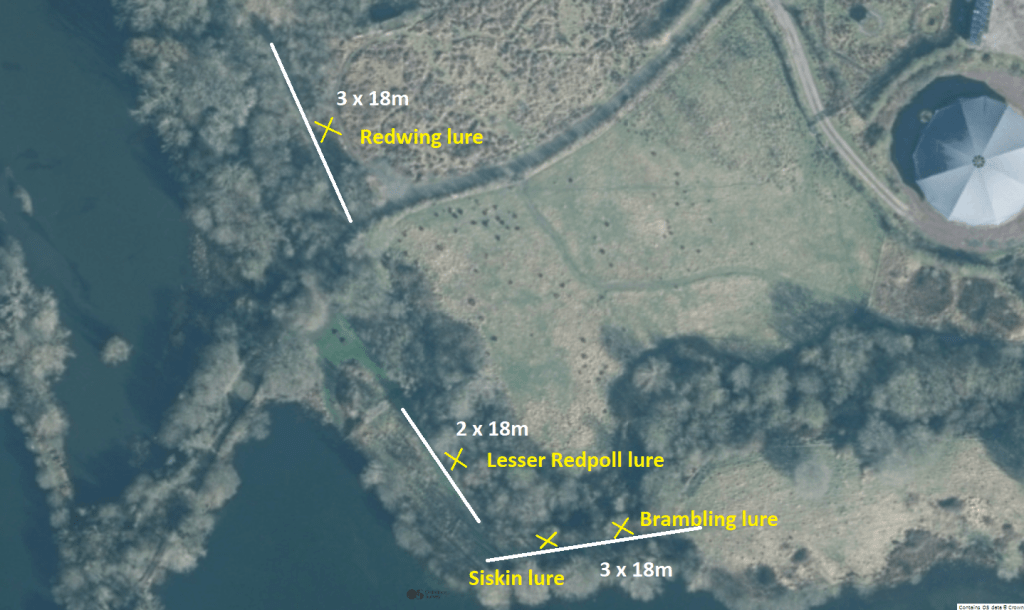
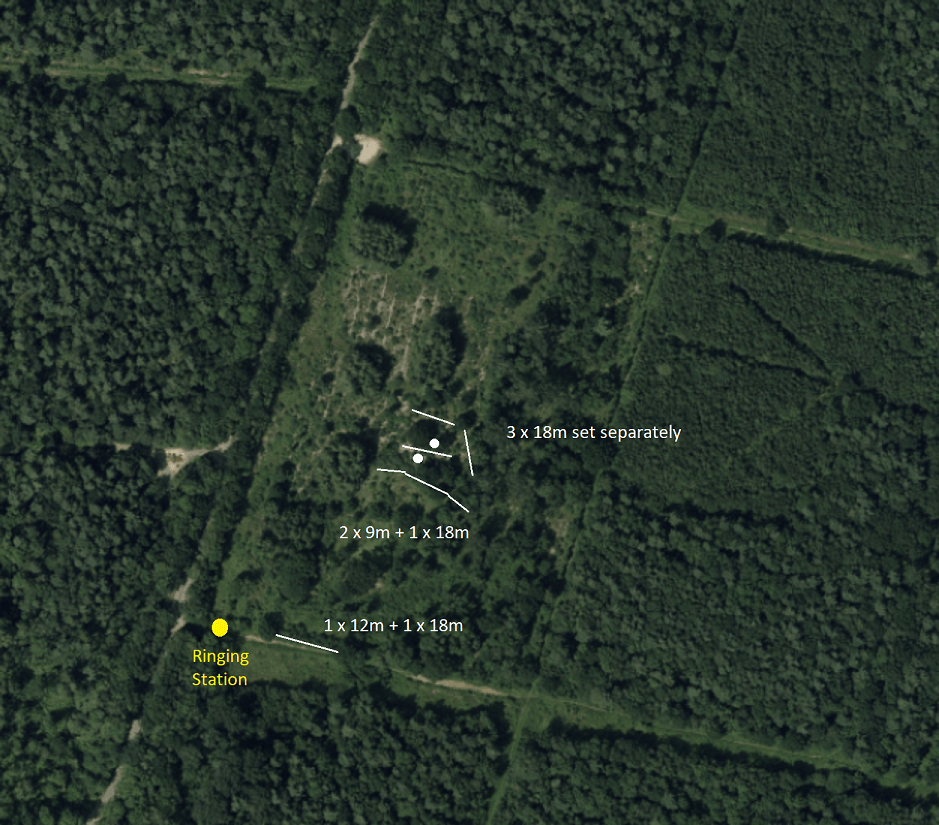
Red Lodge Net Set

I set a lure for Redwing on the net set alongside the pond and lures for Redpoll and Siskin at the 9m and 12m nets. Needless to say, we didn’t catch a single one of the target species. At 10:00 I changed the Redwing lure to Goldcrest, and they turned up straight away. At 11:00 I moved it to the other 2 x 18m net ride and, again, a few more dropped in. I never lure for Goldcrest until well into the session: at approximately 5g in weight, I really don’t want to target them until they have had a chance to warm up and feed first. In fact, unless I am happy with the ambient temperature, I won’t lure for them at all. They are one of the most lure responsive species, and will respond all year round. To date I have not had any cold-related casualties with Goldcrest, and I want to keep it that way.

This Blue Tit decided that it needed a high perch before it flew off back into the wood:

The list for the day was: Nuthatch (1); Blue Tit 20; Great Tit 8(4); Marsh Tit 2(1); Wren 4; Dunnock 2; Robin 3(2); Blackbird (2); Goldcrest 6; Chaffinch 2. Totals: 47 birds ringed from 8 species and 10 birds recaptured from 5 species, making 57 birds processed from 10 species.

We packed up at 11:30 and, as our luck would have it, all the nets were down, the lures switched off, and we were sat at the ringing station processing the last few birds, when a flock of 20 either Siskin or Lesser Redpoll (they were in silhouette) flew into the tops of the trees above the feeding stations! The consensus was that they were Siskin.

Blakehill Farm: Tuesday, 2nd November 2021

The morning was cold at the start: bang on freezing point, with a ground frost and a layer of mist covering the plateau. I was joined by Lucy for the session: cramming in as much cold weather ringing as she can before facing the rigours of Ascension Island in a week’s time. I cannot say how much I pity the hardships he is about to face!

We set nets for Redwing along the perimeter track and four plateau nets, hoping for Stonechat. There was also a plan to set up a Meadow Pipit net but the deer had made a mess of the electric fence across the centre of the plateau and so we held off from setting that until after Jonathan, the farm manager, had repaired his fence. Fortunately the cattle that were in the compartment next to our plateau area did not realise that the fence wasn’t working and avoided it anyway, so the nets were safe. In the end we managed to get the Mipit triangle open at 10:30 but there weren’t many around.

The first round was decent: 16 birds, including four each of Chaffinch and Blue Tit plus five Redwing. It was nice to have four Chaffinch that we could actually ring. They all had nice clean legs: no signs of Fringilla papillomavirus, in contrast to a couple of other occasions at my woodland sites recently.

The next round produced our first three Wren of the morning and two Stonechat. They were a male and a female in the same net about 50cm apart. I will have to look into their pairing and mating habits: do they pair up annually or do they maintain the pair-bond beyond? Anyway, they were fine adult specimens, and he was particularly haughty:

The next couple of rounds produced another eleven birds, including our second Blakehill Linnet of the year:

For some reason our catches of Linnet at Blakehill are very variable. Between 2014 and now, we had excellent catches of 42 and 25 respectively in 2015 & 2016 and then 15 in 2018 but every other year has only produced single digit catches. The most productive months for the good years are April, August and September.

The list for the day was: Blue Tit 4(2); Great Tit 3(1); Long-tailed Tit (1); Wren 6(2); Meadow Pipit 2; Stonechat 2; Robin 1(1); Redwing 7; Song Thrush 1; Blackbird 2; Chaffinch 4; Linnet 1. Totals: 33 birds ringed from 11 species and 7 birds retrapped from 5 species, making 40 birds processed from 12 species.

What was surprising was that 20% of the catch comprised Wrens. Six of the eight were caught in the scattered nets out on the plateau, with just two in the hedgerow of the perimeter track. They were caught in just three rounds between 9:00 and 10:00 and then no more. One of the two retrapped birds, JTY709, was ringed as a juvenile in December 2016, which is a good age for a Wren. The BTO’s Bird Facts data gives a typical lifespan of two years and the maximum age from ringing is 7 years 3 months and 6 days, so logging in at 4 years and 11 months is a venerable age for a Wren.

As you can see from the two photographs, once the sun came out and the mist lifted, the sky was crystal clear. Unfortunately, soon after we had the Meadow Pipit triangle open the breeze got up, the nets became too visible and the catches went right down, and we only caught the two Meadow Pipits, despite a decent number of them flying around the plateau. As a result, as for the next three rounds we were not catching more than one bird per round, we started packing away soon after 11:00 and left site just after 12:30.

West Wilts Ringing Group: October 2021 Results

Despite the dreadful weather of the last week of October, we still had a pretty decent return for our efforts this month. It is our second best October since the group came into its current form: the best having been in 2019.

Numbers of Meadow Pipit were well down compared with last year. The change was that numbers in two of our farmland sites (Blakehill and Jonny’s East Tytherton site) were at one third of the catch last year. Blakehill had the same number of sessions (i.e. one) but East Tytherton had half as many (two) as in 2020.

So, where did the improvement come from: Blackcap and Chiffchaff numbers were well up on last year. Catches were evenly spread throughout the month in both years. Similarly, the number of Blue Tit ringed one third higher than last year. What is most surprising is that the increased number is down to a significant increase in juvenile birds ringed (149 as opposed to 90). As everyone acknowledges: Blue Tit had such a poor breeding season, and yet in both October and September juvenile numbers have been on a par with previous years. One can conjecture as to why this is the case: fewer birds leading to less competition for food, lower likelihood of predation, etc, but who really knows? As you can see from the session statistics: we weren’t running a lot of extra sessions.

Other significant increases were Redwing and Lesser Redpoll arriving in reasonable numbers and being caught earlier than usual. My first Redwing, caught on the 9th of the month, equalled one ringed on Salisbury Plain in 2016 as the earliest we have ringed the species in the autumn. Lesser Redpoll are resident further south in the county, in the Warminster / Longleat area and it is possible that there is a small relict population in Somerford Common but, in the main, the Lesser Redpoll we catch in the north of the county are migrants from up north. Our catch of nine on the 13th of the month, at Somerford Common, matches a catch of two there on that day in 2015 as our earliest autumn catches and the ten in October there is the biggest for us in that month.

Amongst our resident birds, both Robin and Long-tailed Tit showed increased numbers over last year.

So what are the highlights? The standout bird is the Corn Bunting captured on Salisbury Plain. As I mentioned at the time, it is only the third location on the Plain at which the Group has caught one. Seven singles were caught near Winterbourne Stoke, with the last in March 2005, one was caught near Enford in September 2005 and so it has taken another 12 years for one to be caught by us on Salisbury Plain.

Photograph by Ian Grier

Another highlight, because we catch very few, was Jonny’s Skylark at the beginning of the month. Funnily enough, this is our best year for them so far, with four caught, three on Salisbury Plain and this month’s one at his site near Sutton Benger.

Not Jonny’s bird but any excuse for a photo of a Skylark!

Steph’s highlight was her first ever Woodpigeon caught in her garden! We think it had only just fledged as it was very juvenile: no white collar developing yet and, whilst she processed it, a pair of adults sat atop a pole and a neighbouring tree and watched the whole thing intently from capture to release.

Apart from that, we have had notification of a couple of interesting recoveries of our birds this month. A Blackcap ringed in Melksham in early September was recovered by a ringer in the Netherlands at the end of September. It had flown 480km in an ENE direction in 22 days. That is one confused migration!

The second is a Chiffchaff ringed at Langford Lakes in August and recaptured 231km away, due East, 27 days later at the Sandwich Bay Bird Observatory. Another odd looking migration route.

Just to end on a slightly negative note: one of my sites, Red Lodge, has suffered some vandalism. Firstly, the criminal used a power saw to chop off the gate support and then backed their wagon in and dumped a load of rubble blocking the path onto site:

I let Forestry England know and they came and cleared the rubble but didn’t mend the gateway. I went back on Friday to clear my winter net rides and everything was clear. When I went back Saturday afternoon to set up my winter feeding stations I found this:

Clearly taking advantage of the fact that the gate hasn’t been repaired or replaced. I informed Forestry England when I got back. This morning, after setting up another couple of feeding stations and doing a bit more ride clearance, I thought I would pop back to see if the gate was still in place, where I had propped it up. it was, but this has now joined the rubbish dumped on the path:

It won’t keep me out! I plan to be there Wednesday and I will be! I had problems with vandalism of my feeding stations a couple of years ago. The beat forester set up covert camera surveillance and we put up notices, which stopped the problem. Time to do it again I think.

An interesting month with a lot going on. Here’s to a busy November! The weather is looking okay for the next few days.

Somerford Common: Wednesday, 27th October 2021

It was touch and go for a session this morning. Although it was forecast to be dry, there was the threat of winds at a base of 16mph, gusting to in excess of 30mph. Somerford Common is able to offer some relatively sheltered areas but 30+ mph is serious. Opening my door to leave at 6:35, I was disappointed to see that it was raining but, with four of the team turning up to help from varying distances away, I decided to carry on regardless and hope that the forecast would come good. Fortunately, although my windscreen wipers were reacting for the first couple of miles, by the time I got to Somerford the rain had stopped.

I had put up a couple of feeders on Monday morning, on the off-chance that the birds might have discovered it by today and give us a decent haul of birds. They hadn’t, but we ended up with 30 birds, so not too bad.

Arriving on site at 6:45 I was surprised to find Lucy already there and waiting: she’s never late but over 15 minutes early: unheard of for any of my team before today. We were then joined by Rosie, Miranda and Anna and we set to and had the nets open by 8:00. I used the net set that I am going to be using for the winter CES. First opened were the 18m and 12m set along the main ride and, whilst it was still dark, I set the Redwing lure working to see what might drop in whilst we opened the other nets. Twenty minutes later Lucy went to check the nets and set up the ringing station, and she extracted the first birds of the morning: two Long-tailed Tits and (no surprise) a Redwing. As Rosie was doing her usual selfless thing of helping us to set up, before heading off for a hard day’s graft with a chainsaw at Lower Moor Farm, I let her process the first three.

Thereafter, we had a couple of decent catches of Redwing coming to the lure between 9:00 and 10:00. I then changed the lure to Goldcrest, and we started to catch them as well. The other nets had lures for Lesser Redpoll, Siskin and Marsh Tit running – all to no avail. Which is not to say that we didn’t catch birds in those nets: just not those species. Ironically, the penultimate bird out of the nets was this, right next to the Goldcrest lure:

juvenile Lesser Redpoll

Although the tail showed that it was definitely a bird of the year, it had a few pink feathers on the breast, identifying it as a male.

The list for the day was: Blue Tit (2); Great Tit 3; Coal Tit 1; Long-tailed Tit 1(1); Robin (1); Redwing 10; Goldcrest 9(1); Lesser Redpoll 1. Totals: 25 birds ringed from 6 species and 5 birds retrapped from 4 species, making 30 birds processed from 8 species.

Throughout the morning it would spit with rain for a few minutes, then dry up for half-an-hour, then spit with rain again. For most of the morning the wind didn’t interfere with the nets, but as the morning wore on the wind did get stronger, and I decided to close the nets and pack up at 11:00. We took down the feeding station nets first, returning to the main ride to find the Lesser Redpoll and a Great Tit in that net set. We were off site by midday.