The following report has been put together by Jonny Cooper, project lead.


Ringing and recovery activities within & beyond the Braydon Forest
The following report has been put together by Jonny Cooper, project lead.
Whilst restricted to my Wiltshire Wildlife sites (hopefully we will get good news from Forestry England today or tomorrow) I am visiting them on rotation and today was the turn of the Firs. I was joined for the morning by Steph as, previously mentioned, I am also rotating my trainees during this difficult period.
I will be setting up feeding stations this week for my other sites, but have not yet done so for the Firs. The catch was fairly predictable: heavy on the Paridae, light on everything else. The site is always low on finches for some reason and today was no exception. What was unusual about this session was that two-thirds of the catch were retrapped bird.
Among the new birds caught was this rather stunning Great Spotted Woodpecker:
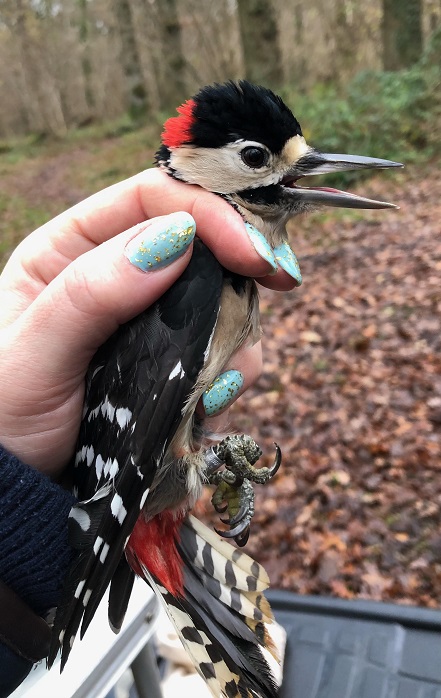
The photo was taken by Steph – and the nails are hers as well (just in case you were wondering).
The list for the morning was: Great Spotted Woodpecker 1; Blue Tit 3(4); Great Tit 2(8); Marsh Tit (1); Long-tailed Tit (1); Robin (1); Blackbird 1; Goldcrest 1(1). Totals: 8 birds ringed from 5 species and 16 birds retrapped from 6 species, making 24 birds processed from 8 species.
We packed up at 11:30 after a nice relaxed session and cleared site just as the first spots of rain started to fall.
November has been a bit of a challenging month. When lockdown 2 was announced most of the regional offices for Forestry England, including our own, were happy to accept the BTO / JNCC / NE decision that ringing constituted “outdoor recreational exercise” and could continue. Unfortunately, a week later the central administration decided to overturn their regional offices and ban all volunteer activities, including ringing, on their properties. Absurdly, that meant I could spend the day birding at any of their sites, but not set any nets. I just love bureaucracy! That has impacted on my activities, with sessions focused on the Wildlife Trust sites at Blakehill Farm, the Firs, Ravensroost Wood and Lower Moor Farm. The only place that I have a feeding station set up is in Ravensroost Wood.
This November was never going to compete with last year for quality of catch, what with Ian and Andy retrapping a Merlin at Battlesbury and my team mist-netting two Buzzards at Somerford Common and our first Firecrest at Red Lodge, (although the last was actually ringed by a member of the North Wilts group, who I was assessing for a C permit at the time (he passed)) and only our second in the Braydon Forest. We have averaged out at slightly more birds per session than last year, and it is our second best November catch since the split at the start of 2013.
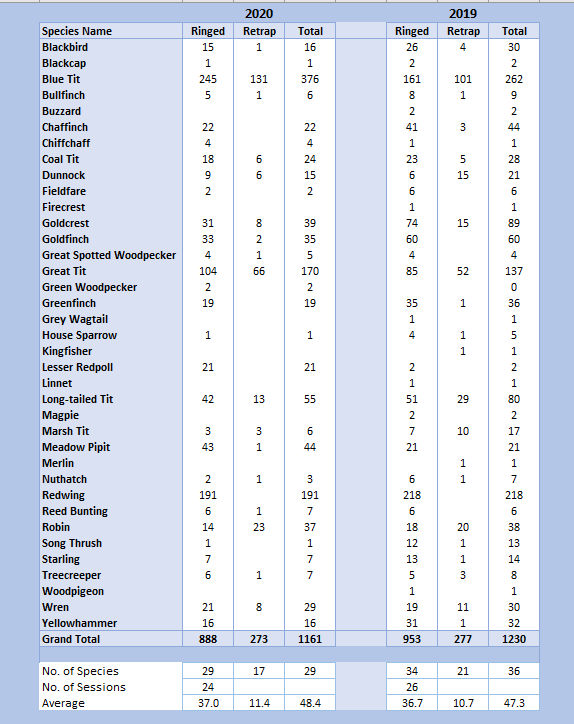
The difference in the catch is that the numbers of Blue Tit, Great Tit, Meadow Pipit and Lesser Redpoll are up, and the numbers of Goldcrest, Goldfinch, Chaffinch, Blackbird and Song Thrush are considerably down. The increase in Blue and Great Tit numbers is mainly down to Jonny’s new site at Biss Wood: large catches heavily skewed towards those two species. By contrast, the Chaffinch and Goldfinch numbers being down is almost certainly the result of my not being able to work at Somerford Common, where the winter catch at the feeding station has been good for these two species in the last couple of years. Meadow Pipit numbers are up because Jonny has started using a Mipit triangle at his farmland sites and being successful with them. Interestingly, last Thursday saw Jonny and I set a Mipit triangle at Blakehill Farm. A flock of about 20 of them came towards the lure and then flew away. Perhaps they are less inclined to seek out additional companions as winter draws on.
Sadly I will almost certainly not be doing any more work at Tedworth House. Help4Heroes has, essentially, mothballed the site, and has made 140 staff redundant! In fact, it seems the only person on site is my friend and fellow ringer, Jack Daw, doing essential maintenance.
He has been having trouble getting out to ring on his Salisbury Plain sites recently, as they seem to be favoured for the current set of military training exercises, so he asked if I would object to him doing some ringing at Tedworth. I have just handed the site over for him to use as his patch going forward. I ringed there because the Wildlife Trust and the charity asked me to, and because it might have been of some help to what they call the beneficiaries. They have cancelled their agreement with the Trust and as there are now no beneficiaries, and are unlikely to be throughout 2021, it would have been churlish to say “No”, so I have just handed it over, no strings attached.
It has always been a funny site: you never knew what you would catch. Apart from the usual woodland suspects it is where I have caught the majority of my less usual birds: Black Redstart being the stand out capture but also Firecrest, Mistle Thrush, Kestrel, Sparrowhawk and these beauties to name a few:

And perhaps the most unexpected catch in one of my mist nets:

Anyway, that’s it for this month except to say that last year was exceptional for us, this year we have already surpassed last year’s total. It is probably because A’s and C’s have done more individual sessions due to coronavirus but, nevertheless, the group is certainly more active now than it has been since the end of 2012.
Part 2 was scheduled for Friday but a bit of illness on Thursday night and freezing weather on Saturday meant that it was put back until today. The idea was to contrast what we caught on the north-east side of the reserve on Thursday with what was to be found in the south-west corner. I was joined for the session by Ellie Jones. My hope was that there might be some Snipe around but, apart from one that was put up as we were setting nets in the dark, we didn’t see any others. The nets set up on a just in case basis caught one bird: a same day retrap Redwing. I got excited when I saw the net moving, and deflated when I realised what it was.
Apart from the pond nets, we went for a very simple net setup, just 4 x 18m along a hedgerow:
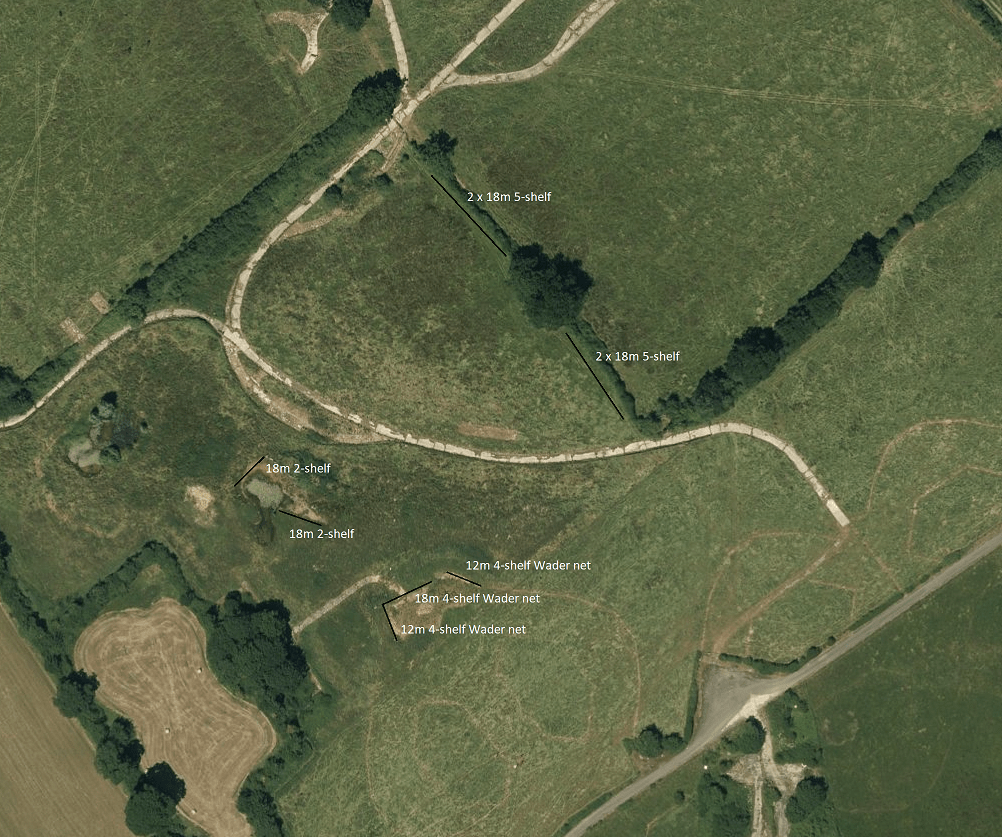
The wader nets have a larger 30mm x 30mm net strand length, whereas the standard nets have a 16mm x 16mm strand length. In this set up we put on lures for Snipe on the pond nets and Starling and Redwing on the hedgerow nets. After a couple of hours it was clear that the Starling lure was having no effect, so we replaced it with another Redwing lure, which was working much better.
The first round delivered a Robin, Blue Tit, two Blackbirds and half-a-dozen Redwing. Thereafter it was pretty much Redwing all the way: Treecreeper 1; Blue Tit 3; Great Tit 1; Wren 1; Robin 1; Blackbird 2; Redwing 30. Total: 39 birds ringed from 7 species.
For the first two-and-a-half hours the sky was overcast but visibility was good but then a cold mist started to develop and by the time we closed the nets at 11:30 everything was damp and dank and much colder and it was nice to get away.
So, how did the 2 sides of the reserve compare: the key difference was the absence of any Long-tailed Tit in the catch. However, it could have been an almost identical catch, as a flock of them flew along the line of the hedgerow, but at tree-top height, not hedgerow height, and avoided the nets. What was noticeable was that, although they did not come to the lure, there were a significant number of Starlings flying around in small to medium sized flocks.
Having spent as many sessions as possible giving my T-permit trainees the chance to join me in these 1 + 1 times, it was good to have my longest suffering trainee, and C-permit holder, Jonny Cooper out with me this morning.
We had a two-fold target: primarily Redwing, secondarily Meadow Pipits. The former we were very successful with, the latter was a complete failure. When we arrived on the site the temperature was just below zero but as the sun broke through the mist it warmed up quite nicely.
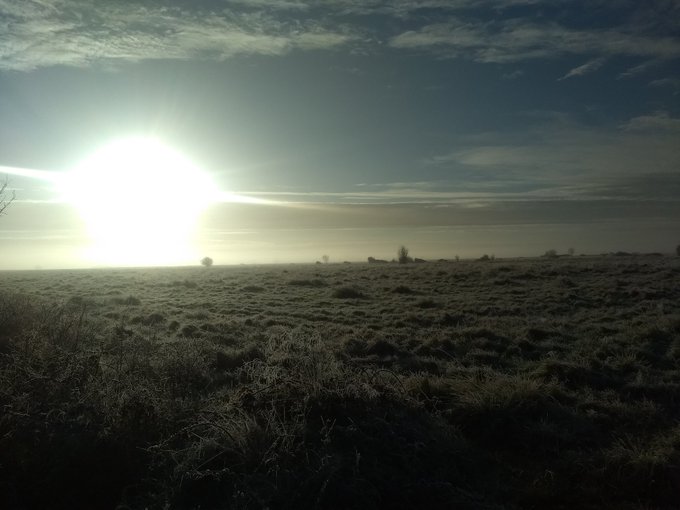
We set up 6 x 18m nets along the perimeter track and put a lure for Redwing in place midway along. Within a few minutes we had the first few Redwing fly in. Apart from a flock of 15 at 9:00, they came in small groups throughout the morning, ending up with a good total of 37 ringed in the session.
Once the peri-track nets were set up, we then set up the Mipit triangle. Unfortunately, all it caught was a solitary Wren. About 10:30 I changed the lure to a louder version, almost immediately a flock of about 30 flew around the nets and then pushed off elsewhere.
At 10:30 we caught and extracted a decent proportion of a foraging flock of Long-tailed Tits: nine of eleven ended up in the nets. We caught a couple of Wrens and Robins and a few Great Tits. All were new birds. The list was: Great Tit 3; Long-tailed Tit 9; Wren 2; Robin 2; Redwing 37. Total: 53 birds ringed from 5 species.
With Jonny having to leave for work at midday, the birds kindly stopped moving at 11:30, giving us just enough time to take everything down before he had to leave.
Part 2 will follow tomorrow, when I will be working with my second longest suffering C-permit holder, Ellie Jones, on the other side of the Blakehill site. Again I will be targeting Redwing and Meadow Pipit so that we can compare and contrast.
On Saturday Ellie spent a couple of hours trying out her new MP3 player with the “Latvian Love Song” lure for Redwing. This is her brief report:
“I’ve been consistently getting 10-15 birds in my two 18m nets, which pro rata doesn’t work out too badly, but on Saturday, given the very calm forecast, I decided to site them along a shrubby field margin. I’d previously seen a lot of ‘action’ in those bushes, but the heavy mist, which persisted until mid-morning, meant that it was a very quiet start. It was a rather sparse session, with a total of only 7 birds – 4 redwing and 1 each of Blackbird, Robin and Great Tit; however, it was great to see the lure working on its first outing.”
Come Monday and Andrew Bray and I had a scheduled session in the wildlife refuge area on the edge of Mallard Lake.
The weather was cold and misty at the outset and, to be honest, it didn’t properly warm up until we started taking down at 11:45am. We set the usual nets in the refuge, plus an extra 9m just inside the gate (the estates team have kindly expanded that ride into something more usable than I had done myself and also refreshed the other rides) and an extra 18m over at the back, along the streamside bushes. That last I often set up, even though it rarely produces much of a catch. We did get four birds out of it today: a Robin, two Wrens and a lovely male Bullfinch:
We did actually catch a second Bullfinch: a female, but she had advanced Fringilla Papillomavirus, nasty encrusted warts in the legs and feet, so I just extracted and released her and disinfected my hands.
For me the highlight of the catch was an overwintering Chiffchaff:
The catch was Blue Tit heavy, as one would expect at this time of year, but there was enough variety to be enjoyable.
In total we caught exactly 40 birds, made up as follows: Blue Tit 10(5); Great Tit 1(1); Long-tailed Tit 1(2); Wren 2(1); Dunnock (1); Robin 3(1); Redwing 5; Blackbird 2; Chiffchaff 1; Goldcrest 3; Bullfinch 1. Totals: 29 birds ringed from 10 species and 11 birds retrapped from 5 species, making 40 birds processed from 11 species.
We spent the morning being regaled by Cetti’s Warblers. There had to be at least 5 territories in the area in which we were set up. Unfortunately, we didn’t manage to catch any of them.
One other interesting catch was a five-and-a-half year old Blue Tit, ringed as a juvenile in June 2015.
With Forestry England’s central body having overridden their regional offices and imposed a blanket ban on volunteer activities on all of their sites during this second lockdown, I am rather restricted to the sites available. Thankfully the Wiltshire Wildlife Trust have followed the decision of the BTO / JNCC / Natural England and continued to allow access to their sites on a 1 + 1 basis.
This morning I went back to Ravensroost Woods. I was expecting a titmouse heavy session, as I set up a feeding station on Thursday. It will boost the number of birds caught, and attract in some other species that are less frequently caught during the rest of the year. My plus one for the session was David, one of my T-permit holders. A word in praise of the BTO. T-permit holders are the lowest level of permit and are not allowed to ring without supervision. The next level up are C-permit holders, who are still trainees but can manage their own sites and ring independently, whilst remaining the responsibility of their trainer. Lockdown 1 clearly hit T-permit holders very hard. The interval between lockdowns has allowed 1 + 1 working, as is the case in lockdown two. This has severely reduced the ability of trainees to get out and ring, so the BTO has agreed that they will waive next year’s renewal charge for those trainees genuinely affected by this. David is one of those so affected.
One benefit of a feeding station is that you can cut down on the number of nets set. We set 7: 4 x 18m in the main ride and then one each of 6m, 9m and 12m set around the feeders. The feeder nets caught most of the birds, the ride nets caught most of the more “interesting” birds.
We started with the obligatory Blue and Great Tits, and then, as the session went on, we had a few Coal Tits and a couple of Marsh Tits turn up, together with a couple of Chaffinches and Nuthatches, all in the vicinity of the feeders.
The ride nets produced a couple of Redwing, a recaptured Bullfinch and, during our last round, 3 more Lesser Redpoll.
The list for the day was: Nuthatch 2(1); Blue Tit 13(9); Great Tit 6(2); Coal Tit 4(1); Marsh Tit 1(1); Long-tailed Tit (1); Wren 1(1); Robin (3); Redwing 2; Goldcrest (1); Chaffinch 1; Lesser Redpoll 3; Bullfinch (1). Totals: 33 birds ringed from 9 species and 21 birds recaptured from 10 species, making 54 birds processed from 13 species.
In amongst the Blue Tits was this poor beastie:
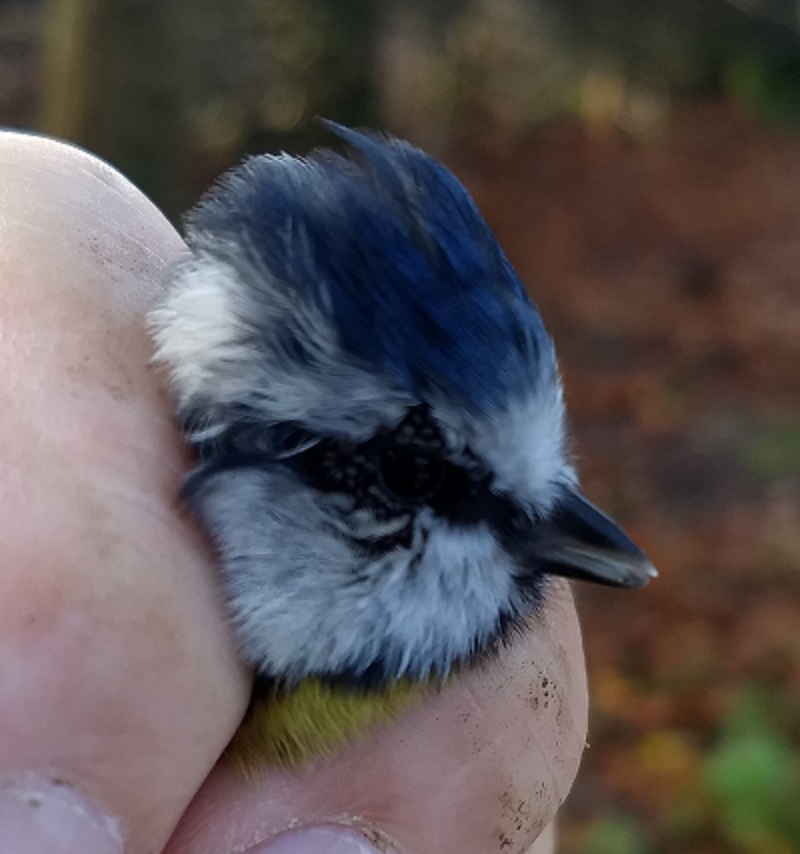
The little grey dots around its eyes are ticks. I have never seen as many as there were on this bird. Not just around the eyes but under its feathers all around the face. There had to be 100 or more of them. It is a frequent point of argument amongst ringers as to whether or not we should interfere and remove ticks or let nature take its course. The BTO’s position is that they have no position, but if you are competent to remove them they won’t object. I have been removing ticks from various animals since I was 20 years old and working with livestock (a very long time ago) and I usually do so. In this case the load was so great that I thought the bird was unlikely to survive without a large reduction in its burden, so I set to and removed as many as I could. What always amazes me about removing ticks from Blue or Great Tits is that throughout the ringing process, from extraction to ringing, measuring and weighing, they will peck at you at every opportunity but when you start to remove ticks they stop. It is almost (he said anthropomorphically) as if they know you are helping.
We had a very sociable morning. Since lockdown this site has become a big favourite with families looking for exercise in the great outdoors and today was no exception. When people stop and ask about what we are doing it is very rare for anyone to express any reservation about the process or the value of ringing. I make a point of explaining the whys and wherefores and people rarely object to getting a close look at our birds. There was a dozen or so groups who stopped for a chat. One young girl (6 years old) has expressed a wish to train to become a ringer!
Of course, readers of this blog will be aware that those that don’t bother to find out, and take things into their own hands, can be a problem. Pleased to say that on Thursday of last week I received a cheque for £100 from one of the two joggers who damaged one of my nets. They had the choice of paying to replace the net they damaged or get a criminal record, as the police tracked them down. I have thanked the police for their help.
Fortunately, for the future the Wildlife Trust have provided me with No Entry signs, and the authority to use them to close off rides when I am actively working on their sites. Personally, I think a Go-Pro will be at the top of my letter to Santa!
With the weather being as volatile as it is, I am trying to get out whenever there is a break in the weather. Unfortunately, along with the bad weather, Forestry England centrally have overridden their regional offices and banned all volunteer activities on their sites. Clearly they see birding as outdoor recreational activity but not bird ringing. That contrasts with the JNCC, Natural England, the BTO, the MoD and the Wildlife Trusts. It is hard to understand how they can come to such a different interpretation of the rules. All of which is a long-winded way of saying that, instead of going to Somerford Common for Redpoll and Siskin, I spent the morning in the Firs.
It was dull and overcast all morning, with passing moments of mist which eventually became fine rain as I was just about finished packing up.
The first bird out of the nets was a Redwing. Unfortunately, it was the only one of the morning. In fact, the catch was totally predictable for this wood at this time of year: Blue and Great Tits and little else: Treecreeper 1; Blue Tit 7(5); Great Tit 4(5); Long-tailed Tit (1); Wren (2); Robin (2); Redwing 1; Goldcrest 1. Totals: 14 birds ringed from 5 species and 15 birds retrapped from 5 species, making 29 birds processed from 8 species.
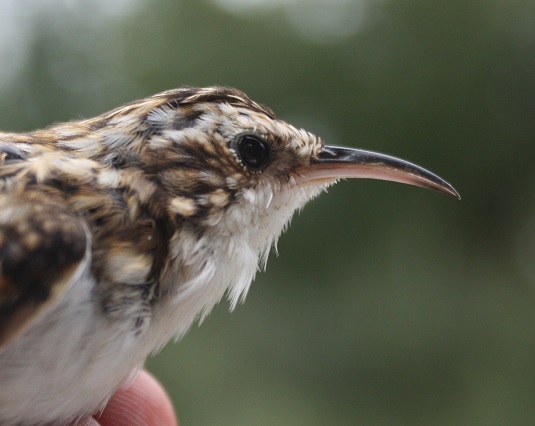
Disappointingly, as at Webb’s and Ravensroost recently, no Marsh Tits, either new or recaptured. The adult Treecreeper was the highlight of the session. They are difficult birds to photograph: not because they struggle but because, with their decurved beak and their tendency to hunch up, they tend to look thoroughly miserable – and we don’t post photographs that might be hijacked by the antis to suggest that ringing is stressful for the birds processed.
Taking advantage of what is forecast to be the last dry day before next week, I decided on a session at Ravensroost Wood. My plus one for the day, as per government guidelines, was Andrew Bray. One of the nice things about woodland ringing is that, unless you are targeting owls, excessively early starts are not necessary. Andrew and I met at 7:00 and erected 3 sets of 2 x 18m nets in the same positions as on my last visit to Ravensroost.
Having set up the nets I drove the car up to the Shooter’s Hut (not that anybody has shot in this wood (at least, not legally) since the Wildlife Trust purchased it) as it is the only place where there is room to turn the car round and drive back to the ringing station. As I drove off a small flock of Lesser Redpoll took flight from a Hazel bush in the coppiced area to my left (coupe T1 for those who know the map). As a result, we put on lures for Lesser Redpoll, as well as Siskin and Redwing, just in case.
It was a slow start. The first bird to hit the nets was a female Chaffinch at 8:15. Thereafter we caught the odd bird until 9:20 when we found a flock of 12 Lesser Redpoll in the nets adjacent to that lure. Over the course of the rest of the session we caught another 5 – much to the delight of several groups of passers by who got to have a socially distanced close up view of these lovely birds.
The catch for the session was: Blue Tit (3); Great Tit 1(1); Wren 2(1); Robin (2); Redwing 4; Blackbird 1; Chiffchaff 1; Goldcrest 4(2); Chaffinch 2; Lesser Redpoll 17. Totals: 32 birds ringed from 8 species and 9 birds retrapped from 5 species, making 41 birds processed from 10 species.
The Lesser Redpoll catch was a great surprise and the best catch of this species that I have had at Ravensroost since I took over the site in October 2012.
Today’s was a decent and varied catch, even if we didn’t manage to catch some of the standard woodland species we might normally expect to catch there (Coal Tit, Marsh Tit, Long-tailed Tit, Nuthatch, Treecreeper, Great Spotted Woodpecker and Song Thrush). I expect that, once I set up the supplementary feeding station, we will have plenty of opportunity to process them as well.
Whilst we were sat at the ringing station we were joined by a Robin, whose territory we had clearly set up in. He spent the morning flitting around the trees and bushes within a few feet of us. As well as that, there were a number of Goldcrests foraging in the trees and bushes around us. Not having masses of birds at any one time gave us ample opportunity to watch their antics. I love the way they can hover briefly as they pick off an insect from the underside of a leaf.
I was looking along the path when a Robin suddenly shot up into the air, wings flapping and legs pushed forward. The next thing there was another: they were having a vigorous territorial dispute. Our national bird is a pretty confrontational character with others of its species. They kept it up for a good two minutes before they went off, one chasing the other into the bushes.
At 12:15 the breeze picked up and we took down and were away from site just after 13:00, very satisfied with an extremely relaxed and pleasant session.
Unlike the first lockdown, the BTO have allowed us to continue ringing at local sites, either solo or on the government’s 1 + 1 allowance. To be fair, this is how we have been working on Wildlife Trust and Forestry England sites since the first lockdown was lifted anyway. Fortunately, both the Trust and Forestry England have adopted the same strategy.
I had planned to go to Webb’s Wood yesterday but when I woke at 6:00 it was raining, so I went back to bed and tried again this morning. It was dull and overcast all morning with a slight breeze. There were a few drops of very light rain from time to time but this morning’s real issue I will discuss later.
I only set 6 x 18m nets in 3 rides, as I was working solo. I haven’t set up feeding stations yet, so the catch can be hit or miss. It started with a couple of Great Tits but then the regular trickle of Goldcrests that I seem to be getting at my woodland sites started up and by the end of the session they were, once again, the commonest bird in the catch.
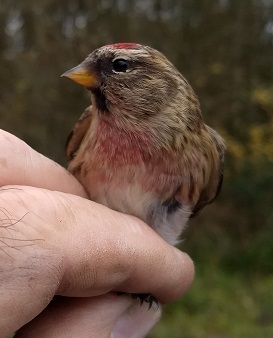
My highlight of the session was a really well marked male Lesser Redpoll:
One of the more difficult bird species to age is the Coal Tit. It is done on differences in the greater coverts. The adult variety are darker and greyer than the juvenile feathers and are fringed grey, whereas the juvenile feathers are fringed a sort of yellow brown colour. It is not always easy to distinguish the difference (particularly for male ringers apparently). So it was good to catch one with a very obvious break between the adult and juvenile feathers:
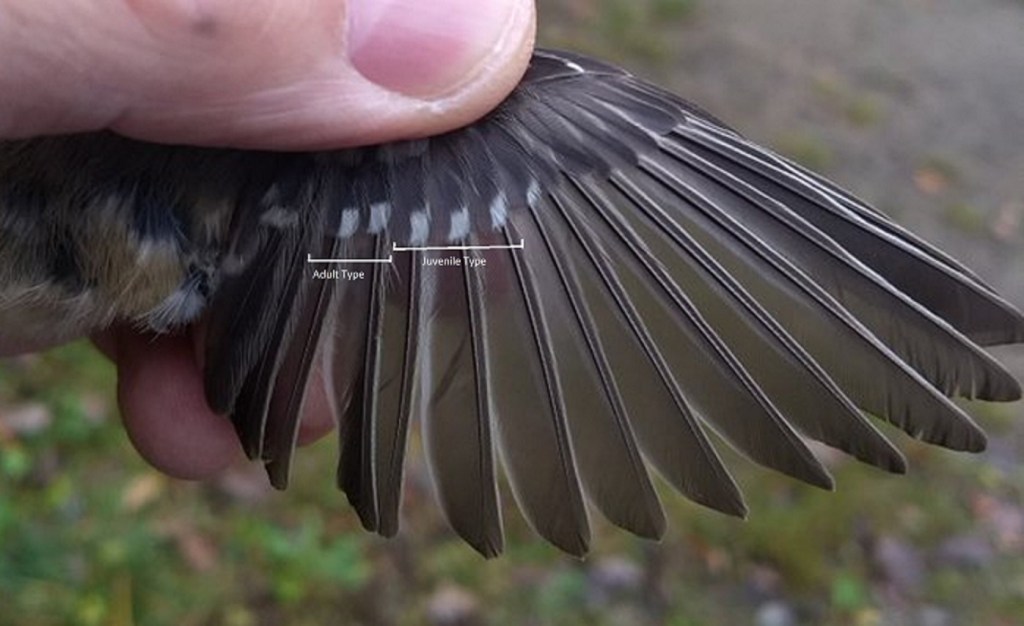
The fringing colour difference is not obvious but the break between different generations of feathers and the difference between base colours is very obvious.
The list for the session was: Treecreeper (1); Blue Tit 4(3); Great Tit 2(1); Coal Tit 1; Wren 1; Robin 1(1); Redwing 1; Goldcrest 7(4); Lesser Redpoll 1. Totals: 18 birds ringed from 8 species and 10 birds retrapped from 5 species, making 28 birds processed from 9 species.
All in all, a decent session. However, it all went very badly wrong from about 2 hours in. Recommendation: avoid deciduous woodlands in the autumn until they have completed abscission. After weeks of high winds you would have thought it would have removed all of the leaves from the trees but, no, it chose today to drop them. Worse than that, although it is mainly a beech wood, it has a lot of oak in it. Their leaves seem to be specially designed to stick in mist nets and to stick mist net shelves together. At times the nets were in a brown blizzard, as leaves poured down and into the nets. I started taking down at 11:30. By 13:30 I had managed to clear 2 nets! I gave up: the rest have been loosely bundled up to be emptied at a later date: this weekend when it is chucking it down!
So my new resolution: leave the woods alone until the leaves have left the wood alone.
 Ringing In The Braydon Forest & Beyond