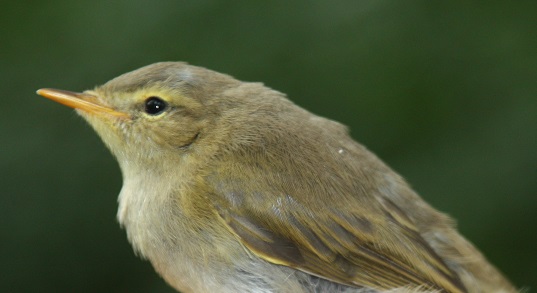
CES 4: Lower Moor Farm, Sunday, 9th June 2019

After some 10 days of frustration, due to a combination of bad weather and illness, it was something of a relief to get out and get CES session 4 done today. With the weather looking decidedly unsettled for the next week, I knew that if we didn’t get it done today we might fail to carry it out at all. This is our fifth year of running the CES at Lower Moor Farm and I would be loathe to have to miss out one of the sessions. Fortunately, Sunday was scheduled to be dry and relatively calm and, apart from a few spots of rain at about 11:00 we had a clear morning.

I was on site for 4:00, joined by David at 4:30 and Ellie, who has been away, joined us a little later.  A little later in the morning we were joined by Abi Stayte, doing work experience at the Trust, and Rich Moore, a volunteer leader for the Trust who is looking at organising surveys and activities at the Trust’s newly acquired site: Morningside Farm.

The session started quite calmly, with 10 birds in the first round and each subsequent round was similar until about 10:00, when we caught a couple of tit flocks: primarily Blue and Long-tailed Tits.  That was a brief busy period.  It then settled down for another hour, until a couple of family groups of Great Tit turned up.

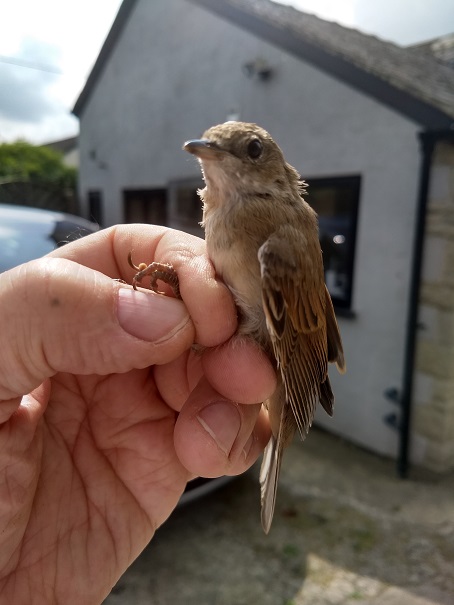
Prior to the session I did have concerns about whether the bad weather of the last few days would have adversely affected the catch, particularly the number of fledglings in the catch.  Fortunately, fledglings were the main part of the catch. We had young from the aforementioned Blue and Great Tits, plus our first juvenile Long-tailed Tits of the year. In addition we had a good number of Blackcaps, some very young Garden Warblers, plus Wrens, Robins, Dunnock and (my personal favourite of the morning) a very young Reed Bunting:

2019_06_09Reebu

The gape is still very obvious.

I am making a slight change to my listings for the time being.  It will now read: Species name Adults / Not-Aged Ringed [Juveniles Ringed] (Recaptured). The list for the morning was: Treecreeper [1]; Blue Tit 4[15](2); Great Tit [9](1); Long-tailed Tit 4[6](2); Wren 1[2]; Dunnock [1](1); Robin 2[4]; Song Thrush 1; Blackbird (1); Cetti’s Warbler (1); Blackcap 1[23](7); Garden Warbler [4](5); Whitethroat (1); Chiffchaff 1[2](3); Bullfinch (1); House Sparrow 1; Reed Bunting [1](1).  Totals: 15 adults ringed from 8 species; 68 juveniles ringed from 11 species; 26 birds recaptured from 12 species, making 109 birds processed from 17 species.

I mentioned in the last blog about how much more productive this year is proving to be. In the first three sessions of last year we processed 82 birds from 19 species, compared to 161 birds processed from 19 species this year.  However, session 4 last year was only 37 birds processed (24 ringed and 13 recaptured) from 14 species.  This really could turn out to be our best CES year this year.

*Having checked the figures, Sunday’s session was the largest CES catch we have had at Lower Moor Farm.  What is pleasing about this is that the other 100+ catches (5 of them) were all in August, when local birds are augmented by birds on passage.


More Fledglings: Lower Moor Farm, Wednesday, 29th May 2019

This was CES session 3 – and a much better session than its corresponding session last year, when a measly 25 birds were recorded.  In the five years that we have been running the CES scheme at Lower Moor Farm, it is the first that had to be curtailed because of bad weather.  We knew there was potential for some rain, only it was expected to arrive at midday.  Instead it arrived at 10:30, forcing us to get the nets closed and away an hour early.  Jonny and I had arrived on site at 4:30, and had all of the nets open by 5:30.  We started catching straight away, but not in great numbers.  However, it was steady and, by the end of the session, we had caught 43 birds.  Ironically, the largest catch came just as we were rushing around to close the nets because of the rain closing in.  Later in the morning we were joined by Abi, getting work experience with the Trust, who is now keen to come out with us again to get more ringing experience.

It was a good catch.  The highlights were our first juvenile Blackcaps and Great Tits of the year, plus another few newly-fledged Blue Tits and Dunnocks.

2019_05_29Blaca

The list for the day was: Blue Tit 3(1); Great Tit 8(1); Wren (2); Dunnock 3; Robin 4; Blackbird (2); Cetti’s Warbler (1); Reed Warbler 1; Blackcap 3(2); Garden Warbler (3); Lesser Whitethroat 2; Chiffchaff 2(1); Willow Warbler (1); Bullfinch 1; House Sparrow 1; Reed Bunting 1.  Totals: 29 birds ringed from 11 species; 14 birds recaptured from 9 species, making 43 birds processed from 16 species.

It really is turning out to be the earliest breeding season I can remember. In the period 27th to the 29th May, in addition to the birds blogged about on my visits, team members have also caught newly-fledged juveniles of Starling (Warminster area), Wren, Long-tailed Tit and Chaffinch (Chippenham area).

Once we had packed up Jonny and I headed off to Blakehill Farm to ring the Jackdaw chicks holed up in the bug hotel at the Whitworth Building on the site.  I have been monitoring the progress over the last few weeks from when there were four, then five, warm eggs.  All hatched and, when I last looked 10 days ago, there were five healthy but blind and featherless pulli in the nest.  This was the perfect time to ring them: they would be feathered and just developing their primary flight feathers but not so advanced that they would try to explode away from the nest.  The first indication that everything was not as it should be was the lack of adult activity at the nest site.  Okay, they could have been away foraging for food for the young but when we checked the nest cavity there was no sign the chicks had ever been there.  It would seem that they have been predated – there is chance that they have fledged already. Given that they were a good size even when first seen as young I can only think it was either Carrion Crow or, possibly, Raven or even Stoat. Who knows because, until we looked, nobody at the Trust knew they were no longer there.  It was disappointing finale to a decent morning’s work.

Fledglings Galore: Ravensroost Woods, Saturday, 25th May 2019

This was our regular monthly session at Ravensroost Woods, and it turned out to be a cracker.   I was joined by Ellie and Jonny.  We met up at 4:30 and set nets up in the wood along the main path north of the bridle path, plus along one newly reopened ride (the nets are in yellow, the red star is the ringing station):

Ravensroost

It did not start auspiciously: with very few birds in the nets before 7:30. The weather was cold and quite misty to start, the sun eventually broke through and warmed the air.  Only after that did the birds start moving. However, the whole session was a mixture of good catches and near blanks.

We started with a Blackbird, then a couple of Blackcaps, but at 7:30 we found a net full of ten newly-fledged Blue Tits plus two adults.  At first we thought it might be a large family group, but the two adults turned out both to be male.

2019_05_25BT

The routine reverted to small catches of a couple of birds, interestingly we caught a couple of newly-fledged Coal Tits, more of which later.  At 10:00 we had another good catch: this time it included an additional eight newly-fledged Coal Tits.

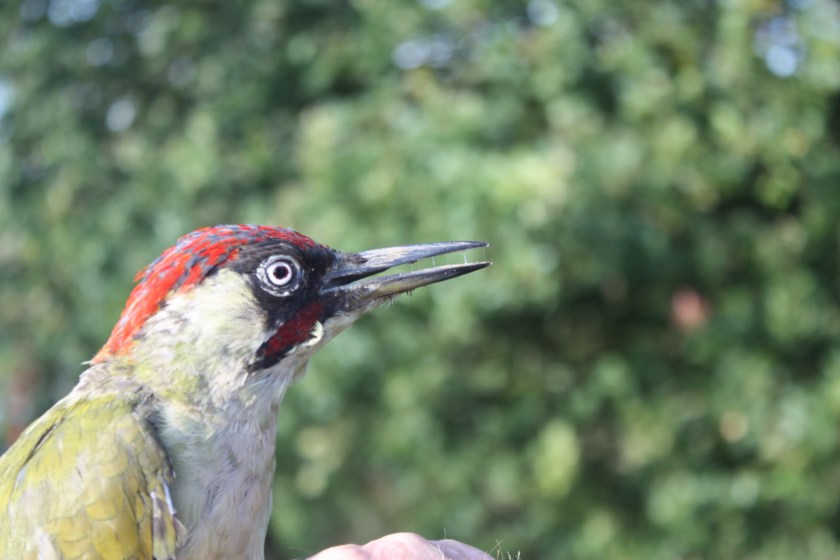
The ringing station was set close to the gates south of the bridle path. It was a good place to meet people and we had a very pleasant morning chatting to the horse riders coming along the bridle path and visitors to the reserve.  One family, granny, dad and young son, plus two lovely dogs, stayed with us for a while to watch us process the birds. In return, we showed them how to safely hold and release a few birds.  They had the experience of seeing the loudest bird in the wood extracted and processed: a female Great Spotted Woodpecker, and thoroughly enjoyed it.

The list for the session was: Woodpigeon 1; Great Spotted Woodpecker 1; Blue Tit 16(2); Great Tit 2(3); Coal Tit 11(1); Robin 2; Blackbird 3(2); Blackcap 3(1); Garden Warbler 1; Chiffchaff 1; Goldcrest 2.  43 birds ringed from 11 species; 9 birds recaptured from 5 species, making 52 birds processed from 11 species.  Of the birds processed 10 each of the ringed Blue and Coal Tits were newly-fledged young, as was one of the Robins.

Ellie’s highlight was the chance to process her first Woodpigeon, coupled with the fact that I took it out of the bag and was the one who was bombed by copious amounts of pigeon guano.

Unusually, the real highlights of the day were the Blue and Coal Tits.  I could not remember ever catching newly-fledged young of these species so early in the year at this site, so I went onto the BTO’s database to check.  Not only are these the earliest we have ever caught them at this site, but it is the earliest that anybody in our group has ever caught them since the group’s records were digitised (I went back nearly 20 years).

This then made me think about the Chiffchaff caught at Lower Moor Farm last Saturday, so I checked the records for them as well.  Again, that is the earliest record we have ever had for a newly-fledged juvenile of that species. I have no idea why this is the case, but it is certainly interesting.

Ravensroost Meadow Pond: Wednesday, 22nd May 2019

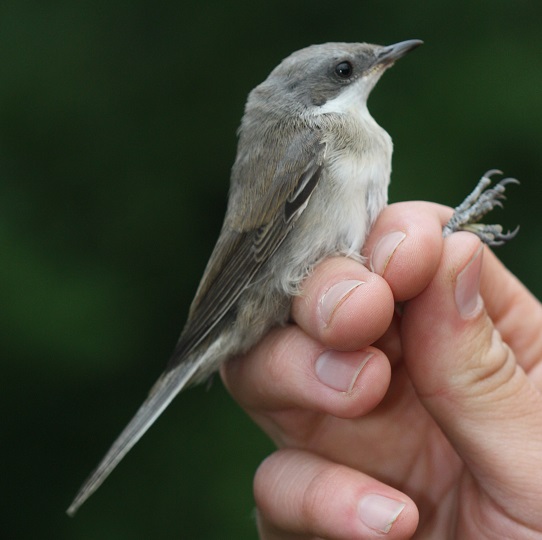
As today promised to be bright and sunny I decided to change from my scheduled venue of Red Lodge to the meadow pond area at Ravensroost.  Jonny and I set up a few nets along the edge of the pond area, one across the causeway and one on the small spit.  We did it for a couple of reasons: hoping we might catch a Swallow / House Martin or two (failed), or a Lesser Whitethroat (succeeded), as we haven’t caught any so far this year.
ravens pond
Whilst we were setting up we heard a male cuckoo calling.  We got some fantastic views of the male, but didn’t manage to persuade him into the net.
We caught birds between 6:00 and 10:00 and then it died a death – but it was a reasonable size catch with good variety: Blue Tit 2(3); Wren 1; Dunnock 2(1); Robin 2; Blackbird 1; Blackcap 2; Garden Warbler 3; Whitethroat 5; Lesser Whitethroat 5; Willow Warbler 2(1); Goldfinch 1; House Sparrow 1; Reed Bunting 1. Totals: 28 birds ringed from 13 species; 5 birds recaptured from 3 species, making 33 birds processed from 13 species.
We caught one each of juvenile Robin and Dunnock. Encouragingly, two each of the Whitethroat and Lesser Whitethroat; one each of the Garden Warbler and the Willow Warbler, plus the Goldfinch and Reed Bunting were females with well-developed brood patches. These birds are definitely breeding in the area of the meadow pond.
Perhaps the oddest catch of the day was the House Sparrow.  Presumably it has come down the road from the stables or the house at the crossroads, possibly from the barns in Avis Meadows – but I have never seen sign of them there.  Anyway, it is a first for us in the Ravensroost complex.
We were packed up and away by 11:30.  On Saturday we will be back at Ravensroost: in the woods this time.  I am hoping that there will be some newly-fledged Marsh Tits around, as I have heard that the young have fledged from some monitored nests on the border of East Anglia.

Fledglings Arrive: CES 2: Lower Moor Farm, Saturday, 18th May 2019.

This session was carried out in almost perfect weather conditions for ringing. It was overcast and windless.  The only problem was that the base temperature was unseasonably cold for the time of year, which tends to suppress the insect activity, which has a knock-on effect on the activity of the birds.  I was helped in the session by Jonny Cooper and Ellie Jones and we were joined by Tim Jukes.  Tim is a volunteer working with Jonny on his Braydon Forest Curlew Project and expressed an interest in finding out about ringing.

This year’s CES is shaping up to reverse the declining trend of the last few years. In each session so far this year we have processed 59 birds, compared to 31 birds processed in session 1, 2018 and 26 birds processed in session 2.  There were plenty of highlights in this catch: a juvenile Song Thrush, our first newly-fledged Robins of the year (five of them) plus our first newly-fledged Chiffchaff:

2019_05_18Chiff

I know this a serious blog – but isn’t that just so cute?  We also caught a Dunnock that was fresh out of the nest.  Perhaps the most encouraging catch of the morning was a female Cetti’s Warbler with a well-developed brood patch.

2019_05_18Cetwa

After an excellent year in 2015, with several youngsters ringed, we have had very few Cetti’s caught – and those we have caught have been males on territory. We caught a male earlier in the year, and have heard singing at every session this Spring. however, this is the first female that we have caught since 2015.  I am hopeful that we will get proof of breeding and some fledglings in the next month or so.

The list for today was: Treecreeper (1); Blue Tit 1(1); Great Tit (2); Wren (3); Dunnock 2(5); Robin 5(3); Song Thrush 2; Blackbird (3); Cetti’s Warbler 1; Blackcap 2(5); Garden Warbler (3); Whitethroat 2; Chiffchaff 1(5); Willow Warbler 1(3); Bullfinch 4; House Sparrow 3; Reed Bunting 1.  Totals: 25 birds ringed from 12 species; 34 birds recaptured from 11 species, making 59 birds processed from 17 species.


Tedworth House: Wednesday, 15th May 2019

Before getting into the session at Tedworth House today I am going to say a few things about the Breeding Bird Survey I carried out yesterday.  For the last six years I have been carrying out the BTO’s Breeding Bird Survey at Brown’s Farm, just south of Marlborough.   As readers of the blog know, I also ring at this site, and did so quite recently.  The difference between ringing the site and doing a breeding bird survey is in the amount of ground you cover.  For BBS I walk two 1 km transects, 1 km apart, recording the birds I see and hear in 10 x 200 metre zones and noting their distance from the track that I walk.  There are 3 zones: <25m; 25m – 100m and >100m.

Whilst in our last ringing session there we caught 4 Linnet, 6 Whitethroat and 5 Yellowhammer: during my walk yesterday I noted over 40 Linnet; 20 Whitethroat and 30 Yellowhammer along the hedgerows.  I was also lucky to see half-a-dozen Hares and had my closest ever encounter with this enigmatic mammal. Half way through the survey I stopped for coffee, sitting on a low bank at the edge of a field.  Two Hares came running up the path towards me, they stopped and a bit of boxing ensued. They then ran on further and sat no more than 5 metres from my position. We “shared a moment” for three minutes before they moved off in different directions.

To Tedworth House.  It was a quiet session, carried out to a background of the constant chatter of the Raven chicks and their parents. They have been fledged for a while now but are clearly still hanging around as a family.  Although I didn’t catch huge numbers of birds, it was quite interesting nonetheless.

The highlight had to be my first Magpie since October 2016.  Of the 15 Magpies caught by the Group since 1st January 2013, 6 of them have been caught at Tedworth House.  The list for the day was: Magpie 1; Nuthatch (2); Blue Tit 1; Song Thrush 1; Blackbird 5(2); Blackcap 3(1); Goldfinch 1; Bullfinch 2.  Totals: 14 birds ringed from 7 species; 5 birds recaptured from 3 species, making 19 birds ringed from 8 species.

The number of Blackbirds was remarkable. One was a juvenile from this year; 4 were second year birds and the two recaptured birds were full adults.  I was joined by several keen observers during the day.  Two were absolutely delighted to be shown how to safely hold and release a Goldfinch and Blackbird respectively.

As the temperature rose, the bird activity fell and I closed the nets at 11:30, after a couple of empty rounds.  The session finished on a bit of a high when Jack, the maintenance man for Tedworth House and expert nest finder, showed me a Goldcrest nest in a fir tree overhanging the children’s play area.

Somerford Common: Saturday, 11th May 2019

Somerford Common is, without doubt, the most varied woodland that I ring.  If I lost all of my other woodland sites, I could replace them with the different habitats available at Somerford.  For today’s session I set up along the rides in the south-east corner of the wood.  The ride running west to east was cleared and widened on the south side considerably three years ago, the paddock area to its north became subject to a coppicing regime two years ago.  Both are growing back and offering a good range of different heights of vegetation.  This is usually a good recipe for getting a decent variety of birds.

Somerford

I was working solo for the session, so I didn’t overdo the number of nets.  You can never tell how big the catch will be at Somerford.  The usual catch at this time of the year is 25 to 30 birds, totally manageable for an experienced ringer.

The list for the day was: Blue Tit (2); Long-tailed Tit 2(5); Dunnock 1; Robin 1; Song Thrush 1; Blackbird 3; Blackcap 4; Garden Warbler 1(1); Chiffchaff 2(1); Willow Warbler 1; Goldcrest 1. Totals: 17 birds ringed from 10 species; 9 birds recaptured from 4 species, making 26 birds processed from 11 species.

The recaptured Garden Warbler, D977367, is not one of our birds. It looks like it is an old ring number and I shall look forward to getting the details, which will indicate how many times this bird has flown from the UK to over-winter in the Congo rain forest.  There were no Garden Warblers caught at the site last year, so this is a welcome return.  When I surveyed the site for the BTO’s Bird Atlas back in 2008, Somerford Common was the best site for Garden Warblers.  The vegetation is now in a similar state to where it was then, so I am hoping that we will have a good catch of the species this summer (and for the next few years).

It was our best catch of Long-tailed Tits for a while and our best catch of them ever at Somerford at this time of year (i.e. with no feeding station and before this year’s youngsters have fledged).  One of them was ringed as a juvenile back in June 2015: a pretty good age for such a small bird.

Update: Garden Warbler D977367 was ringed at Waterhay in the Cotswold Water Park as a juvenile in August 2014.  A well-travelled bird!

CES 1: Tuesday, 7th May 2019 @ Lower Moor Farm

CES stands for Constant Effort Site and is one of the BTO’s most important project schemes. The idea is simple: the same nets are placed in the same positions for the same period of time year after year, roughly 10 days apart throughout the breeding season (the first week of May to the first week of September).  I set my nets and leave them open for 6 hours.  When I first looked into setting up a CES I planned to set a lot of nets, as Lower Moor Farm has a variety of habitats that would bear monitoring.  However, I realised that there would be occasions when I would be working solo, and so I scaled back the plans.  I have 4 rides, comprising 201 metres of net, in 5 habitat variations.  As it happens, today I was working solo, so I am quite pleased that I didn’t go for a large setup.

It was a 4:00 start: as I was setting the nets alone, I thought I had better give myself an earlier start. It did mean that I got to hear the dawn chorus from beginning to end, which isn’t a bad start to anyone’s day.  Unfortunately, the start time was mirrored by the temperature in degrees Celsius: a bit chilly!

I also had another close encounter of the Cuckoo kind.  It started with a male calling from the trees adjacent to where I had just opened my last nets, and I then had super views as it flew around the site, before heading off in a north-westerly direction.  One day I will catch one!

The catch for the day was a big improvement on the equivalent session in the previous two years: Treecreeper 1; Blue Tit 1(1); Great Tit 1(2); Wren 1(1); Dunnock 5(4); Robin (1); Song Thrush (1); Blackbird (1); Blackcap 6(7); Garden Warbler 6(3); Whitethroat 4; Chiffchaff 4(1); Willow Warbler 3(1); Bullfinch (4). Totals: 32 birds ringed from 10 species; 27 birds recaptured from 12 species, making 59 birds processed from 14 species.

One of the recaptured Garden Warblers is not a bird that our group has ringed. I shall look forward to finding out its history.

The most striking catch of the morning was a Black-headed Cardinal Beetle, Pyrochroa coccinea, which I carefully extracted from one of my nets:

Black-headed Cardinal

Not a great photo – but I didn’t have my macro lens with me.  There is already a superb variety of insects flying around the lake sides: one day I will have to eschew the birds for a while and focus on the insects.

Brown’s Farm: Wednesday, 1st May 2019

We had a super session at Brown’s Farm on Wednesday.  It wasn’t a huge catch: there are never lots of birds around in April or May, as the summer migrants are still arriving and the resident birds are being territorial and spread out from their winter foraging flocks.

I had my most experienced lieutenant, Jonny Cooper, with me, so we set a lot of nets.  We set them along the whole of the hawthorn hedge that runs across the fields adjacent to the old pheasant pen. They were placed on the eastern side of the hedgerow, away from the prevailing breeze, on the hedgerow side of the track left between the hedge and the oil-seed rape planted there.

Browns

The catch for the morning was: Long-tailed Tit 1; Dunnock 6; Robin 3; Blackbird 1; Blackcap 1; Whitethroat 6; Willow Warbler 1; Linnet 4; Yellowhammer 4(1).  27 birds ringed from 9 species and one recapture.  The recaptured Yellowhammer was ringed on the farm in February of last year.  Interestingly, the male Linnets and Yellowhammers were coming into breeding condition but the females weren’t.  Both species breed somewhat later than birds like Blue and Great Tits: I think it is basically because the titmice feed on insects and their larvae, which are available earlier than the seeds that the Linnets and Yellowhammers feed on.

That said, the Whitethroats, which are also insect feeders, showed the same difference.  However, the reasons are different: the males arriving first to set up territories: lots of testosterone involved.  Then the females arrive and look for a mate, and they don’t come into breeding condition until somewhat later.

We set up our ringing station close to the entrance to the ride from the main track.  Sitting down to process our first few birds, we were suddenly surprised by the loud calling of a Cuckoo. He was sat in the tree immediately above our heads.  We then watched as he flew off across the fields. They are regular on the site.  I always hear them when I am doing the BTO’s breeding bird survey;  which I plan to do the first of next week.

The fields were alive with insects.  When you hear all of the stories of the dearth of insects on farms, it is actually very pleasant to be surrounded by the continuous buzzing whilst working.  We saw Small Tortoiseshell, Peacock, Orange Tip, Small White and Holly Blue butterflies along the ride.

The wind picked up at about 11:30, just as we started taking down.  Once again, the rain started soon after we left site.

Garden Warblers Arrive: Lower Moor Farm, Wednesday, 24th April 2019

Yesterday’s session at Blakehill Farm was hastily scheduled because the forecast for today and the rest of the week was quite a lot of rain.  However, as I got home to an email from Rachel at the Wiltshire Wildlife Trust asking if she could bring her group along to my planned ringing session, I thought I had better think again. This also reminded me that another group had also asked if they could drop in on our activity.  I checked the forecast, found it had improved, and contacted Ellie to see if she was available to help. Fortunately, she was. I cannot do two very early mornings in a row, so we started at 6:30.  However, we were very aware that the rain was scheduled to arrive at 11:00.

Lower Moor Farm is a very public site, but it does have a wildlife refuge area to which the general public do not have access.  It was in this area that we set up our nets: far from the madding crowd.

The catch was not busy, but a significant improvement on yesterday. Our highlight of the morning was our first catch of Garden Warbler this year. One was a recapture of an adult ringed at Lower Moor Farm in May of last year, plus two new individuals. These are the earliest Garden Warblers caught here, or at any of my sites, by a couple of weeks.

The catch for the day was: Long-tailed Tit 1; Robin 1; Song Thrush 1; Blackbird (1); Blackcap 5(1); Garden Warbler 2(1); Chiffchaff 3(1); Willow Warbler 1; Reed Bunting 1. Totals: 15 birds ringed from 8 species; 3 birds recaptured from 3 species, making 18 birds processed from 9 species.

At 9:00 we were joined by Ian, one of the Trust’s army of volunteers, and then at 9:15 we Rachel and her group from the Royal Wootton Bassett Academy arrived.  About 20 minutes after they left, we were joined by Christine and her group from the Devizes School.  Each group stayed with us for about half-an-hour, during which time I explained the ringing scheme to them.  They were shown how we ring the birds, the biometrics that we take, and ageing and sexing of species.  As ever, you can guarantee that explaining about “cloacal protuberances” will guarantee sniggers from a group of young teenagers. One point, I might have made it before, the children involved all have either challenging behaviour issues or learning difficulties. It would be really nice if, just occasionally, the “run-of-the-mill” pupils could get the opportunity to become involved.  I will always be happy to explain what we do to these groups, it would just be good to expand the audience.

At about 10:15, after the second group had left, we decided to take down.  The birds had stopped moving, and we were mindful of the weather forecast.  For once, the forecast was spot on and our timing was perfect: we had finished packing away, and I had just driven away from the ringing site, when the heavens opened.