First Lesser Redpoll of the Winter: Ravensroost Woods; Tuesday, 12th November 2019

It is at least 3 years since I have run a session that took in the north end of Ravensroost Woods.  The catch in the area had reduced significantly, and it is hard work managing both ends of the wood.  However, as I had a good sized, and experienced, team out with me today: Ellie, Jonny and Alice, we decided to focus on this rather neglected part of the wood. It turned out to be a really good session and I won’t be neglecting it for that length of time again.

Obviously with the problems further north in the country, it would be churlish to complain about the weather, but the rain forecast for 14:00 arrived at 11:30, and the wind really got up from the opposite direction from which it was forecast and which influenced where we set out nets, whilst we were extracting several hundred leaves from the nets and packing away. It seems that weather forecasting is now so inaccurate that looking out of the window is the only way to tell what is going on.

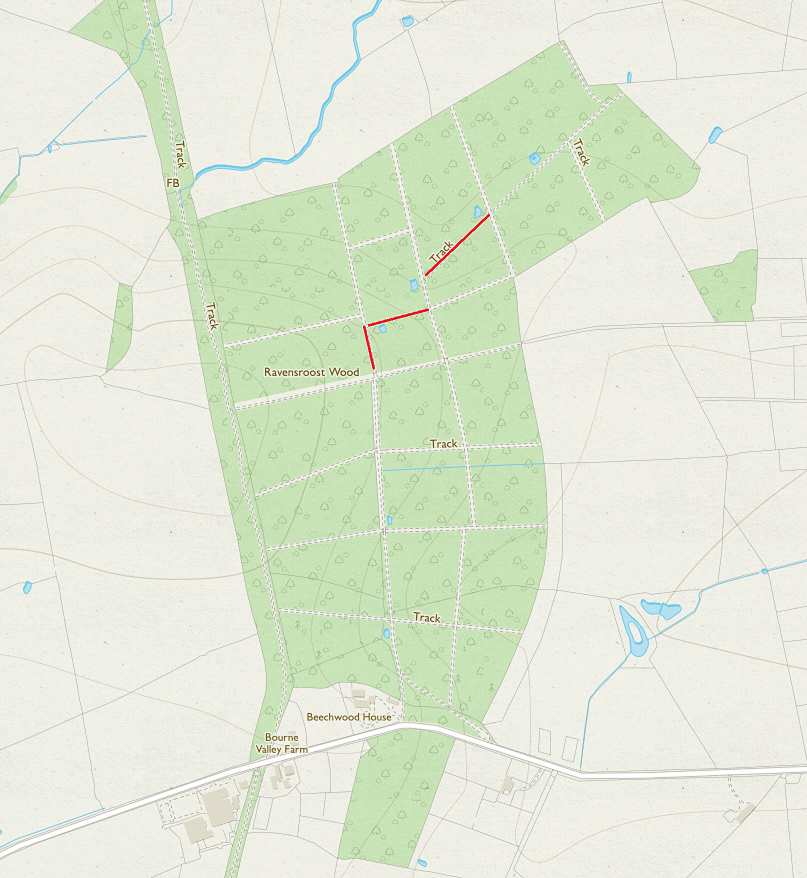
We set up our nets along the main paths (nice not to have to wear wellies for once) as shown below (the red lines):

Ravensroost

It was very quiet for the first hour and a bit but then picked up for the next 2 hours, before we packed away.  There were two significant highlights.  We caught another 4 new Marsh Tits for colour-ringing and recaptured two more ringed earlier this year. Extracting and ringing one was a first for Alice: they are red-listed but Wiltshire woodlands do seem to be strongholds for them.

The second highlight was our first Lesser Redpoll of the year:

20191112Lesre

The list for the session was: Great Spotted Woodpecker 1; Nuthatch 1; Treecreeper 1; Blue Tit 5; Great Tit 2(1); Marsh Tit 4(2); Long-tailed Tit 7(5); Robin (2); Redwing 3; Blackbird 2(1); Goldcrest 5(1); Lesser Redpoll 1.  Totals: 32 birds ringed from 11 species and 12 birds retrapped from 6 species, making 44 birds processed from 12 species.

It is a rare session where you capture more Long-tailed Tits, Marsh Tits and Goldcrests than Blue and / or Great Tits in one of the Braydon Forest woodlands.  One of the retrapped Long-tailed Tits was originally ringed on the  20th September 2014: that is a good age for a bird with an expected lifespan of 2 years!

A Lovely First for Red Lodge: Sunday, 10th November 2019

Several weeks ago I was asked to carry out an assessment of a trainee from another ringing group, to confirm that they were proficient enough to be advanced to C-permit level. Our every effort subsequently has been thwarted by the weather. Most recently, we had planned to meet up yesterday but, with rain scheduled at 9:00, and arriving soon after, it was cancelled.  I agreed with the rest of the team that yesterday’s scheduled session would be moved to Tuesday. As the forecast was considerably better for today, with rain scheduled to pour down overnight, but peter out during the morning, clearing by 9:00, I agreed with the trainee, Ian, that I would keep an eye on the weather and, if it stopped early enough, I would call him and we would carry out a session at Red Lodge.  The Firs was the next on the schedule, but that was already scheduled for Wednesday, so Red Lodge was the logical choice.

The rain actually was stopped by 6:30, so I was on site by 7:00, with the nets open by 7:40.  Birds started arriving almost immediately, and we had a steady run throughout the morning.  There was a couple of early Redwing in the catch and the usual titmice and a few Goldcrest.

After 10:00 we put on a lure for Goldcrest. I always wait until 3 hours after sunrise before luring for them. They come to the lure readily, and I want them to have had plenty of opportunity to feed before we start catching them in any number.  We had a good initial catch, and then a lull in their numbers, until I uttered the fateful words: “We’ll make this the last round, and close the nets and take down!”.

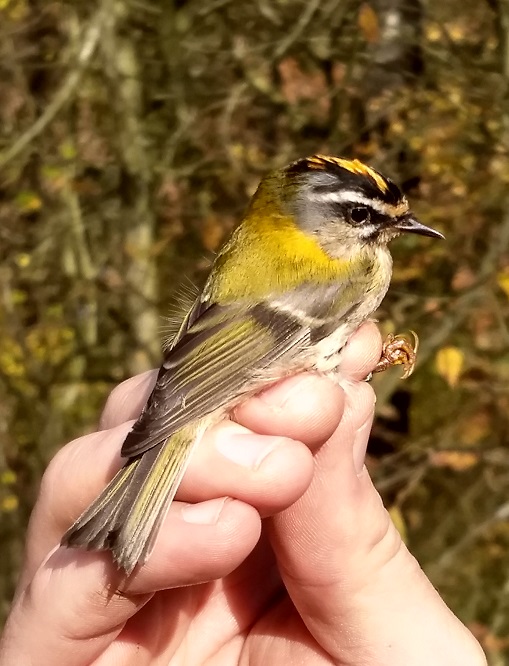
The last round yielded another group of Goldcrest, several Long-tailed Tit, Blue Tits and this beauty:

20191110Firec

This is only the second Firecrest caught in the Braydon Forest. The first was in Ravensroost Woods in November 2015.  As Ian hadn’t seen or handled one before, I gave him the opportunity to extract and process the bird.

All in all, it was a very satisfactory session, resulting in the following catch: Treecreeper 1(1); Blue Tit 13(6);  Great Tit 5(6); Coal Tit 1; Marsh Tit (1); Long-tailed Tit 2(2); Wren 1(2); Robin 3; Redwing 2; Blackbird 2(1); Goldcrest 13(3); Firecrest 1; Chaffinch 1.  Totals: 45 birds ringed from 12 species and 22 birds recaptured from 8 species, making a total of 67 birds processed from 13 species.

The result of the session is that Ian is a competent ringer and I have recommended his advancement to a C-permit.

Somerford Common: Wednesday, 6th November 2019

Given the weather recently it has been quite some achievement to get out to all five of our Braydon Forest woodland sites in the last three weeks.  Somerford Common is, perhaps, our most varied woodland site. It is certainly the only one that is home to a wallaby!  On Monday I optimistically set up a feeding station in the paddock area, hoping that some of the Lesser Redpoll might find it before Wednesday. Forlorn hope! A couple of Blue and Great Tits did but nothing else. Next time!

I was joined for the session by Andrew and Alice, and Steph joined us after the school run.  Our first bird of the day, not caught unfortunately, was a Woodcock which was put up from its roost as we went to set up the first couple of nets.  They usually roost inside the paddock, not adjacent to the path.

Despite the lack of Lesser Redpoll, it was good morning session.  Once again, Goldcrests were present in good numbers.  This is looking like being our best ever year for them in the Braydon Forest, already matching the previous best with two months to go.

Although we caught two of them, they were not the Marsh Tits that were conspicuously calling adjacent to our ringing station!  Hopefully next time.

The list for the session was: Blue Tit 4(3); Great Tit 3; Coal Tit (1); Marsh Tit (2); Wren 1(3); Song Thrush 1; Goldcrest 12(2).  Totals: 21 birds ringed from 5 species; 11 birds recaptured from 5 species, making 32 birds processed from 7 species.


Calf-of-Man to the Braydon Forest, Twice in Two Weeks. Ravensroost Woods: Sunday, 3rd November 2019

As readers of this blog will know, on the 19th October we recaptured a Goldcrest that had been ringed as an adult on the Calf-of-Man on the 7th April.  Today at Ravensroost Woods we recaptured another Goldcrest the alpha part of the ring, KNH, was the same.  When I got home I messaged Aron Sapsford, the warden at the Calf-of-Man observatory, and got confirmation that this bird was ringed there on the 5th September this year.  If we get a third I might seriously have to look into some sort of monitoring project to see whether this is a new migration route!  This was the bird that made the journey, a juvenile male:

20191103Goldc

It has a wing length of 54mm and weighed in at just 5.3g: astonishing.

This was the first time we have managed to make one of our scheduled sessions in Ravensroost Woods for 2.5 months, due to bad weather on the chosen dates.  The weather forecast was for it to rain overnight, with the rain stopping at about 7:00.  I was joined for the second time by Alice. Not wanting her to make the long journey from Cheltenham to Braydon Forest, only to have the session cancelled at the last minute, we arranged to meet at 7:30, to be sure that the weather was following the forecast. It nearly did!  The rain wasn’t hard: there was a mist of very fine rain whilst we were setting the nets, which cleared eventually at about 9:00.  After that it stayed dry, and occasionally sunny, until we started to pack away at 11:50, whereupon it started with the very fine rain again.  We managed to get 2.5 hours of ringing activity in, in relatively good weather. The wind was non-existent.

As usual at this time of year, the catch was basically Blue and Great Tits but Goldcrests again made a significant contribution.  the list was: Nuthatch 2; Treecreeper 1; Blue Tit 8(4); Great Tit 8(5); Coal Tit 1(1); Marsh Tit (1); Wren 3; Robin 3(1); Goldcrest 7(1); Chaffinch 1.  Totals: 34 birds ringed from 9 species and 13 birds recaptured from 6 species, making 47 birds processed from 10 species.

The Goldcrest was the clear highlight of the session: ironically, one of the last birds extracted.  However, it is always pleasing to catch and ring a couple of Nuthatch.  They are always heard but we don’t catch large numbers. These were number 13 & 14 for the year, but only 2 & 3 for Ravensroost, with the other being back in June.

Outside of the ringing activity, we were treated to a pair of Ravens making their presence known for several minutes as they flew around overhead. It took 7 years since I started birding Ravensroost in 1998 to see my first there. They are still only an occasional sighting. I look forward to the day they choose to nest there!

The wood was also full of Long-tailed Tits but we didn’t catch one, unlike our recent forays to the Firs, Red Lodge and Webb’s Wood.  Perhaps the ones in Ravensroost are cannier!

One annoying footnote: once again a “responsible dog owner” has stolen the please keep dogs on a short lead sign from the main gate. They came prepared, as after the previous five times, it had been fixed with security screws!  The arrogance and entitlement of these people beggars belief.  Somerford Common, with no restrictions, is less than three minutes away but they insist on vandalising a nature reserve!

October Review

Wow! is all I can say about this month. What an absolute corker!  Obviously, the Booted / Sykes’ Warbler is head-and-shoulders the stand-out bird. Whichever species it turns out to be, if it can be positively determined, it will be a first ringed in Wiltshire: and the biological records centre have no records of either (or Eastern Olivaceous Warbler, for that matter) being reported in the county.  Social media opinions are almost unanimous that it is Booted Warbler, Iduna calligata.

However, our “mundane, day-to-day” ringing activities have also been a record breaker.  Since the split into the North and the West Wilts Ringing Groups at the end of 2012, the Great Schism as I like to call it, this is far and away our biggest ever month.  We have had the expected large numbers of Blue and Great Tit, but some of the other species have just exploded in number.

October 19

The excellent number of Yellowhammer is a testament to Andy Palmers’ SPTA West site, where the bulk were caught.  Brown’s Farm weighed in with a creditable catch of 12 in just a couple of nets, and Steph caught 3 in her back garden just across the border in Gloucestershire!

It is certainly gratifying to see such good numbers of Long-tailed Tit.  Their numbers dropped dramatically in the Braydon Forest after the wet and cold Spring and early Summer of 2016, we are now catching good numbers there, as is Johnny Cooper in his sites near Chippenham.

The Goldcrest catch has been mainly produced by the Forestry Commission sites in the Braydon Forest, with 23 in Red Lodge, 30 in Webb’s Wood and 10 on Somerford Common.  However, the star Goldcrest was our intrepid bird ringed on the Calf-of-Man and recaptured in the Firs.

Although Redwing are reportedly scarce on the ground at present, we have had a pretty decent increase on last year.  Just under 50% have been caught at Jonny’s sites, with Lower Moor Farm at 25% and Battlesbury at 20%.

It is good to see a return to good numbers of Robin: they have been a bit hit-and-miss lately, and it compares very well with last year’s number.

Apart from that, notable catches for my crew in the north have been: our best month for new Marsh Tits for a long time.  Astonishingly, this has happened without our being able to access Ravensroost Woods, the traditional stronghold for the species in the Braydon Forest.  Apart from 1 retrap in the Firs, the catch has all been in the Forestry Commission sites, mainly Red Lodge.

I took a chance on a trip to Lower Moor Farm on 21st of the month (something to do with having caught my Yellow-browed Warbler there on the 26th October 2017 – just an eternal optimist) and was really surprised to catch our first two Siskin ever at the site.  What’s more, bar one bird on Somerford Common on 30th November 2013, we have never caught an Autumn Siskin before.  All of our other catches have been in Q1 of the calendar year.  So well pleased with them.

Finally, catching my first Sparrowhawk in my Purton garden was an absolute stunner!  I have processed a reasonable number (approximately 1 per year since I started ringing) but this was special: in my own back garden. My fingers are still recovering from safely extracting (safely for him, that is) a very feisty male who was incredibly tangled in the net, because he hit it so hard!

Just  a final note: as well as this being the biggest single monthly catch, we have already exceeded the total catch for any other year since the end of 2012, with 2 months to go.  This is almost all due to the activity levels of Andy Palmer, Andrew Bray, Jonny Cooper and now, Steph Buggins in addition to us old ‘uns.  With Ellie Jones starting out to do her own thing in the near future, things could get even busier.  Funnily enough though: there is not a huge increase in the number of sessions, but it seems Jonny cannot go to one of his sites without breaking the 100 bird barrier, and, as the averages show, the overall catch size has increased significantly.

Webb’s Wood: Wednesday, 30th October 2019

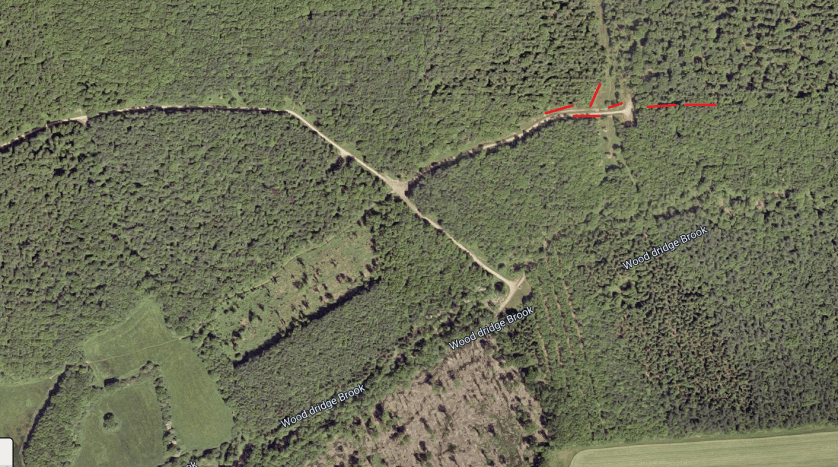
After Monday’s busy session at Red Lodge Plantation, today was scheduled for another Forestry Commission woodland at Webb’s Wood.  I had a big team for the session: Andrew, Ellie, Steph and Lillie all came along to help.  We set up 5 nets rides, all comprising 2 x 18m nets, and I tried out a new net position with a single 18m net (it didn’t work – not a single bird caught by it).  The net positions are marked in red:

webbs

We opened the nets by 7:30 and closed them just after 11:00.  In between we had a very satisfactory catch of 65 birds from 12 species.  The breakdown was: Treecreeper 2(2); Blue Tit 8(1); Great Tit 6(1); Coal Tit (1); Marsh Tit 1; Long-tailed Tit 10(5); Wren 3(1); Robin 2; Redwing 3; Blackbird (1); Goldcrest 14(3); Chaffinch 1.  Totals: 50 birds ringed from 10 species and 15 birds recaptured from 8 species.

Another session with good numbers of Goldcrest and Long-tailed Tit, again outnumbering the usually most common species Blue and Great Tit.  Our twentieth new Marsh Tit of the season gives us hopes of matching our previous best total of 29 in 2017. As we have not yet set up any feeding stations these catch sizes are quite surprising.

One highlight was a positively venerable Long-tailed Tit.  It was ringed as a newly-fledged juvenile on the 20th July 2013, making it 6 years and 3 months since ringing, over 6.5 years old.  As the expected lifespan of the species is 2 years. Juvenile mortality is 75% in the first six months, and 50% thereafter, so to reach this sort of age is worth remarking upon. It was recaptured just once before: in September 2013.  You often wonder where it has been in between captures.  It has 2.5 years to go to beat the longevity record for the species but it is certainly the oldest bird on my rings.

Another highlight was the catch of 4 Treecreeper: 2 new and 2 recaptured.  Our team caught that many Treecreeper in a single session for the first time in Red Lodge (Forestry Commission) in September 2017 and the not again until the 10th of this month, at another Forestry Commission site: Somerford Common.  To have another catch of 4 is very pleasing.

Booted / Sykes’ Warbler: SPTA West, 19th October 2019

During their Salisbury Plain ringing session on 19th October, Andy Palmer extracted what looked like a washed out Reed Warbler.  When Ian Grier saw it, he immediately identified it as an Iduna species warbler.  The most reasonable assumption was that it was an Eastern Olivaceous Warbler, Iduna pallida.

Ian ringed the bird and they took a wide range of biometrics, in order to try to clearly identify the species.

Wing Length: 63mm,  Tail Length: 52mm, Tarsus Length: Max: 24.5mm, Min: 21.5mm

Length from tip of bill to nostril 8.2mm, to feathers 9.5mm, to skull 14.0mm

Bill width at nostrils: 4.2mm

Weight: 10.4g

Wing point (i.e. the feathers that make the longest part of the wing): P3 and P4; P2 = P6

Emargination (this is a narrowing of the top part towards the tip of the  feather) P4 = 15mm; P5=12mm

Difference in feather length: P1-P2 = 26mm; P2-P3 = 5mm; P2-P4 = 5mm; P2-P5 = 4mm; P2-P6 = 0mm; P2-P10 = -8mm

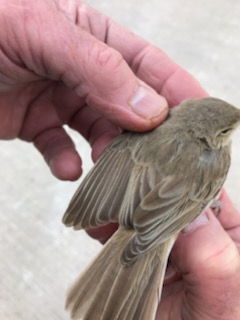
Ian also took a number of photographs of the bird to aid with the confirmation of species.  I have been asked to remove the lateral photograph of the bird because it does not conform to the BTO’s social media guidelines. Whilst the ringers in question know that the bird was perfectly well and flew off strongly after processing, it looks a little fluffed up in the photograph.  It is thought that this could be misused by anti-ringing  groups to spread their message: so I have removed it. Apologies to all who have missed it (although a couple of thousand of you have been fortunate enough to see it).

64

Unfortunately, some of the biometrics did not comfortably fit Eastern Olivaceous Warbler.  As neither Ian nor Andy were overly familiar with this species or the other possible Iduna species, Ian used his contacts within the birding world to get an assessment of the data.  The other two possibilities are Booted Warbler, Iduna caligata, and Sykes’ Warbler, Iduna rama.  At present three experts are split 2:1 Sykes’ to Booted.  The record is being submitted to the British birds Raritis Committee to make their determination, which might well end up as an “either / or” identification.

For any birders / twitchers upset that this was not immediately notified to the wider world, it was not possible to do so. Apart from not having fully identified the species, the site is very close to a live firing range, less than 300m away, and neither the Army nor the Defence Infrastructure Organisation would countenance a large twitch onto the area.


Red Lodge: Monday, 28th October 2019

With the uncertain weather forecasts at the moment I am trying to fit in sessions where I can.  Last Saturday was scheduled for Red Lodge but, as it poured down all day, I moved the session to this Monday morning.  I was joined for the first time by Alice.  Alice was one of the long term volunteers on Skokholm this summer, so we had already met.  Having moved to Cheltenham to do an MSc, Alice was looking for a reasonably local ringing group to work with.  She is a T-permit holder, but her trainer is in Cambridge, hence the need to find a more local group to work with. Having tried a few more local ringers, who were not suitable for providing regular ringing and training, she stumbled across our blog.

Alice didn’t read back enough to find that we had been to Skokholm, so was surprised to find that out when I replied and invited her along.  Impressively, she managed to find the right entrance to Red Lodge and was waiting for me when I arrived!  She has experience of working with mist nets and, as part of her ringing in Cambridge was focused on catching Blue Tits, our local woodlands held no terrors for her.

We set just 3 net rides: one comprising 2 x 18m and 1 x 12m nets, one comprising 2 x 18m nets and one of a single 18m net.  I didn’t want to find ourselves overstretched, as it was just the two of us.

The morning started quite quietly: a couple of birds in the first round, several birds in each subsequent round until 11:00, when we hit a couple of Tit flocks and a goodly number of Goldcrest.   They kept us busy extracting and processing until 12:30, when we closed up the nets and packed away.

The list for the session was: Great Spotted Woodpecker 1; Treecreeper 1(1); Blue Tit 17(4); Great Tit 7(5); Coal Tit 1; Marsh Tit 2(2); Long-tailed Tit 12(1); Wren 1; Dunnock 1; Robin 1(1); Blackbird 1; Goldcrest 19(1); Chaffinch (1).  Totals: 64 birds ringed from 12 species and 16 birds recaptured from 8 species, making 80 birds processed from 13 species.

Our second round delivered another 2 new Marsh Tits for ringing and the 11:00 round delivered two recaptured Marsh Tits, so another couple of good additions to this year’s total.  Alice got to extract and ring her first Great Spotted Woodpecker.  Any woodland session where you ring more Goldcrest than Blue Tit or Great Tit is a good session.

My first this year; and the first caught in my garden: Sunday, 27th October 2019

As yesterday was such a horrible day weather-wise, and this morning was beautiful: dry, bright and windless, I decided to open my nets for a couple of hours and see what I could get.  No need to hurry: I opened the nets at 8:30.  As usual, Blue and Great Tits were straight into the nets, having been busy on the peanut feeder from first light.

I set a lure for Greenfinch and duly caught two in the next round. Deciding to take pity on the neighbours from the repetitive and piercing call of the male Greenfinch, I then changed it to Goldfinch, which is marginally less intense. This resulted in 5 of them dropping in. There were also a couple of Robin and Dunnock caught by the nets.

As I walked up to the first net at 10:30 something shot past from behind me at high speed and hit the net just a couple of feet off the ground: my first Sparrowhawk of the year and my first ever in my garden:

20191027Sparr

It was a juvenile male Sparrowhawk!

The list for the morning was: Sparrowhawk 1; Blue Tit 8(3); Great Tit 3; Dunnock 3; Robin 1(1); Goldfinch 4(1); Greenfinch 2.  Totals: 22 birds ringed from 7 species and 5 birds recaptured from 3 species, making 27 birds processed from 7 species.

One of the things I really like is recapturing birds with consecutive ring numbers, as happened with 2 of the Blue Tits.  Both were juveniles ringed by me in the garden in July.  However, something better than that is recapturing a bird in your garden that was ringed elsewhere.  The third re-caught Blue Tit was ringed in Red Lodge Plantation on the 6th July this year.  It is only a couple of kilometres, and they do disperse quite long distances, but still very pleasing to see the birds moving around my local area.

I just had time to ring and process the Sparrowhawk before shutting up shop for our scheduled Sunday lunch with friends at the Carnavon Hotel at Whitway. I don’t want to do a TripAdvisor but but the food is fantastic, the ambience wonderful and, due to my forgetting to chew a piece of duck properly, they have someone who knows the Heimlich Manoeuvre, to whom I will be forever grateful!

Busy, busy, busy: Thursday, 24th October 2019

It is not often that the West Wilts Ringing Group is quite so busy mid-week.  I suspect that, having seen the weather forecast for the next few days, everybody thought it might be a bit difficult to get out, so we ended up with four teams working at their various sites.

Andy Palmer and Ian Grier were ringing at their site on the Imber Ranges, Salisbury Plain; Andrew Bray was at Lacock Abbey allotments; Jonny Cooper was at his farmland site near Chippenham and I joined Steph at her home in Down Ampney, just over the border in Gloucestershire.

Andrew had his first autumnal session at the Lacock Abbey allotments.  The weather was (as it was for all of us) misty and damp to start with, with rain arriving later in the morning, forcing an end to the session.  As always at this time of year, especially when you re working solo, it seems that a good sized tit flock will descend upon your nets, putting you under pressure to get them extracted in a timely manner.  Andrew cleared his nets, and shut them whilst the birds were processed, so that no birds were left in the nets for any excessive length of time.  Once the nets were re-opened, the birds kept coming in.  The mist became drizzle and Andrew packed up at 11:30.  His list for the session was: Nuthatch 2; Blue Tit 24; Great Tit 9(2); Coal Tit 6; Wren 2; Dunnock 2; Robin 3.  Totals: 47 birds ringed from 7 species and 2 birds recaptured from 1 species, making 49 birds processed from 7 species.

Jonny’s session at his Bailey’s Farm site near Chippenham was his first of the autumn.    Being an arable farm it is difficult to get out during summer months, as many of the fields where nets are set contain crops but, now that the crops have all been harvested, he is able to ring the site as often as he wants to.

The weather forecast was looking a bit hit and miss. With no wind being forecast but a risk of showers throughout the morning. So it was with some trepidation that he headed out, fully expecting to have the session cut short by rain. Thankfully the weather was kind and taking a chance really paid off.

The morning started foggy and the first round produced 10 birds, a solid start if a little slow for the site. The fog then cleared and the numbers of birds just kept increasing. The windless, overcast conditions making perfect ringing weather.

The list for the day was as follows: Blackbird 1(1), Blue Tit 20(7), Chaffinch 12, Dunnock (1), Goldcrest 3, Goldfinch 4, Great Tit 10(9), Greenfinch 28, Long-tailed Tit 2, Redwing 14, Robin (5), Starling 1 and Wren (2). Totals: 95 birds ringed from 10 species and 25 birds re-trapped from 6 species giving a grand total of 120 birds processed.

This is the largest catch ever for the site and its great to see so many birds thriving in this well manged farmland. The main highlights of the catch is the 28 Greenfinch, which were part of a flock of around 80 that were flying around all morning. Greenfinches have had a hard time in recent years due to the Trichomonosis virus, but hopefully this is a good sign they are making a comeback.

The nests were closed and final birds processed and 12:30 and he was packed up and gone by 13:45, “ready to have a nap” he tells me.  These youngsters: no stamina!

Andy and Ian aren’t into blogging, so I don’t have any detail of their activity, just the list of the birds caught: Green Woodpecker (1); Blue Tit 4; Great Tit 1; Meadow Pipit 3; Robin 3; Redwing 3; Song thrush 1; Blackbird 2; Chiffchaff 1; Yellowhammer 12.  Totals: 30 birds ringed from 9 species, 1 bird recaptured, making 31 birds processed from 10 species.  To only recapture one bird in a place that is ringed so regularly is unusual. For that bird to be a Green Woodpecker is most unusual!

Steph has a permit that allows her to ring in her garden unsupervised. However, as Thursday was only going to be her second session in her garden and, as it backs onto fields in a very arable area on the Gloucestershire / Wiltshire border, there are huge flocks of Starling and House Sparrow, as well as a fair few Yellowhammers around. As both the Starlings and House Sparrows have been coming into her garden in large numbers, attracted by the feeders and the mealworms on her bird table, I went along just in case she became inundated with birds.  The weather was definitely dreich and dreary as they say in Scotland: damp and misty.  However, it was not raining or windy and we were ready to start catching from about 9:30 (after the school run).   There is something very civilised about back garden ringing: but when that garden has an outbuilding which was, once upon a time, the village bar (there is no pub in the village), so it has an excellent counter for putting all your equipment out and an open front for the easy release of the birds, it takes it to another level.

Because it is on the edge of farmland, and I am keen to find out what we might attract in, I put on lures for Yellowhammer and Linnet.  We had no luck with the Linnets, but Steph got to ring the first Yellowhammers caught in her garden. I am sure they will be the first of many.  The list from the day was:  Blue Tit 22; Great Tit 6; Dunnock 2; Robin 1; Blackbird 1; House Sparrow 9; Yellowhammer 3.  Total: 44 birds processed from 7 species.

Unfortunately, the Starlings chose not to visit the garden today.  We could see the huge flocks of them flying around the fields, roosting on the telephone wires and chattering away in the trees and hedges behind the house.  I am sure it is only a matter of time!  The rain came on at 11:30 and so we furled and tied the nets and closed the session. In the afternoon the rain relented and Steph got the nets open for another short burst of  ringing.

A word on Yellowhammers.  On the 1st January 2013 the North Wilts Ringing Group was formed by three of the senior ringers from the West Wilts group.  They wanted their own particular identity, being more active, and focused very much more in the north of the county than most of the rest of the group.  That meant that all of the then active farmland sites on the to the north and east of Swindon, the Marlborough Downs and Salisbury Plain were lost to the group.  As a result, our catches of Yellowhammer and other farmland birds dropped dramatically: just 2 ringed in 2013 from 670 in 2012.

In 2014 we ringed 19, in 2015: 17, in 2016: 22.  2014 was the year in which I was given ringing access to Brown’s Farm for the first time (having earned that by carrying out the Breeding Bird Survey there for the previous three years and, importantly, sharing the information with the farmer, who was hugely interested in what was happening on his land) and in 2015 14 of the 17 were ringed there, and in 2016 17 of the 22.  In 2016 Andy Palmer reactivated an older site at Battlesbury Bowl on the Imber Ranges, Jonny Cooper got access to Bailey’s Farm, and the following year we processed 44, mainly at Battlesbury.  In 2018 the catch improved massively and we processed 166: 50% of them at Battlesbury and the other 50% split evenly between Brown’s and Bailey’s Farms.  This year started quietly, until this month.  So far, in October alone, we have processed 106 Yellowhammer: 91 on Battlesbury (a phenomenal result), 12 on Brown’s and 3 at Down Ampney.  The total for the year is currently standing at 167 birds, being our best year for a long, long time.