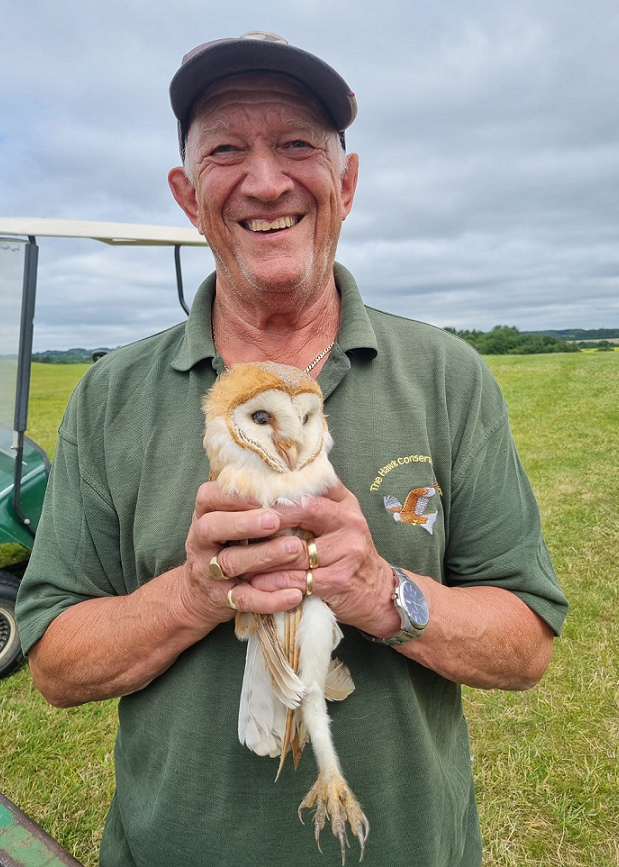
Ravensroost Wood: Saturday, 1st June 2024

With the weather forecast to be dry but breezy, I decided to head to what is normally my most reliably wind-proof site, Ravensroost Wood. I was joined by Ellie and David plus, before heading off to work with the children in the Wildlife Trust’s Watch Group, Rosie and her ne trainee, Ellie. We set our normal nets: 3 x 18m nets to the left of the main path and 5 x 18m + 1 x 9m nets to the right of the main path. Even before we had the nets open, the nets to the right of the path caught a Wren and a Chiffchaff! Unfortunately, in terms of the rest of the session, they were the only birds that counted from that ride. A couple of our other catches did decide to fly straight back into those nets once processed. However, the wind got very fierce, very quickly and that ride was particularly affected, so we had to shut the nets to ensure that no injury befell any of the birds. It was somewhat frustrating as that ride was alive with birdsong.

The nets to the left of the main track were not affected in the same way and it was safe to leave them open. We didn’t have a spectacular catch, on a par with recent sessions in this wood, but what was unusual about it was that, after we had so many newly fledged birds from a good number of species in the Firs on Wednesday, the only young bird we caught was a juvenile Robin. It was a varied, if small, catch. Rosie got to ring a few birds before heading of to work with her Ellie, which made a nice change for her.

The first two birds out of the nets, once fully opened, were a pair of Bullfinch. In the same net, close together, almost certainly a pair, confirmed by the fact that we held them back to be released together after processing (a few seconds, as they were processed simultaneously) and they flew off in the same direction. The female flew straight back into one of the nets, and the male stayed close by waiting for her until she was released (released immediately, I might add).

We weren’t exactly rushed off our feet, so we had lots of time to look at other things. I one thing we did see was that there were plenty of birds flying around both net ride areas. Probably more on the side where we had to shut the nets. There were some very attractive insects around, but no butterflies! There was this rather lovely longhorn moth:

Nemophora degeerella (photo courtesy of Rosie Wilson)

The antennae are astonishingly long – proportionately the longest, as a percentage of body length, in the UK’s moth fauna.

The list for the day was: Blue Tit 1(2); Wren (1); Dunnock 1; Robin 2(1); Blackbird 1(1); Blackcap 3(2); Chiffchaff 1; Chaffinch 1; Bullfinch 2. Totals: 12 birds ringed from 8 species and 7 birds retrapped from 5 species, making 19 birds processed from 9 species.

As we had closed the nets on the right-hand side, we could take them down whilst still monitoring the open nets. We closed the final nets at 11:30 and were off-site by before midday. Not a great session but good company, good chat and some nice birds.

West Wilts Ringing Group Results: May 2024

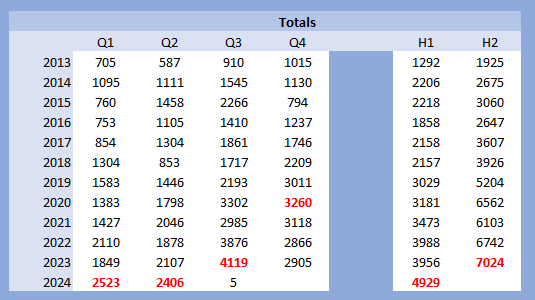
Quite an astonishing month. Last year was our best May to date, thanks to Jonny’s new found enthusiasm for monitoring nest boxes, besides Barn Owl boxes. This May dwarfed last, primarily because of the phenomenal work that Jonny continues to carry out, alongside his full time job.

image.png

The numbers, once you exclude the pulli, are fairly evenly matched, although in fewer sessions.  Added to the list of non-pulli this year are Barn Owls, Coal Tit, Grey Wagtail, Kingfisher, Spotted Flycatcher, Stock Dove and Woodpigeon.  Missing from last year were Dipper, Magpie, Mistle Thrush, Nuthatch, Rook, Skylark, Swallow and Swift.  However, the Magpies, Rooks and Swifts were all ringed at the RSPCA Oak & Furrows Rehabilitation Centre, rather than wild caught.  

It is always interesting to compare numbers year on year. In terms of summer visitors, Blackcap and Chiffchaff numbers were significantly up, whereas Garden, Reed and Sedge Warbler numbers were significantly down.  

Looking at the pulli numbers, the most astonishing increase is in the number of Blue (286 to 82) and Great Tit (105 to 21) chicks ringed.  Added in to the list are the Tree Sparrow nests that Jonny has taken over from the previous ringer, not part of our group, plus two Lapwing chicks, identified through the Project Peewit monitoring scheme that he is managing through his job at the Wiltshire & Swindon Biological Records Centre.  The second ringed was by Aurora near Shalbourne. She is working with Jonny at the WSBRC: image.png

Missing from the nestling list this year are Swallow chicks.  They do seem to have arrived later this year, in fewer numbers and, whilst Rosie is keeping an eye on their progress at Clattinger Farm, they are still either nest building or are still at the egg stage.  Hopefully things will perk up in June.  We have had a reasonable start to the Barn Owl nesting season, with our first brood ringed and three adults captured: one ringed, one retrapped in close proximity to where it nested last year and a control male that we think is the mate of the retrapped female.  There are a number of clutches to be ringed in June plus two broods of Jackdaw, so far.  Getting to some of the boxes has been a challenge as, due to the weather, many fields are impassable, so route marches are the order of the day.

Barn Owls in the Braydon Forest: Part 2

Two more sessions checking on our owl boxes in the Braydon Forest: the first on the 24th May, the second a week later, on the 31st May. As always, these visits are carried out under a Schedule 1 licence issued by the BTO, on behalf of Natural England and DEFRA. I also have an endorsement on my licence that allows me and my team, when with me, to process any adults we catch whilst carrying out these checks.

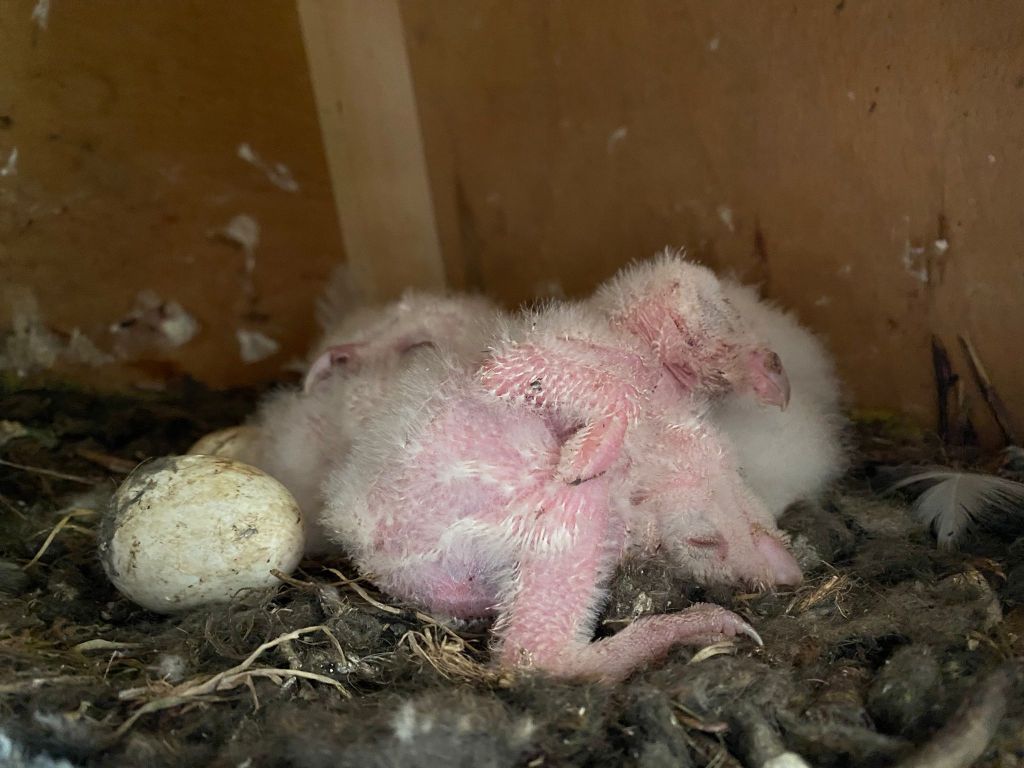
Friday, 24th I was joined by Miranda. We were on a two hour deadline, as Miranda was scheduled to be setting up Longworth live mammal traps for a survey in her local area in the afternoon. The morning started well, but there was a slight issue. Our first box is situated in an oak tree that overhangs Woodbridge Brook, adjacent to Home Farm outside of Brinkworth. On approaching the box both adults flew off. The owners of the site are totally invested in what is happening with their Barn Owls. Whenever I arrive on site I get a breakdown of the parents’ activity levels over their fields in recent weeks. They know the constraints and do not disturb the box at all. We were pretty confident that they would be breeding in the box, as they have every year since I started monitoring them. As we approached the box, I could see that the access hatch was slightly open. The catch, which was simply a bent metal pin, had corroded and broken off. Andy, one of the owners, disappeared off to make a new catch for the hatch. We tried to simply replace it with another bent pin, but it proved impossible as the broken part of the original pin was blocking the access point.. He ended up providing a small wooden bar that we screwed into the wall of the box to hold the access flap in place. Upon looking into the box I found five owlets and one remaining egg. They were not big enough to ring yet: another two to three weeks before that will be done. Unfortunately, as is always the way when you have a time constraint, we took far more time there than intended, which meant we had to curtail our activity.

Next stop was Gospel Oak Farm where we have two boxes. Both boxes last year were taken over by Grey Squirrels, much to our disappointment. The site’s owner had cleared out all of the squirrel materiel over the winter, hoping that they would not be back this year. The first box, which has previously had both Barn Owls and Jackdaws, in different years, had a lot of soft nesting material in it, but no sign of any breeding yet from any species. A lot of preparation but no result yet. The second box, which is usually the roosting site for the adult Barn Owls, held a brood of three Jackdaw chicks. They will be ready for ringing in a couple of weeks.

Our last port of call was White Lodge Farm. We only had time to visit the one box: the easiest of the four visited today. Unfortunately, the fields are so wet that we are having to park away from the boxes and carry all of our kit to them. This was the one box I could drive straight to, as it is in an oak tree in a hedgerow that lines one of the farm tracks: and a proper hard core track at that. Like box two at Gospel Oak, this box had two Jackdaw chicks in situ: both about a week behind the birds over the way from them.

So, of four boxes checked we had one looking good for Barn Owls, two with Jackdaw broods and one in development.

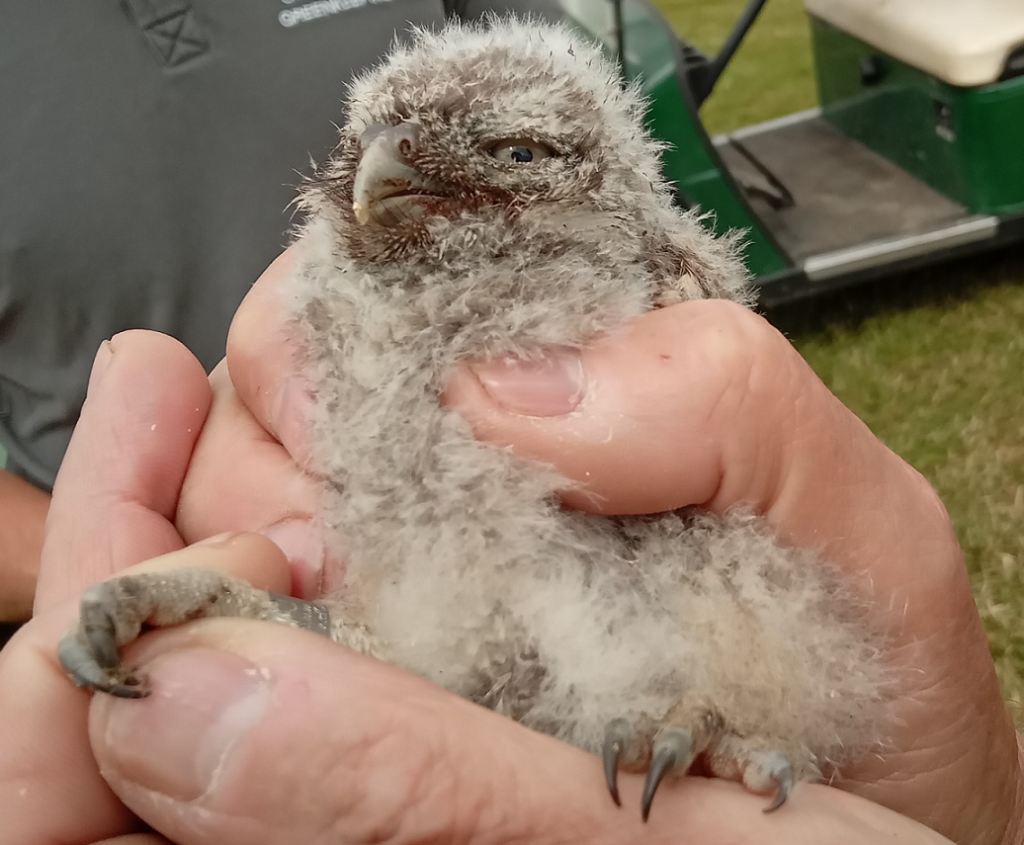
Friday, 31st May, was a late afternoon session so that Ellie and Jonny could join me: both being extremely busy with work. Jonny was my first ever trainee, and Ellie was my second, Jonny now has his A-permit, Ellie has her C-permit and I will put her forward for her A-permit whenever she decides that she wants to. As much as I love working with my current trainees, it is special when the three of us manage to get together. We didn’t plan to do too many boxes and started at Lower Pavenhill. This was a new box that I put up over two years ago. In year one it didn’t attract any interest. In year two I found a couple of Barn Owl feathers in the box, but no pellets or poop, so I was a little concerned about whether it was in the right place. We had the fun of a herd of some thirty horses, including a number of foals and some frisky yearlings, who were intensely interested in what we were doing. It is a good job that three of us are not bothered by large livestock as they became our entourage. Anyway, we got to the box and Jonny put his large hand net over the box, covering the entrance hole. He tapped on the box to persuade any adult to leave. When nothing happened in response, he removed the net and an owl flew out! Ellie suggested that he try again, he went to get his net when a second owl flew out! When Jonny opened the box there were three very small youngsters and an additional egg in there. Hopefully we will be ringing a brood in a month or so! It is nice to see a completely new site come online.

Our next stop was the Plain Farm / Drill Farm complex. The Plain Farm box was accessed through a field of heifers, followed by a field of milkers! Lots of cow pats to avoid, not to mention lots of very large bodies to pass through. When we reached the box, Jonny wielded his hand net to good effect: catching the adult female as she came off the nest. She was ringed by us last June, in the Drill Farm box, along with three youngsters. This year she has five youngsters and there was one unhatched egg in the Plain Farm box. As these chicks were all ready for ringing, it is likely that the egg is infertile. We did ring the brood.

Our final stop was the Drill Farm box. Again, we caught an adult as it left the box. It was a male. Our supposition is that it is probably the partner of the female at Plain Farm. More interestingly, its ring number, GY63202, is not one of ours. It will be interesting to find out where it has arrived from.

I decided that we had done enough for one evening: lots of walking over uneven terrain and an arthritic right ankle do not play well together! The season is shaping up pretty well: eight broods in eleven boxes, with another dozen boxes left to check. Let’s hope that the others are as initially successful as these first few, and that the initial success translates into fledging success!

Fledging Firs: Wednesday, 29th May 2024

With the weather forecast saying that it would be raining until at least 5:30, I arranged for us to meet at the Firs at 6:00. Unfortunately, I still woke up at 4:30 and, by 5:00, was up and ready to go. Fortunately, it had stopped raining, so I went early to site. Just as well that I did and, equally, just as well that I took my brush cutter too. The grass and bramble have shot up and across the glade, so I spent the next thirty minutes ensuring we had some room to set our nets.

At 6:00 I was joined by Rosie (doing her usual, helping set up, ring a couple of birds, go to work), Miranda, Sarah, Teresa and Andy (Andy helped with the initial setup, until the rest of the crew arrived, but then went off to work, and then came back to help pack up at 11:30). We had the nets open before 7:00 and had our first birds out almost straight away.

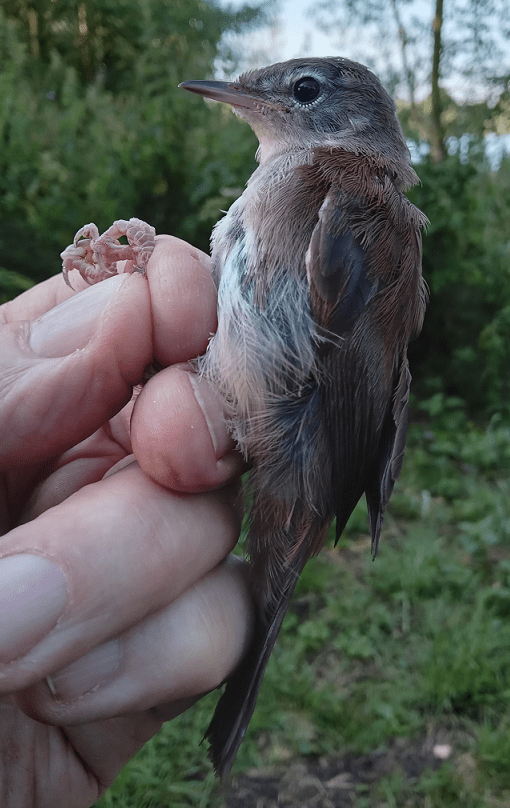
Numbers-wise, it was a reasonable session for this time of year in the local woodlands. However, in many ways it was a remarkable session. The first indicator of how the session was going to go was our third round at 8:00 when we took a juvenile Robin and our first juvenile Blackcap of the year:

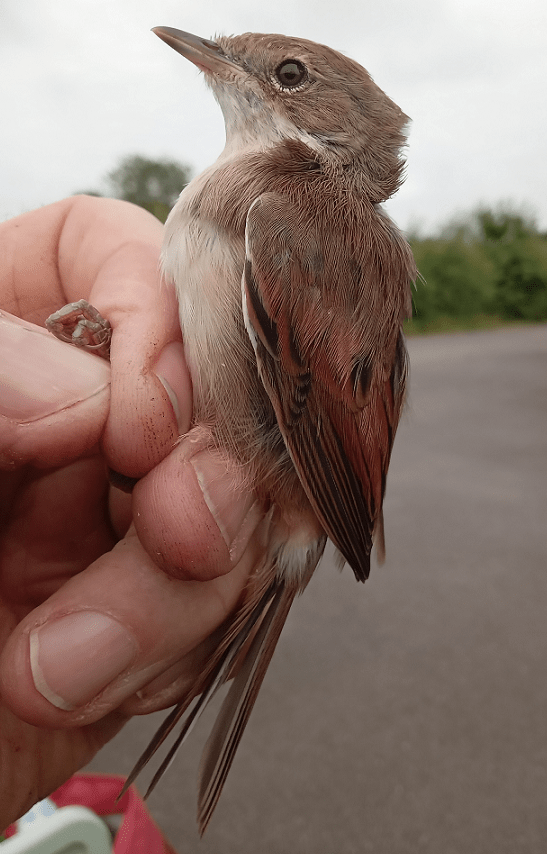
Juvenile Blackcap, Sylvia atricapilla

It was a very young bird, it seemed too young to be out of the nest. Its wings were still showing a lot of pin:

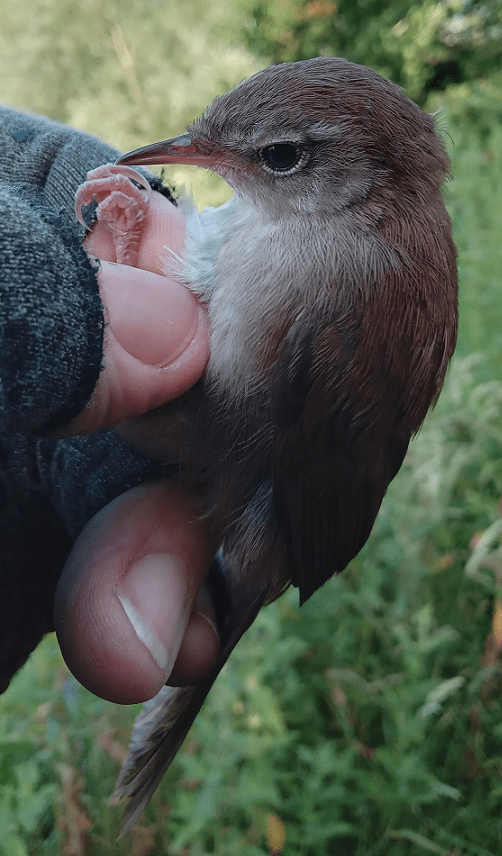
This was then followed a couple of rounds later by this:

Garden Warbler, Sylvia borin

This was only the second Garden Warbler ever caught in the Firs. The first was in June 2019. A couple of rounds later we caught another in the same net as the first. The first was a male, the second was a female with a fully developed brood patch. Hopefully there will be young this year. Their presence could be a result of two things: previous work by the volunteer group and the Ash clearance has opened the wood up somewhat and the understorey has reached that height that I think of as being optimal Garden Warbler habitat.

We then caught our first juvenile Chiffchaffs of the year:

Juvenile Chiffchaff, Phylloscopus collybita

We did have a pretty big, probably family group, of Chiffchaffs flying around the nets. We left the vicinity, to give them a chance to drop into the net. Unfortunately, only one of that group did. We might have passed the forty mark if they had all dropped in. Hard on the heels of these was our first juvenile Marsh Tit of the year. That was the one species that I was concerned might have been affected by the works that took place at the Firs over the winter of 2022 / 2023.

The list structure is: ringed [juvenile ringed] (retraps). Today’s catch was: Jay 1; Blue Tit 2; Great Tit 1; Marsh Tit [1]; Long-tailed Tit 1; Wren 1; Dunnock [1]; Robin [4](1); Song Thrush 2(1); Blackbird 1(2); Blackcap 3[2](1); Garden Warbler 2; Chiffchaff 2[6]; Goldcrest 1. Totals: 17 adults ringed from 11 species, 14 juveniles ringed from 5 species and 5 birds retrapped from 4 species, making 36 birds processed from 14 species. That is an excellent catch variety in such a small woodland.

Teresa was delighted to extract and ring her first Jay. What is more, she did it with minimal damage to herself! When she processed it I remembered to give it a pen to hold on to, to keep its feet occupied, and we kept the bag over its head to keep its beak out of harming way. If only I had remembered all of that when I ringed the Jay at Lower Moor Farm on the 15th May!

We carried out the last round at 11:20, shutting the nets as we went. It delivered a single bird. With five of us taking down we were done very quickly and off site by midday.

Lower Moor Farm, CES3: Saturday, 25th May 2024

With CES 1 showing the same total as CES 1 last year, CES 2 showing one more than last year, I was interested to see how CES 3 would compare with last year’s 21 birds from 8 species. Prior to that, there was no CES 3 in 2022, due to a combination of bad weather and illness on my part, we had 50 birds from 14 species in CES 3 2021. I was interested to see how this year would compare. I met David and Teresa on site at 5:30 and we set the CES nets. I decided to keep it at that to ensure the catch would be manageable for the level of experience available – particularly as my mobility is currently limited by my arthritic right ankle.

We had the nets open pretty quickly but we didn’t catch a single bird until 7:30: not a particularly encouraging start. I am sure that a significant issue was the early morning temperature: just 7oC – in mid-May! It is why “man-made climate change” is so much better a description than “global warming” in general conversation.

Whilst waiting for our first birds to appear we were entertained by some Caddis Fly sex. They stayed around our ringing station, in copulation, for almost the entire morning, disappearing into the vegetation at about 11:00, never once decoupling.

Phryganea grandis: the female is the grey, mottled insect, the male the pale brown one. The female was very much in command: when she started walking around the table bench he was dragged along behind her! Not surprising: apparently she is the largest UK Caddis Fly.

When the birds did start arriving, it was encouraging: six birds in the first round at 7:45. This comprised three Blackcaps and one each of Cetti’s Warbler, Dunnock and Song Thrush. It was nice to catch a female Song Thrush: the other five caught this year have all been male. We caught a couple more birds between then and 8:50, when we then had a lovely catch:

Our first juvenile Long-tailed Tit, Aegithalos caudatus, of the year.

The next catching round, a whole hour later, produced more juvenile Long-tailed Tits and our first juvenile Blackbird of the year. The juvenile Blackbird had clearly been out of the nest for a while. It was undergoing its post-fledging moult and was already the proud owner of a black-feathered tail. After that, things became even more sporadic, until we eventually closed the nets at midday. The list for the session was: Treecreeper (1); Great Tit 1; Long-tailed Tit 5(1); Wren (1); Dunnock (3); Robin 2; Song Thrush 1; Blackbird 1; Cetti’s Warbler (1); Blackcap 3(3); Garden Warbler (1); Bullfinch 1. Totals: 14 birds ringed from 7 species and 11 birds retrapped from 7 species, making 25 birds processed from 12 species. So, four more birds and 50% more species than last year. However, half as many as in the session in 2021, but only two fewer species.

Missing from the catch compared to 2021, which is somewhat surprising given how many were singing around the site, were both Chiffchaff and Willow Warbler. Those two species provided 11 of the catch in 2021 (okay, 10 Chiffchaff, one Willow Warbler) and the Blackcap number was exactly half of the 2021 catch (six ringed, six retrapped). On the absence of Chiffchaff, I am pretty sure that is down to the change in habitat that we have agreed needs fixing: too overgrown and dark, not enough suitable nesting vegetation.

It was an astonishing day for Odonata. Once the weather warmed up there were swarms of Common Blue damselfly. I was delighted to find a dozen or so Red-eyed Damselfly, mostly clinging on to the nets whilst we were trying to take down. Fortunately, they are an easy extract. Our last session was remarkable for the number of Downy Emerald dragonflies on the wing, this time we had an amazing number of Four-Spot Chaser. The star of the show, though, was the first Emperor Dragonfly of the year:

Male Emperor Dragonfly, Anax imperator: a fabulous beast.

With the session time coming to an end we shut the nets and took down. We were helped by Teresa’s partner, Andy and by David’s dad, Trevor, so it was done very quickly, and I got away from site just before 13:00.

All in all, an enjoyable session. I had hoped to set nets in the orchard area, and we might have caught a few Chiffchaff and Willow Warblers, but many of the team were away and I decided it is better to be safe than under pressure! As it was, the Wren that I had to extract was the most difficult extraction I have had to do for years. Fortunately, it was robust, and I was reasonably dexterous, and manged to identify just how it had managed to wrap itself in three pockets of the net, twisting the net around its wings or legs as it went through each pocket: I could not have tied it in more complexly if I had tried! I am quite proud of myself: it was safe and flew off strongly after having been processed, and I did not have to cut a dirty great hole in my net to release it.

Blakehill Bio-Blitz: Sunday, 19th May 2024

Rosie organised a bio-blitz day for a small group of local volunteers. I volunteered to carry out a bird ringing session on the day. Also, I arranged with Rosie that we would set up my moth trap on Saturday evening, so that it was ready for analysis when the volunteers arrived on Sunday morning. At the previous bio-blitz we ran the trap for a few hours in the evening, after the volunteers had spent the rest of the day carrying out their other surveys. It meant that we only had one of the volunteers stay on for the moths. They missed out on a lot of good stuff. This time was better for them.

Also on Saturday evening, Rosie and I both turned up with brush cutters and spent some time clearing a couple of net rides. The hope was that we would catch a couple of Linnets. Unfortunately, without denigrating their skills, I only had Laura and Adam, besides Rosie, to help with the bird ringing. We met and set the nets at 5:30. Rosie was going to be busy with the volunteers from 8:00 and, although both are doing well, Laura and Adam are both still relatively inexperienced, so I didn’t set many nets. The rest of family Childs joined us at a more civilised time, but Daniel is the least experienced with handling birds, and Mark does not partake, but is extremely helpful with the packing away at the end of the session. Doubly unfortunately from a ringing perspective, the nets that we did set didn’t produce a particularly stunning haul.

The odd arrangement along ride 1 was to accommodate the varying heights of the hedge line: tall nearest the building, lowest in the middle, medium height furthest from the building.

We started setting the nets to the sound of a Curlew displaying over the plateau. It was a sound we heard regularly until it was drowned out by cuckoos: more of which later. Firstly: the ringing catch: Blue Tit 1; Great Tit 2; Wren 2; Dunnock 1(1); Robin 2; Chiffchaff 2(1); Willow Warbler 1; House Sparrow 1. Totals: 12 birds ringed from 8 species and 2 birds retrapped from 2 species, making 14 birds processed from 8 species.

As I said, not the greatest haul in the nets, but it would be wrong to say that we didn’t have a good morning. I will come on to the moths in a short while, but the birding was excellent. In my vain attempt to catch and ring a Cuckoo, missing from my life list so far, and second on that list (behind Lesser Spotted Woodpecker, and just ahead of Hawfinch) is this iconic bird. I set up my lure of the female’s bubbling call, and my special Cuckoo trap, and we waited. Immediately the lure went on we had an answer: a female responding to a potential rival, we then had a male. Over the course of the morning Cuckoos were in attendance at all times. Flying overhead we had two males arguing with each other, we had male and female together on multiple occasions, and individuals flying around as well. As a minimum, I can say there were at least two males and two females, but I am pretty certain there were at least three females.

We had Linnet flying along the hedgerows, but managing to miss the nets set for them. The only lure I use at this time of year is for Cuckoo: we aren’t disturbing them on the nest or diverting the parents from the task of feeding their young, so one is simply relying on the other birds flying into the nets, not being attracted to them. There were a few Swallows flying around overhead: not large numbers, plus the odd Pied Wagtail. Buzzard and Red Kite were seen flying over and a Kestrel was hunting the field in front of the building, where we had net rides 3 and 4. I say hunting, I mean trying to hunt whilst being mobbed by an irritating (for the Kestrel) Corvid. The total list of bird species observed was:

The other lists gathered by the volunteers and ourselves are:

Other Vertebrates:

Macro Moths:

The Marbled Minor and Rufous Minor are aggregated for data record entry as absolute distinction requires dissection, which is not something we are prepared to do. I was delighted to be able to add two species to my life list: the Tawny Pinion and this stunning Orange Footman:

Orange Footman, Eilema sororcula

Hawkmoths are usually popular with most people, especially the more colourful specimens (moths that is, not necessarily people):

Lime Hawkmoth, Mimas tiliae

We did have a smallish catch of micro-moths and managed to identify a few:

Cnephasia communana: one of the Grey Tortrix variants. This is identifiable not just by its markings, but also by the fact that it is the earliest flying of the variants.

Other Insects:

Other Invertebrates:

Trees and Shrubs:

Flowering Plants and Herbs:

As you can probably guess: it rained all day today and I had a lot of time on my hands!

Lapwing in North Wiltshire

When I moved to Purton in the late 1990’s and started birding in north Wiltshire my first local site was the Ravensroost Wood and Meadows complex. Back in those days there were a few pairs of Lapwing that could be found in both Ravensroost and Distillery Meadows. There were never many pairs but they tried to breed every year. At that time I was not a bird ringer, nor a member of the BTO’s nest recording scheme, so I never attempted to discover their nests, nor monitor whether they were successful in their breeding attempts. I just enjoyed watching them. However, the last time I saw Lapwing on the site was at least two years before I monitored the area for the BTO Bird Atlas 2007-11. Since then there has been no sign.

Looking at the records for Lapwing processed in Wiltshire by our group, since January 2013, the only Lapwing processed have been young birds found near the Salisbury Plain Training Area between Warminster and Everleigh. There have been 10 ringed by group members since the 2014 breeding season.

This year, the Wiltshire & Swindon Biological Records Centre and the Wiltshire Wildlife Trust have launched Project Peewit: the primary aim is to monitor and report on the status and distribution of Lapwing across the North Wessex Downs, Salisbury Plain & Cranbourne Chase. In addition the project is monitoring other sites in Wiltshire where Lapwing are known to be present. Heading up this effort, alongside his work running the Curlew Call project, monitoring and trying to help boost numbers of this bird in the Braydon Forest area, is Jonny Cooper.

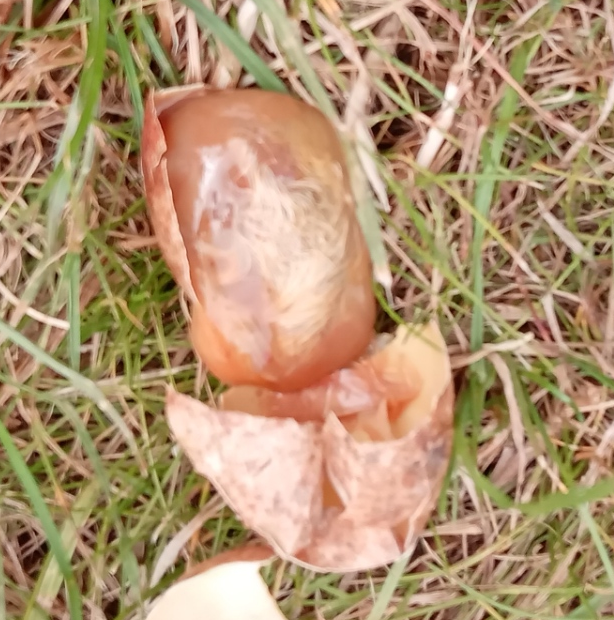
In my recent blog piece about last Thursday’s checking of Barn Owl boxes in the Braydon Forest, I paid a compliment to David Fitzherbert, gentleman farmer who is heavily committed to conservation. Today, Jonny paid a visit to his farm to check on a field that he leaves as a wildflower rich hay meadow. Lapwing have been sighted on the farm in the last few years, mainly as a result of Jonny’s efforts in Curlew Call. Today he was on site checking for both species when he came across this:

Lapwing chick, Vanellus vanellus

The monitoring, handling and ringing were all done under official and special licences from the BTO and Natural England. This is the first Lapwing chick that has been ringed by our group in the north of the county: let’s hope it is the first of many!

More about Project Peewit can be found here: 

https://www.wsbrc.org/projects/project-peewit/ 

Nice Day for Relaxing: Thursday, 16th May 2024

I had planned a solo trip to Ravensroost Wood this morning. Unfortunately, due to my wife becoming ill, being a dutiful husband, I changed tack. I had decided just to abandon the idea and try and finish my Lower Moor Farm report for the Wildlife Trust but, whilst getting breakfast this morning, looking out at the bird feeders, I had the unpleasant site of a Grey Squirrel helping itself to the birds’ food. Clearly it had found a way around the baffle on the pole. I drove it off but 10 minutes later it was back. This time I watched as it used my storm-furled net to leap across to the feeding station. I decided to take down the nets to remove its launch pad. On going out to take them down, I noticed that the first broods of the neighbourhood Starlings had fledged. They were in all of the trees surrounding the garden and the neighbours’ gardens. So, instead of taking the nets down, at about 9:45, I opened them in the hope of catching a couple of Starlings.

Funnily enough, despite their numbers around and about, the first bird into the net was a Woodpigeon. In my ringing career I have ringed 28 Woodpigeons: 24 of them have been caught and processed in my garden. I am always astonished at how strong they are: a real couple of hands full. This one was a second year female. I love them: they can poop on my car whenever they want to! It will clean! Alongside that was a second year male Blackbird.

Over the next hour I took at least one bird out every 10 minutes: but just the one Starling. So I decided to do a bit to attract them in: not sound lures, they have been put away until the end of the breeding season, but a rather large mound of mealworms, a few additional fat balls and filled the coconut shell with minced peanuts and lard. It took a couple of hours but, eventually, they arrived. The first three that I caught escaped the nets as I approached, much to my frustration. I realised that there was too little pocket in the nets, so I adjusted them and, within 15 minutes, I had my first two juvenile Starlings of the year, plus an adult.

Juvenile Starling, Sturnus vulgaris

Talking of Starlings, like with Woodpigeons, the vast bulk of my catch of this species has been my back garden. I have processed 250 of them since I started as a trainee in 2009. Of those, 5 pre-dated my semi-independent / independent ringing. Of the remaining 245, 229 have been processed in my garden.

As usual, I was catching the odd Goldfinch, Greenfinch, Robin and Dunnock. I did catch a retrapped Blue Tit: a female that I ringed as a second year bird in the garden in April 2018. That makes it over seven years old! The oldest known from date of ringing, is just under nine years, so it is quite a venerable bird. It has been caught multiple times in my garden, despite the fact that I don’t provide nest boxes for titmice.

The list for the session was: Woodpigeon 1; Blue Tit (1); Dunnock 1; Robin 2; Blackbird 1; Starling 5(1); Goldfinch 3; Greenfinch 3. Totals: 16 birds ringed from 7 species, 2 birds retrapped from 2 species, making 18 birds processed from 8 species.

At 14:15 I closed the nets and, after stopping for tea and sticky toffee cake, took them down and packed them away. This was to give the birds a few hours of feeding without interference, and to spoil things for the squirrel. I have left a treat for the squirrel: a live trap baited with a few peanuts, put up off the ground away from the bird feeders, on top of the feed bins that the damnable thing has tried to eat its way through. If it works, it will not be able to cause me any future problems.

Webb’s Wood: Wednesday, 15th May 2024

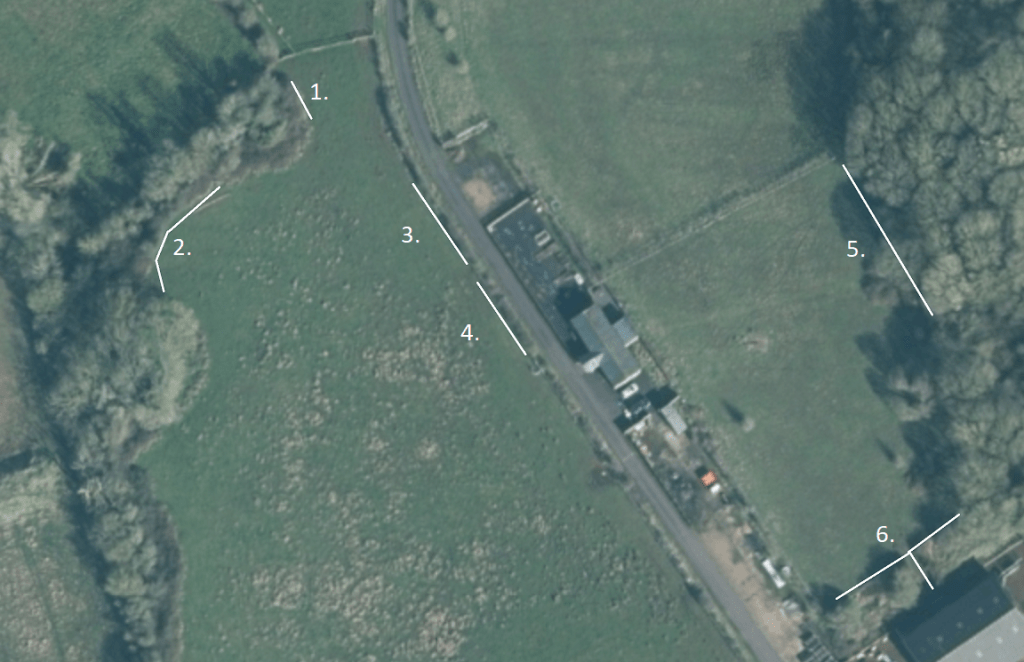
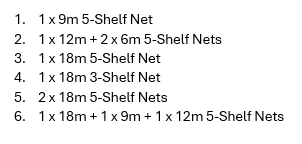
I was joined by Teresa, Andy and Miranda for today’s session. As it was forecast to be windy I decided we needed to be in a woodland. As I am, frankly, sick of being plastered in mud, I decided that Webb’s Wood would be best, as we had a lot of available track with decent verges that we could set the nets on. This was about 300m west of our normal ringing site, at the fork in the track. I used this part of the site last September. It didn’t produce a huge catch but there was reasonable variety (as outlined in the post “Thank Goodness for Goldcrests”). We set up a couple more nest than last time, which were set up as below:

The nets were open by 6:30 and we started catching straight away, with four birds: and then it stopped as soon as it started! Over the next four hours we caught just another eight birds that we could process. We did also have three same day recaptures. All around us was a mass of bird song, but it seems that they were only interested in singing and not in moving around.

The list for the morning was: Blue Tit 2; Robin 1; Song Thrush 1; Blackbird 1; Blackcap 5(1); Willow Warbler 1. Totals: 11 ringed from 6 species and one retrap, making birds processed from 6 species.

We did exercise extreme patience in between rounds, rounds which were mainly either one bird or none. It was helped by long chats with a couple of the regular dog walkers we meet at Webb’s: one with a Black Labrador, the other with a Honey Labrador. However, at 10:30 we decided unanimously that we had had enough, and so packed away the nets and headed for home. We were off-site by 11:15. A bit disappointing, but that just seems to be the way with our catches at present.

Lower Moor Farm, CES2: Saturday, 11th May 2024

Some lovely weather today and we were looking forward to a good session. To be fair, it was a very enjoyable session, and we did catch more birds than in the equivalent session last year, well, one more!

I was joined for the session by the family Childs, David and Sarah. We met at 5:30 and set the nets. The first nets were open by 5:45, with the rest of the CES nets open by 6:15. As well as the CES nets we did try out a new net ride outside of the CES area (ride 6 in the diagram below):

The non-CES net was set up in the newly planted orchard area: lots of apple trees in blossom! Lots of Willow Warblers singing and one Whitethroat. Fortunately, we did actually catch one Willow Warbler and a male Whitethroat in that net ride. Most of the other birds caught were from the ride labelled 1 on the diagram. That is unusual: normally we would have expected the ride labelled 3 to be the main catching area.

The catching was very sporadic, with multiple empty rounds. Fortunately, we had plenty to distract us. Perhaps the most interesting event of the morning was brought to our attention by a photographer who asked my opinion on a bird he had just photographed: it was a Common Sandpiper. I have seen them at Lower Moor Farm in the autumn, but never at this time of year. More interestingly, that one Common Sandpiper turned into two, who spent the next thirty minutes flying around Mallard Lake, from a base of a couple of dead trees that stick out from the main track, flying to the shore line and back again. There have been sporadic records of them breeding in Wiltshire, but is very rare. However, two together, when most will already be heading to their breeding grounds, could be a possibility. Interestingly, I contacted the Cotswold Water Park team and was told that one had been reported at the Lower Mill Estate this morning. Possibly one of the two seen today: there is about one mile between the two sites.

We also had a nice view of a Hobby flying over the site. Given how many dragonflies were emerging on the site, and how many were flying around, I was a little surprised we didn’t see the Hobby hunting. There seemed to be a lot of Downy Emerald flying around:

Downy Emerald, Cordulia aenea. There were also some early Four-spotted Chasers identified.

The list for the day was: Treecreeper 1; Jay 1; Great Tit (1); Wren (1); Dunnock 1(1); Robin 2(1); Blackbird (1); Blackcap 1(2); Whitethroat 1; Willow Warbler 1; Chiffchaff (2). Totals: 8 birds ringed from 7 species and 9 birds retrapped from 7 species, making 17 birds processed from 11 species.

There were definite highlights in the catch:

Robin, Erithacus rubecula, our first newly-fledged juvenile of the year ringed from any species. The next highlight was the previously mentioned Whitethroat. Their numbers have reduced in my catches over the last few years and we had none at Lower Moor last year:

Whitethroat, Curruca communis. I have no idea what took its interest!

Jays are always an infrequent catch: the last one caught at Lower Moor Farm was in May 2021 and the last at any of my sites was in Ravensroost Wood in July 2022. So to catch one, just about our last bird of the day, was a very pleasant surprise:

Jay, Garrulus glandarius: a delight even though it managed to rip my little finger open with one of its claws – blood everywhere, and all blood in this photo is mine!

We ran the CES for the required 6 hours, then closed the nets and took down. It really doesn’t take long when you have a crew of six to help!