A Change, As Good As A Rest? Sunday, 12th March 2023

This is not a ringing blog, just some personal musings about different areas of my birding life, leading to an event yesterday, so be warned. One of the things I was told when I started ringing was that, whilst it wouldn’t necessarily become an obsession, normal, every day birding would take a back seat. I didn’t believe it, it was such a big part of my leisure time.

Having moved to my current rural location in 1997, alongside having some great new patches to go birding, I started doing the RSPB Big Garden Birdwatch. I realised the limitations of that: a great snapshot of the birds coming in for the last weekend of January but saying nothing about the rest of the year. For a more rounded approach, and to give some additional purpose to looking at the birds in my garden, other than pure enjoyment, I joined the BTO’s Garden Birdwatch (GBW) scheme in 2003: recording the weekly maxima of the bird species using my garden, as well as a host of other aspects of garden wildlife. Between 2014 and 2020 I was an ambassador for the scheme, doing regular talks to Women’s Institutes, gardening clubs, the U3A and, indeed, anybody who wanted me to, drumming up members and donations for the scheme. When I stepped down in 2020, I was surprised and delighted to be given a life membership by this part of the BTO, as a thank you for the work I had done over the years.

What got me into ringing was taking part in the BTO Bird Atlas project between 2007 and 2011. I wanted to expand my activities into a more focused approach and I covered 15 of their survey squares, covering my village and what is now my ringing territories in the Braydon Forest, together with the four squares that covered the Coate Water complex on the outskirts of Swindon. That was a total of 60 surveys of those squares at different times of the year. After completing that, I wanted to do something that could provide me with a more scientific approach to my birding, having done nothing with my degree in Zoology for the previous 27 years.

I started ringing in 2009, and it did take up most of my leisure time: usually with two sessions on each day of the weekend. Leisure birding became increasingly restricted to what I could see out of my kitchen window, outside of ringing sessions. Ever since, patch birding has taken a back seat to my ringing activities, apart from time away on holiday, when I always manage to get some birding in. As readers of the blog know, I do a lot of my ringing on Wiltshire Wildlife Trust sites so when a member of the Trust team was looking for someone to give a talk to their River Guardian volunteers on the birds they might encounter whilst carrying out their activities, and then to lead them on a birding session, I volunteered.

It was fun putting a talk together, choosing appropriate photos for the slideshow (thanks to my friend, Barry “Beaker Baz” Woodhouse, for allowing me to use his fabulous Grey Wagtail photos – check out his work, it is truly excellent) and selecting a few bird calls to test their knowledge. The talk took place at the Kingfisher Café meeting room at the Wildlife Trust’s Langford Lakes reserve. It meant that we would have a good opportunity to see some of the birds discussed. We had a rather inauspicious start: as the attendees were assembling, a Song Thrush decided to fly into the window next to the door at such a speed that there was blood on the window and a dead bird on the floor. This was despite the fact that all of the windows are adorned with bird of prey silhouettes to prevent such an accident. After a quick clean up, the attendees got their teas, coffees and biscuits and we could make a start.

The audience had quite a wide range of birding experience, from completely unskilled to a couple of experienced birders. I am pleased to say that the talk went well across the board. After an hour of the presentation and discussions we went for a walk.

I loved it: on the lake immediately outside of the visitor centre / café complex was a large flock of Tufted Duck, together with the obligatory Mallard and multiple Black-headed Gull. The appearance of two drake and one duck Gadwall excited the entire group. We saw a lot of birds from a decent number of species. The species that elicited the most excitement were, firstly, Lapwing: there was a small flock flying around the site. Several of the group had not seen them before, and certainly not the raggedy winged flappy flight they do. Secondly was the burst of sound that heralded the appearance, brief and fleeting as usual, of a Cetti’s Warbler. There were two of them singing in adjacent trees / bushes. Finally, I was excited (and I know, it was probably an escape, so I shouldn’t be) to see a drake Ruddy Shelduck. It gave excellent views and was a first for everyone, except me.

Along the walk we saw the following: Cormorant: the males in full breeding condition and looking magnificent, Mute Swan, Canada Goose, Tufted Duck, Gadwall, Mallard, Shoveler, Black-headed Gull, Red Kite, Buzzard, Rook, Jackdaw, Carrion Crow, Pied Wagtail, Robin, Cetti’s Warbler. We finished at about 12:30 after a great fun morning, thoroughly enjoyed by everyone who came along (at least, that’s what they all told me).
Ringing Demonstration: Saturday, 11th March 2023

At the beginning of the week it really didn’t look as if this Saturday’s ringing demonstration would go ahead: the weather forecast was diabolical. However, as the week unfolded and forecast after forecast proved to be inaccurate, we just had to hope. Wednesday’s session fell foul of the weather, so I was relieved that we made it on Saturday.

There had already been a major kerfuffle: this ringing demonstration was scheduled to take place in Ravensroost Wood. The Swindon Wildlife Group (SWG) and I completed the paperwork by the end of October last, and it was advertised on both the Wildlife Trust’s “What’s On” leaflet and the “What’s On” page on their website from the beginning of November last. Unfortunately, it seems that the reserves management and the events people at the Trust didn’t talk to each other, and reserves management don’t look at their own website, because they arranged for a contractor to come on site and carry out some Ash die-back mitigation and complete the 25 year coppice cycle in Ravensroost Wood a month before our session was scheduled. It was all supposed to be completed within a two week window, but it wasn’t. Mind the work in the Firs, that began last October, I was told was supposed to last 6 weeks: it has been five months so far. With the carpark at Ravensroost Wood still full of timber at the end of last week and, despite the contractors assurance it would be removed last Monday, and that they would be offsite by the time of the demonstration, we took the decision that, to prevent last minute confusion and give plenty of notice to the attendees, we would move the demonstration to Somerford Common. I was also concerned about the impact of the works on the distribution of the birds around the site and, with no opportunity to test this out prior to the event, and the Trust refusing to allow me to set up a feeding station for the week before, to bring some certainty to proceedings, I was very keen on moving to a potentially more reliable site.

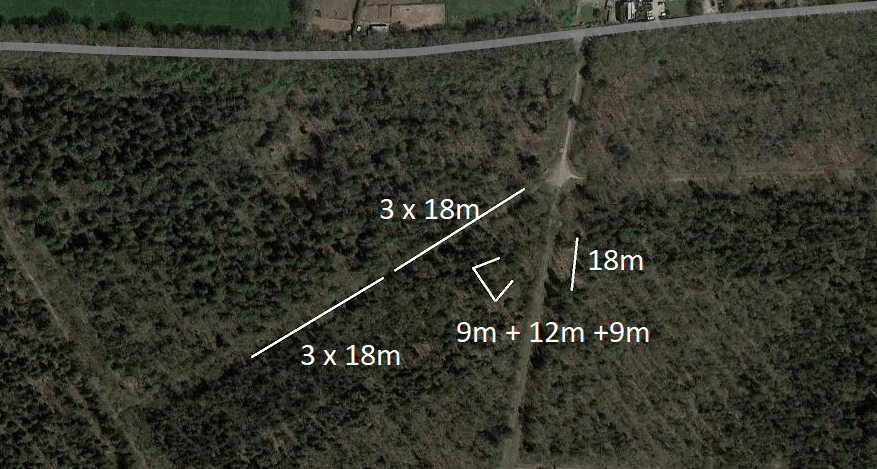
As ever, it was a sell out: 20 adults and half-a-dozen children, and several others on a waiting list missing out. With people arriving for 9:00, I gave the team: Miranda, David and Rosie, a lie-in and we got together at 7:00. We set nets at the feeders, along the track and in a clearing down the main path:

Despite putting lures on all of the net sets, the only one that actually caught any birds was the 9m – 12m – 9m dogleg around the feeding station, so we could have saved ourselves a lot of work had we known.

We had all nets open by 8:30 and birds started arriving pretty much straight away. With all attendees on site by 9:00 it was good to have something to show them straight away. The catch was slow and steady and never too busy, a round of six birds and two four bird rounds were the biggest we had. Mind, the last ringing demonstration, at Blakehill Farm, only delivered seven birds from seven species (mind, they were all cracking birds, especially the second Tree Pipit for the site, and the attendees and organisers were delighted with what they saw) so the attendees were very happy with the 27 we managed to catch this Saturday morning.

The list for the morning was: Nuthatch 1; Blue Tit 7(1); Great Tit 3(2); Coal Tit 3(1); Marsh Tit (2); Long-tailed Tit 1; Dunnock 2; Robin 3(1). Totals: 20 birds ringed from 7 species and 7 birds retrapped from 5 species, making 27 birds processed from 8 species.

It was a surprise not to catch any Goldcrest, they usually come to the lure readily. Let’s hope that the freezing weather and snow on Wednesday and Thursday hasn’t taken a toll.

Throughout the morning we had a Red Kite floating around and about our ringing station. At one point, hawk-eyed Robin Griffiths drew our attention to a Sparrowhawk display flying. It was so high up it was barely visible without your binoculars. I love their display flight: smooth glide followed by frantic wing-flapping, continued time and again. Given that it is the woodland hunter supreme, to see them displaying so high in the sky is just amazing.

We also had a Raven flying around for quite a long period: calling regularly and showing off its distinctive kite-shaped tail.

The weather took a turn for the colder at 10:30 and, with children getting chilled, the event began to break up. We did our last round just before 11:00 and, once we had processed the birds, the organisers from SWG took the remaining attendees on a walk around the site, whilst the team took down the nets and packed away. We were all off site just before 12:30.

Webb’s Wood: Saturday, 4th March 2023

Third time lucky: originally we scheduled to do this on Wednesday, but it rained, then we rescheduled for Friday, but a short visit to A&E at 3:00 in the morning put paid to that, so we finally managed to get there this morning. I was joined by David and later in the morning the two families joined us again for the session.

We set a couple of extra nets up today, in the hope of enhancing the catch:

It was a decent catch, Blue and Great Tit heavy, as expected. The birds arrived regularly, never too many to make it too stressful for either the birds or the pair of us doing the extracting. Naturally, when I declared at 11:15 that we would shut the nets as we emptied them during the next round it triggered a larger catch in that round than we had in the rest of the morning. Unfortunately, three of those were same day retraps and we just had to let them go.

One of the benefits of not having a busy catch was that I could spend some time with young Adam, who was able to expand his ringing experience, adding another three to his list.

There were a number of highlights. With the exception of the landmark year of 2017, when we caught and ringed 10 Marsh Tits in Webb’s, we rarely ring more than two per annum in this wood, with four in 2022 being the only other year that has happened. This morning we caught our first for this year: equal earliest, with 2013, that we have ringed one in this wood.

Other highlights were finch based (at last). Chaffinch is another species that we rarely catch in this wood: just 33 ringed in the 10 years I have worked in Webb’s. This morning we caught another four. Unfortunately, one of them was showing possible signs of Fringilla papillomavirus: a pale dusting over the front of the leg. I couldn’t be sure but we erred on the side of caution. I know some ringers have stopped ringing Chaffinch on a “just in case” basis but, whilst I understand that position, I see it slightly differently. If it is FPV or a mite infection the result for the bird will be the same: eventually it will lose the affected limb or limbs. Putting a ring on it will not change that situation, but might give an opportunity to monitor the progress of the disease and provide some information on how it develops.

The last bird out of the net was a Lesser Redpoll. After the astonishing catch of the species in Webb’s in December 2021 (26 individuals), the numbers have slumped back to pre-2021 levels, so catching one in March for only the third time since records began is pleasing.

The catch for the day was: Blue Tit 16(3); Great Tit 7(6); Coal Tit 1(4); Marsh Tit 1(1); Dunnock 1; Robin (2); Chaffinch 3; Lesser Redpoll 1. Totals: 30 birds ringed from 5 species and 16 birds retrapped from 5 species, making 46 birds processed from 8 species.

With the last birds processed just before midday, we packed away and left site by 12:30 (the benefits of having David’s dad Trevor, Mark and his son Adam all mucking in to help get things packed away).

West Wilts Ringing Group: February 2023 Results

This February had a significantly better result than any previous, although we did manage 17 sessions this February, compared to 13 last year. Incidentally, 13 sessions per month is the average for February since 2013.

image.png

Jonny’s Blackcap, caught at his Melksham site, is only the fourth caught in February by the Group.  He also caught three Linnet at his Hilmarton site: the only ones ever caught in February away from my Brown’s Farm site.  

There were significant increases in the numbers of Chaffinch, Chiffchaff, Dunnock, Goldcrest and Great Tit. The Chiffchaff catch was quite startling: with ten caught at Langford Lakes, eight ringed and two retraps, with one additionally caught at Sutton Benger.   Prior to that we had caught just five ringed and one retrap in a February since 2013.  One each in 2013, 2015 and 2022, two in 2021.  We also ringed four Marsh Tit: three on Somerford Common and one at Red Lodge.  Our best February catch for ringing the species.

Missing from the catch this month were Bullfinch, House Sparrow, Jackdaw, Siskin, Snipe and Starling.  Not for want of trying on the Snipe front: we were stymied by the weather on several occasions and illness on one.  

Somerford Common: Saturday, 25th February 2023

After having to abandon three sessions this week: Tuesday at Blakehill Farm, due to (unforecast) constant light drizzle (is there anything more frustrating than sitting there in the rain looking at multiple weather forecasting apps telling you that it isn’t raining, that there is <5% chance of rain and 0mm of precipitation expected for the day?); Thursday afternoon / evening due to unforecast wind and Friday morning due to overnight illness (also not forecast). We did manage to get out to Somerford Common this morning. Unfortunately, we had to curtail today’s session as unforecast wind got up at 10:00, the nets were billowing, they were getting entangled in the trees (despite being set at least 1 metre away from them) and it was clearly too dangerous to risk damaging the birds. That is not to say that it wasn’t an interesting session.

I was joined at 7:00 by David and at 7:45 by Nikki Morgans, the new Beat Forester for this area from Forestry England, and her son Oscar. A little later still we were joined by Laura, with Adam and Daniel. As there was only myself and David to do the extracting and processing, Laura took over the scribing duties, for which I was extremely grateful. Later still, we had more visitors as Laura’s husband Mark arrived with their friend Alex (who I misnamed as Susan the last time she came to a session, at Ravensroost Wood last autumn)

Unlike the last session at Somerford Common, we managed to avoid birds hitting the nets before they were fully open. However, the first round, at 8:30, was still a busy round, with 17 birds extracted and processed. The next round produced another 13 birds but we only managed one more round, with just two birds, before shutting everything down.

The list for the day was: Nuthatch (1); Blue Tit 2(4); Great Tit 1(9); Coal Tit 1(4); Marsh Tit 1(4); Robin 2(3). Totals: 7 birds ringed from 5 species and 25 birds retrapped from 6 species, making 32 birds processed from 6 species in under 2 hours!!

I have never had a catch that was so heavily weighted towards retrapped birds. Some ringers would conclude that the site has been “ringed out” and, if ringing them is the reason you do it, the site becomes unattractive. If you are a data nerd, like me, recaptured birds are the whole point. Take ACJ5593, a Marsh Tit ringed on the 10th October 2019. It has been recaptured on seven further occasions: twice more in 2019, twice in 2020, once in 2021, not at all in 2022, and now twice in 2023. Not bad for a bird that, according to the statistics from the BTO BirdFacts database, has a typical lifespan of just 2 years. Mind, the oldest recorded (from ringing data) is 11 years and 3 months from date of ringing to date of last recorded recapture. Perhaps more importantly, since the start of this year, at Somerford Common we have ringed three second year Marsh Tits and recaptured seven other individuals of this species. That is encouraging for the current health of the species at this site, given that we are working in a fairly small area, accepting that they are drawn in from a wider area to take advantage of the feeding station.

One could assume that we are catching the same Blue and Great Tits at the feeding station at each session but, when I looked at the Great Tit records, as per the Marsh Tit data, there have been 61 Great Tits processed, representing 46 individual birds, of which 33 have been caught only once. 25 of the Great Tits were ringed in the period, with only 7 of those having been recaptured in the subsequent sessions. With Blue Tits there have been, possibly surprisingly, only 54 birds processed (because it always feels like so many more), representing 48 individual birds, of which 41 have been caught only once in the period. 33 of those Blue Tits were ringed in the period, with only 4 of them being recaptured subsequently.

Still no finches, which is a shame. We did disturb a Chaffinch that was feeding on the spill from the seed-feeder on the ground (the bottom shelf of the nets was set at 70cm off the floor, as there are a few pheasants who weren’t stupid enough to stay where they might get shot, wandering around the site, and I don’t want pheasant sized holes in the bottom of the net and, although I would not be averse to a lead free roast pheasant for Sunday lunch, I am not sure wringing the neck thereof is something to be done in front of the children.

With everybody joining in to help take down and pack away we were off-site soon after 10:30. It was shame we had to shut up shop early but it was a reasonable session nonetheless, and the company was excellent. I am pleased to say that it left a good and positive impression on Nikki, and I am certain that we have established a decent rapport for the future.

Chiffchaffs: Wiltshire to Portugal

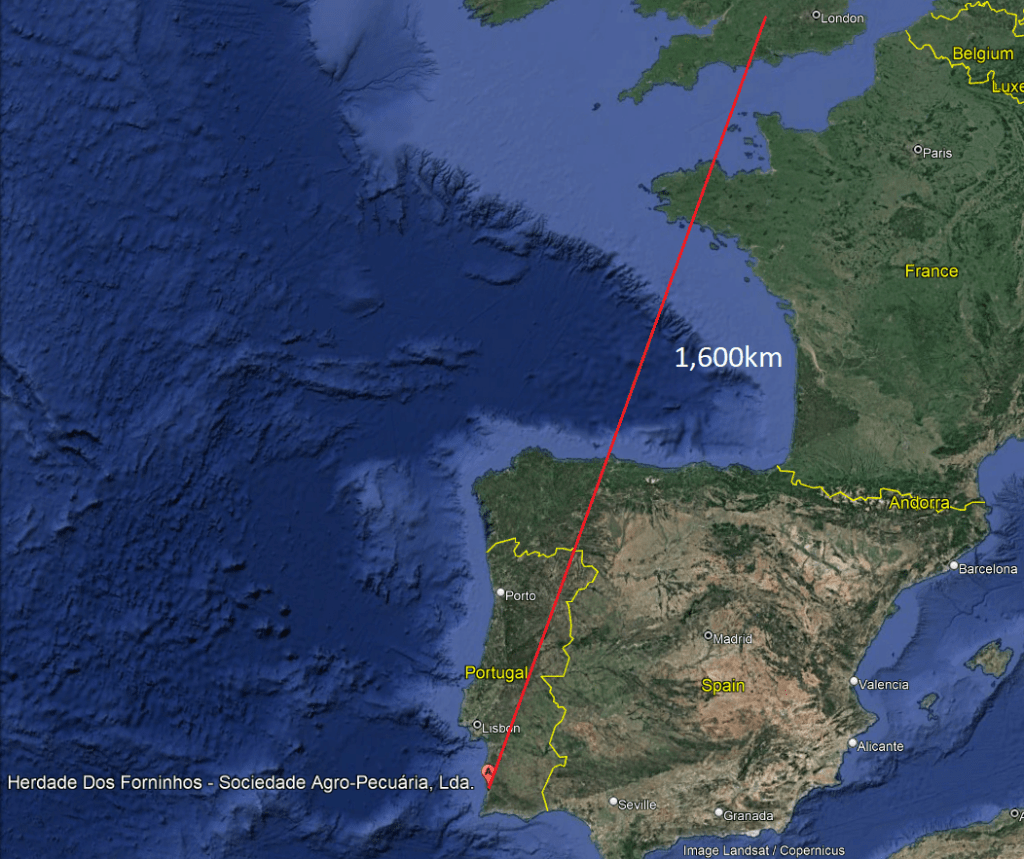
This February we received a report from Portugal of a Chiffchaff ringed on the outskirts of Melksham on the 7th October 2021, that was recovered 1,600km away, on the 25th November 2021, at Herdade dos Forninhos i.e. after 49 days. Unfortunately, it took 438 days for the Portuguese ringing scheme to let us know, but better late than never.

When I share recovery information with the group I always copy in Graham and Phil Deacon of the North Wilts Group. It is a mutual courtesy, so that we know what is happening with the birds in and from our area. Phil and Graham are also committee members of the Wiltshire Ornithological Society, and Phil collates all recoveries of ringed birds either ringed within Wiltshire and recovered elsewhere or ringed elsewhere and recovered in Wiltshire.

He sent me the details on the three other Chiffchaffs recovered in Portugal that were ringed in Wiltshire. The first was ringed by Graham near Sevenhampton, Swindon and also recovered at Herdades dos Forninhos. Second was a bird ringed at the Westdown Plantation on Salisbury Plain Training Area and recovered near Lisbon.

Then, this year there were two recoveries, again from Herdades dos Forninhos, for birds ringed and recovered in 2021. Jonny’s one and the other was ringed by Richard Leighton at Longbridge Deverill on the 13th July 2021 and recovered on the 5th October 2021.

It does seem unusual that, having had only four recoveries in Portugal, from the thousands of Chiffchaff ringed in Wiltshire, over the last 15 years, three of them should be recaptured at the same site:

Red Lodge: Sunday, 19th February 2023

Back to Red Lodge today. Yesterday’s high winds made any thought of ringing impossible, so the contrast with today’s weather was very welcome. I was joined for the session by Anna and Ellie and then, a little later on, by Laura with Daniel and Adam and then, a little later still, by Esmae, a young girl who lives in one the old Forestry Commission worker’s cottages (when they provided that sort of thing for their staff). Adam and Daniel got to ring a few more birds each this morning, and Esmae got to ring her first two (a Robin and a Great Tit.

After the failure of the nets away from the feeding station in the last two visits, I decided to try a different position for the extra nets:

They were about as successful as the ones they replaced: producing a Blackbird and a Wren.

The session was as expected: lots of Blue and Great Tits with a smattering of other species. It was pleasing to catch another Lesser Redpoll, but still no sign of any Siskin. Having seen a huge flock of Redwing when out filling the feeders on Friday, I was hoping there might have been a few around today. Unfortunately, they weren’t.

The list for the session was: Nuthatch (1); Blue Tit 21(11); Great Tit 13(4); Coal Tit (1); Marsh Tit 1; Wren 1; Robin 1(1); Blackbird 1; Lesser Redpoll 1. Totals: 39 birds ringed from 7 species and 18 birds retrapped from 5 species, making 57 birds processed from 9 species.

Another new Marsh Tit colour ringed this year brings it to three, which is a good start, especially as I cannot currently access two of the more productive woods for this species.

We were reasonably busy throughout the whole session, but with enough time to help the children further develop their skills. As usual, when I suggested that we would pack up at 11:30, we had eight birds in each of our last two rounds. We did finally do our last round and closed the nets at midday. With everybody pitching in to help take down and clear away, it took just 25 minutes to get everything packed up, and we were away from site in plenty of time for lunch.

I have to have another whinge about the amount of dog poo at this site. It is almost as if, after Forestry England put up the “No Fouling” signs, dog walkers are deliberately leaving piles of the stuff wherever they can. By my estimation there was approximately one pile of poo in every 1m square. It was impossible not to tread in it without focusing 100% on avoiding it. That is disgraceful. We had three children with us today, and they should not have to be spending their time watching where they are putting their feet because some people are too ignorant and too lazy to clean up after their pets.

Lower Moor Farm: Wednesday, 15th February 2023

The Wiltshire Wildlife Trust lifted their HPAI precautionary ban on bird ringing at their wetland sites, Langford Lakes and Lower Moor Farm, last week. With my options limited currently, because of forestry works at the Firs and Ravensroost Woods, I decided to make a foray to the site this morning. I don’t expect big catches there at this time of year, but we did have 35 caught in February 2021, 20 in February 2016. All others have been less than 15.

I met up with Miranda and Rosie at 7:00, and we set up the following nets:

Following on from Miranda generously replacing my bird bag hanger, Rosie turned up this morning with a replacement for my ringing table, which, after 10 years of service, is very much the worse for wear. I am very lucky to have such considerate trainees. (All right the rest of you: see me for my wish list!!)

It was as quiet as expected, but Rosie did get to ring a couple of birds before heading off to work at 9:00. It helped that she was working with a couple of Trust volunteers at Lower Moor Farm this morning. I was very pleased to catch our first Lesser Redpoll since the middle of November:

We also caught a second Redwing of the year. The catch was small, just 16 birds. There were small flocks flying around, but we were catching just the odd one of each. The list for the session was: Blue Tit (2); Great Tit 2; Long-tailed Tit 1; Wren (2); Dunnock 1(1); Robin 1(1); Redwing 1; Song Thrush 1; Goldcrest 2; Lesser Redpoll 1. 10 birds ringed from 8 species and 6 birds retrapped from 4 species, making 16 birds processed from 10 species.

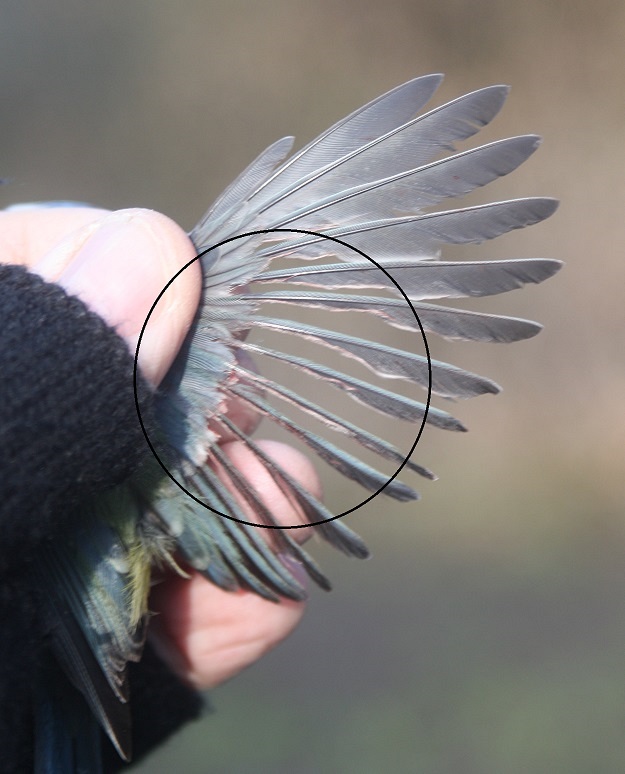
Both Blue Tits were recaptures. One of them, ringed in 2021, was clearly having a problem with its right wing. The left wing was fine.

The tips of the greater coverts were ragged and tinged dull red, which looked like dried blood. Feather barbs were stuck to the shaft, again, by what looked like dried blood. There was no sign of feather mites or other invertebrate pests. The bird was in otherwise good condition: but slightly underweight for this time of year. It would be interesting to know what the issue was. Perhaps it had a close encounter with a predator? Or is it just a somewhat erratic moult of secondaries and associated coverts?

At 10:30 the wind got up unexpectedly and, after two empty rounds, Miranda and I decided to shut the nets and take down. We were off site by 11:15.

Still No Finches: Somerford Common, Saturday, 11th February 2023

After the last session at Somerford Common, as I blogged at the time, I moved the feeding station back to its pre-mulching position. Soon after, I replaced the 2 litre seed feeder with a 6 litre feeder, so I could move the 2 litre feeder to the other side of Somerford Common, to set up the new feeding station used at last Saturday’s session. I topped up all of the feeders on Tuesday and went back to top up at Somerford on Friday. Both the peanut and seed feeders had been emptied in 3 days, that is 6 litres of seed and 1.5 litres of peanuts eaten in three days! Are they trying to bankrupt me? Basically, I knew that today’s session would be busy, and was going to be titmouse heavy again.

When I went out on Friday I also took my secateurs, some branch loppers and a vegetation slasher, to re-establish the net rides. Amazingly, given that they have bright yellow handles, I managed to lose the secateurs. Despite searching for a good twenty minutes, I couldn’t find them and went home in a huff!

The morning started disastrously: having arranged to meet Anna at 7:15, I arrived on site on time, started to get the equipment out and realised that I had left the guy ropes at home. I quickly texted Anna telling her not to panic if I wasn’t there and that I would be back to site just after 7:30 (the joys of having most of your sites just 10 minutes from home, or 6 minutes as it was yesterday). When I got back Anna wasn’t there. Of course, O2 had lived down to its usual standard and the message hadn’t sent. Fortunately, she was running late herself, having had to stop and put some fuel in her car. Better late than never, we started setting the nets. Firstly, the 18m & 9m on the main track. I put on a Redwing lure, hoping that the one at Webb’s Wood on Wednesday wasn’t a one-off stray (it was). We opened them and went to set up the feeding station nets. As we were doing so, Adam, Daniel and dad Mark arrived. They helped me set the rest of the nets, whilst I sent Anna to check on the opened nets. I tasked Adam with finding my secateurs. Thank goodness for young eyes! I have them back.

The net setup was:

Even before we got the nets open the birds (Blue and Great Tits) started to get caught. Meanwhile, Anna was removing a flock of Long-tailed Tits from the other nets. I managed to get the half-a-dozen birds out of the unopened nets without mishap, and went to help Anna finish off the other extractions. Whilst we were extracting, Claire arrived with Zara and Samuel and between the lot of them, they set up the ringing station for us. Claire then scribed for me for most of the rest of the session, which was extremely helpful. Laura came along a bit later and took over scribing duties after Claire & co had left. Essentially, we extracted and ringed for 2.5 hours.

Unfortunately, still no sign of any Lesser Redpoll and Siskin but, equally, it has been a regular site for Goldfinch, again missing, nor Chaffinch, the only finch species we have been catching this year.

The list for the sessions was: Great Spotted Woodpecker (1); Nuthatch (1); Blue Tit 12(9); Great Tit 8(15); Coal Tit 3(3); Marsh Tit (2); Long-tailed Tit 12; Dunnock 1; Robin 1(3); Blackbird 1; Goldcrest (1). Totals: 38 birds ringed from 7 species and 35 birds retrapped from 8 species, making 75 birds processed from 11 species.

The first few rounds were busy but, as we entered the second hour the numbers fell off a bit and all four children had the opportunity to process a couple of birds each, as well as doing the releasing duties. With many hands making light work, packing away took very little time and we were away from site before midday. It would be nice to be catching finches, but it is a reasonable variety for a woodland at this time of year. We might have added a few more Goldcrest, but I didn’t run a lure for them this morning: I don’t know why but, having started off so incompetently, I shall just put it down to that!

Webb’s Wood: Wednesday, 8th February 2023

It was back to Webb’s Wood this morning, and back to the cold weather. It was touch and go when I arrived on site as to whether I would go ahead. The forecast was for it to start warming up from 7:00, so Miranda and I met at 7:15 and opened the nets at 8:00. Interestingly, it actually felt warmer than I expected, although the car’s thermometer was showing minus 5 degrees Celsius. We only set 4 x 18m, 1 x 6m and 1 x 9m net: the small nets around the feeders and the usual 3 x 18m line and a single 18m adjacent to the feeding station (the circle):

The fog that was supposed to be present until 11:00 (according to the Met Office yellow warning) had pretty much lifted by the time we got to site. Surprisingly, as the morning wore on, and the temperature started to rise, the nets actually iced up. We decided to call a halt at just gone 10:00. It was absurd: the sun was out but it felt colder than when we started. There was no sign of cold stress in any of the birds: just in the ringers!

The first surprise of the morning: ever since I started to do solo working I have used a portable clothes airer to hang the birds in bags on whilst they are waiting to be processed. We all used to make tripods from net poles or stick them into bales of straw or strap them horizontally to the ringing table, so that bags could be hung off them. After a few incidents, one involving the back hatch of the car, a couple involving unexpected gusts of wind, there have been repairs and gaffer tape used to hold it together. Imagine my surprise when Miranda produced a brand new one to give to me to use in future! The only thing my trainees have to provide is their time, no money exchanges hands (it will cost them enough once they become independent, and I would be doing this and spending the money anyway) so I was absolutely blown away. One other nice surprise this morning was catching our first Braydon Forest Redwing of the year:

Our last was on the 27th December in Red Lodge.

The catch was: Nuthatch (1); Blue Tit 6(2); Great Tit 3(3); Coal Tit 1(1); Wren (1); Dunnock 1; Robin 1(2); Redwing 1; Blackbird (1). Totals: 13 birds ringed from 6 species and 11 birds retrapped from 7 species, making 24 birds processed from 9 species.

The Dunnock was also an unusual catch for this site: only the eighth caught in 10 years.

We finished packing away by 10:30, but I didn’t get off site until 11:00 as, initially, I was goosed by an overly friendly Labrador, whilst I was pushing the poles into the back of the car. That got my attention. His owner, a very pleasant local gentleman, who is currently putting the neighbourhood plan together for the area, was very keen to talk about the bird life of Webb’s Wood and what Forestry England’s plans are for the wood. We had a good long chat and, hopefully, I will be able to help with his work.