Somerford Blues: Saturday, 11th December 2021

With grovelling apologies to Eddie Cochran:

Not gonna raise a fuss, not gonna raise a holler
But I gotta say something, cos I’m hot under the collar!
I went to the site to do my winter CES
And what I found was this terrible mess
I don’t know what I’m a gonna do, cos there ain’t no cure for the Somerford blues

No place for birds to perch, no place for them to shelter
No place for them to hide from any avian predator
There was just this open devastation
With nothing here to hide my feeding station
I don’t know what I’m a gonna do, cos there ain’t no cure for the Somerford blues

This is what has prompted my terrible verses (and rhyming “shelter” with “predator” should be a capital offence):

This happened between my last session there on the 28th November and when I went to top up the feeding station on Thursday. I was told by Forestry England that the management plan for this area was to be coppiced on an 8 year cycle, but this has been stripped, not even 4 years since it was first done. The exceptions to the clearance being a few straggly bits of Blackthorn, which have been identified as having Brown Hairstreak eggs on them, as well as the established guard trees and the Silver Birch within which my feeding station is set up.

I notified the BTO that I might have to drop the site from the CES trial and, unfortunately, today’s results have confirmed that it cannot continue. To get any sort of decent catch there this winter I am going to have to change the net positions, to incorporate some more cover to protect the birds and make the feeding station a more attractive proposition. To be honest, though, my biggest disappointment is that the place was looking perfect for Garden Warblers next year. Way back in 2008, before I started ringing, I surveyed this site for the BTO’s revised Bird Atlas and, with the vegetation at a similar height and structure to what was in place before this week, my two summer / breeding season visits showed good numbers of Garden Warbler in that area and I was hoping for a repeat.

I was joined for the session by Anna, although she had to leave the session early, but she didn’t miss much. The list from the session was: Great Spotted Woodpecker (1); Blue Tit 1(8); Great Tit 2(6); Coal Tit 1(2); Marsh Tit (3); Dunnock (1); Robin (1); Blackbird 1; Chaffinch 2. Totals: 7 birds ringed from 5 species and 22 birds retrapped from 7 species, making 29 birds processed from 9 species.

One thing that Jonny Cooper and I recently discussed was how frequently we recapture birds with consecutive ring numbers weeks, months and years after they were ringed. For example, today we caught three Blue Tits, with the ring numbers AAL0006, AAL0007 and AAL0008. They were all ringed on the 30th December 2019 at Somerford Common. Numbers 6 and 8 have been recaptured separately on 2 and 4 occasions respectively, but this is the first time they have all been recaptured together and it is almost 2 years since they were ringed. We also caught consecutively numbered Great Tits: PF36524 and PF36525. Not only were their numbers consecutive, but they were close together and in the same net. One is a male, the other a female: do Great Tits form lasting breeding pairs? I have found papers that say that male Great Tits will seek to pair bond early, prior to the breeding season but to catch two birds, ringed at the same time on the same date and recovered, as outlined above, at the same time in the same net. This suggests a multi-season pair bond.

One other interesting catch was a juvenile male Blackbird with a bald spot and a single white feather but, attached to its scalp, at the base of that feather, was a fat and well-fed tick:

I closed the nets at 11:30 and took down and left site by just gone midday – the benefit of only setting six nets.
Webb’s Wonder: Sunday, 5th December 2021

After a week where sessions had to be cancelled at the last minute, because of unforecast changes in the weather, I was determined to get out if at all possible. I woke to find that the overnight rain had cleared, as forecast, and the wind was breezy but not overly strong. By the time I got to Webb’s Wood there was still no sign of rain, but the wind had really picked up. The tops of the trees were whipping around and groaning like crazy. I knew I could set nets in relatively sheltered areas but the feeding station area was in the teeth of the wind.

The feeding station had been topped up on Tuesday but, as my car decided to shred a wheel bearing whilst I was doing the feeding station run and, as my mobile mechanic advised, I was lucky that the wheel did not come off before I got it home, I didn’t get out again to top up at Webb’s before this morning, whilst he got the parts and rebuilt the wheel and axle. The feeders were all empty and I was hopeful of a similar result to our last visit when the team processed 65 birds, including our first Grey Wagtail for the Braydon Forest. With a 7:00 start, I was joined by Adam and Anna, with Jonny popping in to help set up, and for a chat about the planned Dipper project, and Claire brought Samuel along for another taster session a little later on.

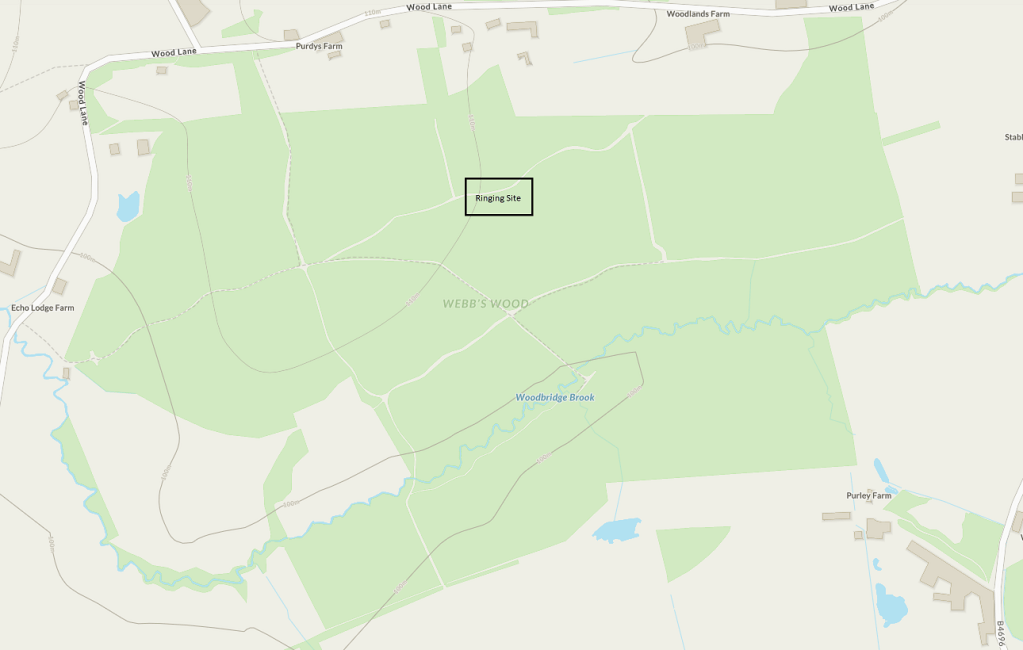
This is where our ringing site is within Webb’s Wood:

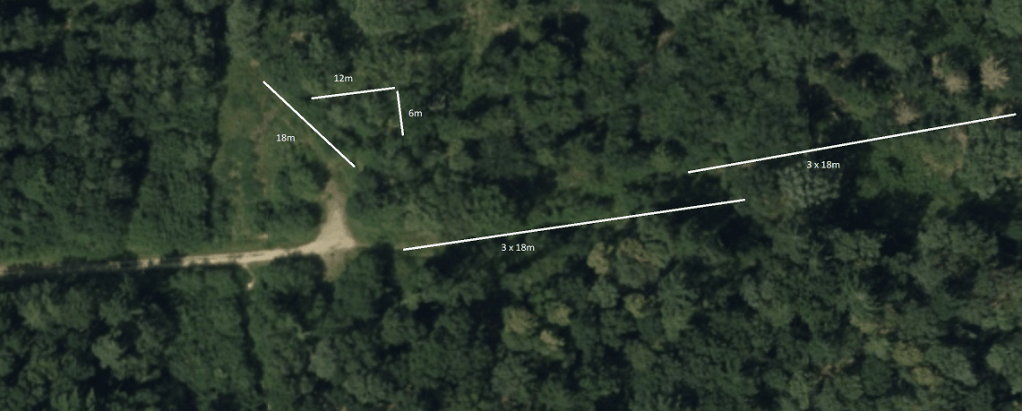
As you can see, it is a fair way into the wood. We set up as follows within that area:

Ordnance Survey have not yet updated their aerial photograph since last winter’s thinning operations, so there is somewhat more space between the trees than this diagram shows. Our ringing station was set up on the turning area at the end of the clear path. We put a lure for Redwing on the easternmost 3 x 18m net ride and for Lesser Redpoll on the other 3 x 18m ride and on the single 18m net. I assumed that the feeding station would be a big enough draw in itself.

We set up the two 3 x 18m net rides first. By the time we had set up the second net ride, two Wrens had flown into the first. As soon as we had set the other three nets we had a Great Tit fly into the 18m single. We waited until 8:30 until we caught another Great Tit and a Blue Tit. Everybody was getting cold, the weather was dull and miserable, and we were sitting there discussing how bad it had to get before we would pack up, go home and get warm, when a small flock of Lesser Redpoll flew into the small clump of willow adjacent to the ringing station. We all held our breath waiting to see what might happen and then watched as they piled into the net. Eleven Lesser Redpoll later we were happy to stay a bit longer! Even Jonny decided that he would actually ring a couple, and I broke my rule and ringed one of them. To put that catch into perspective, the largest catch of Lesser Redpoll in Webb’s Wood was four on the 30th October 2013. Apart from that, we rarely catch them there. I wonder if that is as a result of the thinning of the wood?

Male Lesser Redpoll

Jonny had to leave after that little influx and soon afterwards Claire took Samuel home, as he was getting chilled and a little bored at the lack of activity because. between then and 10:15. we caught only another two birds: a Blackbird and another Lesser Redpoll. Thereafter, between 10:15 and 11:00 we had a good catch of birds: my fault for suggesting that we would start taking down the nets at 10:30, because it wasn’t getting any warmer and we were getting chilled. I have to stress: whilst I am moaning about being cold, it was not too cold for ringing. The temperature never dropped below 4 degrees Celsius, and we did not have a single bird showing signs of cold stress.

The list for the day was: Blue Tit 4(2); Great Tit (5); Coal Tit (1); Long-tailed Tit 5; Wren 2; Dunnock 1; Robin (1); Blackbird 1; Lesser Redpoll 20. Totals: 33 birds ringed from 6 species and 9 birds retrapped from 4 species, making 42 birds processed from 9 species. Of the 43 birds processed, 30 were caught in the single 18m net and 10 were caught in the feeding station nets, 3 in the ride nearest the ringing station and just one same day retrap in the furthest net ride, which we just released. I will bear that in mind for future sessions and might save the effort of putting it up.

To underline the importance of this catch of Lesser Redpoll for my team: it is our biggest to date in the Braydon Forest since I took over managing the ringing in the sites. Last year we caught an excellent total of 17 in Ravensroost Wood’s 8-year coppice area on the 12th November. Somerford Common, where we catch them most regularly, we have had a 14 and a 12, but until now Webb’s has been the second least productive of the Braydon Forest sites (ahead of the Firs, which has only given up two of them on one occasion in November 2016).

Another pleasing aspect of the catch was, following on from ten at our last visit, a small flock of five Long-tailed Tits. On both occasions they were all unringed. The norm in my catches is for 60% to be retraps and 40% unringed.

We finished taking down just after 11:45 and headed home to warm up. As I was driving up the road from the Braydon Crossroads to Purton, I had to slam on my brakes as a Buzzard flew across the road, crossing right in front of my windscreen! A cold but satisfying session.

West Wilts Ringing Group: November 2021 Results

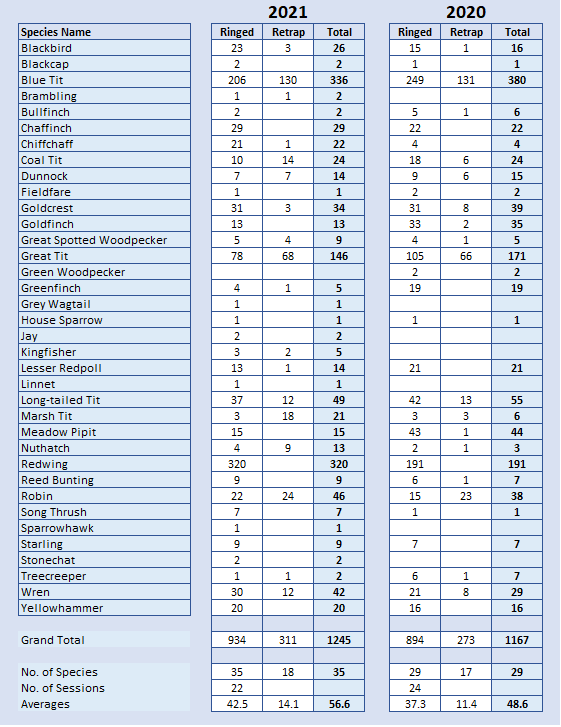
Another good month for the group, despite some pretty iffy weather, culminating in Storm Arwen.  It is our highest catch for any November since the split at the beginning of 2013. The increase was driven by an increased number of retrapped birds and an astonishing number of Redwing.  We managed 22 proper sessions, ignoring the odd bird blundering into a net in Andy’s, Alice’s or my garden. 

After a slow summer, my sites are beginning to pick up and my little team actually produced 35% of the records.  This year it was 315 ringed and 140 retrapped against 260 ringed and 75 retrapped last year.  A huge contribution to that, despite their numbers being down across the group compared to last year, is Blue Tits, with 111 ringed and 53 retrapped against 44 ringed and 27 retrapped in November last year. 

I don’t think it has anything to do with feeding stations: this year I didn’t actually put up my feeding stations until the first week of the month, to coincide with starting the winter CES at Somerford Common.  Last year I opened them in mid-October, but the weather has been much milder this year.  It might well be that the winter CES is responsible: our session two, on the 28th November, delivered 6 new and 39 retrapped birds.  That 39 represents the difference between the previous best November retrap count and this year’s. 

The clear differences in numbers are the lower than last year catches of Meadow Pipit, Blue and Great Tits, and the astonishing increase in the number of Redwing caught this year.  That is mainly down to a huge increase in the catch on Salisbury Plain compared with last year: 142 vs 31, with honourable mentions for East Tytherton at 60 vs 27 and Sutton Benger at 45 vs 22.  The Salisbury Plain catch was driven by a single catch of 69 on the 16th of the month. 

We also had reasonable increases in the numbers of Wren and Robin ringed.  The number of retrapped Marsh Tits was astonishing: the 3 ringed birds (one at Somerford Common and two at Red Lodge) plus the 18 retraps representing 13 individual birds, with 5 doubles at Somerford Common, making a total of 17 encounters this month. No doubt the winter CES is impacting on the recapture of Marsh Tits at Somerford Common.

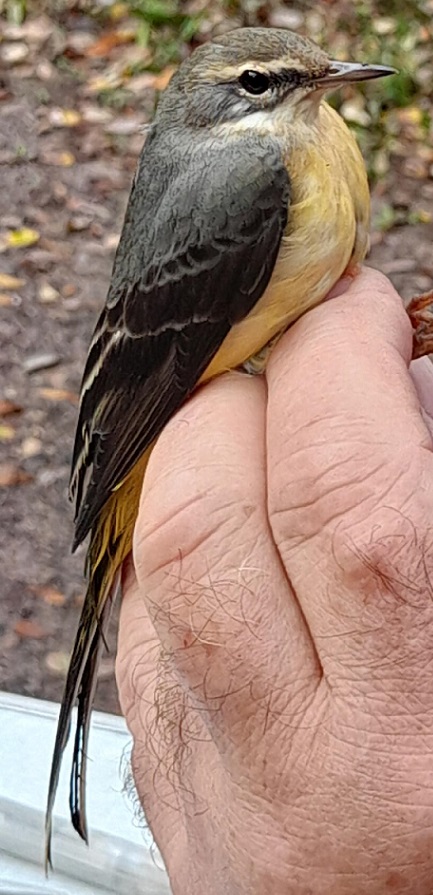
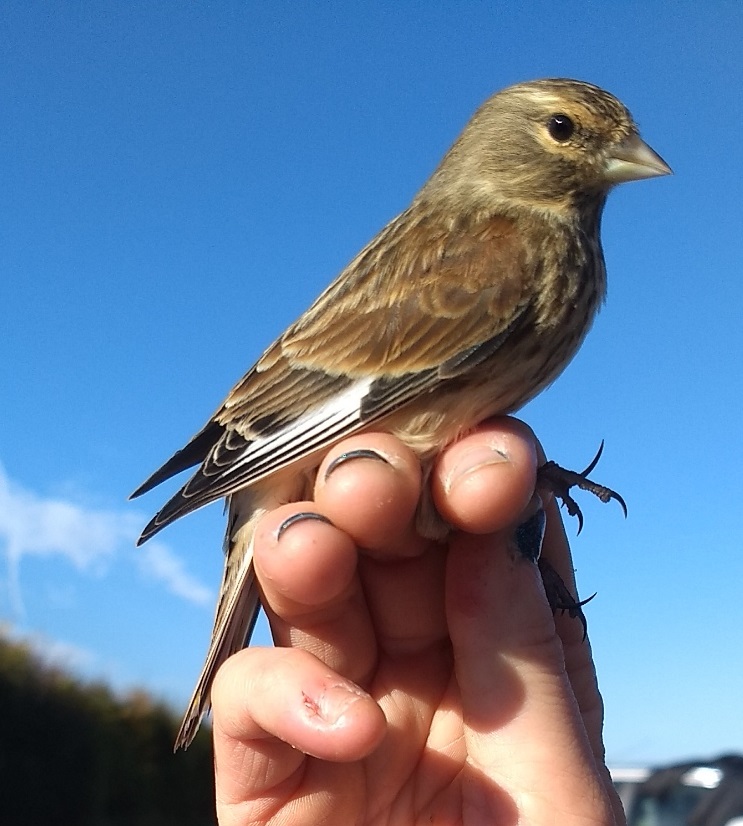
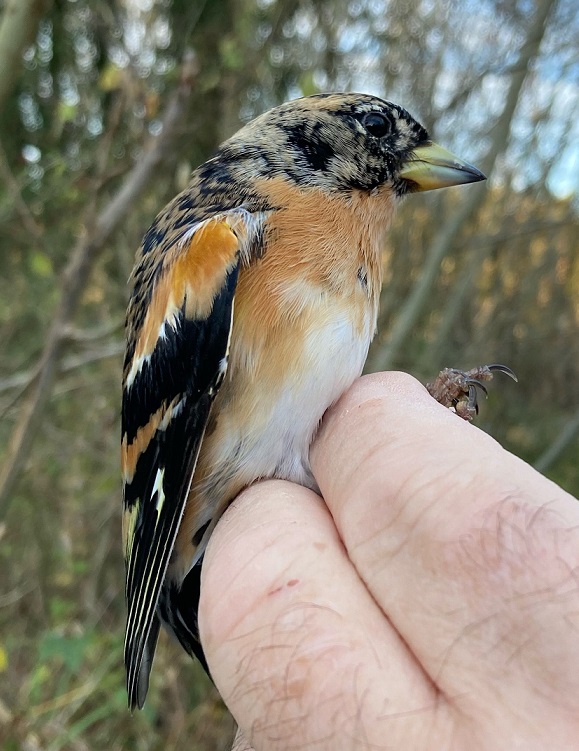
My team had several highlights this month: the two Brambling, a first for Red Lodge and a recapture at Somerford Common of a bird ringed at the site in February of this year, both being our first late autumn birds in the Braydon Forest; a Grey Wagtail in the middle of Webb’s Wood, a first for the site, and a solitary Linnet at Blakehill Farm.  One would expect to catch plenty there but we do catch very few: just 2 or 3 per year with the exception of 2018 when we caught 12.

Grey Wagtail (photo by Anna Cooper)
Linnet
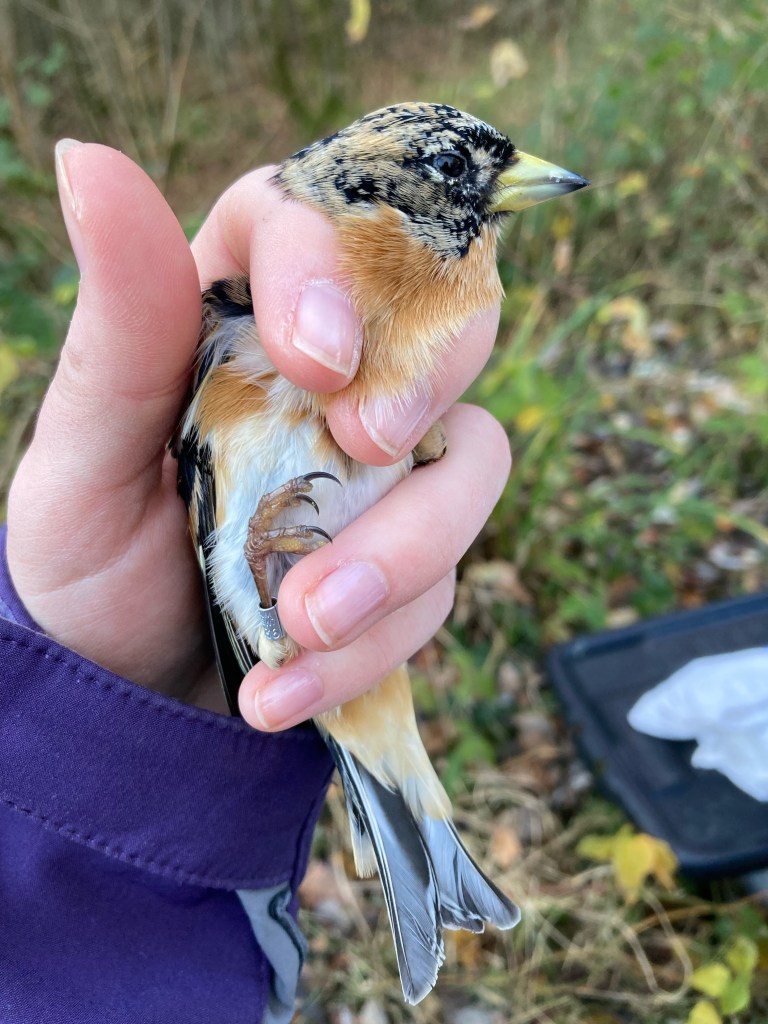
Brambling retrapped at Somerford Common

Retrap Central: Somerford Common, Sunday, 28th November 2021

As Storm Arwen (is J.R.R. Tolkein getting royalties?) hit with a vengeance on Saturday, we pushed the scheduled session back to this Sunday morning. As a result, I lost the services of a couple of the team, having already lost one to illness, so my grand plan for several nets away from the usual setup was shelved. However, I was joined for the session by Anna and we set our usual nets. I was interested to see whether the storm would have impacted on our catch. I think it probably did: we only caught one finch when we would usually expect to catch two or three species of finch. As it was, the one finch we caught was a good one though.

One of the arguments often trotted out by the anti-ringing fraternity is that the recovery rate is so low. If you are ringing at a migration hotspot then the likelihood of a high, local recovery rate is obviously not going to happen. When, like me, you ring the same sites throughout the year, with just one site that attracts good numbers of passage migrants (Blakehill Farm), then your recovery rate is much higher. Over the nine years that I have worked these sites retrap rate is over 25% per annum. Clearly, with young passerines suffering from a 70% to 80% mortality rate in the six months post-fledging, a 25% recovery rate is pretty good.

Today at Somerford Common, carrying out our second winter CES session there, we caught 40 birds from 9 species: 31 of them were recaptured birds. Primarily they were resident species, and to recapture 5 Marsh Tits in one session was extremely pleasing. However, we also had the excitement of catching our first ever retrapped Brambling. It was ringed at Somerford on the 27th February this year.

Brambling photo courtesy of Anna Cooper

The most venerable bird caught today was a Blue Tit, ring number S580946, ringed as a juvenile 5 years ago.

The list for the day was: Nuthatch (3); Blue Tit 3(17); Great Tit 2(2); Coal Tit (1); Marsh Tit (5); Wren 2; Robin 1(2); Blackbird 1; Brambling (1). Totals: 9 birds ringed from 5 species and 31 birds retrapped from 7 species, making 40 birds processed from 9 species.

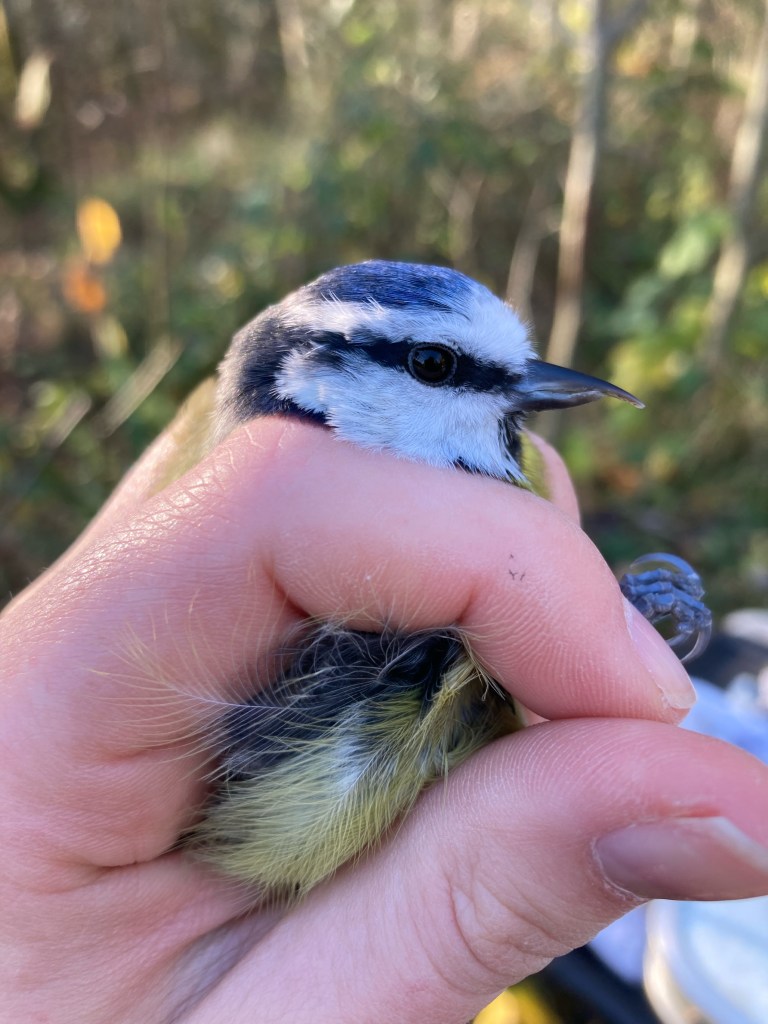
One oddity amongst our catch was a Blue Tit with a deformed bill. It seemed perfectly healthy and was a good weight, so it is clearly not suffering as a result:

Blue Tit with deformed beak. Photo courtesy of Anna Cooper.

We closed the nets after our round at 11:30, took down and left site by 12:15.

Red Lodge Lesser Redpoll Update

I loaded the data from this morning’s session into DemOn by about 14:00. Then I wrote the blogpost about the session, which I published at just after 16:00 this afternoon. Had I looked at my email before publishing I would have found the recovery report from the BTO, which arrived in my inbox at 15:52.

Anyway, to confirm that the bird has northern roots: it was ringed on the 28th September 2020 on a ringing site at Hatfield Moor, South Yorkshire. It has therefore moved 227km, 197 degrees South-South-West. The time gap is 422 days, but that isn’t really relevant, as I suspect it will have moved around in the intervening period.

This is a major benefit of the BTO’s online data entry system. As I entered the data I got notification that our data matched with what would be expected. One day, in a future systems upgrade, we will be able to see the full history of any bird we capture. I can’t wait.

A First for Red Lodge: Wednesday, 24th November 2021

Having had a wasted trip to Brown’s Farm on Saturday when, despite a dry weather, low wind forecast, the farm was wrapped in a blanket of mizzle. We waited, but it showed no signs of lifting after 45 minutes, so we gave it up as a bad job. I then opened some nets in my garden, adjacent to the feeders, and caught virtually nothing when it should have been 20 or 30 birds, so I really needed something to lift my spirits when heading to Red Lodge this morning.

Again, the forecast was dry, but there was definitely some low level moisture in the air when I set off. Red Lodge is only one mile from my house so I was pleasantly surprised when I arrived there to find it as forecast. I was joined for the morning by Miranda, and with Rosie doing her thing of popping in first thing to help set up before heading off to work. This time, for once, she did get the chance to ring a few birds. We only set four nets: just those adjacent to the bird feeders. The damaged gate, the fallen tree and the dumped waste are still blocking the path, so we had to carry all of our ringing station equipment up the track (and back again at the end). I don’t know what is going on in the Braydon Forest but, going to Webb’s Wood on Friday to top up the feeding station, someone has chosen to smash down the gate. I have been working these sites for ten years and, before this year, there has never been any trouble of this sort.

Anyway, to what turned out to be a really good session at Red Lodge this morning. This was the first bird extracted this morning:

juvenile Brambling

This is the first Brambling caught in Red Lodge. The first in the Braydon Forest were caught at Somerford Common in 2019, followed by another in Ravensroost that year. Another was caught at Somerford Common this February, but that is the sum total caught in the Forest since ringing started in 2009.

Just before Rosie had to leave to get to work we caught a couple of Lesser Redpoll. These are the first caught in Red Lodge for four years, so another bonus for the morning. We know, from ringing recoveries of birds we have ringed, that the birds of this species and of Siskin that we ring in the Braydon Forest are primarily migrants from up north, who pass through Argyll and Bute on their journeys, as opposed to the residents that inhabit the woodlands around Warminster and Longleat. One of the two caught today was ringed elsewhere, on another group’s rings. I am looking forward to finding out just where.

The morning was largely as expected: lots of Blue and Great Tits, with a sprinkling of different species. Our last, interesting bird of the morning was this:

Jay

This is the first Jay that we have caught in Red Lodge for over seven years: June 2014 being the last time.

Our list for the day was: Nuthatch 1; Jay 1; Blue Tit 17(9); Great Tit 4(3); Coal Tit (4); Marsh Tit (1); Robin 1(1); Brambling 1; Chaffinch 2; Lesser Redpoll 1(1). Totals: 28 birds ringed from 8 species and 19 birds retrapped from 6 species, making 47 birds processed from 10 species.

One of the last birds extracted was a Great Tit with a leg that had either suffered a break in the past or was born with a deformed right leg:

I had to decide whether or not to put a ring on it. Anti-ringers seeing such a bird would no doubt blame the ringing process for the damage, but I also want to know whether or not it would hamper its survival. I know that we have not damaged any birds in Red Lodge for more years than I can remember and, as this is a bird that fledged this year, I am 100% confident that the damage has nothing to do with our ringing activities. As a result, I took the decision to ring it on its left leg, and to take the photographs to show that the injury pre-dates the ringing process. Hopefully, as we get a good recovery rate on our ringed Great Tits, I will be able to follow the progress of this bird.

At 11:30 Miranda and I closed the nets. We had a couple of stragglers to process, which held us up a bit before we could start taking down. As we sat down to process the birds a flock of finches flew in and landed in the tree tops adjacent to one of the feeding stations. They were unidentifiable, as they were in silhouette and I didn’t have my optics with me. We hurried back, opened one feeding station net, and put on a lure for Lesser Redpoll and Siskin (hedging my bets) and hoped they might come down. We finished processing the stragglers, took down the closed nets and then visited the re-opened net: a solitary Blue Tit. I seem to remember that exactly the same thing happened at the end of our last session at Red Lodge. Clearly it is looking to wind us up at the end of each session! We left site by 12:45 after a very satisfying session.

Blakehill Farm: Wednesday, 17th November 2021

Yesterday I went over to Blakehill Farm mid-morning to do a bit of ride maintenance. I was greeted by the sight of several hundred Redwing and Fieldfare flying around the plateau area. With very light winds forecast for today I thought to take advantage of that and see what was catchable.

The only nets that I planned to set were 7 x 18m along the perimeter hedgerow and the Meadow Pipit triangle. Rosie did her usual of turning up to help set the nets and then having to go to work after ringing a single bird ( a Wren). I was also joined for the session by Miranda and her son Elliot. We met at 7:00 and the nets were open by 8:30 (it is hard work bashing holes into an asphalt track that is pretending to be a grass verge, particularly as the dislodged stones fall back in as you extract the hole maker!).

We put lures for Redwing and Linnet along the perimeter track and the Meadow Pipit lure in the triangle. Unfortunately, only the Redwing lure worked. To be fair to the Mipit triangle, an unforecast breeze did spring up, and very quickly the net pockets were blown out. Birds were flying into the net and flying straight out again. As usual, several used the poles and the top line as perching places. For a few minutes we had a Kestrel using one of the poles as a hunting perch. Unfortunately, we didn’t catch a single bird in the net.

Fortunately for our hedgerow nets, the direction of the breeze meant that the hedgerow itself acted as a windbreak, and it didn’t affect those nets at all. As previously mentioned, the first bird out of the nets was a Wren, but after that the bulk of the catch was Redwing.

As we were processing a few birds at the ringing station, we noticed a small flock of Long-tailed Tits fly across the gateway to the plateau and into the hedgerow where our nets were set. Sure enough on the next round we extracted eight Long-tailed Tits!

The list for the day was: Blue Tit 6; Great Tit 1(1); Long-tailed Tit 4(4); Wren 1; Dunnock (1); Robin 2; Redwing 29; Blackbird (1).

It was a good catch of Redwing. As usual, the vast bulk were juveniles, with only two adults in the mix.

Juvenile Redwing: note the diagnostic white fringing on the tertials, which resemble the logo of a certain sports clothing / footwear company

The only downside to the hedgerow windbreak was that by the time we were ready to pack up the nets were full of leaves! I love autumn! We closed the nets at 11:30 and left site, after emptying as many of the leaves as possible whilst taking down, just before 13:00! A clear indication of just how many leaves we removed: the tragic thing being how many more there are to remove!

Winter CES1: Somerford Common, Monday, 15th November 2021

For the second year running, the BTO are looking to trial the Constant Effort Site format, that is a keystone of their summer data collection, during the winter. There will be eight sessions, approximately two weeks apart, between November and the end of February. The key difference between the summer and the winter CES formats is that the winter one allows for provision of a feeding station. With the agreement of Forestry England, I have decided to trial it at Somerford Common.

This morning was my first session of the trial. For a number of reasons, not least that it is a Monday and some people have to work for a living, I ended up doing this one solo. Naturally that meant it would be the busiest session that I have had all year! A total of 85 birds were processed. I set the nets as diagrammed in my previous Somerford Common post: just 6 of them, 4 around the feeding station and two in a line along the main path (my Redwing nets).

The first round was a nice enough indicator of the morning: just four birds but one was a new Marsh Tit and another was a retrapped Marsh Tit, plus a Robin and a Blue Tit. However, the second round was crazy, with 51 birds extracted from the nets. Fortunately, they were all very accommodating, even the Wrens and the Blue Tits, and it did not take a huge amount of time to clear them. However, I did process them in batches (smallest birds first), so that I could keep a check on the nets within my preferred 15 to 20 minute timeframe.

During that second round, a decent catch of seven Redwing flew in to the main ride nets. I caught a couple more in the following two rounds and it also caught a small flock of Lesser Redpoll.

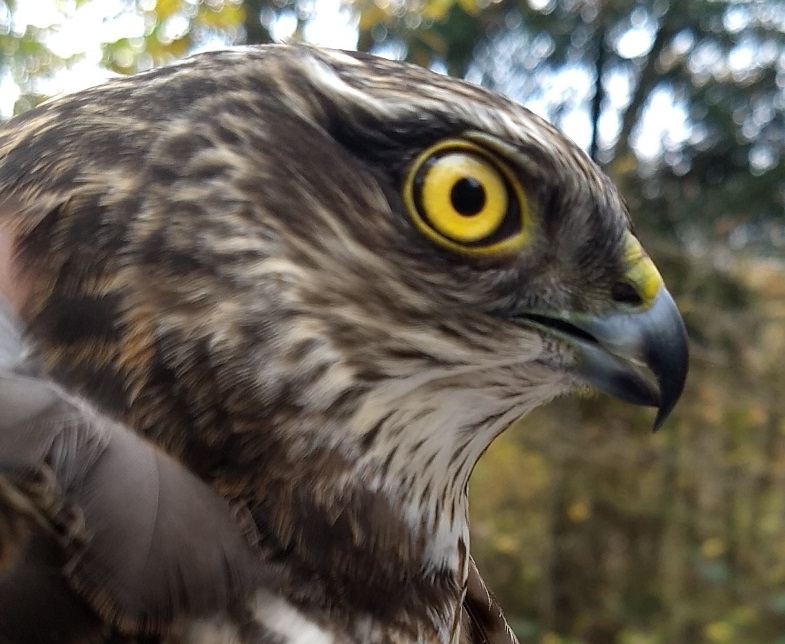
The third round brought in my bird of the day (possibly of the year) for she was the biggest female Sparrowhawk that I have handled for a long time:

She was lying in the bottom shelf of the Redwing net, with her belly facing out and when I first saw her I was somewhat dismayed, because it looked for all the world as though one of the hen pheasants, that had been conspicuous all morning, had blundered in. As I went over to remove it from my net (pheasants and mist nets do not go well together – and the net comes off the worse), I soon realised my mistake and my arthritic limbs were once again spurred into an uncommon action for them, called “running”. The extraction was not difficult, as she was just lying in the pocket of the net and could be simply picked up and out, and I managed to ring, sex, age, weigh and measure the bird without any damage to myself (or her). Without someone to hold the bird for photographs I have had to make do with this head shot.

Alongside that, it was good to catch and ring a couple of juvenile female Great Spotted Woodpeckers. Mostly this year we have been retrapping those ringed in previous years.

The list for the day was: Sparrowhawk 1; Great Spotted Woodpecker 2; Nuthatch (2); Blue Tit 20(13); Great Tit 7(10); Coal Tit (1); Marsh Tit 1(5); Wren 2(1); Robin 1(1); Redwing 9; Chaffinch 3; Lesser Redpoll 6. Totals: 52 birds ringed from 10 species and 33 birds retrapped from 7 species, making 85 birds processed from 12 species.

All in all, a very satisfying morning’s work. Any session in which we encounter 6 Marsh Tits is a good session. I closed the nets at 11:30, took down and was away by 12:30 – the benefit of only having six nets in your set up.

Ravensroost Wood: Saturday, 13th November 2021

We had hoped to have another farmland session at Brown’s Farm this morning but the forecast was for windy weather so I changed venue to Ravensroost Wood. I set up a feeding station, and cut the appropriate net rides, on Tuesday. Next time I really must remember to take my gardening gloves, as the dog rose fought back:

Loads of blood!

The net setup was as shown on the diagram below:

1 = 2 x 18m; 2 = 12m; 3 = 9m; 4 & 5 = 6m; 6 = 3 x 18m.

I was joined for the session by Ellie, Rosie and Anna and by Samuel and his mum, Claire. This was Samuel’s third session with me, and his first time actually processing some birds. So far he has been learning how to hold them and how not to react when Blue Tits and Great Tits let you know that they are displeased.

The feeding station did its job, and we had a good haul of Blue and Great Tits, but so did the bird seed dispensers, as we also attracted in both Chaffinches and Lesser Redpoll. On visiting Ravensroost yesterday to check on and top up the bird feeders, I noticed a large flock of Redwing, so we set the net ride number 6 with a lure playing for the first couple of hours. It did attract in a couple of Redwing and a Song Thrush. The only (slight) disappointment of the session was that there was a good sized flock of Long-tailed Tits flying around the woodland adjacent to net ride 6 and we didn’t manage to catch a single one.

The list for the day was: Great Spotted Woodpecker (1); Nuthatch (2); Blue Tit 21(4); Great Tit 7(3); Coal Tit (2); Marsh Tit (3); Song Thrush 1; Redwing 2; Chiffchaff 1; Goldcrest (2); Chaffinch 3; Lesser Redpoll 6. Totals: 41 birds ringed from 7 species and 17 birds recaptured from 7 species, making 58 birds processed from 12 species.

As much as it was very pleasing to recapture three Marsh Tits, the highlights for the team had to be the Lesser Redpoll. In particular, it was good to have some clearly marked adult males in the catch to contrast with an adult female:

Adult Male Lesser Redpoll
Adult Female Lesser Redpoll

Samuel started his ringing career by ringing two Chaffinch and a Blue Tit and processing a recaptured Great Tit and Coal Tit.

A couple of the team had to leave at 11:00 to get their Covid-19 booster shots and, as the number of birds had dropped off, we did a last round at 11:20, closed the nets and took down. We were off site by just after midday.

Barn Owls: 2021 Breeding Season Review

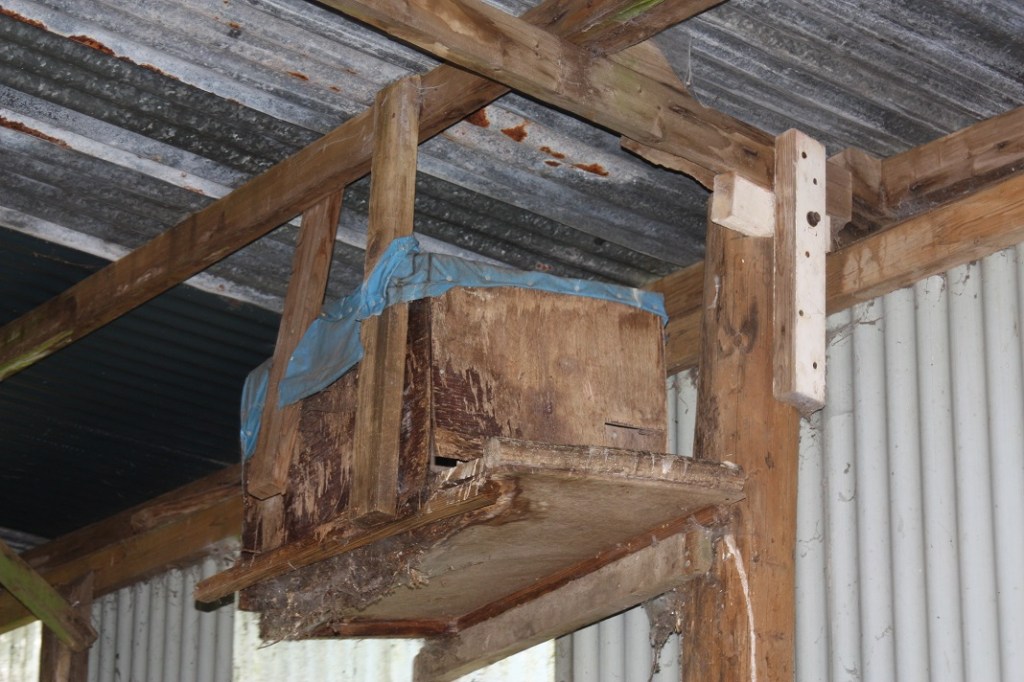
I started monitoring Barn Owl breeding in north-west Wiltshire in 2017. In that first year my team helped me check on 15 boxes. To be fair, we didn’t start until the September, so it wasn’t too surprising that we only ringed 3 broods comprising 8 chicks: at Drill Farm, Plain Farm and Blakehill Farm. We also managed to ring 4 Jackdaws in 2 broods at Blakehill Farm. It was a similar situation in 2018, but only 2 broods of Barn Owl chicks were ringed, plus one roosting adult. This time we had youngsters in one box at Blakehill and an adult in another there. The other brood was ringed in a condemned barn, in the worst box of our entire stock.

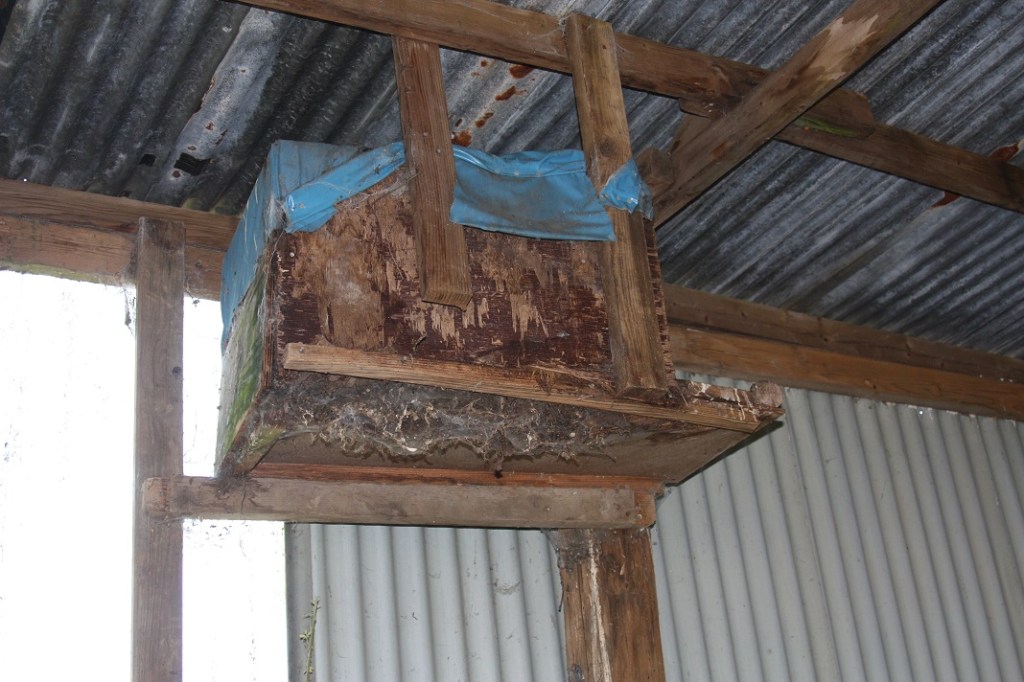
This box has been one of our most consistently productive but it won’t be there much longer. If it doesn’t fall down it will be pulled down. The Wildlife Trust, I am delighted to say, erected three new boxes in 2020, in the immediate area of this box.

2019 produced 10 youngsters and 2 adults from 15 boxes visited. It also produced one brood of 2 Stock Doves. 2020 was a bad year, primarily due to Covid restrictions imposed by the BTO, plus the need for social distancing and taking sensible precautions. We still ringed 8 young from 3 broods plus two broods of 2 Jackdaw chicks each.

So to 2021. Unfortunately, our nice Jackdaw nests, in the bug hotel at Blakehill Farm, were made homeless over-winter when the structure collapsed. However, we did get to check on 20 boxes. Of those 20, one box failed: there were 6 eggs laid but, on first checking, they were cold. On second checking six weeks later, they were still cold and unhatched. Eight boxes produced 26 young Barn Owls, one produced an adult Barn Owl, two of the new boxes erected by the Wildlife Trust produced a young Stock Dove each, and one box near Somerford Common produced young Jackdaws.

Some images from this year’s activity:

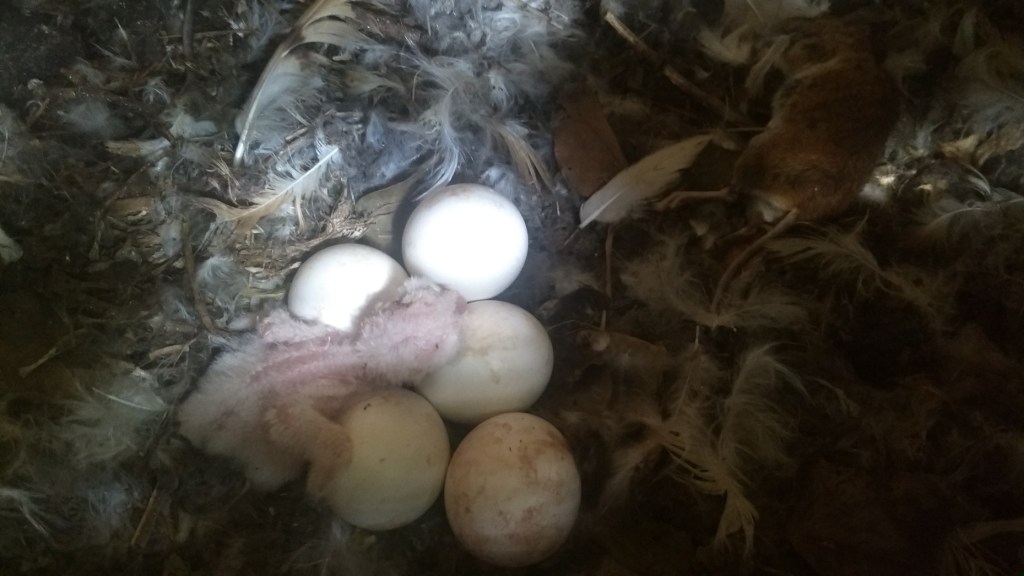
Newly hatched chick plus eggs (four hatched and fledged)
Fluffy chick stage: for such beautiful pale birds they do live in muck
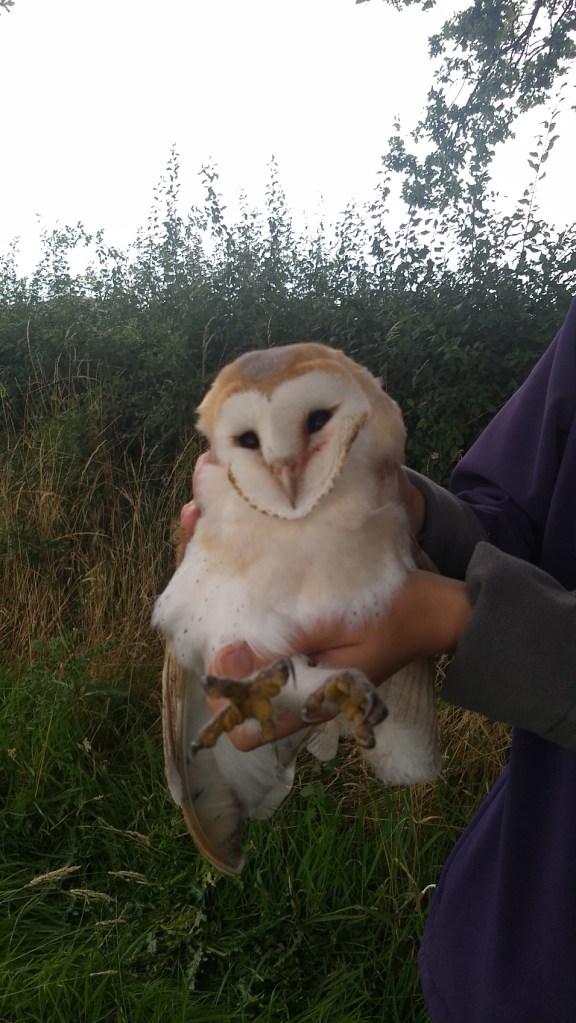
Ready to fledge

Many of the boxes that we have been checking are very old and becoming extremely dilapidated, so I looked into if I could get funding to replace them. I approached one of the local landfill operators, Thomas Crapper & Sons, as I know they have been generous funders of developments for the Wildlife Trust, and they pointed me in the direction of Community First. I had to jump through a few hoops, filling in forms, getting quotations, so that they could put it forward to Entrust, who approve or deny such applications. I am delighted to say that I have received notification that the application has been successful and that the funding (hopefully) will be made available mid-November. That will set my team up for some hard work over the winter. The offer has been made to the team: the more help they give to get these boxes set up, the more opportunity I will give them to ring Barn Owls. Bribery is not always corruption.

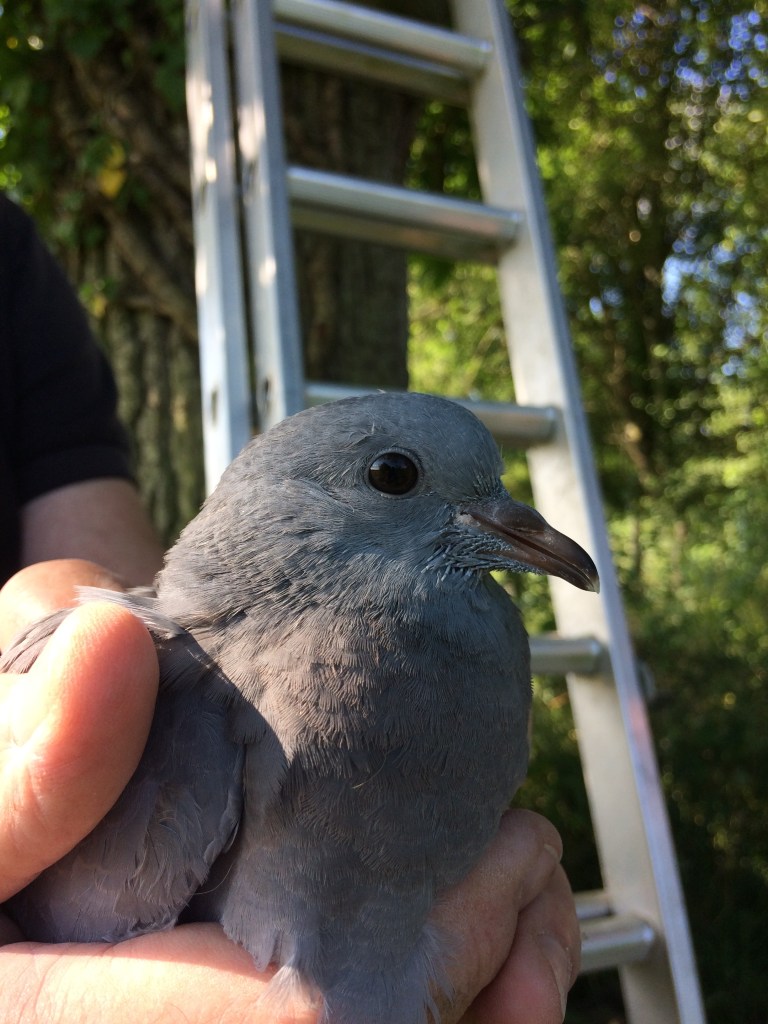
Stock Dove a couple of weeks to fledging
Stock Dove ready to fledge