Two types of greyness affected our session at Webb’s Wood. To start with, the three weather apps that I use (Meteo, Met Office and xcweather) all forecast a dry morning, with the wind getting up towards midday. When I stepped out of the house into a fine spray of mizzle, I was concerned. As Rosie was joining me for the session, and would be able to stay for the entire time, I was reluctant to call it off. I also had David back after a few weeks away and Anna coming a fair distance to join me, so I decided that we would see how it went. The mizzle was light enough for us to set up and go for it. There were patches of dry weather but it did not fully arrive until we started to take down and it stayed grey all morning. However, the mizzle never breached that barrier where it would have been inappropriate to continue.
I had set up a feeding station on Tuesday, and the fact that the peanuts had disappeared but the seed mix had been ignored let me know what sort of morning we were in for. It was a decent session for the first couple of hours, with 25 birds processed between 7:45 and 8:55. We then only caught one bird in the next hour and twenty minutes. As I am suffering with a painful, and sleep-depriving, neck problem, getting cold and miserable with no birds was more than I was prepared to put up with. I made the fateful statement: “If there are no birds in the next round we will pack up, go home and get warm”. Next round we extracted 27 birds.
That is where grey became interesting. In all of my ringing in the Braydon Forest my team has never caught one of these:
Juvenile Grey Wagtail, photo by Anna Cooper
I have processed a good number as a trainee, but none of my sites regularly plays host to them. Anna extracted this beauty from one of the nets adjacent to the feeding station which, in turn, is nowhere adjacent to a water source: just a few puddles. Anna has now processed her first Grey Wagtail.
The list for the session was as follows: Great Spotted Woodpecker (1); Blue Tit 16(7); Great Tit 8(5); Long-tailed Tit 10; Wren 1; Grey Wagtail 1; Redwing 4; Goldcrest 12. Totals: 52 birds ringed from 7 species and 13 birds retrapped from 3 species, making 65 birds processed from 8 species.
We are getting good numbers of Goldcrest in the Forest at the moment. Interestingly, our last session at Webb’s Wood was on the 6th October and we caught 12 Goldcrest, exactly the same as we had today. I had better schedule a session for the 6th December!
After our bumper round at 10:25 the numbers fell away again for the next two rounds, and we decided to pack up and head home.
This year has been a cracking year for fungi all over my local area. I found this in the feeding station:
Yellow Stag’s Horn Fungus: Calocera viscosa
I might have a look to see if I can identify the lichen that is just to the left of the fungus.
We were off site just after midday after a surprisingly satisfactory session, despite the weather.
We last had a session in Red Lodge on the 4th September. I had planned to run a session mid-October but, when driving past a few days before, I noticed this:
The gate support had been sawn off. I went back to have a look and found a lorry load of rubble had been fly-tipped:
I contacted Forestry England to let them know. Due to holidays and staffing it took a couple of weeks to get it cleared. As I was planning on setting up my feeding station over last weekend, on Friday I went back to do some ride clearance. It was great to be able to drive up to our usual parking spot and get on with the task in hand. I went back on Saturday, just after lunch, to set up the feeding station, and found this:
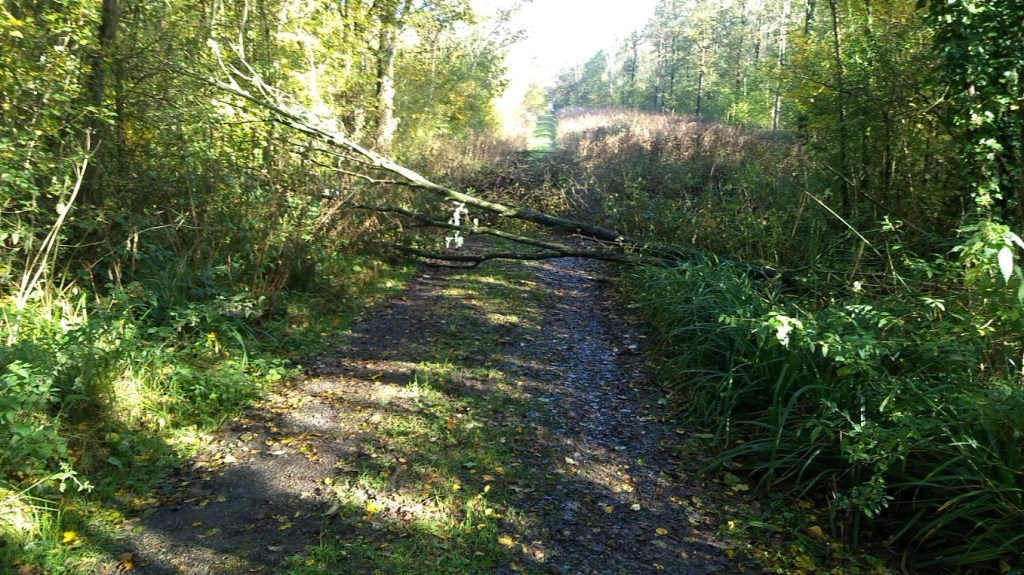
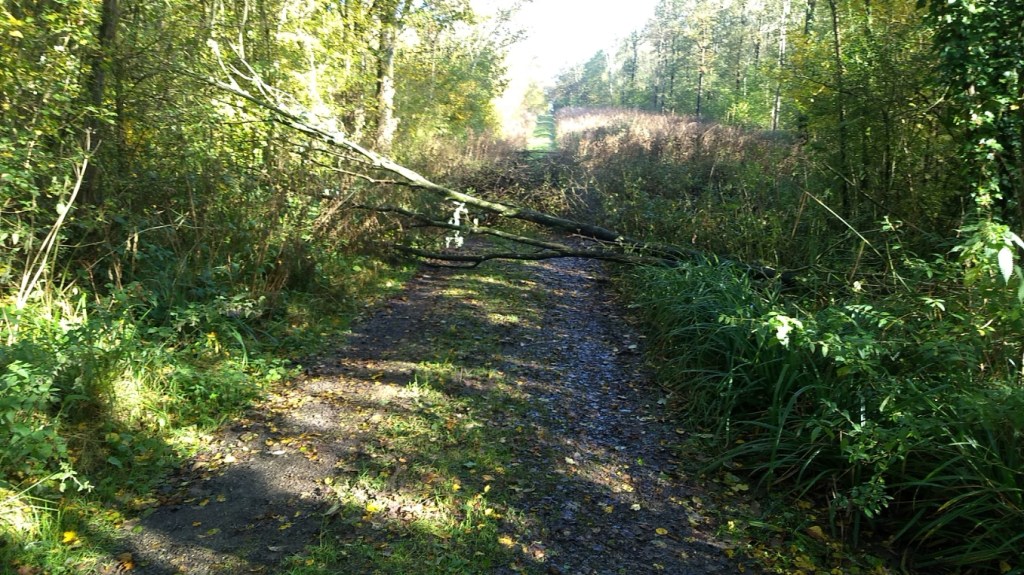
Some deeply unpleasant individual had taken advantage of the fact that Forestry England hadn’t managed to fix the gate and had dumped a load of tree waste in exactly the same spot as the rubble had previously been dumped. I had a chat with David, one of the locals, who told me that when he had walked his dog there that morning, between 10:00 and 11:30, the path had been clear. So whomsoever did this, did it at lunchtime, in broad daylight, on a busy road. I went back on Monday to see whether it was worth me trying to clear it, or if there was sufficient room for the team to park safely away from the road, to find this:
At least this was a natural occurrence. I let Forestry England know again. They are, unsurprisingly, angry and upset about this vandalism and the incurred costs. There is an epidemic of fly-tipping in our area at the moment.
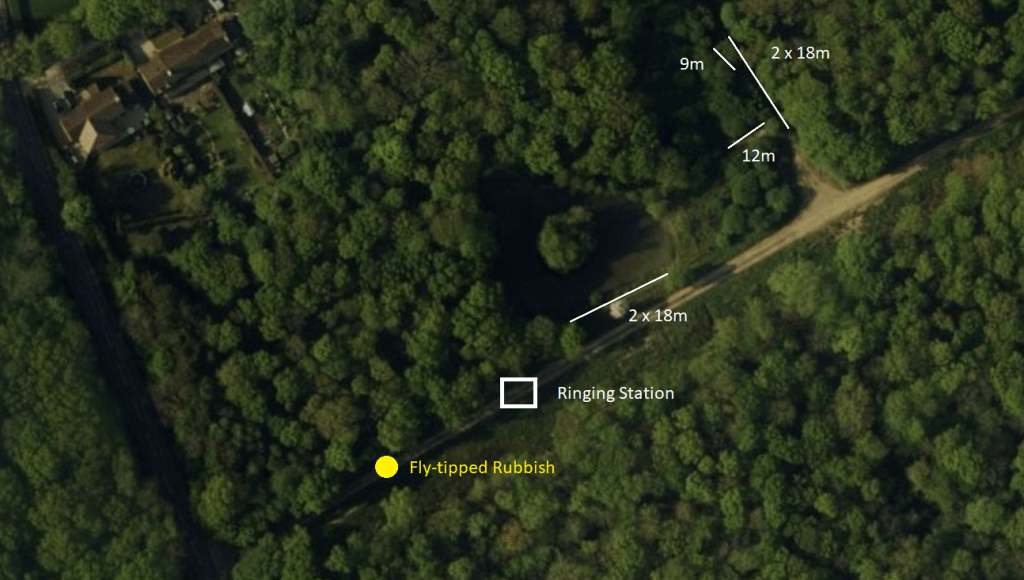
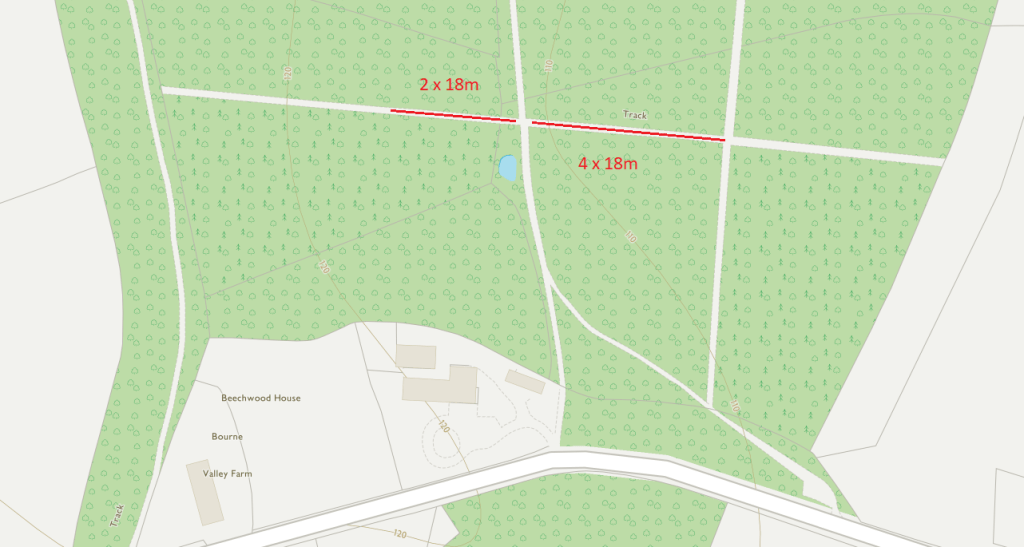
So, I decided that they weren’t going to stop me carrying on with my session. I was joined at 6:30 by Lucy and Miranda for the full session, and Rosie and her new Wildlife Trust colleague, Charlotte, for the start of it. We set nets by the pond and the feeding stations: just 6 nets: 4 x 18m and one each of 9m and 12m.
One thing I noticed immediately: the birds had found the feeders. They were all empty! We refilled them and had all of the nets open by 7:15 and had our first birds straight away. As is usual once the feeders are up, the session was Blue Tit heavy, with a supporting cast of Great Tits. However, we did have some decent catches of other birds: another two Marsh Tits ringed and an older one, ringed in October 2019, recaptured.
Red Lodge Net Set
I set a lure for Redwing on the net set alongside the pond and lures for Redpoll and Siskin at the 9m and 12m nets. Needless to say, we didn’t catch a single one of the target species. At 10:00 I changed the Redwing lure to Goldcrest, and they turned up straight away. At 11:00 I moved it to the other 2 x 18m net ride and, again, a few more dropped in. I never lure for Goldcrest until well into the session: at approximately 5g in weight, I really don’t want to target them until they have had a chance to warm up and feed first. In fact, unless I am happy with the ambient temperature, I won’t lure for them at all. They are one of the most lure responsive species, and will respond all year round. To date I have not had any cold-related casualties with Goldcrest, and I want to keep it that way.
This Blue Tit decided that it needed a high perch before it flew off back into the wood:
The list for the day was: Nuthatch (1); Blue Tit 20; Great Tit 8(4); Marsh Tit 2(1); Wren 4; Dunnock 2; Robin 3(2); Blackbird (2); Goldcrest 6; Chaffinch 2. Totals: 47 birds ringed from 8 species and 10 birds recaptured from 5 species, making 57 birds processed from 10 species.
We packed up at 11:30 and, as our luck would have it, all the nets were down, the lures switched off, and we were sat at the ringing station processing the last few birds, when a flock of 20 either Siskin or Lesser Redpoll (they were in silhouette) flew into the tops of the trees above the feeding stations! The consensus was that they were Siskin.
The morning was cold at the start: bang on freezing point, with a ground frost and a layer of mist covering the plateau. I was joined by Lucy for the session: cramming in as much cold weather ringing as she can before facing the rigours of Ascension Island in a week’s time. I cannot say how much I pity the hardships he is about to face!
We set nets for Redwing along the perimeter track and four plateau nets, hoping for Stonechat. There was also a plan to set up a Meadow Pipit net but the deer had made a mess of the electric fence across the centre of the plateau and so we held off from setting that until after Jonathan, the farm manager, had repaired his fence. Fortunately the cattle that were in the compartment next to our plateau area did not realise that the fence wasn’t working and avoided it anyway, so the nets were safe. In the end we managed to get the Mipit triangle open at 10:30 but there weren’t many around.
The first round was decent: 16 birds, including four each of Chaffinch and Blue Tit plus five Redwing. It was nice to have four Chaffinch that we could actually ring. They all had nice clean legs: no signs of Fringilla papillomavirus, in contrast to a couple of other occasions at my woodland sites recently.
The next round produced our first three Wren of the morning and two Stonechat. They were a male and a female in the same net about 50cm apart. I will have to look into their pairing and mating habits: do they pair up annually or do they maintain the pair-bond beyond? Anyway, they were fine adult specimens, and he was particularly haughty:
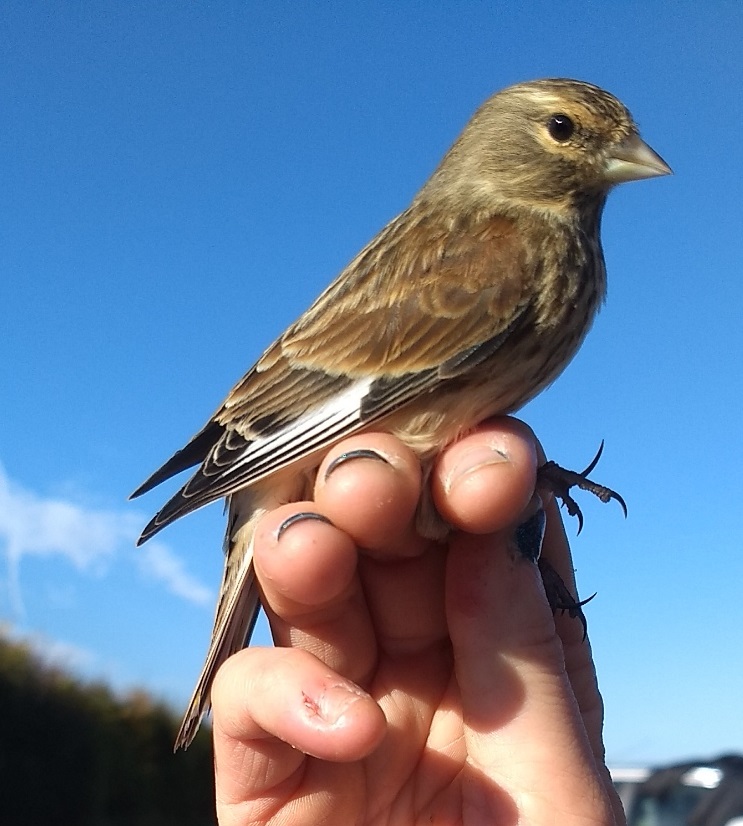
The next couple of rounds produced another eleven birds, including our second Blakehill Linnet of the year:
For some reason our catches of Linnet at Blakehill are very variable. Between 2014 and now, we had excellent catches of 42 and 25 respectively in 2015 & 2016 and then 15 in 2018 but every other year has only produced single digit catches. The most productive months for the good years are April, August and September.
The list for the day was: Blue Tit 4(2); Great Tit 3(1); Long-tailed Tit (1); Wren 6(2); Meadow Pipit 2; Stonechat 2; Robin 1(1); Redwing 7; Song Thrush 1; Blackbird 2; Chaffinch 4; Linnet 1. Totals: 33 birds ringed from 11 species and 7 birds retrapped from 5 species, making 40 birds processed from 12 species.
What was surprising was that 20% of the catch comprised Wrens. Six of the eight were caught in the scattered nets out on the plateau, with just two in the hedgerow of the perimeter track. They were caught in just three rounds between 9:00 and 10:00 and then no more. One of the two retrapped birds, JTY709, was ringed as a juvenile in December 2016, which is a good age for a Wren. The BTO’s Bird Facts data gives a typical lifespan of two years and the maximum age from ringing is 7 years 3 months and 6 days, so logging in at 4 years and 11 months is a venerable age for a Wren.
As you can see from the two photographs, once the sun came out and the mist lifted, the sky was crystal clear. Unfortunately, soon after we had the Meadow Pipit triangle open the breeze got up, the nets became too visible and the catches went right down, and we only caught the two Meadow Pipits, despite a decent number of them flying around the plateau. As a result, as for the next three rounds we were not catching more than one bird per round, we started packing away soon after 11:00 and left site just after 12:30.
Despite the dreadful weather of the last week of October, we still had a pretty decent return for our efforts this month. It is our second best October since the group came into its current form: the best having been in 2019.
Numbers of Meadow Pipit were well down compared with last year. The change was that numbers in two of our farmland sites (Blakehill and Jonny’s East Tytherton site) were at one third of the catch last year. Blakehill had the same number of sessions (i.e. one) but East Tytherton had half as many (two) as in 2020.
So, where did the improvement come from: Blackcap and Chiffchaff numbers were well up on last year. Catches were evenly spread throughout the month in both years. Similarly, the number of Blue Tit ringed one third higher than last year. What is most surprising is that the increased number is down to a significant increase in juvenile birds ringed (149 as opposed to 90). As everyone acknowledges: Blue Tit had such a poor breeding season, and yet in both October and September juvenile numbers have been on a par with previous years. One can conjecture as to why this is the case: fewer birds leading to less competition for food, lower likelihood of predation, etc, but who really knows? As you can see from the session statistics: we weren’t running a lot of extra sessions.
Other significant increases were Redwing and Lesser Redpoll arriving in reasonable numbers and being caught earlier than usual. My first Redwing, caught on the 9th of the month, equalled one ringed on Salisbury Plain in 2016 as the earliest we have ringed the species in the autumn. Lesser Redpoll are resident further south in the county, in the Warminster / Longleat area and it is possible that there is a small relict population in Somerford Common but, in the main, the Lesser Redpoll we catch in the north of the county are migrants from up north. Our catch of nine on the 13th of the month, at Somerford Common, matches a catch of two there on that day in 2015 as our earliest autumn catches and the ten in October there is the biggest for us in that month.
Amongst our resident birds, both Robin and Long-tailed Tit showed increased numbers over last year.
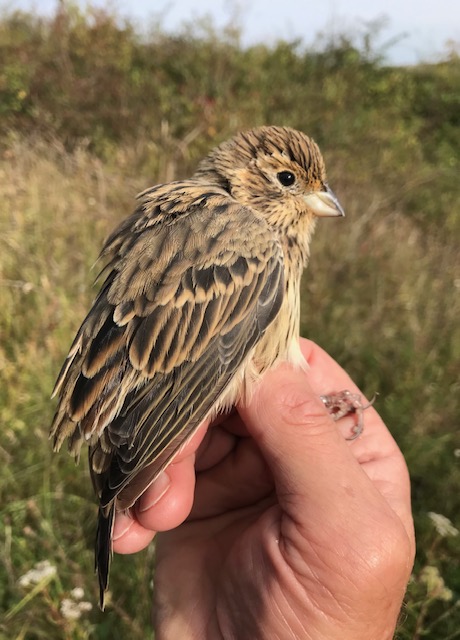
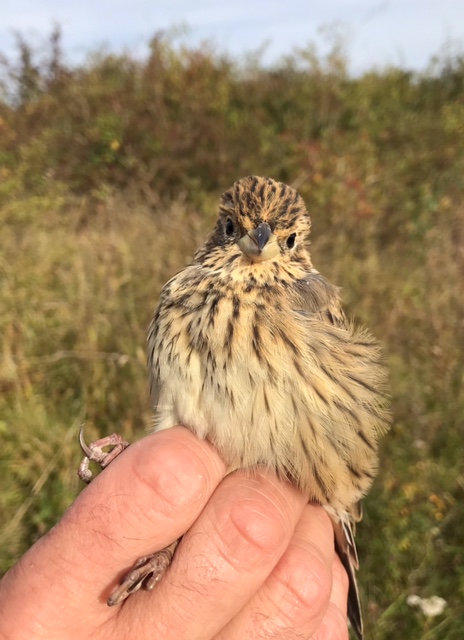
So what are the highlights? The standout bird is the Corn Bunting captured on Salisbury Plain. As I mentioned at the time, it is only the third location on the Plain at which the Group has caught one. Seven singles were caught near Winterbourne Stoke, with the last in March 2005, one was caught near Enford in September 2005 and so it has taken another 12 years for one to be caught by us on Salisbury Plain.
Photograph by Ian Grier
Another highlight, because we catch very few, was Jonny’s Skylark at the beginning of the month. Funnily enough, this is our best year for them so far, with four caught, three on Salisbury Plain and this month’s one at his site near Sutton Benger.
Not Jonny’s bird but any excuse for a photo of a Skylark!
Steph’s highlight was her first ever Woodpigeon caught in her garden! We think it had only just fledged as it was very juvenile: no white collar developing yet and, whilst she processed it, a pair of adults sat atop a pole and a neighbouring tree and watched the whole thing intently from capture to release.
Apart from that, we have had notification of a couple of interesting recoveries of our birds this month. A Blackcap ringed in Melksham in early September was recovered by a ringer in the Netherlands at the end of September. It had flown 480km in an ENE direction in 22 days. That is one confused migration!
The second is a Chiffchaff ringed at Langford Lakes in August and recaptured 231km away, due East, 27 days later at the Sandwich Bay Bird Observatory. Another odd looking migration route.
Just to end on a slightly negative note: one of my sites, Red Lodge, has suffered some vandalism. Firstly, the criminal used a power saw to chop off the gate support and then backed their wagon in and dumped a load of rubble blocking the path onto site:
I let Forestry England know and they came and cleared the rubble but didn’t mend the gateway. I went back on Friday to clear my winter net rides and everything was clear. When I went back Saturday afternoon to set up my winter feeding stations I found this:
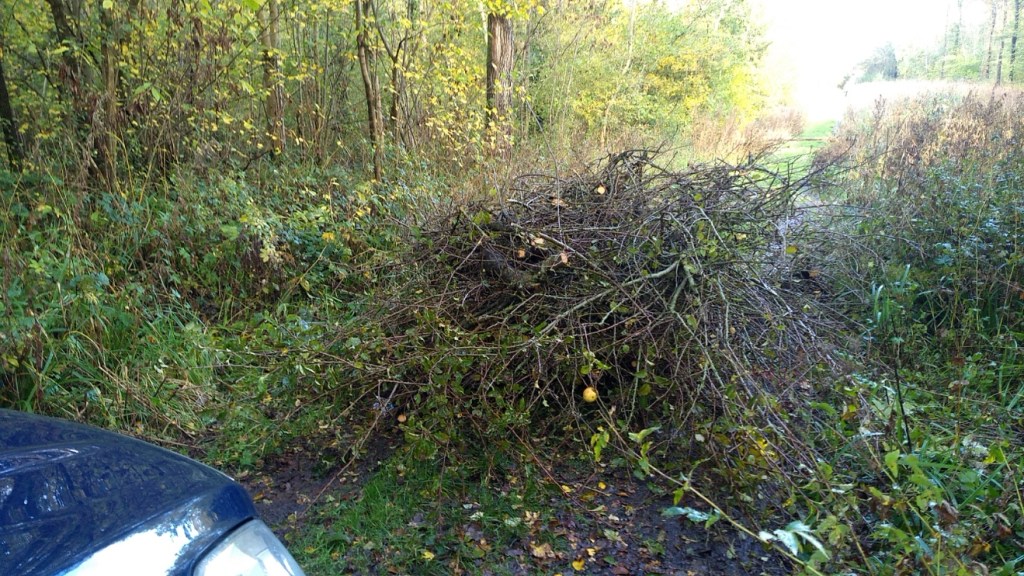
Clearly taking advantage of the fact that the gate hasn’t been repaired or replaced. I informed Forestry England when I got back. This morning, after setting up another couple of feeding stations and doing a bit more ride clearance, I thought I would pop back to see if the gate was still in place, where I had propped it up. it was, but this has now joined the rubbish dumped on the path:
It won’t keep me out! I plan to be there Wednesday and I will be! I had problems with vandalism of my feeding stations a couple of years ago. The beat forester set up covert camera surveillance and we put up notices, which stopped the problem. Time to do it again I think.
An interesting month with a lot going on. Here’s to a busy November! The weather is looking okay for the next few days.
It was touch and go for a session this morning. Although it was forecast to be dry, there was the threat of winds at a base of 16mph, gusting to in excess of 30mph. Somerford Common is able to offer some relatively sheltered areas but 30+ mph is serious. Opening my door to leave at 6:35, I was disappointed to see that it was raining but, with four of the team turning up to help from varying distances away, I decided to carry on regardless and hope that the forecast would come good. Fortunately, although my windscreen wipers were reacting for the first couple of miles, by the time I got to Somerford the rain had stopped.
I had put up a couple of feeders on Monday morning, on the off-chance that the birds might have discovered it by today and give us a decent haul of birds. They hadn’t, but we ended up with 30 birds, so not too bad.
Arriving on site at 6:45 I was surprised to find Lucy already there and waiting: she’s never late but over 15 minutes early: unheard of for any of my team before today. We were then joined by Rosie, Miranda and Anna and we set to and had the nets open by 8:00. I used the net set that I am going to be using for the winter CES. First opened were the 18m and 12m set along the main ride and, whilst it was still dark, I set the Redwing lure working to see what might drop in whilst we opened the other nets. Twenty minutes later Lucy went to check the nets and set up the ringing station, and she extracted the first birds of the morning: two Long-tailed Tits and (no surprise) a Redwing. As Rosie was doing her usual selfless thing of helping us to set up, before heading off for a hard day’s graft with a chainsaw at Lower Moor Farm, I let her process the first three.
Thereafter, we had a couple of decent catches of Redwing coming to the lure between 9:00 and 10:00. I then changed the lure to Goldcrest, and we started to catch them as well. The other nets had lures for Lesser Redpoll, Siskin and Marsh Tit running – all to no avail. Which is not to say that we didn’t catch birds in those nets: just not those species. Ironically, the penultimate bird out of the nets was this, right next to the Goldcrest lure:
juvenile Lesser Redpoll
Although the tail showed that it was definitely a bird of the year, it had a few pink feathers on the breast, identifying it as a male.
The list for the day was: Blue Tit (2); Great Tit 3; Coal Tit 1; Long-tailed Tit 1(1); Robin (1); Redwing 10; Goldcrest 9(1); Lesser Redpoll 1. Totals: 25 birds ringed from 6 species and 5 birds retrapped from 4 species, making 30 birds processed from 8 species.
Throughout the morning it would spit with rain for a few minutes, then dry up for half-an-hour, then spit with rain again. For most of the morning the wind didn’t interfere with the nets, but as the morning wore on the wind did get stronger, and I decided to close the nets and pack up at 11:00. We took down the feeding station nets first, returning to the main ride to find the Lesser Redpoll and a Great Tit in that net set. We were off site by midday.
Back at the beginning of May regular readers might remember that we had one excellent session at Brown’s Farm (first Wiltshire Yellow Wagtail for me, first Firecrest for Lucy (and in the most improbable of habitats). That was followed by a disappointing solo session right at the end of the month – and that has been it since then. I have no idea why I haven’t been back but I decided that it was about time I put that right. I was joined for the morning by Anna.
The farmer there, James, runs a small scale pheasant and partridge shoot and by “small scale” I mean I never see pheasant, and just the occasional red-legged partridge, there outside of the shooting season. He has planted up a good number of game cover crops in the corner of many of his arable fields. I carried out a reconnaissance visit on Thursday to decide where to set the nets. The plan was to set up as shown below around the game cover adjacent to the old dismantled railway track. Two key reasons for that: 1) it was the most accessible for my car and 2) that field has been left as stubble, so there was no crop to avoid.
Immediately we opened the net set that is at 90 degrees to the track, birds started to get caught. With just the two of us, and Anna being very new in her ringing career, I decided to abandon the planned 2-shelf net set along the field side of the game cover to ensure that we weren’t overrun with birds. As a trainer, I am always conscious of not putting trainees under the pressure of numbers. There is enough pressure with safely extracting the birds, ageing, sexing and measuring.
The first bird out of the net was a Robin, followed by a Wren: that is the standard opening combination for most of my sites, occasionally augmented by an early morning Blackbird.
I was hoping that we would get Anna her first Yellowhammer and Linnet to process. We only managed one of the two: which was a little surprising. None of my sites in the north of the county produce regular Yellowhammer catches. In my 12 years of ringing I have only caught and ringed a single Yellowhammer away from Brown’s Farm: at Blakehill Farm in October 2016. When I first moved to Purton in 1997 there was a reasonable population of Yellowhammer in the fields surrounding the village but, with everything gone to cattle, sheep and horses, they are long gone. Brown’s is now the only site I have where I can catch them regularly. Linnet is slightly different, we can still see them in the fields around the village and they are a reasonably regular catch at Blakehill Farm but not as regularly as I catch them at Brown’s Farm. There again, I have never repeated the astonishing catch of 44 of them at Brown’s on the 7th April 2015. Unfortunately, we didn’t get any at all today but we did get half-a-dozen Yellowhammer:
Juvenile Male Yellowhammer
The list for the day was: Blue Tit 3; Wren 2; Dunnock 10; Robin 4; Song Thrush 1; Blackbird 2; Chaffinch 4; Reed Bunting 5; Yellowhammer 6. Totals: 37 birds ringed from 9 species.
The birding was also good, with highlights being excellent views of a cruising Red Kite and a hunting Sparrowhawk. The catch died off quite quickly after 10:45 and we closed the nets and took down just after 11:30. It won’t be 5 months before I am back there again1
With Wednesday blowing at gale force for most of the day, with occasional downpours as well, I postponed that session to Friday. Also, because there was still a significant amount of wind forecast, coming from the west, and the rides there running from north to south, I moved the session to the Firs.
I was joined for the morning by Rosie, doing her usual of dropping in to help and heading off to work soon after the nets are open, Miranda and Lucy. Thanks to half-term, a little later we were joined again by Claire with her son Samuel and, this time, daughter Zara. Once again they were given the opportunity to be pecked by Blue Tits and Great Tits. Samuel has expressed a wish to take up ringing, so he is going to have to get used to getting pecked first.
The first round was good: just 4 birds but from 4 species. These were given to Rosie to process and then she headed off to her day job as an estates worker for the Wiltshire Wildlife Trust. Our second round was satisfying as a small tit flock hit with 11 new birds and 2 retraps. The third consisted of two each new and retraps – and then we had a big tit flock of 21 new birds and 8 retraps. Miranda took over scribing duties so I could focus with Lucy on clearing the catch as quickly as possible.
The list for today was: Treecreeper (1); Blue Tit 22(6); Great Tit 6(6); Coal Tit 2; Long-tailed Tit 2; Wren 2; Robin (1); Redwing 1; Song Thrush 1; Goldcrest 3. Totals: 39 birds ringed from 8 species and 14 birds retrapped from 4 species, making 53 birds processed from 10 species.
Given how poorly the breeding season went for Blue and Great Tits this year, I am catching an astonishing number of juveniles this autumn: 23 of those processed were juvenile Blue Tits and 5 of the 6 Great Tits ringed were also juveniles.
Equally, since the beginning of October there has been a sudden upsurge in the numbers of birds being caught in the woodland sites, despite no change to our regime: same number of nets in the usual places. I will be setting up the feeding stations next week so it will be interesting to see what happens then.
With three of us to get it done, we packed up at about 11:15, it didn’t take long and we had all left the site by midday.
Like a large number of the dwellers of these isles, I feed the birds in my garden. As my entries to the BTO’s Garden Birdwatch Scheme show, the commonest birds in my garden are Goldfinch, Starling, Woodpigeon and, in fourth place, Blue Tit. I feed all year round in my garden: sunflower hearts, fat balls and peanuts, and provide water. I do exercise exemplary feeder hygiene, I hasten to add, and I ring the birds that use my garden as well as in the local woodlands, as the village of Purton falls within the historical boundaries of the Braydon Forest. My Braydon Forest woodland sites are fed with a seed mix and peanuts between the beginning of November until the end of February each year.
There was a recent paper looking at the potential impact of feeding the commoner birds that take advantage of our supplementary feeding on those rarer, less competitive species, that we don’t tend to see using those resources. The paper’s specific example was the potential impact of feeding Blue Tits. As I understand it, the range of food stuffs was identified by DNA analysis in their faecal samples, and those faecal samples were taken from birds at differing ranges from local feeding stations, to see how far their influence might extend. I don’t want to misrepresent the paper, so this is a link to it so you can read it for yourselves. It is open access:
One of my key projects is monitoring the Marsh Tit population within the Braydon Forest. This red-listed species is holding on well within the Forest, with its population stable. With Forestry England making this bird their priority species in their latest 10-year plan for the area, so that they will be managing the woodlands to their benefit, and the Wildlife Trust also keenly invested in the future of this species, I would hate to think that I might inadvertently contribute to a decline in its fortunes locally. They are regularly caught at the winter feeding stations, along with a wide range of other species.
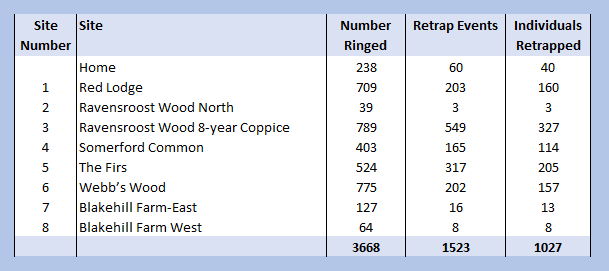
Because of this paper and its conclusions, I have been prompted to have a look at the Blue Tits I have ringed in my garden and the rest of my sites in the Braydon Forest and to see how they have moved around the area. I also had a look at those Blue Tits recovered within the Braydon Forest but ringed elsewhere. Since August 2012, when I started ringing in my garden, Ravensroost Wood, the Firs and Webb’s Wood, through until the end of September 2021, 3,688 Blue Tits have been ringed in the Braydon Forest. Of those ringed, there have been 1,523 subsequent encounters, representing 1,027 individual birds. In my garden, I have ringed 238 of the total caught and have retrapped ringed birds there on exactly 60 occasions, representing 40 individual birds.
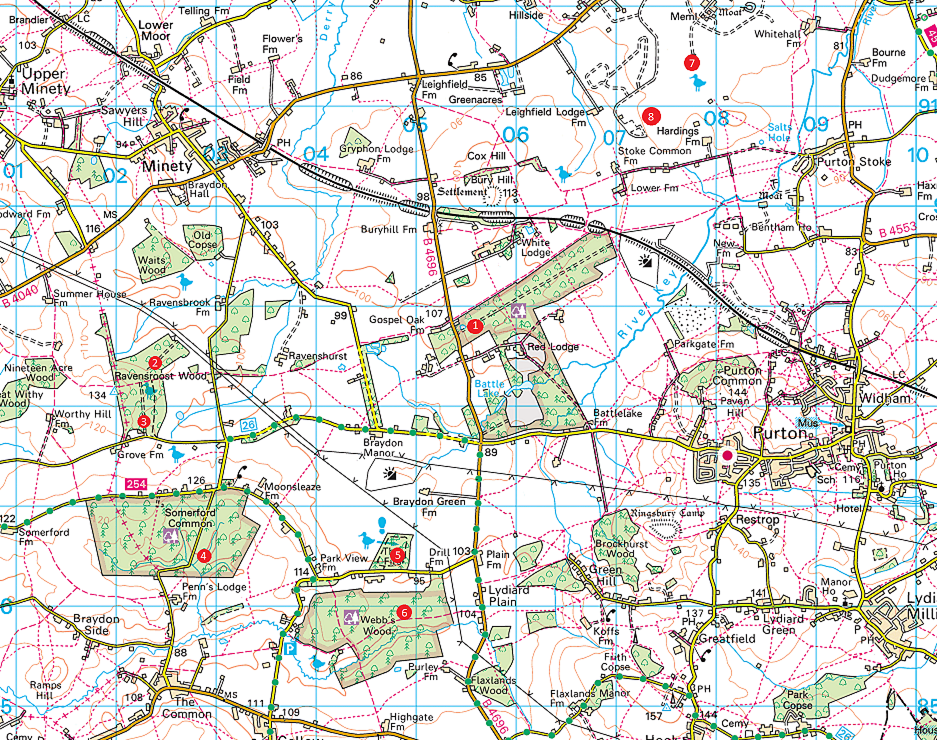
In order to test the likelihood of my feeding Blue Tits impacting on other species in my local area, I have done an analysis of those birds ringed in my garden, to identify how many were recaptured away from my garden. I have also done an analysis of the birds ringed elsewhere in the Forest that have been recaptured in my garden and, for comparison, movements within and without the Forest as a whole. The spatial distribution between my Braydon Forest sites is shown on the diagram below:
The unnumbered pink dot is the location of my garden. The numbered red dots are my Braydon Forest ringing sites and are as follows:
Of those 1,523 recaptures only 4 of them were ringed in my garden and recovered elsewhere, and only 2 of the 3,430 birds ringed elsewhere have been recaptured in my garden.
Table 2: Movements In / Out of My Garden
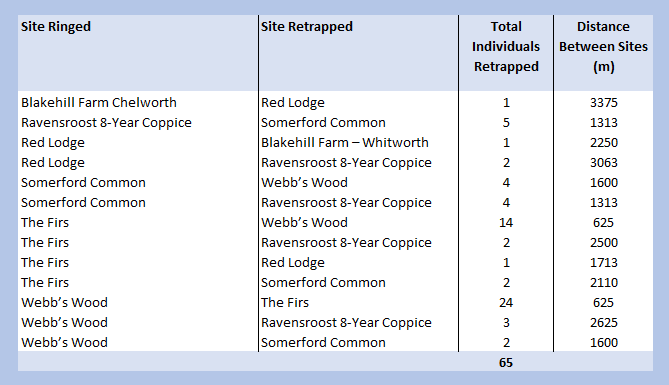
The other movements around the Braydon Forest sites are also quite interesting. I haven’t done individual records, just a summary:
Table 3: Other Blue Tit Movements Around the Braydon Forest
As expected, the highest volume of traffic is between the sites nearest each other. Other than that, movement between sites is minimal. To put it into perspective: of 3,688 birds ringed only 71 have been shown to have moved away from the site at which they were ringed, i.e. 1.93%. Of those using the feeders in my garden, the percentage movement is 0.15%. The overall number of individual Blue Tits recaptured within the Braydon Forest (as opposed to the total number of recapture events, represented by the figure of 1,523) is 1,027, or 27.85% of those ringed.
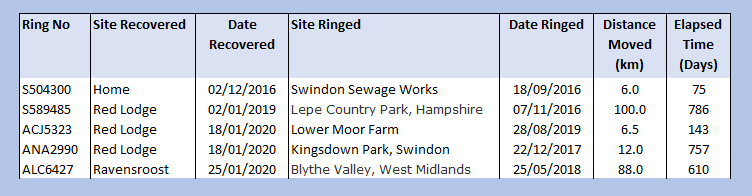
For the sake of completeness, I have had a look at those Blue Tits ringed elsewhere and recovered in the Braydon Forest. There are very few: only five of those retrapped came in from outside of the Forest. These are their details:
Table 4: Blue Tits Ringed Elsewhere Recovered in the Braydon Forest
I could find no records of Blue Tits that have moved from within the Braydon Forest to sites outside of the area within the studied timeframe (or outside of it for that matter).
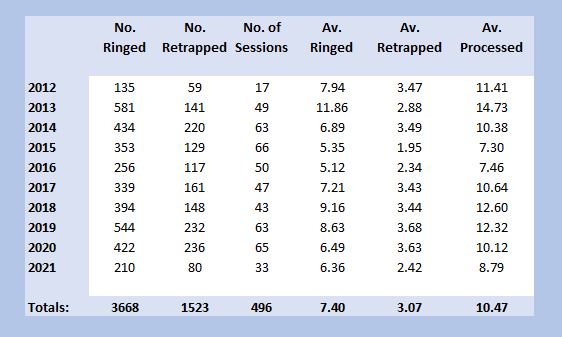
I decided to have a look at my average catches of Blue Tit by year to see if there was any indication of population growth:
Table 5: Average Numbers Ringed & Retrapped by Session by Year
Putting that into graphical form shows the trend even more clearly:
Fig 1: Average Numbers Ringed & Retrapped by Session by Year
Apart from the spike in 2013, there is no indication of significant growth or decline in the catch of Blue Tits in the Braydon Forest sites. The current slight decline showing for 2021 is because I catch significantly more Blue Tits in the last 3 months of the year than at any other time, as they form winter feeding flocks which, when caught, can number in tens of birds.
On reading the paper, one of the key pieces that I did not immediately grasp, is that they also provided nest boxes. The reason that they did that was so that they knew where to collect their faecal samples. What I didn’t see was any allowance for the potential impact of providing those additional nest boxes on their results, but they do refer to increased use of nest boxes, along with earlier laying dates, as one of their considerations in the likely impact on more vulnerable species. We don’t provide titmouse nest boxes in any of the Forestry England sites and, although there are a few extremely dilapidated boxes in Ravensroost Wood, as far as I am aware, no new titmouse boxes have been installed in any of my ringing sites since before 2009. It was discussed in the past, but the considered opinion was that these would only benefit Blue and Great Tits, which definitely would help increase their populations and, therefore, the possibility of competition for vulnerable species would be intensified.
To quote from the discussion section of the paper: “We infer from this that any impacts from supplementary feeding will be felt far wider than solely in urban environments as has hitherto been considered [1,33]. As we find that supplementary food usage is strongly associated with a dramatic increase in nest-box occupation (a proxy of breeding density) and an advance in lay date, it is perhaps unsurprising then that we find the national population trends of supplementary feeder-using woodland bird species are increasing on average while the populations of competitor species not benefitting from supplementary feeders are decreasing.”
My key question is: is the potential negative effect just from supplementary feeding or does it need the combination of supplementary feeding and nest box provision to have a negative impact? The authors are using locally gathered data and matching that to national trend data, whereas I have focused solely on my local area. Their data is unarguable, but I would like to see some follow up to test their hypothesis.
Whilst making no great claims about the scientific rigour of my analysis (to me R is just the eighteenth letter of the alphabet), the dispersal of Blue Tits into other areas just doesn’t seem to be replicated within my ringing sites. Nor is there any obvious population trend amongst their numbers when averaged out by session by year. Clearly, I am not analysing what the paper is, I am analysing the movements of ringed birds in a relatively small area. Also, I am not looking at a few hundred specimens here: my analysis, such as it is, is based on over 3,500 individual birds ringed and over 1,500 recapture events over 9 full years.
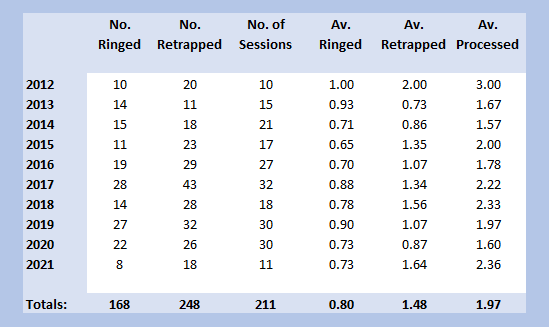
So, how are the Braydon Forest Marsh Tits doing?
Table 6: Marsh Tit Average Numbers Ringed & Retrapped by Session by Year
The number of sessions differs from Table 5 because it is recording those occasions on which Marsh Tits were caught, in the same way that I have only recorded the sessions in which Blue Tits were caught. Three of the Braydon Forest sites, the two at Blakehill and my garden in Purton, are entirely the wrong habitat for Marsh Tit and will never produce a catch. This year’s decline in actual numbers to date is entirely down to my being unable to access three of the most productive sites for the species for a significant part of the year. Ravensroost and Webb’s were out of bounds until September and July respectively, and Red Lodge has been out of bounds for the last two months, due to vandalism / fly-tipping and the access road being blocked as a result. However, there is no obvious trend either up or down. To put that into perspective, in two sessions in Ravensroost Wood in October I have ringed a further 3 Marsh Tits.
Due to restrictions imposed by the Wildlife Trust on my ringing activities at this site, as a result of both Covid and the unpleasant incident in Ravensroost Wood in July 2020, my work within Ravensroost Wood has been severely limited so far this year. When I finally got back into the Wood, on the 8th July, it was not an auspicious start: just two birds, a Blackbird and a Song Thrush, in three hours before I gave up and went home. The next attempt was a month ago, on the 15th September. That was slightly better with eleven birds ringed and three retrapped from a total of eight species. The only real highlight of that session was a new Marsh Tit. So it was with some trepidation that I approached today’s session. To be completely honest, I had hoped to go to Brown’s Farm this morning but, unfortunately, due to them hosting their first pheasant shoot of the year today (they used to run them on a Friday) I was asked to put it off until next Saturday. With all of my other sites either already visited recently or too exposed for today’s breeze, that left Ravensroost Wood.
Part of my trepidation was because I was being joined by Rosie and Anna for the session. Rosie has been a star: selflessly turning up to help me set up, and then having to leave to go to work before being able to process many birds. Anna has turned up regularly but it seems every session she was available for had a small catch. One other pressure: after my last Lower Moor Farm ringing demonstration I was contacted by one of the Mum’s (Claire) whose young son (Samuel) is very keen to become involved in bird ringing and asked if they could come to another session and we arranged for the session this weekend.
I set just 6 x 18m nets in the top rides either side of the main path:
I started with a lure for Redwing on the left-hand double and Siskin and Marsh Tit on the right-hand quadruple. After two hours with no sign of any Redwing I changed that lure to Lesser Redpoll. Then, an hour later after no sign of any Lesser Redpoll, I changed it to Goldcrest: that was a good move.
The session started quietly with three birds in the first round: Blackbird, Bullfinch and retrapped Marsh Tit. Between 9:00 and 10:00 we processed just ten birds, including one Goldcrest – and then, as previously mentioned, I changed that lure to Goldcrest. It made all the difference. In the next couple of rounds we took out 12 Goldcrests.
It is not to say that the morning had not been satisfying up to that point: any session with two new Marsh Tits and two new Nuthatch is a good morning in my book.
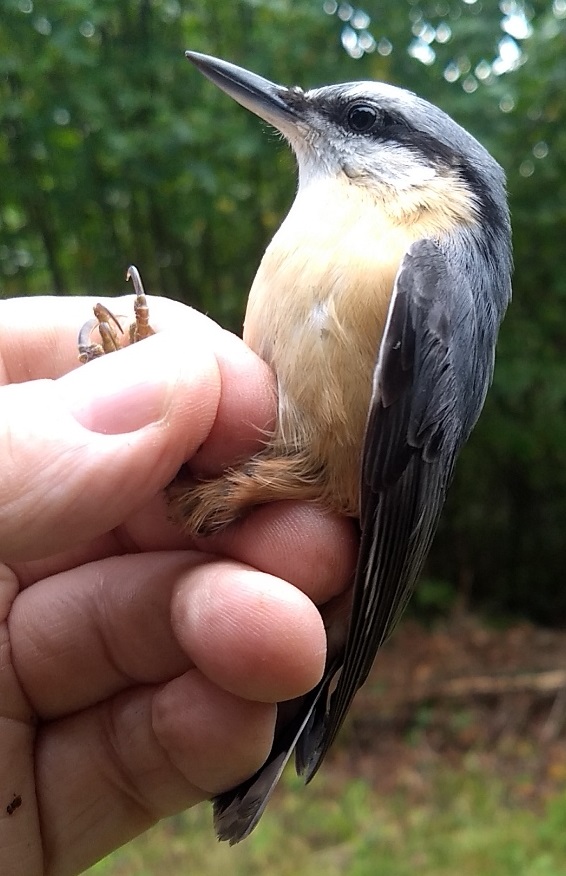
Nuthatch
I made the mistake of saying to everyone at 11:45 that we would shut the nets as we emptied the nets on the next round: cue our biggest round of the day, another 14 birds! We shut the nets as we emptied them.
The final catch was: Nuthatch 2; Blue Tit 9; Great Tit 3(2); Marsh Tit 2(1); Long-tailed Tit 3(1); Wren 1; Robin 1(1); Song Thrush 1; Blackbird 2; Goldcrest 16; Bullfinch 1. Totals: 41 birds ringed from 11 species and 5 birds retrapped from 4 species, making 46 birds processed from 11 species.
It was a lovely relaxed session and gave Samuel a lot of opportunity to find out a lot more about bird ringing. He was given a lot of opportunity to handle the birds, and to get used to being pecked by both Blue and Great Tits which, if he wants to become a ringer, is essential. I am sure he will be back as I have promised that he can start ringing birds next time! It also gave Rosie a chance to start her extracting career with me, which both she and Anna did extremely competently.
After we finished processing our last round of birds, we took down, and left site by 13:00.
Corn Bunting are a red-listed bird in the UK, with its population having plummeted as a result of modern farming practices. Given that it is a bird of least concern in the rest of Europe and in its south-west Asian territories, the problem clearly lies within the UK and, therefore, so does the solution.
Since the West Wilts Ringing Group came into its current form, at the beginning of 2013, we have not had any sites at which Corn Bunting are resident. In the years leading up to the North Wilts group splitting off to create their own identity, a total of 429 Corn Buntings had been ringed since our earliest computerised record in the national database at the BTO, starting in the year 2000. Of those, the vast majority had been ringed by Matt Prior and his teams on the Marlborough Downs, near Ogbourne St Andrew, and on the Pewsey Downs, near Stanton St Bernard.
(Before moving on, a little personal anecdote: the first bird I ever ringed was a Corn Bunting. It was on the 10th January 2009 at Ogbourne St Andrew, the second ringing session I had ever attended. Hooked for life.)
In all of the time between 2000 and 2013, only eight of them have been ringed on Salisbury Plain; seven of those at a site near Winterbourne Stoke. Since the split, nobody from the West Wilts Ringing Group has ringed a Corn Bunting at any of our sites. That was until one of the team was lucky enough to catch and ring one at their site on Salisbury Plain on Monday of this week:
Photos courtesy and copyright of Ian Grier
What a cracking bird! I would love to have the opportunity to get close to this species again.











 Ringing In The Braydon Forest & Beyond