West Wilts Ringing Group August 2021 Results

This August was a bad one for me, just able to get out for 5 ringing sessions, as I spent much of the month crippled with arthritis, and then fed up with small catches when I could get out. I don’t go for huge catches: 20 to 30 birds per person in a 6 hour session is always my aim. That gives plenty of time for appreciation of the bird in the hand, ensuring we get the details right without stressing either bird or ringer, and for training the team. At the moment it is more like 10 to 12 per person per 6 hour session. Therefore, I am astonished to report that this is our second best August for the group in its current form!  Most of that is down to Jonny and his work around the reed beds and waterways at three of his sites.

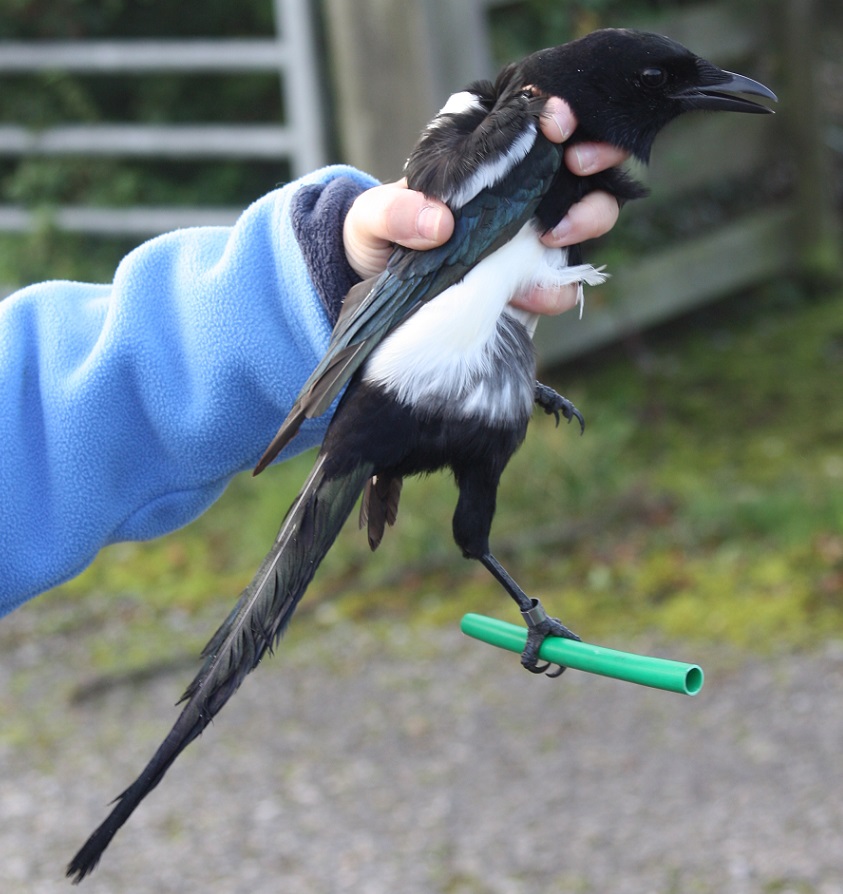
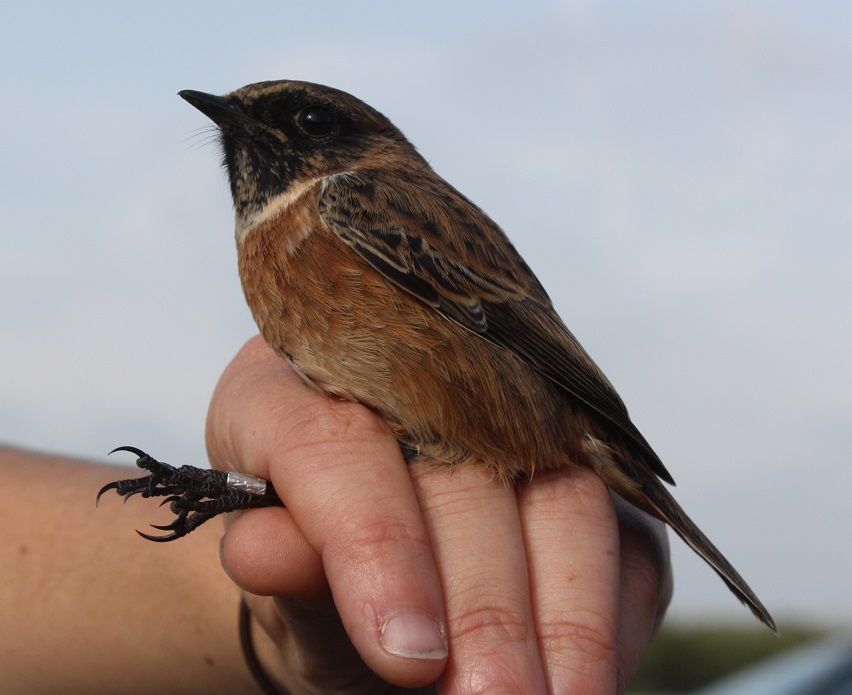
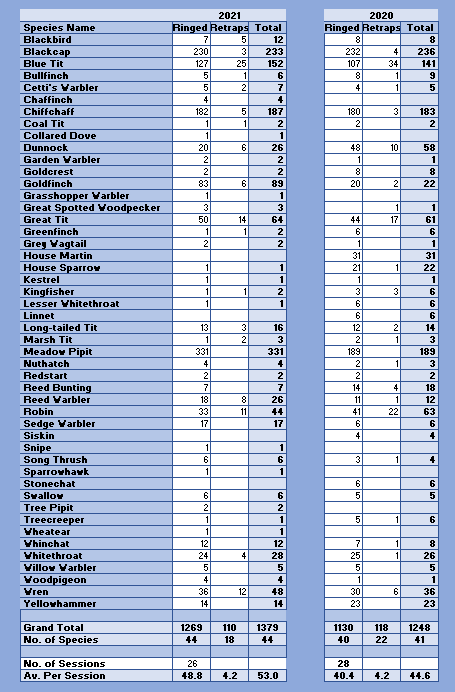
We didn’t have either of the spectacular catches from last year: Long-eared Owl and Nightjar; nor did we have some of the early migrants / scarcer residents: Whinchat and Meadow Pipit, and several of our regular woodland / garden species, namely Marsh and Coal Tit, Magpie, Jay, Jackdaw and Woodpigeon. We ended up with birds from 40 species, compared to 45 in August last year.

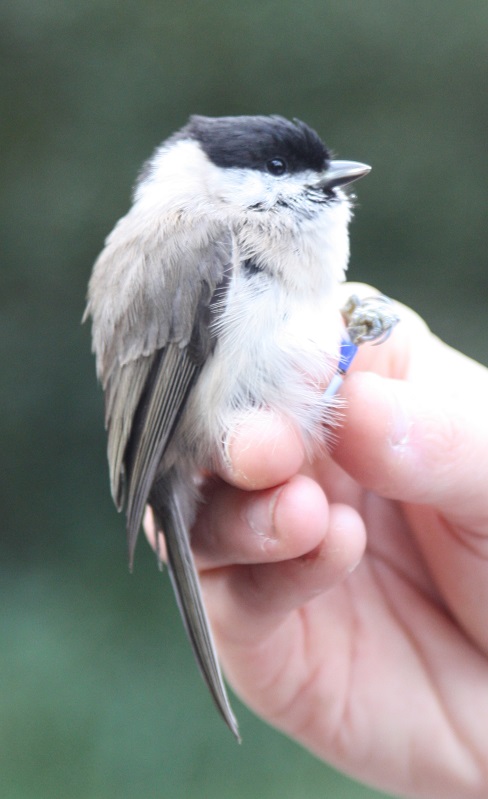
We did add a new species to our list: Canada Goose! Why, or how, Jonny managed to catch them I have no idea.  I have ringed one with the Wildfowl and Wetlands Trust a few years ago but don’t fancy doing any more.

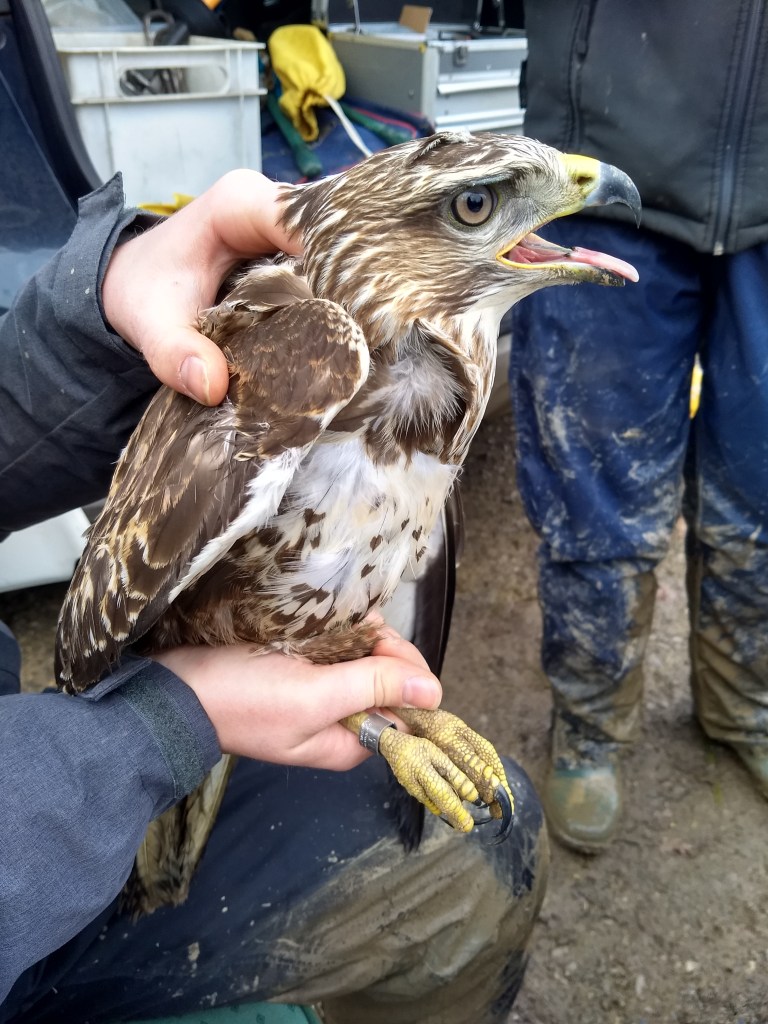
My highlight for the month has been Barn Owls: another 7 ringed and 3 recaptured, taking the total ringed this year to 34, the best so far.  We also know that all of our broods that advanced beyond the egg stage have fledged some young. The three recaptures were all this year’s birds. There has only been one nest failure: 6 eggs checked back in June and found to be cold then were still there when we checked the box again on the 31st August. An adult has been seen in the area but perhaps it lost its mate and abandoned the brood before it hatched. I still have some boxes to check and, given that second broods are definitely on the agenda this year, with reports from across the country of adults still on eggs and / or naked young, it certainly has been a good year for them and we might be able to add a few more to the list.  A word about the landowners: it has been extremely gratifying at how much interest and support they have shown towards our activities monitoring the Barn Owls this year. We have had no problems with access, several have built and erected new boxes themselves. It is hugely encouraging.

Cute photo by Alice Edney

This is the list for the month:

Now that September has arrived and the autumn migration is picking up, here’s looking forward to a really interesting and exciting month ahead.

Blakehill Farm: First Focus on Autumn Migration, Wednesday, 1st September 2021

The plateau at Blakehill Farm is out of bounds for ringing over the summer months, so that the ground-nesting birds, particularly Curlew, are not disturbed. Normally I would have started back mid-August, but weather and a mobility problem had put a spoke in that possibility. However, I was very keen to see what we might get, after a largely disappointing summer at my other sites.

Today I was joined by Lucy, back from a summer as a warden of the Little Tern colony at Spurn Point and before she heads of to Lundy for a month to carry out seal surveys. A little later Miranda joined us to see what is involved before deciding whether or not to take up ringing training.

After a busy morning checking Barn Owl boxes with Alice yesterday (we ringed another 4 chicks and could confirm that another 14 have fledged successfully, making a total of 34 ringed so far this year), Lucy and I went over to Blakehill to do a bit of trimming and strimming, ready for setting the nets this morning. The weather forecast was that the wind would be right on the edge of what would be acceptable for ringing on this side of Blakehill, but I had offered to host one of the Wiltshire Wildlife Trust’s Well-Being Groups and I didn’t want to let them down, so we strimmed the areas in front of the bushes that would give maximum protection from the wind. In the event, it was windy but, by setting the nets low on the leeward side of the bushes, it worked well. Naturally the forecast wasn’t completely accurate and what was supposed to be a warm, dry day turned out to be a cool day, occasionally spitting with rain throughout the morning.

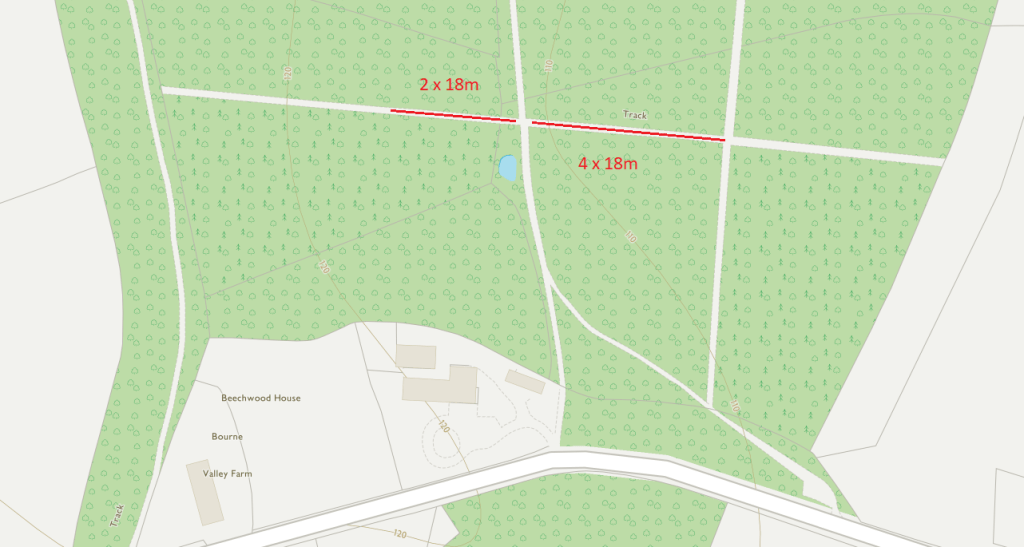
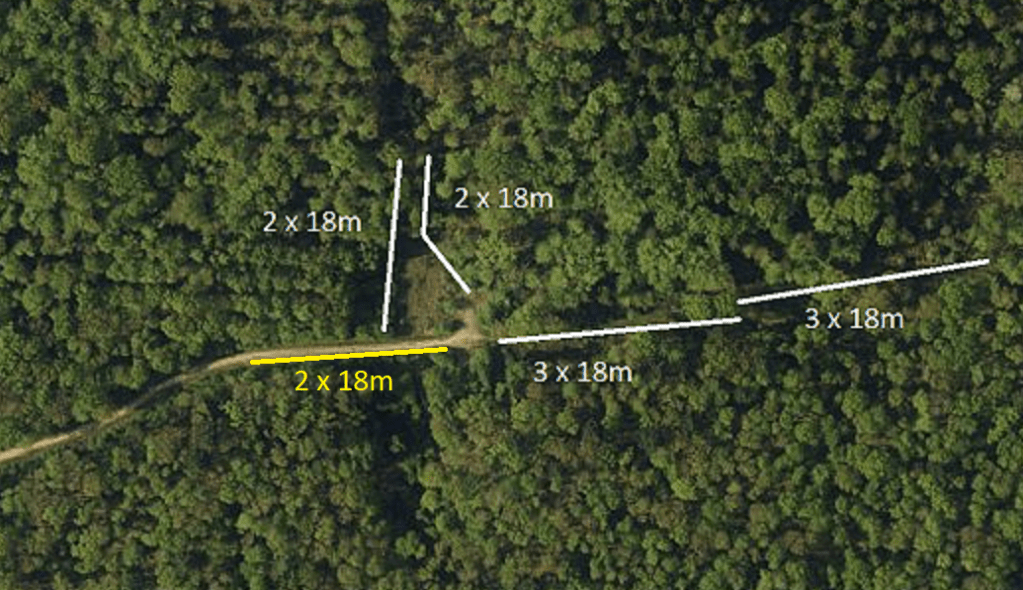
This was the setup we used:

The setup was as follows: 1 = 6m 5-shelf net; 2= 3 x 12m 4-shelf nets (a Mipit triangle); 3 = 6m 5-shelf net; 4 = 18m 2-shelf net; 5 = 12m 4-shelf net; 6, 7 and 8 = 9m 5-shelf nets; 9 = 12m 5-shelf net. Unusually, every net set, bar 3, caught. Net 3 is usually reliable. Unfortunately, the Mipit triangle, whilst it caught a Chiffchaff, and despite having the usual MP3 lure playing all morning, it did not produce any Meadow Pipits.

Our first productive round, at 8:15 (so why were we there at 5:30?), produced two Goldfinch and a Whitethroat – all juveniles.

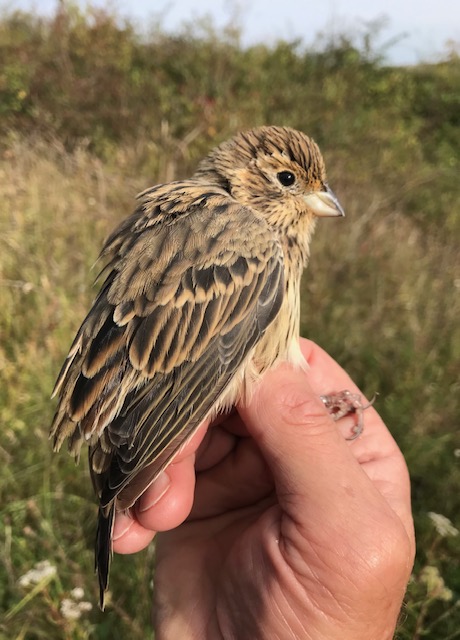
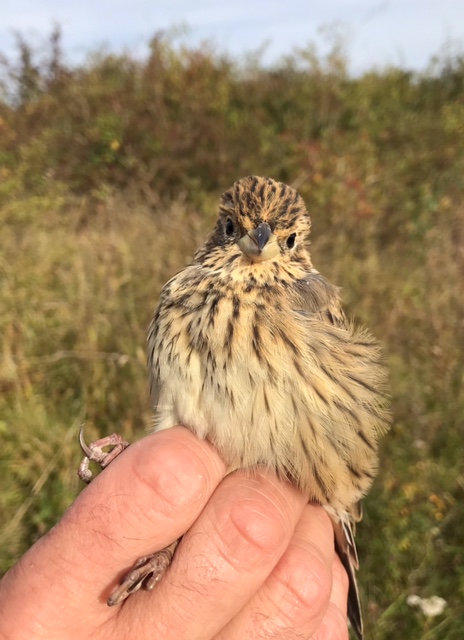
The next round produced our first juvenile Reed Bunting of the year:

Photo courtesy of Lucy Mortlock

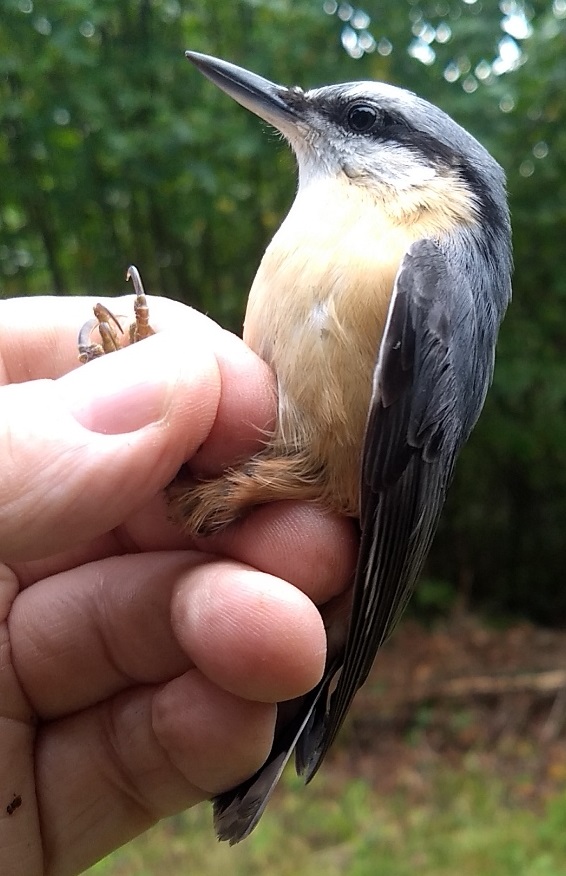
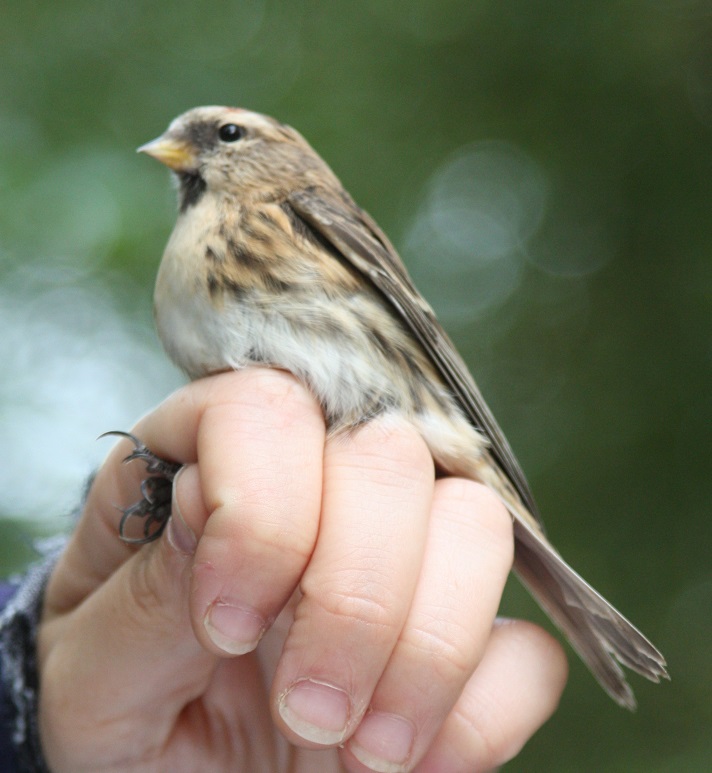
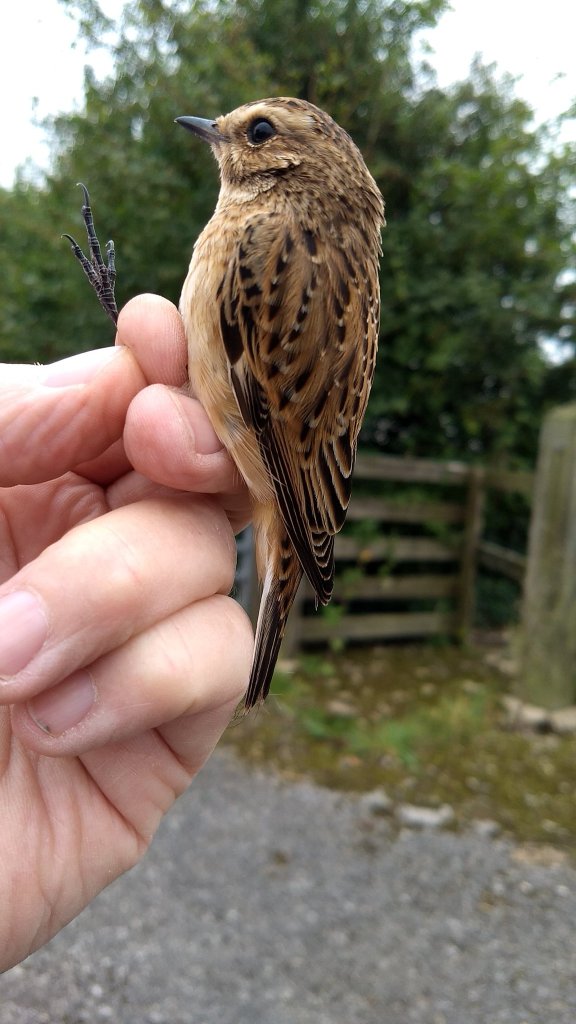
It also caught our first two of these for the autumn:

What we didn’t know was that this would be our best ever catch of Whinchat in a single session. The previous best had been 9 on 8th September 2018. Today we ended up with 10! That is a lovely catch. It was also Lucy’s first Whinchat: and she got to ring another 4 of them. We had great fun ageing and sexing these birds: it is all down to markings on the greater coverts and the colour of the lining of the upper mandible.

The list for the day was: Dunnock 1[1]; Whinchat 2[8]; Whitethroat [2]; Chiffchaff [1]; Willow Warbler [1]; Goldfinch [2]; Reed Bunting [3]. Totals: 3 adults ringed from 2 species and 18 juveniles ringed from 7 species. It was unusual to catch absolutely no retrapped birds at this site.

Our visitors did get horribly delayed by some over-running roadworks on the main route through to site so, after some navigation advice from me over the mobile, they arrived at 11:00. Luckily we had a number of birds from different species to show them. We then took them for a walk around the setup, so they could see how it works. Whilst doing so, I extracted our last bird of the morning: a Chiffchaff from, as mentioned before, the Mipit triangle. Fortunately, the Well-Being group were very happy with what we had to show them.

Whilst Lucy, Miranda and I took down the nets, the Well-Being crew had a brew-up and a spot of lunch, and we all left site by 13:00. Not a huge catch but a very satisfying one!

CES 12: Lower Moor Farm, Sunday, 29th August 2021

This was a similar result to CES 11 back on the 14th August: 35 birds – about one third of what we caught in CES 12 in 2019. However, being as unpressured as it was, it enabled me to work with Anna, the newest recruit to the team. After a couple of taster sessions, and the opportunity to ring a couple of Barn Owl chicks, she is now my newest trainee.

In the last taster session Anna ringed her first bird. That bird was handed to her. Today she had to get to grips with safely removing birds from the storage bags, settling it into the ringer’s grip and then setting the ring correctly in the pliers, applying the ring whilst holding the bird, and then taking the wing length measurement, weighing the bird and releasing it. We also touched on ageing, sexing and moult.

Although I now set my nets in areas that are not open to the public, following the well-documented problems with interference, leading to a damaged bird and vandalised nets, at Lower Moor Farm I set up my ringing station in the picnic area on the edge of Mallard Lake. We had a lovely chatty morning, with lots of people stopping to see what was going on, and giving me the chance to explain the rationale and benefits of the ringing scheme. This was finished by a visit from a small group of three families, with 6 children, who were delighted to see Blue Tits and Blackcaps up close. The children were particularly pleased with the amount of aggression the Blue Tit I processed showed: pecking me at every opportunity, including hanging on to my finger with its beak after I had released it.

The catch for the day was: Treecreeper [2]; Blue Tit [2]; Dunnock [1]; Robin [1](3); Blackcap [20] (2); Garden Warbler [1]; Chiffchaff [2]; Willow Warbler [1]. Totals: 30 juveniles ringed from 8 species and 5 birds retrapped from 2 species, making 35 birds processed from 8 species. Interestingly, the only adult caught was one of the retrapped Blackcaps, so 34 of the 35 birds processed were juveniles. Given how few adults we have caught at Lower Moor Farm (or at any of my sites this year), I strongly suspect that we were lucky to be on the flightpath of a bunch of juveniles starting their autumn migration.

The adult Blackcap was ringed by Steph as a juvenile almost exactly 4 years ago. This was the first time it has been recaptured, and it was retrapped in exactly the same net ride as it was originally. The second retrapped Blackcap was ringed as a nestling in May of this year. It is not one of our rings, so I look forward to finding out where it fledged. The other retrapped birds were all Robins originally ringed at Lower Moor Farm.

One unusual occurrence: throughout the morning, I don’t know if it was just one or a number of, Common Darter dragonflies decided that my head was a good resting place. I was happy to be of service but I would have been happier if I had been able to see it! It was a long session and we finally left site at 13:30.

Somerford Common: Sunday, 22nd August 2021

It has been a while since I have been to this site. Every time I planned to go, something got in the way, so I was pleased to be able to get there this morning. Unfortunately, it is suffering from the same malaise as all of my other woodland sites! I was joined by David for the morning.

The weather was spot on for the session: after torrential rain last night the morning arrived dry and virtually windless. We met at 6:00 and set up three net rides in our usually most productive areas. It really wasn’t the result we wanted: Great Tit (1); Wren 1[1]; Robin [2]; Blackcap 1[2]; Chiffchaff [1]; Bullfinch (1). Totals: 2 adults ringed from 2 species; 6 juveniles ringed from 4 species and 2 birds recaptured from 2 species, making a total of 10 birds processed from 6 species.

As you can see, not a lot to write home, or a blog about. There were two highlights however. Neither was bird related. David noticed some movement on his rucksack and was surprised, and delighted, to find this running around his bag:

Common Lizard: Zootoca vivipara

It was only about 10cm long. This is the first lizard that I have seen in 9 years of working the site. Apparently, it is also known as the Viviparous Lizard, because it gives birth to live young. This was definitely a young beast. I loved the bluish tone to the tail area.

Later on I found this on my rucksack (why were these things attracted to rucksacks?):

Dark Bush Cricket: Pholidoptera griseoaptera

This is the second Orthopteran that I have had the pleasure to encounter close up in the last couple of days. On Friday of last week I photographed this on the windscreen of my car:

Common Green Grasshopper: Omocestus viridulus (Male)

With the birds just not appearing we packed up early and left site by 11:30. I know from others’ posts that the autumn migration has started. Here is hoping that a few of them start dropping in at my sites! I will be trying out the meadows at Ravensroost and Blakehill Farm when the weather allows hoping for better things.

Purple Hands Are Back Again: Saturday, 14th August 2021

It is that time of year again when ringers go home with purple hands: the blackberries are ripening and the birds are taking advantage. This morning was a busier session than we have had recently. It was CES 11 and we had agreed with the Swindon Wildlife Group to make it one of our formal ringing demonstrations. As regular readers will know, my recent sessions have had disappointingly small catches and I was seriously worried about whether we would have a reasonable sort of catch to show twenty or so adults who had paid £5 each for the pleasure of our company (not to me, I hasten to add: to the SWG who use their income to support Wiltshire Wildlife Trust initiatives).

Due to a combination of factors (births, self-isolation from a Covid ping, family holidays, moving home, etc) it was down to just David and myself to manage the session. Fortunately, we had a steady stream of birds coming through and the assembled watchers certainly got a good experience. They were a lovely crowd as well, very interested, asking intelligent questions and one has asked me if I will ring the Swallows that nest in his workshop in future seasons!

We didn’t actually catch any birds until 8:00, a pretty late start to proceedings. As you can imagine, that didn’t fill me with confidence. That they were 3 Blue Tits, a Blackbird and a Blackcap didn’t seem particularly exciting. As the visitors arrived at just after 9:00, so the catch improved in variety. The first birds they got to see were a couple of juvenile Whitethroat, a juvenile Bullfinch, a juvenile Blackcap and an adult Chiffchaff in full wing moult. So it continued throughout the morning. The star attraction for the group was our second juvenile, and third in total, Green Woodpecker of the year. They are striking birds and the people loved it: being particularly fascinated by that long sticky tongue. I did my usual thing of showing people how to safely hold and release birds. Apart from stimulating interest in ringing, I feel that if they do have to handle a wild bird for any reason they might be better prepared to do so.

The list for the session was: Green Woodpecker [1]; Blue Tit 3[3](2); Great Tit (2); Wren [2]; Dunnock [2]; Robin [2]; Blackbird [2]; Blackcap [6]; Garden Warbler [4]; Whitethroat [2]; Chiffchaff 1; Willow Warbler 1; Bullfinch 1[4](1). Totals: 6 adults ringed from 4 species, 28 juveniles ringed from 10 species and 5 birds retrapped from 3 species, making 39 birds processed from 13 species. This compares somewhat better with the equivalent session in 2019 in which 58 birds were processed from 16 species. The key difference is in the number of retrapped birds (17) which, given how quiet the sessions have been to date this year, is entirely unsurprising.

We had birds continuously throughout the morning between their arrival at 9:00 and their leaving at just before midday. All in all, a thoroughly enjoyable morning. Thanks to David for doing the donkey work of extracting the birds whilst the demonstration was in progress and to his dad, Trevor, for helping us pack away at the end of the session.

Spurn Observatory: Other Birding / Ringing Activities, Summer 2021

Another post from Lucy, updating her activities at Spurn Observatory. This time she is blogging about her activities away from the Little Tern colony.

Summer is turning to autumn here at Spurn, but in the past month I have had some fantastic opportunities to ring a range of young birds.

Having checked the barn owl box in late June to find four chicks only a few days old it was lovely to return in July to find five big, healthy looking chicks, ready to be ringed. The adult birds can regularly be seen hunting in the surrounding fields, and have been very successful parents in the past. These were the first barn owls that I have ringed, and they are an absolute delight!

The following morning I ringed two Stock Dove chicks whose parents had taken up residence in an owl box. They had very full crops and were about a week off fledging. I forgot to get a picture of them!

I have spent a couple of beautiful evenings mist netting juvenile Swallows and Sand Martins. We set up a single double shelfed net along a hedgerow adjacent to a pond and set tapes to lure the birds in. They are amazing acrobats and spent as much time sitting on the top and middle shelf of the nets as they did wheeling above our heads. A steady stream of birds were caught and ringed, and the nets brought down in time for the swallows and sand martins to roost in the rushes in the pond. Again, I forgot to take a picture of the Sand Martins.

My most recent ringing exploit was to a nest box just behind my accommodation where four Tree Sparrows were ringed. As you can see they were very close to fledging and stayed in the box for only a couple of days after they were ringed.

Ringing here at Spurn continues to surprise and delight me and I’m very excited for what the coming weeks will hold!

All birds were ringed under license from the BTO.

Little Terns & More: Spurn Bird Observatory, Summer 2021

The following post is by WWRG trainee Lucy Mortlock, currently working as a warden at the Little Tern colony at Spurn Point, covering her work at the site.

The Little Tern project at Spurn is primarily focused on monitoring and protecting the Little Terns that arrive here each spring. Maximum numbers of Little Terns are currently around 100 individuals most days. Some adults and juveniles have arrived from colonies further north, slightly swelling our numbers, but they are remaining fairly consistent. Our first chicks hatched on 3rd July, meaning that we now have some of our very own juveniles fledging. So far we have three fledglings, with more to follow this week. It’s an absolute delight to watch them stretching their wings and preening their feathers on the shoreline, and a little scary to think these tiny, young birds will soon be departing for west Africa.

Little Tern chick

As part of the project chicks are ringed with metal BTO rings and, if they are big enough, yellow colour rings.

Little Tern chick with yellow Darvic ring

The colony is protected by an electric fence and has a 24 hour warden watching effort, meaning that it is a great choice of nesting habitat for other ground nesting birds. In among the terns, Oystercatchers and Ringed Plovers have been nesting and raising young. At least 10 pairs of Ringed Plover have successfully hatched chicks, and as recently as this week two new pairs of chicks have been seen on the shoreline.

Ringed Plover chick

Ringed Plover chicks can run and feed themselves within a few hours of hatching, meaning that you can often see these fuzzy little pompoms dashing about on the shoreline, more or less completely independent of the adult birds.

Oystercatcher chicks are a little less independent of their parents, and tend to be seen in association with an adult bird. Seven Oystercatcher chicks from four nests have hatched within the colony, and this lucky bird got a ring. While Ringed Plover chicks can be ringed while they are still very young, Oystercatchers need a couple of weeks to grow into their legs before they can be ringed.

Oystercatcher chick

The Little Terns will be heading off within the next couple of weeks and we’ll have a final count of the number of chicks fledged. It will be very quiet without them!

All birds have been ringed under license from the BTO.

Barn Owl Tales: Monday, 2nd August 2021

We have been busy monitoring Barn Owls in north Wiltshire this year. Our activity started on the 14th June, when we ringed 4 chicks at the Wiltshire Wildlife Trust Avis Meadows site. Since then we have visited 20 boxes and have been pleased with how productive things have been.

Today I was joined by Anna, and we went to carry out some follow up checks on boxes. We started at Upper Waterhay Farm. At my last visit there, on the 23rd June, the box to the east of the farm had 5 warm eggs in it, the dilapidated box in the grounds of the Chancel was empty and the box to the west of the farm was full of twigs and muck where we had not been able to get to it to clean it out last winter. Needless to say, we cleared the box on the 23rd June, so wanted to see if anything had taken advantage.

We were joined by local farmer and birder Andy Rumming and his children. They were keen to see what they have on their land. It was very pleasing to find that 3 of the eggs in the east box had hatched and the young were of a good size, ready for ringing. This enabled Anna, on only her second ringing trip, to ring her first Barn Owl and Andy and his children to see the birds close up. The chancel box is looking even worse, and we really will have to replace it this winter. When we got to the west box an adult flew off as we put the ladder in position. I climbed up and saw this:

Newly Hatched Chick plus 5 Warm Eggs

We will check it again in about 5 weeks time. Hopefully we will find 5 healthy chicks in the box. What you cannot see from the photo are the corpses of half-a-dozen short-tailed voles that the parents have clearly provisioned for the larder. There does seem to be a glut of these rodents in the area this year. Not only have I seen the evidence in the Barn Owl boxes but several local landowners have commented on what they have seen on their own farms to me.

Having finished with these boxes, we headed off to Plain and Drill Farms to check the boxes there. First we went to Drill Farm, where we ringed 3 Barn Owl chicks on the 17th June. I fully expected them all to have fledged by now but wanted to be able to confirm that they had been successfully reared. They certainly have, but they are still using the box as a roost. One flew off when I opened the box and a second seemed a bit bemused by it all, and I managed to catch her and process the biometrics and, as you can tell from the pronoun, sex the bird.

We first visited the box at Plain Farm on the 17th June when, despite the back of the box having fallen inwards, leaving it open to both the elements and predation, we found 4 naked young. We went back to ring them on the 2nd July and ringed the three surviving chicks. Again, I wanted to check on their progress. The largest chick flew off strongly from the box as we approached. The others decided that they would try and fledge prematurely. One flopped into the hedgerow and disappeared; the other flew into the field next door and was soon recaptured and returned to the box. I take my responsibilities very seriously, and this is the first time that this has happened with any birds on my watch, so I was determined to get it returned home. However, search as we may, we couldn’t find it.

I decided to leave it for a while and then go back, working on the assumption that it would work its way back towards the box if left alone. In the event, it was pouring with rain for the rest of the afternoon, so I went back at 6:30. The bird was found quite quickly and, although it made a dash for it, an accurate throw of my ringing smock managed to cover it. I bagged it and carried it back to the car, put up the ladder (don’t tell Health & Safety but I was working solo), climbed up, opened the back of the box and put it back in. Only it decided to go straight out the front and fly into the next field! Not to be outdone by a Barn Owl chick, I thought about it and decided that, next time, I would put it back in from the front of the box, so I could block its exit. So I caught the bird again and bagged it. Then I brought the ladder through to the front of the box and replaced the bird in the box. This time it stayed put and I could go home.

Butter wouldn’t melt!

West Wilts Ringing Group July 2021 Results

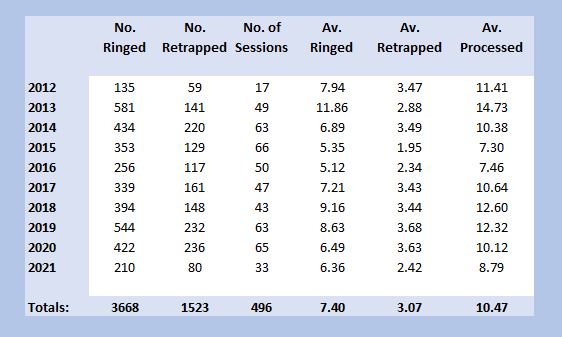
July 2021 has been dreadful – not for everybody, and certainly not for Jonny Cooper, with the receipt of his A-permit, making him now a fully-fledged, independent ringer, but it certainly has been poor for me and my sites in the Braydon Forest and at Lower Moor Farm.  For the first time I can remember, I abandoned 2 sessions, after 3 hours each with 2 and 3 birds at Ravensroost Woods and Meadows respectively, and finished it with just 7 at Webb’s Wood on Saturday.  I ended the month with just 59 birds ringed and 26 retrapped (which includes 4 Barn Owl chicks and 2 Stock Doves chicks ringed earlier in the month and still in the nest boxes, so they don’t really count) from 21 species.  Compared to Covid-constrained activity last year, when I still managed 240 ringed and 24 retrapped from 31 species, it really is a poor return. 

To be fair, July of last year was our best ever performance in that month, by over 300 birds from the next best (in 2015) and only 100 d0wn on 2019. The weather didn’t help, with too many wet and windy days, and then nearly a week of cripplingly high temperatures, during which I banned my team from doing any ringing, to avoid heatstroke for them and heat stress for the birds.  Others also clearly had better catches than me but we still processed nearly 10 birds fewer per session compared with 2020.

Comparison July 21 to July 20

The difference in the species catches is clear to see from the table: the numbers ringed almost across the board were down. In fact, of those species where we ringed more than a token few, the only species to show a clear increase in numbers ringed was Starling, the only one to show a comparable figure with last year was Great Tit, the rest, resident or summer visitor, were well down.  Looking for positives, 45 species ringed this month, compared to 39 last year. 

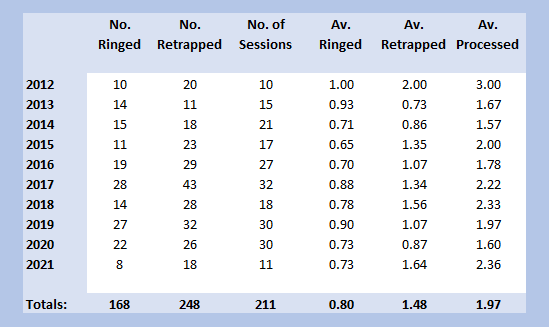
The most measurable fall for me was in my Lower Moor Farm CES. 2019 was the last time I was able to carry it out, as Covid prevented me accessing the majority of my rides in 202. These are the comparisons:

CES Comparison July 2019 to July 2021

Looking forward to August and hoping that it is an improvement both on July and on last August.

If you go down to the woods…. Saturday, 31st July 2021

I haven’t been into Webb’s Wood since November of last year. Over the winter the contractors were on-site carrying out extensive thinning operations in the wood. Once they finished, at the end of February, the track was left impassable to anything but off-road vehicles with high ground clearance. The track was repaired over the next couple of months but with other commitments, and a combination of weather and illness, this was the first scheduled session at the site that has actually taken place since it became accessible again.

In 2015, following the thinning operations at Red Lodge, it took until the winter feeding flocks for the numbers to recover. I was interested to see how the work would have impacted on Webb’s Wood. Part of me hoped that, as the thinning work stopped just shy of my ringing area, that it might have concentrated birds into there. That was tempered by the knowledge that my sessions in July have been just dreadful, with just 53 birds ringed and 25 birds recaptured from 20 species in 7 sessions! 6 of those recaptures were, in fact, revisits to nests to see if the young had fledged. They hadn’t, so the recapture numbers were inflated by 4 Barn Owl and 2 Stock Dove nestlings.

I was joined by Ellie for the morning, and had invited Anna Cooper along for a taster session. Anna is looking for a trainer, having had a little experience of mist netting and ringing whilst doing her Biology degree, and contacted the BTO rep for north Wiltshire, who asked me if I could take her on. Having disposed of one trainee, as Jonny Cooper has graduated to a full A-permit, I have room for another.

Unfortunately, Anna didn’t get the chance to handle too many birds – because we only caught 7! The list was: Coal Tit [1](1); Wren 2[1]; Chiffchaff [1]; Goldcrest [1]. Totals: 2 adults ringed from 1 species; 4 juveniles ringed from 4 species and 1 bird retrapped, making 7 birds processed from 4 species.

This is not to say that it was not an interesting catch: the juvenile Coal Tit and Goldcrest are the first of the year. I knew it was the first juvenile Coal Tit, so took a photo, but didn’t realise it was the first juvenile Goldcrest, and so I didn’t.

As the wind started to get up at about 10:00 and few birds coming in, we packed up and left site just before 11:00. We didn’t manage to put Anna off – she is joining me to check some Barn Owl boxes tomorrow. I am pretty confident she will get a chance to ring her first Barn Owl chick.