As the Ravensroost Wood Volunteers are going to be active in the wood every Wednesday from now until March, I decided that a change of venue was needed for today’s session. It’s not that I have a problem with the volunteers, or vice versa, it is just that the parking becomes an issue. Because they were joining me for the session, I gave Lucy and Miranda the choice of going for Meadow Pipit in Ravensroost Meadows or, having been told by Robin Griffiths, the Ravensroost Reserve volunteer warden, that there were flocks of Siskin at Somerford Common, trying for them. Lucy responded instantly, with a request for Siskin. So this morning we decamped to Somerford Common.
Although we agreed to meet at 7:00, I actually arrived on site at just after 6:30 and set the usual 18m + 12m line along the main path (net 3 below). My intention was to put on a lure for Redwing from daylight, for a couple of hours. Having caught a couple at Blakehill on Saturday, I was pretty certain there would be one or two at Somerford Common – the previous holder of my record for my earliest Autumn Redwing. I must have been still asleep: I put the lure on – only it wasn’t for Redwing! It took me over an hour to realise my mistake and change the record!
That was just as well, as it gave us a chance to set the other nets, because immediately I changed the lure to the “Latvian love song” we just had to sit back and watch as Redwing flocked into the trees around that part of the site. There was well over 100 of them, but they weren’t coming down, which we put down to them being able to see our ringing station. So, we moved the ringing table and the equipment under cover and waited. We didn’t have to wait long.
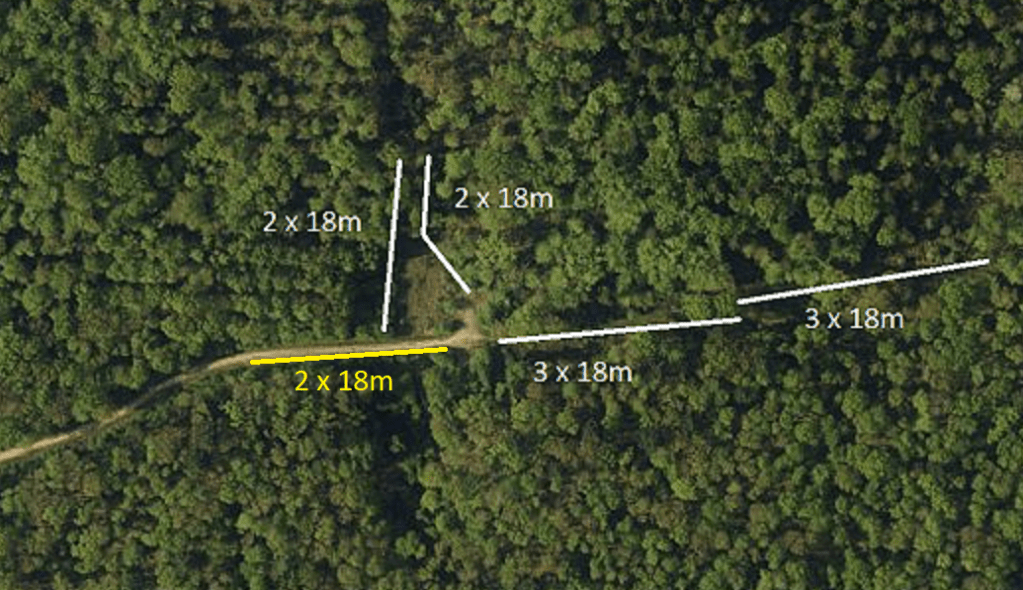
The net setup we used today, and the lures associated, was:
Nets 1, 4 and 5 had Siskin playing; net 2 had Lesser Redpoll playing and net 3 had Redwing (eventually). Throughout the morning we had small flocks of birds flying around, whether or not they were Siskin is anybody’s guess. All I know is that, despite overkill on the lure front, we didn’t catch a single one.
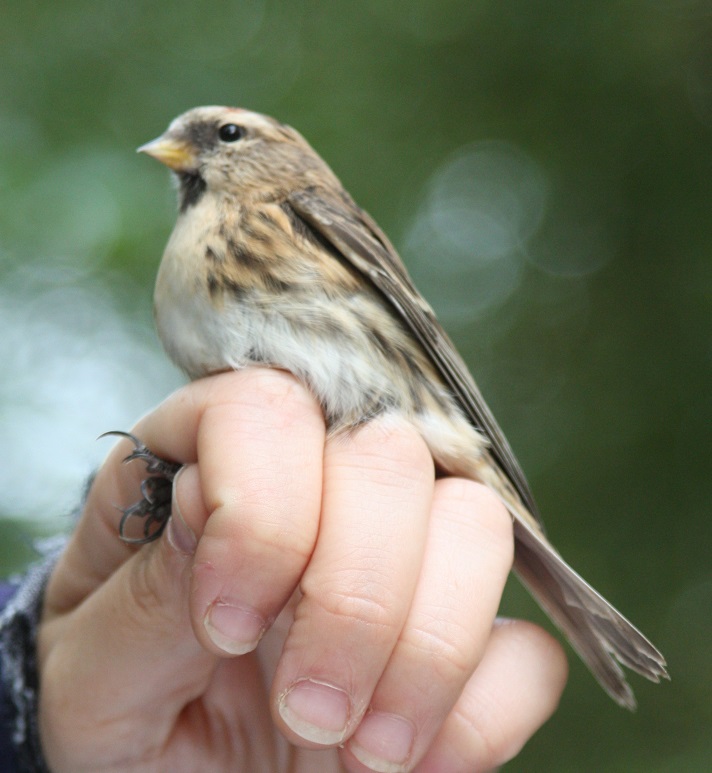
Round one delivered a single bird: our first bird out of the nets was actually a Coal Tit from net 2. This was followed in round 2 by a Goldcrest in the same net. Then I changed the lure to what it should have been and in round 3 we extracted our first Redwing of the session plus six Blue Tits and (and much to my surprise) seven Lesser Redpoll. I had hoped for one or two over the course of the morning, so this was delightful.
This matches the earliest catch date for Lesser Redpoll in the Braydon Forest, back in 2015, but is far and away the largest catch we have had there in October. The previous largest was just 4 on 30th October 2013.
Having resolved the lure issue, we then caught several Redwing in each round, until we closed up at 11:45, ending up with a decent haul of 18. Like the Lesser Redpoll, this is a significantly larger catch of this species than in any previous October. Other October catches of 12 (2015) and 13 (2016) birds came at the end of the month, not the middle.
The list for the day was: Treecreeper 1; Blue Tit [9]; Great Tit 1[2](1); Coal Tit [1](1); Robin [2](1); Redwing 5[13]; Goldcrest [2]; Lesser Redpoll 1[8]. Totals: 8 adults ringed from 4 species, 37 juveniles ringed from 7 species and 3 birds retrapped from 3 species, making 48 birds processed from 8 species.
After a thoroughly enjoyable session, we were off site by 12:45.
David and Lucy arranged to be with me from 7:00, with Steph joining us when she could get there, as she was bringing the family along. I had mentioned the possibility of Stonechat at Blakehill to Lucy whilst we were working at Webb’s Wood on Wednesday. She was excited at the prospect, having not processed one before. When I checked the records I noted that David hadn’t processed Stonechat either, so I was hoping to attract a couple in for them this session, and prepared two lures for the plateau bushes.
Having woken early, I was on site by 6:30. This suited me, because I had seen a tweet from Nigel Pleass reporting hearing Redwing flying over on migration at night near Swindon, and I wanted to get nets open and the lure on for them before it was light. I set my “Redwing nets” along the perimeter track on the Chelworth Industrial Estate side of the reserve and put on a lure. It was very misty first thing with not a lot of movement so, as David and Lucy had arrived we went out onto the plateau to set up a few nets out there. I decided to only set 4 nets: 3 x 9m and 1 x 12 in the clump of bushes and ignore the extremities. Two reasons: 1) they haven’t been catching during the height of migration and 2) I needed to ensure I was away from site by 13:00, so I could get to the doctor’s surgery for 13:25 for my flu jab, so didn’t want to have too much work to do to get packed away.
Once those nets were up, I sent David and Lucy to check the Redwing nets, whilst I started setting up the Meadow Pipit triangle. They came back with a Chaffinch.
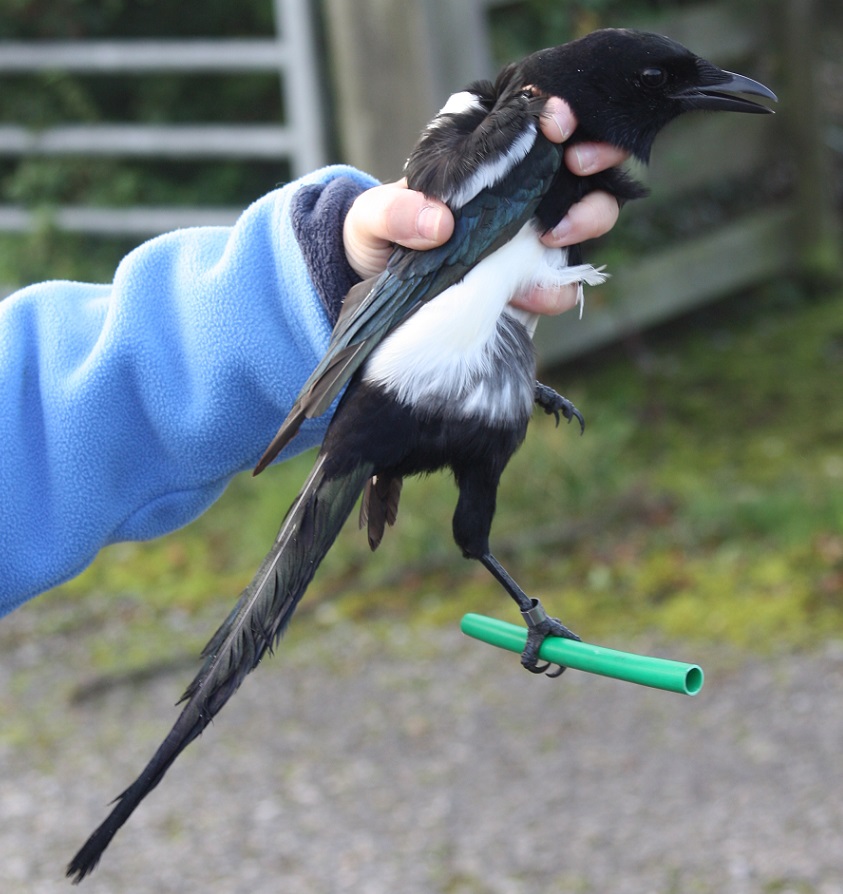
For the first full round, at 8:00 I checked the Redwing nets, whilst the others went to check the plateau nets. At this point we didn’t have the Meadow Pipit lure switched on (mainly because that was on the same machine as the Redwing lure) so, unsurprisingly, there weren’t any in the first catch. It is unlikely that they would have been moving much anyway in the mist. However, something definitely was, as Lucy returned with this beauty:
I don’t understand why this species is vilified and killed indiscriminately by some “country folk”.
Next round I, again, did the Redwing net, on the basis that I would swap out the Redwing lure for Blackcap and Linnet, just in case. This time I removed a Blackcap, Chiffchaff, Starling and two Redwing from the nets. The lure had worked. This is the earliest that I have ever caught autumn Redwing – by one day! The same round produced a couple of Reed Bunting.
I set up the Meadow Pipit lure in the middle of the Mipit triangle and they immediately appeared, seemingly from nowhere and started sitting on the nets and then onto the floor. The next round delivered a couple of them, but the key round was at 10:20. As hoped for, it turned up half-a-dozen Meadow Pipits. In the end we had 12 of them. Next time I will bait the area with mealworms, as they weren’t as invested in the triangle as I would have liked, with plenty getting away each round.
However, in that round the Redwing nets had caught 13 Long-tailed Tits. This was not our single biggest catch of Long-tailed Tits in one net round, that was an astonishing 21 in my garden, but that one was the result of fat balls, peanuts and sunflower hearts. In the past, we have had one 14 bird catch in a single net round, and two 13 bird single net round catches: all at Somerford Common, in a mixed woodland setting. However, the last big single round catch we had of them there was in September 2016, with 13. Since then there have been no single net round catches in double figures. In fact, their numbers overall had fallen right away in my “wild” sites. So this morning we had 13 of them in that round, in 2 x 18m nets, along the perimeter track. It is a record for this site.
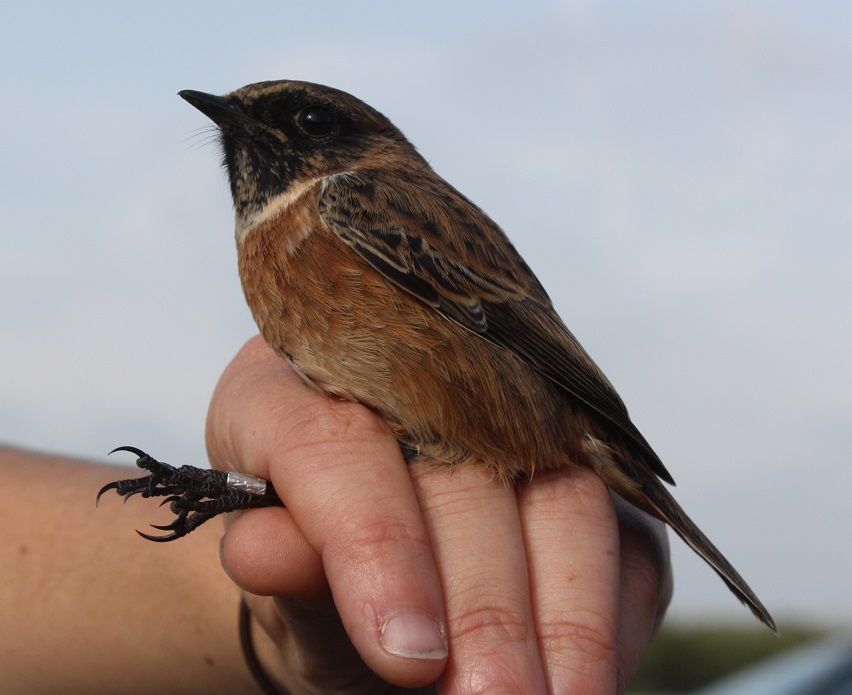
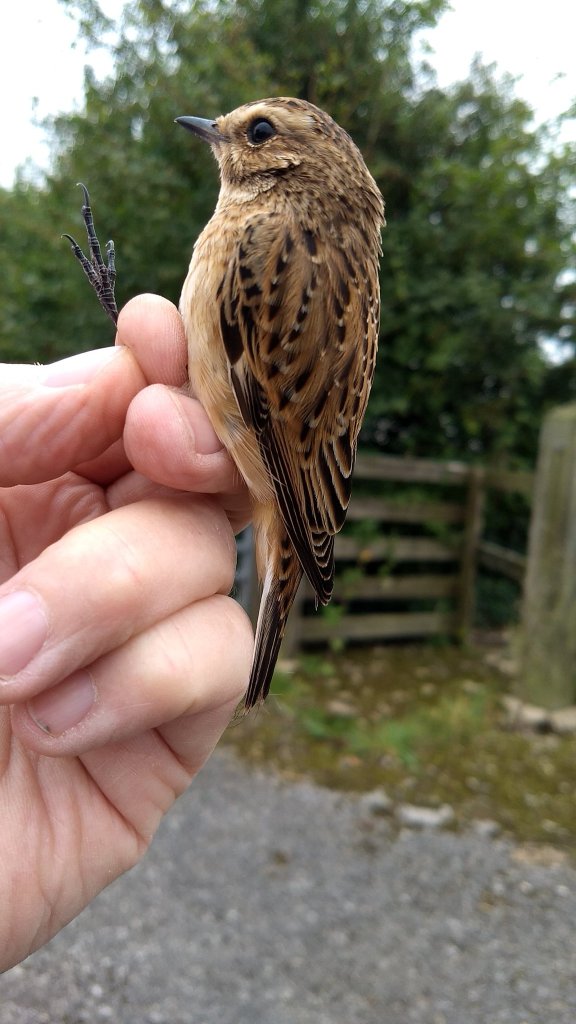
Unfortunately, although we had a lovely morning, by the time of the last round we hadn’t seen hide nor hair of Stonechat. David and I did the plateau nets, whilst Lucy and Steph did the Redwing nets. We had one last Meadow Pipit in the triangle and then, as we approached the second 9m net, I noticed a dark bird in it. I called to David, who was nearest “Stonechat, go for it”. He ran to the net but, just as he reached it, the bird got out of the net and flew off, only to hit the next net. David ran after it again and, as before, just as he got to it, it got out of the net, bounced off another part of that net and flew on – into the last of our nets. This time it didn’t get away. As I walked up to the third net, I noticed another bird in it: Stonechat number 2. As David came back excited with his first Stonechat extraction and looking forward to ringing it, I asked if he had actually checked the rest of the net for other birds. He hadn’t, so I went for a look: Stonechat number 3! Good things come to those who wait. David, Lucy and Lillie got to ring them: all adults, all male.
Male Stonechat
The list for the day was: Magpie [1]; Blue Tit [4](1); Great Tit 1; Long-tailed Tit {13}; Wren (1); Meadow Pipit 1[11]; Stonechat 3; Robin [1]; Redwing 2; Blackcap [1]; Chiffchaff [2]; Starling [1]; Chaffinch 1; Reed Bunting [2]. Totals: 13 unaged from 1 species; 8 adults ringed from 4 species; 23 juveniles ringed from 8 species and 2 birds retrapped from 2 species, making 46 birds processed from 14 species.
We had a brilliant morning: good birds in the nets, good birding, and the children were just great: filling in the gaps between rounds with fun and laughter. Not only that but I was 20 minutes early for my jab and they saw me straight away. Result!
This is an entirely personal, and emotive, post based on two recent recoveries of special birds that my team ringed, that have been found dead in what I consider suspicious circumstances. It does not necessarily reflect the opinions of all members of the group.
One of the worst aspects of ringing is getting the report that one of the birds you have ringed has been found dead. Regular readers of the blog will know that I did an analysis of the various death reports (yes – of those where cause of death was identified, cats were the main killers). Unfortunately, a lot of them do not have cause of death identified: sometimes it just isn’t possible when bits are found, but I am sure that, quite often, it is because the finder has some responsibility for the death. This is particularly the case when dealing with Corvids and birds of prey.
On the 14th April 2017, at Tedworth House, we ringed four Raven chicks. As far as I am aware, and have been able to find out, these are the only Ravens ever ringed in Wiltshire. If you look at the Wiltshire Bird Atlas, they are an extremely scarce breeding bird in the County.
This did not stop Michael Gove, when he was in charge of DEFRA, allowing licences to be issued to cull Ravens in Wiltshire, on the made-up charge that they “damage livestock”. Nobody has ever proven that Ravens kill healthy lambs. The best you ever get is a farmer or shepherd holding a dead lamb, that has clearly been scavenged post-mortem, claiming it was killed by whichever species they want to vilify that day (Carrion Crow, Raven, Buzzard, Red Kite, Fox, Badger).
At the beginning of July I was sent a recovery report from the BTO specifying that one of the Ravens had been found dead. There were no details on the cause of death, just that the ring had been handed to another ringer to report back to the BTO. That in itself I find suspicious. All I know is that it was found on farmland near Combe in West Berkshire: 633 days after it was ringed and 19km north-east from where it was ringed.
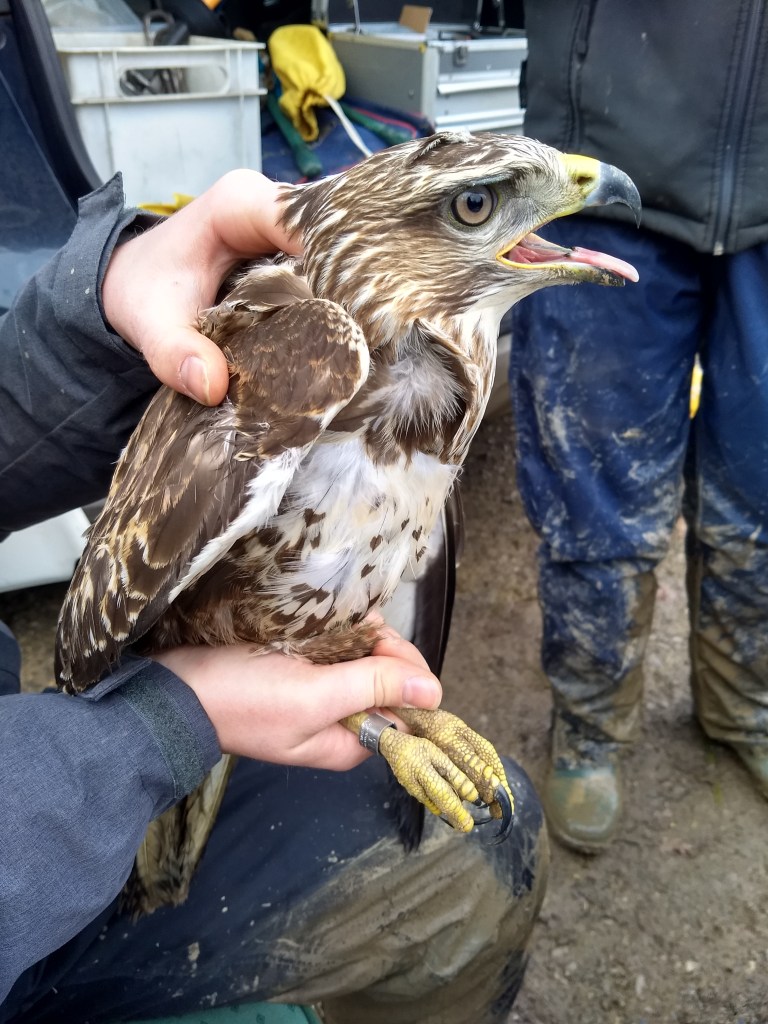
This week I received another report. Back on 30th November 2019 we mist-netted and ringed two juvenile Buzzards. An astonishing catch. This one:
GV62815
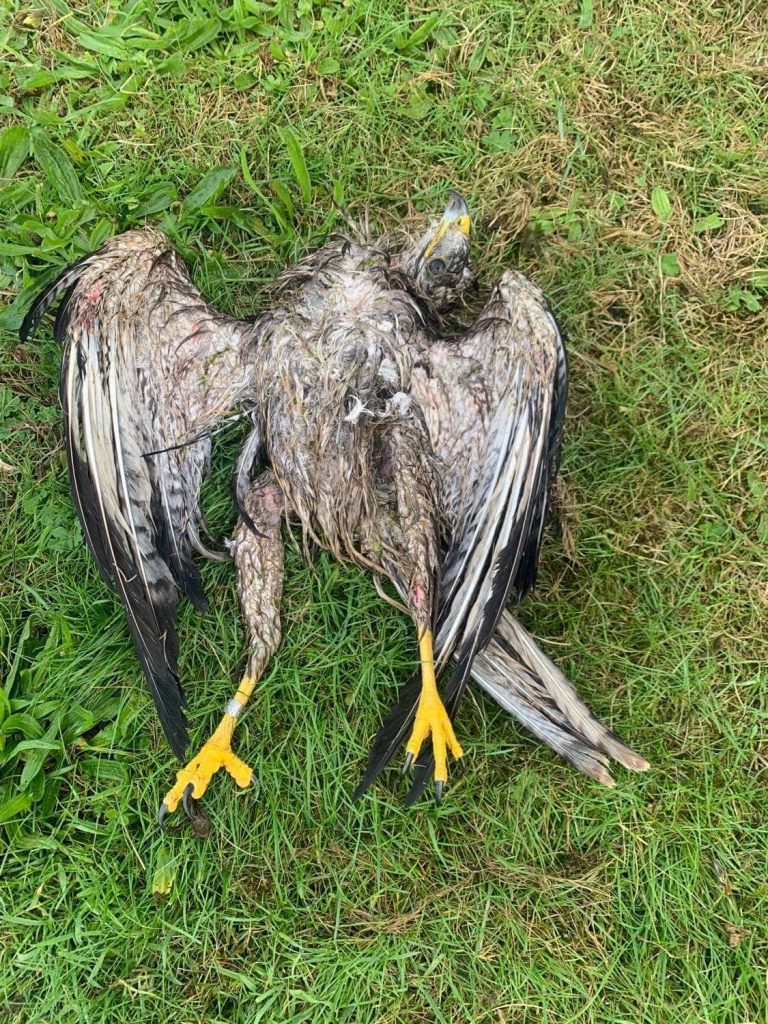
was the subject of the report. Ringed as a juvenile, female Buzzard, she was found dead on playing fields adjacent to a nature reserve in Netherton, West Midlands: 101km and 674 days after she was ringed. Just 2 years into a life that could have lasted over a decade. The oldest recorded from ringing recoveries lived for over 30 years from the date on which it was ringed.
The person who found the bird had provided their email address so I was able to contact them for further details. Firstly, I was sent two photographs of the carcass:
There has clearly been a lot of bad weather recently, and you can see that the carcass is soaking wet. The reporter said that the carcass was not there the day before on their walk through the area, and that there had been rain overnight and before their walk when they found the bird. They reported that there was blood around the neck and the wing joint – but this carcass does not look scavenged at all.
I wondered if it might have died as a result of the bad weather and starvation, so asked the finder to weigh the bird. They did so, and she weighed in at 1kg: bang on for a healthy adult female Buzzard.
I gave the finder the contact details for the Predatory Bird Monitoring Service who were excellent and responded immediately. The bird is now on its way for a post-mortem examination and we are both waiting to hear the outcome. We will see if my scepticism is warranted. If you do come across a bird of prey carcass you can contact the PBMS at:
My last trip to Webb’s Wood was at the end of July and to say it was disappointing would be an understatement: 7 birds from 4 species in 4 hours is a poor return for our efforts. Whether this was a hangover from the extensive thinning operations in the wood over the winter or not I don’t know. Red Lodge had a similar, though not so drastic, fall off after its extensive thinning operation. However, as Red Lodge this time was put out of commission by the fly-tippers, as reported yesterday, and it has been a long while since I have been to Webb’s Wood, I decided to give it another go.
I was joined once again by Rosie, turning up to help setup, and then leaving to go to work before getting a chance to ring a single bird. Lucy is back from her travels for a month, before heading off to the Ascension Islands for the next year. I am not sure that my sites can compete with Spurn, Lundy and the Ascensions but we do our best!
Our ringing station is a long way away from the public car park, a distance of about 1.3km away, so we see few people during a session. The nets were pretty much set as we did during the July session, except for the net line shown in yellow. The tree line has expanded out to the point that I would have had to drill holes in the hardcore track to insert my poles.
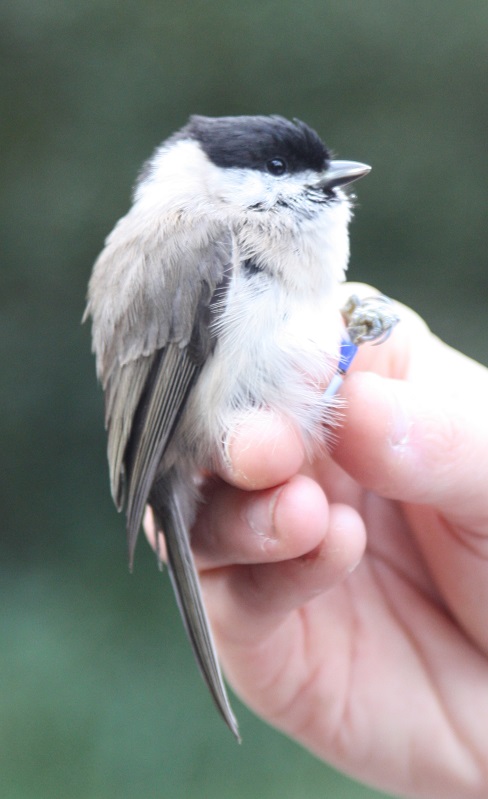
The difference this time was, being outside of the breeding season, I could use lures. I hedged my bets: Blackcap, in case there were any stragglers hanging about; Lesser Redpoll and Siskin, just in case any of them have arrived yet; Goldcrest, because they always respond if they are about (plus a cheeky Firecrest, just in case) and finally, Marsh Tit. Goldcrest worked well and Marsh Tit worked once and I caught only my eighth ringed so far this year:
We had a 7:00 start and the nets were all open just after 8:00 and we were soon busy. The first round delivered 13 birds, mainly Blue Tits. A round at 9:45 produced 10 birds, mainly Goldcrest, and things were small but regular until we got to 11:15, when we had a catch of 20 birds, primarily Great Tits.
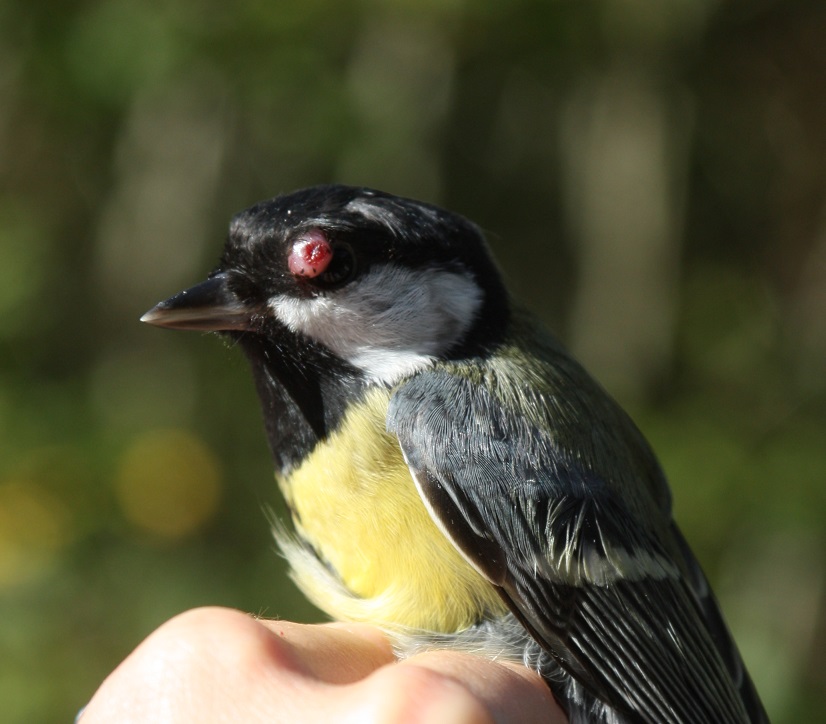
Given how few we have caught this year, it is pleasing to see both Blue and Great Tits in the catch in decent numbers. However, one of the Great Tits we caught is suffering from avian pox:
This is the first time for several years that I have had a poxed bird in my catch. I ringed it regardless. Previously I have ringed a Great Tit which, upon recapture, had developed avian but, when recaptured a year or so later, showed a few scars from the poxes but was otherwise fit and healthy. Hopefully we will recapture this bird in the future, and see it without the swelling.
The catch today was: Blue Tit 3[16](1); Great Tit 2[11](1); Coal Tit [5](1); Marsh Tit [1]; Long-tailed Tit (1); Wren 1; Robin [1](1); Goldcrest [11](1). Totals: 6 adults ringed from 3 species, 45 juveniles ringed from 6 species and 6 birds retrapped from 6 species, making 57 birds processed from 8 species.
The breeze got up at just before midday, so we shut the nets, extracting a few additional birds as we went, and took down and were off site by 13:00. Lucy has developed a new skill since she has been working at Spurn and on Lundy: taking in nets. It really does speed up the process when there are two of you doing it.
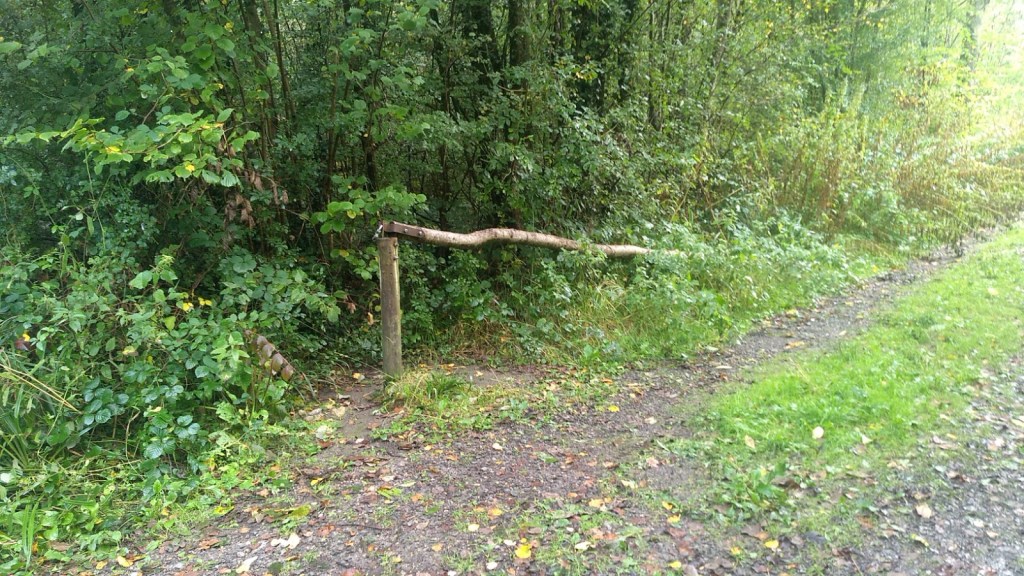
I planned a ringing session at Red Lodge for tomorrow morning, so I went to site this morning to do some net ride maintenance. This is what greeted me:
The support pillar for the log barrier has been cut through with a chainsaw.
The barrier moved out of the way and
this pile of rubble and other rubbish has been dumped blocking the main path.
This is happening all around our local area, costing local farmers and landowners, the Wildlife Trust and Forestry England, £000’s to clean up. Obviously, the people doing this are criminals, but the people that commission these people to remove their rubbish, without checking their credentials and track record, are nearly as much to blame.
Unfortunately, without getting too political, with the huge cuts in personnel to the police services, this sort of crime is not a police priority. I have offered to help Forestry England with the removal when they are in a position to do so. Whilst it is left like this it is just an invitation for more criminals to do the same. We need a CCTV camera setup ASAP.
After Saturday’s complete washout, I moved the session at Somerford Common to Sunday, knowing that it would be dry first thing, but also that the session would be curtailed by strong winds later in the morning. I decided that, as we weren’t setting lots of net, that a 7:00 start would suffice, much to everyone’s delight.
I say everyone because I was joined by Ellie, David, Rosie and Anna. Unfortunately, once again Rosie came along and helped get setup and then had to go off to work: apple picking at one of the Wildlife Trust’s orchards that had to be postponed from Saturday because of the torrential rain. One day she will get to benefit from her labours with the ringing team!
I will be setting up feeding stations in the next couple of weeks, as well as seeing the first of our winter visitors arrive. This site is good for Redwing and our most regular site for Lesser Redpoll and Siskin. We did set one net in a stand of birch trees, where the latter two species are usually encountered, but the MP3 player that the lure was on decided to throw a wobbler and not work. Plenty of charge, but the play button needed continuous holding down for it to work properly. Nobody was interested in sitting there just holding it down.
The early signs were all too typical of recent times in my woodland sites: few early birds around. The session was rescued by a decent tit-flock catch at 10:00, comprising eight Long-Tailed Tits and five Blue Tits. Over the course of the morning we caught: Treecreeper 1; Blue Tit 4(1); Great Tit (1); Coal Tit 2; Long-tailed Tit 8; Wren (1); Robin 3; Blackcap 1; Goldcrest 1(1). Totals: 20 birds ringed from 7 species and 4 birds retrapped from 4 species, making 24 birds processed from 9 species.
The BTO are looking to set up a new winter monitoring project, along the lines of the Constant Effort Site programme they run in the breeding season. This involves carrying out eight sessions, approximately every two weeks, between the beginning of November and the end of February, with nets set in the same positions, and left open for the same length of time, on each occasion. Over the years this will show fluctuations in the birds using the site knowing that the numbers are not affected by putting the nets in different places and varying the length of the session. Unlike CES, however, this will allow supplementary feeding during the period of study. I have contacted Forestry England to make sure that they have no objection to the planned use of the site in this study. They are generally very supportive of my efforts, so I am hoping for a positive outcome.
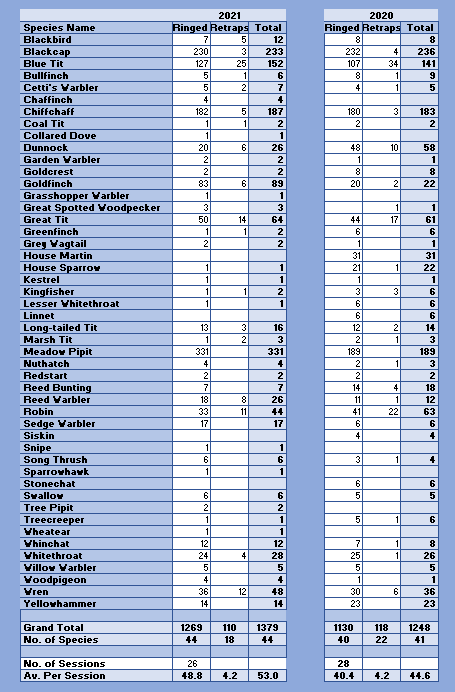
Last year’s September catch was excellent, this year’s is actually better:
This is the largest monthly catch we have had in any month since the departure of the North Wilts Group personnel and their sites. Given that, some of Jonny’s sites aside, we are not particularly blessed / cursed with extremely busy sites and large catches, and I am pretty sure that is how we like it, this is an excellent result. It’s certainly how I like it but, then, I spend most of my time training others, and that needs time.
There is quite a lot to review here. Starting with the seemingly mundane: Blue Tits and Great Tits. Up and down the country it has been reported as a bad breeding season for these birds, as has been documented in my last couple of reports, with numbers well down. So, explain this month, which more than matches 2020, a “normal” breeding season for these species. With Blue Tits, last year we caught 83 juveniles and 24 adults in September: this year it was 119 juveniles and only 8 adults. Then Great Tits: in 2020, 39 juveniles and 5 adults, in 2020, 39 juveniles and 11 adults. Any thoughts on why there is such a strong showing of juvenile birds at this time would be very welcome. It is certainly surprising.
A couple of species missing this year: House Martin and Siskin. Siskin is not that surprising, outside of those resident in the Warminster area that end up in Andy’s garden, the only catch we have had on autumn migration were those 4 last year at Ravensroost Meadows. Given that New Zealand Farm has been worked throughout the autumn migration period, that no House Martins were caught this September is surprising. Mind, none had been caught there before 2020 either. It would be surprising if that were a one-off, but perhaps it was. Equally, none were caught in the sessions at Blakehill or in Ravensroost Meadows, the only other sites they are occasionally caught at. The nearest I got to catching any were my two Ravensroost Meadow sessions in September: on the first occasion there had been no sign of any hirundines during the entire session, it was only as I was closing the gate behind me to leave site that a flock of a hundred or so Swallows and House Martins decided to fly around the pond and the adjacent meadow. On the second occasion, whilst a flock did fly over and respond to the lure, they didn’t get close enough for the net to catch any. I think the issue might be the way the pond has developed. Whereas the pond to the west of the causeway was clear of rushes / reeds, so the birds could fly in from the east, dip down to drink and then away, now there is a mass of vegetation, making that approach no longer available. In fact, the only hirundine I caught this autumn was in a net between the edge of the meadow and the pond, away from the lure.
Once again we had an extremely good haul of Meadow Pipits. Unlike last year, when nearly two-thirds of the total were caught at Blakehill Farm, and nearly one-third at Jonny’s Sutton Benger farmland site and just 3 at his East Tytherton site, the reverse was the case. Jonny had 3 catches of approximately 70 birds each at the East Tytherton farmland site and one catch of 38 at the Sutton Benger site and 38 at Blakehill. Back in 2014 I set up a Mipit triangle at Lower Moor Farm in September and caught 22 of them. For some reason I had never done it there again. With a ringing demo scheduled for the 25th, and having seen and caught the 38 Mipits at my second visit to Blakehill, plus 7 at my second visit to Ravensroost Meadows, and just seeing there were lots around from Jonny’s data, I thought I would try it again at Lower Moor – something different for the attendees. Although they didn’t make an appearance until after 10:00, we did end up with 9 there as well. Unfortunately, winds gusting way beyond what is feasible for such an open site put paid to a planned third visit to Blakehill, scheduled for the 28th September. On the equivalent session last year we caught 109 of them. Definitely a significant migration this September. I will see what I can get in early October.
Warbler numbers were generally good, with Blackcap, Whitethroat, Chiffchaff and Willow Warbler equivalent to last year, Sedge and Reed Warblers were up on last year and Lesser Whitethroat down. The numbers of Blackcap and Chiffchaff, despite the dearth of them in my catches at my sites during the breeding season, but then we caught our fair share on migration, rather underlines my thought that the rain in May just meant they kept heading north until they escaped the rain. It will be interesting to see what next year brings.
So to my highlights. I had three personal milestones this month. Firstly, I have been lucky enough to catch both Snipe and Jack Snipe at Blakehill Farm’s ponds in January 2019 and January 2020. They are the only specimens caught since the split. As I understand that a scrape is being developed at Langford Lakes, hopefully in future years we might see more regular wader catches. Now, if I can persuade the Trust to do the same at Lower Moor Farm that would be a real result. However, on my first visit to the Meadows this month I startled a Snipe, who had clearly flown in after I had set my nets, but who rapidly disappeared from view and I thought had escaped, until I saw one of the nets over the back bouncing, whereupon I recovered this beauty:
I don’t run often but in this case I made an exception! Robin, the reserve warden, told me that the odd one has been seen there, but not at this time of year.
Although I was lucky enough to ring two on Skokholm back in 2014, and despite there being loads of them moving through Blakehill Farm on both spring and autumn migration, Wheatear have eluded not just my nets, but there hasn’t been one caught by the team in over 8 years at any of our sites! So I was absolutely delighted to catch this beauty on my second visit to Blakehill:
On top of these, we had our best ever catch of Whinchat at Blakehill Farm: 10 of them on the 1st September. This is the best ever catch at Blakehill (9 on the 8th September 2018). In fact, it is the best ever catch by the West Wilts Ringing Group, beating the 9 at Haxton Hill, near Everleigh, on the 27th August 2011 (and I ringed 3 of them – I remember it well because I also extracted most of them from a single 18m 2-shelf net).
I am quite astonished at the depth of interest from people looking to join or work with our merry band. After Anna joined in last month, this month I have also been joined by Miranda, Rosie and Adam on several occasions, along with most of the rest of the team for the odd session (particularly helpful at the ringing demo were Rosie, Adam and Steph – just as David was a hero at August’s demo). Adam is a C-ringer and has worked with others in the area before, Miranda and Anna are testing the water to see if they are going to take it on. Rosie works with the Estates Management team at the Wildlife Trust and has, so far, been really helpful with the setting up before having to leave early, after only processing a couple of birds, to get to work.
So, an excellent month, let’s hope October follows suit.
Back on the 14th August, CES 11, we hosted a ringing demonstration on behalf of the Swindon Wildlife Group. The Trust limit the number of people who can attend to 20 adults, but the SWG had twice that many wanting to attend. Because we aim to please, I agreed to host another ringing demonstration for the Group today. This time we had 18 adults and a number of children attend.
To ensure that we would have a few birds to show them, I set up a couple of peanut and a couple of seed feeders in the Wildlife Refuge area 10 days before. I checked them again on Thursday and noted that the seed feeders had hardly been touched, but the peanut feeders had definitely attracted the attention of the local birds, almost certainly Blue and Great Tits. At least that meant we would have some birds to show the attendees. I removed them at the end of the session: the Trust have been having problems at the site, near the hides, where photographers have been baiting the area to attract wildlife in so they can get better photographs. This has led to increased numbers of rats and we don’t want to attract rats into the Wildlife Refuge.
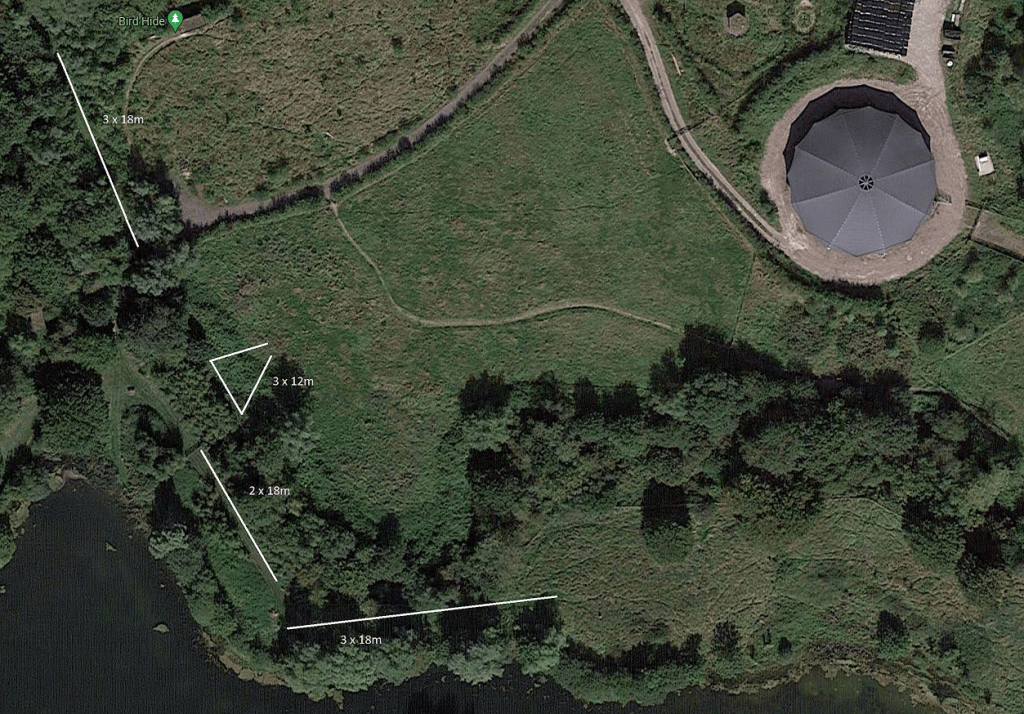
This morning I was joined by Rosie, Steph and Adam at 6:30, and we set up most of the CES nets plus, having confirmed with Jonathan, the farm manager, that he had moved his Belted Galloway bull out of the field, we set a Mipit triangle in the field behind where we usually set our nets:
Lures were set for Blackcap along the three usual rides and Meadow Pipit in the middle of the 3 x 12m open triangle. It was misty, and a little damp, early on and the mist didn’t actually start to rise until about 8:30.
Our first round, at 7:30, was quite productive and, in fact, all of our early rounds had reasonable returns. My only concern was that we would exhaust the birds coming in before the paying public arrived. In the event, I need not have worried. The birds came through in a steady, if not heavy, stream throughout the morning.
The public arrived at 9:00, just as we returned with a good haul of Blackcaps and Blue Tits (the benefits of the lures and the peanut feeders) and we started our presentation. I always give an overview of the genesis of the ringing scheme, and its contribution to the science of ornithology, as my preamble. One of the attendees asked the inevitable “aren’t the birds stressed / terrified by being captured”: to which my answer was to demonstrate a Blue Tit attacking my finger whilst I processed it. We discussed mortality statistics and how peer-reviewed studies in both the US and the UK have shown how negligible they are (both studies showed just 1 in 1,000 as a result of ringing, and the vast majority of them were to predation by other wildlife). I did my usual thing of getting the children, first, followed by the adults, once all of the children had their fill, to safely hold and release the birds. Engagement and understanding is the whole point of these sessions. That the person who asked “the inevitable question” joined the cohort who actually wanted to hold and release the birds, I suspect that I handled her question satisfactorily.
We had a few Chiffchaff and Wren enter the mix but the Meadow Pipit triangle was sadly empty from when I put the lure on at 7:30 until 10:00. Then we saw a few Meadow Pipits flying around, and the next round produced three caught in the nets. Thereafter, we had one or two in nearly every round.
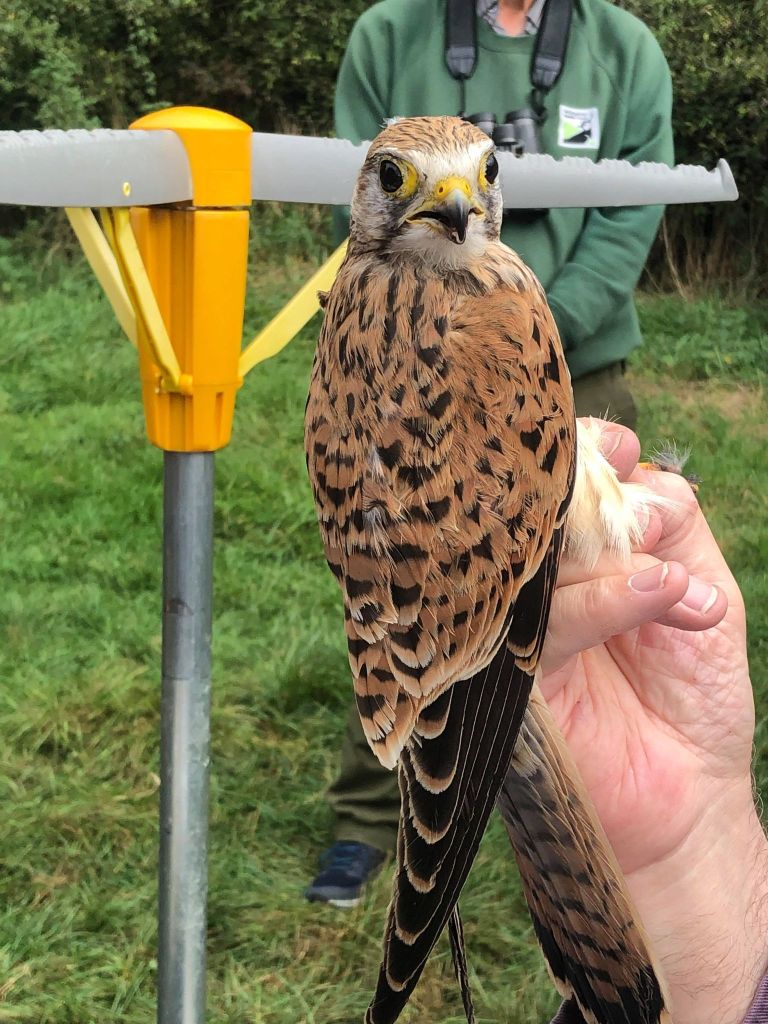
Everybody had an enjoyable time but, as things were meandering to a close, one of the families and several of the individuals were taking their leave when I was asked to go and give Steph a hand with a Sparrowhawk. I was delighted to go and help: they can be a swine to extract, and drawing blood is a regular result. This also resulted in an about turn by all of those who had started to leave. Only it wasn’t a Sparrowhawk:
Juvenile Female Kestrel – photo by Steph
She was an absolutely gorgeous bird and posed beautifully for the attendees. This is the first Kestrel that I have caught at Lower Moor Farm, and only the fifth that has been caught at any of my sites in 9.5 years, and of those I had only processed one of them myself, having given the others to members of my team, so I decided to do this one myself.
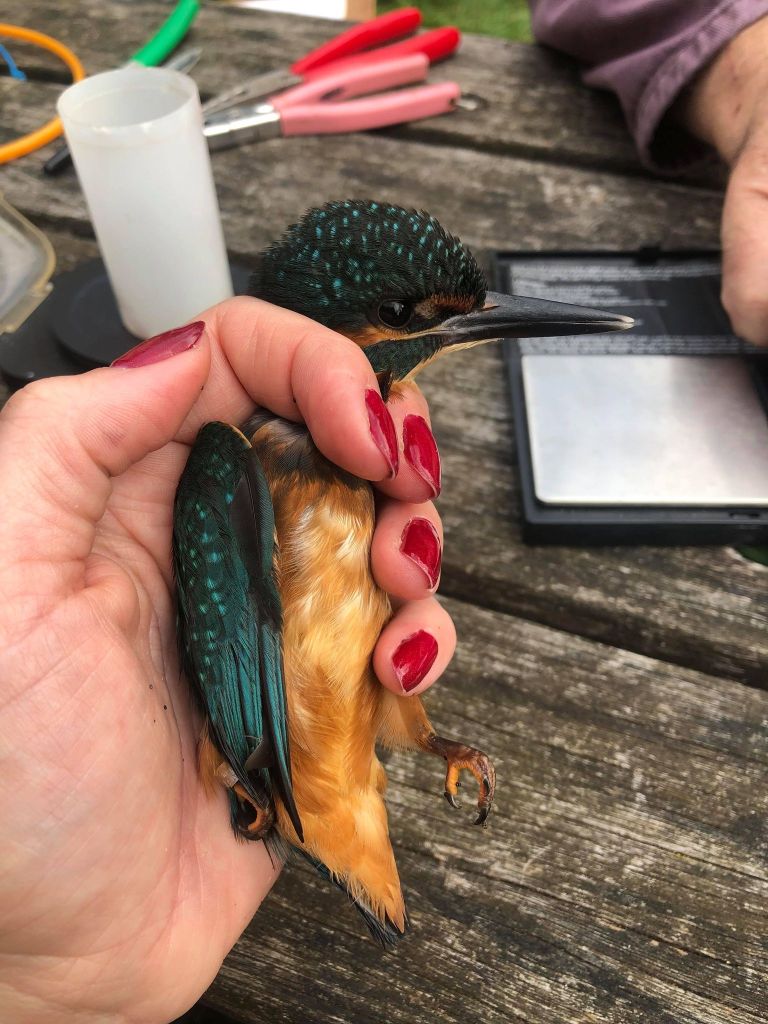
Having processed this final catch of birds, it was approaching midday and I decided to bring the session to a halt. The attendees left and we did a final sweep of the nets, closing them as we went. Only, as Steph and I were closing out the last net ride, she noticed a bird in the furthest net away and it turned out to be this:
Juvenile Male Kingfisher – photo by Steph
Unfortunately, by this time all of the attendees, apart from the dad and his daughter, who is a friend of Lillie, Steph’s daughter, had left so they did not get the chance to see it. However, we were able to delight an elderly passing couple who, by coincidence, turned out to be the grandparents of another friend of Lillie and her attending friend.
The list for the day was: Kestrel [1]; Kingfisher [1]; Blue Tit 2[25](3); Great Tit [3](3); Long-tailed Tit 1; Wren [1](2); Meadow Pipit [9]; Robin (1); Blackcap 5[17](2); Chiffchaff [4]. Totals: 7 adults ringed from 2 species; 1 full-grown but unaged bird ringed; 61 juveniles ringed from 8 species and 11 birds retrapped from 5 species, making 80 birds processed from 10 species. This just happens to be my biggest catch of the year so far.
Many hands make light work, and we were off site a little after 13:00. It was, without doubt, the best ringing demonstration I have carried out – and big thanks are due to my team for their help, support and their skills.
As noted in my previous post, Saturday’s excursion to Ravensroost Meadows had to be postponed due to my car’s clutch failing. Thanks to my good lady wife, I was able to get out today. Given that her vehicle is a Ford Ka, I had to flatten the seats, including the passenger side front seat, and organise the poles diagonally, to get them in. So I chose to just take the bare minimum that would fit into the car. Fortunately, that meant that I could set all of my usual nets. Unfortunately, today Meadow Pipits decided to arrive en masse at the site, and I didn’t have the equipment to set up a Mipit triangle. I have caught Meadow Pipit there before, but two singles (2014 and 2015) and one double (2017), all in September. As you can see, it is not a prolific catch for this site. Today’s was the largest flock I have seen there, on a par with some of those seen at Blakehill. Hopefully they will still be around for the next week or two and I can have a proper go for them. (The car will, hopefully, be fixed tomorrow!)
Rosie, from the Wildlife Trust’s estates management team, joined me at 6:00 to help set up the nets. It was misty and a bit chilly at first, so very little bird movement. We did have a couple of Swallows flitting around in the gloom, but nothing caught until just after 8:00, by which time Rosie had to leave to get to work! She is going to join me again on Saturday to help set up for the ringing demonstration. That should enable her to actually process a few birds although, again, she will have to leave early to go to work, but not quite so early as today. Hard taskmasters!
Once the birds started moving I was getting rounds of 3 to 5 birds each time, with one round at 11:15 delivering 10 of them. As is usual at this time of the autumn, the majority of the catch were Blackcap. About 9:30 a mixed flock of 50 or so Swallow and House Martin flew over and around the site. I was playing a lure for Swallow but they were just flying down and away, rather than getting caught in the net. The difference this year, from previous where we have caught Swallows and Martins in the nets, is that the pond this year has a substantial growth of rush and reed either side of the causeway. We would catch them coming in to drink from the pond, as it was a natural flyway, in and away, that now no longer exists. Time for a rethink perhaps.
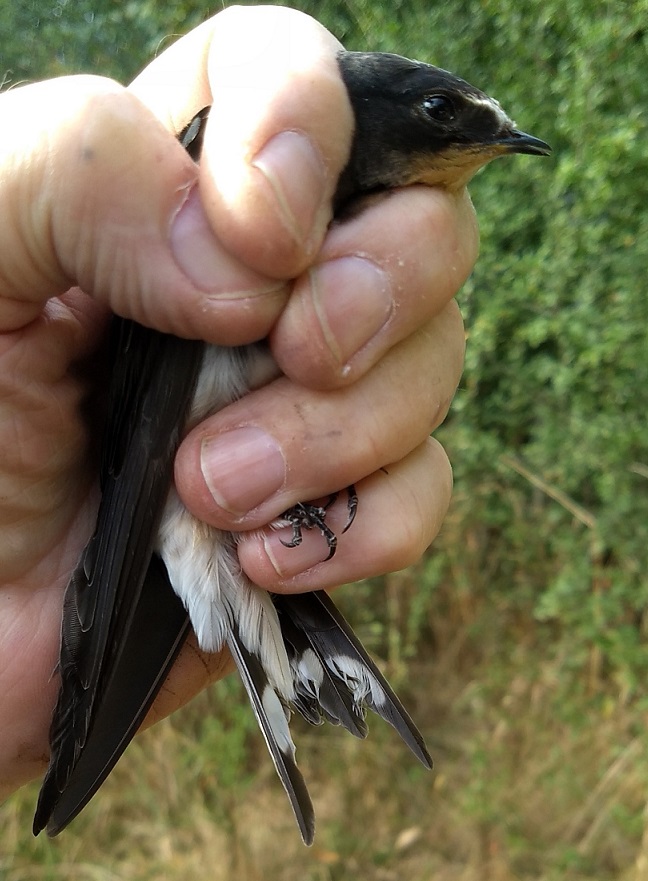
As luck would have it, one juvenile Swallow did blunder into one of the nets – the one along the bank nearest the meadow itself. My first of the year:
Swallow juvenile – being held gently before release, not being throttled(their legs are too short for a normal photo grip)
After the Swallows and Martins passed over, they didn’t hang around, I did see the previously mentioned flock of Meadow Pipits. I changed the Swallow / House Martin lure to Meadow Pipit, and watched them fly in and sit on the top line of the nets, as is par for the course. As I walked towards those particular nets they flew back out into the meadow, but two of them hadn’t been quite so clever. After I had processed them, I had a look out into the field and about 20 of the Meadow Pipits were sitting on the boundary fence between the meadow and the pond area. So I walked out into the field and then along behind them, to encourage them to fly back into the pond area, which they very obligingly did. On my next round there was another six of them in the nets. Four were in the 9m net on the spit: a net that had caught absolutely nothing all year, and I was debating with myself whether to continue to use it. Unfortunately, I had to extract a spinning, double-pocketed Wren before getting to the Pipits, and one of them had managed to extract themselves from the net by the time I got to the spit. Still, a total of seven Meadow Pipits (six juveniles and one adult) is the best catch of them that I have had at this site.
The list for the day was: Swallow [1]; Blue Tit 1[3]; Great Tit [1]; Wren [2](1); Meadow Pipit 1[6]; Song Thrush [1]; Blackcap 1[17]; Chiffchaff [2]; Goldcrest [1]. Totals: 3 adults ringed from 3 species, 34 juveniles ringed from 9 species and 1 retrap, making 38 birds processed from 9 species. The recaptured Wren was also a juvenile bird.
Sat at the ringing station before the first round, Rosie noticed a yellow moth flying around. It very obligingly sat on my knee. I slowly reached for my phone to get the camera app – only it wouldn’t accept my fingerprint (moisture) and, just after I finished entering my 4-digit security code, the moth flew off! There were several more seen throughout the morning: Sallow – a September / October flyer. Still plenty of Common Darter flying around, many in copulating pairs, but the love story of the morning was this:
Mating Slugs – tentatively Deroceras laeve – the Marsh Slug
It is clearly not a rapid process for these hermaphrodites. They remained engaged for over an hour before separating. The brown morph stayed put for another 20 minutes or so, whilst the black morph headed off into the vegetation. Eventually the brown morph headed off in the opposite direction: clearly a one-morning stand. To be clear, apart from the photo, I was not voyeuristically stood there watching them, I just took note as I passed their love nest whilst doing my net rounds.
The other very noticeable thing this morning were the number of Dog Rose plants with these stunning Bedeguar / Robin’s Pincushion galls:
Robin’s Pincushion Gallcaused by Diplolepsis rosae
At about midday the breeze got up and some of the nets started billowing, so I packed up and went home. A very satisfying morning that was just a couple of steps away from a brilliant session.
I was not planning to ring in the garden this morning: I was hoping for a session at Ravensroost Meadows luring for Swallows and House Martins, but my car had other ideas and burned the clutch out as I returned from setting up a couple of feeders at Lower Moor Farm for next week’s ringing demonstration last Thursday. Quite astonishingly, although the instantly recognisable stink of a failing clutch kicked in as I left the site, I managed to get the car home and parked up in its usual position before the clutch failed completely. Now the pedal goes to the floor and won’t return, so the gears can’t engage. My friendly local mechanic will, hopefully, have it fixed before next weekend.
As a result, I decided to set up in the garden. Just 2 x 6m nets, one either side of the feeder set up: an arch feeder support with 2 x Sunflower Hearts; 1 x Fat Balls feeders (X1 on the diagram) and 1 x Peanuts (X2 in the apple tree). This is my setup:
The nets are red 1 and 2. Interestingly, only net 1 caught any of the birds. I did notice flocks of Goldfinch flying in and out but their ascent and descent has been virtually vertical, so I have caught a few, but only a fraction of what is actually coming in to the garden.
This was my favourite catch of the morning:
Collared Dove juvenile
Since the ringing group came into its current structure, at the beginning of 2013, we have ringed only 6 Collared Doves: 2 in Andy Palmer’s garden in Warminster and 4 in my Purton garden. It isn’t that they aren’t common, they are, but they are very good at getting out of mist nets. This is a juvenile: the iris is a dark brown colour, which is a diagnostic feature.
Apart from that, a number of Woodpigeons managed to blunder into the nets. One key feature of the Merlin nets I use in my garden: they are strong enough to hold these heavy birds without ripping: they all weighed in at just under half a kilogram. All three were juveniles: but one was very young. As you can see from the photograph, it doesn’t yet have its white collar:
Woodpigeon juvenile
The rest of the catch was as expected: Blue and Great Tits and Goldfinch, as follows: Woodpigeon [3]; Collared Dove [1]; Blue Tit 2[12](4); Great Tit [2]; Goldfinch 3[8]. Totals: 5 adults ringed from 2 species, 26 juveniles ringed from 5 species and 4 birds retrapped from 1 species, making 35 birds processed from 5 species.
There were actually 27 juveniles processed. One of the Blue Tit retraps was a juvenile ringed just 6 days ago in my session at Blakehill Farm. Some post-fledging dispersal going on. It is of interest to me because of some recent discussion after the release of a paper looking at the possible impact of feeding robust resident birds on those that do not participate and are less aggressive (everything is less aggressive than Blue Tits), e.g. Blue Tits vs Marsh Tits. I intend to blog about this when I have reread the paper and done a bit more analysis from our group records.










 Ringing In The Braydon Forest & Beyond