Somerford Common: Saturday, 3rd November 2018

With winds forecast to be gusting to over 30 mph in Wiltshire today, I had to abandon the planned visit to Brown’s Farm.  It is far too exposed, sitting atop the hills south of Marlborough. Instead, Annie Hatt and I headed to one of the more thickly wooded parts of Somerford Common.  I put up a couple of peanut feeders and put seed onto the bird table on Friday morning, to ensure that we would have a reasonable catch.

It is Annie’s first trip out for quite a while, due to pressure of work, so I decided to keep the number of nets low and easily manageable.  We had 3 x 18m nets down the main path and 1 x 12m parallel to the path and behind the feeders.  The aim being to catch birds coming in and out of the feeding station.  The strategy worked: the nets were untroubled by the wind, we had a good catch of birds and they came in a constant and manageable flow.

We know that our catches are going to be dominated by Blue Tits under these circumstances but, with a new BTO-backed study being run on this species, there is plenty of data available.

The list for the day was: Nuthatch 1; Treecreeper 2; Blue Tit 10(6); Great Tit 4(1); Coal Tit 7 (4); Marsh Tit 1; Long-tailed Tit (1); Wren 1; Robin 1; Blackbird 2; Goldcrest 10; Chaffinch 1.  Totals:  40 birds ringed from 11 species; 12 birds recaptured from 4 species, making 52 birds processed from 12 species.

Amongst the decent haul of Coal Tits was D664806, which was a juvenile ringed in October 2013. It has been caught on four other occasions, including this.  According to BTO Bird Facts, the typical lifespan is 2 years, the oldest is 9 years and just under 3 months, so it is doing well, but has a few years to go before threatening the record.   We ringed our thirteenth Marsh Tit of 2018: we need another 11 in two months to match the excellent total of last year.

Soon after we had emptied the nets from the first round and were sat processing the catch, we had a female Sparrowhawk fly along the length of the net ride. It is a wonderful sight, watching this magnificent bird of prey flying directly towards you.  Better than that, no more than 10m away from us, it veered up and into a tree adjacent to the ringing station and sat there, had a good look at us, before flying off.

We closed the nets at 12:00 and spent the next hour removing leaves from the nets as we packed away: it is an occupational hazard of ringing att his time of year.


The Firs: Thursday, 1st November 2018

We were asked to do a session for the Wildlife Trust’s Wellbeing team, so we moved our scheduled session from Wednesday to Thursday: something we are always happy to do.  I had set up a feeding station on Tuesday, hoping that it would ensure we had a few birds for the session.   The birds had clearly found the feeders, as the peanuts and seed mix had been reduced by one third.

As luck would have it, Wednesday was dry and sunny, Thursday was overcast and showery.  Andrew Bray and I arrived at 6:30 and set the nets.  We only set nets down the central glade, as there was just the two of us.  Immediately, we had opened them we had to shut them, as it started to rain.  We were able to open them just after 8:00 and got a good first round of 18 birds in.  The rain started again at 8:30, so we closed the nets again, able to open them at 9:15.  It seemed that as soon as we opened them birds started flying in.  The rest of the morning remained dry – apart from the water continually dripping off the trees every time there was a breath of wind.

The list for the day was: Great Spotted Woodpecker (1); Nuthatch 1(3); Treecreeper 2; Blue Tit 14(19); Great Tit 2(7); Coal Tit 4(2); Marsh Tit (2); Long-tailed Tit 2(2); Wren 1(2); Goldcrest (2).  Totals: 26 ringed from 7 species; 40 birds recaptured from 9 species, making 66 birds processed from 10 species.

We caught a Great Tit, which was one of the first I ringed after getting my C-permit, D056678. This was ringed as an adult, just up the road in a private site on Wood Lane, in October 2012, so it is at least 7 years old. Typical lifespan of Great Tits is 3 years, but the oldest known, from ringing, is a massive 13 years 11 months and 5 days.

Any session where we catch four Nuthatches is a good session: three recaptures and one new bird.  Add in a couple of recaptured Marsh Tits and Goldcrests plus two new Treecreepers and it becomes a very good session.

The Wellbeing group arrived at just before 10:00, and we were able to show them a wide range of different birds.  Jo Woodhams and Chelsie Phillips, valuable members of the Wellbeing Team, had organised the group and persuaded them to get to site an hour earlier than they would normally start.  It was a diverse group of varying ages.  One thing they all had in common was a real interest in the birds we showed them.  Several were knowledgeable, but this was the first time they had been able to see them up close, and they were delighted.

Blakehill Farm: Wednesday, 24th October 2018

With lots of reports of Redwing arriving, and the team catching several on Friday and Saturday at Battlesbury Bowl on Salisbury Plain, we headed for Blakehill Farm to see whether they had arrived for us yet.  They are a little later than last year: our group’s first last year was on the 11th October at Somerford Common.  Last year was a quiet one for Redwing at Blakehill: the perimeter fence had a severe pruning in the early autumn which reduced its value as a food source.  As a result, we caught none there between October and Christmas 2017, compared with 79 in the same period in 2016.  This year, the hedgerow is looking so much better, as a result of the pruning, and full of haws and sloes, so we are hopeful of a restoration of the catch this year.

The day was set to be fair and virtually windless, so just right to have a session at Blakehill.  I was joined by Ellie, Jonny, Steph and Lillie.  We arrived to a clear morning and set nets along the perimeter track first: to target Redwing coming out of roost, before heading onto the plateau to set the Meadow Pipit and bush nets.  As we were setting these nets the temperature dropped and a ground mist formed: which also stopped the birds moving for a while.  I had good views of a fox moving across the plateau in one direction and, a little later, a hare running off in the opposite direction.

We set a couple of lures running, for Meadow Pipit and Redwing.  Both worked.  The list for the session was: Blue Tit 1; Great Tit 1; Long-tailed Tit 3; Wren 1(2); Meadow Pipit 8; Redwing 8; Chiffchaff 1; Goldcrest 2; Linnet 3; Reed Bunting 7(1).  Totals: 35 birds ringed from 10 species; 3 birds recaptured from 2 species, making 38 birds processed from 10 species.


Ravensroost Wood: Saturday, 20th October 2018

It seems like an age since we were last in Ravensroost Woods.  Most of our sessions are carried out in the coppiced area at the south of the wood.  Today, for a change, we decided to ring in the area to the north of the bridle path to see whether it would be any different.  I was joined by my two C-permit holders: Ellie Jones and Jonny Cooper.

The session started in fairly thick mist, which lifted only slowly, keeping the temperature cold and the birds in bed.  We caught small numbers regularly throughout the morning and ended up with a total of 40 birds.  Given how little ringing we have done in that part of the wood recently, it was good that one-fifth of the catch were recaptures.

One Blue Tit in particular was a nice recovery: ALC4992 was ringed in Red Lodge on the 10th October this year.  It is only 3km, but still a surprise when this sort of thing occurs.

The list from today: Nuthatch 1; Treecreeper 1; Blue Tit 4(3); Great Tit 6(3); Coal Tit 5; Marsh Tit 1; Long-tailed Tit 4; Wren 2; Blackbird 1(1); Chiffchaff 1; Goldcrest 6; Chaffinch 1.  Totals: 33 birds ringed from 12 species; 7 birds recaptured from 3 species, making 40 birds processed from 12 species.

My highlight of the session was our twelfth new Marsh Tit of the year, but 5 Coal Tits and 6 Goldcrests at this time of the year, with no feeding stations set up, is always a pleasure.

Red Lodge: Wednesday, 10th October 2018

This Wednesday I was joined by Jonny Cooper and Andrew Bray for a session in Red Lodge Plantation.  Jonny and I having temporarily weaned ourselves off Meadow Pipits and Reed Buntings to have a look at some woodland species.  The site is a fairly contradictory place and you can never be sure of what you will catch.  In 2015 / 16 there was some fairly extensive thinning of the Beech wood, allowing the undergrowth to thicken somewhat, but it still seems relatively clear of what I consider sustenance trees and shrubs: Hawthorn, Blackthorn, Bramble, etc. However, since the thinning, the catches have improved in both number and diversity.  We now catch the odd finch species in there and, a couple of years ago, a juvenile Spotted Flycatcher.  So it is certainly a site well worth the visit: even if it is always titmouse heavy.

In the winter the main track becomes impassable for all but high clearance vehicles but, at the present, I can get my vehicle past the deepest ruts and excavations and further into the wood.  This enabled us yesterday to set our nets in the three best catching spots: two of which happen to be adjacent to small ponds and one by the large pond near the entrance:

redlodge

We caught 80 birds at our last session in August, and we always prefer to catch a number that gives us enough time to process all of the birds and do all of the bio-metric assessments without stress to (most importantly) the birds or the team, so we restricted ourselves to just these net positions.

It was just as well: we caught 94 birds today.  Both catches are quite surprising as I haven’t set up any feeding stations yet.  However, there does seem to be a definite trend of improving catches at the site, since the thinning operations.  The list for today was: Nuthatch (1); Treecreeper 1; Blue Tit 25(4); Great Tit 13(6); Coal Tit 3(1); Marsh Tit (1); Long-tailed Tit 6(1); Wren 7(2); Robin 3(1); Blackbird 3(1); Blackcap 2; Goldcrest 12; Chaffinch 1.  Totals: 76 birds ringed from 11 species, 18 birds recaptured from 9 species, making 94 birds processed from 13 species.

It is a good catch: we also heard, but did not catch, Lesser Redpoll during the session. We did have one Chaffinch that was suffering with the Fringilla Papilloma Virus, so it was released from the net without ringing it.   Also, as we were packing away the nets at 12:30, several flocks of birds flew through where we had just removed the nets, so it could have been a much larger catch.  I will set up the feeding stations once the temperature drops – which doesn’t look as though it is going to happen for a few weeks and one would expect some fairly heavy catches over the winter.  However, that will depend very much on what other food is available in the wood to keep the birds local.

There are several highlights in the catch: good numbers of Goldcrest and Long-tailed Tits, after small numbers for the last couple of years.  However, the absolute stand out was the recaptured Nuthatch: it did not have one of my rings on it.  Therefore, it has come in from outside the Braydon Forest area. Now, I ring all of the adjacent woodlands.  The nearest potential sources for this bird are the Cotswold Water Park, possibly Swindon Sewage Works or the woodlands to the east of Swindon, as those are the only places in the local area that are ringed regularly.  As soon as I know where it came from I will update the blog.  The furthest recorded movement of a Nuthatch in the UK is 260km: I doubt this is in that league.


Yet More Meadow Pipits: Blakehill Farm, Sunday, 7th October 2018

One of the benefits of scheduling ringing sessions for the Saturday is that, when it rains all day, you can move the session to Sunday.  As it was just myself and Jonny, I gave Jonny the choice of venue and he chose Blakehill: clearly he hasn’t had enough of Meadow Pipits yet.  We arrived on site for 6:00, in an effort to get the plateau edge nets open before it was light, and also to give ourselves enough time, given that there was just the two of us, to set the perimeter track nets. I wanted to have a shot at catching some Linnets – and they are most likely to be found in the perimeter hedgerow.

The weather was  excellent all morning.  However, the first couple of hours were very cold, with an extensive ground frost.  This almost certainly held back the birds from an early start, which was helpful in getting all of the nets open, unlike the last session.  Once it warmed up, at about 9:00, they started moving and we started catching.

Before we started our catching for the day, we were diverted by a Wheatear that landed on the gate to the central plateau, then hopped onto the gatepost of the gate in the electric fence before flying off across the field.  We had excellent views but didn’t have cameras to hand before it flew off.  Needless to say, we didn’t catch it.

The first full round of the day delivered a bumper catch of Reed Bunting. We went on to have a total of 19 in the session. We have only ever caught that many on one other occasion, on the 9th September 2016. Apart from that the largest Reed Bunting catch at Blakehill was 12.

The list for the day was: Blue Tit 5; Great Tit 3; Meadow Pipit 34(1); Wren 1; Dunnock 1; Stonechat 1; Whinchat 3; Blackcap 2; Chiffchaff 3; Starling 2; Linnet 9; Reed Bunting 18(1). Totals: 82 birds ringed from 12 species, plus 2 recaptured from 2 species, making 84 birds processed from 12 species.

This really is turning into a bumper autumn migration for Whinchat, with 15 caught at Blakehill Farm since 5th September.  We also caught our second Stonechat of the autumn. As for Meadow Pipits, well it is just remarkable: 148 birds caught in the same period, compared with a next best maximum of 47 in the whole of 2017. Prior to that we had never caught more than 20 Meadow Pipits in an entire calendar year at Blakehill.  What is interesting is that last Saturday, at Brown’s Farm, I caught 19 Meadow Pipits, where in the previous 3 years and some 15 sessions, I had only caught one.  Perhaps they have just had a really good year.  We have had one of our Blakehill birds recaptured just over the border into Oxfordshire, and on Saturday we caught a bird that was ringed some 43km south at Westdown Plantation on Salisbury Plain, so they are certainly moving around the county.

The plan for Linnets worked, with a nice catch of 9 during the session, all in the hedgerow adjacent to the lure we used.  Just before noon, I looked up from where I was sitting at the ringing station to see Jonny run from one side of the ringing site to the other.  This was the reason why:

2018_10_07Starl

We don’t catch many Starlings: they are clever birds and seem adept at avoiding capture.  Jonny was running because three of them were in the net only, by the time he got there, two of them had escaped.  That we caught another one later was pure serendipity.  The nets were kept open until 12:30, by which time the birds had become accustomed to the nets and we had a couple of empty rounds. It was a super session, just like the last two!


The Firs: Wednesday, 3rd October 2018

Ellie Jones, the Wildlife Trust’s Northern Reserves Manager and one of my most experienced team members, and I had a session at the Firs this morning.  It is a feature of how dry this year has been that I was able to wear ordinary walking boots for the entire morning.  The site is nicknamed the Braydon Bog and it is definitely not living up to it this year.
We were joined at about 9:30 by Christine Crookhall-Fallon, the Wildlife Trust’s Education and Wellbeing Officer, and a group from the Devizes School.  It was perfect timing, as we had just completed a very successful second extraction round.  The students were given the opportunity to see a range of species at first-hand and they all took turns being taught how to safely hold and release a bird (or two or three) and were given an introduction into how you age birds, and some information on how to sex those species that are sexually dimorphic.
I am always pleased by how interested these children, who are either excluded from school or in special measures, are in nature and wildlife. As Ellie and I discussed, it seems a shame that children have to be deemed difficult to be given the opportunities that these children get.  It would be nice to see some class trips to the wild for the other pupils.  The catch continued the trend of improvement since the central glade was opened up and the two small ponds dug.  With further works planned for the winter to thin out the wood and open up the canopy some more, we can look forward to monitoring continued improvements in the diversity in this small woodland.
Today’s catch comprised: Nuthatch 1; Blue Tit 21(2); Great Tit 21(2); Marsh Tit 1; Long-tailed Tit 7(1); Wren 2; Robin (1); Chiffchaff 1; Goldcrest 3.  Totals: 57 birds ringed from 8 species; 6 birds recaptured from 4 species, making 63 birds processed from 9 species.
This is our second best catch of Long-tailed Tits this year. Their numbers have decreased dramatically in our Braydon Forest catches since 2015, so we are always pleased when we catch a reasonable number. Interestingly, the best catch this year was just over the road in Webb’s Wood.  We have only caught them on 7 occasions in the Braydon Forest so far this year, out of 32 sessions (22%).  Compare that with 2017, when we caught them on 30 occasions out of 53 sessions (57%): and that was a bad year for the species.   Numbers have definitely had a massive reverse over the last few years.  I will do an extended analysis on this at the end of the year, once I have the complete data set for 2018. It would be interesting to find out if other areas are finding a similar reversal in fortunes for this species.

Brown’s Farm: Saturday, 29th September 2018

Unfortunately, none of the rest of the group were available to give me a hand for this session, so I knew it would be hard work.  As it has been a while since I was last there, I paid a quick visit to the site Friday, to do a bit of a reconnaissance mission, to decide where to put the nets.  It was a worthwhile visit: a couple of Wheatear were seen flying along the hedgerow lining the main path (you can see the details of the farm on the Sites page), there was also a Mistle Thrush and lots of Meadow Pipit in the first field on the left out of the farmyard.  We had only ever caught a single Meadow Pipit previously at Brown’s Farm so I was quite keen to try for them on Saturday.

This morning I set my nets in the first two fields both left and right of the track.  I only set 5 short rides, as I didn’t want to tempt fate and potentially get swamped. The first two hours delivered just two birds: a Robin and a Goldfinch.  Our last visit, at the height of the drought, delivered only 9 birds.  I was really hoping we wouldn’t have a repeat!  As a bit of a hedge against that, I opened up another short ride just off the farmyard itself, as there had been a few House Sparrows larking about in that area. As is typical, the next round was significantly busier and I extracted over 30 birds.  The following round produced another 20, so I shut all of the nets to the right of the track, so that I could process the birds I had without worrying about them being kept too long in the bag and, certainly, to ensure that they were in the nets for the minimum possible time.  Even so, I extracted another 17 birds in the next round, and shut the rest of the nets, as I felt that was enough (and it was 11:30 by then, the breeze was beginning to get up, and I was going to be taking down single-handedly, which can be a nightmare at this site once the wind starts pushing the nets into the hedgerows).

It was a really decent catch: Blue Tit 3; Meadow Pipit 19; Dunnock 6; Robin 4; Blackcap 1; Chiffchaff 3; Chaffinch 3; Goldfinch 1; House Sparrow 11(2); Yellowhammer 16.  Totals: 67 birds ringed from 10 species; 2 birds recaptured from 1 species, making 69 birds processed from 10 species.  The recaptured House Sparrows were a nice find: one was ringed last year, the other was ringed as a juvenile in August 2015.

There are three notable things about this catch:

  1. we have now caught 20 Meadow Pipits at Brown’s Farm, 19 in this session;
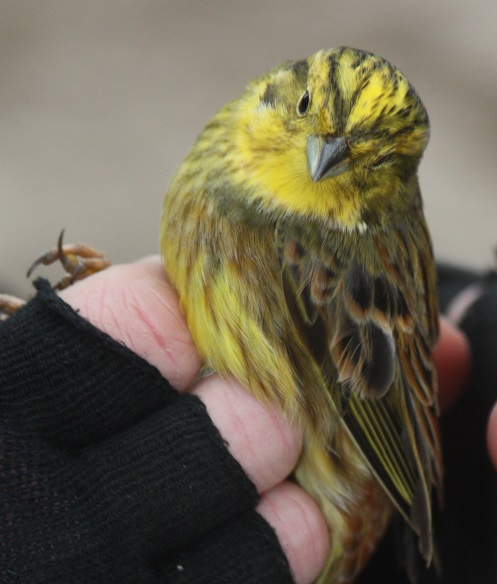
  2. this is the largest catch of Yellowhammer I have had at any of my sites, bear in mind that there is no supplementary / bait feeding at this site to attract them in;
  3. no Linnets: that is perhaps the most remarkable thing, as this is the first time we have drawn a blank with this species at the site.

All in all, a very satisfying session.  Under the previous tenants we could not ring the site in the late autumn / winter months as they ran a pheasant and partridge shoot.  The new tenant, who also owns the farm next door, has moved the cattle onto that farm, and converted the cattle byres into stables, fenced off a couple of fields as paddocks, and rented them out to a number of owners.  Perhaps thoroughbreds and shooting don’t mix. Regardless of that, it means that we can ring the site over the winter months, which will give us a chance to compare the avi-fauna throughout the entire year.

A Plethora of Pipits: Blakehill Farm, Tuesday, 25th September 2018

Some time back we had scheduled to run one of our regular ringing demonstrations for the Swindon Wildlife Group at Blakehill Farm. We normally do Saturdays but, with the 22nd September coinciding with the Wildlife Trust’s “Country Comes to Town” event, we scheduled for Sunday, 23rd September.  Unfortunately, it decided to rain torrentially for most of the day and we had to cancel.

Having caught a decent haul of Meadow Pipits at Blakehill last time out, Jonny and I decided to have a session Tuesday morning to see if we could catch a few more.  Unlike the last session, we were sharing half of the site with the Trust’s cattle: cows with calves and their superb Aberdeen Angus bull.  The electric fence was off all morning.  The cattle clearly didn’t realise, as they dutifully stayed away from the wires.  We have found on several occasions that we can safely work around the cattle.  I suppose it helps that both Jonny and I have farming backgrounds, so have experience of working around livestock, and it helps that they just don’t seem interested in our nets.  We didn’t tempt fate too much, with just two net sets in the cattle field.

At 6:00 this morning the temperature was zero degrees Celsius and the place was shrouded in mist, which was quite handy, as it didn’t lift at all until we had the plateau nets open. We never got round to setting the perimeter track nets, as we started catching almost straight away. It seemed every bush had a Meadow Pipit or three sitting atop it. The temperature began to rise and the mist lifted.  By 10:00 it was a very comfortable 23 degrees Celsius and the birds became very active.

We were confident that there were well over 200 Meadow Pipits out on the plateau.  Between 8:00 and 11:30 we caught 131 birds, of which 98 were Meadow Pipits. An excellent haul, given that we only had half our normal nets set up.

As anyone who reads the West Wilts Ringing Group blog knows, we don’t target big catches: our preference is for low intensity sessions where we can focus on each individual bird and maximise the data from each and maximise the training opportunity for the team.  As all of the major migration hot-spot sites on Salisbury Plain or the Marlborough Downs are already taken, our approach is realistic for the sites we have available.  A catch of this size is unusual for my team.  It is our second largest ever.  Blakehill is our favourite place (when we can get on it: weather and sensitivity to ground nesting birds control access), because you never know what will turn up, but we are never going to catch 200+ Blackcaps on migration because rightly, given its special status as the main lowland neutral grassland reserve in the UK, there are no large areas of low scrub so beloved by birds on migration.  However, this catch came exclusively from the small isolated bushes on the plateau’s edge.  We think that one key reason for so many Meadow Pipits being about was that there were swarms of crane-flies around the plateau.  Being an insectivorous bird this must have helped to attract them in.

Blakehill 2

This was our net set.  The yellow line is the position of the electric fence, the red lines are the nets: mainly 6m, 9m and 12m and one 18m, providing the backbone of the complex set.  Meadow Pipits are slow flying and so the traditional method of catching them is to set up an open triangle of nets with a lure placed towards the back net.  The birds are attracted to the lure and, if the trappers run toward them, through the open end of the triangle, they fly off less carefully than normal and some end up in the nets ready for extraction and ringing.  We augmented the nets in that complex with several spring traps and Potter traps (a walk in cage with a tripwire mechanism) baited with live mealworms. They were, generally, a failure, with just one spring trap doing its job. The complex itself delivered 30% of the Meadow Pipits and 3 of the Chiffchaffs, so well worth the effort.

The list for the day was: Blue Tit 4; Great Tit 2; Dunnock 2; Stonechat 1; Whinchat 3; Robin 1; Meadow Pipit 97(1); Blackcap 1; Chiffchaff 4; Goldfinch 2; Linnet 1; Reed Bunting 11(1).  Totals 129 birds ringed from 12 species; 2 birds recaptured from 3 species, making 131 birds processed from 12 species.

This takes our Whinchat total to 12 for Blakehill this year, our best ever.  It was our first Stonechat of the year anywhere.  It was a cracking juvenile male:

2018_09_25stoch

There was also only our second Linnet for the whole Blakehill complex for this year.  We recaptured a Meadow Pipit from our last ringing session.  The other recapture was a Reed Bunting, but the ring it was sporting was not one of ours.  It will be interesting to find out exactly where and when it was ringed (and whether we have correctly interpreted age and sex).

The weather was flat calm throughout the morning until just gone 11:30 when, from nowhere, a pretty strong breeze sprang up and brought our session to an end.  It was a cracking session: the birds came regularly, but not in such numbers that we couldn’t easily manage them.  The variety was good and the Meadow Pipit catch astonishing.

Tedworth House: Thursday, 13th September 2018

As Dave Turner was scheduled to be involved in a team building exercise with the Help4Heroes crew at Tedworth House today, I was fully expecting to do this one solo. It was a very pleasant surprise when he rolled up just after 6:00 to help me get set up.  A good man. Furthermore, it meant that my monthly bacon sarnie was also back on the menu, before he met up with the “team” for their building exercise at 8:30. The hash brown was a bonus!

Unlike last month’s session, this one started brightly: the first round delivering 11 birds: two more than the entirety of August’s.  In those 11 birds were 2 each of Goldfinch, Greenfinch and Blackcap plus a Chiffchaff and a Dunnock  and the obligatory Blue Tits (3 thereof).

Round two delivered another 9 birds and I was hopeful of a good sized catch by the end of the session – and then it just died off.  The day was rescued by the last catch: a juvenile female Sparrowhawk.  We don’t catch many: this is the second caught at the site in 5 years of working there and only the sixth that I have processed in my 9 year ringing career to date.  Unfortunately, there is no photograph, as I was working alone.  I was able to show the bird to one family who were visiting the site, and they were absolutely delighted to see such a stunning bird close up.

The list for the day was: Sparrowhawk 1; Blue Tit 4(1); Dunnock 1(1); Robin (2); Blackbird 1(1); Blackcap 4(2); Chiffchaff 1; Goldfinch 2; Greenfinch 2.  Totals: 16 birds ringed from 8 species; 7 birds recaptured from 5 species, making 23 birds processed from 9 species. Of these, all bar 4 were juvenile birds.  The adults were the retrapped Blackbird and one of the retrapped Blackcaps, plus one each of the Goldfinch and Greenfinch.

I did spend some time looking at the absolute carpets of fungi covering the lawn leading up from the House to the Reflection Pond. A few photos.  I have no idea what species they are except for one that I think might be Coprinus comatus: the Shaggy Cap or Lawyer’s Wig:

F5

There were several other species around. These are some of the better looking ones:

If anyone can identify them I would be delighted to find out what they are.