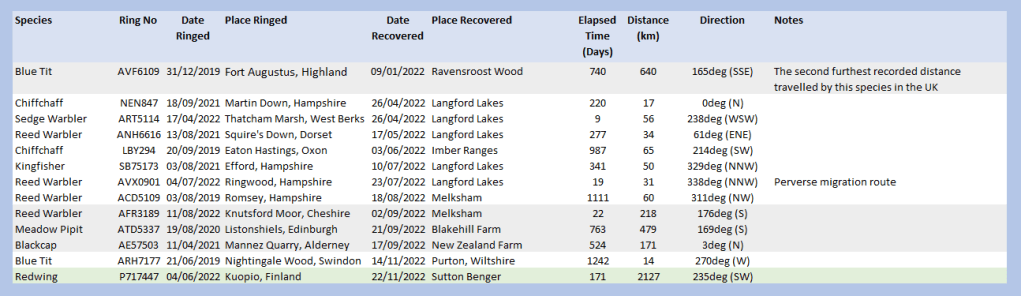
There are two tables in this part: the first is list of the birds recovered by us but ringed elsewhere; the second is the reverse, ringed by us but recovered elsewhere. The pale green band identifies foreign recoveries or recoveries of foreign birds, whilst the pale purple band identifies birds that have travelled further than 100km within the UK.
I have not included the details of the 15 birds recovered after being killed by cats.
The key recoveries in this section are the Finnish Redwing and, funnily enough, the first Blue Tit in the list. The only other foreign recovery we have had of Redwing was a bird ringed at Lower Moor Farm in October 2015 and shot by some (expletive deleted) in France in December 2017. Having just checked the BTO on-line ringing reports, it looks as though this is the furthest movement of a recovered Redwing in the UK. The previous highest was a mere 1,905km!
As indicated in the notes, I was astonished to find just how far this Blue Tit had moved. The furthest Blue Tit movement within the UK is actually 770km and the next after our one is 611km. Interestingly, there have been some foreign recoveries, but the furthest of them is 573km.
Obviously, the long distance travels of both Sedge and Reed Warbler would dwarf those of our wee movements into France, as they continue on to Africa to spend the winter.
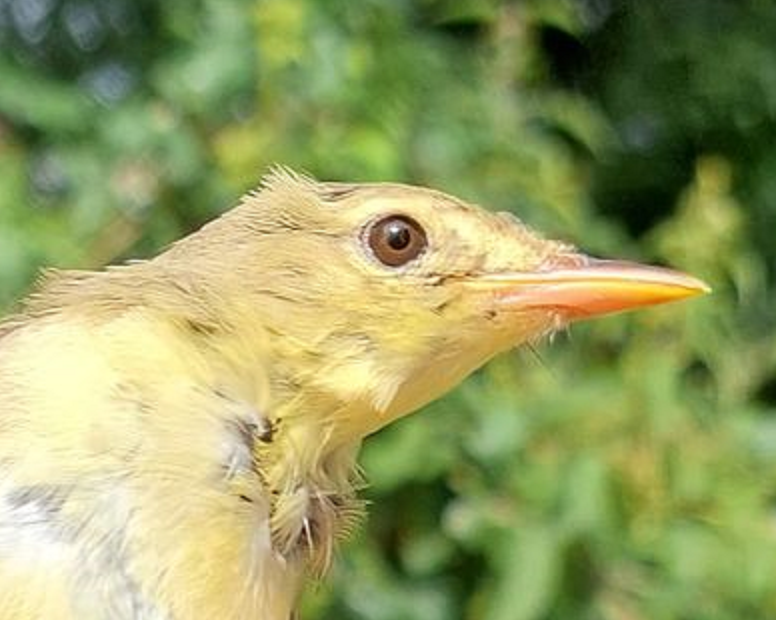
There is a lot to choose from for last year. No doubt every ringer will have their own personal favourites but some things just stand out. To me, the bird of the year has to be the Icterine Warbler caught by Jonny at the Wiltshire Wildlife Trust reserve at Langford Lakes.
This is the only record I have found of one being caught and ringed in the county by our group.
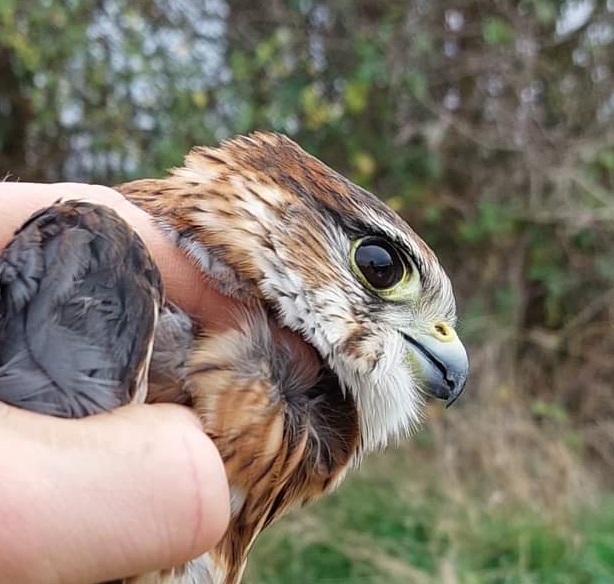
The Merlin caught by Jonny Cooper at a farmland site near Calne was another brilliant catch. Ian processed a retrap on the Imber Ranges in 2019, a habitat that I would associate with over-wintering Merlin far more than arable farmland. Whilst I understand that there are one or two other records logged with the Swindon & Wiltshire Biological Records Centre, the only other record we have of a Merlin being ringed was back in July 2003, at a site near to Beckhampton on the Marlborough Downs.
Jonny has clearly had an absolutely stellar year. In addition to these two beauties, he also caught and colour-ringed four Dipper, as part of a new project kicked off this year:
Andy and Ian had an excellent catch of three Nightjar at their Salisbury Plain sites: two at New Zealand Farm and one on the Imber Ranges. This adds to the singleton caught on the Imber ranges in 2020.
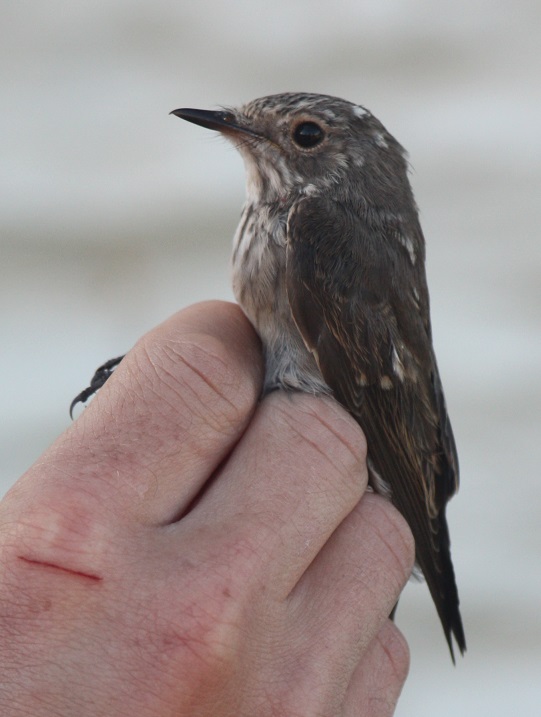
Three Spotted Flycatcher is also something of a rarity for our group. Before this year we had caught seven in the previous nine years: all within the woodlands of the Braydon Forest, from our first two in the Firs in August 2016. This year they were shared out amongst the group: Ian at New Zealand Farm, Jonny at Langford Lakes and me at the Trust reserve at Blakehill Farm. Mine, ironically, was caught in a Mipit triangle with a lure for Meadow Pipit playing:
Although we have good numbers of them at a number of locations around our sites, all ringers know that Fieldfare are a difficult catch. The Imber Ranges have provided a few good catches but Ian seems to have found a decent catching spot in an old orchard near to Erlestoke and caught six of them in the run up to Christmas.
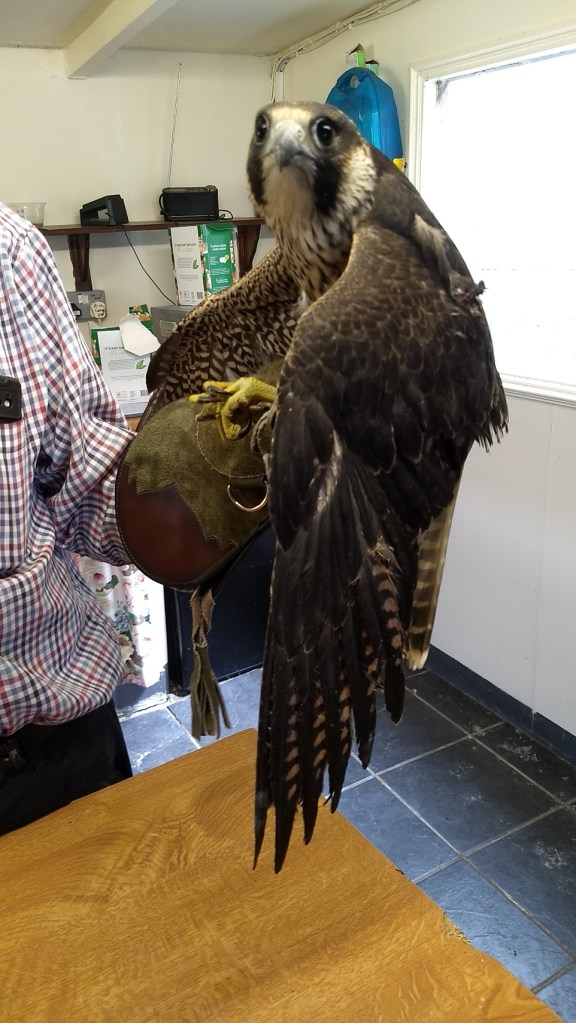
All in all, a good year for both variety and numbers and, whilst it is not the same as catching them in the wild, I am never going to forget my first experience of coming close to a Peregrine Falcon: what a magnificent bird:
In other news, I was delighted to be able to put Alice through for her A-permit. She was assessed by Oliver Padgett in Oxford and, as a result, was approved both for her A-permit and the upgrade to be a trainer, an S-permit. Between them they have set up the Central Oxford Ringing Group, so we have lost her from the group as a result.
I have also lost a few other personnel this year: Lucy has taken up a warden’s post at the Wildfowl & Wetlands Trust site at Caerlaverock; Tanya has started an ecological consultant’s post in Shropshire and so has moved to train with a ringer local to her and Annie has found working full time and being Mum to two young children just hasn’t left her enough time to continue ringing.
However, I have also gained a couple of additional trainees this year: the indomitable Rosie, who turns up to nearly every midweek, and quite a few weekend sessions, with just enough time to help me get setup and ring a few birds before heading off to her job at the Wiltshire Wildlife Trust; Miranda, who is, like me, retired and is a great help with the midweek sessions and Anna, who, having changed job from ecological consultant, which had her running all over the country and reducing her availability for ringing, has joined the Swindon & Wiltshire Biological Records Centre and will now be able to fit in more ringing sessions.
We are a small group, largely working independently of each other, except for myself, as the only active trainer in the group these days. Currently we comprise three geriatric A-ringers (in which I include myself), one young, fit and active A-ringer (who is responsible for just under 60% of our catches), four C-permit holders of varying degrees of activity, and I currently have three licensed T-permit holders, plus four children taking their first steps into bird ringing.
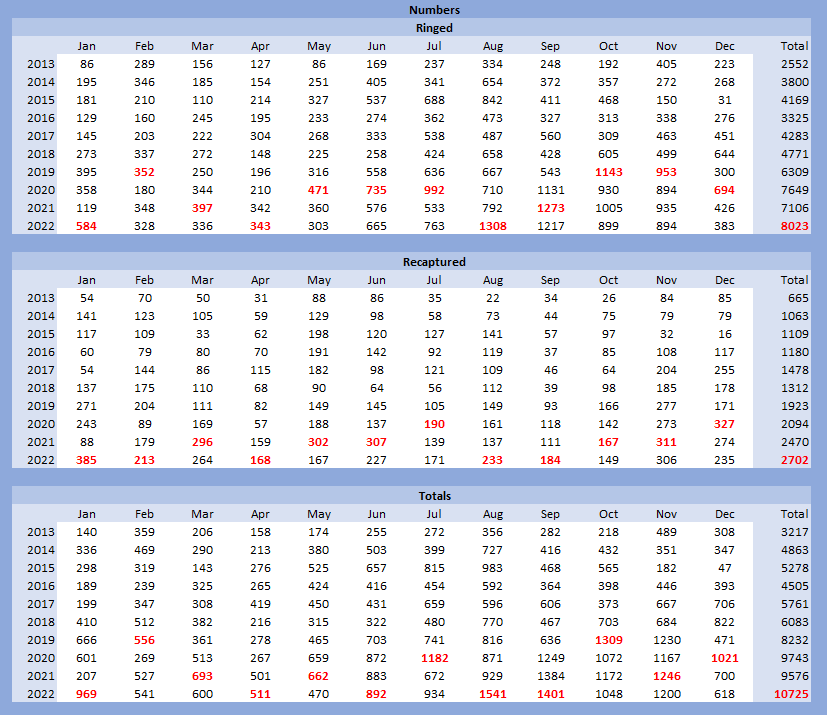
It has been an excellent year for the group in 2022. Far and away our best return in the last decade:
In only three months of the year did we have our best ringing totals, but August was phenomenal, with our best ever total of birds ringed in any month, but also the best ever stand-alone month for birds processed. Also, January was quite exceptional, with our best ringing and recapture totals for that month, with a near 50% increase over the previous best. Indeed, the recapture total for January was the best ever for an individual month. I suspect that this January is not going to be able to compete, unless this wind drops and rain ceases.
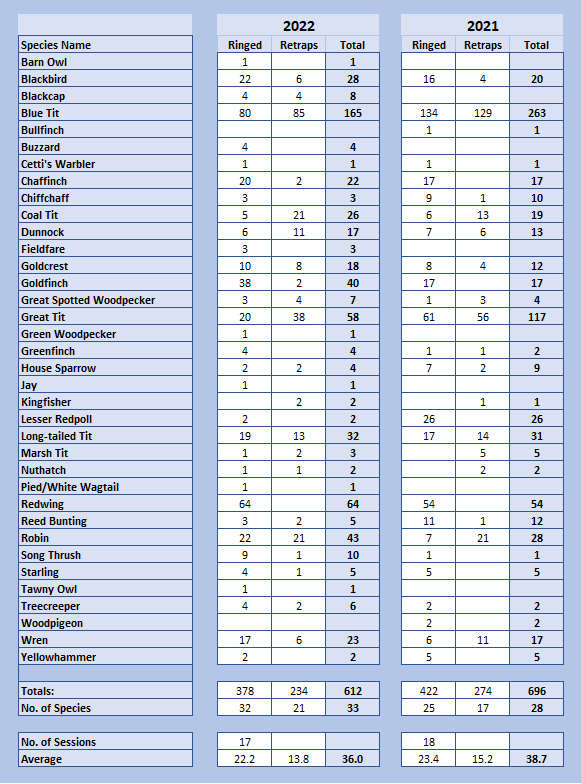
Although on the face of it we processed more species than last year, 70 against 68, in reality, the wild bird catch was 67 vs 68, as that 2022 total includes the ringing of the rehabilitated Peregrine Falcon at Mere Falconry Centre and the Buzzards and Tawny Owl at RSPCA Oak & Furrows.
(Just a note for non-ringers: N = New / Ringed; S = Subsequent Encounters / Retraps, BTO nomenclature).
It was a bittersweet year for a number of reasons. We ringed 20 Barn Owl chicks and one adult, compared to 26 chicks and one adult in 2021. However, unlike 2021, we lost 3 ringed chicks to predation at the fledging stage and had a brood at the egg / naked young stage also predated. During the drought, one of our ringed chicks became emergency rations for its siblings, as did an unringed chick at another of the boxes.
The result of the Barn Owl boxes breeding 2022 was as follows:
The predation of the three youngsters at Plain Farm was a hugely upsetting experience. I found two of the carcasses on the ground 10m and 15m respectively away from the box. All that remained of those two were the wings, which were fully grown, the spine and the legs: all still connected. Of the third, I found one wing inside the box. It is hard to know what predated the birds. I am aware that Goshawk have recently started to nest in the area. Others have suggested Buzzard or Red Kite, driven to extremes by the drought conditions this summer. Who knows?
We had a major departure from previous years, in that we got access to the stables / outhouses at Clattinger Farm, which enabled us to monitor and ring a number of Swallow nests, and one House Sparrow nest, where they had taken over an unoccupied Swallow nest. The results were as follows:
All of these youngsters fledged successfully. To be honest, the House Sparrow’s nest mates had already fledged and were on various perches in the stable. It was definitely ready to fly off and, indeed did so once ringed. If we had left it a day later I doubt it would have been there.
Plans for 2023:
Over this winter we are adding another 6 boxes to our current set up at 2 new farm locations and replacing derelict boxes at two other locations. White Lodge Farm and Greenacres Farm are new sites. White Lodge will add two boxes near to the provision at Gospel Oak Farm and Greenacres Farm will add one box near to the provision at Drill Farm and Plain Farm. In addition, the plan is to replace two boxes at Swillbrook Farm and one box at Church Farm, Brinkworth.
Also, I plan to expand the Swallow nest monitoring as I have had permission from several local people to do so at their properties.
With Monday looking to be the only day this week for which the forecast was suitable for ringing, I decided to head off to Somerford Common. On New Year’s Day I topped up the feeders at my Forestry England sites, readying Somerford for today.
I arrived on site at 7:30 and Rosie, accompanied by Rufus the Hound (a German wire-haired pointer) that she is dog-sitting for a month over Christmas. It looked hopeful: the two-litre seed feeder had been half-emptied and the peanut feeder one-third emptied since 10:45 Sunday morning. We set up the three usual nets around the feeders and set two mixed lures for Brambling, Lesser Redpoll and Siskin. We set the usual three nets around the feeders and two nets on the main track.
We were joined by two family groups: Laura and her boys, Adam and Daniel, and later husband Mark. Soon after they arrived, one of my C’s, Steph, arrived with husband Stu and girls Isobel and Beatrice. I have to be honest, I have never actually run a family group ringing session before. Obviously, I have done plenty of organised ringing demonstrations for the Wildlife Trust and the Swindon Wildlife Group, but this was different.
It was fun (which is not to say that the ringing demos aren’t fun, but this was a much more relaxed affair). Poor Rufus became a bit overwhelmed by the numbers: he didn’t know who to rub up against next, so Rosie took him off for a long walk, which also brought an end to her ringing activities for the morning. Both Adam and Daniel are becoming competent ringers and their biometric measurements are usually spot on. Perhaps more importantly, I have only given them Blue or Great Tits to ring so far and they have passed that test with flying colours! If I remember correctly, they are both using their experience towards the natural history scout badge and Daniel is also using it towards his Duke of Edinburgh Award. Happy to help.
We had a decent catch: although it was very much a question of “never mind the quality, feel the width”. The list for the session was: Great Spotted Woodpecker (2); Nuthatch 1(2); Treecreeper 1; Blue Tit 8(5); Great Tit 7(5); Coal Tit 4(5); Marsh Tit (4); Long-tailed Tit 1; Robin 1; Blackbird 1; Goldcrest 5(1); Chaffinch 1. Totals: 30 birds ringed from 10 species and 24 birds retrapped from 7 species, making 54 birds processed from 12 species.
Unfortunately, no sign of any Redwing, Lesser Redpoll or Siskin yet. The Redwing must have just moved on elsewhere: for Somerford Common in winter 20/21 we processed 29, in winter 21/22 we processed 39, so far this winter we have processed just 5. This pattern is repeated at Blakehill Farm, where we catch most of our Redwing, so I guess they have just moved on.
With respect to Lesser Redpoll, their arrival is somewhat more variable and we might yet catch reasonable numbers in January and February. As for Siskin, we just don’t catch them until February / March at this site.
Highlights of the catch for me were a Marsh Tit and a Nuthatch both of which were ringed 4 years ago, both as adults / unaged. The highlights for others were the Nuthatches, the Great Spotted Woodpeckers, the Treecreeper and what is monikered as our Ukrainian Marsh Tit: because it has a yellow / blue right leg colour ring combination.
We closed the nets at 11:30 and, with many hands making light work, had everything packed away by midday. A decent session, I just hope that the forecast changes for the rest of the week so we can get out again before the children go back to school.
Despite the weather, we did manage to get a decent number of full sessions in this month. With 8 days of deep freeze followed by a solid week of wind and rain, it was amazing that we got as many sessions carried out as we did.
The key reduction this year was in the catch of Blue and Great Tits and Lesser Redpoll. How much of that is down to access to the Firs being denied whilst the landowner is having all of the Ash removed, because of Chalara dieback I don’t know. Although the Trust manage the site, they don’t own it and this was not their decision. I am sure it has certainly impacted on my team’s catch of the two Tit species. However, the Trust’s ban on supplementary feeding this winter, acting on the “precautionary principle” with regard to the current avian flu issues, will certainly have had an impact.
In contrast to those decreases there were significant increases in the numbers of Goldfinch and Robin and, on a lesser scale, but proportionately higher, Song Thrush. There are lots of other ups and downs, as you can see from the table.
Although we processed 33 species this December, as opposed to 28 last year, three of those species were as a result of my new project working with the Oak & Furrows Wildlife Rescue Centre. They contacted me and asked if I would ring birds prior to release. I have agreed to do so (indeed, I am happy to do so) for birds of prey and Corvids plus any real oddities that might turn up.
Compared to last year, missing from the catch this month were Bullfinch and Woodpigeon. Added to the catch this year, excluding the Barn Owl, Buzzards and Tawny Owl processed at Oak & Furrows, were Blackcap, Fieldfare, Green Woodpecker, Jay and Pied Wagtail. Of those, all bar one Blackcap and the Pied Wagtail came from an old orchard in the area around Erlestoke.
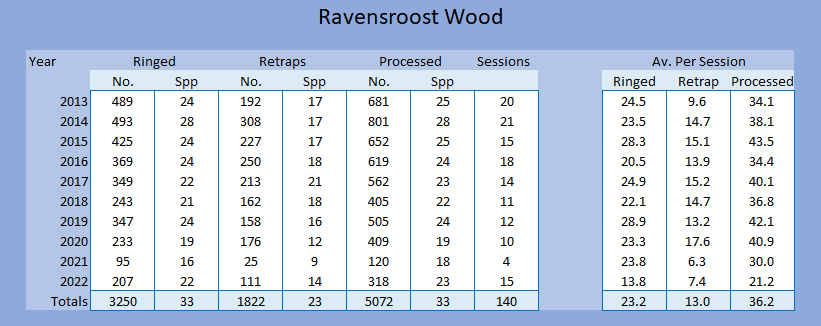
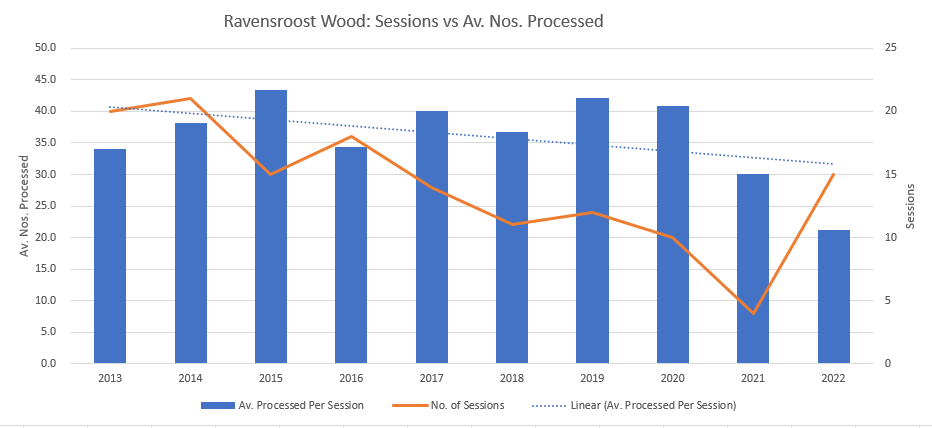
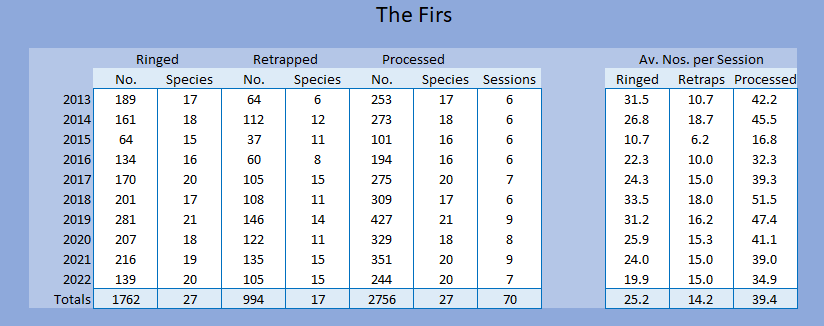
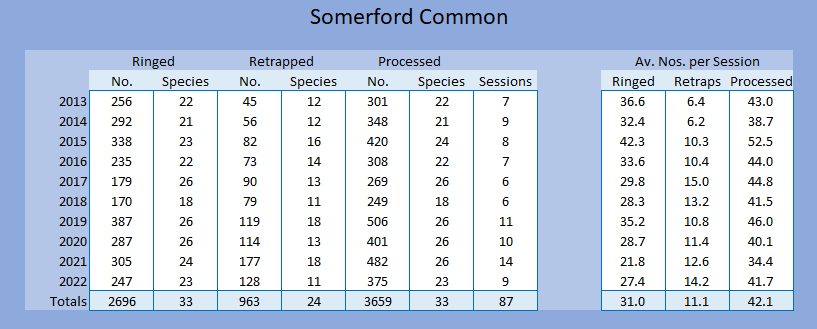
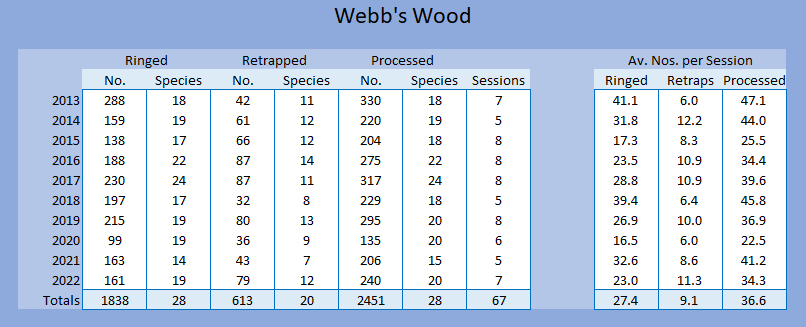
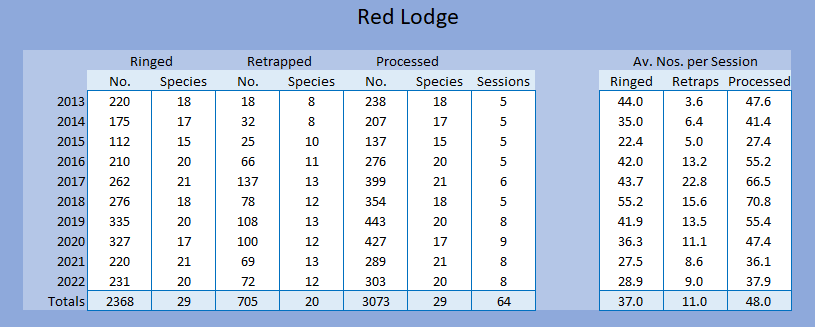
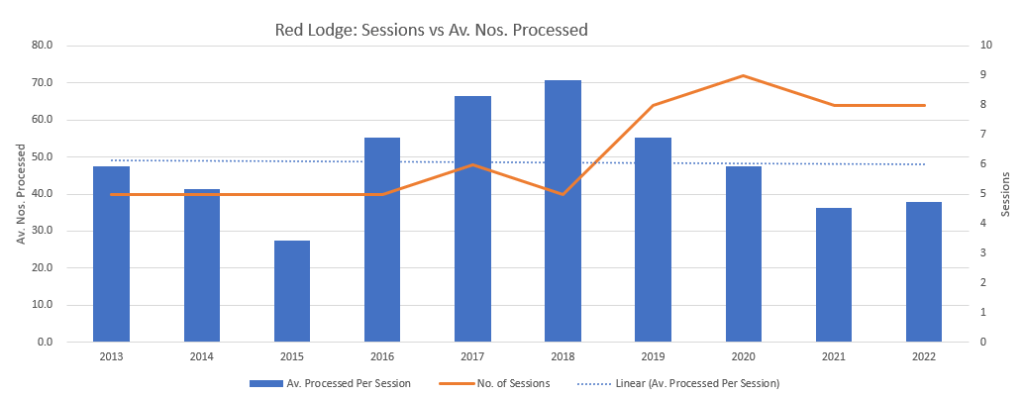
Following on from yesterday’s post I have waded through the entirety of the data from that decade and that is what follows, if you are interested, and have the stamina to look through it. For each site there is a table showing year on year statistics plus a graph comparing the average numbers of birds processed per session (columns) and the number of sessions per year (the brown line), with a trend line (blue dotted) showing the trend for each site. At the end I have consolidated all sites to give a final analysis.
Ravensroost Wood:
The Firs:
Somerford Common:
Webb’s Wood:
Red Lodge:
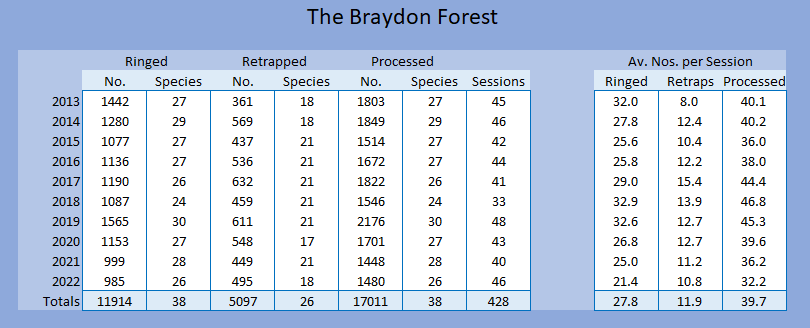
The Braydon Forest Totals:
Despite the variations in the number of sessions in each wood over the years, there is a remarkable amount of consistency. Of all sites, the Firs is the only one that shows an increasing trend in catch size over the years. It will be interesting to see what the impact of the current forestry works will have on the catches. Red Lodge shows consistency of catch over the years. Both Somerford Common and Webb’s Wood have shown a slight decreasing trend, whereas Ravensroost Wood shows a more pronounced decrease in catch size. That has certainly been driven by the reductions in the last two years. It now has the lowest average catch size of any of the sites, just below Webb’s Wood, although the catch at Webb’s was seriously affected by the thinning works removing an entire winter’s catch and the following spring catch. The overall impact is that the catch has reduced very slightly over the decade.
Somewhat to my surprise, the largest average catches are at Red Lodge, with 6 birds per session more than the next largest: Somerford Common. There is more to find out from this data. With the current forecast for filthy weather next week, perhaps there will be more of this, be warned!!!
When I moved to Purton at the end of 1997, I soon discovered Ravensroost Wood and the surrounding meadows. It quickly became my local birding patch. When I started training as a ringer in 2009 I was keen that we should ring the site. I contacted the Wiltshire Wildlife Trust, a wonderful gentleman called Piers Mobsby and, after some discussion, and a memorandum of understanding and risk assessment provided by my then trainer, we were given access. In mid-2012, having got my C-permit, I took over the site. The Trust also offered me the Firs, as they had very little information on the bird life in that woodland. Leaving Ravensroost one day I bumped into a representative of the Forestry Commission. On a whim, I asked if it was possible to get access to their woodlands in the Braydon Forest. He gave me a name and a number and, a couple of meetings later, I had the key to the gates and permission to work them.
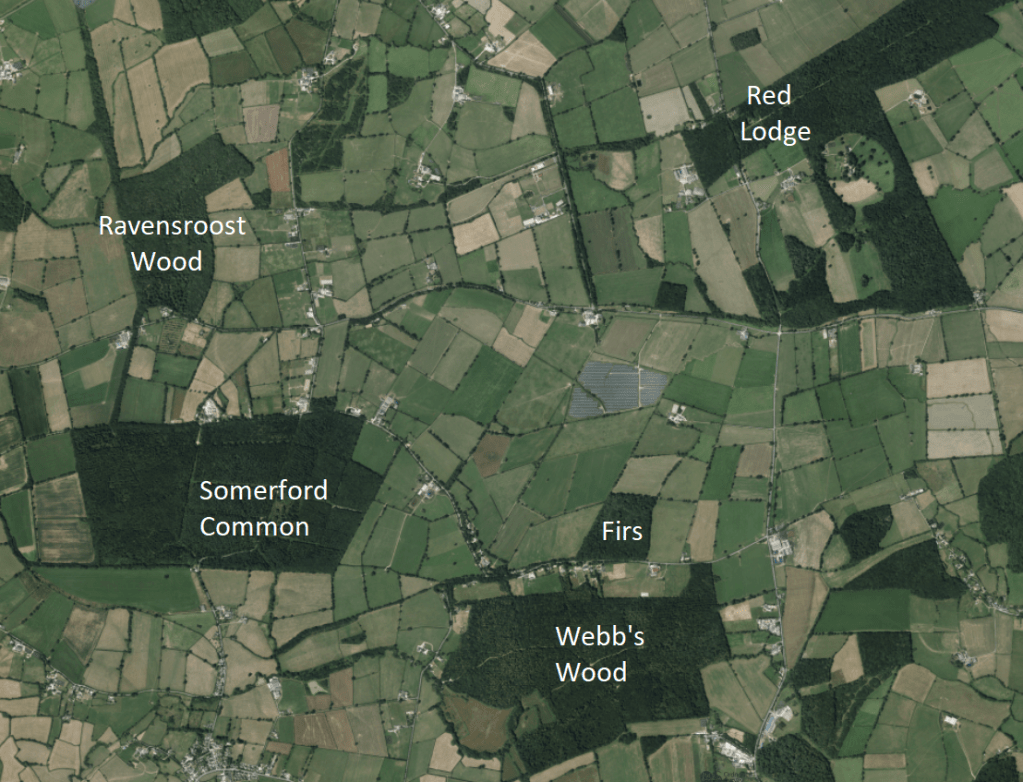
Since then, for ten full years, I and, latterly, since I got my A-permit and training licence, my team, have ringed these sites as part of an ongoing project: the Braydon Forest As A Living Landscape. I have started to do some analysis on the results so far. These are the various woodland sites:
Ravensroost Wood was my primary focus initially, as I was running a specific project looking at the impact, if any, of the 8-year coppice cycle on its usage by the local bird life. After 8-years of the project, Covid and lockdown made a natural breakpoint and I brought the project to a close. The short answer is that there was no obvious impact, almost certainly because each of the four coupes is quite small, and they are surrounded on the perimeter by much longer established woodland, which almost certainly exerts the greater influence.
Over 10 years all sites have undergone periods of change. Ravensroost has its coppicing, which also includes a 25 year coppice, that has just started to be harvested. The Firs, when I first started working there, was a dark, closed in woodland. It was very wet and the only place in the Forest where there was (and still is) a good growth of ferns. Over the years it has been thinned considerably, opening up the central glade to encourage the butterflies and moths found on the site. At my suggestion, the Trust installed two wildlife ponds halfway along the glade. Of course, it had always been in the plans, it just took someone to nudge them into action. Right now it is being trashed, as the owner (the Trust manage but don’t own the wood) has decided to remove all of the Ash, because of die-back, and is mitigating the cost by allowing the contractors to also remove significant numbers of mature oak trees. Ironically this is happening just as a new paper has been published suggesting that not all Ash trees are susceptible and resistant trees can help repopulate those other areas.
The Forestry Commission, as was, Forestry England as it now is, obviously have plans for both the development and the commercial exploitation of their woodlands but with a strong focus on conservation. Somerford Common is the most obviously commercial of the sites in that 50% of it is conifer plantation. As a result I only make occasional forays into that part of the wood. Where we tend to work is a mixed woodland / mulched paddock area (think of the Ravensroost 8 year coppicing project only, instead of coppicing, all of the brush is slashed out, leaving just the mature trees). Webb’s Wood was clear felled after World War 2 and replanted as part Beech and part conifer. Over the last 15 years or so, the conifer has been cut back and the land left fallow or replaced with native species. Over the winter of 2020/21 the Beech was heavily thinned and harvested. Red Lodge is a long-established plantation. These days, where we ring is primarily Beech, further into the wood it is primarily Oak, but there is a lot of odd stuff in between: including stands of bamboo, and there are small ponds throughout the wood. There is also a larger pond near the entrance. When I first started there the pond was drying out and pretty well useless. A word with Forestry England and the next month they brought in a JCB and restored it brilliantly. The Beech was thinned out and harvested in winter 2014/15.
Since this project began we have ringed 11,914 birds from 38 species and retrapped birds on 5,097 occasions, from 26 species, making 17,011 birds processed from 38 species.
Ringing Highlights:
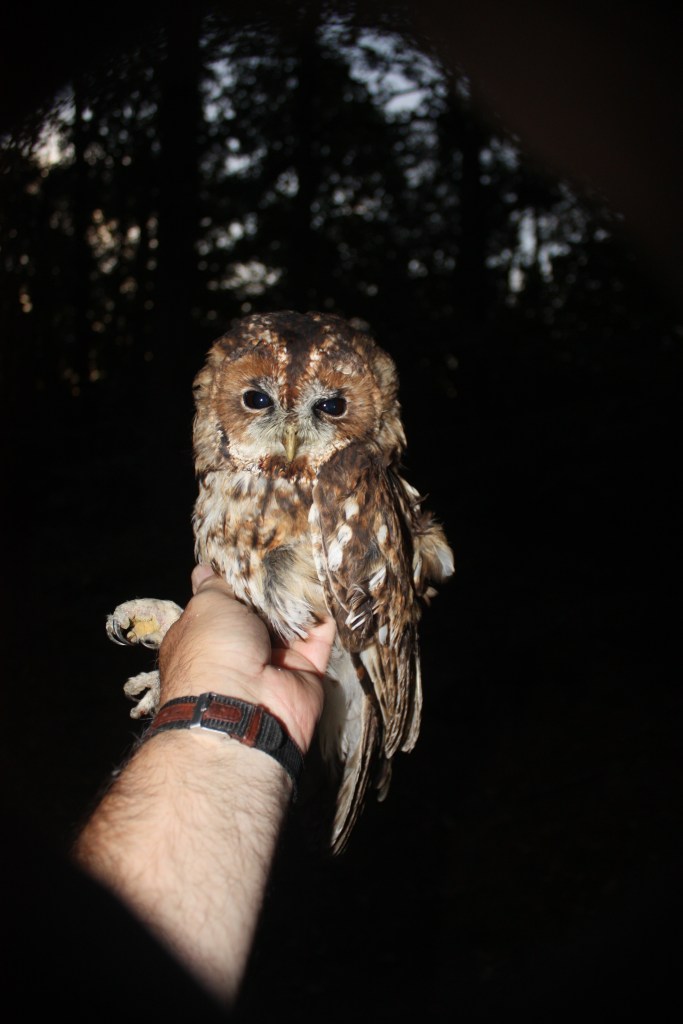
This is just a brief overview of either a few firsts for the woodlands or otherwise notable catches for me, done in chronological order. The first is an adult Tawny Owl caught in the Firs on the 1st October 2014. I had ringed one adult as a trainee and several nestlings on and around Salisbury Plain as part of a team, but this was the first (and only, so far) adult I had caught myself:
Next up was the first ever Firecrest seen, let alone caught, in Ravensroost Wood on the 22nd November 2015. Although I had done several previously, this was a stellar bird for this wood. Not only that but it was Jonny that came across it in the net, extracted it and ringed it: his first ever. After it had been ringed I got quite a few reports from other users of the wood that the bird had been seen all over the wood.
On the 3rd August 2016 the first bird out of the nets at the Firs was the first Spotted Flycatcher ringed in the Braydon Forest. Again, it was Jonny who extracted it, but I ringed it. At the end of the session we caught another, which Jonny ringed. Both were juveniles. They have been seen around the Forest for years, and they definitely breed there, but this was the start of ringing them. 18 days later we caught another in Red Lodge: Ellie found and extracted this one. We have subsequently caught them in Ravensroost Wood and on Somerford Common. Only Webb’s Wood to go for the whole set.
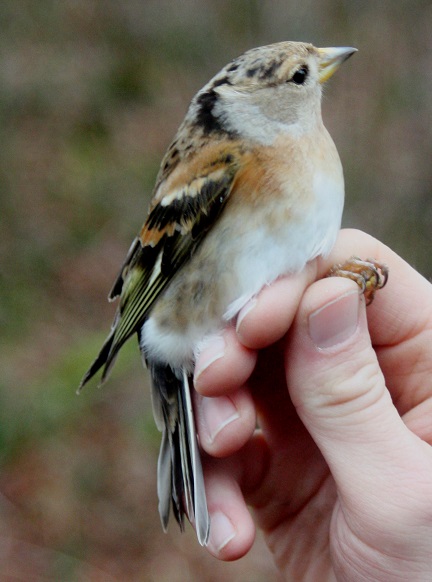
The next new bird highlight wasn’t until the 11th February 2019 at Somerford Common:
I had been jealous for years at hearing tales of Brambling being caught in the woods to the south and east of the Braydon Forest, but hadn’t seen sight nor sound of them until we caught two on the 11th, two more there on the 20th and a singleton at Ravensroost Wood on the 16th. This was also a first for Ravensroost, although someone had once reported one flying over. Another two were caught on Somerford Common in the November of the same year. They are not a common catch, being pretty hit and miss, but great when we do. Another was caught in Red Lodge in 2021, with another new and a retrap at Somerford Common. Most recently, we caught another two on the 30th October 2022 in Webb’s Wood. That just leaves the Firs for them to have been found in all sites.
However, perhaps the most astonishing catches we have had happened in the conifer plantation of Somerford Common:
Not one but two Buzzards found their way into our nets!
On the 6th November 2021 we had a very surprising catch: a Grey Wagtail (for which I, inexplicably, have no photograph). We associate them mainly with streams and rivers, but this was caught in the middle of Webb’s Wood, nowhere near any obvious water source.
Retrap Highlights:
For me there is only one place to start: JJP007 a Goldcrest ringed in Ravensroost Wood as a juvenile on 22nd November 2015 and recovered on the Isles of Scilly on the 8th March 2021. Not only is this the oldest ever recorded Goldcrest (1,933 days or 5 years 3 months and 14 days) but it looks as though it is a migratory bird so it boggles the mind as to how many miles it has flown in its lifetime.
Goldcrests have provided a couple of other good records: two of them were ringed at the Calf of Man Observatory, one in April 2019, retrapped in the Firs in October 2019, the other ringed in September 2019, recovered in Ravensroost in November 2019. That same year, a Goldcrest ringed in the Firs in the October was recovered on Bardsey Island at the Bird Observatory in March 2020. Those three movements rather establish that there is a Goldcrest migration flyway running up the west coast of the UK.
Perhaps the oddest recovery was a Blue Tit. Obviously it is a resident species and, as my previously blogged analysis shows, those that reside within the Braydon Forest are not that prone to long movements. However, in early January this year we caught AVF6109: ringed in the Highland of Scotland in December 2019. It had travelled a distance of 640km: the second longest movement recorded for a Blue Tit within the UK.
Webb’s Wood had a Blackcap, ringed in Spain in September 2014 was recovered by us on the 4th June 2016: a distance of 1,041km. Another, ringed in Webb’s on the 18th July 2014, was retrapped at Faro in Portugal on 9th October 2018: a distance of 1,667km.
Red Lodge served up a Lesser Redpoll, ringed in Yorkshire in September 2020, retrapped by us on the 24th November 2021: 422 days and 227km later. The only other movement of note from there was a Great Spotted Woodpecker, ringed in August 2018 that was caught in Northamptonshire, 77km away, in February 2019. I just think of them as being highly sedentary.
The boring stuff, numerical analyses, will follow in a subsequent post, as I am still working on it.
After the sub-zero temperatures, followed by the wind and the rain, I hadn’t managed to get out for a proper ringing session since Thursday, 15th December. Christmas Eve morning was scheduled to be dry but a bit breezy, so I decided to try out Ravensroost Wood. Given how poor the results have been in different parts of the wood this year, I decided to set up in zone 1, just along from the car park, as identified in my previous post. The zone 1 area to the east of the main path is currently being coppiced by the Ravensroost volunteers group, so we were restricted to the site to the west of the path. Not that it should be a problem: it is where I have done most of my winter ringing in Ravensroost Wood in recent years. Of course, this year we are not allowed to put up a feeding station, as part of the Wiltshire Wildlife Trust’s response to the avian flu epidemic. I was joined by Anna, and we set up 5 x 18m nets as a line of 2 and a line of 3. Whilst we were finishing the setup, Laura and her two boys arrived. We sat down and waited, checked the empty nets and waited, and waited, occasionally taking a bird out of the nets! Between 8:00 and 11:00 we caught precisely 9 birds: Blue Tit 2; Great Tit 1; Wren 1; Robin 2; Blackbird (1); Goldcrest 1(1). Totals: 7 birds ringed from 5 species and 2 birds retrapped from 2 species, making 9 birds processed from 6 species.
The last time we ringed this part of Ravensroost Wood on Christmas Eve was in 2020, when we processed 48 birds from 10 species: only that time we did have a feeding station in place. Although in reality it has nothing to do with me, I always feel guilty when we have a poor session, as I am the person who has chosen the location.
The Nice:
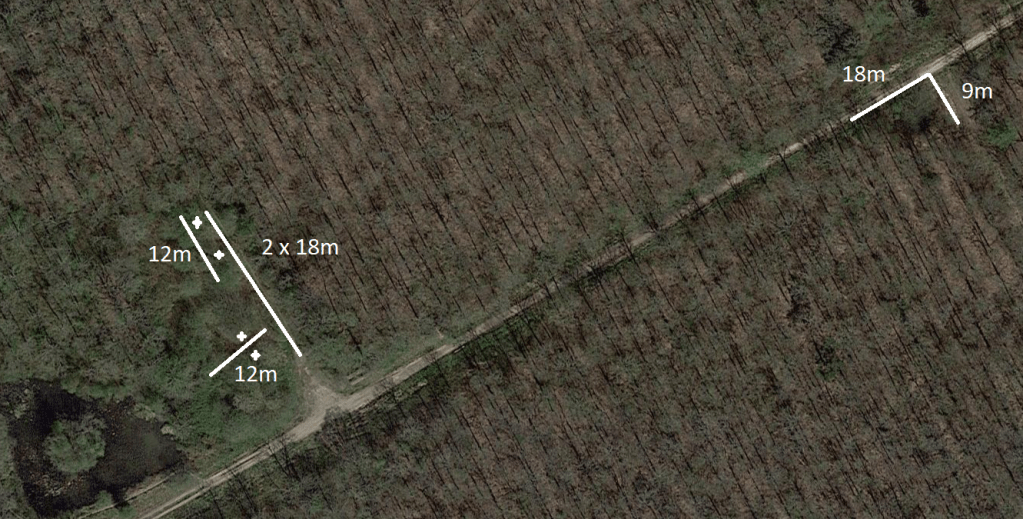
With the rest of this week looking horribly wet and windy going into the New Year, I decided to get out again today, the 27th December. Anna clearly hadn’t learnt her lesson as she joined me again this morning. We set up our usual nets around the feeding station (Forestry England have not banned their use, so I am maintaining feeding stations at Red Lodge, Webb’s Wood and Somerford Common, which I topped up after we closed up on Christmas Eve) plus two nets I haven’t used for some considerable time: a dog-legged 18m x 9m on two sides of a pond.
The + signs are the bird feeders.
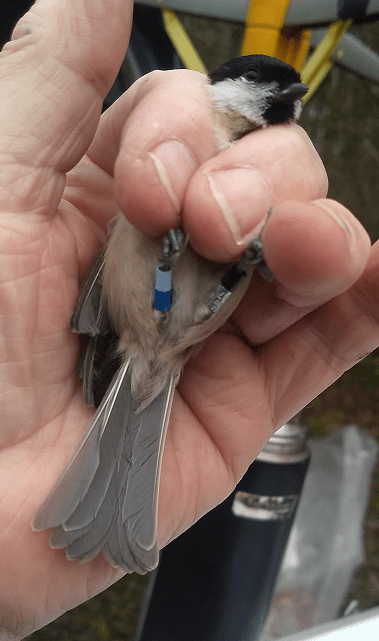
This was a far more satisfying session. We met at 7:30 and had the nets up and open by about 8:30. The birds did not arrive straight away but, when they did, they came in decent numbers. We were busy pretty much from 9:00 until 11:30. Not only were the nets by the feeding station busy, but so was the dog-leg. I put a lure for Redwing on that net set and we caught anything but, until the final bird Anna took out of the net! The other nets had lures for Brambling, Lesser Redpoll and Siskin! Always an optimist! Having heard a Marsh Tit calling when topping up the feeders on Christmas Eve, I also put on a lure for that species. It did work: we retrapped one that we ringed earlier this year and caught an unringed bird that now sports a nice colour-combination so anyone seeing it can let me know:
I do get fairly regular reports to which I respond with the bird’s history, as far as I know it.
There were plenty of Blue Tits around the feeders, as one would expect, but overall there was reasonable variety of other species: although the only finch species we caught was a couple of Chaffinch. We ringed one, but the other looked as though it might be in the early stages of Fringilla papillomavirus. Its legs were not deformed but looked as though they had been coated in an off-white powder, so we released it unringed.
The list for the day was: Treecreeper 3; Blue Tit 15(7); Great Tit 1(1); Coal Tit 2(3); Marsh Tit 1(1); Long-tailed Tit 10(1); Wren 1; Dunnock (1); Robin (2); Redwing 1; Goldcrest 1(3); Chaffinch 1. Totals: 36 birds ringed from 10 species and 19 birds retrapped from 8 species, making 55 birds processed from 12 species.
I was extremely pleased with the results that we got from the dog-leg nets: the Treecreepers, seven of the Long-tailed Tits, the Goldcrests and the Redwing all came out of there.
As we were processing the last few birds it started to spit with rain. This was at 11:30, so we shut them, took down and left site just after midday, after a very pleasing session. Fortunately, it didn’t really start to rain hard until we had left site.
Following on from ringing a couple of birds at the Mere Falconry Centre (having being blown away at the chance to get up close and personal with a Peregrine Falcon), I have been lucky enough to be asked to ring birds at the RSPCA Oak & Furrows Wildlife Rescue Centre. It helped that the Centre Manager, Rachel, used to work for the Wiltshire Wildlife Trust, and came across my activities through that route.
So, my new project for 2023 is to ring the larger and more unusual birds that are brought into their centre (although I am writing this today because I have actually started this week). We have discussed how to proceed and agreed that I won’t ring the commoner small Passerine species. I have just notified the BTO of the project, and am waiting with bated breath to get stuck into the bureaucracy, to finalise the project details.
In the meanwhile, Rachel contacted me at the end of last week, as she has a number of birds almost ready for release. On Tuesday afternoon I went on site to ring a Tawny Owl and a Barn Owl. The Tawny was an eye-opener for me: it had arrived at the centre with a broken wing. They fixed it and the bird has fully recovered and was ready for release. I have always assumed that a broken wing would lead to the bird being euthanised. Clearly that is not the case. I was able to both age and sex the bird using the guide referred to at the end of this blog piece.
The Barn Owl had been found suffering from an infection that had affected its vision. It is coming to the end of its treatment, has already successfully flown without mishap and will be released soon. I could age and sex the bird based on its plumage. Female Barn Owls have black specks on the white underwing coverts. The number and size is variable, and males may have a few but they are few and tiny. This specimen was definitely female.
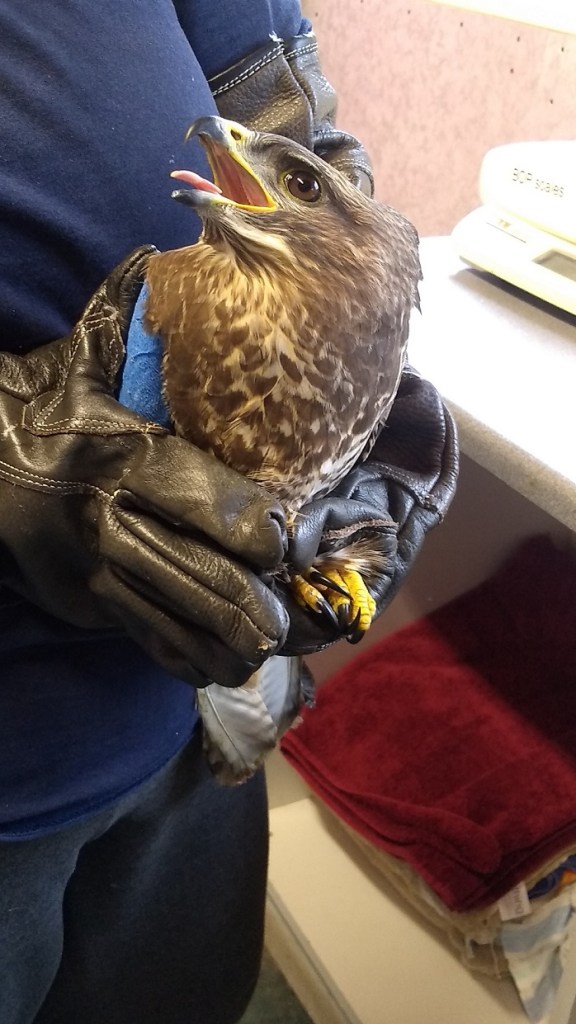
Today I was asked back to ring a couple of Buzzards: by the time I arrived there were four!
The first Buzzard that I ringed had been found on the ground in the Swindon area and was malnourished. Although it has no sign of physical injury, it is being fed up before release back into the wild. It is putting on weight, but it still needs to put on at least another 100g before it is released.
The middle two birds had been brought in each with one broken wing: one has healed completely and is capable of flight. It will be released very soon. The other’s wing is still splinted, but it is mending and expected to make a full recovery:
The fourth bird, the most recent arrival, has a hip displacement issue, but is in otherwise good health. It weighed in at a decent 1,050g, which identifies it as a female: males top out at a weight of 980g. It will be x-rayed tomorrow to establish what exactly the problem is.
All birds were capable of being aged, based on the pattern on their tail feathers using Jeff Baker’s guide. (Baker, J.: Identification of European Passerines – A BTO Guide, pp 192 -195). The two with broken wings were juveniles that fledged this year, the other two were adults.
I cannot understate how impressed I was with the work the staff at the centre are carrying out and how much they manage to achieve.













 Ringing In The Braydon Forest & Beyond